
In the ever-evolving landscape of data management, Microsoft Fabric emerges as a beacon of innovation, promising to redefine the way we approach data science, data analytics, data engineering, and data reporting. In this blog post, we will delve into the intricacies of Microsoft Fabric, exploring its transformative potential and the impact it is poised to make on the data industry.
Understanding Microsoft Fabric: A Paradigm Shift in Data Management
Seamless Integration of Data Sources
Microsoft Fabric serves as a unified platform that seamlessly integrates diverse data sources, erasing the boundaries between structured and unstructured data. This integration empowers data scientists, analysts, and engineers to access a comprehensive view of data, fostering more informed decision-making processes.
Advanced Data Processing Capabilities
Fabric boasts cutting-edge data processing capabilities, enabling real-time data analysis and complex computations. Its scalable architecture ensures that it can handle vast datasets with ease, paving the way for more sophisticated algorithms and in-depth analyses.
AI-Powered Insights
At the heart of Microsoft Fabric lies the power of artificial intelligence. By harnessing machine learning algorithms, Fabric identifies patterns, predicts trends, and provides actionable insights, allowing businesses to stay ahead of the curve and make data-driven decisions in real time.
Micosoft Fabric Experiences (Workloads) and Components
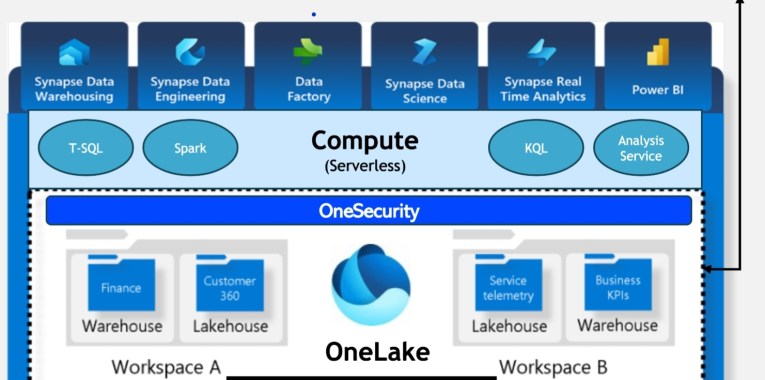
Microsoft Fabric, is the evolutionary next step in cloud data management, providing an all-in-one analytics solution for enterprises that covers everything from data movement to data science, Real-Time Analytics, and business intelligence – all in one place. Microsoft Fabric brings together new and existing components from Azure Power BI, Azure Synapse Analytics, and Azure Data Factory into a single integrated environment. These components are then presented in various customised user experiences or Fabric workloads (the compute layer) including Data Factory, Data Engineering, Data Warehousing, Data Science, Realtime Analytics and Power BI with OneLake as the storage layer.
- Data Factory: Combine the simplicity of Power Query with the scalability of Azure Data Factory. Utilize over 200 native connectors to seamlessly connect to on-premises and cloud data sources.
- Data Engineering: Experience seamless data transformation and democratization through our world-class Spark platform. Microsoft Fabric Spark integrates with Data Factory, allowing scheduling and orchestration of notebooks and Spark jobs, enabling large-scale data transformation and lakehouse democratization.
- Data Warehousing: Experience industry-leading SQL performance and scalability with our Data Warehouse. Separating compute from storage allows independent scaling of components. Data is natively stored in the open Delta Lake format.
- Data Science: Build, deploy, and operationalise machine learning models effortlessly within your Fabric experience. Integrated with Azure Machine Learning, it offers experiment tracking and model registry. Empower data scientists to enrich organisational data with predictions, enabling business analysts to integrate these insights into their reports, shifting from descriptive to predictive analytics.
- Real-Time Analytics: Handle observational data from diverse sources such as apps and IoT devices with ease. Real-Time Analytics, the ultimate engine for observatio nal data, excels in managing high-volume, semi-structured data like JSON or Text, providing unmatched analytics capabilities.
- Power BI: As the world’s leading Business Intelligence platform, Power BI grants intuitive access to all Fabric data. Empowering business owners to make informed decisions swiftly.
- OneLake: …the OneDrive for data. OneLake, catering to both professional and citizen developers, offers an open and versatile data storage solution. It supports a wide array of file types, structured or unstructured, storing them in delta parquet format atop Azure Data Lake Storage Gen2 (ADLS). All Fabric data, including data warehouses and lakehouses, automatically store their data in OneLake, simplifying the process for users who need not grapple with infrastructure complexities such as resource groups, RBAC, or Azure regions. Remarkably, it operates without requiring users to 1possess an Azure account. OneLake resolves the issue of scattered data silos by providing a unified storage system, ensuring effortless data discovery, sharing, and compliance with policies and security settings. Each workspace appears as a container within the storage account, and different data items are organized as folders under these containers. Furthermore, OneLake allows data to be accessed as a single ADLS storage account for the entire organization, fostering seamless connectivity across various domains without necessitating data movement. Additionally, users can effortlessly explore OneLake data using the OneLake file explorer for Windows, enabling convenient navigation, uploading, downloading, and modification of files, akin to familiar office tasks.
- Unified governance and security within Microsoft Fabric provide a comprehensive framework for managing data, ensuring compliance, and safeguarding sensitive information across the platform. It integrates robust governance policies, access controls, and security measures to create a unified and consistent approach. This unified governance enables seamless collaboration, data sharing, and compliance adherence while maintaining airtight security protocols. Through centralised management and standardised policies, Fabric ensures data integrity, privacy, and regulatory compliance, enhancing overall trust in the system. Users can confidently work with data, knowing that it is protected, compliant, and efficiently governed throughout its lifecycle within the Fabric environment.
Revolutionising Data Science: Unleashing the Power of Predictive Analytics
Microsoft Fabric’s advanced analytics capabilities empower data scientists to delve deeper into data. Its predictive analytics tools enable the creation of robust machine learning models, leading to more accurate forecasts and enhanced risk management strategies. With Fabric, data scientists can focus on refining models and deriving meaningful insights, rather than grappling with data integration challenges.
Transforming Data Analytics: From Descriptive to Prescriptive Analysis
Fabric’s intuitive analytics interface allows data analysts to transition from descriptive analytics to prescriptive analysis effortlessly. By identifying patterns and correlations in real time, analysts can offer actionable recommendations that drive business growth. With Fabric, businesses can optimize their operations, enhance customer experiences, and streamline decision-making processes based on comprehensive, up-to-the-minute data insights.
Empowering Data Engineering: Streamlining Complex Data Pipelines
Data engineers play a pivotal role in any data-driven organization. Microsoft Fabric simplifies their tasks by offering robust tools to streamline complex data pipelines. Its ETL (Extract, Transform, Load) capabilities automate data integration processes, ensuring data accuracy and consistency across the organization. This automation not only saves time but also reduces the risk of errors, making data engineering more efficient and reliable.
Elevating Data Reporting: Dynamic, Interactive, and Insightful Reports
Gone are the days of static, one-dimensional reports. With Microsoft Fabric, data reporting takes a quantum leap forward. Its interactive reporting features allow users to explore data dynamically, drilling down into specific metrics and dimensions. This interactivity enhances collaboration and enables stakeholders to gain a deeper understanding of the underlying data, fostering data-driven decision-making at all levels of the organization.
Conclusion: Embracing the Future of Data Management with Microsoft Fabric
In conclusion, Microsoft Fabric stands as a testament to Microsoft’s commitment to innovation in the realm of data management. By seamlessly integrating data sources, harnessing the power of AI, and providing advanced analytics and reporting capabilities, Fabric is set to revolutionize the way we perceive and utilise data. As businesses and organisations embrace Microsoft Fabric, they will find themselves at the forefront of the data revolution, equipped with the tools and insights needed to thrive in the digital age. The future of data management has arrived, and its name is Microsoft Fabric.
 renierbotha ltd