
Saying “No” to Say “Yes”: Unlocking Tomorrow’s Innovation

The Unexpected Power of Saying “No”: Ensuring the Success of Your Technology Development Project

In the fast-paced world of technology development, there’s a tendency to say “yes” to almost every idea, request, or feature that comes along. After all, isn’t innovation about pushing boundaries and exploring all possibilities? The truth is, while it’s critical to be open to new ideas, knowing when – and how – to say “no” can be just as vital for the success of your project and the well-being of your team.

Below, we’ll explore why this simple two-letter word holds such unexpected power and how you can use it to streamline your team’s efforts while driving better project outcomes.

1. Protecting Your Team’s Focus

Every technology project comes with a finite set of resources: time, budget, and talent. When your team is bombarded with new feature requests or sudden changes, it can quickly spread everyone too thin. By strategically declining certain requests, you:

  • Preserve Focus: Your team can devote their full attention and expertise to the most critical parts of the project.
  • Reduce Context Switching: Constantly shifting gears between tasks drains mental energy and slows progress, leading to potential errors and burnout.
  • Maintain Momentum: A focused, united team progresses faster and makes better decisions.

Tip: Communicate clearly why you’re saying “no,” highlighting the importance of current priorities. This clarity fosters understanding and trust within the team and with stakeholders.

2. Avoiding Scope Creep

Scope creep – when a project’s requirements balloon beyond original estimates – is notorious in technology development. Overextending the project scope:

  • Delays Releases: More time is needed to accommodate additional features.
  • Increases Costs: Unplanned tasks can quickly drain the budget.
  • Erodes Team Morale: Unrealistic workloads create stress and reduce motivation.

Saying “no” to additional requests (or at least deferring them) helps keep your project aligned with its initial scope. It can be challenging to push back on stakeholders, but in doing so, you protect your project’s timeline and ensure a more predictable delivery.

Tip: Offer to revisit rejected requests in future development phases or product iterations, so good ideas aren’t lost—they’re simply postponed to a more appropriate time.

3. Prioritizing High-Impact Work

One of the critical responsibilities of a project manager or team lead is to prioritize initiatives that will yield the greatest impact. Not all ideas are created equal. If you say “yes” to everything:

  • Resources are watered down: Your top performers might end up working on minor tasks that don’t move the needle.
  • Quality suffers: Juggling too many features at once can compromise the quality of each deliverable.
  • Long-term vision is overshadowed: The project may lose coherence if it grows in too many directions at once.

By confidently saying “no” to lower-impact tasks, you allow your team to invest their time and skills into truly valuable work that advances the core objectives of the project.

4. Empowering Your Team

Saying “no” isn’t just a way to shield your project from unnecessary detours—it also empowers your team. When you, as a leader, demonstrate the ability to set boundaries, you encourage your team members to speak up and focus on what truly matters. This culture of mutual respect ensures that:

  • Team Members Feel Valued: They see that their time, energy, and well-being are taken seriously.
  • Innovation Thrives: With clear priorities and fewer distractions, your team can pursue more thoughtful, high-quality innovations.
  • Ownership Increases: Individuals become more confident in making decisions and pushing back when a request doesn’t align with project goals.

Tip: Cultivate a team culture that is comfortable questioning the status quo. When someone challenges a new idea by asking, “Does this serve our core goals?” it often leads to more robust decision-making.

5. Building Trust with Stakeholders

Counterintuitive as it may sound, saying “no” can actually strengthen trust with stakeholders—if handled correctly. When you explain your reasoning (e.g., resource limitations, strategic focus, or overall impact), stakeholders see that decisions aren’t arbitrary but grounded in a thoughtful process. Over time:

  • Credibility Grows: Stakeholders recognize that you make difficult calls to preserve quality and deliver on promises.
  • Expectations are Aligned: By clarifying the limits of what can be done, you set achievable goals and reduce the chance of negative surprises.
  • Better Relationships Develop: Open, honest communication builds a more productive collaboration. Stakeholders may feel disappointed at first, but they often appreciate transparency in the long run.

Tip: Whenever you say “no,” remember to present a recommended alternative or a timeline for when you can re-evaluate the idea. This supportive approach shows you’re solution-oriented, rather than dismissive.

6. How to Say “No” Effectively

Knowing you need to say “no” is one thing; doing so with empathy and clarity is another. Here are a few guidelines:

  1. Be Transparent: Explain the rationale behind your decision in clear, concise terms. For example, “Focusing on X feature right now ensures we meet our promised launch date.”
  2. Listen First: If a stakeholder or team member proposes an idea, make sure they feel heard before responding. Restate their idea so they know you understand, then provide your perspective.
  3. Offer Alternatives: If you have to decline, suggest compromises or adjustments that could still meet their need without derailing the project.
  4. Keep it Professional and Constructive: Saying “no” with empathy involves acknowledging the effort or creativity behind the request. Emphasize that you value their contribution and will revisit it later if possible.

7. Conclusion

In technology development—where complex projects, tight deadlines, and multiple stakeholders intersect—saying “yes” to everything is often counterproductive. Learning to set boundaries and give a firm, thoughtful “no” protects your team’s bandwidth, preserves project quality, and builds trust through honest communication.

As a leader or project manager, the unexpected power of saying “no” lies in its ability to guard against scope creep, maintain focus on the highest-impact work, and nurture a healthy team culture. So, the next time you’re confronted with a new feature request or an appealing idea that doesn’t quite fit, remember that declining may be the best way to ultimately say “yes” to a successful, impactful project.

Remember: A strategic “no” today can create the space, time, and resources for a definitive “yes” to the innovations that truly matter tomorrow. Embrace this principle, and you’ll find your team more engaged, your goals more achievable, and your technology development projects more successful.

The Epiphany Moment of Euphoria in a Data Estate Development Project

In our technology-driven world, engineers pave the path forward, and there are moments of clarity and triumph that stand comparable to humanity’s greatest achievements. Learning at a young age from these achievements shape our way of thinking and can be a source of inspiration that enhances the way we solve problems in our daily lives. For me, one of these profound inspirations stems from an engineering marvel: the Paul Sauer Bridge over the Storms River in Tsitsikamma, South Africa – which I first visited in 1981. This arch bridge, completed in 1956, represents more than just a physical structure. It embodies a visionary approach to problem-solving, where ingenuity, precision, and execution converge seamlessly.

The Paul Sauer Bridge across the Storms River Gorge in South Africa.

The bridge’s construction involved a bold method: engineers built two halves of the arch on opposite sides of the gorge. Each section was erected vertically and then carefully pivoted downward to meet perfectly in the middle, completing the 100m span, 120m above the river. This remarkable feat of engineering required foresight, meticulous planning, and flawless execution – a true epiphany moment of euphoria when the pieces fit perfectly.

Now, imagine applying this same philosophy to building data estate solutions. Like the bridge, these solutions must connect disparate sources, align complex processes, and culminate in a seamless result where data meets business insights.

This blog explores how to achieve this epiphany moment in data projects by drawing inspiration from this engineering triumph.

The Parallel Approach: Top-Down and Bottom-Up

Building a successful data estate solution, I believe requires a dual approach, much like the simultaneous construction of both sides of the Storms River Bridge:

  1. Top-Down Approach:
    • Start by understanding the end goal: the reports, dashboards, and insights that your organization needs.
    • Focus on business requirements such as wireframe designs, data visualization strategies, and the decisions these insights will drive.
    • Use these goals to inform the types of data needed and the transformations required to derive meaningful insights.
  2. Bottom-Up Approach:
    • Begin at the source: identifying and ingesting the right raw data from various systems.
    • Ensure data quality through cleaning, validation, and enrichment.
    • Transform raw data into structured and aggregated datasets that are ready to be consumed by reports and dashboards.

These two streams work in parallel. The Top-Down approach ensures clarity of purpose, while the Bottom-Up approach ensures robust engineering. The magic happens when these two streams meet in the middle – where the transformed data aligns perfectly with reporting requirements, delivering actionable insights. This convergence is the epiphany moment of euphoria for every data team, validating the effort invested in discovery, planning, and execution.

When the Epiphany Moment Isn’t Euphoric

While the convergence of Top-Down and Bottom-Up approaches can lead to an epiphany moment of euphoria, there are times when this anticipated triumph falls flat. One of the most common reasons is discovering that the business requirements cannot be met as the source data is insufficient, incomplete, or altogether unavailable to meet the reporting requirements. These moments can feel like a jarring reality check, but they also offer valuable lessons for navigating data challenges.

Why This Happens

  1. Incomplete Understanding of Data Requirements:
    • The Top-Down approach may not have fully accounted for the granular details of the data needed to fulfill reporting needs.
    • Assumptions about the availability or structure of the data might not align with reality.
  2. Data Silos and Accessibility Issues:
    • Critical data might reside in silos across different systems, inaccessible due to technical or organizational barriers.
    • Ownership disputes or lack of governance policies can delay access.
  3. Poor Data Quality:
    • Data from source systems may be incomplete, outdated, or inconsistent, requiring significant remediation before use.
    • Legacy systems might not produce data in a usable format.
  4. Shifting Requirements:
    • Business users may change their reporting needs mid-project, rendering the original data pipeline insufficient.

The Emotional and Practical Fallout

Discovering such issues mid-development can be disheartening:

  • Teams may feel a sense of frustration, as their hard work in data ingestion, transformation, and modeling seems wasted.
  • Deadlines may slip, and stakeholders may grow impatient, putting additional pressure on the team.
  • The alignment between business and technical teams might fracture as miscommunications come to light.

Turning Challenges into Opportunities

These moments, though disappointing, are an opportunity to re-evaluate and recalibrate your approach. Here are some strategies to address this scenario:

1. Acknowledge the Problem Early

  • Accept that this is part of the iterative process of data projects.
  • Communicate transparently with stakeholders, explaining the issue and proposing solutions.

2. Conduct a Gap Analysis

  • Assess the specific gaps between reporting requirements and available data.
  • Determine whether the gaps can be addressed through technical means (e.g., additional ETL work) or require changes to reporting expectations.

3. Explore Alternative Data Sources

  • Investigate whether other systems or third-party data sources can supplement the missing data.
  • Consider enriching the dataset with external or public data.

4. Refine the Requirements

  • Work with stakeholders to revisit the original reporting requirements.
  • Adjust expectations to align with available data while still delivering value.

5. Enhance Data Governance

  • Develop clear ownership, governance, and documentation practices for source data.
  • Regularly audit data quality and accessibility to prevent future bottlenecks.

6. Build for Scalability

  • Future-proof your data estate by designing modular pipelines that can easily integrate new sources.
  • Implement dynamic models that can adapt to changing business needs.

7. Learn and Document the Experience

  • Treat this as a learning opportunity. Document what went wrong and how it was resolved.
  • Use these insights to improve future project planning and execution.

The New Epiphany: A Pivot to Success

While these moments may not bring the euphoria of perfect alignment, they represent an alternative kind of epiphany: the realisation that challenges are a natural part of innovation. Overcoming these obstacles often leads to a more robust and adaptable solution, and the lessons learned can significantly enhance your team’s capabilities.

In the end, the goal isn’t perfection – it’s progress. By navigating the difficulties of misalignment, incomplete or unavailable data with resilience and creativity, you’ll lay the groundwork for future successes and, ultimately, more euphoric epiphanies to come.

Steps to Ensure Success in Data Projects

To reach this transformative moment, teams must adopt structured practices and adhere to principles that drive success. Here are the key steps:

1. Define Clear Objectives

  • Identify the core business problems you aim to solve with your data estate.
  • Engage stakeholders to define reporting and dashboard requirements.
  • Develop a roadmap that aligns with organisational goals.

2. Build a Strong Foundation

  • Invest in the right infrastructure for data ingestion, storage, and processing (e.g., cloud platforms, data lakes, or warehouses).
  • Ensure scalability and flexibility to accommodate future data needs.

3. Prioritize Data Governance

  • Implement data policies to maintain security, quality, and compliance.
  • Define roles and responsibilities for data stewardship.
  • Create a single source of truth to avoid duplication and errors.

4. Embrace Parallel Development

  • Top-Down: Start designing wireframes for reports and dashboards while defining the key metrics and KPIs.
  • Bottom-Up: Simultaneously ingest and clean data, applying transformations to prepare it for analysis.
  • Use agile methodologies to iterate and refine both streams in sync.

5. Leverage Automation

  • Automate data pipelines for faster and error-free ingestion and transformation.
  • Use tools like ETL frameworks, metadata management platforms, and workflow orchestrators.

6. Foster Collaboration

  • Establish a culture of collaboration between business users, analysts, and engineers.
  • Encourage open communication to resolve misalignments early in the development cycle.

7. Test Early and Often

  • Validate data accuracy, completeness, and consistency before consumption.
  • Conduct user acceptance testing (UAT) to ensure the final reports meet business expectations.

8. Monitor and Optimize

  • After deployment, monitor the performance of your data estate.
  • Optimize processes for faster querying, better visualization, and improved user experience.

Most Importantly – do not forget that the true driving force behind technological progress lies not just in innovation but in the people who bring it to life. Investing in the right individuals and cultivating a strong, capable team is paramount. A team of skilled, passionate, and collaborative professionals forms the backbone of any successful venture, ensuring that ideas are transformed into impactful solutions. By fostering an environment where talent can thrive – through mentorship, continuous learning, and shared vision – organisations empower their teams to tackle complex challenges with confidence and creativity. After all, even the most groundbreaking technologies are only as powerful as the minds and hands that create and refine them.

Conclusion: Turning Vision into Reality

The Storms River Bridge stands as a symbol of human achievement, blending design foresight with engineering excellence. It teaches us that innovation requires foresight, collaboration, and meticulous execution. Similarly, building a successful data estate solution is not just about connecting systems or transforming data – it’s about creating a seamless convergence where insights meet business needs. By adopting a Top-Down and Bottom-Up approach, teams can navigate the complexities of data projects, aligning technical execution with business needs.

When the two streams meet – when your transformed data delivers perfectly to your reporting requirements – you’ll experience your own epiphany moment of euphoria. It’s a testament to the power of collaboration, innovation, and relentless dedication to excellence.

In both engineering and technology, the most inspiring achievements stem from the ability to transform vision into reality. The story of the Paul Sauer Bridge teaches us that innovation requires foresight, collaboration, and meticulous execution. Similarly, building a successful data estate solution is not just about connecting systems or transforming data, it’s about creating a seamless convergence where insights meet business needs.

The journey isn’t always smooth. Challenges like incomplete data, shifting requirements, or unforeseen obstacles can test our resilience. However, these moments are an opportunity to grow, recalibrate, and innovate further. By adopting structured practices, fostering collaboration, and investing in the right people, organizations can navigate these challenges effectively.

Ultimately, the epiphany moment in data estate development is not just about achieving alignment, it’s about the collective people effort, learning, and perseverance that make it possible. With a clear vision, a strong foundation, and a committed team, you can create solutions that drive success and innovation, ensuring that every challenge becomes a stepping stone toward greater triumphs.

Top 10 Strategic Technology Trends for 2025 -Aligning Your Technology Strategy

A Guide for Forward-Thinking CIOs

As 2025 approaches, organisations must prepare for a wave of technological advancements that will shape the business landscape. This year’s Gartner Top Strategic Technology Trends serves as a roadmap for CIOs and IT leaders, guiding them to navigate a future marked by both opportunity and challenge. These trends reveal new ways to overcome obstacles in productivity, security, and innovation, helping organisations embrace a future driven by responsible innovation.

Planning for the Future: Why These Trends Matter

CIOs and IT leaders face unprecedented social and economic shifts. To thrive in this environment, they need to look beyond immediate challenges and position themselves for long-term success. Gartner’s Top Strategic Technology Trends for 2025 encapsulates the transformative technologies reshaping how organisations operate, compete, and grow. Each trend provides a pathway towards enhanced operational efficiency, security, and engagement, serving as powerful tools for navigating the future.

Using Gartner’s Strategic Technology Trends to Shape Tomorrow

Gartner has organised this year’s trends into three main themes: AI imperatives and risks, new frontiers of computing, and human-machine synergy. Each theme presents a unique perspective on technology’s evolving role in business and society, offering strategic insights to help organisations innovate responsibly.


Theme 1: AI Imperatives and Risks – Balancing Innovation with Safety

1. Agentic AI

Agentic AI represents the next generation of autonomous systems capable of planning and acting to achieve user-defined goals. By creating virtual agents that work alongside human employees, businesses can improve productivity and efficiency.

  • Benefits: Virtual agents augment human work, enhance productivity, and streamline operations.
  • Challenges: Agentic AI requires strict guardrails to align with user intentions and ensure responsible use.

2. AI Governance Platforms

AI governance platforms are emerging to help organisations manage the ethical, legal, and operational facets of AI, providing transparency and building trust.

  • Benefits: Enables policy management for responsible AI, enhances transparency, and builds accountability.
  • Challenges: Consistency in AI governance can be difficult due to varied guidelines across regions and industries.

3. Disinformation Security

As misinformation and cyber threats increase, disinformation security technologies are designed to verify identity, detect harmful narratives, and protect brand reputation.

  • Benefits: Reduces fraud, strengthens identity validation, and protects brand reputation.
  • Challenges: Requires adaptive, multi-layered security strategies to stay current against evolving threats.

Theme 2: New Frontiers of Computing – Expanding the Possibilities of Technology

4. Post-Quantum Cryptography (PQC)

With quantum computing on the horizon, PQC technologies are essential for protecting data from potential decryption by quantum computers.

  • Benefits: Ensures data protection against emerging quantum threats.
  • Challenges: PQC requires rigorous testing and often needs to replace existing encryption algorithms, which can be complex and costly.

5. Ambient Invisible Intelligence

This technology integrates unobtrusively into the environment, enabling real-time tracking and sensing while enhancing the user experience.

  • Benefits: Enhances efficiency and visibility with low-cost, intuitive technology.
  • Challenges: Privacy concerns must be addressed, and user consent obtained, for certain data uses.

6. Energy-Efficient Computing

Driven by the demand for sustainability, energy-efficient computing focuses on greener computing practices, optimised architecture, and renewable energy.

  • Benefits: Reduces carbon footprint, meets sustainability goals, and addresses regulatory and commercial pressures.
  • Challenges: Requires substantial investment in new hardware, training, and tools, which can be complex and costly to implement.

7. Hybrid Computing

Hybrid computing blends multiple computing methods to solve complex problems, offering a flexible approach for various applications.

  • Benefits: Unlocks new levels of AI performance, enables real-time personalisation, and supports automation.
  • Challenges: The complexity of these systems and the need for specialised skills can present significant hurdles.

Theme 3: Human-Machine Synergy – Bridging Physical and Digital Worlds

8. Spatial Computing

Spatial computing utilises AR and VR to create immersive digital experiences, reshaping sectors like gaming, healthcare, and e-commerce.

  • Benefits: Enhances user experience with immersive interactions, meeting demands in gaming, education, and beyond.
  • Challenges: High costs, complex interfaces, and data privacy concerns can limit adoption.

9. Polyfunctional Robots

With the ability to switch between tasks, polyfunctional robots offer flexibility, enabling faster return on investment without significant infrastructure changes.

  • Benefits: Provides scalability and flexibility, reduces reliance on specialised labour, and improves ROI.
  • Challenges: Lack of industry standards on price and functionality makes adoption unpredictable.

10. Neurological Enhancement

Neurological enhancement technologies, such as brain-machine interfaces, have the potential to enhance cognitive abilities, creating new opportunities for personalised education and workforce productivity.

  • Benefits: Enhances human skills, improves safety, and supports longevity in the workforce.
  • Challenges: Ethical concerns, high costs, and security risks associated with direct brain interaction present significant challenges.

Embrace the Future with Responsible Innovation

As 2025 nears, these technological trends provide organisations with the strategic insights needed to navigate a rapidly evolving landscape. Whether adopting AI-powered agents, protecting against quantum threats, or integrating human-machine interfaces, these trends offer a framework for responsible and innovative growth. Embracing them will allow CIOs and IT leaders to shape a future where technology serves as a bridge to more efficient, ethical, and impactful business practices.

Ready to Dive Deeper?

Partnering with RenierBotha Ltd (reierbotha.com) provides your organisation with the expertise needed to seamlessly align your technology strategy with emerging trends that will shape the future of business. With a focus on driving digital transformation through strategic planning, RenierBotha Ltd helps organisations incorporate top technology advancements into their digital ambitions, ensuring that each step is optimised for impact, scalability, and long-term success. By leveraging our deep industry knowledge, innovative approaches, and tailored solutions, RenierBotha Ltd empowers your team to navigate complex challenges, integrate cutting-edge technologies, and lead responsibly in a rapidly evolving digital landscape. Together, we can shape a future where technology and business strategies converge to unlock sustainable growth, resilience, and a competitive edge.

Navigating the Trough of Disillusionment

A Guide to Sustained Success in Business Vision, Strategy, and Technology Delivery

The Trough of Disillusionment in Business Vision, Strategy, and Technology Delivery

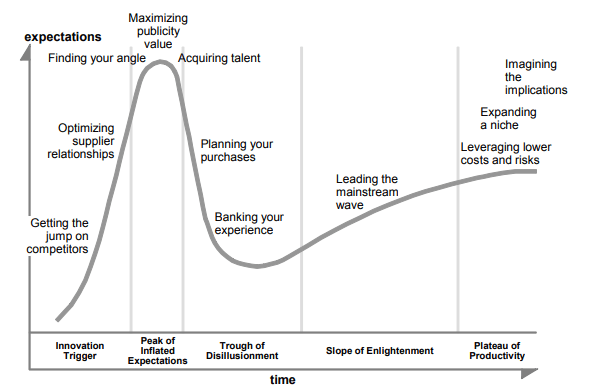
In the dynamic, innovative and interwoven landscape of business and technology, the concept of the “trough of disillusionment” stands as a critical phase that organisations must navigate to achieve long-term success. Coined by the research and advisory firm Gartner, this term is part of the “Hype Cycle,” which describes the typical progression of new technologies from innovation to mainstream adoption. The trough of disillusionment specifically represents a period where inflated expectations give way to a more sober, realistic assessment of a technology’s capabilities and limitations. Understanding this phase is crucial for shaping effective business vision, strategy, and technology delivery.

The Hype Cycle and the Trough of Disillusionment

The Hype Cycle is divided into five key stages:

  1. Innovation Trigger: A breakthrough, product launch, or other event generates significant press and interest.
  2. Peak of Inflated Expectations: Early publicity produces a number of success stories—often accompanied by scores of failures.
  3. Trough of Disillusionment: Interest wanes as experiments and implementations fail to deliver. Producers of the technology shake out or fail. Investments continue only if the surviving providers improve their products to the satisfaction of early adopters.
  4. Slope of Enlightenment: More instances of how the technology can benefit the enterprise start to crystallise and become more widely understood.
  5. Plateau of Productivity: Mainstream adoption starts to take off. Criteria for assessing provider viability are more clearly defined. The technology’s broad market applicability and relevance are clearly paying off.

The Trough of Disillusionment in Business Vision

In the context of business vision, the trough of disillusionment is a reality check that tests the resilience and adaptability of organisational goals. Visionary leaders often set ambitious targets based on the initial promise of new technologies. However, as these technologies face real-world challenges and fail to meet sky-high expectations, the resultant disillusionment can lead to strategic pivoting.

Leaders must anticipate this phase and prepare to manage the potential decline in enthusiasm and support. This involves:

  • Realistic Goal Setting: Establishing achievable milestones and preparing for potential setbacks.
  • Stakeholder Communication: Maintaining transparent communication with stakeholders to manage expectations and reinforce long-term vision despite short-term disappointments.
  • Flexibility and Adaptability: Being ready to pivot strategies based on new insights and developments during the disillusionment phase.

The Trough of Disillusionment in Business Strategy

Strategically, the trough of disillusionment necessitates a recalibration of efforts and resources. Businesses must:

  • Evaluate and Learn: Critically analyse why initial implementations fell short. Was it due to technology immaturity, unrealistic expectations, or lack of necessary infrastructure?
  • Refine Use Cases: Focus on identifying practical, high-value use cases where the technology can realistically deliver benefits.
  • Resource Management: Reallocate resources to areas with a higher likelihood of successful outcomes, potentially slowing down investments in more speculative projects.

Strategists must balance the initial enthusiasm with a grounded approach that incorporates lessons learned during the disillusionment phase. This balanced approach ensures that when the technology matures, the organisation is well-positioned to capitalise on its potential.

The Trough of Disillusionment in Technology Delivery

For technology delivery teams, the trough of disillusionment is a period of introspection and iterative improvement. During this phase, the emphasis shifts from innovation to execution:

  • Improving Product Quality: Focus on addressing the shortcomings of the technology, such as stability, scalability, and usability.
  • Enhanced Training and Support: Providing better training and support for users to maximise the technology’s current capabilities.
  • Incremental Development: Adopting an incremental approach to development, where continuous feedback and iterations help refine the technology and its applications.

Delivery teams must maintain a commitment to excellence and incremental improvement, recognising that sustained effort and adaptation are key to moving through the trough of disillusionment towards the slope of enlightenment.

Conclusion

The trough of disillusionment, while challenging, is a natural and necessary phase in the adoption of new technologies. For businesses, it offers a reality check that can lead to more sustainable, long-term success. By setting realistic expectations, maintaining transparent communication, and being willing to adapt and learn, organisations can navigate this phase effectively. In technology delivery, a focus on incremental improvements and user support ensures that when the technology matures, it can deliver on its early promise. Ultimately, understanding and managing the trough of disillusionment is essential for leveraging new technologies to achieve lasting business success.

Beyond Timelines and Budgets: The Vital Quest for Purpose in Innovation

Building for Impact: The Essential Lesson from Eric Ries

We live in fast evolving world! Within this world of innovation and entrepreneurship, Eric Ries’ poignant question resonates deeply: “What if we found ourselves building something that nobody wanted? In that case, what did it matter if we did it on time and on budget?” This question, at the heart of Ries’ philosophy in the Lean Startup methodology, serves as a critical reminder of the importance of not just building, but building something that matters.

The Pitfall of Misplaced Priorities

In the pursuit of success, it’s easy to get caught up in the metrics that traditionally define progress: adherence to timelines, staying within budget, and completing tasks with precision. Whilst these aspects are undoubtedly important, they risk becoming the sole focus, overshadowing the fundamental question of whether the project or product in development truly meets a need or solves a real problem. Ries challenges us to shift our focus from simply completing tasks to ensuring that what we are building has inherent value and demand.

The Lean Startup Approach

At the core of the Lean Startup methodology is the concept of building, measuring, and learning in rapid, iterative cycles. This approach encourages entrepreneurs and innovators to validate their ideas and assumptions through continuous feedback from their target audience. The goal is to learn what customers really want and need before investing too much time, energy, and resources into a product or service that may not find its market. This philosophy not only saves valuable resources but also steers projects in a direction more likely to achieve meaningful impact.

Illustrating the Impact with Case Studies

  • Dropbox: Before Dropbox became a household name, its founder Drew Houston realised the importance of validating the market need for a cloud storage solution. Initially, instead of fully developing the product, he created a simple video demonstrating how Dropbox would work. The overwhelming positive response to this video was a clear indication of market demand, guiding the team to proceed with confidence. This early validation saved significant resources and positioned Dropbox to meet its users’ real needs effectively.
  • Zappos: Zappos, now a leading online shoe and clothing retailer, began with a simple experiment to test market demand. Founder Nick Swinmurn initially posted pictures of shoes from local stores online without actually holding any inventory. When a pair was ordered, he would purchase it from the store and ship it to the customer. This lean approach to validating customer interest in buying shoes online allowed Zappos to scale confidently, knowing there was a genuine demand for their business model.
  • Pebble Technology: Pebble Technology’s approach to validating the demand for their smartwatch is a modern example of leveraging community support through crowdfunding. Before mass-producing their product, Pebble launched a Kickstarter campaign to gauge interest. The campaign not only surpassed its funding goal but also became one of the most successful Kickstarter campaigns at the time. This validation through crowdfunding underscored the market’s desire for their product, enabling Pebble to proceed with a clear indication of customer demand.

The Importance of Building Something Wanted

The essence of Ries’ question underscores a fundamental truth in both business and personal endeavours: the importance of purpose and relevance. Building something that nobody wants is akin to solving a problem that doesn’t exist—it may be an impressive feat of engineering, creativity, or organisation, but it misses the mark on making a difference in the world. The measure of success, therefore, should not only be in the completion of the project itself but in its ability to address real needs and improve lives.

Embracing Flexibility and Adaptation

Adopting a mindset that prioritises impact over mere completion requires a willingness to be flexible and adapt to feedback. It means being prepared to pivot when data shows that the original plan isn’t meeting the needs of the market. This adaptability is crucial in navigating the unpredictable waters of innovation, where the true north is the value created for others.

Measuring and Evaluating the Relevance

Measuring and evaluating the relevance of a product or service is crucial for ensuring that it meets the actual needs of its intended users and can achieve success in the marketplace. This process involves several strategies and tools designed to gather feedback, analyze market trends, and adjust to user expectations. Below are additional insights on how to effectively carry out this evaluation.

  • 1. Customer Feedback and Engagement
    • Surveys and Questionnaires: Regularly conduct surveys to gather insights directly from your users about their experiences, preferences, and any unmet needs. Tailor these tools to collect specific information that can guide product development and improvement.
    • User Interviews: Conduct in-depth interviews with users to understand their pain points, the context in which they use your product, and their satisfaction levels. These interviews can uncover detailed insights not evident through surveys or data analysis alone.
    • Social Media and Online Forums: Monitor social media platforms and online forums related to your industry. These channels are rich sources of unsolicited feedback and can reveal how users perceive your product and what they wish it could do.
  • Usability Testing
    • Prototype Testing: Before full-scale production, use prototypes to test how potential users interact with your product. Observing users as they navigate a prototype can highlight usability issues and areas for improvement.
    • A/B Testing: Implement A/B testing to compare different versions of your product or its features. This method can help identify which variations perform better in terms of user engagement, satisfaction, and conversion rates.
  • Analyzing Market Trends
    • Competitor Analysis: Keep a close watch on your competitors and their offerings. Understanding their strengths and weaknesses can help you identify gaps in the market and opportunities for differentiation.
    • Market Research Reports: Leverage industry reports and market research to stay informed about broader trends that could impact the relevance of your product. This includes shifts in consumer behavior, technological advancements, and regulatory changes.
  • Metrics and Analytics
    • Usage Metrics: Track how users are interacting with your product through metrics such as daily active users (DAUs), session length, and feature usage rates. These indicators can help you understand which aspects of your product are most valuable to users.
    • Churn Rate: Monitor your churn rate closely to understand how many users stop using your product over a given period. A high churn rate can signal issues with product relevance or user satisfaction.
    • Customer Lifetime Value (CLV): Calculating the CLV provides insights into the long-term value of maintaining a relationship with your customers. This metric helps assess whether your product continues to meet users’ needs over time.
  • Feedback Loops and Continuous Improvement
    • Implement Continuous Feedback Loops: Establish mechanisms to continuously gather and act on feedback. This could involve regular updates based on user input, as well as ongoing testing and iteration of your product.
    • Pivot When Necessary: Be prepared to pivot your product strategy if significant feedback indicates that your product does not meet market needs as expected. Pivoting can involve changing your target audience, adjusting key features, or even redefining your value proposition.

The Ultimate Goal: Making a Difference

Ultimately, the question posed by Eric Ries invites us to reflect on why we embark on the projects we choose. Are we building to simply see our plans materialise, or are we driven by a desire to make a tangible difference in the world? The true reward lies not in the accolades for completing a project on time and within budget but in the knowledge that what we have built serves a greater purpose.

As we navigate the complexities of bringing new ideas to life, let us keep this lesson at the forefront of our minds. By ensuring that what we build is truly wanted and needed, we not only enhance our chances of success but also contribute to a world where innovation and impact go hand in hand.

In conclusion, effectively measuring and evaluating the relevance of a product or service is an ongoing process that requires a combination of direct user engagement, market analysis, and data-driven insights. By staying attuned to the needs and feedback of your users and being willing to adapt based on what you learn, you can ensure that your product remains relevant and successful in meeting the evolving demands of the market.