
Leveraging Generative AI to Boost Office Productivity

Generative AI tools like ChatGPT and CoPilot are revolutionising the way we approach office productivity. These tools are not only automating routine tasks but are also enhancing complex processes, boosting both efficiency and creativity in the workplace. In the modern fast-paced business environment, maximising productivity is crucial for success. Generative AI tools are at the forefront of this transformation, offering innovative ways to enhance efficiency across various office tasks. Here, we explore how these tools can revolutionise workplace productivity, focusing on email management, consultancy response documentation, data engineering, analytics coding, quality assurance in software development, and other areas.

Here’s how ChatGPT can be utilised in various aspects of office work:

  • Streamlining Email Communication – Email remains a fundamental communication tool in offices, but managing it can be time-consuming. ChatGPT can help streamline this process by generating draft responses, summarising long email threads, and even prioritising emails based on urgency and relevance. By automating routine correspondence, employees can focus more on critical tasks, enhancing overall productivity.
  • Writing Assistance – Whether drafting emails, creating content, or polishing documents, writing can be a significant drain on time. ChatGPT can act as a writing assistant, offering suggestions, correcting mistakes, and improving the overall quality of written communications. This support ensures that communications are not only efficient but also professionally presented.
  • Translating Texts – In a globalised work environment, the ability to communicate across languages is essential. ChatGPT can assist with translating documents and communications, ensuring clear and effective interaction with diverse teams and clients.
  • Enhancing Consultancy Response Documentation – For consultants, timely and accurate documentation is key. Generative AI can assist in drafting documents, proposals, and reports. By inputting the project’s parameters and objectives, tools like ChatGPT can produce comprehensive drafts that consultants can refine and finalise, significantly reducing the time spent on document creation.
  • Enhancing Research – Research can be made more efficient with ChatGPT’s ability to quickly find relevant information, summarise key articles, and provide deep insights. Whether for market research, academic purposes, or competitive analysis, ChatGPT can streamline the information gathering and analysis process.
  • Coding Assistance in Data Engineering and Analytics – For developers, coding can be enhanced with the help of AI tools. By describing a coding problem or requesting specific snippets, ChatGPT can provide relevant and accurate code suggestions. This assistance is invaluable for speeding up development cycles and reducing bugs in the code. CoPilot, powered by AI, transforms how data professionals write code. It suggests code snippets and entire functions based on the comments or the partial code already written. This is especially useful in data engineering and analytics, where writing efficient, error-free code can be complex and time-consuming. CoPilot helps in scripting data pipelines and performing data analysis, thereby reducing errors and improving the speed of development. More on this covered within the Microsoft Fabric and CoPilot section below.
  • Quality Assurance and Test-Driven Development (TDD) – In software development, ensuring quality and adhering to the principles of TDD can be enhanced using generative AI tools. These tools can suggest test cases, help write test scripts, and even provide feedback on the coverage of the tests written. By integrating AI into the development process, developers can ensure that their code not only functions correctly but also meets the required standards before deployment.
  • Automating Routine Office Tasks – Beyond specialised tasks, generative AI can automate various routine activities in the office. From generating financial reports to creating presentations and managing schedules, AI tools can take over repetitive tasks, freeing up employees to focus on more strategic activities. Repetitive tasks like scheduling, data entry, and routine inquiries can be automated with ChatGPT. This delegation of mundane tasks frees up valuable time for employees to engage in more significant, high-value work.
  • Planning Your Day – Effective time management is key to productivity. ChatGPT can help organise your day by taking into account your tasks, deadlines, and priorities, enabling a more structured and productive routine.
  • Summarising Reports and Meeting Notes – One of the most time-consuming tasks in any business setting is going through lengthy documents and meeting notes. ChatGPT can simplify this by quickly analysing large texts and extracting essential information. This capability allows employees to focus on decision-making and strategy rather than getting bogged down by details.
  • Training and Onboarding – Training new employees is another area where generative AI can play a pivotal role. AI-driven programs can provide personalised learning experiences, simulate different scenarios, and give feedback in real-time, making the onboarding process more efficient and effective.
  • Enhancing Creative Processes – Generative AI is not limited to routine or technical tasks. It can also contribute creatively, helping design marketing materials, write creative content, and even generate ideas for innovation within the company.
  • Brainstorming and Inspiration – Creativity is a crucial component of problem-solving and innovation. When you hit a creative block or need a fresh perspective, ChatGPT can serve as a brainstorming partner. By inputting a prompt related to your topic, ChatGPT can generate a range of creative suggestions and insights, sparking new ideas and solutions.
  • Participating in Team Discussions – In collaborative settings like Microsoft Teams, ChatGPT and CoPilot can contribute by providing relevant information during discussions. This capability improves communication and aids in more informed decision-making, making team collaborations more effective.
  • Entertainment – Finally, the workplace isn’t just about productivity, it’s also about culture and morale. ChatGPT can inject light-hearted fun into the day with jokes or fun facts, enhancing the work environment and strengthening team bonds.

Enhancing Productivity with CoPilot in Microsoft’s Fabric Data Platform

The Microsoft’s Fabric Data Platform, a comprehensive ecosystem for managing and analysing data, represents an advanced approach to enterprise data solutions. Integrating AI-driven tools like GitHub’s CoPilot into this environment, significantly enhance the efficiency and effectiveness of data operations. Here’s how CoPilot can be specifically utilised within Microsoft’s Fabric Data Platform to drive innovation and productivity.

  • Streamlined Code Development for Data Solutions – CoPilot, as an AI pair programmer, offers real-time code suggestions and snippets based on the context of the work being done. In the environment of Microsoft’s Fabric Data Platform, which handles large volumes of data and complex data models, CoPilot can assist data engineers and scientists by suggesting optimised data queries, schema designs, and data processing workflows. This reduces the cognitive load on developers and accelerates the development cycle, allowing more time for strategic tasks.
  • Enhanced Error Handling and Debugging – Error handling is critical in data platforms where the integrity of data is paramount. CoPilot can predict common errors in code based on its learning from a vast corpus of codebases and offer preemptive solutions. This capability not only speeds up the debugging process but also helps maintain the robustness of the data platform by reducing downtime and data processing errors.
  • Automated Documentation – Documentation is often a neglected aspect of data platform management due to the ongoing demand for delivering functional code. CoPilot can generate code comments and documentation as the developer writes code. This integration ensures that the Microsoft Fabric Data Platform is well-documented, facilitating easier maintenance and compliance with internal and external audit requirements.
  • Personalised Learning and Development – CoPilot can serve as an educational tool within Microsoft’s Fabric Data Platform by helping new developers understand the intricacies of the platform’s API and existing codebase. By suggesting code examples and guiding through best practices, CoPilot helps in upskilling team members, leading to a more competent and versatile workforce.
  • Proactive Optimisation Suggestions – In data platforms, optimisation is key to handling large datasets efficiently. CoPilot can analyse the patterns in data access and processing within the Fabric Data Platform and suggest optimisations in real-time. These suggestions might include better indexing strategies, more efficient data storage formats, or improved data retrieval methods, which can significantly enhance the performance of the platform.

Conclusion

As we integrate generative AI tools like ChatGPT and CoPilot into our daily workflows, their potential to transform office productivity is immense. By automating mundane tasks, assisting in complex processes, and enhancing creative outputs, these tools not only save time but also improve the quality of work, potentially leading to significant gains in efficiency and innovation. The integration of generative AI tools into office workflows not only automates and speeds up processes but also brings a new level of sophistication to how tasks are approached and executed. From enhancing creative processes to improving how teams function, the role of AI in the office is undeniably transformative, paving the way for a smarter, more efficient workplace.

The integration of GitHub’s CoPilot into Microsoft’s Fabric Data Platform offers a promising enhancement to the productivity and capabilities of data teams. By automating routine coding tasks, aiding in debugging and optimisation, and providing valuable educational support, CoPilot helps build a more efficient, robust, and scalable data management environment. This collaboration not only drives immediate operational efficiencies but also fosters long-term innovation in handling and analysing data at scale.

As businesses continue to adopt these technologies, the future of work looks increasingly promising, driven by intelligent automation and enhanced human-machine collaboration.
Bimodal Organisations

The continuous push towards business improvement combined with the digital revolution, that has changed the way the customer is engaging with business through the use of technology, have introduced the need for an agility in the delivery of IT services. This speed and agility in IT delivery, for the business to keep abreast of a fast evolving and innovative technology landscape and to gain an competitive advantage are not just required in the development and/or introduction of new technology into the business, but in the way “keep the lights on” IT operations are reliably delivered through stable platforms and processes enabling business growth as well.

IT Bimodal

We can agree that once systems and solutions are adopted and integrated into business operations, the business requirement for IT delivery changes with IT stability, reliability, availability and quality as key enablers to business performance optimisation. There are thus two very distinct and equally important ways or modes of delivering IT services that should seamlessly combine into the overall IT Service Operations contributing to business growth.

Gartner minted in 2016 the concept of IT Bimodal – the practise to manage two separate coherent modes of IT delivery.

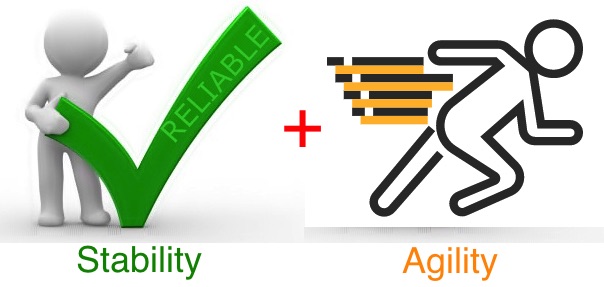
Mode 1: Focussed on Stability Mode 2: Focussed on Agility
Traditional Exploratory
Sequential Non-linear
Emphasis on: Safety & Accuracy Emphasis on: Agility and Speed

Each of the delivery modes has their own set of benefits and flaws depending on the business context – ultimately the best of both worlds must be adapted as the new way in which technology delivers into business value. Businesses require agility in change without compromising the stability of operations. Change to this new way and associated new Target Operating Model (TOM) is required.

Bimodal Organisation

This transformation is not just applicable to IT but the entire organisation. IT and “the business” are the two parts of the modern digital business. “The Business” needs to adapt and change their work style (operating model) towards digital as well. This transformation by both IT and “the business”, branded by Gartner as Bimodal, is the transformation towards a new business operating model (a new way of working) embracing a common goal of strategic alignment. Full integration of IT and business are the core of a successful digital organisation competing in the digital era.

The introduction of Agile development methodologies and DevOps, led to a transformation in how technology is being delivered into business operations. IT Service Management (ITSM) and the ITIL framework have matured the operational delivery of IT services, as a business (#ITaaBusiness) or within a business while Lean Six Sigma enables business process optimisation to ultimate quality delivery excellence. But these new “agile” ways of working, today mainly applied within IT, is not enough for the full bimodal transformation. Other aspects involving the overall organisation such as business governance and strategy, management structures and organisational architecture, people (Human Capital Management – HCM), skills, competencies, culture, change management, leadership and performance management as well as the formal management of business and technology innovation and integration, form additional service areas that have to be established or transformed.

How do organisations go about defining this new Bimodal TOM? – In come Bimodal Enablement Consulting Services in short BECS.

BECS – Bimodal Enablement Consulting Services

Gartner’s definition: “An emerging market that leverages a composite set of business and technology consulting services and IP assets to achieve faster more reliable and secure, as well as business aligned, solutions in support of strategic business initiatives.”

To establish a Bimodal enabled TOM, organisations need to architect/design the organisation to be customer centric, focussing on the value adding service delivered to the client/customer – a Service Oriented Organisation (SOO) designed using a Service Oriented Architecture (SOA). This set of customer services (external facing) should relay back to a comprehensive and integrated set of supporting and enabling business services (internal facing) that can quickly and effectively enable the business to innovate and rapidly adapt and deliver to changing customer needs and the use of technology within the digital era. This journey of change, that businesses needs to undergo, is exactly what digital transformation is about – not just focused on the technology, processes, quality and customer service, but on the business holistically, starting with the people working within the business and how they add value through the development and use of the right skills and tools, learning an applying it rapidly throughout the business value chain.

A customer centric delivery approach requires the development and adoption of new ways in which work are conducted – new management structures, building and enhancing A-teams (high performing individuals and teams, getting the job done), optimised processes and the right tool sets.

BECS must address the top bimodal drivers or goals, as identified by Gartner research:

  • Deliver greater IT value to the business
  • Shorten the time to deliver solutions
  • Enable digital business strategies
  • Accelerate IT innovation
  • Transform IT talent/culture/operations
  • Increase the interaction between business and IT
  • Embrace leading-edge technologies, tools and/or practices
  • Reduce IT costs (always a favourite)
  • Change the organisation’s culture

Take Action

Are you ready, aligned and actively engaging in the digital world?

Can you accelerate change and enable revenue growth with rock-solid service and business operations?

Are you actively practicing bimodal, continuously adapting to the changing digitally empowered customer demand?

The ultimate test to determine if you are bimodal: Every business process and every enterprise system needs to work without a blip, even as more innovation and disruptors are introduced to make the business more efficient and responsive.

It is time to be a bimodal organisation!

___________Renier Botha specialises in helping organisation to optimise their ability to better integrate technology and change into their main revenue channels – make contact today.

Related post: Success – People First; Performance ImprovementAGILE – What business executives need to know #1; AGILE – What business executives need to know #2; Lean Six Sigma; The Digital Transformation Necessity; Structure Tech for Success

The Business Consulting Industry Is Booming, and It’s About to Be Disrupted

Guest Blog: Soren Kaplan via Inc

Image CREDIT: Getty Images

Whether the focus is strategy, operations, tax, finance, HR, or IT, business consultants are a staple of corporate life. Today, over 700,000 consulting firms provide services across virtually all aspects of business globally. From defining strategic direction to simply serving as an additional pair of hands for outsourced work, consultants have become inextricably linked to the success of most large organizations.

Here’s the issue: Festering underneath myriad consulting offerings, methodologies, tools, and firms lie some vulnerabilities that will eventually unravel the consulting business model — the same kind of dramatic disruption that other industries like photography, publishing, health care, and many others have experienced.

An industry becomes susceptible to disruption when it becomes entrenched in its longstanding solutions and financial structure. Disruptive innovations provide simpler or more elegant solutions to existing problems, enabled by new technology and often at a lower cost. Think portable calculators versus computers, Amazon versus bookstores, Netflix versus Blockbuster, or digital cameras versus film.

Management consulting is not immune to the dynamics of disruption. According to IBISWorld, for example, “the Management Consulting industry is in the mature stage of its life cycle. The industry is characterized by growth in line with the overall economy, an increasing number of industry players, and technological change based on improving efficiency rather than developing entirely new services.”

In any industry, when the basis of competition becomes efficiency versus innovation and new solutions, disruption lies on the horizon.

Five fatal flaws of the consulting industry

Here are five inherent qualities of the management consulting industry that make it susceptible to technology-driven disruption:

  1. Labor intensive. Most consulting services rely on humans as the fundamental source of research, analysis, recommendations, process definition, process management, and facilitation.
  2. Billable time-based business model. The fee structure underlying most consulting services is tied to billable hours or days, which encourages lengthy, overstaffed engagements to maximize revenue.
  3. High margins. The cost of “goods” in consulting refers not to products but to people. The billable rates of junior consultants in most large firms far exceed what they are paid by the firms in which they work. Value pricing models also dramatically increase the profitability of many projects and firms.
  4. Time-bound value. With the increasing pace of change, the moment a research report, competitive analysis, or strategic plan is delivered to a client, its currency and relevance rapidly diminishes as new trends, issues, and unforeseen disrupters arise.
  5. Knowledge commoditization. The models, templates, and tools of the consulting trade have historically been kept “secret” by consultants and locked away as intellectual capital. The “democratization” of just about everything, including management information and knowledge, will continue so that anyone can access and apply “best practices” on their own.

Paradoxically, even with these fundamental flaws — all of which are contrary to the best interests of clients — the industry continues to grow. Last year, for example, the management consulting industry saw a 4.1 percent growth rate.

So why be concerned?

Intersecting trends drive disruption.

Rapidly emerging trends have created a new breed of competitor — even if the industry doesn’t yet view these upstarts as competition. Firms like Domo, Looker, Qlik, Radius, and CBInsights tap into the converging trends shaping the future of business, and the world. By creating solutions at the intersection of big data, data analytics, the cloud, cognitive computing, visualization, and cross platform anytime access, these firms provide a glimpse into the type of automated, scalable data gathering, insights, and decision-making made possible by next generation technology.

The first to feel the detrimental effects of disruption will likely be the large research and advisory firms such as Gartner, Forrester, and IDC. With models that rely on armies of analysts, PDF reports that become outdated the moment they’re published, and significant annual subscription fees, these firms embody the most significant vulnerabilities of the larger consulting industry. And this is just the tip of the iceberg. Just about any consultant or firm that conducts primary or secondary research will see the value of these offerings — and clients’ willingness to pay for them — diminish significantly.

While many consultants and consulting firms have established practices advising clients on strategies to leverage disruptive trends and technologies, few apply this to themselves. Investing in the technological innovations and next generation business models is a fundamentally paradoxical concept in an industry driven by billable hours, billable days, and closely held best practices in the form of “knowledge capital.”

Eat your own dog food.

In 2000, I wrote an article in the first issue of Consulting to Management (C2M) about the importance of creating “knowledge assets” as a strategy to scale professional services offerings. The article described the importance of capturing and codifying intellectual capital in the form of process methodologies, tools, and templates. Many firms do that quite successfully today.

Repeatable processes, models and tools are indeed important for efficiency, scalability, and profitability. Yet the physical delivery of these staples of the trade remain chained to an entrenched business model. A new approach is needed if the management consulting industry — let alone individual firms and consultants — will have the chance to unlock the next phase of its evolution and value, before some dramatic external threat forces the issue.

Many clients hire consultants to tap into strategic thinking — seeing the big picture, identifying scenarios, choosing options, and creating game plans. Yet a conspicuous void exists when it comes to addressing strategic questions by and for the industry itself.

Here is a set of questions that can help jump start new business models for management consulting:

  • Transformative problems. What emerging client challenges and needs exist that, if addressed, would transform their business by 10x, or even 100x?
  • Radical intelligence. How do we leverage big data, artificial intelligence, collaboration tools, and other technologies to create a step change in the level of knowledge and insight we deliver?
  • Scalable relevance. How do we scale our tools and methods while ensuring applicability to the widest possible audience globally?
  • Knowledge democratization. How do we make our models, tools, and resources ubiquitously available while building a sustainable business model?
  • Collaborative ecosystems. What networks can we build or join that exponentially elevate the value we create and deliver?

In the field of business strategy, the “tyranny of success” is a well-known dynamic: what led to today’s success will ultimately lead to tomorrow’s failure. Individual consultants and consulting firms that recognize the limitations of their existing business model while exploring opportunities that tap into emerging technologies and new delivery models will have the best chance of thriving in the fast-approaching disruptive future.

The opinions expressed here by Inc.com columnists are their own, not those of Inc.com.