

A Guide to Sustained Success in Business Vision, Strategy, and Technology Delivery
The Trough of Disillusionment in Business Vision, Strategy, and Technology Delivery
In the dynamic, innovative and interwoven landscape of business and technology, the concept of the “trough of disillusionment” stands as a critical phase that organisations must navigate to achieve long-term success. Coined by the research and advisory firm Gartner, this term is part of the “Hype Cycle,” which describes the typical progression of new technologies from innovation to mainstream adoption. The trough of disillusionment specifically represents a period where inflated expectations give way to a more sober, realistic assessment of a technology’s capabilities and limitations. Understanding this phase is crucial for shaping effective business vision, strategy, and technology delivery.
The Hype Cycle and the Trough of Disillusionment
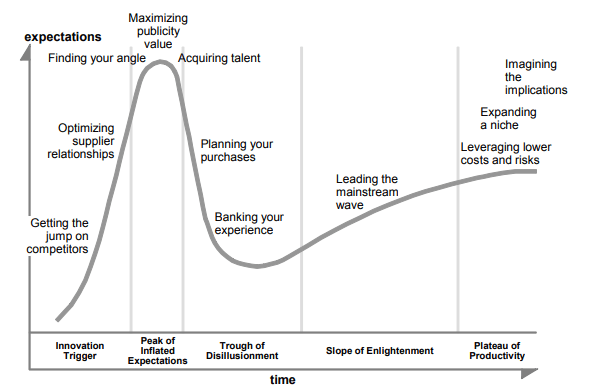
The Hype Cycle is divided into five key stages:
- Innovation Trigger: A breakthrough, product launch, or other event generates significant press and interest.
- Peak of Inflated Expectations: Early publicity produces a number of success stories—often accompanied by scores of failures.
- Trough of Disillusionment: Interest wanes as experiments and implementations fail to deliver. Producers of the technology shake out or fail. Investments continue only if the surviving providers improve their products to the satisfaction of early adopters.
- Slope of Enlightenment: More instances of how the technology can benefit the enterprise start to crystallise and become more widely understood.
- Plateau of Productivity: Mainstream adoption starts to take off. Criteria for assessing provider viability are more clearly defined. The technology’s broad market applicability and relevance are clearly paying off.
The Trough of Disillusionment in Business Vision
In the context of business vision, the trough of disillusionment is a reality check that tests the resilience and adaptability of organisational goals. Visionary leaders often set ambitious targets based on the initial promise of new technologies. However, as these technologies face real-world challenges and fail to meet sky-high expectations, the resultant disillusionment can lead to strategic pivoting.
Leaders must anticipate this phase and prepare to manage the potential decline in enthusiasm and support. This involves:
- Realistic Goal Setting: Establishing achievable milestones and preparing for potential setbacks.
- Stakeholder Communication: Maintaining transparent communication with stakeholders to manage expectations and reinforce long-term vision despite short-term disappointments.
- Flexibility and Adaptability: Being ready to pivot strategies based on new insights and developments during the disillusionment phase.
The Trough of Disillusionment in Business Strategy
Strategically, the trough of disillusionment necessitates a recalibration of efforts and resources. Businesses must:
- Evaluate and Learn: Critically analyse why initial implementations fell short. Was it due to technology immaturity, unrealistic expectations, or lack of necessary infrastructure?
- Refine Use Cases: Focus on identifying practical, high-value use cases where the technology can realistically deliver benefits.
- Resource Management: Reallocate resources to areas with a higher likelihood of successful outcomes, potentially slowing down investments in more speculative projects.
Strategists must balance the initial enthusiasm with a grounded approach that incorporates lessons learned during the disillusionment phase. This balanced approach ensures that when the technology matures, the organisation is well-positioned to capitalise on its potential.
The Trough of Disillusionment in Technology Delivery
For technology delivery teams, the trough of disillusionment is a period of introspection and iterative improvement. During this phase, the emphasis shifts from innovation to execution:
- Improving Product Quality: Focus on addressing the shortcomings of the technology, such as stability, scalability, and usability.
- Enhanced Training and Support: Providing better training and support for users to maximise the technology’s current capabilities.
- Incremental Development: Adopting an incremental approach to development, where continuous feedback and iterations help refine the technology and its applications.
Delivery teams must maintain a commitment to excellence and incremental improvement, recognising that sustained effort and adaptation are key to moving through the trough of disillusionment towards the slope of enlightenment.
Conclusion
The trough of disillusionment, while challenging, is a natural and necessary phase in the adoption of new technologies. For businesses, it offers a reality check that can lead to more sustainable, long-term success. By setting realistic expectations, maintaining transparent communication, and being willing to adapt and learn, organisations can navigate this phase effectively. In technology delivery, a focus on incremental improvements and user support ensures that when the technology matures, it can deliver on its early promise. Ultimately, understanding and managing the trough of disillusionment is essential for leveraging new technologies to achieve lasting business success.






 renierbotha ltd