Modular Operating Model for Strategy Agility

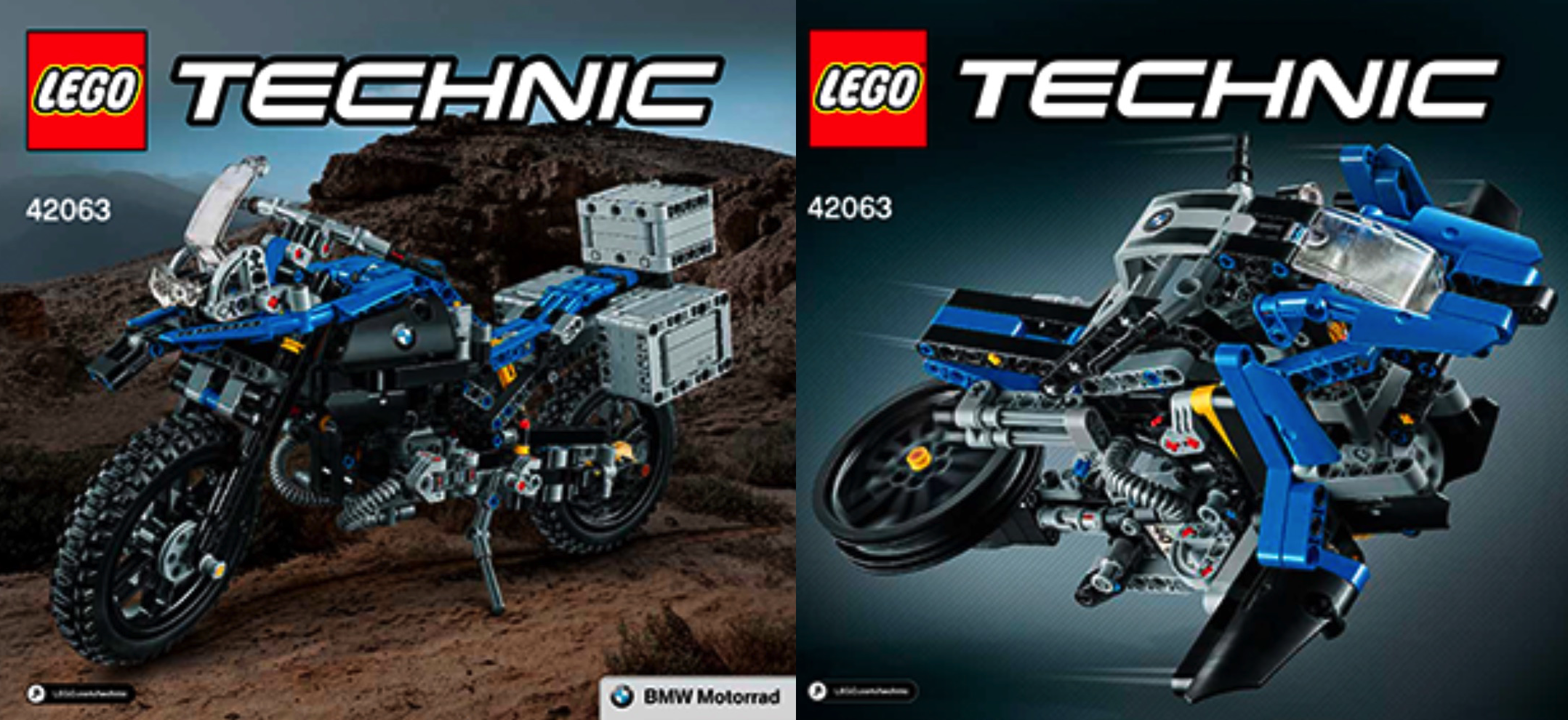
One of life’s real pleasures, is riding a motorcycle. The sense of freedom when it is just you, machine and the open road is something only sharing enthusiast would truly understand. Inspired, I recently completed a hobby project building the Lego Set 42063. The building blocks of this Technic model constructs the BMW R1200GS Adventure motorcycle, arguably the best allrounder, adapted to handle all road conditions. The same building blocks can also be used to build a futuristic flying scooter, or shall I call it a speedster in true Star Wars style… While building the model I was marvelled by the ingeniousness of the design and how the different components come together in a final product – fit for purpose today but easily adapted to be fit for future.
Lego-Technic-modular

This made me think about business agility – how can this modular approach be used within business. We know that SOA (Service Oriented Architecture) takes a modular approach in building adaptable software application and in the talk on “Structure Technology for Success – using SOA” I explained a modular approached to design a Service Orientated Organisation (SOO), to directly contribute to the business success.

Recently I’ve also written about how to construct a business Operating Models that delivers. Such an operating model aligns the business operations with the needs of it’s customers, while it provides the agility to continuously adapt to changes in this fast changing technological ecosystem we live in. An Operating Model that delivers, fit for purpose today but easy adaptable to be fit for the future, in other words – a Modular Operating Model.

As the environment for a company changes rapidly, static operating models lack the agility to respond. Successful companies are customer centric and embrace continuous innovation to enhance the ability of the organisation to re-design it’s operations. This requires an Operating Model that incorporates the agility to be responsive to changes in business strategy and customer needs. A modular operating model enables agility in business operations with a design that can respond to change by defining standard building blocks and how to dynamically combine them. Modular blocks (with the specific operational complexity contained) simplifies managing complexity. This reduces the time to produce a new operational outcome, irrespective of this being a new services, product or just an efficiency improvement within an existing value chain.  

An example of applying modular thinking to a operational delivery methodology is covered in the blog post: “How to Innovate to stay Relevant”. In combining the core principles and benefits of three different delivery methodologies, Design Thinking, Lean Startup and Agile Scrum as modular building blocks, a delivery methodology are constructed that ensures rapid delivery of innovation into customer centric revenue channels while optimising the chances of success through continuous alignment with customer and market demand.

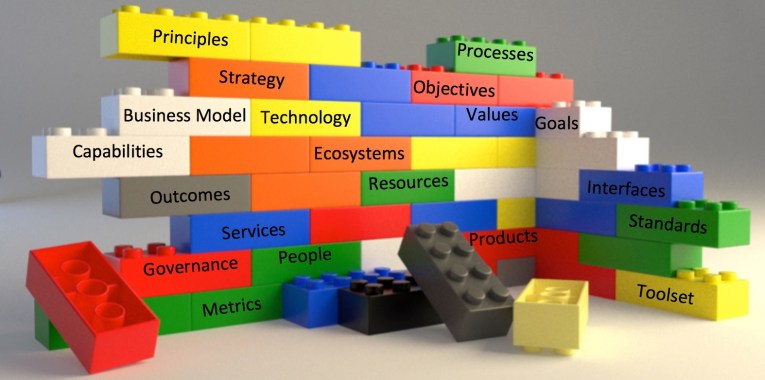
A modular operating model imbeds operational agility through the ability to use, re-use, plug and play different capabilities, processes and resources (building blocks) tech-TOMto easily produce new business outcomes without having to deal with the complexities which are already defined within the individual building blocks – just like a Lego set using the same set of standardised and pre-defined blocks to build completely different things. The focus is on re-using the blocks and not on the design of the blocks itself. Off course a lot of thinking has gone into the design of the different building blocks, but through re-using the same block designs, the model design time is focussed on a new/different outcome and not on a component of an outcome.

Designing modular capabilities, processes and resources that are used to design operating models have benefits not just in efficiencies and savings through economies of scale, but also in the reduction of time to market. These benefits are easier to accomplish in larger multi-divisional organisation with multiple operating models or organisations with complex operating models bringing together multiple organisations and different locations, where the re-use of modular operating model blocks bring demonstrable efficiencies – but is also possible for smaller organisations and start-ups.

If you want a Operating Model that Delivers and are agile to adapt to the challenges introduced by new technologies and digital business models – ensure the Target Operating Model (TOM) design methodology focusses on modular thinking from the offset and through the design process.

renierbotha Ltd has a demonstrable track record of compiling and delivering visionary Target Operating Models.

Talk to us – we can help you with the Digital Transformation to align your business operations and business model to the modern customers expectations.


Also read…

Case Study – Renier Botha’s Game-Changing Leadership at Systems Powering Healthcare (2015-2017)

Posted on November 1, 2017

Introduction:
Back in December 2015, Renier Botha stepped in as the big boss—Managing Director and Head of Service at Systems Powering Healthcare, aka SPHERE. This place is all about delivering top-notch IT services and infrastructure to a whole lot of NHS healthcare workers—over 10,000 to be exact. Let’s dive into how Botha totally revamped SPHERE in his two year tenure, turning it into a powerhouse through his sharp strategic moves, cool innovations, and rock-solid leadership.

Facing the Music and Setting Goals:
Right off the bat, Botha was up against some big challenges. He had to shift SPHERE from an old-school cost-plus model to a snazzy commercial-service-catalogue model while also trying to attract more clients. His main to-dos were to get the company on stable footing, map out a strategic game plan, and make sure they were all about putting customers first.

Key Moves and Wins:

  1. Strategic Master Plan: Botha wasted no time. Within the first three months, he whipped up a six-year strategic plan that laid out all the key investments and milestones to get SPHERE to grow and thrive.
  2. From Startup to Star: Managing a team of 75, Botha steered SPHERE from its startup phase to become a well-known medium-sized business, hitting their three-year targets way ahead of schedule – in just two years!
  3. Tech Makeover: One of his big programmes was pouring £42M into beefing up SPHERE’s tech – think better networks, better hosting, the works. This move was all about making sure they could keep up and stay ahead in the long run.
  4. Service Delivery Shake-up: Botha brought in a new, customer-focused operating model and rolled out Service-Now to up their tech game. This not only made things run smoother but also saved a ton of money, giving them a killer return on investment.
  5. Financial Growth: Under his guidance, SPHERE’s dough rolled in 42% thicker thanks to smart mergers, acquisitions, and raking in new clients. They also managed to save the NHS about £3m a year with their shared service gig.
  6. Cost-Cutting Genius: He managed to slash the “Cost per IT User” by 24% in two years, showing just how much bang for the buck SPHERE could offer.
  7. Big Win: Thanks to a revamped service catalogue, SPHERE nailed a whopping £10m contract to provide IT services for Northumbria Healthcare NHS Foundation Trust.
  8. Happy Campers: Botha didn’t just focus on the numbers; he also built a workplace where people actually wanted to stick around. Employee retention jumped from 82% to a whopping 98% by the end of his run.

Conclusion:
Renier Botha’s time at SPHERE shows just what can happen when you mix visionary leadership with a knack for making smart moves in healthcare IT. He not only met the big challenges head-on but also made sure that SPHERE became a go-to example of how IT can seriously improve healthcare services. His story isn’t just about a job well done; it’s about setting a whole new standard in the industry.

Empowering Healthcare through Strategic Leadership: Systems Powering Healthcare Case Study (2015-2017)

Introduction:
In December 2015, Renier Botha assumed the role of Managing Director (CEO) & Head of Service (CIO) at Systems Powering Healthcare (SPHERE), an IT specialist organisation providing essential IT infrastructure and shared IT services to over 10,000 healthcare workers in the NHS. This case study delves into Botha’s transformative journey, focusing on his strategic vision, innovative solutions, and steadfast leadership that reshaped SPHERE into a thriving and client-focused enterprise.

Challenges and Objectives:
When Botha took charge, SPHERE faced the challenge of transitioning from a cost-plus model to a commercial-service-catalogue model while expanding its clientele. His primary objectives included stabilising the newly founded business, developing a strategic roadmap, and establishing a customer-centric approach to service delivery.

Strategic Initiatives and Achievements:

  1. Strategic Planning: Within the initial three months, Botha meticulously crafted a six-year strategic business plan for SPHERE. This plan outlined clear annual investment and service delivery milestones, providing a roadmap for the organisation’s growth and development.
  2. Operational Excellence: Botha directed a workforce of 75 employees, overseeing the execution of the strategic plan. Under his leadership, SPHERE transformed from a startup to an established medium-sized enterprise, achieving its third-year targets by the end of the second financial year.
  3. IT Infrastructure Transformation: Botha led a comprehensive IT estate refresh strategy, investing £42M in core capabilities like IP Networks, Service Hosting, End User Computing, and more. This initiative not only modernised SPHERE’s infrastructure but also ensured long-term sustainability and efficiency.
  4. Service Delivery Innovation: Botha introduced a customer-centric Target Operating Model (TOM) and implemented Service-Now as the supporting ERP toolset. This digital transformation not only increased business maturity but also resulted in a five-year £2.4m NPV saving and a remarkable ROI of 493%.
  5. Financial Growth: Through strategic M&A, business transformation, and the onboarding of new clients, SPHERE’s revenue grew by 42%. This growth not only secured significant ROI for shareholders but also saved the NHS approximately £3m per annum through a shared service solution.
  6. Operational Efficiency: Botha defined and achieved the “Cost per IT User” KPI, showcasing SPHERE’s value proposition. The strategic business plan led to an 11% reduction in the Cost per IT User in 2016 and a further 13% reduction in 2017, surpassing the target KPI by 12%.
  7. Commercial Success: Botha developed a compelling commercial Service Catalogue, instrumental in winning a £10m tender bid to become an IT Service Provider to Northumbria Healthcare NHS Foundation Trust.
  8. Cultural Transformation: Through a focus on commercial awareness, customer-centricity, and employee empowerment, Botha fostered a high-performing team. Staff retention rates increased from 82% in early 2016 to an impressive 98% by the end of 2017.

Conclusion:
Renier Botha’s strategic foresight, operational acumen, and emphasis on innovation and client satisfaction transformed Systems Powering Healthcare into a robust, client-focused organisation. His leadership not only steered SPHERE through critical transitions but also positioned it as a beacon of efficiency and excellence within the healthcare technology sector. This case study exemplifies the profound impact of visionary leadership on organisational growth and success.