Debunking Five Leadership Myths That Hinder Success

Leadership is an evolving skill that demands constant cultivation. While some individuals may naturally step into leadership roles, no one is born fully equipped to be a CEO.

Numerous misconceptions about leadership persist, often clashing with the actual demands and realities that new CEOs encounter upon assuming their positions.

From my professional experience, I’ve encountered several prevalent myths about leadership. With time and experience, I have observed how successful CEOs reshape their thinking and develop unique leadership philosophies, guiding them towards improved leadership.

Myth 1: Leaders Must Be Perfect
A prevalent myth is that leaders must be flawless, possessing an inherent knack for impeccable decision-making. This belief compels leaders to appear unshakeably strong. However, effective leadership involves nuances.

Accomplished leaders embrace vulnerability and understand that decision-making is an ongoing learning process. By fostering an environment where learning from mistakes is encouraged, leaders can genuinely connect with their teams, enhancing trust and openness.

As a new CEO, I initially isolated myself, mistakenly thinking I needed all the answers. I quickly learned that this was not the case.

Eventually, every leader faces decisions that do not pan out as expected. The best leaders are those who remain resilient, adaptable, and receptive to new information, fostering a culture of mutual learning and improvement.

Myth 2: Leadership Equals Commanding
Another myth is that leadership primarily involves issuing commands, supporting a directive or authoritarian approach. True leadership is dynamic, with leaders serving as key decision-makers. However, a directive approach can quash creativity and hinder open communication.

Exceptional leaders create inclusive workplaces where collaboration thrives, ideas are exchanged freely, and team members feel empowered to share their insights, even if it challenges established views.

Leadership is not about merely giving orders; it is about inspiring, guiding, and facilitating team success. Leaders can harness their teams’ diverse skills and perspectives by delegating and letting go of the need for absolute control.

Myth 3: One Correct Way to Lead
It’s a misconception that there is a single “correct” way to lead. Many influential leaders and mentors adopt vastly different leadership styles. While some believe that all successful leaders are extroverts, introverted leaders often excel by capitalising on their strong listening skills for thoughtful decision-making.

Most successful leaders share common traits: emotional intelligence and empathy. They demonstrate genuine care for their team members, fostering trust, enhancing communication, and creating a positive atmosphere.

Myth 4: Leaders Should Only Communicate Positive News
Some leaders believe they should shield their employees from negative news to prevent demoralisation. However, when leaders cease open communication, team members begin to speculate, leading to isolation for the leader.

As noted by Jim Collins, confronting harsh realities is essential. Great leaders engage their team’s trust and cooperation by being transparent, treating them as partners in tackling challenges together, and fostering a sense of shared responsibility.

Myth 5: Leadership is a Lonely Journey
Leadership might appear to be a solitary role, but it is far from being a lone endeavour. Effective leaders deliberately assemble a diverse team and often engage with other CEOs who face similar challenges.

Leaders benefit from diverse perspectives, which help them differentiate between facts and personal biases or assumptions. Engaging with peers allows for constructive feedback and opportunities for adjustment.

Interacting with leaders outside one’s organisation provides space for open discussions about strengths, weaknesses, and challenges, unveiling a critical truth: no leader has all the answers. Acknowledging this reality can enhance leadership abilities and cultivate a supportive network that encourages collective growth.

Overcoming these myths is crucial for personal and organisational advancement. Embracing vulnerability, fostering transparent communication, and promoting collaboration, while moving away from a controlling leadership style, are vital for becoming an effective leader.

Leadership is not a final destination but a unique, dynamic journey that demands lifelong dedication to growth, adaptability, and learning.

CEO’s guide to digital transformation : Building AI-readiness. 

Digital Transformation remains a necessity which, based on the pace of technology evolution, becomes a continuous improvement exercise. In the blog post “The Digital Transformation Necessity” we covered digital transformation as the benefit and value that technology can enable within the business through technology innovation including IT buzz words like: Cloud Service, Automation, Dev-Ops, Artificial Intelligence (AI) inclusinve of Machine Learning & Data Science, Internet of Things (IoT), Big Data, Data Mining and Block Chain. Amongst these AI has emerged as a crucial factor for future success. However, the path to integrating AI into a company’s operations can be fraught with challenges. This post aims to guide CEOs to an understanding of how to navigate these waters: from recognising where AI can be beneficial, to understanding its limitations, and ultimately, building a solid foundation for AI readiness.

How and Where AI Can Help

AI has the potential to transform businesses across all sectors by enhancing efficiency, driving innovation, and creating new opportunities for growth. Here are some areas where AI can be particularly beneficial:

  1. Data Analysis and Insights: AI excels at processing vast amounts of data quickly, uncovering patterns, and generating insights that humans may overlook. This capability is invaluable in fields like market research, financial analysis, and customer behaviour studies.
  2. Support Strategy & Operations: Optimised data driven decision making can be a supporting pillar for strategy and operational execution.
  3. Automation of Routine Tasks: Tasks that are repetitive and time-consuming can often be automated with AI, freeing up human resources for more strategic activities. This includes everything from customer service chatbots to automated quality control in manufacturing and the use of use of roboticsc and Robotic Process Automation (RPA).
  4. Enhancing Customer Experience: AI can provide personalised experiences to customers by analysing their preferences and behaviours. Recommendations on social media, streaming services and targeted marketing are prime examples.
  5. Innovation in Products and Services: By leveraging AI, companies can develop new products and services or enhance existing ones. For instance, AI can enable smarter home devices, advanced health diagnostics, and more efficient energy management systems.

Where Not to Use AI

While AI has broad applications, it’s not a panacea. Understanding where not to deploy AI is crucial for effective digital transformation:

  1. Complex Decision-Making Involving Human Emotions: AI, although making strong strides towards causel awareness, struggles with tasks that require empathy, moral judgement, and understanding of nuanced human emotions. Areas involving ethical decisions or complex human interactions are better left to humans.
  2. Highly Creative Tasks: While AI can assist in the creative process, the generation of original ideas, art, and narratives that deeply resonate with human experiences is still a predominantly human domain.
  3. When Data Privacy is a Concern: AI systems require data to learn and make decisions. In scenarios where data privacy regulations or ethical considerations are paramount, companies should proceed with caution.
  4. Ethical and Legislative restrictions: AI requires access to data which are heavily protected by legislation

How to Know When AI is Not Needed

Implementing AI without a clear purpose can lead to wasted resources and potential backlash. Here are indicators that AI might not be necessary:

  1. When Traditional Methods Suffice: If a problem can be efficiently solved with existing methods or technology, introducing AI might complicate processes without adding value.
  2. Lack of Quality Data: AI models require large amounts of high-quality data. Without this, AI initiatives are likely to fail or produce unreliable outcomes.
  3. Unclear ROI: If the potential return on investment (ROI) from implementing AI is uncertain or the costs outweigh the benefits, it’s wise to reconsider.

Building AI-Readiness

Building AI readiness involves more than just investing in technology, it requires a holistic approach:

  1. Fostering a Data-Driven Culture: Encourage decision-making based on data across all levels of the organisation. This involves training employees to interpret data and making data easily accessible.
  2. Investing in Talent and Training: Having the right talent is critical for AI initiatives. Invest in hiring AI specialists and provide training for existing staff to develop AI literacy.
  3. Developing a Robust IT Infrastructure: A reliable IT infrastructure is the backbone of successful AI implementation. This includes secure data storage, high-performance computing resources, and scalable cloud services.
  4. Ethical and Regulatory Compliance: Ensure that your AI strategies align with ethical standards and comply with all relevant regulations. This includes transparency in how AI systems make decisions and safeguarding customer privacy.
  5. Strategic Partnerships: Collaborate with technology providers, research institutions, and other businesses to stay at the forefront of AI developments.

For CEOs, the journey towards AI integration is not just about adopting new technology but transforming their organisations to thrive in the digital age. By understanding where AI can add value, recognising its limitations, and building a solid foundation for AI readiness, companies can harness the full potential of this transformative technology.

Decoding the CEO’s Wishlist: What CEOs Seek in Their CTOs

The key difference between a Chief Information Officer (CIO) and a Chief Technology Officer (CTO) lies in their strategic focus and responsibilities within an organisation. A CIO primarily oversees the management and strategic use of information and data, ensuring that IT systems align with business objectives, enhancing operational efficiency, managing risk, and ensuring data security and compliance. On the other hand, a CTO concentrates on technology innovation and product development, exploring emerging technologies, driving technical vision, leading prototyping efforts, and collaborating externally to enhance the organisation’s products or services. While both roles are essential, CIOs are primarily concerned with internal IT operations, while CTOs focus on technological advancement, product innovation, and external partnerships to maintain the organisation’s competitive edge.

In 2017, I’ve written a post “What CEOs are looking for in their CIO” after an inspirational presentation by Simon La Fosse, CEO of Le Fosse Associates, a specialist technology executive search and head-hunter with more than 30 years experience in the recruitment market. The blog post was really well received on LinkedIn resulting in an influencer badge. In this post I am focussing on the role of the CTO (Chief Technology Officer).

In this digital age and ever-evolving landscape of the corporate world, the role of CTO stands as a linchpin for innovation, efficiency, and strategic progress. As businesses traverse the digital frontier, the significance of a visionary and adept CTO cannot be overstated. Delving deeper into the psyche of CEOs, let’s explore, in extensive detail, the intricate tapestry of qualities, skills, and expertise they ardently seek in their technology leaders.

1. Visionary Leadership:

CEOs yearn for CTOs with the acumen to envision not just the immediate technological needs but also the future landscapes. A visionary CTO aligns intricate technological strategies with the overarching business vision, ensuring that every innovation, every line of code, propels the company towards a future brimming with possibilities.

2. Innovation and Creativity:

Innovation is not just a buzzword; it’s the lifeblood of any progressive company. CEOs pine for CTOs who can infuse innovation into the organisational DNA. Creative thinking coupled with technical know-how enables CTOs to anticipate industry shifts, explore cutting-edge technologies, and craft ingenious solutions that leapfrog competitors.

3. Strategic Thinking and Long-Term Planning:

Strategic thinking is the cornerstone of successful CTOs. CEOs crave technology leaders who possess the sagacity to foresee the long-term ramifications of their decisions. A forward-looking CTO formulates and executes comprehensive technology plans, meticulously aligned with the company’s growth and scalability objectives.

4. Profound Technical Proficiency:

The bedrock of a CTO’s role is their technical prowess. CEOs actively seek CTOs who possess not just a surface-level understanding but a profound mastery of diverse technologies. From software development methodologies to data analytics, cybersecurity to artificial intelligence, a comprehensive technical acumen is non-negotiable.

5. Inspirational Team Leadership and Collaboration:

Building and leading high-performance tech teams is an art. CEOs admire CTOs who inspire their teams to transcend boundaries, fostering a culture of collaboration, innovation, and mutual respect. Effective mentoring and leadership ensure that the collective genius of the team can be harnessed for groundbreaking achievements.

6. Exceptional Communication Skills:

CTOs are conduits between the intricate realm of technology and the broader organisational spectrum. CEOs value CTOs who possess exceptional communication skills, capable of articulating complex technical concepts in a manner comprehensible to both technical and non-technical stakeholders. Clear communication streamlines decision-making processes, ensuring alignment with broader corporate goals.

7. Problem-Solving Aptitude and Resilience:

In the face of adversity, CEOs rely on their CTOs to be nimble problem solvers. Whether it’s tackling technical challenges, optimising intricate processes, or mitigating risks, CTOs must exhibit not just resilience but creative problem-solving skills. The ability to navigate through complexities unearths opportunities in seemingly insurmountable situations.

8. Profound Business Acumen:

Understanding the business implications of technological decisions is paramount. CEOs appreciate CTOs who grasp the financial nuances of their choices. A judicious balance between innovation and fiscal responsibility ensures that technological advancements are not just visionary but also pragmatic, translating into tangible business growth.

9. Adaptive Learning and Technological Agility:

The pace of technological evolution is breathtaking. CEOs seek CTOs who are not just adaptive but proactive in their approach to learning. CTOs who stay ahead of the curve, continuously updating their knowledge, can position their companies as trailblazers in the ever-changing technological landscape.

10. Ethical Leadership and Social Responsibility:

In an era marked by digital ethics awareness, CEOs emphasise the importance of ethical leadership in technology. CTOs must uphold the highest ethical standards, ensuring data privacy, security, and the responsible use of technology. Social responsibility, in the form of sustainable practices and community engagement, adds an extra layer of appeal.

In conclusion, the modern CTO is not merely a technical expert; they are strategic partners who contribute significantly to the overall success of the organisation. By embodying these qualities, CTOs can not only meet but exceed the expectations of CEOs, driving their companies to new heights in the digital age.

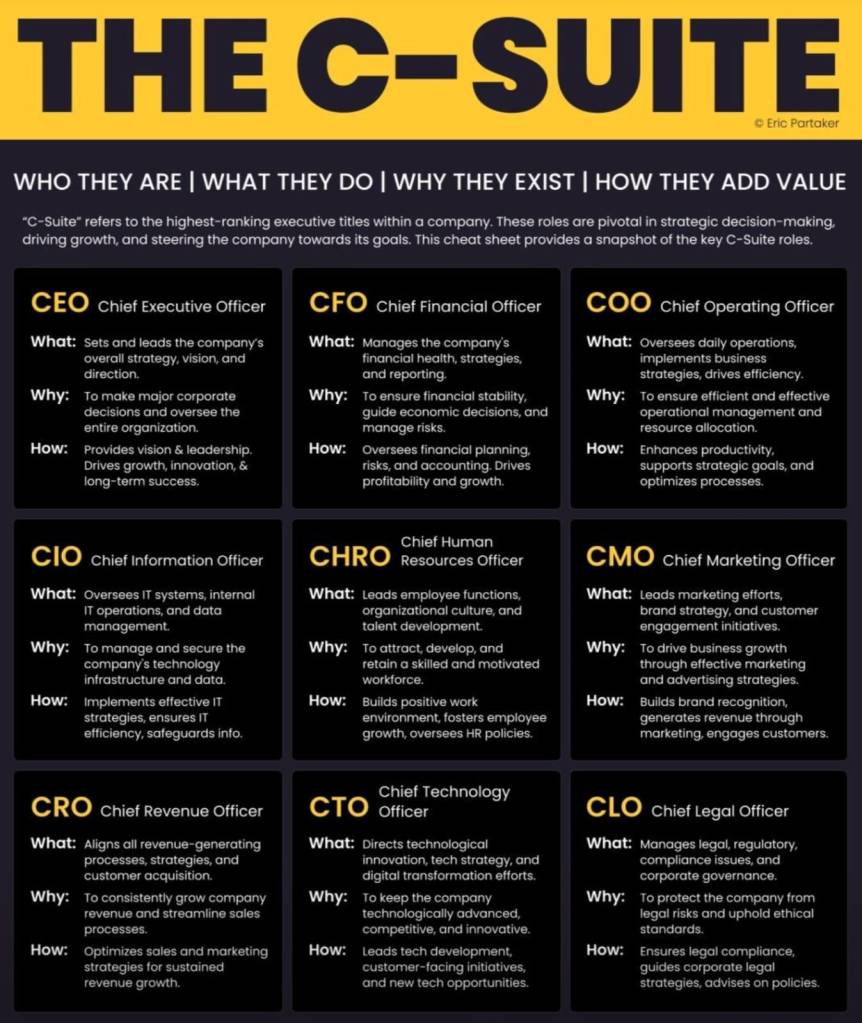
The C-Suite

WHO they are, What the do, Why they exist, How they add value

In corporate leadership, the C-Suite stands as the command centre, where strategic decisions are made, and the future of the company is shaped. Comprising key executives with specialised roles, the C-Suite plays a crucial role in steering organisations towards success. In this blog post, we’ll delve into the world of the C-Suite, shedding light on the responsibilities and value each role brings to the table.

  1. CEO – Chief Executive Officer

The CEO, or Chief Executive Officer, is the captain of the ship, responsible for charting the company’s course and ensuring its overall success. The CEO sets the vision, mission, and strategy, providing leadership to the entire organisation. They are the ultimate decision-maker, accountable to the board of directors and stakeholders.

  1. CFO – Chief Financial Officer

The CFO, or Chief Financial Officer, is the financial maestro of the C-Suite. Tasked with overseeing the financial health of the organisation, the CFO manages budgets, financial planning, and investment strategies. They play a pivotal role in risk management, ensuring sustainable growth and profitability.

  1. COO – Chief Operating Officer

The COO, or Chief Operating Officer, is the executor of the CEO’s vision. Responsible for day-to-day operations, the COO ensures that the company’s processes and systems align with strategic goals. They focus on efficiency, productivity, and scalability, optimising internal functions for maximum performance.

  1. CIO – Chief Information Officer

In the digital age, the CIO, or Chief Information Officer, holds a critical role. Charged with managing the company’s technology infrastructure, the CIO ensures that information systems align with business objectives. They play a pivotal role in driving innovation and digital transformation.

  1. CHRO – Chief Human Resources Officer

The CHRO, or Chief Human Resources Officer, is the guardian of the company’s most valuable asset—its people. Responsible for talent acquisition, employee development, and creating a positive work culture, the CHRO plays a key role in shaping the organisation’s human capital strategy.

  1. CMO – Chief Marketing Officer

The CMO, or Chief Marketing Officer, is the storyteller-in-chief. Charged with building and promoting the company’s brand, the CMO develops marketing strategies to drive growth and customer engagement. They are instrumental in shaping the company’s public image and market positioning.

  1. CRO – Chief Revenue Officer

The CRO, or Chief Revenue Officer, is the architect of revenue streams. Focused on driving sales and revenue growth, the CRO collaborates with sales, marketing, and other departments to optimise customer acquisition and retention strategies.

  1. CTO – Chief Technology Officer

The CTO, or Chief Technology Officer, is the technology visionary. Tasked with leading technological innovation, the CTO develops and implements technology strategies that align with the company’s business goals. They often play a crucial role in product development and ensuring technological competitiveness.

  1. CLO – Chief Legal Officer

The CLO, or Chief Legal Officer, is the legal guardian of the organisation. Responsible for managing legal risks and ensuring compliance with laws and regulations, the CLO provides legal counsel to the executive team and oversees matters such as contracts, intellectual property, and litigation.

Summary – Cheat sheet

Conclusion

The C-Suite represents a powerhouse of expertise, each member contributing their unique skills to the overall success of the organisation. By understanding the roles and responsibilities of the CEO, CFO, COO, CIO, CHRO, CMO, CRO, CTO, and CLO, we gain insights into the intricate workings of corporate leadership. Together, these leaders form a cohesive unit, steering the ship through the complexities of the business world, adding significant value to the organisation and its stakeholders.

Leadership definition

What is Leadership? How do you define Leadership in a concise sentence?

According to Forbes a leader has got nothing to do with title, seniority or position within an organisation, personal attributes and management are definitely not leadership.

So what is leadership then?

Some thought leaders of our time define leadership as…

Peter Drucker: “The only definition of a leader is someone who has followers.”

Warren Bennis: “Leadership is the capacity to translate vision into reality.”

Bill Gates: “As we look ahead into the next century, leaders will be those who empower others.”

John Maxwell: “Leadership is influence – nothing more, nothing less.”

“Leadership is the art of leading others to deliberately create a result
that wouldn’t have happened otherwise.”

Forbes: “Leadership is a process of social influence, which maximizes the efforts of others, towards the achievement of a goal.”

Wikipedia: Leadership is “a process of social influence in which one person can enlist the aid and support of others in the accomplishment of a common task“.

My definition: “Leadership is the art of leading a group of people or an organization to execute a common task by providing a vision that they follow willingly through the inspiration received from the leader’s passion , knowledge, methodologies, approach and ability to influence the interests of all members and stakeholders.”

What CEOs are looking for in their CIO

During the CIO-Dialogue 6 held in Brighton in November 2012, I had the privilege to listen to Simon La Fosse presenting. Simon, CEO of La Fosse Associates, is a specialist technology executive search and head-hunter with 25 years experience in the recruitment market.

What does a CEO really want from his CIO?… Simon presented the head-hunters perspective followed by a lively discussion. This presentation had a profoundly positive impact on my confidence especially after pondering on the key aspects that was highlighted (listed below) and measuring yourself to identify areas of strength and where I can improve.

What I took away from the interaction…

The CEO is looking for a CIO that he can build a professional relationship with. Someone they can trust to help them through the disruption technology is continuously causing in business.

The CIO must not be too involved in the daily operations as they have to see the bigger picture and spot opportunities through interaction with peers and bring those to the CEO in clear, concise, precise and commercial terms. To be able to do this the CIO needs a fantastic leadership team in place. Smart people that know how to do their job (see ‘Success?… People Come First’) and bring valuable feedback and management information to the CIO in support of the business. A leadership team that will give the CIO the time to focus on the bigger picture. Measuring your management team with the same criteria is important as your team in essence are the channel that will get the job done.

Key aspects that are personality trades and skills

that the CIO must possess to satisfy the CEO’s requirements…

  1. Emotional Intelligence – Someone that understands and who can manage emotions. Emotions bridge thought, feeling and actions and affect many aspects of a person and hence teams. There are three aspects of the effect of emotions: Physical, Behavioural and Cognitive. How tuned in is your intuition to understand and manage emotions? Emotional intelligence is about two key principles: firstly it is about awareness, identifying and understanding emotions and secondly it is about using and managing emotions. Emotional intelligence is a key trade in the success of influence and motivation of people. How emotionally intelligent are you?
  2. Ambition – CIOs have to have a desire for achievement, success, honor and the willingness to strive for it’s attainment. Ambitions drives change for the better which is should be a constant in any CIOs strategy and objectives.
  3. Advocacy – Supporting the CIO in his business vision, mission and strategy and continuously recommending technology innovative ideas and plans in support of the his technology team to drive the success of the CIOs objectives.
  4. Influence – Gravitas within his personality to be a compelling force in the organisation that effects peoples actions, behaviour, opinions, decisions for the better good of the business.
  5. Assertiveness – Be confidently self assured and positive in his communication, strategy and decisions to build the confidence in others that the right things are going to happen. Someone that can stand his ground without being aggressive.
  6. Authenticity – You get hired for the person you are. Be truthful to yourself and others and do not wear a mask at work.
  7. Results – CEO are looking for results, getting the job done by not taking too high risk.
  8. Simplicity – Do your thinking before hand and present to the CEO in a compelling way. Exercise the art of taking a complex subject and present it in a simple compelling way that enable the CEO to make knowledgeable and quick decisions.
  9. Commerciality – Continuously keep an eye on the business commercials. Look for ways to improve the bottom line. How can you improve the revenue and reduce the cost? Question if the status quo are still relevant. Constantly drive improvements. Keep coming back with savings.
  10. Dissatisfaction – Always look for ways to improve without demoralising your team. Evaluate and embrace innovative ideas.
  11. Leadership – Leadership is the art of leading a group of people or an organization to execute a common task by providing a vision that they follow willingly through the inspiration received from the leader’s passion , knowledge, methodologies, and ability to influence the interests of all members and stakeholders. (see ‘Leadership by Definition‘) Do not just lead your technology team – lead from the top, also lead your piers – lead sideways. Be accountable and responsible.
  12. Values – The basis for ethical action and believes. Values defines your sense for right and wrong. Values influence attitudes and behaviours. Ethical personal and cultural values are very important. Understand the business ethics and the values of your CEO.
  13. Culture fit – Specifically referring to organisational culture which is the behaviour of the people working within the organisation. You must be getting on with people. Understand when the culture is changing and influence the change to the desired outcome.
  14. Sector Knowledge – Know your subject (technology) in relation to the business but more importantly know your organisation’s product, their market and the opposition.
  15. Supplier Relationships – Know the industry to bring options in supplier selection. Understand how the CEO wants this to be managed. Build meaningful and, more importantly, business valuable relationships. Aggressively manage the suppliers by always comparing and looking for the best value delivery – this is not always the cheapest option…
  16. International Experience – We live a multi-cultural society where a dynamic mixture of races, languages and culture are working together in a global environment. The CIO must be confident and at ease in his environment through cultural understanding, exposure and experience gained through international exposure.
  17. Agility – You must ensure that you and your organisation have the ability to rapidly respond to change without disrupting the stability to operations on a continuous basis.
  18. Trust – The CEO is relying on the CIO and visa versa. Trust involves two parties with a ‘trustee’ and a ‘trustor’ – The trustor is reliant on the actions of the trustee. In the CEO and CIO relationship the trust is mutual to each other. Trust is the believe that the other will do as expected to ensure a positive outcome of a situation with an unknown outcome in the future. Trust is so key that if you loose the trust of the CEO, move on.
  19. Accountability – According to Wiki is Accountability the acknowledgment and assumption of responsibility for actions, products, decisions, and policies including the administration, governance, and implementation within the scope of the role or employment position and encompassing the obligation to report, explain and be answerable for resulting consequences. The CEO has to know that the CIO will take accountability for the actions of his devision. CIOs have to take accountability with comments like: “leave this to us/ IT”, “it is our issue, we’ll sort it out”.
  20. Complexity – Technology is complex but the CEO relies on the CIO to keep things simple. The CEO has lots on his mind and relies on the CIO to be short, precise and to the point explaining a complex situation or proposition in simple terms.
  21. Surprise – Most CEO will agree with this, they just do not like surprises! Keep them informed so no situation or communication turns into a surprise.

A view additional trades and skills – from my perspective…

  1. Visionary – Have the ability to read the current trends and envision the future. Have a clear and specific view of the future incorporating the advances in technology and social or political arrangements. Bring those views to the CIO to incorporate in his vision for the business.
  2. Motivator – The ability to get the best out of people through your ability to understand, manage and work with people. This links in closely with Leadership and Emotional Intelligence. You must be able to motivate and keep your teams motivated to ensure optimum productivity and delivery to expectations.
  3. Coach & Mentor – Build a relationship with your staff and piers to help encourages the lending of assistance, guidance and help. Nurture relationships of learning, open dialogue and challenge to drive towards greater knowledge, experience that ultimately leads to increased wisdom which in turn achieve the goals of the business.
  4. Catalyst for Innovation – Encourage and reward the continuous renewing, changing and creating of move effective products, operational processes and business models to adapt to a changing environment. This links in with agility mentioned above.
  5. Integrator – Be the person that ensures the forming components of an organisation, for example the different departments, sub systems, infrastructure, governance groups and teams, etc. sufficiently integrate with each other forming a single unit driving towards the same business objectives. Technology can and should provide the glue between the different components. To accomplish this, a very good understanding of the bigger picture of the organisation is needed. Innovation with different parts of the business will not deliver it full value without effective integration into the revenue streams of the business.

What other trades and skills do you feel is key for a CIO to fulfil the expectations of the CEO?

Let’s Talk – Are you looking to achieve your goals faster? Create better business value? Build strategies to improve growth? We can help – make contact!