The C-Suite

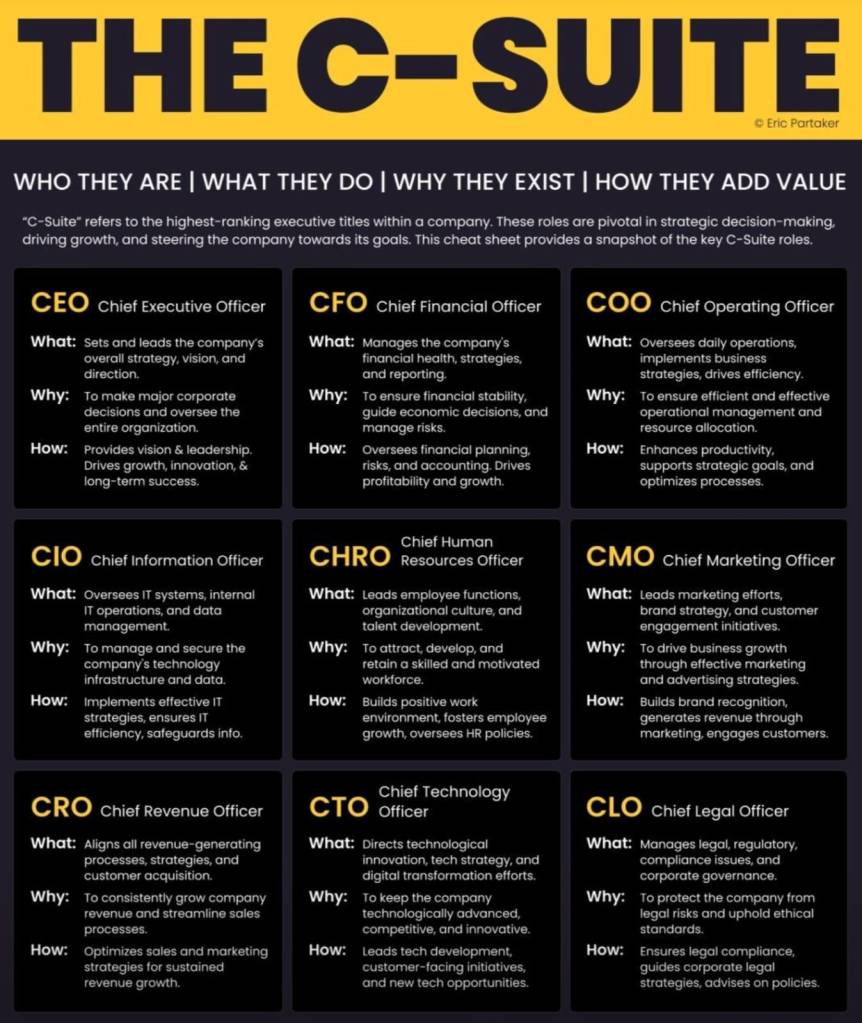
WHO they are, What the do, Why they exist, How they add value

In corporate leadership, the C-Suite stands as the command centre, where strategic decisions are made, and the future of the company is shaped. Comprising key executives with specialised roles, the C-Suite plays a crucial role in steering organisations towards success. In this blog post, we’ll delve into the world of the C-Suite, shedding light on the responsibilities and value each role brings to the table.

  1. CEO – Chief Executive Officer

The CEO, or Chief Executive Officer, is the captain of the ship, responsible for charting the company’s course and ensuring its overall success. The CEO sets the vision, mission, and strategy, providing leadership to the entire organisation. They are the ultimate decision-maker, accountable to the board of directors and stakeholders.

  1. CFO – Chief Financial Officer

The CFO, or Chief Financial Officer, is the financial maestro of the C-Suite. Tasked with overseeing the financial health of the organisation, the CFO manages budgets, financial planning, and investment strategies. They play a pivotal role in risk management, ensuring sustainable growth and profitability.

  1. COO – Chief Operating Officer

The COO, or Chief Operating Officer, is the executor of the CEO’s vision. Responsible for day-to-day operations, the COO ensures that the company’s processes and systems align with strategic goals. They focus on efficiency, productivity, and scalability, optimising internal functions for maximum performance.

  1. CIO – Chief Information Officer

In the digital age, the CIO, or Chief Information Officer, holds a critical role. Charged with managing the company’s technology infrastructure, the CIO ensures that information systems align with business objectives. They play a pivotal role in driving innovation and digital transformation.

  1. CHRO – Chief Human Resources Officer

The CHRO, or Chief Human Resources Officer, is the guardian of the company’s most valuable asset—its people. Responsible for talent acquisition, employee development, and creating a positive work culture, the CHRO plays a key role in shaping the organisation’s human capital strategy.

  1. CMO – Chief Marketing Officer

The CMO, or Chief Marketing Officer, is the storyteller-in-chief. Charged with building and promoting the company’s brand, the CMO develops marketing strategies to drive growth and customer engagement. They are instrumental in shaping the company’s public image and market positioning.

  1. CRO – Chief Revenue Officer

The CRO, or Chief Revenue Officer, is the architect of revenue streams. Focused on driving sales and revenue growth, the CRO collaborates with sales, marketing, and other departments to optimise customer acquisition and retention strategies.

  1. CTO – Chief Technology Officer

The CTO, or Chief Technology Officer, is the technology visionary. Tasked with leading technological innovation, the CTO develops and implements technology strategies that align with the company’s business goals. They often play a crucial role in product development and ensuring technological competitiveness.

  1. CLO – Chief Legal Officer

The CLO, or Chief Legal Officer, is the legal guardian of the organisation. Responsible for managing legal risks and ensuring compliance with laws and regulations, the CLO provides legal counsel to the executive team and oversees matters such as contracts, intellectual property, and litigation.

Summary – Cheat sheet

Conclusion

The C-Suite represents a powerhouse of expertise, each member contributing their unique skills to the overall success of the organisation. By understanding the roles and responsibilities of the CEO, CFO, COO, CIO, CHRO, CMO, CRO, CTO, and CLO, we gain insights into the intricate workings of corporate leadership. Together, these leaders form a cohesive unit, steering the ship through the complexities of the business world, adding significant value to the organisation and its stakeholders.

Top 10 Technology Trends Impacting Infrastructure & Operations for 2018

Does your IT strategy include infrastructure, operations (I&O) practices and data center architectures that are sufficient to meet the demands of the digital business. Digital transformation requires IT agility and velocity that outstrips classical architectures and practices.

David Cappuccio, from Gartner outlines the top 10 trends that will impact IT operations (I&O) in 2018. Each will have an impact on how IT operates, plans, enhances internal skill sets, and supports the business.


Guest Blog: Original Article @ Gartner

Outside forces will shape IT’s journey towards a digital infrastructure.

Legacy infrastructure and operations (I&O) practices and traditional data center architectures are not sufficient to meet the demands of the digital business. Digital transformation requires IT agility and velocity that outstrips classical architectures and practices.

In 2018, IT will be increasingly tasked with supporting complex, distributed applications using new technologies that are spread across systems in multiple locations, including on-premises data centers, the public cloud and hosting providers.

David Cappuccio, vice president and distinguished analyst at Gartner, says I&O leaders should focus on 10 key technologies and trends to support digital transformation.

“These are not necessarily the top 10 technologies, or the hottest trends in IT, but rather the 10 trends we feel will have an impact on I&O teams over the next few years,” says Cappuccio. “Some are happening already, some are just beginning, but each will have an impact on how IT operates, plans, enhances internal skill sets, and supports the business.”

Strategic

Trend 1: Geo Planning
Outside factors including the European Union’s General Data Protection Regulation (GDPR), geo specific workloads and global and regional network access are driving IT to spend more time on geo planning as part of their longer term strategies. The long term objective is not to own a global infrastructure, but to build the infrastructure needed to support the business via partners, as well as leveraging an organization’s partner’s infrastructure to help support initiatives such as multiple network connections and infrastructure design and support.

Trend 2: The Intelligent Edge
Many digital business projects create data that can be processed more efficiently when the computing power is close to the thing or person generating it. Edge computing solutions address this need for localized computing power. For example, in the context of the Internet of Things (IoT), the sources of data generation are usually things with sensors or embedded devices. The intelligent edge serves as the decentralized extension of the campus networks, cellular networks, data center networks or the cloud. Organizations that have embarked on a digital business journey have realized that a more decentralized approach is required to address digital business infrastructure requirements.

Trend 3: Intent-based Networking (IBNS)
Gartner predicts that by 2020, more than 1,000 large enterprises will use intent-based networking systems in production, up from less than 50 today. Intent-based networking (IBNS) is not a product, or a market. Instead, it is a piece of networking software that helps to plan, design and implement/operate networks that can improve network availability and agility, which becomes increasingly important as organizations transition towards digital business.

With IBNS, rather than explicitly defining to the network what needs to be done, the software translates the business intent to determine the “correctness” of the network configuration before deployment. The system then continuously compares the actual and desired state of the running network.

Say no to business as usual
Gartner IT Operations Strategies & Solutions Summit 2018

LEARN MORE

Tactical

Trend 4: APIs – Integration Economy
A digital business is supported by technology platforms in five areas: information systems; customer experience; data and analytics; IoT; and ecosystems. The ecosystems technology platform supports the creation of, and connection to, external ecosystems, marketplaces and communities. Application performance interface (API) management enables the digital platform to function.

Organizations should design APIs from the “outside in,” based on ecosystem requirements, not “inside out,” based on existing applications or technology infrastructure. “Ensure that your organization takes an ‘API first’ approach, designing APIs based on the requirements of your organization’s ecosystem,” says Cappuccio. “APIs designed in this way can be mapped to internal technology infrastructure. This approach is more effective than simply generating APIs based on existing infrastructure and data models.”

Trend 5: Reputation and Digital Experience
There are two interlinked trends impacting business today that have nothing to do with IT infrastructure, but everything to do with infrastructure design. Digital experience management (DEM) is the impact of presenting the right digital experience to customers. The experience could be mobile or web-based, and should be always available, continually improving and perform quickly and consistently. If any of these tenants are lacking, customer satisfaction is in peril. If customer satisfaction is in peril, especially in today’s social media savvy world, corporate reputation could quickly be damaged.

Trend 6: Beyond Traditional IT – New Realities
Business units are demanding agility, in opening new markets, taking on emerging competitors, bringing in new suppliers, and creating innovative ways of interacting with customers. Over 30% of current IT spend is not part of the IT budget, but overall responsibility for supporting these new initiatives, once they are tested and stabilized, will reside with traditional IT. Managing those new providers, managing workflows and managing new types of assets in this hybrid environment, regardless of where they are located, will become crucial to IT’s success.

Operational

Trend 7: DCaaS as a Strategy
In a perfect world, at least from the perspective of many business leaders, IT and the data center would be essentially a very agile provider of service outcomes, rather than the owner of the infrastructure. To do this organizations are creating a data center as a service (DCaaS) model, where the role of IT and the data center is to deliver the right service, at the right pace, from the right provider, at the right price.

“Making key short-term decisions can lead to a long-term strategy that incorporates the best of ‘as a service’ and the cloud without compromising IT’s overall goals to both protect and enable the business,” says Cappuccio. “In this manner, IT can enable the use of cloud services across the business, but with a focus on picking the right service, at the right time, from the right provider, and in such a way that underlying IT service and support does not get compromised.”

Trend 8: Cautious Cloud Adoption
For many enterprises the journey to the cloud is a slow, controlled process. Colocation and hosting providers have established private or shared clouds on their premises to provide customers some basic cloud services, enabling controlled migrations, staff skills training and a “safe” cloud environment as a stepping stone to increased cloud adoption in the future. As customers get comfortable with these services and costs, increased migrations to external providers are enabled via interconnect services. Using this partner ecosystem to enable an agile infrastructure is a rapidly emerging trend.

Trend 9: Capacity Optimization – Everywhere
Organizations need to focus on optimizing capacity and guard against stranded capacity – things that are paid for, but not really being used. This issue can be found both in existing on premise data centers and in the cloud. A change in culture is needed to fix this problem. Organizations must learn to focus not just on uptime and availability, but also on capacity, utilization and density. Doing so can extend the life of an existing data center and reduce operating expenditures from cloud providers.

Trend 10: Extended Infrastructure Management
The data center as the sole source of IT infrastructure has given way to a hybrid of on-premises, colocation, hosting, and public and private cloud solutions. These elements are being combined with a focus on providing business-enabling services and outcomes, rather than a focus on physical infrastructure. Enterprises must apply a future-looking, enterprise-wide “steady hand” to IT strategy and planning, and apply appropriate guardrails, or face the possibility of losing relevance, governance and enterprise agility.


Empowering Healthcare through Strategic Leadership: Systems Powering Healthcare Case Study (2015-2017)

Introduction:
In December 2015, Renier Botha assumed the role of Managing Director (CEO) & Head of Service (CIO) at Systems Powering Healthcare (SPHERE), an IT specialist organisation providing essential IT infrastructure and shared IT services to over 10,000 healthcare workers in the NHS. This case study delves into Botha’s transformative journey, focusing on his strategic vision, innovative solutions, and steadfast leadership that reshaped SPHERE into a thriving and client-focused enterprise.

Challenges and Objectives:
When Botha took charge, SPHERE faced the challenge of transitioning from a cost-plus model to a commercial-service-catalogue model while expanding its clientele. His primary objectives included stabilising the newly founded business, developing a strategic roadmap, and establishing a customer-centric approach to service delivery.

Strategic Initiatives and Achievements:

  1. Strategic Planning: Within the initial three months, Botha meticulously crafted a six-year strategic business plan for SPHERE. This plan outlined clear annual investment and service delivery milestones, providing a roadmap for the organisation’s growth and development.
  2. Operational Excellence: Botha directed a workforce of 75 employees, overseeing the execution of the strategic plan. Under his leadership, SPHERE transformed from a startup to an established medium-sized enterprise, achieving its third-year targets by the end of the second financial year.
  3. IT Infrastructure Transformation: Botha led a comprehensive IT estate refresh strategy, investing £42M in core capabilities like IP Networks, Service Hosting, End User Computing, and more. This initiative not only modernised SPHERE’s infrastructure but also ensured long-term sustainability and efficiency.
  4. Service Delivery Innovation: Botha introduced a customer-centric Target Operating Model (TOM) and implemented Service-Now as the supporting ERP toolset. This digital transformation not only increased business maturity but also resulted in a five-year £2.4m NPV saving and a remarkable ROI of 493%.
  5. Financial Growth: Through strategic M&A, business transformation, and the onboarding of new clients, SPHERE’s revenue grew by 42%. This growth not only secured significant ROI for shareholders but also saved the NHS approximately £3m per annum through a shared service solution.
  6. Operational Efficiency: Botha defined and achieved the “Cost per IT User” KPI, showcasing SPHERE’s value proposition. The strategic business plan led to an 11% reduction in the Cost per IT User in 2016 and a further 13% reduction in 2017, surpassing the target KPI by 12%.
  7. Commercial Success: Botha developed a compelling commercial Service Catalogue, instrumental in winning a £10m tender bid to become an IT Service Provider to Northumbria Healthcare NHS Foundation Trust.
  8. Cultural Transformation: Through a focus on commercial awareness, customer-centricity, and employee empowerment, Botha fostered a high-performing team. Staff retention rates increased from 82% in early 2016 to an impressive 98% by the end of 2017.

Conclusion:
Renier Botha’s strategic foresight, operational acumen, and emphasis on innovation and client satisfaction transformed Systems Powering Healthcare into a robust, client-focused organisation. His leadership not only steered SPHERE through critical transitions but also positioned it as a beacon of efficiency and excellence within the healthcare technology sector. This case study exemplifies the profound impact of visionary leadership on organisational growth and success.

The Digital Transformation Necessity

Listening to every keynote, panel discussion or reading articles relating to business sustainability through technology, one message is repeated over and over again – Digital Transformation is imperative for all businesses!

Although this message is coming through loudly, is it not always clear to business leaders and the workforce, exactly what digital transformation really is and what it means for their organisation.

In explaining digital transformation as the benefit and value that technology can enable within the business through technology innovation including IT buzz words like: Cloud, Automation, Dev-Ops, Artificial Intelligence (AI), Machine Learning, Internet of Things (IoT), Single Sign-On, Data Mining & Big Data, Bit Chain – does not really make the need for digital transformation any clearer.

One thing is clear though – we are living in a hyper-connected world where technology and more specifically, digital devices, are the glue linking together people and information in new ways we can hardly comprehend. In this statement, is the clue of what digital transformation entails…

What is digital transformation?

We can define digital transformation as the fundamental changes in the manner in which business and organisational operations are conducted, to adapt to the changes and to leverage the opportunities, caused by the use of digital devices and their accelerated impact on the way we live.

Digital devices, operate on digital signals running through electronic circuits to collect, store, manipulate, interpret and display information. These digital electronic integrated circuits (ICs) evolved since 1947, when the functional transistor was invented, into what we know today as computers. All digital devices are, at its core, a computer of some sorts used by humans to interact with information.

Transformation on the other hand implies a fundamental change in the way things used to be (converting something from one state to another) – it enables new creativity and innovation inspired by technology evolution, bringing change that introduces a new way, a different way to do things, rather than just enhancing or improving an old or current way.

To simplify it, you could say that digital transformation is the profound changes in the way business is conducted, to adapt to the changes in society caused by the continuous evolvement of computers.

A typical example of digital transformation is the “paperless office” – fundamentally changing the way we preserve information by storing it in digital format rather than writing it down on paper. This concept has profound implications in our commerce interaction expectations if you are comparing the speed in which information can be recalled and processed through digital means vs paper files, archives and libraries…

Who should lead the Digital Transformation?

Computers are hardly breaking news anymore as it is widely used within business where technology has become an integral enabling part of any organisation. Modern digital devices i.e. tablets, smart phones, the IoT, smart watches and other smart wearable devices, are changing the way we live and interact in commerce and hence the way we, as the consumer society, expect business to be conducted. Digital transformation is thus more about the change in business operations – processes and systems – than just the adoption of new technologies. Due to the importance of technology in organisations and the key role IT plays in the organisation’s ability to adapt to the society’s changing needs, it is the role of the CIO to lead the Digitial Transformation initiatives.

Digital Transformation matters because…

Any business change is costly and businesses might avoid change, for that very reason. Howard King of The Guardian, (Nov’13) puts it this way: “Businesses don’t transform by choice because it is expensive and risky. Businesses go through transformation when they have failed to evolve.” He continues in saying that evolving businesses never necessarily need to transform as they are continually focussed on their clients. This evolution ensures the key drivers of transformation namely: changing customer demand, changing technology and changing competition, never coincide in such a way that the business operating model can no longer service it’s customers. When it does, the business reaches a tipping point that requires transformation within the business, to adapt and re-align or tip over the edge.

The pace, at which digital devices have evolved, changed the way we interact with information and has become an intrinsic and material part of daily live. This has left organisations, which did not evolve with the technology, at a tipping point. For businesses approaching or reaching this tipping point it might be too late to evolve and hence Digital Transformation becomes a necessity for survival.

Emerging, disruptive technology driven, companies are changing industries leaving competitor companies with one choice – adapt, through digital transformation, or face the consequences of slowly loosing market share and eventually…

What does a typical Digital Transformation strategy involve?

As every organisation delivers their products and services (the value proposition to it’s clients and customers) in a different way, so will the digital transformation within one company differ from the other.

To define a transformation strategy and the associate change programme, one must look at the value chain of the organisation. Each element within the value chain can, and in most cases must, contribute to the scope:

  • Infrastructure
  • People – Leadership and the overall Workforce
  • Technology
  • Supply Chain
  • Procurement
  • Operations
  • Manufacturing (Engineering)
  • Fulfillment
  • Marketing
  • Sales
  • Service Delivery
  • Business Market (Client’s & Customers)

For each of the business value chain components, one must question the impact of the key transformation drivers:

  • Change in Customer Demand
  • Change in Technology
  • Change in Competition

Understanding these impacts will outline what needs to change, which generally comes down to:

  • Transform the Customer Experience
  • Transform the Operational Processes
  • Transform the Business Model

Note that IT is not singled out in the above – this is because IT is the catalyst that should overall enable these transformation initiatives.

The following examples of Digital Transformation Frameworks can also be helpful in defining the strategy:

Change brings uncertainty… Address it!

Transformation, by definition, brings change and a typical digital transformation programme will dramatically change the organisation. This change will especially affect a key business asset within the value chain – the people working within the business – “Success?.. People come First!”.

It will also dramatically effect, if not completely change, the organisation’s culture. Culture comes from the top – make sure that the board and executives are promoting the transformation and are willing to change themselves, as change is always desired until it is required of one-self.

Empower the workforce to understand the reasons why transformation is needed. Involve everyone to actively contribute to the innovative rethinking of their roles – how does digital technologies impact their daily work experience? Articulate the core business focus (what is the value proposition to the clients and customers) and ask, how can enabling digital technologies be used in support of achieving value excellence?

Find ways to make the necessity of the change a positive win for everyone, as supporting the people through the transformation is just as important as the digital technology you are trying to embrace.

To Conclude

Digital organisations outperform organisations doing digital – making Digital Transformation the last survival action for organisations that have not evolved with digital technology.

Transformation is a dramatic change and hence must the people aspect and business culture be treated with extreme care and sensitivity. A strong CIO is needed to drive the transformation programme with full buy-in from the rest of the executives and the whole workforce.

A well executed digital transformation strategy will re-align the business with the growing digital demands of it’s customers, by addressing the needed adoption of technology innovation across the business value chain resulting in an agile business ready for a fast evolving digital future.

Let’s Talk – Are you looking to achieve your goals faster? Create better business value? Build strategies to improve growth? We can help – make contact!

Leadership definition

What is Leadership? How do you define Leadership in a concise sentence?

According to Forbes a leader has got nothing to do with title, seniority or position within an organisation, personal attributes and management are definitely not leadership.

So what is leadership then?

Some thought leaders of our time define leadership as…

Peter Drucker: “The only definition of a leader is someone who has followers.”

Warren Bennis: “Leadership is the capacity to translate vision into reality.”

Bill Gates: “As we look ahead into the next century, leaders will be those who empower others.”

John Maxwell: “Leadership is influence – nothing more, nothing less.”

“Leadership is the art of leading others to deliberately create a result
that wouldn’t have happened otherwise.”

Forbes: “Leadership is a process of social influence, which maximizes the efforts of others, towards the achievement of a goal.”

Wikipedia: Leadership is “a process of social influence in which one person can enlist the aid and support of others in the accomplishment of a common task“.

My definition: “Leadership is the art of leading a group of people or an organization to execute a common task by providing a vision that they follow willingly through the inspiration received from the leader’s passion , knowledge, methodologies, approach and ability to influence the interests of all members and stakeholders.”

What CEOs are looking for in their CIO

During the CIO-Dialogue 6 held in Brighton in November 2012, I had the privilege to listen to Simon La Fosse presenting. Simon, CEO of La Fosse Associates, is a specialist technology executive search and head-hunter with 25 years experience in the recruitment market.

What does a CEO really want from his CIO?… Simon presented the head-hunters perspective followed by a lively discussion. This presentation had a profoundly positive impact on my confidence especially after pondering on the key aspects that was highlighted (listed below) and measuring yourself to identify areas of strength and where I can improve.

What I took away from the interaction…

The CEO is looking for a CIO that he can build a professional relationship with. Someone they can trust to help them through the disruption technology is continuously causing in business.

The CIO must not be too involved in the daily operations as they have to see the bigger picture and spot opportunities through interaction with peers and bring those to the CEO in clear, concise, precise and commercial terms. To be able to do this the CIO needs a fantastic leadership team in place. Smart people that know how to do their job (see ‘Success?… People Come First’) and bring valuable feedback and management information to the CIO in support of the business. A leadership team that will give the CIO the time to focus on the bigger picture. Measuring your management team with the same criteria is important as your team in essence are the channel that will get the job done.

Key aspects that are personality trades and skills

that the CIO must possess to satisfy the CEO’s requirements…

  1. Emotional Intelligence – Someone that understands and who can manage emotions. Emotions bridge thought, feeling and actions and affect many aspects of a person and hence teams. There are three aspects of the effect of emotions: Physical, Behavioural and Cognitive. How tuned in is your intuition to understand and manage emotions? Emotional intelligence is about two key principles: firstly it is about awareness, identifying and understanding emotions and secondly it is about using and managing emotions. Emotional intelligence is a key trade in the success of influence and motivation of people. How emotionally intelligent are you?
  2. Ambition – CIOs have to have a desire for achievement, success, honor and the willingness to strive for it’s attainment. Ambitions drives change for the better which is should be a constant in any CIOs strategy and objectives.
  3. Advocacy – Supporting the CIO in his business vision, mission and strategy and continuously recommending technology innovative ideas and plans in support of the his technology team to drive the success of the CIOs objectives.
  4. Influence – Gravitas within his personality to be a compelling force in the organisation that effects peoples actions, behaviour, opinions, decisions for the better good of the business.
  5. Assertiveness – Be confidently self assured and positive in his communication, strategy and decisions to build the confidence in others that the right things are going to happen. Someone that can stand his ground without being aggressive.
  6. Authenticity – You get hired for the person you are. Be truthful to yourself and others and do not wear a mask at work.
  7. Results – CEO are looking for results, getting the job done by not taking too high risk.
  8. Simplicity – Do your thinking before hand and present to the CEO in a compelling way. Exercise the art of taking a complex subject and present it in a simple compelling way that enable the CEO to make knowledgeable and quick decisions.
  9. Commerciality – Continuously keep an eye on the business commercials. Look for ways to improve the bottom line. How can you improve the revenue and reduce the cost? Question if the status quo are still relevant. Constantly drive improvements. Keep coming back with savings.
  10. Dissatisfaction – Always look for ways to improve without demoralising your team. Evaluate and embrace innovative ideas.
  11. Leadership – Leadership is the art of leading a group of people or an organization to execute a common task by providing a vision that they follow willingly through the inspiration received from the leader’s passion , knowledge, methodologies, and ability to influence the interests of all members and stakeholders. (see ‘Leadership by Definition‘) Do not just lead your technology team – lead from the top, also lead your piers – lead sideways. Be accountable and responsible.
  12. Values – The basis for ethical action and believes. Values defines your sense for right and wrong. Values influence attitudes and behaviours. Ethical personal and cultural values are very important. Understand the business ethics and the values of your CEO.
  13. Culture fit – Specifically referring to organisational culture which is the behaviour of the people working within the organisation. You must be getting on with people. Understand when the culture is changing and influence the change to the desired outcome.
  14. Sector Knowledge – Know your subject (technology) in relation to the business but more importantly know your organisation’s product, their market and the opposition.
  15. Supplier Relationships – Know the industry to bring options in supplier selection. Understand how the CEO wants this to be managed. Build meaningful and, more importantly, business valuable relationships. Aggressively manage the suppliers by always comparing and looking for the best value delivery – this is not always the cheapest option…
  16. International Experience – We live a multi-cultural society where a dynamic mixture of races, languages and culture are working together in a global environment. The CIO must be confident and at ease in his environment through cultural understanding, exposure and experience gained through international exposure.
  17. Agility – You must ensure that you and your organisation have the ability to rapidly respond to change without disrupting the stability to operations on a continuous basis.
  18. Trust – The CEO is relying on the CIO and visa versa. Trust involves two parties with a ‘trustee’ and a ‘trustor’ – The trustor is reliant on the actions of the trustee. In the CEO and CIO relationship the trust is mutual to each other. Trust is the believe that the other will do as expected to ensure a positive outcome of a situation with an unknown outcome in the future. Trust is so key that if you loose the trust of the CEO, move on.
  19. Accountability – According to Wiki is Accountability the acknowledgment and assumption of responsibility for actions, products, decisions, and policies including the administration, governance, and implementation within the scope of the role or employment position and encompassing the obligation to report, explain and be answerable for resulting consequences. The CEO has to know that the CIO will take accountability for the actions of his devision. CIOs have to take accountability with comments like: “leave this to us/ IT”, “it is our issue, we’ll sort it out”.
  20. Complexity – Technology is complex but the CEO relies on the CIO to keep things simple. The CEO has lots on his mind and relies on the CIO to be short, precise and to the point explaining a complex situation or proposition in simple terms.
  21. Surprise – Most CEO will agree with this, they just do not like surprises! Keep them informed so no situation or communication turns into a surprise.

A view additional trades and skills – from my perspective…

  1. Visionary – Have the ability to read the current trends and envision the future. Have a clear and specific view of the future incorporating the advances in technology and social or political arrangements. Bring those views to the CIO to incorporate in his vision for the business.
  2. Motivator – The ability to get the best out of people through your ability to understand, manage and work with people. This links in closely with Leadership and Emotional Intelligence. You must be able to motivate and keep your teams motivated to ensure optimum productivity and delivery to expectations.
  3. Coach & Mentor – Build a relationship with your staff and piers to help encourages the lending of assistance, guidance and help. Nurture relationships of learning, open dialogue and challenge to drive towards greater knowledge, experience that ultimately leads to increased wisdom which in turn achieve the goals of the business.
  4. Catalyst for Innovation – Encourage and reward the continuous renewing, changing and creating of move effective products, operational processes and business models to adapt to a changing environment. This links in with agility mentioned above.
  5. Integrator – Be the person that ensures the forming components of an organisation, for example the different departments, sub systems, infrastructure, governance groups and teams, etc. sufficiently integrate with each other forming a single unit driving towards the same business objectives. Technology can and should provide the glue between the different components. To accomplish this, a very good understanding of the bigger picture of the organisation is needed. Innovation with different parts of the business will not deliver it full value without effective integration into the revenue streams of the business.

What other trades and skills do you feel is key for a CIO to fulfil the expectations of the CEO?

Let’s Talk – Are you looking to achieve your goals faster? Create better business value? Build strategies to improve growth? We can help – make contact!

Revolutionizing Healthcare Technology Management: Systems Powering Healthcare Case Study

Introduction:
Systems Powering Healthcare, a leading healthcare technology solutions provider, faced a critical challenge in optimizing their service delivery. Renier Botha, the Managing Director, and Head of Service recognised the need for innovation and efficiency to meet the evolving demands of the healthcare industry. This case study explores how Botha’s strategic vision and decisive actions transformed Systems Powering Healthcare into a trailblazer in healthcare technology share service management solutions.

Background:
Systems Powering Healthcare specialised in providing cutting-edge technology solutions to healthcare providers, aiming to streamline operations and enhance patient care. Despite their reputation, the company grappled with inefficiencies in service delivery, leading to customer dissatisfaction and internal frustrations.

Challenges Faced:

  1. Inefficient Service Delivery: Systems Powering Healthcare struggled with delays in product deployments and customer support, impacting client satisfaction.
  2. Outdated Systems: Legacy software hindered the company’s ability to adapt to emerging technologies and market demands.
  3. Competitive Pressure: Rising competition in the healthcare technology sector necessitated innovative solutions to maintain market leadership.

Renier Botha’s Strategy:
Renier Botha, recognizing the urgency of change, devised a multifaceted strategy to address these challenges.

  1. Investment in R&D: Botha spearheaded a robust Research and Development initiative, focusing on developing state-of-the-art healthcare management software tailored to the unique needs of clients.
  2. Process Optimization: He implemented lean methodologies, optimizing internal processes to reduce operational bottlenecks and enhance efficiency.
  3. Talent Development: Botha championed training programs and talent acquisition, ensuring the team was equipped with the latest skills and knowledge.
  4. Client-Centric Approach: Systems Powering Healthcare adopted a client-centric approach, actively engaging with customers to understand their needs and concerns, shaping product development accordingly.
  5. Technological Upgrade: Outdated systems were replaced with cutting-edge technology, enabling the company to offer scalable and adaptable solutions.

Results:
Renier Botha’s strategic initiatives led to significant improvements at Systems Powering Healthcare:

  1. Enhanced Service Delivery: Streamlined processes and innovative solutions reduced deployment times by 40%, delighting clients and improving customer satisfaction.
  2. Market Leadership: Systems Powering Healthcare regained its competitive edge, securing new contracts and partnerships, expanding its market share.
  3. Innovation Recognition: The company gained recognition for its innovative products, earning accolades and awards in the healthcare technology sector.
  4. Revenue Growth: Efficient operations and increased client satisfaction translated into a 30% growth in revenue within the first year of implementing Botha’s strategies.
  5. Employee Morale: Talent development and a focus on employee well-being improved morale, fostering a positive work environment and increasing productivity.

Conclusion:
Renier Botha’s visionary leadership and strategic acumen revitalized Systems Powering Healthcare, transforming it into a market leader in healthcare technology solutions. His emphasis on innovation, efficiency, and customer satisfaction not only resolved the company’s challenges but also positioned it for sustained success in the dynamic healthcare industry. This case study stands as a testament to the transformative power of strategic leadership in overcoming challenges and achieving organizational excellence.

Managing Outsourced Relationships – an in-source approach

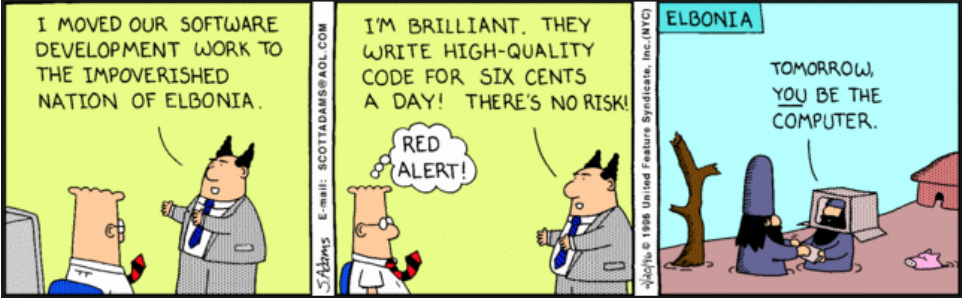
IT outsourcing is big business and a provide real business value, financial savings and resource flexibility.

But is cheaper really better?

Dilbert Outsourcing

You cannot outsource a mess! Get your own house in order first before engage in a outsourcing partnership and managing IT vendors.

You should not outsource your core business proposition! Determine what your business is about and excel in the delivery of that – everything that is not core can be candidates for outsourcing.

Renier Botha spoke at the CIO Dialogue in Brighton about the value and risk associated with IT outsourcing. He introduced an insource Service Orientated (SOA) approach to outsourcing to mitigate the risks and ensure the appropriate governance delivering the right quality and customer service are achieved.

Slide Presentation pdf: Managing Outsourced Relationships

Slide Share via LinkedIn: Managing Outsourced Relationships

Renier’s Biog for the Conference:

CIO-Dialogue8 Biog


For High Performing Teams, CIOs must Lead by Character

Guest Blog: Doug Moran via Heller Search Associates

As CIO, you can lead with character, by knowing what are your values and what you believe.

Character is the attribute we ascribe to people whose lives and actions reflect their beliefs and values.  Strong character requires emotional maturity and self-confidence.  But leading with character goes beyond simply havingcharacter.  Our ability to lead is in large part based on our ability to trust ourselves and  instill trust in others.  Those we lead want and need to trust us.  And to trust us, they must know us.  That means allowing them to get close.  It means sharing and exposing our beliefs and values.

Leading with character can be uncomfortable.  We are in essence giving others insight into who we truly are.  Leading with character also means exposing ourselves to criticism and doubt, especially when our actions diverge (or appear to diverge) from our stated values.

The Part Character Plays in the CIO Role

Character has special importance for CIOs and other IT leaders.  This has nothing to do with moral superiority.  It is simply a function of the unique perspective our roles provide.  Because technology is a critical enabler connecting and touching every part of the enterprise, we have the ability to see how the groups or functions interact and interrelate.  We can see what works well and where challenges exist.  We can see the unintended consequences of actions and the knock-on value that no one anticipated.

“Strong character forms a strong leadership foundation.  It gives us the confidence to do what is right regardless of the doubts and complaints of others..”


Connecting Character to Great Leadership

Our unique perspective is an invaluable resource.  Unfortunately, we often fail to exploit it fully.  The problem is that most of us fail to see how important our character is.  We fail to see the connection between our beliefs and values and the service we provide.  Great leaders, however, see the connection.  They recognize that their character enables them to guide and propel their organizations into the future.

Although I’ve spent nearly 20 years working in IT, my greatest challenges have rarely been technical.  My biggest obstacles to overcome have been organizational complexities or dysfunctions.   These challenges provide CIOs many opportunities to develop their ability to lead with character.

CIOs play a key role in the softer side of business.  We are key contributors to things like defining and promoting corporate culture and organizational identity.   The character of an organization is often a reflection of its leaders’ beliefs and values.  As we provide solutions that cut across the enterprise and connect different parts of the organization together, we can often see things as they really are.  We observe the behaviors that reinforce or undermine the organization’s values.  For example, an organization may place a premium on collaboration and honesty.  Do our business partners look for ways to share resources or collaborate when they acquire new capabilities?  Does our reward and compensation system promote or discourage this type of behavior?  Our perspective enables us to see the interactions that either reflect a particular value or run counter to that value.

Why Character Matters in IT Leadership

It is easy to see the role character plays in the softer side of business.  What about the more objective functions?  How does character contribute to things like strategic planning, R&D, technology innovation, project prioritization, capacity planning, vendor/product selection, and the myriad other tasks for which we are accountable?  Character matters for these things, because our values determine what and how things are done.  For example, we all strive for objectivity and intellectual rigor in our decision-making processes.  Look at how business cases are evaluated and priorities are set.  How often do sponsors “game” the system to get their project done?  Does the CEO’s pet project that has questionable value make the cut because no one is willing to ask the hard questions?  How can you influence those processes to ensure that they remain objective and analytically sound?

Ultimately, we can use our position and visibility to understand and change fundamentally how our organizations operate and behave.  We can encourage positive behavior while identifying and correcting problems.  The challenge for us is to overcome our trepidation about the personal (and often polarizing) aspects of character.  It is important to find balance in how we express our values and beliefs.  At one extreme, we can come across as self-righteous.  At the other, we seem irresolute.

Strong character comes from knowing oneself.  Self-knowledge gives us the confidence to trust ourselves.  The more we demonstrate the strength of our character – by ensuring that our words and deeds are consistent with our beliefs and values – the stronger that trust grows.  Strong character forms a strong leadership foundation.  It gives us the confidence to do what is right regardless of the doubts and complaints of others.

How do we build and demonstrate a strong character?  Here are five steps that one can take to begin the process.

  1. Decide that character matters.  The simple act of making character important will raise your awareness of whether your actions are harmonious with your beliefs.
  2. Take time to inventory and examine your beliefs and values.  Your beliefs and values are your character’s foundation.  The process of fully understanding them is unending, so get started now!  While you are at it, take a look at your organization’s beliefs and values.  Examine the character of other leaders around you. Are your beliefs and values aligned?
  3. Share your beliefs and values.  Leading with character means being open and explicit about what truly matters.  This means talking about your personal beliefs, your organization’s beliefs and what they mean to you.
  4. Test your actions and decisions. Critical self-examination will help us maintain alignment between our actions and our beliefs and values.
  5. Have the character to act on your self-examination.  It takes character to stay the course when all doubt you.  It also takes character to change your position, especially one that you hold dear.  Leadership demands that we be able to do both as the situation dictates.

Character builds our self-confidence and trust.  It allows us to trust ourselves and others.  Being a leader often means taking unpopular positions.  It means making difficult decisions.  Our positions and decisions may cause others to doubt us.  At times, we may even share their doubt.  When our actions are based on who we are and what we believe, we will have the strength of character to endure these doubts.  Success in the face of doubt depends on our ability to remain true to our principles and beliefs.  Failures will occur, and we will make mistakes.  Character is not about perfection.  It is about striving to seek the wisdom to know what is right and having the conviction to do it regardless of the opinion of others.