
Strengthening Cybersecurity in an Era of Increasing Threats

Day 2 of Renier Botha’s 10-Day Blog Series on Navigating the Future: The Evolving Role of the CTO

Daily the frequency and sophistication of cyber-attacks are rising at an alarming rate. As businesses become increasingly reliant on digital technologies, the need for robust cybersecurity measures has never been more critical. For Chief Technology Officers (CTOs), safeguarding sensitive data and maintaining trust is a top priority. This blog post explores the latest strategies to strengthen cybersecurity and provides insights from industry leaders along with real-world examples.

The Growing Cybersecurity Threat

Cyber-attacks are evolving rapidly, targeting organizations of all sizes and across various sectors. The cost of cybercrime is expected to reach $10.5 trillion annually by 2025, according to a report by Cybersecurity Ventures. As Satya Nadella, CEO of Microsoft, remarked, “Cybersecurity is the central challenge of the digital age.”

Key Cybersecurity Challenges

  • Advanced Persistent Threats (APTs): These prolonged and targeted cyber-attacks aim to steal data or sabotage systems. APTs are challenging to detect and mitigate due to their sophisticated nature.
  • Ransomware: This malicious software encrypts a victim’s data, demanding a ransom for its release. High-profile ransomware attacks, like the one on Colonial Pipeline, have highlighted the devastating impact of such threats.
  • Phishing and Social Engineering: Cybercriminals use deceptive tactics to trick individuals into divulging sensitive information. Phishing attacks have become more sophisticated, making them harder to identify.

Strategies for Strengthening Cybersecurity

To combat these threats, CTOs must implement comprehensive and proactive cybersecurity strategies. Here are some of the latest approaches:

1. Zero Trust Architecture

Zero Trust is a security model that assumes that threats can come from both outside and inside the network. It operates on the principle of “never trust, always verify.” Every request for access is authenticated, authorized, and encrypted before being granted.

“Zero Trust is the future of security,” says John Kindervag, the creator of the Zero Trust model. Implementing Zero Trust requires segmenting the network, enforcing strict access controls, and continuously monitoring for anomalies.

2. Multi-Factor Authentication (MFA)

MFA adds an extra layer of security by requiring users to provide multiple forms of verification before accessing systems. This significantly reduces the risk of unauthorized access, even if login credentials are compromised.

For example, Google reported a 99.9% reduction in automated phishing attacks when MFA was implemented. MFA should be used alongside strong password policies and regular user training.

3. Advanced Threat Detection and Response

Leveraging AI and machine learning for threat detection can help identify and respond to cyber threats more quickly and accurately. These technologies analyze vast amounts of data to detect patterns and anomalies that may indicate a cyber-attack.

IBM’s Watson for Cyber Security uses AI to analyze and respond to threats in real-time. By correlating data from various sources, it can identify and mitigate threats faster than traditional methods.

4. Endpoint Protection

With the rise of remote work, securing endpoints (laptops, smartphones, tablets) has become crucial. Endpoint protection platforms (EPP) and endpoint detection and response (EDR) solutions help secure devices against malware, ransomware, and other threats.

CrowdStrike’s Falcon platform, for instance, provides real-time endpoint protection, detecting and preventing breaches before they cause damage.

5. Employee Training and Awareness

Human error remains one of the weakest links in cybersecurity. Regular training and awareness programs can help employees recognize and respond to potential threats.

Kevin Mitnick, a renowned cybersecurity expert, states, “Companies spend millions of dollars on firewalls, encryption, and secure access devices, and it’s money wasted because none of these measures address the weakest link in the security chain: the people who use, administer, and operate computer systems.”

6. Regular Security Audits and Penetration Testing

Conducting regular security audits and penetration testing helps identify vulnerabilities before cybercriminals can exploit them. This proactive approach ensures that security measures are up to date and effective.

7. Executive Ownership and Board-Level Focus

To ensure cybersecurity is prioritized, executive ownership and adding security as a board agenda point are crucial. This top-down approach emphasizes the importance of cybersecurity across the entire organization.

“Cybersecurity must be a priority at the highest levels of an organization. Leadership commitment is key to creating a culture of security,” says Mary Barra, CEO of General Motors.

Actionable Advice for CTOs:

  • Assign Executive Ownership: Designate a C-suite executive responsible for cybersecurity to ensure accountability and focus.
  • Board Involvement: Regularly update the board on cybersecurity risks, strategies, and progress. Incorporate cybersecurity as a standing agenda item in board meetings.
  • Develop a Cybersecurity Framework: Create a comprehensive cybersecurity framework that aligns with business objectives and regulatory requirements.
  • Encourage Cross-Department Collaboration: Ensure that cybersecurity is integrated across all departments, promoting a unified approach to risk management.

By implementing these strategies, organizations can build a robust cybersecurity posture that not only protects their assets but also fosters trust and confidence among stakeholders.

The cybersecurity firm, FireEye, emphasizes the importance of penetration testing: “Penetration testing should be part of any mature cybersecurity program. It provides an opportunity to identify and fix security weaknesses before they can be exploited.”

Real-World Examples

Example 1: Maersk

In 2017, Maersk, a global shipping giant, was hit by the NotPetya ransomware attack, causing over $300 million in damages. The attack disrupted operations across 76 ports worldwide. Maersk responded by rebuilding its entire IT infrastructure, emphasizing the importance of robust backup and disaster recovery plans.

Example 2: Equifax

The 2017 Equifax data breach exposed the personal information of 147 million people. The breach was attributed to unpatched vulnerabilities in their web application. In response, Equifax implemented comprehensive security measures, including a bug bounty program and enhanced patch management processes.

Example 3: Target

In 2013, Target suffered a data breach that compromised 40 million credit and debit card accounts. The breach was traced to network credentials stolen from a third-party vendor. Target has since invested heavily in cybersecurity, adopting advanced threat detection systems and implementing stricter access controls for vendors.

Conclusion

Strengthening cybersecurity in an era of increasing threats requires a multifaceted approach. By adopting strategies such as Zero Trust Architecture, Multi-Factor Authentication, advanced threat detection, and comprehensive employee training, CTOs can protect their organizations from evolving cyber threats.

As Brad Smith, President of Microsoft, aptly puts it, “Cybersecurity is an urgent challenge for everyone. We need to come together to address this and ensure that we create a safer digital world for all.”

Read more blog posts on Cyber and information Security here : https://renierbotha.com/tag/security/

Stay tuned as we continue to explore these critical topics in our 10-day blog series, “Navigating the Future: A 10-Day Blog Series on the Evolving Role of the CTO” by Renier Botha.

Visit www.renierbotha.com for more insights and expert advice.

Harnessing the Power of Artificial Intelligence and Machine Learning

Day 1 of Renier Botha’s 10-Day Blog Series on Navigating the Future: The Evolving Role of the CTO

Artificial Intelligence (AI) and Machine Learning (ML) have swiftly transitioned from futuristic concepts to fundamental components of modern business strategy. These technologies are revolutionizing industries by enhancing business processes and significantly improving customer experiences. For Chief Technology Officers (CTOs), understanding and leveraging AI and ML is essential to gaining a competitive edge in today’s fast-paced market.

The Transformative Power of AI and ML

AI and ML are not just buzzwords, they are transformative technologies that are reshaping industries. According to Sundar Pichai, CEO of Alphabet Inc., “AI is probably the most important thing humanity has ever worked on. I think of it as something more profound than electricity or fire.”

Enhancing Business Processes

AI and ML enhance business processes by automating repetitive tasks, improving decision-making, and enabling predictive analytics. For example, in manufacturing, AI-powered predictive maintenance systems can anticipate equipment failures before they occur, reducing downtime and saving costs. General Electric (GE) has implemented AI-driven predictive maintenance in its industrial operations, resulting in a 20% reduction in maintenance costs.

In the finance sector, AI algorithms analyze vast amounts of data to detect fraudulent activities in real-time. JPMorgan Chase’s COiN platform uses ML to review legal documents and extract critical data points, a task that previously took thousands of hours of manual review. This automation has drastically increased efficiency and accuracy.

Improving Customer Experiences

AI and ML also play a crucial role in enhancing customer experiences. Personalization is a prime example. Companies like Amazon and Netflix use ML algorithms to analyze user behavior and preferences, providing personalized recommendations that enhance customer satisfaction and loyalty. Reed Hastings, CEO of Netflix, stated, “Machine learning is the foundation for creating a personalized experience on a global scale.”

Chatbots and virtual assistants, powered by AI, offer another way to improve customer service. These tools provide instant responses to customer inquiries, handle routine tasks, and escalate complex issues to human agents. For instance, Bank of America’s virtual assistant, Erica, helps customers with banking transactions and financial advice, improving overall customer engagement and satisfaction.

Strategies for CTOs to Leverage AI and ML

To harness the power of AI and ML effectively, CTOs need to implement strategic approaches that align with their organization’s goals.

1. Building a Data-Driven Culture

AI and ML thrive on data. CTOs must foster a data-driven culture where data is seen as a valuable asset. This involves investing in data management, data cloud platforms and associated profesional data management and analytics tools, ensuring data quality, and promoting data literacy across the organization. As DJ Patil, former U.S. Chief Data Scientist, said, “Data science is a team sport.”

2. Investing in Talent and Training

The success of AI and ML initiatives depends on skilled talent. CTOs should invest in hiring and training data scientists, AI specialists, and ML engineers. Continuous learning and development programs help keep the team updated with the latest advancements in the field.

3. Collaborating with Experts

Collaborating with AI and ML experts, whether through partnerships with tech companies, research institutions, or hiring consultants, can provide valuable insights and accelerate AI adoption. For example, Airbus partnered with Palantir Technologies to develop Skywise, a data platform that improves aircraft maintenance and operations.

4. Implementing Scalable Infrastructure

AI and ML require significant computational power. CTOs should ensure their infrastructure can scale to meet the demands of AI workloads. Cloud-based solutions like AWS, Google Cloud, and Microsoft Azure offer scalable and cost-effective platforms for AI and ML applications.

5. Focusing on Ethical AI

As AI becomes more integrated into business processes, ethical considerations become paramount. CTOs must ensure that their AI systems are transparent, fair, and accountable. Addressing biases in AI algorithms and safeguarding data privacy are critical steps in building trust with customers and stakeholders.

Real-World Examples

Healthcare

In healthcare, AI and ML are driving innovations in diagnostics and treatment. IBM’s Watson Health uses AI to analyze medical data and provide insights for cancer treatment, helping doctors make more informed decisions. The technology has shown promise in identifying patterns that human doctors might miss, potentially leading to earlier and more accurate diagnoses.

Retail

Retailers are using AI to optimize inventory management and enhance the shopping experience. Zara, the global fashion retailer, employs AI to predict fashion trends and manage stock levels, ensuring that popular items are always available while minimizing overstock. This approach has improved operational efficiency and customer satisfaction.

Transportation

In transportation, AI-powered systems are enhancing safety and efficiency. Tesla’s Autopilot uses ML to improve its self-driving capabilities, learning from millions of miles driven by Tesla vehicles. This continuous learning loop enhances the system’s ability to navigate complex driving environments and improve overall safety.

Conclusion

AI and ML are no longer optional for businesses aiming to stay competitiv -they are essential. By harnessing these technologies, CTOs can transform business processes, enhance customer experiences, and drive innovation. As Satya Nadella, CEO of Microsoft, aptly puts it, “AI is the defining technology of our time.”

For CTOs, the journey of integrating AI and ML into their organizations is both challenging and rewarding. By building a data-driven culture, investing in talent, collaborating with experts, implementing scalable infrastructure, and focusing on ethical AI, they can unlock the full potential of these transformative technologies and lead their organizations into the future.

Read more blog post on AI here : https://renierbotha.com/tag/ai/

Stay tuned as we delve deeper into these topics and more in our 10-day blog series, “Navigating the Future: A 10-Day Blog Series on the Evolving Role of the CTO” by Renier Botha.

Visit www.renierbotha.com for more insights and expert advice.

Beyond Welcomes Renier Botha as Group Chief Technology Officer to Drive Innovation and Transformative Solutions in Data Analytics

We’re delighted to announce that we welcome Renier Botha MBCS CITP MIoD to the group as #cto.

His strategic vision and leadership will enhance our technological capabilities, fostering #innovation and enabling us to further push the boundaries of what is possible in the world of #dataanalytics. His track record of delivering #transformative technological solutions will be instrumental in driving our mission to help clients maximise the value of their #data assets.

Renier has over 30 years of experience, mostly recently as a management consultant working with organisations to optimise their technology. Prior to this he was CTO at a number of businesses including Collinson Technology Service and Customer First Solutions (CFS). He is renowned for his ability to lead cross-functional teams, shape technology strategy, and execute on bold initiatives. 

On his appointment, Renier said: “I am delighted to join Beyond and be part of a group that is known for its innovation. Over the course of my career, I have been committed to driving the technological agenda and I look forward to working with likeminded people in order to further unlock the power of data.”

Paul Alexander adds :” Renier’s extensive experience in technology, marketing and data analytics aligns perfectly with our business. His technological leadership will be pivotal in developing groundbreaking solutions that our clients need to thrive in today’s data-driven, technologically charged world.”

Decoding the CEO’s Wishlist: What CEOs Seek in Their CTOs

The key difference between a Chief Information Officer (CIO) and a Chief Technology Officer (CTO) lies in their strategic focus and responsibilities within an organisation. A CIO primarily oversees the management and strategic use of information and data, ensuring that IT systems align with business objectives, enhancing operational efficiency, managing risk, and ensuring data security and compliance. On the other hand, a CTO concentrates on technology innovation and product development, exploring emerging technologies, driving technical vision, leading prototyping efforts, and collaborating externally to enhance the organisation’s products or services. While both roles are essential, CIOs are primarily concerned with internal IT operations, while CTOs focus on technological advancement, product innovation, and external partnerships to maintain the organisation’s competitive edge.

In 2017, I’ve written a post “What CEOs are looking for in their CIO” after an inspirational presentation by Simon La Fosse, CEO of Le Fosse Associates, a specialist technology executive search and head-hunter with more than 30 years experience in the recruitment market. The blog post was really well received on LinkedIn resulting in an influencer badge. In this post I am focussing on the role of the CTO (Chief Technology Officer).

In this digital age and ever-evolving landscape of the corporate world, the role of CTO stands as a linchpin for innovation, efficiency, and strategic progress. As businesses traverse the digital frontier, the significance of a visionary and adept CTO cannot be overstated. Delving deeper into the psyche of CEOs, let’s explore, in extensive detail, the intricate tapestry of qualities, skills, and expertise they ardently seek in their technology leaders.

1. Visionary Leadership:

CEOs yearn for CTOs with the acumen to envision not just the immediate technological needs but also the future landscapes. A visionary CTO aligns intricate technological strategies with the overarching business vision, ensuring that every innovation, every line of code, propels the company towards a future brimming with possibilities.

2. Innovation and Creativity:

Innovation is not just a buzzword; it’s the lifeblood of any progressive company. CEOs pine for CTOs who can infuse innovation into the organisational DNA. Creative thinking coupled with technical know-how enables CTOs to anticipate industry shifts, explore cutting-edge technologies, and craft ingenious solutions that leapfrog competitors.

3. Strategic Thinking and Long-Term Planning:

Strategic thinking is the cornerstone of successful CTOs. CEOs crave technology leaders who possess the sagacity to foresee the long-term ramifications of their decisions. A forward-looking CTO formulates and executes comprehensive technology plans, meticulously aligned with the company’s growth and scalability objectives.

4. Profound Technical Proficiency:

The bedrock of a CTO’s role is their technical prowess. CEOs actively seek CTOs who possess not just a surface-level understanding but a profound mastery of diverse technologies. From software development methodologies to data analytics, cybersecurity to artificial intelligence, a comprehensive technical acumen is non-negotiable.

5. Inspirational Team Leadership and Collaboration:

Building and leading high-performance tech teams is an art. CEOs admire CTOs who inspire their teams to transcend boundaries, fostering a culture of collaboration, innovation, and mutual respect. Effective mentoring and leadership ensure that the collective genius of the team can be harnessed for groundbreaking achievements.

6. Exceptional Communication Skills:

CTOs are conduits between the intricate realm of technology and the broader organisational spectrum. CEOs value CTOs who possess exceptional communication skills, capable of articulating complex technical concepts in a manner comprehensible to both technical and non-technical stakeholders. Clear communication streamlines decision-making processes, ensuring alignment with broader corporate goals.

7. Problem-Solving Aptitude and Resilience:

In the face of adversity, CEOs rely on their CTOs to be nimble problem solvers. Whether it’s tackling technical challenges, optimising intricate processes, or mitigating risks, CTOs must exhibit not just resilience but creative problem-solving skills. The ability to navigate through complexities unearths opportunities in seemingly insurmountable situations.

8. Profound Business Acumen:

Understanding the business implications of technological decisions is paramount. CEOs appreciate CTOs who grasp the financial nuances of their choices. A judicious balance between innovation and fiscal responsibility ensures that technological advancements are not just visionary but also pragmatic, translating into tangible business growth.

9. Adaptive Learning and Technological Agility:

The pace of technological evolution is breathtaking. CEOs seek CTOs who are not just adaptive but proactive in their approach to learning. CTOs who stay ahead of the curve, continuously updating their knowledge, can position their companies as trailblazers in the ever-changing technological landscape.

10. Ethical Leadership and Social Responsibility:

In an era marked by digital ethics awareness, CEOs emphasise the importance of ethical leadership in technology. CTOs must uphold the highest ethical standards, ensuring data privacy, security, and the responsible use of technology. Social responsibility, in the form of sustainable practices and community engagement, adds an extra layer of appeal.

In conclusion, the modern CTO is not merely a technical expert; they are strategic partners who contribute significantly to the overall success of the organisation. By embodying these qualities, CTOs can not only meet but exceed the expectations of CEOs, driving their companies to new heights in the digital age.

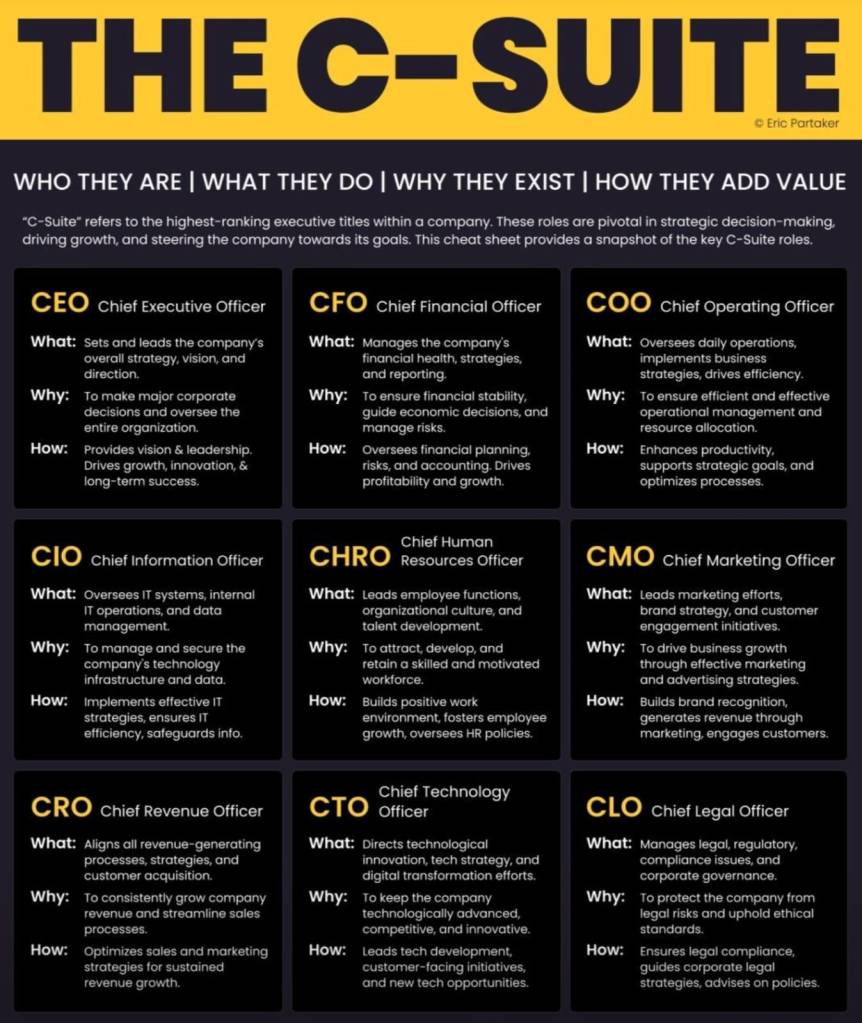
The C-Suite

WHO they are, What the do, Why they exist, How they add value

In corporate leadership, the C-Suite stands as the command centre, where strategic decisions are made, and the future of the company is shaped. Comprising key executives with specialised roles, the C-Suite plays a crucial role in steering organisations towards success. In this blog post, we’ll delve into the world of the C-Suite, shedding light on the responsibilities and value each role brings to the table.

  1. CEO – Chief Executive Officer

The CEO, or Chief Executive Officer, is the captain of the ship, responsible for charting the company’s course and ensuring its overall success. The CEO sets the vision, mission, and strategy, providing leadership to the entire organisation. They are the ultimate decision-maker, accountable to the board of directors and stakeholders.

  1. CFO – Chief Financial Officer

The CFO, or Chief Financial Officer, is the financial maestro of the C-Suite. Tasked with overseeing the financial health of the organisation, the CFO manages budgets, financial planning, and investment strategies. They play a pivotal role in risk management, ensuring sustainable growth and profitability.

  1. COO – Chief Operating Officer

The COO, or Chief Operating Officer, is the executor of the CEO’s vision. Responsible for day-to-day operations, the COO ensures that the company’s processes and systems align with strategic goals. They focus on efficiency, productivity, and scalability, optimising internal functions for maximum performance.

  1. CIO – Chief Information Officer

In the digital age, the CIO, or Chief Information Officer, holds a critical role. Charged with managing the company’s technology infrastructure, the CIO ensures that information systems align with business objectives. They play a pivotal role in driving innovation and digital transformation.

  1. CHRO – Chief Human Resources Officer

The CHRO, or Chief Human Resources Officer, is the guardian of the company’s most valuable asset—its people. Responsible for talent acquisition, employee development, and creating a positive work culture, the CHRO plays a key role in shaping the organisation’s human capital strategy.

  1. CMO – Chief Marketing Officer

The CMO, or Chief Marketing Officer, is the storyteller-in-chief. Charged with building and promoting the company’s brand, the CMO develops marketing strategies to drive growth and customer engagement. They are instrumental in shaping the company’s public image and market positioning.

  1. CRO – Chief Revenue Officer

The CRO, or Chief Revenue Officer, is the architect of revenue streams. Focused on driving sales and revenue growth, the CRO collaborates with sales, marketing, and other departments to optimise customer acquisition and retention strategies.

  1. CTO – Chief Technology Officer

The CTO, or Chief Technology Officer, is the technology visionary. Tasked with leading technological innovation, the CTO develops and implements technology strategies that align with the company’s business goals. They often play a crucial role in product development and ensuring technological competitiveness.

  1. CLO – Chief Legal Officer

The CLO, or Chief Legal Officer, is the legal guardian of the organisation. Responsible for managing legal risks and ensuring compliance with laws and regulations, the CLO provides legal counsel to the executive team and oversees matters such as contracts, intellectual property, and litigation.

Summary – Cheat sheet

Conclusion

The C-Suite represents a powerhouse of expertise, each member contributing their unique skills to the overall success of the organisation. By understanding the roles and responsibilities of the CEO, CFO, COO, CIO, CHRO, CMO, CRO, CTO, and CLO, we gain insights into the intricate workings of corporate leadership. Together, these leaders form a cohesive unit, steering the ship through the complexities of the business world, adding significant value to the organisation and its stakeholders.