
The Epiphany Moment of Euphoria in a Data Estate Development Project

In our technology-driven world, engineers pave the path forward, and there are moments of clarity and triumph that stand comparable to humanity’s greatest achievements. Learning at a young age from these achievements shape our way of thinking and can be a source of inspiration that enhances the way we solve problems in our daily lives. For me, one of these profound inspirations stems from an engineering marvel: the Paul Sauer Bridge over the Storms River in Tsitsikamma, South Africa – which I first visited in 1981. This arch bridge, completed in 1956, represents more than just a physical structure. It embodies a visionary approach to problem-solving, where ingenuity, precision, and execution converge seamlessly.

The Paul Sauer Bridge across the Storms River Gorge in South Africa.

The bridge’s construction involved a bold method: engineers built two halves of the arch on opposite sides of the gorge. Each section was erected vertically and then carefully pivoted downward to meet perfectly in the middle, completing the 100m span, 120m above the river. This remarkable feat of engineering required foresight, meticulous planning, and flawless execution – a true epiphany moment of euphoria when the pieces fit perfectly.

Now, imagine applying this same philosophy to building data estate solutions. Like the bridge, these solutions must connect disparate sources, align complex processes, and culminate in a seamless result where data meets business insights.

This blog explores how to achieve this epiphany moment in data projects by drawing inspiration from this engineering triumph.

The Parallel Approach: Top-Down and Bottom-Up

Building a successful data estate solution, I believe requires a dual approach, much like the simultaneous construction of both sides of the Storms River Bridge:

  1. Top-Down Approach:
    • Start by understanding the end goal: the reports, dashboards, and insights that your organization needs.
    • Focus on business requirements such as wireframe designs, data visualization strategies, and the decisions these insights will drive.
    • Use these goals to inform the types of data needed and the transformations required to derive meaningful insights.
  2. Bottom-Up Approach:
    • Begin at the source: identifying and ingesting the right raw data from various systems.
    • Ensure data quality through cleaning, validation, and enrichment.
    • Transform raw data into structured and aggregated datasets that are ready to be consumed by reports and dashboards.

These two streams work in parallel. The Top-Down approach ensures clarity of purpose, while the Bottom-Up approach ensures robust engineering. The magic happens when these two streams meet in the middle – where the transformed data aligns perfectly with reporting requirements, delivering actionable insights. This convergence is the epiphany moment of euphoria for every data team, validating the effort invested in discovery, planning, and execution.

When the Epiphany Moment Isn’t Euphoric

While the convergence of Top-Down and Bottom-Up approaches can lead to an epiphany moment of euphoria, there are times when this anticipated triumph falls flat. One of the most common reasons is discovering that the business requirements cannot be met as the source data is insufficient, incomplete, or altogether unavailable to meet the reporting requirements. These moments can feel like a jarring reality check, but they also offer valuable lessons for navigating data challenges.

Why This Happens

  1. Incomplete Understanding of Data Requirements:
    • The Top-Down approach may not have fully accounted for the granular details of the data needed to fulfill reporting needs.
    • Assumptions about the availability or structure of the data might not align with reality.
  2. Data Silos and Accessibility Issues:
    • Critical data might reside in silos across different systems, inaccessible due to technical or organizational barriers.
    • Ownership disputes or lack of governance policies can delay access.
  3. Poor Data Quality:
    • Data from source systems may be incomplete, outdated, or inconsistent, requiring significant remediation before use.
    • Legacy systems might not produce data in a usable format.
  4. Shifting Requirements:
    • Business users may change their reporting needs mid-project, rendering the original data pipeline insufficient.

The Emotional and Practical Fallout

Discovering such issues mid-development can be disheartening:

  • Teams may feel a sense of frustration, as their hard work in data ingestion, transformation, and modeling seems wasted.
  • Deadlines may slip, and stakeholders may grow impatient, putting additional pressure on the team.
  • The alignment between business and technical teams might fracture as miscommunications come to light.

Turning Challenges into Opportunities

These moments, though disappointing, are an opportunity to re-evaluate and recalibrate your approach. Here are some strategies to address this scenario:

1. Acknowledge the Problem Early

  • Accept that this is part of the iterative process of data projects.
  • Communicate transparently with stakeholders, explaining the issue and proposing solutions.

2. Conduct a Gap Analysis

  • Assess the specific gaps between reporting requirements and available data.
  • Determine whether the gaps can be addressed through technical means (e.g., additional ETL work) or require changes to reporting expectations.

3. Explore Alternative Data Sources

  • Investigate whether other systems or third-party data sources can supplement the missing data.
  • Consider enriching the dataset with external or public data.

4. Refine the Requirements

  • Work with stakeholders to revisit the original reporting requirements.
  • Adjust expectations to align with available data while still delivering value.

5. Enhance Data Governance

  • Develop clear ownership, governance, and documentation practices for source data.
  • Regularly audit data quality and accessibility to prevent future bottlenecks.

6. Build for Scalability

  • Future-proof your data estate by designing modular pipelines that can easily integrate new sources.
  • Implement dynamic models that can adapt to changing business needs.

7. Learn and Document the Experience

  • Treat this as a learning opportunity. Document what went wrong and how it was resolved.
  • Use these insights to improve future project planning and execution.

The New Epiphany: A Pivot to Success

While these moments may not bring the euphoria of perfect alignment, they represent an alternative kind of epiphany: the realisation that challenges are a natural part of innovation. Overcoming these obstacles often leads to a more robust and adaptable solution, and the lessons learned can significantly enhance your team’s capabilities.

In the end, the goal isn’t perfection – it’s progress. By navigating the difficulties of misalignment, incomplete or unavailable data with resilience and creativity, you’ll lay the groundwork for future successes and, ultimately, more euphoric epiphanies to come.

Steps to Ensure Success in Data Projects

To reach this transformative moment, teams must adopt structured practices and adhere to principles that drive success. Here are the key steps:

1. Define Clear Objectives

  • Identify the core business problems you aim to solve with your data estate.
  • Engage stakeholders to define reporting and dashboard requirements.
  • Develop a roadmap that aligns with organisational goals.

2. Build a Strong Foundation

  • Invest in the right infrastructure for data ingestion, storage, and processing (e.g., cloud platforms, data lakes, or warehouses).
  • Ensure scalability and flexibility to accommodate future data needs.

3. Prioritize Data Governance

  • Implement data policies to maintain security, quality, and compliance.
  • Define roles and responsibilities for data stewardship.
  • Create a single source of truth to avoid duplication and errors.

4. Embrace Parallel Development

  • Top-Down: Start designing wireframes for reports and dashboards while defining the key metrics and KPIs.
  • Bottom-Up: Simultaneously ingest and clean data, applying transformations to prepare it for analysis.
  • Use agile methodologies to iterate and refine both streams in sync.

5. Leverage Automation

  • Automate data pipelines for faster and error-free ingestion and transformation.
  • Use tools like ETL frameworks, metadata management platforms, and workflow orchestrators.

6. Foster Collaboration

  • Establish a culture of collaboration between business users, analysts, and engineers.
  • Encourage open communication to resolve misalignments early in the development cycle.

7. Test Early and Often

  • Validate data accuracy, completeness, and consistency before consumption.
  • Conduct user acceptance testing (UAT) to ensure the final reports meet business expectations.

8. Monitor and Optimize

  • After deployment, monitor the performance of your data estate.
  • Optimize processes for faster querying, better visualization, and improved user experience.

Most Importantly – do not forget that the true driving force behind technological progress lies not just in innovation but in the people who bring it to life. Investing in the right individuals and cultivating a strong, capable team is paramount. A team of skilled, passionate, and collaborative professionals forms the backbone of any successful venture, ensuring that ideas are transformed into impactful solutions. By fostering an environment where talent can thrive – through mentorship, continuous learning, and shared vision – organisations empower their teams to tackle complex challenges with confidence and creativity. After all, even the most groundbreaking technologies are only as powerful as the minds and hands that create and refine them.

Conclusion: Turning Vision into Reality

The Storms River Bridge stands as a symbol of human achievement, blending design foresight with engineering excellence. It teaches us that innovation requires foresight, collaboration, and meticulous execution. Similarly, building a successful data estate solution is not just about connecting systems or transforming data – it’s about creating a seamless convergence where insights meet business needs. By adopting a Top-Down and Bottom-Up approach, teams can navigate the complexities of data projects, aligning technical execution with business needs.

When the two streams meet – when your transformed data delivers perfectly to your reporting requirements – you’ll experience your own epiphany moment of euphoria. It’s a testament to the power of collaboration, innovation, and relentless dedication to excellence.

In both engineering and technology, the most inspiring achievements stem from the ability to transform vision into reality. The story of the Paul Sauer Bridge teaches us that innovation requires foresight, collaboration, and meticulous execution. Similarly, building a successful data estate solution is not just about connecting systems or transforming data, it’s about creating a seamless convergence where insights meet business needs.

The journey isn’t always smooth. Challenges like incomplete data, shifting requirements, or unforeseen obstacles can test our resilience. However, these moments are an opportunity to grow, recalibrate, and innovate further. By adopting structured practices, fostering collaboration, and investing in the right people, organizations can navigate these challenges effectively.

Ultimately, the epiphany moment in data estate development is not just about achieving alignment, it’s about the collective people effort, learning, and perseverance that make it possible. With a clear vision, a strong foundation, and a committed team, you can create solutions that drive success and innovation, ensuring that every challenge becomes a stepping stone toward greater triumphs.


Unleashing the Power of Data Analytics: Integrating Power BI with Azure Data Marts

Leveraging the right tools can make a significant difference in how organisations harness and interpret their data. Two powerful tools that, when combined, offer unparalleled capabilities are Power BI and Azure Data Marts. In this blog post, we compare and will explore how these tools integrate seamlessly to provide robust, scalable, and high-performance data analytics solutions.

What is a Data Mart

A data mart is a subset of a data warehouse that is focused on a specific business line, team, or department. It contains a smaller, more specific set of data that addresses the particular needs and requirements of the users within that group. Here are some key features and purposes of a data mart:

  • Subject-Specific: Data marts are designed to focus on a particular subject or business area, such as sales, finance, or marketing, making the data more relevant and easier to analyse for users within that domain.
  • Simplified Data Access: By containing a smaller, more focused dataset, data marts simplify data access and querying processes, allowing users to retrieve and analyse information more efficiently.
  • Improved Performance: Because data marts deal with smaller datasets, they generally offer better performance in terms of data retrieval and processing speed compared to a full-scale data warehouse.
  • Cost-Effective: Building a data mart can be less costly and quicker than developing an enterprise-wide data warehouse, making it a practical solution for smaller organisations or departments with specific needs.
  • Flexibility: Data marts can be tailored to the specific requirements of different departments or teams, providing customised views and reports that align with their unique business processes.

There are generally two types of data marts:

  • Dependent Data Mart: These are created by drawing data from a central data warehouse. They depend on the data warehouse for their data, which ensures consistency and integration across the organisation.
  • Independent Data Mart: These are standalone systems that are created directly from operational or external data sources without relying on a central data warehouse. They are typically used for departmental or functional reporting.

In summary, data marts provide a streamlined, focused approach to data analysis by offering a subset of data relevant to specific business areas, thereby enhancing accessibility, performance, and cost-efficiency.

Understanding the Tools: Power BI and Azure Data Marts

Power BI Datamarts:
Power BI is a leading business analytics service by Microsoft that enables users to create interactive reports and dashboards. With its user-friendly interface and powerful data transformation capabilities, Power BI allows users to connect to a wide range of data sources, shape the data as needed, and share insights across their organisation. Datamarts in Power BI Premium are self-service analytics solutions that allow users to store and explore data in a fully managed database.

Azure Data Marts:
Azure Data Marts are a component of Azure Synapse Analytics, designed to handle large volumes of structured and semi-structured data. They provide high-performance data storage and processing capabilities, leveraging the power of distributed computing to ensure efficient query performance and scalability.

Microsoft Fabric:

In Sep’23, as a significant step forward for data management and analytics, Microsoft has bundled Power BI and Azure Synapse Analytics (including Azure Data Marts) as part of its Fabric SaaS suite. This comprehensive solution, known as Microsoft Fabric, represents the next evolution in data management. By integrating these powerful tools within a single suite, Microsoft Fabric provides a unified platform that enhances data connectivity, transformation, and visualisation. Users can now leverage the full capabilities of Power BI and Azure Data Marts seamlessly, driving more efficient data workflows, improved performance, and advanced analytics capabilities, all within one cohesive ecosystem. This integration is set to revolutionise how organisations handle their data, enabling deeper insights and more informed decision-making.

The Synergy: How Power BI and Azure Data Marts Work Together

Integration and Compatibility

  1. Data Connectivity:
    Power BI offers robust connectivity options that seamlessly link it with Azure Data Marts. Users can choose between Direct Query and Import modes, ensuring they can access and analyse their data in real-time or work with offline datasets for faster querying.
  2. Data Transformation:
    Using Power Query within Power BI, users can clean, transform, and shape data imported from Azure Data Warehouses or Azure Data Marts into PowerBI Data Marts. This ensures that data is ready for analysis and visualisation, enabling more accurate and meaningful insights.
  3. Visualisation and Reporting:
    With the transformed data, Power BI allows users to create rich, interactive reports and dashboards. These visualisations can then be shared across the organisation, promoting data-driven decision-making.

Workflow Integration

The integration of Power BI with Azure Data Marts follows a streamlined workflow:

  • Data Storage: Store large datasets in Azure Data Marts, leveraging its capacity to handle complex queries and significant data volumes.
  • ETL Processes: Utilise Power Query or Azure Data Factory or other ETL tools to manage data extraction, transformation, and loading into the Data Mart.
  • Connecting to Power BI: Link Power BI to Azure Data Marts using its robust connectivity options.
  • Further Data Transformation: Refine the data within Power BI using Power Query to ensure it meets the analytical needs.
  • Creating Visualisations: Develop interactive and insightful reports and dashboards in Power BI.
  • Sharing Insights: Distribute the reports and dashboards to stakeholders, fostering a culture of data-driven insights.

Benefits of the Integration

  • Scalability: Azure Data Marts provide scalable storage and processing, while Power BI scales visualisation and reporting.
  • Performance: Enhanced performance through optimised queries and real-time data access.
  • Centralised Data Management: Ensures data consistency and governance, leading to accurate and reliable reporting.
  • Advanced Analytics: Combining both tools allows for advanced analytics, including machine learning and AI, through integrated Azure services.

In-Depth Comparison: Power BI Data Mart vs Azure Data Mart

Comparing the features, scalability, and resilience of a PowerBI Data Mart and an Azure Data Mart or Warehouse reveals distinct capabilities suited to different analytical needs and scales. Here’s a detailed comparison:

Features

PowerBI Data Mart:

  • Integration: Seamlessly integrates with Power BI for reporting and visualisation.
  • Ease of Use: User-friendly interface designed for business users with minimal technical expertise.
  • Self-service: Enables self-service analytics, allowing users to create their own data models and reports.
  • Data Connectivity: Supports connections to various data sources, including cloud-based and on-premises systems.
  • Data Transformation: Built-in ETL (Extract, Transform, Load) capabilities for data preparation.
  • Real-time Data: Can handle near-real-time data through direct query mode.
  • Collaboration: Facilitates collaboration with sharing and collaboration features within Power BI.

Azure Data Warehouse (Azure Synapse Analytics / Microsoft Fabric Data Warehouse):

  • Data Integration: Deep integration with other Azure services (Azure Data Factory, Azure Machine Learning, etc.).
  • Data Scale: Capable of handling massive volumes of data with distributed computing architecture.
  • Performance: Optimised for large-scale data processing with high-performance querying.
  • Advanced Analytics: Supports advanced analytics with integration for machine learning and AI.
  • Security: Robust security features including encryption, threat detection, and advanced network security.
  • Scalability: On-demand scalability to handle varying workloads.
  • Cost Management: Pay-as-you-go pricing model, optimising costs based on usage.

Scalability

PowerBI Data Mart:

  • Scale: Generally suitable for small to medium-sized datasets.
  • Performance: Best suited for departmental or team-level reporting and analytics.
  • Limits: Limited scalability for very large datasets or complex analytical queries.

Azure Data Warehouse:

  • Scale: Designed for enterprise-scale data volumes, capable of handling petabytes of data.
  • Performance: High scalability with the ability to scale compute and storage independently.
  • Elasticity: Automatic scaling and workload management for optimised performance.

Resilience

PowerBI Data Mart:

  • Redundancy: Basic redundancy features, reliant on underlying storage and compute infrastructure.
  • Recovery: Limited disaster recovery features compared to enterprise-grade systems.
  • Fault Tolerance: Less fault-tolerant for high-availability requirements.

Azure Data Warehouse:

  • Redundancy: Built-in redundancy across multiple regions and data centres.
  • Recovery: Advanced disaster recovery capabilities, including geo-replication and automated backups.
  • Fault Tolerance: High fault tolerance with automatic failover and high availability.

Support for Schemas

Both PowerBI Data Mart and Azure Data Warehouse support the following schemas:

  • Star Schema:
    • PowerBI Data Mart: Supports star schema for simplified reporting and analysis.
    • Azure Data Warehouse: Optimised for star schema, enabling efficient querying and performance.
  • Snowflake Schema:
    • PowerBI Data Mart: Can handle snowflake schema, though complexity may impact performance.
    • Azure Data Warehouse: Well-suited for snowflake schema, with advanced query optimisation.
  • Galaxy Schema:
    • PowerBI Data Mart: Limited support, better suited for simpler schemas.
    • Azure Data Warehouse: Supports galaxy schema, suitable for complex and large-scale data models.

Summary

  • PowerBI Data Mart: Ideal for small to medium-sized businesses or enterprise departmental analytics with a focus on ease of use, self-service, and integration with Power BI.
  • Azure Data Warehouse: Best suited for large enterprises requiring scalable, resilient, and high-performance data warehousing solutions with advanced analytics capabilities.

This table provides a clear comparison of the features, scalability, resilience, and schema support between PowerBI Data Mart and Azure Data Warehouse.

Feature/AspectPowerBI Data MartAzure Data Warehouse (Azure Synapse Analytics)
IntegrationSeamless with Power BIDeep integration with Azure services
Ease of UseUser-friendly interfaceRequires technical expertise
Self-serviceEnables self-service analyticsSupports advanced analytics
Data ConnectivityVarious data sourcesWide range of data sources
Data TransformationBuilt-in ETL capabilitiesAdvanced ETL with Azure Data Factory
Real-time DataSupports near-real-time dataCapable of real-time analytics
CollaborationSharing and collaboration featuresCollaboration through Azure ecosystem
Data ScaleSmall to medium-sized datasetsEnterprise-scale, petabytes of data
PerformanceSuitable for departmental analyticsHigh-performance querying
Advanced AnalyticsBasic analyticsAdvanced analytics and AI integration
SecurityBasic security featuresRobust security with encryption and threat detection
ScalabilityLimited scalabilityOn-demand scalability
Cost ManagementIncluded in Power BI subscriptionPay-as-you-go pricing model
RedundancyBasic redundancyBuilt-in redundancy across regions
RecoveryLimited disaster recoveryAdvanced disaster recovery capabilities
Fault ToleranceLess fault-tolerantHigh fault tolerance and automatic failover
Star Schema SupportSupportedOptimised support
Snowflake Schema SupportSupportedWell-suited and optimised
Galaxy Schema SupportLimited supportSupported for complex models
Datamart: PowerBI vs Azure

Conclusion

Integrating Power BI with Azure Data Marts is a powerful strategy for any organisation looking to enhance its data analytics capabilities. Both platforms support star, snowflake, and galaxy schemas, but Azure Data Warehouse provides better performance and scalability for complex and large-scale data models. The seamless integration offers a robust, scalable, and high-performance solution, enabling users to gain deeper insights and make informed decisions.

Additionally, with Power BI and Azure Data Marts now bundled as part of Microsoft’s Fabric SaaS suite, users benefit from a unified platform that enhances data connectivity, transformation, visualisation, scalability and resilience, further revolutionising data management and analytics.

By leveraging the strengths of Microsoft’s Fabric, organisations can unlock the full potential of their data, driving innovation and success in today’s data-driven world.

Building Bridges in Tech: The Power of Practice Communities in Data Engineering, Data Science, and BI Analytics

Technology team practice communities, for example those within a Data Specialist organisation focused on Business Intelligence (BI) Analytics & Reporting, Data Engineering and Data Science, play a pivotal role in fostering innovation, collaboration, and operational excellence within organisations. These communities, often comprised of professionals from various departments and teams, unite under the common goal of enhancing the company’s technological capabilities and outputs. Let’s delve into the purpose of these communities and the value they bring to a data specialist services provider.

Community Unity

At the heart of practice communities is the principle of unity. By bringing together professionals from data engineering, data science, and BI Analytics & Reporting, companies can foster a sense of belonging and shared purpose. This unity is crucial for cultivating trust, facilitating open communication and collaboration across different teams, breaking down silos that often hinder progress and innovation. When team members feel connected to a larger community, they are more likely to contribute positively and share knowledge, leading to a more cohesive and productive work environment.

Standardisation

Standardisation is another key benefit of establishing technology team practice communities. With professionals from diverse backgrounds and areas of expertise coming together, companies can develop and implement standardised practices, tools, and methodologies. This standardisation ensures consistency in work processes, data management, and reporting, significantly improving efficiency and reducing errors. By establishing best practices across data engineering, data science, and BI Analytics & Reporting, companies can ensure that their technology initiatives are scalable and sustainable.

Collaboration

Collaboration is at the core of technology team practice communities. These communities provide a safe platform for professionals to share ideas, challenges, and solutions, fostering an environment of continuous learning and improvement. Through regular meetings, workshops, and forums, members can collaborate on projects, explore new technologies, and share insights that can lead to breakthrough innovations. This collaborative culture not only accelerates problem-solving but also promotes a more dynamic and agile approach to technology development.

Mission to Build Centres of Excellence

The ultimate goal of technology team practice communities is to build centres of excellence within the company. These centres serve as hubs of expertise and innovation, driving forward the company’s technology agenda. By concentrating knowledge, skills, and resources, companies can create a competitive edge, staying ahead of technological trends and developments. Centres of excellence also act as incubators for talent development, nurturing the next generation of technology leaders who can drive the company’s success.

Value to the Company

The value of establishing technology team practice communities is multifaceted. Beyond enhancing collaboration and standardisation, these communities contribute to a company’s ability to innovate and adapt to change. They enable faster decision-making, improve the quality of technology outputs, and increase employee engagement and satisfaction. Furthermore, by fostering a culture of excellence and continuous improvement, companies can better meet customer needs and stay competitive in an ever-evolving technological landscape.

In conclusion, technology team practice communities, encompassing data engineering, data science, and BI Analytics & Reporting, are essential for companies looking to harness the full potential of their technology teams. Through community unity, standardisation, collaboration, and a mission to build centres of excellence, companies can achieve operational excellence, drive innovation, and secure a competitive advantage in the marketplace. These communities not only elevate the company’s technological capabilities but also cultivate a culture of learning, growth, and shared success.

Data as the Currency of Technology: Unlocking the Potential of the Digital Age

Introduction

In the digital age, data has emerged as the new currency that fuels technological advancements and shapes the way societies function. The rapid proliferation of technology has led to an unprecedented surge in the generation, collection, and utilization of data. Data, in various forms, has become the cornerstone of technological innovation, enabling businesses, governments, and individuals to make informed decisions, enhance efficiency, and create personalised experiences.

This blog post delves into the multifaceted aspects of data as the currency of technology, exploring its significance, challenges, and the transformative impact it has on our lives.

1. The Rise of Data: A Historical Perspective

The evolution of data as a valuable asset can be traced back to the early days of computing. However, the exponential growth of digital information in the late 20th and early 21st centuries marked a paradigm shift. The advent of the internet, coupled with advances in computing power and storage capabilities, laid the foundation for the data-driven era we live in today. From social media interactions to online transactions, data is constantly being generated, offering unparalleled insights into human behaviour and societal trends.

2. Data in the Digital Economy

In the digital economy, data serves as the lifeblood of businesses. Companies harness vast amounts of data to gain competitive advantages, optimise operations, and understand consumer preferences. Through techniques involving Data Engineering, Data Analytics and Data Science, businesses extract meaningful patterns and trends from raw data, enabling them to make strategic decisions, tailor marketing strategies, and improve customer satisfaction. Data-driven decision-making not only enhances profitability but also fosters innovation, paving the way for ground-breaking technologies like artificial intelligence and machine learning.

3. Data and Personalisation

One of the significant impacts of data in the technological landscape is its role in personalisation. From streaming services to online retailers, platforms leverage user data to deliver personalised content and recommendations. Algorithms analyse user preferences, browsing history, and demographics to curate tailored experiences. Personalisation not only enhances user engagement but also creates a sense of connection between individuals and the digital services they use, fostering brand loyalty and customer retention.

4. Data and Governance

While data offers immense opportunities, it also raises concerns related to privacy, security, and ethics. The proliferation of data collection has prompted debates about user consent, data ownership, and the responsible use of personal information. Governments and regulatory bodies are enacting laws such as the General Data Protection Regulation (GDPR) in Europe and the California Consumer Privacy Act (CCPA) in the United States to safeguard individuals’ privacy rights. Balancing innovation with ethical considerations is crucial to building a trustworthy digital ecosystem.

5. Challenges in Data Utilization

Despite its potential, the effective utilization of data is not without challenges. The sheer volume of data generated daily poses issues related to storage, processing, and analysis. Additionally, ensuring data quality and accuracy is paramount, as decisions based on faulty or incomplete data can lead to undesirable outcomes. Moreover, addressing biases in data collection and algorithms is crucial to prevent discrimination and promote fairness. Data security threats, such as cyber-attacks and data breaches, also pose significant risks, necessitating robust cybersecurity measures to safeguard sensitive information.

6. The Future of Data-Driven Innovation

Looking ahead, data-driven innovation is poised to revolutionize various sectors, including healthcare, transportation, and education. In healthcare, data analytics can improve patient outcomes through predictive analysis and personalized treatment plans. In transportation, data facilitates the development of autonomous vehicles, optimizing traffic flow and enhancing road safety. In education, personalized learning platforms adapt to students’ needs, improving educational outcomes and fostering lifelong learning.

Conclusion

Data, as the currency of technology, underpins the digital transformation reshaping societies globally. Its pervasive influence permeates every aspect of our lives, from personalized online experiences to innovative solutions addressing complex societal challenges. However, the responsible use of data is paramount, requiring a delicate balance between technological advancement and ethical considerations. As we navigate the data-driven future, fostering collaboration between governments, businesses, and individuals is essential to harness the full potential of data while ensuring a fair, secure, and inclusive digital society. Embracing the power of data as a force for positive change will undoubtedly shape a future where technology serves humanity, enriching lives and driving progress.

Microsoft Fabric: Revolutionising Data Management in the Digital Age

In the ever-evolving landscape of data management, Microsoft Fabric emerges as a beacon of innovation, promising to redefine the way we approach data science, data analytics, data engineering, and data reporting. In this blog post, we will delve into the intricacies of Microsoft Fabric, exploring its transformative potential and the impact it is poised to make on the data industry.

Understanding Microsoft Fabric: A Paradigm Shift in Data Management

Seamless Integration of Data Sources
Microsoft Fabric serves as a unified platform that seamlessly integrates diverse data sources, erasing the boundaries between structured and unstructured data. This integration empowers data scientists, analysts, and engineers to access a comprehensive view of data, fostering more informed decision-making processes.

Advanced Data Processing Capabilities
Fabric boasts cutting-edge data processing capabilities, enabling real-time data analysis and complex computations. Its scalable architecture ensures that it can handle vast datasets with ease, paving the way for more sophisticated algorithms and in-depth analyses.

AI-Powered Insights
At the heart of Microsoft Fabric lies the power of artificial intelligence. By harnessing machine learning algorithms, Fabric identifies patterns, predicts trends, and provides actionable insights, allowing businesses to stay ahead of the curve and make data-driven decisions in real time.

Micosoft Fabric Experiences (Workloads) and Components

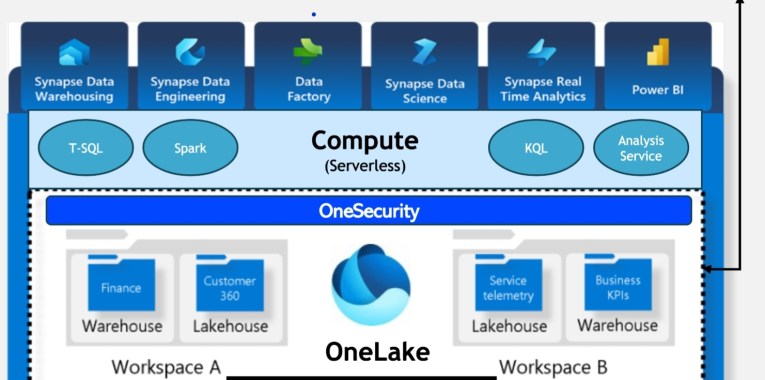
Microsoft Fabric, is the evolutionary next step in cloud data management, providing an all-in-one analytics solution for enterprises that covers everything from data movement to data science, Real-Time Analytics, and business intelligence – all in one place. Microsoft Fabric brings together new and existing components from Azure Power BI, Azure Synapse Analytics, and Azure Data Factory into a single integrated environment. These components are then presented in various customised user experiences or Fabric workloads (the compute layer) including Data Factory, Data Engineering, Data Warehousing, Data Science, Realtime Analytics and Power BI with OneLake as the storage layer.

  1. Data Factory: Combine the simplicity of Power Query with the scalability of Azure Data Factory. Utilize over 200 native connectors to seamlessly connect to on-premises and cloud data sources.
  2. Data Engineering: Experience seamless data transformation and democratization through our world-class Spark platform. Microsoft Fabric Spark integrates with Data Factory, allowing scheduling and orchestration of notebooks and Spark jobs, enabling large-scale data transformation and lakehouse democratization.
  3. Data Warehousing: Experience industry-leading SQL performance and scalability with our Data Warehouse. Separating compute from storage allows independent scaling of components. Data is natively stored in the open Delta Lake format.
  4. Data Science: Build, deploy, and operationalise machine learning models effortlessly within your Fabric experience. Integrated with Azure Machine Learning, it offers experiment tracking and model registry. Empower data scientists to enrich organisational data with predictions, enabling business analysts to integrate these insights into their reports, shifting from descriptive to predictive analytics.
  5. Real-Time Analytics: Handle observational data from diverse sources such as apps and IoT devices with ease. Real-Time Analytics, the ultimate engine for observatio nal data, excels in managing high-volume, semi-structured data like JSON or Text, providing unmatched analytics capabilities.
  6. Power BI: As the world’s leading Business Intelligence platform, Power BI grants intuitive access to all Fabric data. Empowering business owners to make informed decisions swiftly.
  7. OneLake: …the OneDrive for data. OneLake, catering to both professional and citizen developers, offers an open and versatile data storage solution. It supports a wide array of file types, structured or unstructured, storing them in delta parquet format atop Azure Data Lake Storage Gen2 (ADLS). All Fabric data, including data warehouses and lakehouses, automatically store their data in OneLake, simplifying the process for users who need not grapple with infrastructure complexities such as resource groups, RBAC, or Azure regions. Remarkably, it operates without requiring users to 1possess an Azure account. OneLake resolves the issue of scattered data silos by providing a unified storage system, ensuring effortless data discovery, sharing, and compliance with policies and security settings. Each workspace appears as a container within the storage account, and different data items are organized as folders under these containers. Furthermore, OneLake allows data to be accessed as a single ADLS storage account for the entire organization, fostering seamless connectivity across various domains without necessitating data movement. Additionally, users can effortlessly explore OneLake data using the OneLake file explorer for Windows, enabling convenient navigation, uploading, downloading, and modification of files, akin to familiar office tasks.
  8. Unified governance and security within Microsoft Fabric provide a comprehensive framework for managing data, ensuring compliance, and safeguarding sensitive information across the platform. It integrates robust governance policies, access controls, and security measures to create a unified and consistent approach. This unified governance enables seamless collaboration, data sharing, and compliance adherence while maintaining airtight security protocols. Through centralised management and standardised policies, Fabric ensures data integrity, privacy, and regulatory compliance, enhancing overall trust in the system. Users can confidently work with data, knowing that it is protected, compliant, and efficiently governed throughout its lifecycle within the Fabric environment.

Revolutionising Data Science: Unleashing the Power of Predictive Analytics

Microsoft Fabric’s advanced analytics capabilities empower data scientists to delve deeper into data. Its predictive analytics tools enable the creation of robust machine learning models, leading to more accurate forecasts and enhanced risk management strategies. With Fabric, data scientists can focus on refining models and deriving meaningful insights, rather than grappling with data integration challenges.

Transforming Data Analytics: From Descriptive to Prescriptive Analysis

Fabric’s intuitive analytics interface allows data analysts to transition from descriptive analytics to prescriptive analysis effortlessly. By identifying patterns and correlations in real time, analysts can offer actionable recommendations that drive business growth. With Fabric, businesses can optimize their operations, enhance customer experiences, and streamline decision-making processes based on comprehensive, up-to-the-minute data insights.

Empowering Data Engineering: Streamlining Complex Data Pipelines

Data engineers play a pivotal role in any data-driven organization. Microsoft Fabric simplifies their tasks by offering robust tools to streamline complex data pipelines. Its ETL (Extract, Transform, Load) capabilities automate data integration processes, ensuring data accuracy and consistency across the organization. This automation not only saves time but also reduces the risk of errors, making data engineering more efficient and reliable.

Elevating Data Reporting: Dynamic, Interactive, and Insightful Reports

Gone are the days of static, one-dimensional reports. With Microsoft Fabric, data reporting takes a quantum leap forward. Its interactive reporting features allow users to explore data dynamically, drilling down into specific metrics and dimensions. This interactivity enhances collaboration and enables stakeholders to gain a deeper understanding of the underlying data, fostering data-driven decision-making at all levels of the organization.

Conclusion: Embracing the Future of Data Management with Microsoft Fabric

In conclusion, Microsoft Fabric stands as a testament to Microsoft’s commitment to innovation in the realm of data management. By seamlessly integrating data sources, harnessing the power of AI, and providing advanced analytics and reporting capabilities, Fabric is set to revolutionize the way we perceive and utilise data. As businesses and organisations embrace Microsoft Fabric, they will find themselves at the forefront of the data revolution, equipped with the tools and insights needed to thrive in the digital age. The future of data management has arrived, and its name is Microsoft Fabric.

Case Study: Renier Botha’s Leadership in the Winning NHS Professionals Tender Bid for Beyond

Introduction

Renier Botha, a seasoned technology leader, spearheaded Beyond’s successful response to a Request for Proposal (RFP) from NHS Professionals (NHSP) for outsourced data services. This case study examines the strategic approaches, leadership, and technical expertise employed by Botha and his team in securing this critical project.

Context and Challenge

NHSP sought to outsource its data engineering services to enhance data science and reporting capabilities. The challenge was multifaceted, requiring a deep understanding of NHSP’s current data operations, stringent data governance and GDPR compliance, and the integration of advanced cloud technologies.

Strategy and Implementation

1. Stakeholder Engagement:
Botha led the initial stages by conducting key stakeholder interviews and meetings to gauge the current state and expectations. This hands-on approach ensured alignment between NHSP’s needs and Beyond’s proposal.

2. Gap Analysis:
By understanding the existing Data Engineering function, Botha identified inefficiencies and gaps. His team offered strategic recommendations for process improvements, directly addressing NHSP’s operational challenges.

3. Infrastructure Assessment:
Botha’s review of the current data processing systems uncovered dependencies that could impact future scalability and integration. This was crucial for designing a solution that was not only compliant with current standards but also adaptable to future technological advancements.

4. Data Governance Review:
Given the critical importance of data security in healthcare, Botha prioritised a thorough review of data governance practices, ensuring all proposed solutions were GDPR compliant.

5. Future State Architecture:
Utilising cloud technologies, Botha proposed a high-level architecture and design for NHSP’s future data estate. This included a blend of strategic and BAU tasks aimed at transforming NHSP’s data handling capabilities.

6. Team and Service Delivery Design:
Botha defined the composition of the Data Engineering team necessary to deliver on NHSP’s objectives. This included detailed job descriptions and a clear division of responsibilities, ensuring a match between team capabilities and service delivery goals.

7. KPIs and Service Levels:
Critical to the project’s success was the definition of KPIs and proposed service levels. Botha’s strategic vision included measurable outcomes to track progress and ensure accountability.

8. RFP Response and Roadmap:
Botha’s provided a detailed response to the RFP, outlining a clear and actionable data engineering roadmap for the first two years of service, broken down into six-month intervals. This detailed planning demonstrated a strong understanding of NHSP’s needs and showcased Beyond’s commitment to service excellence.

9. Technical Support:
Beyond also supported NHSP with system architecture queries, ensuring that all technical aspects were addressed comprehensively.

Results and Impact

Under Botha’s leadership, Beyond won the NHSP contract by effectively demonstrating a profound understanding of the project requirements and crafting a tailored, forward-thinking solution. The strategic approach not only aligned with NHSP’s operational goals but also positioned them for future scalability and innovation.

Conclusion

Botha’s expertise in data engineering and project management was pivotal in Beyond’s success. By meticulously planning and executing each phase of the RFP response, he not only led his team to a significant business win but also contributed to the advancement of data management practices within NHSP. This project serves as a benchmark in effective stakeholder management, strategic planning, and technical execution in the field of data engineering services.