
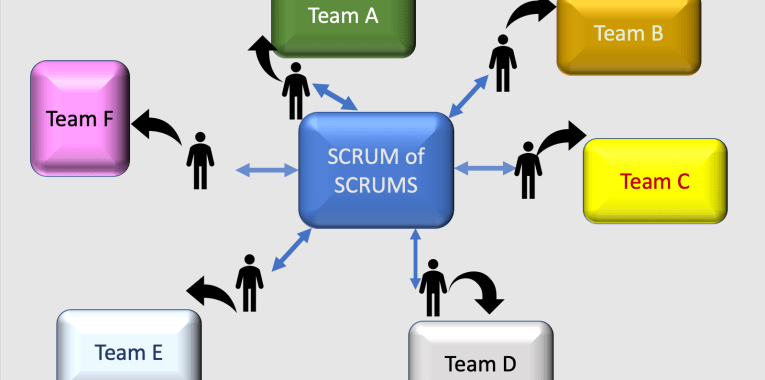
The Scrum of Scrums is a scaled agile framework used to coordinate the work of multiple Scrum teams working on the same product or project. It is a meeting or a communication structure that allows teams to discuss their progress, identify dependencies, and address any challenges that may arise during the development process. The Scrum of Scrums is often employed in large organisations where a single Scrum team may not be sufficient to deliver a complex product or project.
The primary purpose of the Scrum of Scrums is to facilitate coordination and communication among multiple Scrum teams. It ensures that all teams are aligned towards common goals and are aware of each other’s progress.
Here are some key aspects of the Scrum of Scrums:
Frequency:
- The frequency of Scrum of Scrums meetings depends on the project’s needs, but they are often daily or multiple times per week to ensure timely issue resolution.
- Shorter daily meetings focussing on progress, next steps and blockers can be substantiated by a longer weekly meeting covering an agenda of all projects and more detailed discussions.
Participants – Scrum Teams and Representatives:
- In a large-scale project or programme, there are multiple Scrum teams working on different aspects of the product or project.
- Each Scrum team is represented by one or more members (often the Scrum Masters or team leads) in the Scrum of Scrums meeting. Each team selects one or more representatives to attend the Scrum of Scrums meeting.
- These representatives are typically Scrum Masters or team leads who can effectively communicate the status, challenges, and dependencies of their respective teams.
- The purpose of these representatives is to share information about their team’s progress, discuss impediments, and collaborate on solutions.
Meeting Structure & Agenda:
- The Scrum of Scrums meeting follows a structured agenda that may include updates on team progress, identification of impediments, discussion of cross-team dependencies, reviewing and updating the overall RAID log with associated mitigation action progress and and collaborative problem-solving.
- A key focus of the Scrum of Scrums is identifying and addressing cross-team dependencies. Teams discuss how their work may impact or be impacted by the work of other teams, and they collaboratively find solutions to minimise bottlenecks and define a overall critical path / timeline for the project delivery.
Tools and Techniques:
- While the Scrum of Scrums is often conducted through face-to-face meetings, organisations may use various tools and techniques for virtual collaboration, especially if teams are distributed geographically. Video conferencing, collaboration platforms, and digital boards are common aids.
Focus on Coordination:
- The primary goal of the Scrum of Scrums is to facilitate communication and coordination among the different Scrum teams.
- Teams discuss their plans, commitments, and any issues they are facing. This helps in identifying dependencies and potential roadblocks early on.
Problem Solving:
- If there are impediments or issues that cannot be resolved within individual teams, the Scrum of Scrums provides a forum for collaborative problem-solving.
- The focus is on finding solutions that benefit the overall project, rather than just individual teams.
Scaling Agile:
- The Scrum of Scrums is in line with the agile principles of adaptability and collaboration. It allows organisations to scale agile methodologies effectively by maintaining the iterative and incremental nature of Scrum while accommodating the complexities of larger projects.
Information Flow: & Sharing
- The Scrum of Scrums ensures that information flows smoothly between teams, preventing silos of knowledge and promoting transparency across the organisation.
- The Scrum of Scrums provides a platform for teams to discuss impediments that go beyond the scope of individual teams. It fosters a collaborative environment where teams work together to solve problems and remove obstacles that hinder overall progress.
- Transparency is a key element of agile development, and the Scrum of Scrums promotes it by ensuring that information flows freely between teams. This helps prevent misunderstandings, duplication of effort, and ensures that everyone is aware of the overall project status.
Adaptability:
- The Scrum of Scrums is adaptable to the specific needs and context of the organisation. It can be tailored based on the size of the project, the number of teams involved, and the nature of the work being undertaken.
- In summary, the Scrum of Scrums is a crucial component in the toolkit of agile methodologies for large-scale projects. It fosters collaboration, communication, and problem-solving across multiple Scrum teams, ensuring that the benefits of agile development are retained even in complex and extensive projects.
In Summary, the Scrum of Scrums is a crucial component in the toolkit of agile methodologies for large-scale projects. It fosters collaboration, communication, and problem-solving across multiple Scrum teams, ensuring that the benefits of agile development are retained even in complex and extensive projects.
It’s important to note that the Scrum of Scrums is just one of several techniques used for scaling agile. Other frameworks like SAFe (Scaled Agile Framework), LeSS (Large-Scale Scrum), and Nexus also provide structures for coordinating the work of multiple teams. The choice of framework depends on the specific needs and context of the organisation.



 renierbotha ltd