

Get the Top Line Right, and the Bottom Line Will Follow

“Get the Top Line Right, and the Bottom Line Will Follow: The Role of the Right People”

Every company dreams of a healthy bottom line – profitability that ensures sustainability and growth. But too often, leaders and teams focus solely on cost-cutting measures and operational efficiency in a desperate attempt to shore up their bottom line. While these are important, they are only half the story. True success lies in focusing on the top line – revenue generation. Why? Because when you get the top line right, the bottom line will naturally follow. However, there’s a critical factor that underpins both top-line growth and bottom-line stability: your people.

The right team can supercharge your top-line growth, ensuring sustained success. After all, when you get the top line—and your people—right, the bottom line will naturally follow.

The Top Line vs. The Bottom Line: A Quick Overview

The top line refers to your business’s gross revenue or total sales, while the bottom line represents net profit after deducting expenses. While businesses often focus on improving the bottom line (net income – what’s left after deducting all expenses, taxes, and costs from revenue) by cutting costs, it’s a short-term strategy with diminishing returns. Instead, driving top-line growth – through sales, customer acquisition, and retention – is critical for lasting profitability. While both are crucial indicators of a business’s health, prioritizing the top line creates a foundation for sustainable profitability.

Why the Top Line Matters

  1. Revenue Drives Growth Opportunities
    Revenue is the lifeblood of a business. A strong top line means your business has the means to invest in new products, enter new markets, and scale operations. Without sufficient revenue, even the most cost-efficient operations can’t thrive.
  2. Top-Line Growth Inspires Confidence
    Investors, partners, and employees look for signs of growth. A consistently increasing top line signals a growing market presence and customer demand, instilling confidence in stakeholders and boosting morale.
  3. Cost-Cutting Has Limits
    While reducing expenses is important, there’s only so much you can cut. Revenue, on the other hand, has virtually no ceiling. A laser focus on driving sales and expanding market share is the only way to unlock unlimited potential.

Strategies to Get the Top Line Right

  1. Customer-Centric Approach
    Happy customers mean repeat business and referrals, which drive revenue. Focus on delivering exceptional value and improving the customer experience to build loyalty.
  2. Invest in Marketing and Sales
    Effective marketing and a high-performing sales team are essential for attracting and converting leads. Adopt data-driven strategies, leverage digital tools, and invest in training to maximize their impact.
  3. Innovate Constantly
    Offer products or services that solve real problems or provide unique value. Whether through innovation or iteration, keeping your offerings relevant and appealing ensures sustained customer interest.
  4. Expand Your Reach
    Enter new markets, diversify your product lines, or explore partnerships to tap into new revenue streams. The more diversified your top line, the more resilient your business becomes.
  5. Empower Your Team
    Employees are at the core of driving revenue. Equip them with the tools, training, and motivation they need to perform at their best.

The Bottom Line Follows

Once you’ve secured a robust and growing top line, optimizing the bottom line becomes significantly easier. Increased revenue allows you to:

  • Absorb Costs: With more cash flow, fixed costs become a smaller percentage of revenue, improving profit margins.
  • Reinvest Wisely: You can allocate resources to high-return initiatives like R&D, employee development, and customer acquisition.
  • Weather Challenges: A strong revenue base provides a cushion during economic downturns or industry disruptions.

But what many businesses overlook is that the key to both revenue growth and efficiency is having the right people in the right roles.

Why People Are the Key to Driving the Top Line

  1. Innovators Bring Unique Value
    Innovation is essential for creating products or services that attract and retain customers. The right employees are those who bring creativity, problem-solving skills, and a commitment to improvement. They generate ideas that keep your offerings relevant and competitive.
  2. Customer Experience Starts with Employees
    Happy, engaged employees deliver better service. This translates to higher customer satisfaction, retention, and word-of-mouth referrals, which all drive revenue growth. The right people are those who align with your values and prioritize your customers’ success.
  3. A High-Performing Sales and Marketing Team
    Your sales and marketing team directly impacts the top line. Talented professionals who understand your market and know how to communicate value effectively will help capture leads, close deals, and drive sustainable growth.
  4. Strategic Thinkers Create Growth Opportunities
    The right leaders and strategists within your organization will find ways to expand your market share, enter new verticals, and develop partnerships that increase revenue streams. These visionaries take your business to the next level.

The Cost of the Wrong People

Just as the right employees are your greatest asset, the wrong ones can hinder growth. Poorly aligned team members may drain resources, slow productivity, and negatively affect morale. High turnover, which often results from hiring misfits, not only disrupts operations but also creates significant recruitment and onboarding costs.

Retaining the right people is as important as hiring them. Employees need a culture that fosters growth, collaboration, and purpose. Without it, even the best talent may disengage or leave.

Strategies to Hire and Retain the Right People

  1. Focus on Cultural Fit and Values
    Skills can be taught, but values and attitudes are harder to change. Hire people who align with your company’s mission, vision, and culture. They’ll be more motivated to contribute to long-term success.
  2. Invest in Employee Development
    Top performers want opportunities to learn and grow. By offering training, mentoring, and career advancement opportunities, you build a loyal team that consistently drives top-line results.
  3. Compensation and Recognition
    A competitive compensation package and recognition of achievements are essential for attracting and retaining top talent. When employees feel valued, they’re more likely to go above and beyond for your business.
  4. Create an Inclusive and Collaborative Culture
    Foster an environment where diverse perspectives are welcomed, and collaboration is encouraged. A strong team dynamic results in better ideas, solutions, and customer experiences.
  5. Measure and Optimize Engagement
    Use tools like employee satisfaction surveys to understand your team’s needs and identify potential pain points. Addressing these proactively helps retain your best talent.

Getting the Top Line and Your People Right

To achieve top-line growth, focus on building a team that can execute your vision and deliver results. Employees who are aligned, motivated, and engaged will naturally contribute to higher sales, better customer experiences, and a stronger brand.

Once you have the right people driving your revenue, the bottom line becomes a byproduct of their success. Higher revenue provides the flexibility to invest further in your workforce, fueling a cycle of growth and profitability.

Conclusion: The People Factor

The phrase “Get the top line right, and the bottom line will follow” rings true, but it’s incomplete without the recognition that the right people are what make the top line soar. Hiring and retaining the right employees isn’t just an HR function, it’s a growth strategy.

Prioritizing revenue generation fuels growth, inspires confidence, and lays the groundwork for long-term profitability. While keeping an eye on the bottom line is essential, don’t lose sight of the bigger picture: if you’re not actively working to grow your top line, you’re limiting your potential. Focus on the top line, and let your success cascade down to the bottom.

When you combine top-line focus with a strong, capable team, you create a resilient business that’s ready to tackle challenges, seize opportunities, and achieve sustainable success. Remember: invest in your people, prioritize growth, and the bottom line will take care of itself.

“Get the Top Line Right, and the Bottom Line Will Follow”
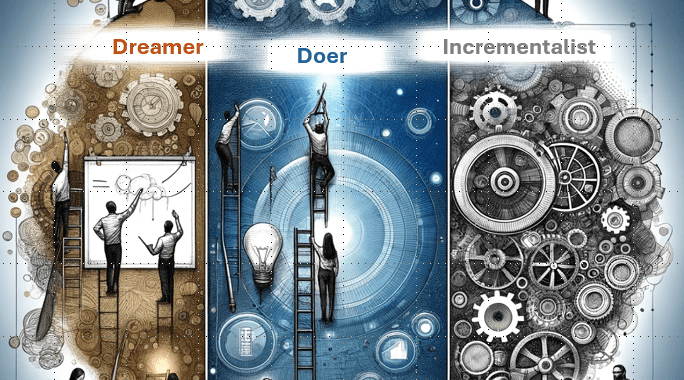
Optimising Team Dynamics: The Dreamer, Doer, and Incrementalist Framework

With over 30 years of experience in managing diverse teams, I’ve learnt that one of the key components of successful leadership is a deep understanding of your workforce’s character. Recognising the unique strengths and preferences of each individual not only enhances job satisfaction and personal development but also significantly boosts the overall productivity and harmony within the team. The Dream, Doer, and Incrementalist framework provides an invaluable tool in this regard, offering insights into effectively harnessing diverse talents and fostering an environment where innovative ideas, efficient execution, and continuous improvement thrive together.

The Dream, Doer, and Incrementalist framework offers a perspective on team dynamics and personal strengths within a professional environment. By analysing the characteristics, strengths, challenges, and synergistic potential of each type, organisations can optimise collaboration and enhance outcomes. This article delves into each of these aspects, providing a comprehensive understanding of how these personality types interact and contribute to success.

The Dreamer

Characteristics: Dreamers are visionary thinkers. They excel at big-picture thinking and are often the source of innovative ideas and ambitious goals. They thrive on possibilities and what could be, often pushing boundaries and challenging the status quo.

Strengths: The primary strength of Dreamers lies in their ability to envision and articulate a compelling future. They are great at motivating others and are often seen as charismatic leaders. Their creativity is a catalyst for innovation and inspiration within teams.

Challenges: Dreamers can sometimes struggle with the practical aspects of project execution. Their focus on visions can lead to difficulties in managing details or maintaining interest in the mundane aspects of implementation. They may also face challenges in setting realistic goals or timelines.

Examples: Visionary leaders like Steve Jobs or Elon Musk embody the Dreamer archetype, driving their companies towards groundbreaking innovations.

The Doer

Characteristics: Doers are action-oriented and pragmatic. They excel in environments where clear objectives and efficiency are prioritised. Doers are the workforce engines, turning ideas into reality through hard work and dedication.

Strengths: The primary strength of Doers lies in their ability to execute. They are dependable, often excel at managing resources, and can navigate the logistics of how to accomplish tasks effectively and efficiently.

Challenges: Doers may struggle with ambiguity and are less comfortable in situations where the goals are not clear or the pathway to them is not well defined. They may also be resistant to change and less receptive to abstract ideas that cannot be immediately acted upon.

Examples: Operations managers or project leads often fit the Doer profile, expertly translating strategic objectives into actionable plans and ensuring that goals are met on time.

The Incrementalist

Characteristics: Incrementalists are systematic thinkers who focus on gradual improvement. They excel at optimising processes and are adept at identifying and implementing small changes that cumulatively lead to significant improvements.

Strengths: Incrementalists bring a level of stability and continuous improvement to teams. They are great at problem-solving within existing frameworks and excel in environments where they can make iterative adjustments to enhance performance.

Challenges: Incrementalists may be perceived as overly cautious or resistant to radical change. Their preference for small, safe steps can sometimes hinder innovation or rapid adaptation in fast-paced environments.

Examples: Quality assurance managers or continuous improvement specialists who focus on refining processes and systems gradually are typical Incrementalists.

Collaboration and Team Dynamics

Dream and Doer: When Dreamers and Doers collaborate, they balance each other’s strengths. Dreamers provide the vision and motivation, while Doers handle the logistics and execution. This partnership can lead to high productivity and effective realisation of innovative ideas.

Dream and Incrementalist: This pairing can stabilise the radical ideas of the Dreamer with the practical, step-wise approach of the Incrementalist. It ensures that innovation is grounded in reality and is implemented progressively.

Doer and Incrementalist: Together, Doers and Incrementalists form an efficient and reliable team. They excel in environments that require high operational efficiency and risk management. However, this pairing might lack the creative spark provided by Dreamers.

All Three Together: When Dreamers, Doers, and Incrementalists work together, they form a powerful trio that can dream, plan, and refine continuously. This combination ensures that visionary ideas are not only executed efficiently but are also continuously improved upon.

Key Insights

Understanding the characteristics of Dreams, Doers, and Incrementalists allows organisations to form teams that can leverage diverse strengths. Effective management of these personalities requires recognising their unique contributions and challenges, and strategically pairing them to balance creativity, execution, and improvement. When these types are aligned with roles that suit their strengths, and when they are paired thoughtfully, they can significantly enhance team dynamics and drive successful outcomes.

Building Bridges in Tech: The Power of Practice Communities in Data Engineering, Data Science, and BI Analytics

Technology team practice communities, for example those within a Data Specialist organisation focused on Business Intelligence (BI) Analytics & Reporting, Data Engineering and Data Science, play a pivotal role in fostering innovation, collaboration, and operational excellence within organisations. These communities, often comprised of professionals from various departments and teams, unite under the common goal of enhancing the company’s technological capabilities and outputs. Let’s delve into the purpose of these communities and the value they bring to a data specialist services provider.

Community Unity

At the heart of practice communities is the principle of unity. By bringing together professionals from data engineering, data science, and BI Analytics & Reporting, companies can foster a sense of belonging and shared purpose. This unity is crucial for cultivating trust, facilitating open communication and collaboration across different teams, breaking down silos that often hinder progress and innovation. When team members feel connected to a larger community, they are more likely to contribute positively and share knowledge, leading to a more cohesive and productive work environment.

Standardisation

Standardisation is another key benefit of establishing technology team practice communities. With professionals from diverse backgrounds and areas of expertise coming together, companies can develop and implement standardised practices, tools, and methodologies. This standardisation ensures consistency in work processes, data management, and reporting, significantly improving efficiency and reducing errors. By establishing best practices across data engineering, data science, and BI Analytics & Reporting, companies can ensure that their technology initiatives are scalable and sustainable.

Collaboration

Collaboration is at the core of technology team practice communities. These communities provide a safe platform for professionals to share ideas, challenges, and solutions, fostering an environment of continuous learning and improvement. Through regular meetings, workshops, and forums, members can collaborate on projects, explore new technologies, and share insights that can lead to breakthrough innovations. This collaborative culture not only accelerates problem-solving but also promotes a more dynamic and agile approach to technology development.

Mission to Build Centres of Excellence

The ultimate goal of technology team practice communities is to build centres of excellence within the company. These centres serve as hubs of expertise and innovation, driving forward the company’s technology agenda. By concentrating knowledge, skills, and resources, companies can create a competitive edge, staying ahead of technological trends and developments. Centres of excellence also act as incubators for talent development, nurturing the next generation of technology leaders who can drive the company’s success.

Value to the Company

The value of establishing technology team practice communities is multifaceted. Beyond enhancing collaboration and standardisation, these communities contribute to a company’s ability to innovate and adapt to change. They enable faster decision-making, improve the quality of technology outputs, and increase employee engagement and satisfaction. Furthermore, by fostering a culture of excellence and continuous improvement, companies can better meet customer needs and stay competitive in an ever-evolving technological landscape.

In conclusion, technology team practice communities, encompassing data engineering, data science, and BI Analytics & Reporting, are essential for companies looking to harness the full potential of their technology teams. Through community unity, standardisation, collaboration, and a mission to build centres of excellence, companies can achieve operational excellence, drive innovation, and secure a competitive advantage in the marketplace. These communities not only elevate the company’s technological capabilities but also cultivate a culture of learning, growth, and shared success.

Beyond Timelines and Budgets: The Vital Quest for Purpose in Innovation

Building for Impact: The Essential Lesson from Eric Ries

We live in fast evolving world! Within this world of innovation and entrepreneurship, Eric Ries’ poignant question resonates deeply: “What if we found ourselves building something that nobody wanted? In that case, what did it matter if we did it on time and on budget?” This question, at the heart of Ries’ philosophy in the Lean Startup methodology, serves as a critical reminder of the importance of not just building, but building something that matters.

The Pitfall of Misplaced Priorities

In the pursuit of success, it’s easy to get caught up in the metrics that traditionally define progress: adherence to timelines, staying within budget, and completing tasks with precision. Whilst these aspects are undoubtedly important, they risk becoming the sole focus, overshadowing the fundamental question of whether the project or product in development truly meets a need or solves a real problem. Ries challenges us to shift our focus from simply completing tasks to ensuring that what we are building has inherent value and demand.

The Lean Startup Approach

At the core of the Lean Startup methodology is the concept of building, measuring, and learning in rapid, iterative cycles. This approach encourages entrepreneurs and innovators to validate their ideas and assumptions through continuous feedback from their target audience. The goal is to learn what customers really want and need before investing too much time, energy, and resources into a product or service that may not find its market. This philosophy not only saves valuable resources but also steers projects in a direction more likely to achieve meaningful impact.

Illustrating the Impact with Case Studies

  • Dropbox: Before Dropbox became a household name, its founder Drew Houston realised the importance of validating the market need for a cloud storage solution. Initially, instead of fully developing the product, he created a simple video demonstrating how Dropbox would work. The overwhelming positive response to this video was a clear indication of market demand, guiding the team to proceed with confidence. This early validation saved significant resources and positioned Dropbox to meet its users’ real needs effectively.
  • Zappos: Zappos, now a leading online shoe and clothing retailer, began with a simple experiment to test market demand. Founder Nick Swinmurn initially posted pictures of shoes from local stores online without actually holding any inventory. When a pair was ordered, he would purchase it from the store and ship it to the customer. This lean approach to validating customer interest in buying shoes online allowed Zappos to scale confidently, knowing there was a genuine demand for their business model.
  • Pebble Technology: Pebble Technology’s approach to validating the demand for their smartwatch is a modern example of leveraging community support through crowdfunding. Before mass-producing their product, Pebble launched a Kickstarter campaign to gauge interest. The campaign not only surpassed its funding goal but also became one of the most successful Kickstarter campaigns at the time. This validation through crowdfunding underscored the market’s desire for their product, enabling Pebble to proceed with a clear indication of customer demand.

The Importance of Building Something Wanted

The essence of Ries’ question underscores a fundamental truth in both business and personal endeavours: the importance of purpose and relevance. Building something that nobody wants is akin to solving a problem that doesn’t exist—it may be an impressive feat of engineering, creativity, or organisation, but it misses the mark on making a difference in the world. The measure of success, therefore, should not only be in the completion of the project itself but in its ability to address real needs and improve lives.

Embracing Flexibility and Adaptation

Adopting a mindset that prioritises impact over mere completion requires a willingness to be flexible and adapt to feedback. It means being prepared to pivot when data shows that the original plan isn’t meeting the needs of the market. This adaptability is crucial in navigating the unpredictable waters of innovation, where the true north is the value created for others.

Measuring and Evaluating the Relevance

Measuring and evaluating the relevance of a product or service is crucial for ensuring that it meets the actual needs of its intended users and can achieve success in the marketplace. This process involves several strategies and tools designed to gather feedback, analyze market trends, and adjust to user expectations. Below are additional insights on how to effectively carry out this evaluation.

  • 1. Customer Feedback and Engagement
    • Surveys and Questionnaires: Regularly conduct surveys to gather insights directly from your users about their experiences, preferences, and any unmet needs. Tailor these tools to collect specific information that can guide product development and improvement.
    • User Interviews: Conduct in-depth interviews with users to understand their pain points, the context in which they use your product, and their satisfaction levels. These interviews can uncover detailed insights not evident through surveys or data analysis alone.
    • Social Media and Online Forums: Monitor social media platforms and online forums related to your industry. These channels are rich sources of unsolicited feedback and can reveal how users perceive your product and what they wish it could do.
  • Usability Testing
    • Prototype Testing: Before full-scale production, use prototypes to test how potential users interact with your product. Observing users as they navigate a prototype can highlight usability issues and areas for improvement.
    • A/B Testing: Implement A/B testing to compare different versions of your product or its features. This method can help identify which variations perform better in terms of user engagement, satisfaction, and conversion rates.
  • Analyzing Market Trends
    • Competitor Analysis: Keep a close watch on your competitors and their offerings. Understanding their strengths and weaknesses can help you identify gaps in the market and opportunities for differentiation.
    • Market Research Reports: Leverage industry reports and market research to stay informed about broader trends that could impact the relevance of your product. This includes shifts in consumer behavior, technological advancements, and regulatory changes.
  • Metrics and Analytics
    • Usage Metrics: Track how users are interacting with your product through metrics such as daily active users (DAUs), session length, and feature usage rates. These indicators can help you understand which aspects of your product are most valuable to users.
    • Churn Rate: Monitor your churn rate closely to understand how many users stop using your product over a given period. A high churn rate can signal issues with product relevance or user satisfaction.
    • Customer Lifetime Value (CLV): Calculating the CLV provides insights into the long-term value of maintaining a relationship with your customers. This metric helps assess whether your product continues to meet users’ needs over time.
  • Feedback Loops and Continuous Improvement
    • Implement Continuous Feedback Loops: Establish mechanisms to continuously gather and act on feedback. This could involve regular updates based on user input, as well as ongoing testing and iteration of your product.
    • Pivot When Necessary: Be prepared to pivot your product strategy if significant feedback indicates that your product does not meet market needs as expected. Pivoting can involve changing your target audience, adjusting key features, or even redefining your value proposition.

The Ultimate Goal: Making a Difference

Ultimately, the question posed by Eric Ries invites us to reflect on why we embark on the projects we choose. Are we building to simply see our plans materialise, or are we driven by a desire to make a tangible difference in the world? The true reward lies not in the accolades for completing a project on time and within budget but in the knowledge that what we have built serves a greater purpose.

As we navigate the complexities of bringing new ideas to life, let us keep this lesson at the forefront of our minds. By ensuring that what we build is truly wanted and needed, we not only enhance our chances of success but also contribute to a world where innovation and impact go hand in hand.

In conclusion, effectively measuring and evaluating the relevance of a product or service is an ongoing process that requires a combination of direct user engagement, market analysis, and data-driven insights. By staying attuned to the needs and feedback of your users and being willing to adapt based on what you learn, you can ensure that your product remains relevant and successful in meeting the evolving demands of the market.