

Blog 2#2: A Unified Framework for Data Ingestion and Transformation Across Time Contexts
The explosion of diverse data sources – ranging from real-time IoT streams to historical archives – has made it critical for organizations to adopt architectures that handle this complexity seamlessly. The data lakehouse has emerged as a solution, blending the scalability of data lakes with the analytical rigor of data warehouses. Central to its success is metadata-driven architecture, which enables organizations to not only manage but also harmonize data from different sources and time contexts effectively.
This second blog on metadata driven data lakehouse architecture explores how metadata powers the ingestion, transformation, and integration of diverse data sources in a lakehouse, with particular focus on handling time context – an often overlooked but crucial dimension of modern data architectures.
The Challenge of Time Context in Data Integration
When integrating data from multiple sources, time context presents unique challenges:
- Real-Time vs. Batch Data:
- Real-time data streams from IoT devices, clickstreams, or financial transactions require immediate processing and storage.
- Historical data, often loaded in batches, needs to coexist with real-time data for comprehensive analysis.
- Temporal Data Structures:
- Different systems use varying temporal formats (e.g., Unix timestamps, ISO 8601).
- Some datasets capture event timestamps, while others represent data as snapshots or aggregates.
- Evolving Data Over Time:
- Data schemas and business definitions change over time, requiring careful version control and lineage tracking.
Without a robust strategy, these discrepancies can lead to data inconsistencies, failed queries, and unreliable insights. Metadata-driven lakehouse architecture addresses these challenges head-on.
Metadata as the Key to Time-Aware Data Integration
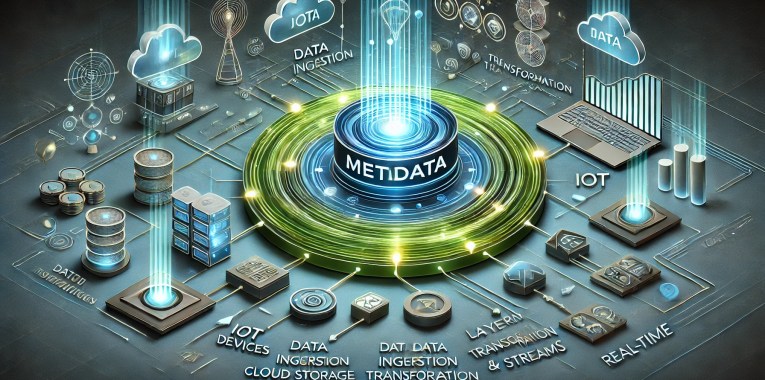
Metadata acts as the connective tissue that unifies data ingestion and transformation processes, ensuring data from different time contexts can be ingested, transformed, and analyzed harmoniously.
1. Metadata-Driven Ingestion
Metadata defines how data from various sources and time contexts is ingested into the lakehouse:
- Source Definition: Metadata captures details about the source system (e.g., streaming vs. batch, API vs. file-based ingestion) and its temporal properties (e.g., timestamp format, latency expectations).
- Schema Evolution: Metadata tracks schema versions over time, ensuring that schema changes in source systems do not disrupt downstream processes. For example, adding a new column to a real-time stream can be handled without breaking existing pipelines.
- Time Partitioning: Metadata drives time-based partitioning strategies, storing data efficiently for fast querying. For instance, real-time data might be partitioned by hour, while historical data is partitioned by day or month.
2. Metadata-Driven Transformation
Once ingested, data often needs to be transformed for consistency and usability. Metadata defines the rules and logic for these transformations:
- Time Normalization: Metadata-driven pipelines can standardize temporal formats (e.g., converting Unix timestamps to ISO 8601) and align timestamps across different time zones.
- Temporal Context Mapping: Metadata can encode business rules to map temporal data to specific contexts. For example:
- IoT data might include a metadata tag linking each event to a “shift” or “workday.”
- Sales data could include metadata to align transactions with fiscal quarters or promotional periods.
- Deduplication and Merging: Metadata can define rules for deduplication and merging. For instance, a metadata tag might indicate whether the dataset uses append-only records or includes updates that overwrite previous entries.
3. Metadata-Driven Time Context Reconciliation
Reconciling data across different time contexts is critical for accurate analytics. Metadata facilitates this by:
- Tracking Data Lineage Across Time: Metadata records the lineage of every dataset, capturing transformations, aggregations, and their time contexts. For example, metadata might show that a weekly sales summary was derived from daily transactional data ingested five days earlier.
- Version Control: Metadata maintains a version history of datasets, ensuring that analysts can recreate past analyses using historical data and its corresponding transformations.
- Defining Temporal Joins: Metadata can specify how to join datasets with different time granularities. For example:
- Joining hourly web traffic data with daily revenue data might involve metadata-driven rules to aggregate traffic data to the daily level.
- A metadata tag might define how to interpolate missing time points in IoT data.
Metadata in Action: Real-World Use Cases
Use Case 1: Retail Analytics
- Challenge: Combine real-time inventory data with historical sales trends to optimize restocking.
- Solution: Metadata tags specify:
- Real-time inventory feeds as “streaming” data with minute-level granularity.
- Historical sales as “batch” data aggregated by day.
- Transformation rules to align both datasets to daily granularity for analysis.
Use Case 2: Smart Manufacturing
- Challenge: Analyze equipment sensor data (real-time) alongside maintenance logs (historical).
- Solution: Metadata defines:
- Sensor streams with millisecond timestamps.
- Maintenance logs with work order timestamps.
- Temporal reconciliation rules to align sensor data with maintenance periods for predictive analytics.
Use Case 3: Financial Risk Management
- Challenge: Monitor real-time market data alongside historical portfolio performance.
- Solution: Metadata captures:
- Market feeds as “high-frequency” data with second-level granularity.
- Portfolio data as “low-frequency” daily snapshots.
- Aggregation rules to down-sample market data for portfolio risk analysis.
Best Practices for Metadata-Driven Time Context Management in Lakehouses
- Adopt a Unified Metadata Layer: Use centralized tools (e.g., Apache Atlas, Databricks Unity Catalog) to manage and query metadata across all datasets.
- Enforce Metadata Standards: Establish standards for metadata tagging, including temporal properties, source details, and transformation rules.
- Automate Metadata Collection: Use tools that automatically harvest metadata from ingestion and transformation pipelines to ensure consistency and reduce manual effort.
- Enable Active Metadata: Invest in systems where metadata dynamically updates as data flows through the lakehouse. This ensures that time-sensitive transformations and reconciliations remain accurate.
- Prioritize Temporal Lineage: Ensure that metadata includes detailed lineage tracking to trace how datasets evolve over time, including their time contexts.
Conclusion
Metadata-driven architecture is the linchpin of modern data lakehouses, enabling organizations to harmonize data from diverse sources and time contexts. By leveraging metadata, organizations can ensure seamless ingestion, efficient transformation, and accurate reconciliation of data across real-time and historical dimensions.
As the demand for real-time analytics grows, metadata-driven lakehouses offer a scalable and future-proof solution. By adopting this approach, businesses can unlock deeper insights, drive innovation, and remain competitive in the data-first economy.
 renierbotha ltd