
Harnessing the Power of Generative AI: A Blueprint for Business Success

For businesses to stay relevant and ahead of the competition requires embracing cutting-edge technologies. One such transformative technology is generative AI. This blog post delves into how generative AI can revolutionise business operations, enhance creativity, and foster innovation. By establishing an AI Centre of Excellence, companies can effectively integrate AI into their workflows, empowering employees and driving efficiency. Whether you’re a large enterprise or a nimble start-up, this guide provides valuable insights into harnessing the power of generative AI to propel your business into the future. Join us as we explore the potential of AI and its impact on the modern workplace.

The Potential of Generative AI

Generative AI, when harnessed correctly, has the power to revolutionise the way companies operate, innovate, and compete. The key to unlocking this potential lies in establishing an AI Centre of Excellence (CoE) that integrates IT with learning and development to meet business needs.

Establishing an AI Centre of Excellence

An AI Centre of Excellence is not exclusive to large enterprises; even smaller companies can set one up. In fact, smaller businesses can be more agile and flexible, enabling them to outpace larger competitors in AI adoption. The CoE requires a two-pronged approach: learning from external best practices and understanding internal AI usage.

Learning from Generative AI Best Practices

Look Outward: The first step is to observe how other companies have successfully integrated AI into their operations. These companies serve as valuable case studies, showcasing both successes and challenges. For example, some companies use AI for creative content generation in marketing, while others apply it to predict customer behaviour in sales. By studying these practices, businesses can formulate a unified AI strategy.

Look Inward: The second step is an internal audit to understand how employees are currently using generative AI. This can reveal unexpected insights and areas for improvement. Encouraging employees to share their AI experiences fosters a culture of innovation and makes AI integration a company-wide effort.

Overcoming Integration Challenges

Many companies face challenges when integrating AI into their workflows. However, initial evidence suggests that AI can boost individual productivity by 20% to 70%, with output quality often surpassing non-AI-assisted tasks. This highlights AI’s potential as a personal productivity tool, especially when used by experts in their fields.

Despite this, AI currently enhances individual productivity more than organisational productivity. As noted by Ethan Mollick from the Wharton School, AI can be unpredictable and error-prone, making it difficult to scale across an organisation. However, recognising AI’s potential as a personal productivity tool and leveraging it within your organisation can empower employees and improve efficiency. As AI technology evolves, it will become more reliable and scalable, eventually enhancing overall organisational productivity.

Key Principles for a Successful AI Centre of Excellence

Once a company has gathered the necessary information, the next step is to establish an AI Centre of Excellence. This centre should be co-led by teams from IT and HR, combining technical expertise with a focus on learning and development. The CoE serves as a hub for AI-related activities, providing guidance, setting best practices, and ensuring alignment across departments.

To ensure success, the AI Centre of Excellence should adhere to the following guiding principles:

  1. Clear Vision and Mission: Define the strategic objectives of the CoE and align them with the overall business strategy. For example, if the goal is to leverage AI for content creation, the mission could be to develop and implement best practices in this area.
  2. Foster Collaboration and Communication: Act as a bridge between departments, facilitating the sharing of knowledge and best practices. For instance, insights from the marketing team’s use of AI can benefit other departments through the CoE.
  3. Focus on Continuous Improvement: Regularly review and refine processes to remain effective and relevant. Stay updated with the latest AI technologies and incorporate them into the company’s practices.
  4. Promote a Culture of Learning and Development: Provide training and resources to enhance employees’ AI skills and knowledge. Offer workshops on using generative AI tools and resources for self-learning.

Serving Business Operations Through an AI Centre of Excellence

The ultimate goal of establishing an AI Centre of Excellence is to enhance business operations. Generative AI can streamline processes, improve efficiency, and drive innovation. By learning from others, understanding internal usage, and centralising AI initiatives, companies can harness AI’s potential and transform their operations.

The CoE plays a crucial role in this transformation, guiding the integration of AI into business operations. Whether it’s automating routine tasks, generating creative content, or predicting market trends, the CoE ensures these initiatives align with strategic objectives and best practices.

For example, to streamline customer service operations with AI, the CoE could develop a roadmap, identify the best AI tools, train staff, and set up a system for monitoring and improvement.

Moreover, the CoE fosters a culture of continuous learning and innovation, keeping the company up-to-date with AI advancements, encouraging exploration of new AI applications, and promoting experimentation and risk-taking.

Conclusion: GenAI – A Path to Growth and Success

The journey towards effective use of generative AI may seem daunting, but with the right approach, it can lead to unprecedented growth and success. Embrace the potential of AI, establish your Centre of Excellence, and watch as AI propels your business into the future.

Remember, the future of business lies in not just adopting new technologies, but understanding, integrating, and using them to drive operational excellence. Let the Centre of Excellence be your guide on this journey towards a future powered by generative AI.

Are you ready to unlock the full potential of generative AI and transform your business operations? At renierbotha Ltd, we specialise in helping companies of all sizes establish AI Centres of Excellence, ensuring seamless integration of AI technologies into your workflow. Our team of experts is dedicated to providing tailored solutions that drive innovation, enhance efficiency, and give you a competitive edge.

Get in touch with renierbotha Ltd today to start your journey towards a future powered by generative AI. Contact us directly to learn more about how we can support your AI initiatives and help your business thrive in the modern landscape.


Comprehensive Guide to Strategic Investment in IT and Data for Sustainable Business Growth and Innovation

In this post, Renier is exploring the critical importance of appropriate investment in technology, data and innovation for continued business growth and a strategy to stay relevant.

Introduction

This comprehensive guide explores the strategic importance of investing in information technology (IT) and data management to foster sustainable business growth and innovation. It delves into the risks of underinvestment and the significant advantages that proactive and thoughtful expenditure in these areas can bring to a company. Additionally, it offers actionable strategies for corporate boards to effectively navigate these challenges, ensuring that their organisations not only survive but thrive in the competitive modern business landscape.

The Perils of Underinvestment in IT: Navigating Risks and Strategies for Corporate Boards

In the digital age, information technology (IT) is not merely a support tool but a cornerstone of business strategy and operations. However, many companies still underinvest in their IT infrastructure, leading to severe repercussions. This section explores the risks associated with underinvestment in IT, the impact on businesses, and actionable strategies that company Boards can adopt to mitigate these risks and prevent potential crises.

The Impact of Underinvestment in IT

Underinvestment in IT can manifest in numerous ways, each capable of stifling business growth and operational efficiency. Primarily, outdated systems and technologies can lead to decreased productivity as employees struggle with inefficient processes and systems that do not meet contemporary standards. Furthermore, it exposes the company to heightened security risks such as data breaches and cyberattacks, as older systems often lack the capabilities to defend against modern threats.

Key Risks Introduced by Underinvestment

  • Operational Disruptions – With outdated IT infrastructure, businesses face a higher risk of system downtimes and disruptions. This not only affects daily operations but can also lead to significant financial losses and damage to customer relationships.
  • Security Vulnerabilities – Underfunded IT systems are typically less secure and more susceptible to cyber threats. This can compromise sensitive data and intellectual property, potentially resulting in legal and reputational harm.
  • Inability to Scale – Companies with poor IT investment often struggle to scale their operations efficiently to meet market demands or expand into new territories, limiting their growth potential.
  • Regulatory Non-Compliance – Many industries have strict regulations regarding data privacy and security. Inadequate IT infrastructure may lead to non-compliance, resulting in hefty fines and legal issues.

What Can Boards Do?

  • Prioritise IT in Strategic Planning – Boards must recognise IT as a strategic asset rather than a cost centre. Integrating IT strategy with business strategy ensures that technology upgrades and investments are aligned with business goals and growth trajectories.
  • Conduct Regular IT Audits – Regular audits can help Boards assess the effectiveness of current IT systems and identify areas needing improvement. This proactive approach aids in preventing potential issues before they escalate.
  • Invest in Cybersecurity – Protecting against cyber threats should be a top priority. Investment in modern cybersecurity technologies and regular security training for employees can shield the company from potential attacks.
  • Establish a Technology Committee – Boards could benefit from establishing a dedicated technology committee that can drive technology strategy, oversee technology risk management, and keep the Board updated on key IT developments and investments.
  • Foster IT Agility – Encouraging the adoption of agile IT practices can help organisations respond more rapidly to market changes and technological advancements. This includes investing in scalable cloud solutions and adopting a culture of continuous improvement.
  • Education and Leadership Engagement – Board members should be educated about the latest technology trends and the specific IT needs of their industry. Active engagement from leadership can foster an environment where IT is seen as integral to organisational success.

Maximising Potential: The Critical Need for Proper Data Utilisation in Organisations

In today’s modern business landscape, data is often referred to as the new oil—a vital asset that can drive decision-making, innovation, and competitive advantage. Despite its recognised value, many organisations continue to underinvest and underutilise data, missing out on significant opportunities and exposing themselves to increased risks. This section examines the consequences of not fully leveraging data, the risks associated with such underutilisation, and practical steps organisations can take to better harness the power of their data.

The Consequences of Underutilisation

Underutilising data can have far-reaching consequences for organisations, impacting everything from strategic planning to operational efficiency. Key areas affected include:

  • Inefficient Decision-Making – Without robust data utilisation, decisions are often made based on intuition or incomplete information, which can lead to suboptimal outcomes and missed opportunities.
  • Missed Revenue Opportunities – Data analytics can uncover trends and insights that drive product innovation and customer engagement. Organisations that fail to leverage these insights may fall behind their competitors in capturing market share.
  • Operational Inefficiencies – Data can optimise operations and streamline processes. Lack of proper data utilisation can result in inefficiencies, higher costs, and decreased productivity.

Risks Associated with Data Underutilisation

  • Competitive Disadvantage – Companies that do not invest in data analytics may lose ground to competitors who utilise data to refine their strategies and offerings, tailor customer experiences, and enter new markets more effectively.
  • Security and Compliance Risks – Underinvestment in data management can lead to poor data governance, increasing the risk of data breaches and non-compliance with regulations like GDPR and HIPAA, potentially resulting in legal penalties and reputational damage.
  • Strategic Misalignmen – Lack of comprehensive data insights can lead to strategic plans that are out of sync with market realities, risking long-term sustainability and growth.

Mitigating Risks and Enhancing Data Utilisation

  • Enhance Data Literacy Across the Organisation – Building data literacy across all levels of the organisation empowers employees to understand and use data effectively in their roles. This involves training programmes and ongoing support to help staff interpret and leverage data insights.
  • Invest in Data Infrastructure – To harness data effectively, robust infrastructure is crucial. This includes investing in secure storage, efficient data processing capabilities, and advanced analytics tools. Cloud-based solutions can offer scalable and cost-effective options.
  • Establish a Data Governance Framework – A strong data governance framework ensures data quality, security, and compliance. It should define who can access data, how it can be used, and how it is protected, ensuring consistency and reliability in data handling.
  • Foster a Data-Driven Culture – Encouraging a culture that values data-driven decision-making can be transformative. This involves leadership endorsing and modelling data use and recognising teams that effectively use data to achieve results.
  • Utilise Advanced Analytics and AI – Advanced analytics, machine learning, and AI can transform raw data into actionable insights. These technologies can automate complex data analysis tasks, predict trends, and offer deeper insights that human analysis might miss.
  • Regularly Review and Adapt Data Strategies – Data needs and technologies evolve rapidly. Regular reviews of data strategies and tools can help organisations stay current and ensure they are fully leveraging their data assets.

The Essential Role of Innovation in Business Success and Sustainability

Innovation refers to the process of creating new products, services, processes, or technologies, or significantly improving existing ones. It often involves applying new ideas or approaches to solve problems or meet market needs more effectively. Innovation can range from incremental changes to existing products to groundbreaking shifts that create whole new markets or business models.

Why is Innovation Important for a Business?

  • Competitive Advantage – Innovation helps businesses stay ahead of their competitors. By offering unique products or services, or by enhancing the efficiency of processes, companies can differentiate themselves in the marketplace. This differentiation is crucial for attracting and retaining customers in a competitive landscape.
  • Increased Efficiency – Innovation can lead to the development of new technologies or processes that improve operational efficiency. This could mean faster production times, lower costs, or more effective marketing strategies, all of which contribute to a better bottom line.
  • Customer Engagement and Satisfaction – Today’s consumers expect continual improvements and new experiences. Innovative businesses are more likely to attract and retain customers by meeting these expectations with new and improved products or services that enhance customer satisfaction and engagement.
  • Revenue Growth – By opening new markets and attracting more customers, innovation directly contributes to revenue growth. Innovative products or services often command premium pricing, and the novelty can attract customers more effectively than traditional marketing tactics.
  • Adaptability to Market Changes – Markets are dynamic, with consumer preferences, technology, and competitive landscapes constantly evolving. Innovation enables businesses to adapt quickly to these changes. Companies that lead in innovation can shape the direction of the market, while those that follow must adapt to changes shaped by others.
  • Attracting Talent – Talented individuals seek dynamic and progressive environments where they can challenge their skills and grow professionally. Innovative companies are more attractive to potential employees looking for such opportunities. By drawing in more skilled and creative employees, a business can further enhance its innovation capabilities.
  • Long-Term Sustainability – Continuous innovation is crucial for long-term business sustainability. By constantly evolving and adapting through innovation, businesses can foresee and react to changes in the environment, technology, and customer preferences, thus securing their future relevance and viability.
  • Regulatory Compliance and Social Responsibility – Innovation can also help businesses meet regulatory requirements more efficiently and contribute to social and environmental goals. For example, developing sustainable materials or cleaner technologies can address environmental regulations and consumer demands for responsible business practices.

In summary, innovation is essential for a business as it fosters growth, enhances competitiveness, and ensures ongoing relevance in a changing world. Businesses that consistently innovate are better positioned to thrive and dominate in their respective markets.

Strategic Investment in Technology, Product Development, and Data: Guidelines for Optimal Spending in Businesses

There isn’t a one-size-fits-all answer to how much a business should invest in technology, product development, innovation, and data as a percentage of its annual revenue. The appropriate level of investment can vary widely depending on several factors, including the industry sector, company size, business model, competitive landscape, and overall strategic goals. However, here are some general guidelines and considerations:

Strategic Considerations

  • Technology and Innovation – Companies in technology-driven industries or those facing significant digital disruption might invest a larger portion of their revenue in technology and innovation. For instance, technology and software companies typically spend between 10% and 20% of their revenue on research and development (R&D). For other sectors where technology is less central but still important, such as manufacturing or services, the investment might be lower, around 3-5%.
  • Product Development – Consumer goods companies or businesses in highly competitive markets where product lifecycle is short might spend a significant portion of revenue on product development to continually offer new or improved products. This could range from 4% to 10% depending on the industry specifics and the need for innovation.
  • Data – Investment in data management, analytics, and related technology also varies. For businesses where data is a critical asset for decision-making, such as in finance, retail, or e-commerce, investment might be higher. Typically, this could be around 1-5% of revenue, focusing on capabilities like data collection, storage, analysis, and security.
  • Growth Phase – Start-ups or companies in a growth phase might invest a higher percentage of their revenue in these areas as they build out their capabilities and seek to capture market share.
  • Maturity and Market Position – More established companies might spend a smaller proportion of revenue on innovation but focus more on improving efficiency and refining existing products and technologies.
  • Competitive Pressure – Companies under significant competitive pressure may increase their investment to ensure they remain competitive in the market.
  • Regulatory Requirements – Certain industries might require significant investment in technology and data to comply with regulatory standards, impacting how funds are allocated.

Benchmarking and Adaptation

It is crucial for businesses to benchmark against industry standards and leaders to understand how similar firms allocate their budget. Additionally, investment decisions should be regularly reviewed and adapted based on the company’s performance, market conditions, and technological advancements.

Ultimately, the key is to align investment in technology, product development, innovation, and data with the company’s strategic objectives and ensure these investments drive value and competitive advantage.

Conclusion

The risks associated with underinvestment in IT are significant, but they are not insurmountable. Boards play a crucial role in ensuring that IT receives the attention and resources it requires. By adopting a strategic approach to IT investment, Boards can not only mitigate risks but also enhance their company’s competitive edge and operational efficiency. Moving forward, the goal should be to view IT not just as an operational necessity but as a strategic lever for growth and innovation.

The underutilisation of data presents significant risks but also substantial opportunities for organisations willing to invest in and prioritise their data capabilities. By enhancing data literacy, investing in the right technologies, and fostering a culture that embraces data-driven insights, organisations can mitigate risks and position themselves for sustained success in an increasingly data-driven world.

In conclusion, strategic investment in IT, innovation and data is crucial for any organisation aiming to maintain competitiveness and drive innovation in today’s rapidly evolving market. By understanding the risks of underinvestment and implementing the outlined strategies, corporate boards can ensure that their companies leverage technology and data effectively. This approach will not only mitigate potential risks but also enhance operational efficiency, open new avenues for growth, and ultimately secure a sustainable future for their businesses.

Are you ready to elevate your organisation’s competitiveness and innovation? Consider the strategic importance of investing in IT and data. We encourage corporate boards and business leaders to take proactive steps: assess your current IT and data infrastructure, align investments with your strategic goals, and foster a culture that embraces technological advancement. Start today by reviewing the strategies outlined in this guide to ensure your business not only survives but thrives in the digital age. Act now to secure a sustainable and prosperous future for your organisation.

Performance Improvement: Effective & Efficient

Performance is simply the action taken or process followed in doing a task or function.

Performance improvement – the continuous driver to be better, to grow, to achieve great things!

Directly related to business performance is the ability to change the business processes for greater effectiveness and efficiency increasing productivity while terms like specialisation, standardisation comes to mind followed by measurement, data analysis, statistical analysis, root cause analysis and finally process control and quality control and the overriding metric – customer satisfaction.

Remember the saying by Peter Drucker: “What gets measured, gets improved”…

Measuring performance involves the ability to measure the effectiveness of an initiative or action as well as the efficiency in which it is achieved. Similarly performance improvement involves the enhancement of effectiveness while optimising the efficiency.

Effective: Success in delivering a desired or intended result.

Efficient: Achieving maximum productivity through optimal use of resources with minimum waste or expense.

Depending on your business and your situation you must select or develop key performance indicators (KPIs) to calculate the effectiveness and efficiency of your activities – for business this is usually calculated in monetary terms. Once you understand your current performance you can set KPI targets and work on improvement initiatives.

I found this flow on Pinterest that gives a great overview of the processes involved in enhancing effectiveness and efficiency to increase business performance summarised in 5 habits of the mind:

  1. Know where time goes
  2. Focus on outward contribution
  3. Build on Strengths
  4. Concentrate on selected area that produce outstanding results
  5. Make effective decisions

Linking appropriate KPIs to this flow can measure progress and deliver improving results.

Effective_Efficient

Performance Management

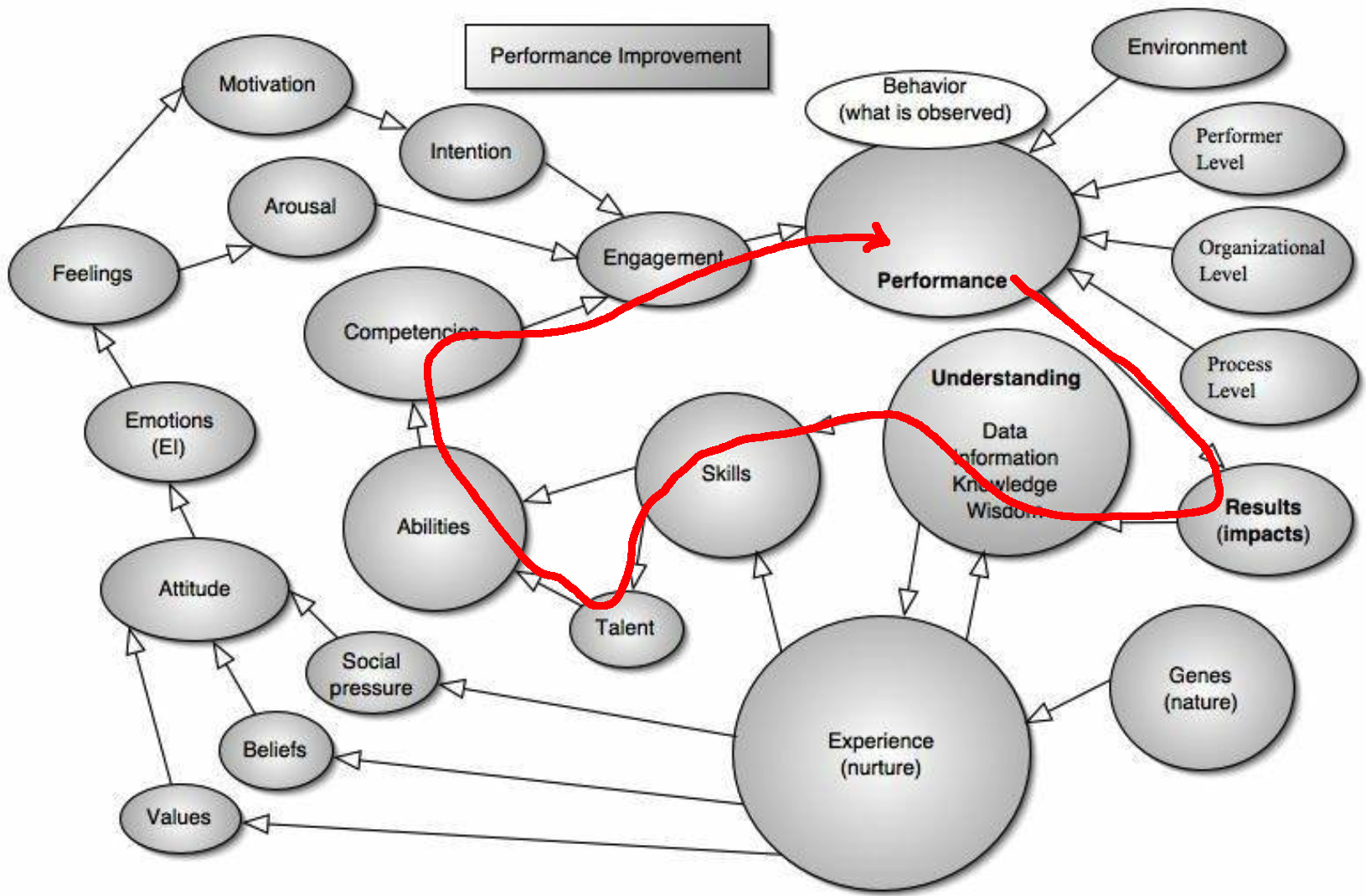
Performance (Effectiveness and Efficiency) can be influenced by various different factors – illustrated in the diagram below.

Performance_Improvement - CP.png

In using this diagram, a critical path (Shown in red above) can be drawn to improve performance in a specific area i.e. staff performance.

  1. First performance is defined,
  2. then measured to get a specific result (and understanding the impact it has overall).
  3. Understanding the results to determine which key skills, abilities and competeencies or lack there-of are contributing to the specific performance.
  4. Talent is needed to deliver performance – talent skills, abilities and competencies can be trained or recruited.
  5. Engagement is key – involve, motivate and empower your talent to respond and interact with the business – engagement brings a sense of happiness, which is a great motivator for creativity and performance.
  6. And the cycle repeats in never ending quality improvement loop.

This methodology can be adapted and used for performance improvement in any area of the business value chain.

Remember performance improvement is always reflected in the customer satisfaction. Satisfied customers engage with the business recurrently – hence revenue growth!

Let’s Talk – renierbotha Ltd specialises in the performance improvement of business and IT operations. Are you looking to achieve your goals faster? Create better business value? Build strategies to improve growth? We can help – make contact!

Case Study – Renier Botha’s Game-Changing Leadership at Systems Powering Healthcare (2015-2017)

Posted on November 1, 2017

Introduction:
Back in December 2015, Renier Botha stepped in as the big boss—Managing Director and Head of Service at Systems Powering Healthcare, aka SPHERE. This place is all about delivering top-notch IT services and infrastructure to a whole lot of NHS healthcare workers—over 10,000 to be exact. Let’s dive into how Botha totally revamped SPHERE in his two year tenure, turning it into a powerhouse through his sharp strategic moves, cool innovations, and rock-solid leadership.

Facing the Music and Setting Goals:
Right off the bat, Botha was up against some big challenges. He had to shift SPHERE from an old-school cost-plus model to a snazzy commercial-service-catalogue model while also trying to attract more clients. His main to-dos were to get the company on stable footing, map out a strategic game plan, and make sure they were all about putting customers first.

Key Moves and Wins:

  1. Strategic Master Plan: Botha wasted no time. Within the first three months, he whipped up a six-year strategic plan that laid out all the key investments and milestones to get SPHERE to grow and thrive.
  2. From Startup to Star: Managing a team of 75, Botha steered SPHERE from its startup phase to become a well-known medium-sized business, hitting their three-year targets way ahead of schedule – in just two years!
  3. Tech Makeover: One of his big programmes was pouring £42M into beefing up SPHERE’s tech – think better networks, better hosting, the works. This move was all about making sure they could keep up and stay ahead in the long run.
  4. Service Delivery Shake-up: Botha brought in a new, customer-focused operating model and rolled out Service-Now to up their tech game. This not only made things run smoother but also saved a ton of money, giving them a killer return on investment.
  5. Financial Growth: Under his guidance, SPHERE’s dough rolled in 42% thicker thanks to smart mergers, acquisitions, and raking in new clients. They also managed to save the NHS about £3m a year with their shared service gig.
  6. Cost-Cutting Genius: He managed to slash the “Cost per IT User” by 24% in two years, showing just how much bang for the buck SPHERE could offer.
  7. Big Win: Thanks to a revamped service catalogue, SPHERE nailed a whopping £10m contract to provide IT services for Northumbria Healthcare NHS Foundation Trust.
  8. Happy Campers: Botha didn’t just focus on the numbers; he also built a workplace where people actually wanted to stick around. Employee retention jumped from 82% to a whopping 98% by the end of his run.

Conclusion:
Renier Botha’s time at SPHERE shows just what can happen when you mix visionary leadership with a knack for making smart moves in healthcare IT. He not only met the big challenges head-on but also made sure that SPHERE became a go-to example of how IT can seriously improve healthcare services. His story isn’t just about a job well done; it’s about setting a whole new standard in the industry.