
The Epiphany Moment of Euphoria in a Data Estate Development Project

In our technology-driven world, engineers pave the path forward, and there are moments of clarity and triumph that stand comparable to humanity’s greatest achievements. Learning at a young age from these achievements shape our way of thinking and can be a source of inspiration that enhances the way we solve problems in our daily lives. For me, one of these profound inspirations stems from an engineering marvel: the Paul Sauer Bridge over the Storms River in Tsitsikamma, South Africa – which I first visited in 1981. This arch bridge, completed in 1956, represents more than just a physical structure. It embodies a visionary approach to problem-solving, where ingenuity, precision, and execution converge seamlessly.

The Paul Sauer Bridge across the Storms River Gorge in South Africa.

The bridge’s construction involved a bold method: engineers built two halves of the arch on opposite sides of the gorge. Each section was erected vertically and then carefully pivoted downward to meet perfectly in the middle, completing the 100m span, 120m above the river. This remarkable feat of engineering required foresight, meticulous planning, and flawless execution – a true epiphany moment of euphoria when the pieces fit perfectly.

Now, imagine applying this same philosophy to building data estate solutions. Like the bridge, these solutions must connect disparate sources, align complex processes, and culminate in a seamless result where data meets business insights.

This blog explores how to achieve this epiphany moment in data projects by drawing inspiration from this engineering triumph.

The Parallel Approach: Top-Down and Bottom-Up

Building a successful data estate solution, I believe requires a dual approach, much like the simultaneous construction of both sides of the Storms River Bridge:

  1. Top-Down Approach:
    • Start by understanding the end goal: the reports, dashboards, and insights that your organization needs.
    • Focus on business requirements such as wireframe designs, data visualization strategies, and the decisions these insights will drive.
    • Use these goals to inform the types of data needed and the transformations required to derive meaningful insights.
  2. Bottom-Up Approach:
    • Begin at the source: identifying and ingesting the right raw data from various systems.
    • Ensure data quality through cleaning, validation, and enrichment.
    • Transform raw data into structured and aggregated datasets that are ready to be consumed by reports and dashboards.

These two streams work in parallel. The Top-Down approach ensures clarity of purpose, while the Bottom-Up approach ensures robust engineering. The magic happens when these two streams meet in the middle – where the transformed data aligns perfectly with reporting requirements, delivering actionable insights. This convergence is the epiphany moment of euphoria for every data team, validating the effort invested in discovery, planning, and execution.

When the Epiphany Moment Isn’t Euphoric

While the convergence of Top-Down and Bottom-Up approaches can lead to an epiphany moment of euphoria, there are times when this anticipated triumph falls flat. One of the most common reasons is discovering that the business requirements cannot be met as the source data is insufficient, incomplete, or altogether unavailable to meet the reporting requirements. These moments can feel like a jarring reality check, but they also offer valuable lessons for navigating data challenges.

Why This Happens

  1. Incomplete Understanding of Data Requirements:
    • The Top-Down approach may not have fully accounted for the granular details of the data needed to fulfill reporting needs.
    • Assumptions about the availability or structure of the data might not align with reality.
  2. Data Silos and Accessibility Issues:
    • Critical data might reside in silos across different systems, inaccessible due to technical or organizational barriers.
    • Ownership disputes or lack of governance policies can delay access.
  3. Poor Data Quality:
    • Data from source systems may be incomplete, outdated, or inconsistent, requiring significant remediation before use.
    • Legacy systems might not produce data in a usable format.
  4. Shifting Requirements:
    • Business users may change their reporting needs mid-project, rendering the original data pipeline insufficient.

The Emotional and Practical Fallout

Discovering such issues mid-development can be disheartening:

  • Teams may feel a sense of frustration, as their hard work in data ingestion, transformation, and modeling seems wasted.
  • Deadlines may slip, and stakeholders may grow impatient, putting additional pressure on the team.
  • The alignment between business and technical teams might fracture as miscommunications come to light.

Turning Challenges into Opportunities

These moments, though disappointing, are an opportunity to re-evaluate and recalibrate your approach. Here are some strategies to address this scenario:

1. Acknowledge the Problem Early

  • Accept that this is part of the iterative process of data projects.
  • Communicate transparently with stakeholders, explaining the issue and proposing solutions.

2. Conduct a Gap Analysis

  • Assess the specific gaps between reporting requirements and available data.
  • Determine whether the gaps can be addressed through technical means (e.g., additional ETL work) or require changes to reporting expectations.

3. Explore Alternative Data Sources

  • Investigate whether other systems or third-party data sources can supplement the missing data.
  • Consider enriching the dataset with external or public data.

4. Refine the Requirements

  • Work with stakeholders to revisit the original reporting requirements.
  • Adjust expectations to align with available data while still delivering value.

5. Enhance Data Governance

  • Develop clear ownership, governance, and documentation practices for source data.
  • Regularly audit data quality and accessibility to prevent future bottlenecks.

6. Build for Scalability

  • Future-proof your data estate by designing modular pipelines that can easily integrate new sources.
  • Implement dynamic models that can adapt to changing business needs.

7. Learn and Document the Experience

  • Treat this as a learning opportunity. Document what went wrong and how it was resolved.
  • Use these insights to improve future project planning and execution.

The New Epiphany: A Pivot to Success

While these moments may not bring the euphoria of perfect alignment, they represent an alternative kind of epiphany: the realisation that challenges are a natural part of innovation. Overcoming these obstacles often leads to a more robust and adaptable solution, and the lessons learned can significantly enhance your team’s capabilities.

In the end, the goal isn’t perfection – it’s progress. By navigating the difficulties of misalignment, incomplete or unavailable data with resilience and creativity, you’ll lay the groundwork for future successes and, ultimately, more euphoric epiphanies to come.

Steps to Ensure Success in Data Projects

To reach this transformative moment, teams must adopt structured practices and adhere to principles that drive success. Here are the key steps:

1. Define Clear Objectives

  • Identify the core business problems you aim to solve with your data estate.
  • Engage stakeholders to define reporting and dashboard requirements.
  • Develop a roadmap that aligns with organisational goals.

2. Build a Strong Foundation

  • Invest in the right infrastructure for data ingestion, storage, and processing (e.g., cloud platforms, data lakes, or warehouses).
  • Ensure scalability and flexibility to accommodate future data needs.

3. Prioritize Data Governance

  • Implement data policies to maintain security, quality, and compliance.
  • Define roles and responsibilities for data stewardship.
  • Create a single source of truth to avoid duplication and errors.

4. Embrace Parallel Development

  • Top-Down: Start designing wireframes for reports and dashboards while defining the key metrics and KPIs.
  • Bottom-Up: Simultaneously ingest and clean data, applying transformations to prepare it for analysis.
  • Use agile methodologies to iterate and refine both streams in sync.

5. Leverage Automation

  • Automate data pipelines for faster and error-free ingestion and transformation.
  • Use tools like ETL frameworks, metadata management platforms, and workflow orchestrators.

6. Foster Collaboration

  • Establish a culture of collaboration between business users, analysts, and engineers.
  • Encourage open communication to resolve misalignments early in the development cycle.

7. Test Early and Often

  • Validate data accuracy, completeness, and consistency before consumption.
  • Conduct user acceptance testing (UAT) to ensure the final reports meet business expectations.

8. Monitor and Optimize

  • After deployment, monitor the performance of your data estate.
  • Optimize processes for faster querying, better visualization, and improved user experience.

Most Importantly – do not forget that the true driving force behind technological progress lies not just in innovation but in the people who bring it to life. Investing in the right individuals and cultivating a strong, capable team is paramount. A team of skilled, passionate, and collaborative professionals forms the backbone of any successful venture, ensuring that ideas are transformed into impactful solutions. By fostering an environment where talent can thrive – through mentorship, continuous learning, and shared vision – organisations empower their teams to tackle complex challenges with confidence and creativity. After all, even the most groundbreaking technologies are only as powerful as the minds and hands that create and refine them.

Conclusion: Turning Vision into Reality

The Storms River Bridge stands as a symbol of human achievement, blending design foresight with engineering excellence. It teaches us that innovation requires foresight, collaboration, and meticulous execution. Similarly, building a successful data estate solution is not just about connecting systems or transforming data – it’s about creating a seamless convergence where insights meet business needs. By adopting a Top-Down and Bottom-Up approach, teams can navigate the complexities of data projects, aligning technical execution with business needs.

When the two streams meet – when your transformed data delivers perfectly to your reporting requirements – you’ll experience your own epiphany moment of euphoria. It’s a testament to the power of collaboration, innovation, and relentless dedication to excellence.

In both engineering and technology, the most inspiring achievements stem from the ability to transform vision into reality. The story of the Paul Sauer Bridge teaches us that innovation requires foresight, collaboration, and meticulous execution. Similarly, building a successful data estate solution is not just about connecting systems or transforming data, it’s about creating a seamless convergence where insights meet business needs.

The journey isn’t always smooth. Challenges like incomplete data, shifting requirements, or unforeseen obstacles can test our resilience. However, these moments are an opportunity to grow, recalibrate, and innovate further. By adopting structured practices, fostering collaboration, and investing in the right people, organizations can navigate these challenges effectively.

Ultimately, the epiphany moment in data estate development is not just about achieving alignment, it’s about the collective people effort, learning, and perseverance that make it possible. With a clear vision, a strong foundation, and a committed team, you can create solutions that drive success and innovation, ensuring that every challenge becomes a stepping stone toward greater triumphs.

When Longevity Becomes a Liability: The Innovation Challenge of Long-Tenured Staff

Why Long-Tenure Staff May Hinder Innovation in Business

in the digital era, businesses are under constant pressure to innovate, adapt, and stay ahead of the competition. Technology is no longer just a supporting function; it is the backbone of modern business operations. Consequently, the IT department plays a pivotal role in driving innovation. However, many organisations are beginning to realise that long-tenure IT staff—while valuable in many ways—can sometimes act as a barrier to the innovation required for growth and success.

Here, we’ll explore why this phenomenon occurs and how businesses can balance institutional knowledge with fresh perspectives to foster innovation.

The Benefits of Long-Tenure IT Staff

Before diving into the challenges, it’s important to recognise the advantages long-tenured IT staff bring:

  1. Deep Institutional Knowledge: Long-tenured employees are often well-versed in a company’s systems, processes, and history. They understand the intricacies of legacy systems, organisational workflows, and the cultural nuances that drive decision-making.
  2. Reliability and Stability: Experienced IT staff often become the go-to experts for troubleshooting and maintaining the systems that keep businesses running smoothly.
  3. Strong Relationships: Over time, long-term employees build trust and rapport with other departments, vendors, and stakeholders.

While these qualities are beneficial for operational continuity, they can inadvertently create barriers to innovation.

The Innovation Problem with Long-Tenured IT Staff

  1. Comfort with the Status Quo Long-tenured IT professionals often grow comfortable with existing systems and processes. This familiarity can breed complacency or resistance to change. Phrases like “We’ve always done it this way” become a common refrain, stifling creative problem-solving and the adoption of cutting-edge solutions.
  2. Over-Reliance on Legacy Systems IT staff who have been with an organisation for a long time may have invested significant effort in developing or maintaining legacy systems. They may resist initiatives that threaten to replace or overhaul these systems, even when such changes are critical for innovation. This attachment can lead to technical debt and inhibit digital transformation.
  3. Skill Stagnation Technology evolves rapidly, and IT professionals must continually learn and adapt. However, long-tenured staff may prioritise maintaining existing systems over acquiring new skills, leaving the organisation at a disadvantage when adopting emerging technologies such as artificial intelligence, blockchain, or advanced data analytics.
  4. Criticism of Change to Protect Knowledge Long-tenured staff often perceive change as a threat to their hold on knowledge and influence within the organisation. New systems, tools, or processes might reduce the reliance on their expertise, potentially diminishing their perceived value. As a result, they may criticise or sabotage new initiatives to maintain their authority, hindering the adoption of innovations that could benefit the business.
  5. Conflicts with Other Staff and Held Grudges Over time, long-tenured employees may develop personal or professional conflicts with colleagues. These grudges can create tension and impede collaboration. For instance, they might resist new ideas proposed by newer staff, not because the ideas lack merit, but due to unresolved interpersonal issues. Such behaviour fosters a toxic environment that stifles innovation and discourages cross-functional teamwork.
  6. Groupthink and Insular Thinking Long-term employees often form tight-knit teams that share similar perspectives. While this cohesion can be beneficial, it can also lead to groupthink, where alternative ideas and outside-the-box thinking are dismissed. This insularity can prevent the organisation from exploring innovative approaches.
  7. Lack of Fresh Perspectives Innovation often comes from diverse perspectives and new ways of thinking. Long-tenured IT staff, steeped in a company’s established practices, may lack the external viewpoints needed to challenge norms and drive disruptive innovation.

Balancing Institutional Knowledge with Innovation

To foster a culture of innovation without losing the value of long-tenured staff, organisations should adopt a balanced approach:

  1. Encourage Lifelong Learning Provide long-tenured staff with access to training, certifications, and opportunities to learn emerging technologies. Encouraging continuous education can help them stay relevant and open to change.
  2. Infuse New Talent Actively recruit IT professionals with diverse experiences and fresh perspectives. These new hires can bring innovative ideas and challenge entrenched ways of thinking.
  3. Promote Cross-Functional Collaboration Innovation often arises from collaboration across departments. Encourage IT teams to work closely with other areas of the business, such as marketing, product development, and customer experience, to identify and implement creative solutions.
  4. Reward Risk-Taking and Experimentation Create a culture that rewards experimentation and tolerates failure. This will motivate both new and long-tenured employees to propose bold ideas and explore innovative technologies.
  5. Address Interpersonal Conflicts Organisations should prioritise conflict resolution strategies to address grudges or interpersonal issues. This could involve mediation, open discussions, or team-building exercises to rebuild trust and foster collaboration.
  6. Implement Reverse Mentorship Programmes Pair long-tenured staff with newer employees or younger professionals who can share fresh perspectives, tech trends, and innovative approaches. This two-way exchange benefits both parties and enhances the organisation’s overall agility.
  7. Embrace Agile Practices Adopting agile methodologies can help break down silos and encourage iterative innovation. This can be especially helpful in pushing long-tenured staff to embrace change and adapt to dynamic business needs.

Conclusion

While long-tenured IT staff are valuable for their institutional knowledge and operational stability, their comfort with the status quo, resistance to change, and interpersonal conflicts can inadvertently stifle innovation. Businesses must recognise these challenges and proactively address them by fostering a culture that balances experience with fresh perspectives. Encouraging lifelong learning, resolving conflicts, and embracing diverse viewpoints are essential steps to maintaining a forward-thinking IT team.

Ultimately, innovation isn’t just about technology—it’s about mindset. By addressing these barriers, organisations can empower their IT departments to become true catalysts for transformation, driving growth and competitiveness in today’s rapidly evolving landscape.

Navigating the Trough of Disillusionment

A Guide to Sustained Success in Business Vision, Strategy, and Technology Delivery

The Trough of Disillusionment in Business Vision, Strategy, and Technology Delivery

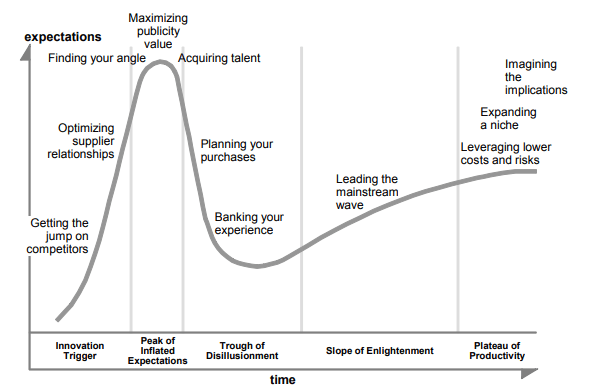
In the dynamic, innovative and interwoven landscape of business and technology, the concept of the “trough of disillusionment” stands as a critical phase that organisations must navigate to achieve long-term success. Coined by the research and advisory firm Gartner, this term is part of the “Hype Cycle,” which describes the typical progression of new technologies from innovation to mainstream adoption. The trough of disillusionment specifically represents a period where inflated expectations give way to a more sober, realistic assessment of a technology’s capabilities and limitations. Understanding this phase is crucial for shaping effective business vision, strategy, and technology delivery.

The Hype Cycle and the Trough of Disillusionment

The Hype Cycle is divided into five key stages:

  1. Innovation Trigger: A breakthrough, product launch, or other event generates significant press and interest.
  2. Peak of Inflated Expectations: Early publicity produces a number of success stories—often accompanied by scores of failures.
  3. Trough of Disillusionment: Interest wanes as experiments and implementations fail to deliver. Producers of the technology shake out or fail. Investments continue only if the surviving providers improve their products to the satisfaction of early adopters.
  4. Slope of Enlightenment: More instances of how the technology can benefit the enterprise start to crystallise and become more widely understood.
  5. Plateau of Productivity: Mainstream adoption starts to take off. Criteria for assessing provider viability are more clearly defined. The technology’s broad market applicability and relevance are clearly paying off.

The Trough of Disillusionment in Business Vision

In the context of business vision, the trough of disillusionment is a reality check that tests the resilience and adaptability of organisational goals. Visionary leaders often set ambitious targets based on the initial promise of new technologies. However, as these technologies face real-world challenges and fail to meet sky-high expectations, the resultant disillusionment can lead to strategic pivoting.

Leaders must anticipate this phase and prepare to manage the potential decline in enthusiasm and support. This involves:

  • Realistic Goal Setting: Establishing achievable milestones and preparing for potential setbacks.
  • Stakeholder Communication: Maintaining transparent communication with stakeholders to manage expectations and reinforce long-term vision despite short-term disappointments.
  • Flexibility and Adaptability: Being ready to pivot strategies based on new insights and developments during the disillusionment phase.

The Trough of Disillusionment in Business Strategy

Strategically, the trough of disillusionment necessitates a recalibration of efforts and resources. Businesses must:

  • Evaluate and Learn: Critically analyse why initial implementations fell short. Was it due to technology immaturity, unrealistic expectations, or lack of necessary infrastructure?
  • Refine Use Cases: Focus on identifying practical, high-value use cases where the technology can realistically deliver benefits.
  • Resource Management: Reallocate resources to areas with a higher likelihood of successful outcomes, potentially slowing down investments in more speculative projects.

Strategists must balance the initial enthusiasm with a grounded approach that incorporates lessons learned during the disillusionment phase. This balanced approach ensures that when the technology matures, the organisation is well-positioned to capitalise on its potential.

The Trough of Disillusionment in Technology Delivery

For technology delivery teams, the trough of disillusionment is a period of introspection and iterative improvement. During this phase, the emphasis shifts from innovation to execution:

  • Improving Product Quality: Focus on addressing the shortcomings of the technology, such as stability, scalability, and usability.
  • Enhanced Training and Support: Providing better training and support for users to maximise the technology’s current capabilities.
  • Incremental Development: Adopting an incremental approach to development, where continuous feedback and iterations help refine the technology and its applications.

Delivery teams must maintain a commitment to excellence and incremental improvement, recognising that sustained effort and adaptation are key to moving through the trough of disillusionment towards the slope of enlightenment.

Conclusion

The trough of disillusionment, while challenging, is a natural and necessary phase in the adoption of new technologies. For businesses, it offers a reality check that can lead to more sustainable, long-term success. By setting realistic expectations, maintaining transparent communication, and being willing to adapt and learn, organisations can navigate this phase effectively. In technology delivery, a focus on incremental improvements and user support ensures that when the technology matures, it can deliver on its early promise. Ultimately, understanding and managing the trough of disillusionment is essential for leveraging new technologies to achieve lasting business success.

The Transformative Impact of AI in the Workplace

In just a few short years, the landscape of work as we know it has undergone a dramatic transformation, driven largely by the rapid evolution of artificial intelligence (AI). What once seemed like futuristic technology is now an integral part of our daily professional lives, reshaping industries, workflows, and job markets at an unprecedented pace. From enhancing productivity and creativity to redefining job roles and career paths, AI’s influence is profound and far-reaching. This post delves into the findings of the 2024 Work Trend Index, offering a comprehensive look at how AI is revolutionising the workplace and setting the stage for future innovations.

The 2024 Work Trend Index, released jointly by Microsoft and LinkedIn, provides an in-depth look at how AI is reshaping the workplace and the broader labor market. This comprehensive report, based on data from 31,000 individuals across 31 countries, offers valuable insights into the current state and future trajectory of AI in professional settings.

The Proliferation of AI in the Workplace

In the past year, generative AI has emerged as a transformative force, fundamentally changing how employees interact with technology. The relentless pace of work, accelerated by the pandemic, has driven employees to adopt AI tools on a significant scale. However, while leaders acknowledge AI’s critical role in maintaining competitiveness, many are still grappling with how to implement and measure its impact effectively.

Key Findings from the Work Trend Index

  1. Employee-Driven AI Adoption:
    • Widespread AI Usage: A significant 75% of knowledge workers are now integrating AI into their daily tasks.
    • Productivity Boosts: AI is helping employees save time, enhance creativity, and focus on essential work.
    • Leadership Challenges: Despite the widespread use of AI, many leaders find it difficult to quantify its productivity gains and feel unprepared to create a comprehensive AI strategy.
  2. AI’s Influence on the Job Market:
    • Talent Shortages: More than half of business leaders (55%) express concerns about filling open positions, especially in fields like cybersecurity, engineering, and creative design.
    • Career Shifts: With a high number of professionals considering career changes, AI skills are becoming increasingly crucial. LinkedIn data reveals a significant rise in professionals adding AI competencies to their profiles.
    • Training Disparities: While leaders prefer hiring candidates with AI expertise, only 39% of employees have received formal AI training from their employers, prompting many to upskill independently.
  3. Emergence of AI Power Users:
    • Workflow Optimisation: Power users of AI have restructured their workdays, saving significant time and improving job satisfaction.
    • Supportive Work Environments: These users often work in companies where leadership actively promotes AI usage and provides tailored training.

Enhancing AI Utilisation with Copilot for Microsoft 365

To address the challenges of effectively utilising AI, Microsoft has introduced a suite of new features in Copilot for Microsoft 365. These innovations are meticulously designed to simplify AI interactions, making them more intuitive and significantly enhancing overall productivity. Here’s a closer look at the key features:

  • Prompt Auto-Completion: One of the standout features of Copilot for Microsoft 365 is the Prompt Auto-Completion tool. This functionality aims to streamline the process of interacting with AI by offering intelligent suggestions to complete user prompts. Here’s how it works:
    • Contextual Suggestions: When users begin typing a prompt, Copilot leverages contextual understanding to offer relevant completions. This helps in formulating more precise queries or commands, saving users time and effort.
    • Enhanced Creativity: By providing detailed and nuanced suggestions, Prompt Auto-Completion helps users explore new ways to leverage AI, sparking creativity and innovation in task execution.
    • Efficiency Boost: This feature reduces the cognitive load on users, allowing them to focus on critical aspects of their work while Copilot handles the intricacies of prompt formulation.
  • Rewrite Feature: The Rewrite Feature is another powerful tool within Copilot for Microsoft 365, designed to elevate the quality of AI interactions:
    • Transformation of Basic Prompts: Users can input basic, rudimentary prompts, and the Rewrite Feature will enhance them into rich, detailed commands. This ensures that users can maximize the capabilities of AI without needing to craft complex prompts themselves.
    • User Empowerment: This feature empowers all users, regardless of their technical proficiency, to harness the full potential of AI. It acts as a bridge, turning simple ideas into fully realised AI-driven solutions.
    • Consistency and Accuracy: By refining prompts, the Rewrite Feature helps in achieving more accurate and consistent results from AI, leading to better decision-making and outcomes.
  • Catch Up Interface: The Catch Up Interface is an innovative chat-based feature designed to keep users informed and prepared, enhancing their ability to manage tasks effectively:
    • Personalised Insights: This interface provides personalized insights based on the user’s recent activities and interactions. It surfaces relevant information, such as project updates, deadlines, and upcoming meetings, tailored to the individual’s workflow.
    • Responsive Recommendations: Catch Up Interface offers proactive recommendations, like preparing for meetings by providing detailed notes or suggesting resources. These recommendations are dynamically generated, helping users stay ahead of their schedule.
  • Streamlined Communication: By consolidating essential information into an easy-to-navigate chat format, this feature ensures that users have quick access to what they need, reducing the time spent searching for information and improving overall efficiency.
  • Seamless Integration and User Experience: These features within Copilot for Microsoft 365 are designed to work seamlessly together, providing a cohesive and intuitive user experience. The integration of these tools into daily workflows means that users can interact with AI in a more natural and productive manner. The aim is to not only simplify AI utilisation but also to enhance the overall quality of work by leveraging AI’s full potential.

The introduction of these advanced features in Copilot for Microsoft 365 marks a significant step forward in AI utilisation within the workplace. By simplifying interactions, enhancing prompt formulation, and providing personalised insights, Microsoft is making it easier for employees to integrate AI into their daily tasks. These innovations are set to transform the way we work, driving productivity and fostering a more creative and efficient work environment. As AI continues to evolve, tools like Copilot for Microsoft 365 will be crucial in helping businesses and employees stay competitive and ahead of the curve.

The Introduction of AI-Enabled PCs

Building on the momentum of AI integration, Microsoft has launched the CoPilot+ PC, marking a significant advancement in personal computing. This AI-enabled PC, powered by state-of-the-art processor technology, is designed to maximise AI capabilities, offering several key benefits:

  • Enhanced Performance: The new processors significantly boost computing power, enabling faster data processing and more efficient multitasking. This ensures that AI applications run smoothly, enhancing overall user experience.
  • Seamless AI Integration: CoPilot+ PCs are optimised to work seamlessly with AI tools like Microsoft 365’s Copilot, providing users with intuitive and responsive AI interactions that streamline workflows and boost productivity.
  • Improved Multitasking: With advanced hardware designed to handle multiple AI-driven tasks simultaneously, users can manage their workload more effectively, reducing downtime and increasing efficiency.
  • User-Friendly Experience: These PCs are designed to be user-friendly, making it easier for individuals to harness AI technology without needing extensive technical knowledge.

The launch of the CoPilot+ PC represents a significant leap forward in how hardware and AI can combine to enhance productivity and efficiency in the workplace. This innovation underscores the critical role that advanced technology will continue to play in driving the future of work.

Conclusion

The 2024 Work Trend Index underscores the transformative potential of AI in the workplace. As AI continues to evolve, both employees and leaders must adapt, upskill, and embrace new technologies to stay ahead. The introduction of AI-enabled PCs like the CoPilot+ marks an exciting development in this journey, promising to further revolutionize how we work. For a deeper exploration of these insights, the full Work Trend Index report is available on WorkLab, alongside extensive resources on AI and the labor market provided by LinkedIn.

Comprehensive Guide to Strategic Investment in IT and Data for Sustainable Business Growth and Innovation

In this post, Renier is exploring the critical importance of appropriate investment in technology, data and innovation for continued business growth and a strategy to stay relevant.

Introduction

This comprehensive guide explores the strategic importance of investing in information technology (IT) and data management to foster sustainable business growth and innovation. It delves into the risks of underinvestment and the significant advantages that proactive and thoughtful expenditure in these areas can bring to a company. Additionally, it offers actionable strategies for corporate boards to effectively navigate these challenges, ensuring that their organisations not only survive but thrive in the competitive modern business landscape.

The Perils of Underinvestment in IT: Navigating Risks and Strategies for Corporate Boards

In the digital age, information technology (IT) is not merely a support tool but a cornerstone of business strategy and operations. However, many companies still underinvest in their IT infrastructure, leading to severe repercussions. This section explores the risks associated with underinvestment in IT, the impact on businesses, and actionable strategies that company Boards can adopt to mitigate these risks and prevent potential crises.

The Impact of Underinvestment in IT

Underinvestment in IT can manifest in numerous ways, each capable of stifling business growth and operational efficiency. Primarily, outdated systems and technologies can lead to decreased productivity as employees struggle with inefficient processes and systems that do not meet contemporary standards. Furthermore, it exposes the company to heightened security risks such as data breaches and cyberattacks, as older systems often lack the capabilities to defend against modern threats.

Key Risks Introduced by Underinvestment

  • Operational Disruptions – With outdated IT infrastructure, businesses face a higher risk of system downtimes and disruptions. This not only affects daily operations but can also lead to significant financial losses and damage to customer relationships.
  • Security Vulnerabilities – Underfunded IT systems are typically less secure and more susceptible to cyber threats. This can compromise sensitive data and intellectual property, potentially resulting in legal and reputational harm.
  • Inability to Scale – Companies with poor IT investment often struggle to scale their operations efficiently to meet market demands or expand into new territories, limiting their growth potential.
  • Regulatory Non-Compliance – Many industries have strict regulations regarding data privacy and security. Inadequate IT infrastructure may lead to non-compliance, resulting in hefty fines and legal issues.

What Can Boards Do?

  • Prioritise IT in Strategic Planning – Boards must recognise IT as a strategic asset rather than a cost centre. Integrating IT strategy with business strategy ensures that technology upgrades and investments are aligned with business goals and growth trajectories.
  • Conduct Regular IT Audits – Regular audits can help Boards assess the effectiveness of current IT systems and identify areas needing improvement. This proactive approach aids in preventing potential issues before they escalate.
  • Invest in Cybersecurity – Protecting against cyber threats should be a top priority. Investment in modern cybersecurity technologies and regular security training for employees can shield the company from potential attacks.
  • Establish a Technology Committee – Boards could benefit from establishing a dedicated technology committee that can drive technology strategy, oversee technology risk management, and keep the Board updated on key IT developments and investments.
  • Foster IT Agility – Encouraging the adoption of agile IT practices can help organisations respond more rapidly to market changes and technological advancements. This includes investing in scalable cloud solutions and adopting a culture of continuous improvement.
  • Education and Leadership Engagement – Board members should be educated about the latest technology trends and the specific IT needs of their industry. Active engagement from leadership can foster an environment where IT is seen as integral to organisational success.

Maximising Potential: The Critical Need for Proper Data Utilisation in Organisations

In today’s modern business landscape, data is often referred to as the new oil—a vital asset that can drive decision-making, innovation, and competitive advantage. Despite its recognised value, many organisations continue to underinvest and underutilise data, missing out on significant opportunities and exposing themselves to increased risks. This section examines the consequences of not fully leveraging data, the risks associated with such underutilisation, and practical steps organisations can take to better harness the power of their data.

The Consequences of Underutilisation

Underutilising data can have far-reaching consequences for organisations, impacting everything from strategic planning to operational efficiency. Key areas affected include:

  • Inefficient Decision-Making – Without robust data utilisation, decisions are often made based on intuition or incomplete information, which can lead to suboptimal outcomes and missed opportunities.
  • Missed Revenue Opportunities – Data analytics can uncover trends and insights that drive product innovation and customer engagement. Organisations that fail to leverage these insights may fall behind their competitors in capturing market share.
  • Operational Inefficiencies – Data can optimise operations and streamline processes. Lack of proper data utilisation can result in inefficiencies, higher costs, and decreased productivity.

Risks Associated with Data Underutilisation

  • Competitive Disadvantage – Companies that do not invest in data analytics may lose ground to competitors who utilise data to refine their strategies and offerings, tailor customer experiences, and enter new markets more effectively.
  • Security and Compliance Risks – Underinvestment in data management can lead to poor data governance, increasing the risk of data breaches and non-compliance with regulations like GDPR and HIPAA, potentially resulting in legal penalties and reputational damage.
  • Strategic Misalignmen – Lack of comprehensive data insights can lead to strategic plans that are out of sync with market realities, risking long-term sustainability and growth.

Mitigating Risks and Enhancing Data Utilisation

  • Enhance Data Literacy Across the Organisation – Building data literacy across all levels of the organisation empowers employees to understand and use data effectively in their roles. This involves training programmes and ongoing support to help staff interpret and leverage data insights.
  • Invest in Data Infrastructure – To harness data effectively, robust infrastructure is crucial. This includes investing in secure storage, efficient data processing capabilities, and advanced analytics tools. Cloud-based solutions can offer scalable and cost-effective options.
  • Establish a Data Governance Framework – A strong data governance framework ensures data quality, security, and compliance. It should define who can access data, how it can be used, and how it is protected, ensuring consistency and reliability in data handling.
  • Foster a Data-Driven Culture – Encouraging a culture that values data-driven decision-making can be transformative. This involves leadership endorsing and modelling data use and recognising teams that effectively use data to achieve results.
  • Utilise Advanced Analytics and AI – Advanced analytics, machine learning, and AI can transform raw data into actionable insights. These technologies can automate complex data analysis tasks, predict trends, and offer deeper insights that human analysis might miss.
  • Regularly Review and Adapt Data Strategies – Data needs and technologies evolve rapidly. Regular reviews of data strategies and tools can help organisations stay current and ensure they are fully leveraging their data assets.

The Essential Role of Innovation in Business Success and Sustainability

Innovation refers to the process of creating new products, services, processes, or technologies, or significantly improving existing ones. It often involves applying new ideas or approaches to solve problems or meet market needs more effectively. Innovation can range from incremental changes to existing products to groundbreaking shifts that create whole new markets or business models.

Why is Innovation Important for a Business?

  • Competitive Advantage – Innovation helps businesses stay ahead of their competitors. By offering unique products or services, or by enhancing the efficiency of processes, companies can differentiate themselves in the marketplace. This differentiation is crucial for attracting and retaining customers in a competitive landscape.
  • Increased Efficiency – Innovation can lead to the development of new technologies or processes that improve operational efficiency. This could mean faster production times, lower costs, or more effective marketing strategies, all of which contribute to a better bottom line.
  • Customer Engagement and Satisfaction – Today’s consumers expect continual improvements and new experiences. Innovative businesses are more likely to attract and retain customers by meeting these expectations with new and improved products or services that enhance customer satisfaction and engagement.
  • Revenue Growth – By opening new markets and attracting more customers, innovation directly contributes to revenue growth. Innovative products or services often command premium pricing, and the novelty can attract customers more effectively than traditional marketing tactics.
  • Adaptability to Market Changes – Markets are dynamic, with consumer preferences, technology, and competitive landscapes constantly evolving. Innovation enables businesses to adapt quickly to these changes. Companies that lead in innovation can shape the direction of the market, while those that follow must adapt to changes shaped by others.
  • Attracting Talent – Talented individuals seek dynamic and progressive environments where they can challenge their skills and grow professionally. Innovative companies are more attractive to potential employees looking for such opportunities. By drawing in more skilled and creative employees, a business can further enhance its innovation capabilities.
  • Long-Term Sustainability – Continuous innovation is crucial for long-term business sustainability. By constantly evolving and adapting through innovation, businesses can foresee and react to changes in the environment, technology, and customer preferences, thus securing their future relevance and viability.
  • Regulatory Compliance and Social Responsibility – Innovation can also help businesses meet regulatory requirements more efficiently and contribute to social and environmental goals. For example, developing sustainable materials or cleaner technologies can address environmental regulations and consumer demands for responsible business practices.

In summary, innovation is essential for a business as it fosters growth, enhances competitiveness, and ensures ongoing relevance in a changing world. Businesses that consistently innovate are better positioned to thrive and dominate in their respective markets.

Strategic Investment in Technology, Product Development, and Data: Guidelines for Optimal Spending in Businesses

There isn’t a one-size-fits-all answer to how much a business should invest in technology, product development, innovation, and data as a percentage of its annual revenue. The appropriate level of investment can vary widely depending on several factors, including the industry sector, company size, business model, competitive landscape, and overall strategic goals. However, here are some general guidelines and considerations:

Strategic Considerations

  • Technology and Innovation – Companies in technology-driven industries or those facing significant digital disruption might invest a larger portion of their revenue in technology and innovation. For instance, technology and software companies typically spend between 10% and 20% of their revenue on research and development (R&D). For other sectors where technology is less central but still important, such as manufacturing or services, the investment might be lower, around 3-5%.
  • Product Development – Consumer goods companies or businesses in highly competitive markets where product lifecycle is short might spend a significant portion of revenue on product development to continually offer new or improved products. This could range from 4% to 10% depending on the industry specifics and the need for innovation.
  • Data – Investment in data management, analytics, and related technology also varies. For businesses where data is a critical asset for decision-making, such as in finance, retail, or e-commerce, investment might be higher. Typically, this could be around 1-5% of revenue, focusing on capabilities like data collection, storage, analysis, and security.
  • Growth Phase – Start-ups or companies in a growth phase might invest a higher percentage of their revenue in these areas as they build out their capabilities and seek to capture market share.
  • Maturity and Market Position – More established companies might spend a smaller proportion of revenue on innovation but focus more on improving efficiency and refining existing products and technologies.
  • Competitive Pressure – Companies under significant competitive pressure may increase their investment to ensure they remain competitive in the market.
  • Regulatory Requirements – Certain industries might require significant investment in technology and data to comply with regulatory standards, impacting how funds are allocated.

Benchmarking and Adaptation

It is crucial for businesses to benchmark against industry standards and leaders to understand how similar firms allocate their budget. Additionally, investment decisions should be regularly reviewed and adapted based on the company’s performance, market conditions, and technological advancements.

Ultimately, the key is to align investment in technology, product development, innovation, and data with the company’s strategic objectives and ensure these investments drive value and competitive advantage.

Conclusion

The risks associated with underinvestment in IT are significant, but they are not insurmountable. Boards play a crucial role in ensuring that IT receives the attention and resources it requires. By adopting a strategic approach to IT investment, Boards can not only mitigate risks but also enhance their company’s competitive edge and operational efficiency. Moving forward, the goal should be to view IT not just as an operational necessity but as a strategic lever for growth and innovation.

The underutilisation of data presents significant risks but also substantial opportunities for organisations willing to invest in and prioritise their data capabilities. By enhancing data literacy, investing in the right technologies, and fostering a culture that embraces data-driven insights, organisations can mitigate risks and position themselves for sustained success in an increasingly data-driven world.

In conclusion, strategic investment in IT, innovation and data is crucial for any organisation aiming to maintain competitiveness and drive innovation in today’s rapidly evolving market. By understanding the risks of underinvestment and implementing the outlined strategies, corporate boards can ensure that their companies leverage technology and data effectively. This approach will not only mitigate potential risks but also enhance operational efficiency, open new avenues for growth, and ultimately secure a sustainable future for their businesses.

Are you ready to elevate your organisation’s competitiveness and innovation? Consider the strategic importance of investing in IT and data. We encourage corporate boards and business leaders to take proactive steps: assess your current IT and data infrastructure, align investments with your strategic goals, and foster a culture that embraces technological advancement. Start today by reviewing the strategies outlined in this guide to ensure your business not only survives but thrives in the digital age. Act now to secure a sustainable and prosperous future for your organisation.

The Enterprise Case for AI: Identifying AI Use Cases or Opportunities

Artificial intelligence (AI) stands out as a disruptive and potentially transformative force across various sectors. From streamlining operations to delivering unprecedented customer experiences, AI’s potential to drive innovation and efficiency is immense. However, identifying and implementing AI use cases that align with specific business objectives can be challenging. This blog post explores practical strategies for business leaders to uncover AI opportunities within their enterprises.

Understanding AI’s Potential

Before diving into the identification of AI opportunities, it’s crucial for business leaders to have a clear understanding of AI’s capabilities and potential impact. AI can enhance decision-making, automate routine tasks, optimise logistics, improve customer service, and much more. Recognising these capabilities enables leaders to envisage how AI might solve existing problems or unlock new opportunities.

Steps to Identify AI Opportunities

1. Define Business Objectives

Start by clearly defining your business objectives. Whether it’s increasing efficiency, reducing costs, enhancing customer satisfaction, or driving innovation, understanding what you aim to achieve is the first step in identifying relevant AI use cases.

2. Conduct an AI Opportunity Audit

Perform a thorough audit of your business processes, systems, and data. Look for areas where AI can make a significant impact, such as data-heavy processes ripe for automation or analytics, customer service touchpoints that can be enhanced with natural language processing, or operational inefficiencies that machine learning can optimise.

3. Engage with Stakeholders

Involve stakeholders from various departments in the identification process. Different perspectives can unearth hidden opportunities for AI integration. Additionally, stakeholder buy-in is crucial for the successful implementation and adoption of AI solutions.

4. Analyse Data Availability and Quality

AI thrives on data. Evaluate the availability, quality, and accessibility of your enterprise data. High-quality, well-structured data is a prerequisite for effective AI applications. Identifying gaps in your data ecosystem early can save significant time and resources.

5. Leverage External Expertise

Don’t hesitate to seek external expertise. AI consultants and service providers can offer valuable insights into potential use cases, feasibility, and implementation strategies. They can also help benchmark against industry best practices.

6. Prioritise Quick Wins

Identify AI initiatives that offer quick wins—projects that are relatively easy to implement and have a clear, measurable impact. Quick wins can help build momentum and secure organisational support for more ambitious AI projects.

7. Foster an AI-ready Culture

Cultivate a culture that is open to innovation and change. Educating your team about AI’s benefits and involving them in the transformation process is vital for overcoming resistance and fostering an environment where AI can thrive.

8. Experiment and Learn

Adopt an experimental mindset. Not all AI initiatives will succeed, but each attempt is a learning opportunity. Start with pilot projects to test assumptions, learn from the outcomes, and iteratively refine your approach.

Conclusion

Finding AI use cases within an enterprise is a strategic process that involves understanding AI’s capabilities, aligning with business objectives, auditing existing processes, engaging stakeholders, and fostering an innovative culture. By methodically identifying and implementing AI solutions, businesses can unlock significant value, driving efficiency, innovation, and competitive advantage. The journey towards AI transformation is ongoing, and staying informed, adaptable, and proactive is key to leveraging AI’s full potential.

Making your digital business resilient using AI

To staying relevant in a swift-moving digital marketplace, resilience isn’t merely about survival, it’s about flourishing. Artificial Intelligence (AI) stands at the vanguard of empowering businesses not only to navigate the complex tapestry of supply and demand but also to derive insights and foster innovation in ways previously unthinkable. Let’s explore how AI can transform your digital business into a resilient, future-proof entity.

Navigating Supply vs. Demand with AI

Balancing supply with demand is a perennial challenge for any business. Excess supply leads to wastage and increased costs, while insufficient supply can result in missed opportunities and dissatisfied customers. AI, with its predictive analytics capabilities, offers a potent tool for forecasting demand with great accuracy. By analysing vast quantities of data, AI algorithms can predict fluctuations in demand based on seasonal trends, market dynamics, and even consumer behaviour on social media. This predictive prowess allows businesses to optimise their supply chains, ensuring they have the appropriate amount of product available at the right time, thereby maximising efficiency and customer satisfaction.

Deriving Robust and Scientific Insights

In the era of information, data is plentiful, but deriving meaningful insights from this data poses a significant challenge. AI and machine learning algorithms excel at sifting through large data sets to identify patterns, trends, and correlations that might not be apparent to human analysts. This capability enables businesses to make decisions based on robust and scientific insights rather than intuition or guesswork. For instance, AI can help identify which customer segments are most profitable, which products are likely to become bestsellers, and even predict churn rates. These insights are invaluable for strategic planning and can significantly enhance a company’s competitive edge.

Balancing Innovation with Business as Usual (BAU)

While innovation is crucial for growth and staying ahead of the competition, businesses must also maintain their BAU activities. AI can play a pivotal role in striking this balance. On one hand, AI-driven automation can take over repetitive, time-consuming tasks, freeing up human resources to focus on more strategic, innovative projects. On the other hand, AI itself can be a source of innovation, enabling businesses to explore new products, services, and business models. For example, AI can help create personalised customer experiences, develop new delivery methods, or even identify untapped markets.

Fostering a Culture of Innovation

For AI to truly make an impact, it’s insufficient for it to be merely a tool that is used—it needs to be part of the company’s DNA. This means fostering a culture of innovation where experimentation is encouraged, failure is seen as a learning opportunity, and employees at all levels are empowered to think creatively. Access to innovation should not be confined to a select few; instead, an environment where everyone is encouraged to contribute ideas can lead to breakthroughs that significantly enhance business resilience.

In conclusion, making your digital business resilient in today’s volatile market requires a strategic embrace of AI. By leveraging AI to balance supply and demand, derive scientific insights, balance innovation with BAU, and foster a culture of innovation, businesses can not only withstand the challenges of today but also thrive in the uncertainties of tomorrow. The future belongs to those who are prepared to innovate, adapt, and lead with intelligence. AI is not just a tool in this journey; it is a transformative force that can redefine what it means to be resilient.

Building Bridges in Tech: The Power of Practice Communities in Data Engineering, Data Science, and BI Analytics

Technology team practice communities, for example those within a Data Specialist organisation focused on Business Intelligence (BI) Analytics & Reporting, Data Engineering and Data Science, play a pivotal role in fostering innovation, collaboration, and operational excellence within organisations. These communities, often comprised of professionals from various departments and teams, unite under the common goal of enhancing the company’s technological capabilities and outputs. Let’s delve into the purpose of these communities and the value they bring to a data specialist services provider.

Community Unity

At the heart of practice communities is the principle of unity. By bringing together professionals from data engineering, data science, and BI Analytics & Reporting, companies can foster a sense of belonging and shared purpose. This unity is crucial for cultivating trust, facilitating open communication and collaboration across different teams, breaking down silos that often hinder progress and innovation. When team members feel connected to a larger community, they are more likely to contribute positively and share knowledge, leading to a more cohesive and productive work environment.

Standardisation

Standardisation is another key benefit of establishing technology team practice communities. With professionals from diverse backgrounds and areas of expertise coming together, companies can develop and implement standardised practices, tools, and methodologies. This standardisation ensures consistency in work processes, data management, and reporting, significantly improving efficiency and reducing errors. By establishing best practices across data engineering, data science, and BI Analytics & Reporting, companies can ensure that their technology initiatives are scalable and sustainable.

Collaboration

Collaboration is at the core of technology team practice communities. These communities provide a safe platform for professionals to share ideas, challenges, and solutions, fostering an environment of continuous learning and improvement. Through regular meetings, workshops, and forums, members can collaborate on projects, explore new technologies, and share insights that can lead to breakthrough innovations. This collaborative culture not only accelerates problem-solving but also promotes a more dynamic and agile approach to technology development.

Mission to Build Centres of Excellence

The ultimate goal of technology team practice communities is to build centres of excellence within the company. These centres serve as hubs of expertise and innovation, driving forward the company’s technology agenda. By concentrating knowledge, skills, and resources, companies can create a competitive edge, staying ahead of technological trends and developments. Centres of excellence also act as incubators for talent development, nurturing the next generation of technology leaders who can drive the company’s success.

Value to the Company

The value of establishing technology team practice communities is multifaceted. Beyond enhancing collaboration and standardisation, these communities contribute to a company’s ability to innovate and adapt to change. They enable faster decision-making, improve the quality of technology outputs, and increase employee engagement and satisfaction. Furthermore, by fostering a culture of excellence and continuous improvement, companies can better meet customer needs and stay competitive in an ever-evolving technological landscape.

In conclusion, technology team practice communities, encompassing data engineering, data science, and BI Analytics & Reporting, are essential for companies looking to harness the full potential of their technology teams. Through community unity, standardisation, collaboration, and a mission to build centres of excellence, companies can achieve operational excellence, drive innovation, and secure a competitive advantage in the marketplace. These communities not only elevate the company’s technological capabilities but also cultivate a culture of learning, growth, and shared success.

Beyond Welcomes Renier Botha as Group Chief Technology Officer to Drive Innovation and Transformative Solutions in Data Analytics

We’re delighted to announce that we welcome Renier Botha MBCS CITP MIoD to the group as #cto.

His strategic vision and leadership will enhance our technological capabilities, fostering #innovation and enabling us to further push the boundaries of what is possible in the world of #dataanalytics. His track record of delivering #transformative technological solutions will be instrumental in driving our mission to help clients maximise the value of their #data assets.

Renier has over 30 years of experience, mostly recently as a management consultant working with organisations to optimise their technology. Prior to this he was CTO at a number of businesses including Collinson Technology Service and Customer First Solutions (CFS). He is renowned for his ability to lead cross-functional teams, shape technology strategy, and execute on bold initiatives. 

On his appointment, Renier said: “I am delighted to join Beyond and be part of a group that is known for its innovation. Over the course of my career, I have been committed to driving the technological agenda and I look forward to working with likeminded people in order to further unlock the power of data.”

Paul Alexander adds :” Renier’s extensive experience in technology, marketing and data analytics aligns perfectly with our business. His technological leadership will be pivotal in developing groundbreaking solutions that our clients need to thrive in today’s data-driven, technologically charged world.”

Unlocking Developer Potential: Strategies for Building High-Performing Tech Teams

Introduction

Attracting and retaining top developer talent is crucial for technology leaders, especially in a highly competitive landscape. With software innovation driving business growth, organisations with high-performing engineering cultures gain a significant advantage. Fostering this culture goes beyond perks; it requires a thoughtful approach to talent management that prioritises the developer experience.

This blog post explores strategies to enhance talent management and create an environment where developers thrive. By fostering psychological safety, investing in top-tier tools, and offering meaningful growth opportunities, we can boost innovation, productivity, and satisfaction. Let’s dive in and unlock the full potential of our development teams.

1. Understanding the Importance of Developer Experience

Before diving into specific tactics, it’s important to understand why prioritising developer experience matters:

  • Attracting Top Talent: In a competitive job market, developers can choose their employers. Organisations that offer opportunities for experimentation, stay abreast of the latest technologies, and focus on outcomes over outputs have an edge in attracting the best talent.
  • Boosting Productivity and Innovation: Supported, empowered, and engaged developers bring their best to work daily, resulting in higher productivity, faster problem-solving, and innovative solutions.
  • Reducing Turnover: Developers who feel valued and fulfilled are less likely to leave, improving retention rates and reducing the costs associated with constant hiring and training.

2. Fostering Psychological Safety

Psychological safety—the belief that one can speak up, take risks, and make mistakes without fear of punishment—is essential for high-performing teams. Here’s how to cultivate it:

  • Encourage Open Communication: Create an environment where developers feel safe sharing ideas, asking questions, and providing feedback. Use one-on-ones, team meetings, and anonymous surveys to solicit input.
  • Embrace Failure as Learning: Frame mistakes as learning opportunities rather than assigning blame. Encourage developers to share their failures and lessons learned.
  • Model Vulnerability: Leaders set the tone. By admitting mistakes and asking for help, we create space for others to do the same.

3. Investing in World-Class Tools

Providing the best tools boosts productivity, creativity, and job satisfaction. Focus on these areas:

  • Hardware and Software: Equip your team with high-performance computers, multiple monitors, and ergonomic peripherals. Regularly update software licences.
  • Development Environments: Offer cutting-edge IDEs, version control systems, and collaboration tools. Automate tasks like code formatting and testing.
  • Infrastructure: Ensure your development, staging, and production environments are reliable, scalable, and easy to work with. Embrace cloud technologies and infrastructure-as-code for rapid iteration and deployment.

4. Providing Meaningful Growth Opportunities

Developers thrive on challenge and growth. Here’s how to keep them engaged:

  • Tailored Learning Paths: Work with each developer to create a personalised learning plan aligned with their career goals. Provide access to online courses, face-to-face training, conferences, and mentorship.
  • Encourage Side Projects: Give developers time for passion projects to stretch their skills. Host hackathons or innovation days to spark new ideas.
  • Create Leadership Opportunities: Identify high-potential developers and offer chances to lead projects, mentor juniors, or present work to stakeholders.

5. Measuring and Iterating

Measure the impact of talent management efforts and continuously improve:

  • Developer Satisfaction: Survey your team regularly to gauge happiness, engagement, and psychological safety. Look for trends and areas for improvement.
  • Productivity Metrics: Track key performance indicators such as Objectives and Key Results (OKRs), cycle time, defect rates, and feature throughput. Celebrate successes and identify opportunities to streamline processes.
  • Retention Rates: Monitor turnover and conduct exit interviews to understand why developers leave. Use these insights to refine your approach.

6. Partnering with HR

Enhancing developer experience requires collaboration with HR:

  • Collaborate on Hiring: Work with recruiters to create compelling job descriptions and interview processes that highlight your commitment to the developer experience.
  • Align on Performance Management: Ensure that performance reviews, compensation, and promotions align with your talent management philosophy. Advocate for practices that reward innovation and growth.
  • Champion Diversity, Equality, and Inclusion: Partner with HR to create initiatives that foster a diverse and inclusive culture, driving innovation through multiple perspectives.

7. Building a Community of Practice

Build a sense of community among your developers:

  • Host Regular Events: Organise meetups, lunch-and-learns, or hackathons for knowledge sharing and collaboration.
  • Create Communication Channels: Use Slack, Microsoft Teams, or other tools for technical discussions and informal conversations.
  • Celebrate Successes: Regularly recognise and reward developers who exemplify your values or achieve significant milestones.

Conclusion

In conclusion, cultivating a high-performing tech team goes beyond simply hiring skilled developers, it requires a strategic and holistic approach to talent management. By prioritising psychological safety, investing in superior tools, and providing avenues for meaningful growth, organisations can not only attract top talent but also nurture a culture of innovation and satisfaction. Regular assessment of these strategies through feedback, performance metrics, and collaboration with HR can further refine and enhance the developer experience. By committing to these principles, technology leaders can build resilient, innovative teams that are well-equipped to drive business success in an ever-evolving digital landscape. Let’s take these insights forward and transform our development teams into powerful engines of growth and innovation.

Case Study: Renier Botha’s Leadership in the Winning NHS Professionals Tender Bid for Beyond

Introduction

Renier Botha, a seasoned technology leader, spearheaded Beyond’s successful response to a Request for Proposal (RFP) from NHS Professionals (NHSP) for outsourced data services. This case study examines the strategic approaches, leadership, and technical expertise employed by Botha and his team in securing this critical project.

Context and Challenge

NHSP sought to outsource its data engineering services to enhance data science and reporting capabilities. The challenge was multifaceted, requiring a deep understanding of NHSP’s current data operations, stringent data governance and GDPR compliance, and the integration of advanced cloud technologies.

Strategy and Implementation

1. Stakeholder Engagement:
Botha led the initial stages by conducting key stakeholder interviews and meetings to gauge the current state and expectations. This hands-on approach ensured alignment between NHSP’s needs and Beyond’s proposal.

2. Gap Analysis:
By understanding the existing Data Engineering function, Botha identified inefficiencies and gaps. His team offered strategic recommendations for process improvements, directly addressing NHSP’s operational challenges.

3. Infrastructure Assessment:
Botha’s review of the current data processing systems uncovered dependencies that could impact future scalability and integration. This was crucial for designing a solution that was not only compliant with current standards but also adaptable to future technological advancements.

4. Data Governance Review:
Given the critical importance of data security in healthcare, Botha prioritised a thorough review of data governance practices, ensuring all proposed solutions were GDPR compliant.

5. Future State Architecture:
Utilising cloud technologies, Botha proposed a high-level architecture and design for NHSP’s future data estate. This included a blend of strategic and BAU tasks aimed at transforming NHSP’s data handling capabilities.

6. Team and Service Delivery Design:
Botha defined the composition of the Data Engineering team necessary to deliver on NHSP’s objectives. This included detailed job descriptions and a clear division of responsibilities, ensuring a match between team capabilities and service delivery goals.

7. KPIs and Service Levels:
Critical to the project’s success was the definition of KPIs and proposed service levels. Botha’s strategic vision included measurable outcomes to track progress and ensure accountability.

8. RFP Response and Roadmap:
Botha’s provided a detailed response to the RFP, outlining a clear and actionable data engineering roadmap for the first two years of service, broken down into six-month intervals. This detailed planning demonstrated a strong understanding of NHSP’s needs and showcased Beyond’s commitment to service excellence.

9. Technical Support:
Beyond also supported NHSP with system architecture queries, ensuring that all technical aspects were addressed comprehensively.

Results and Impact

Under Botha’s leadership, Beyond won the NHSP contract by effectively demonstrating a profound understanding of the project requirements and crafting a tailored, forward-thinking solution. The strategic approach not only aligned with NHSP’s operational goals but also positioned them for future scalability and innovation.

Conclusion

Botha’s expertise in data engineering and project management was pivotal in Beyond’s success. By meticulously planning and executing each phase of the RFP response, he not only led his team to a significant business win but also contributed to the advancement of data management practices within NHSP. This project serves as a benchmark in effective stakeholder management, strategic planning, and technical execution in the field of data engineering services.

Case Study: Driving Transformation and Innovation at Shawbrook Bank

Background:
Shawbrook Bank, a specialised savings and lending institution, faced the challenge of enhancing its service delivery, operational efficiency, and fostering a culture of innovation. In late 2019, Renier Botha, the Head of Delivery and Innovation (Central Functions), took charge to lead the bank’s central functions, including Risk & Regulatory, Compliance, Finance, Human Resources, Procurement, Cyber Security, and IT Infrastructure, towards achieving annual growth and service delivery targets.

Challenge:
Renier Botha was tasked with initiating and sustaining strategic changes across various departments. The objective was not just to meet the annual growth and service delivery targets but also to establish a culture of innovation and excellence within the bank.

Solution:
1. Strategic Change Leadership:
Renier Botha played a pivotal role in overseeing a £5.5m Central Functions strategic & continuous change portfolio. Under his guidance, 16 programmes, projects, and continuous change workstreams were executed, resulting in a 10.1% saving against the budget.

2. Talent Empowerment:
Botha’s key initiative involved building a highly skilled and customer-focused core change team. By empowering the team and ensuring knowledge retention, Shawbrook Bank could rely on a group of experts capable of driving change and innovation forward.

3. Vendor Management and Partnerships:
Effective negotiation of commercial and Service Level Agreements (SLAs) ensured strong relationships with vendors and flexible resource partners. This approach guaranteed specialised service delivery and viable solutions for the bank’s diverse needs.

4. Innovation and Automation:
The establishment of the Change Portfolio Management Office (PMO), under Renier Botha’s leadership, marked a significant milestone. Skilled staff, mentored by Botha, collected key performance metrics to produce real-time Management Information (MI). Automation and data-driven insights facilitated proactive governance, setting new standards for efficiency and decision-making.

5. Mentorship and Coaching:
Renier Botha took on the responsibility of coaching and mentoring technology and project management staff. This personalised approach not only helped individuals achieve their career objectives but also aligned their goals with the broader business strategy.

Results:

  • Operational Efficiency: Streamlining processes and embracing automation led to a substantial increase in operational efficiency. Issues that previously took over 30 days to resolve were now tackled within 2 days, ensuring uninterrupted services.
  • Innovation Culture: The bank’s culture shifted towards innovation, with the establishment of the Testing Capability initiative being a testament to this. By reducing regression testing efforts by 95%, continuous delivery became a reality, fostering a culture of innovation and rapid adaptation.
  • Recognition and Acclaim: Shawbrook Bank’s transformation efforts, especially the successful Ambit Enterprise upgrade, received accolades from the board, positioning the bank as a leader in managed delivery practices.

Conclusion:
Under the leadership of Renier Botha, the Head of Delivery and Innovation, Shawbrook Bank successfully reshaped its central functions. By embracing change and cultivating a culture of excellence and innovation, Shawbrook Bank not only met its growth and service delivery targets but also set new industry standards, positioning itself as a beacon of success and innovation in the competitive financial sector. Renier Botha’s strategic vision and hands-on leadership were instrumental in this transformative journey, making Shawbrook Bank a leader in the ever-evolving landscape of banking and finance.

Innovation Case Study: Test Automation & Ambit Enterprise Upgrade

A business case of how technology innovation successfully integrated into the business operations an improved the way of working that supported business success.

  
Areas of Science and TechnologyData Engineering, Computer Science
R&D Start DateDec 2018
R&D End DateSeptember 2019
Competent ProfessionalRenier Botha


Overview and Available Baseline Technologies

Within the scope of the project, the competent professionals sought to develop a regression testing framework aimed at testing the work carried out to upgrade the Ambit application[1] from a client service solution to a software as a service solution (SaaS) operating in the Cloud. The test framework developed is now used to define and support any testing initiatives across the Bank. The team also sought to automate the process, however this failed due to lack of existing infrastructure in the Bank. 

Initial attempts to achieve this by way of third-party solution providers, such as Qualitest, were unsuccessful, as these providers were unable to develop a framework or methodology which could be documented and reused across different projects. For this the team sought to develop the framework from the ground up. The project was successfully completed in September 2019. 

Technological Advances

The upgrade would enable access to the system via the internet, meaning users would no longer need a Cisco connection onto the specific servers to engage with the application. The upgrade would also enable the system to be accessed from devices other than a PC or laptop. Business Finance at Shawbrook is comprised of 14 different business units, with each unit having a different product which is captured and processed through Ambit. All the existing functionality, and business specific configuration needed to be transferred into the new Enterprise platform, as well as the migration of all the associated data. The competent professionals at Shawbrook sought to appreciably improve the current application through the following technological advances:

  • Development of an Automated Test Framework which could be used across different projects

Comprehensive, well executed testing is essential for mitigating risks to deployment. Shawbrook did not have a documented, standardised, and proven methodology that could be adopted by different projects to ensure that proper testing practises are incorporated into project delivery. There was a requirement to develop a test framework to plan, manage, govern and support testing across the agreed phases, using tools and practices that help mitigate risks in a cost-effective and commensurate way.

The test team sought to develop a continuous delivery framework, which could be used across all units within Business Finance. The Ambit Enterprise Upgrade was the first project at Shawbrook to adopt this framework, which lead to the development of a regression test pack and the subsequent successful delivery of the Ambit upgrade. The Ambit Enterprise project was the first project within the Bank which was delivered with no issues raised post release.

The development of a regression test pack which would enable automated testing of future changes or upgrades to the Ambit platform

Regression testing is a fundamental part of the software development lifecycle. With the increased popularity of the Agile development methodology, regression testing has taken on added importance. The team at Shawbrook sought to adopt an iterative, Agile approach to software development. 

A manual regression test pack was developed which could be used for future testing without the need for the involvement of business users. This was delivered over three test cycles with the team using the results of each cycle (bugs identified and resolved) to issue new releases. 

173 user paths were captured in the regression test pack, across 14 different divisions within Business Finance. 251 issues were found during testing, with some being within the Ambit application. Identifying and resolving these issues resulted in the advancement of Ambit Enterprise platform itself. This regression test pack can now be used for future changes to the Ambit Enterprise application, as well as future FIS[2] releases, change requests and enhancements, without being dependent on the business users to undertake UAT. The competent professionals at Shawbrook are currently using the regression test pack to test the integration functionality of the Ambit Enterprise platform.

  • Development of a costing tool to generate cost estimates for cloud test environment requirements

In order to resolve issues, solutions need to be tested within test environments. A lack of supply was identified within Shawbrook and there was an initiative to increase supply using the Azure cloud environment. The objective was to increase the capability within Business Finance to manage an Azure flexible hosting environment where necessary test environments could be set up on demand. There was also a requirement to plan and justify the expense of test environment management. The competent professionals sought to develop a costing tool, based on the Azure costing model, which could be used by project managers within Business Application Support (“BAS”) to quickly generate what the environment cost would be on a per day or per hour running basis. Costs were calculated based on the environment specification required and number of running hours required. Environment specification was classified as either “high”, “medium” or “low”. For example, the test environment specification required for a web server is low, an application server is medium while a database server is high. Shawbrook gained knowledge and increase its capability of the use of the Azure cloud environment and as a result are actively using the platform to undertake cloud-based testing.

The above constitutes an advance in knowledge and capability in the field of Data Engineering and Computer Science, as per sections 9 a) and c) of the BEIS Guidelines.

Technological Uncertainties and activities carried out to address them

The following technological uncertainties were encountered while developing the Ambit Enterprise upgrade, mainly pertaining to system uncertainty:

  • Implementation of the new Ambit Enterprise application could disrupt existing business processes

The biggest risks for the programme of change, was the potential disruption of existing business processes due to the implementation of the change without validation of the upgraded application against the existing functionality. This was the primary focus of the risk mitigation process for the project. Following the test phases set out in the test framework would enable a clear understanding of all the residual risks encountered approaching implementation, providing stakeholders with the context required to make a calculated judgement on these risks.

When an issue was identified through testing, a triage process was undertaken to categorise the issues as either a technical issue, or a user issue. User issues were further classified as “training” or “change of business process”. Technical issues were classified as “showstoppers”, “high”, “medium” and “low”. These were further categorised by priority as “must haves” and “won’t haves” in order to get well-defined acceptance criteria for the substantial list of bugs that arose from the testing cycles. In total, 251 technical issues were identified.

The acceptance criteria for the resolution of issues were:

  • A code fix was implemented
    • A business approved work around was implemented
    • The business accepted the risk

All showstoppers were resolved with either a code fix or and an acceptable work around. Configuration issues were within the remit of Shawbrook’s business application support (“BAS”) team to resolve, whilst other issues could only be resolved by the FIS development team. When the application went live, there were no issues raised post release, and all issues present were known and met the acceptance criteria of the business. 

  • Business processes may no longer align with the new web-based application

Since the project was an upgrade, there was the potential for operational impact of existing functionality due to differences between the Ambit client server solution, and the upgraded Ambit Enterprise web-based solution. The BAS team at Shawbrook were required to make changes to the business processes in order to align with the way the Ambit Enterprise solution now operated. Where Shawbrook specific issues could not be resolved through the configuration of the application with the business processes, changes were made to the functionality within Ambit, for example, additional plug-ins were developed for the Sales Portal platform to integrate with the Ambit Enterprise application. 

Because Ambit Enterprise was a web-based application, application and security vulnerabilities needed to be identified so that the correct security level was achieved. Because of this, performance and security testing, which was currently not being executed, needed to be introduced to the test framework. Performance testing also needed to be executed so that speed and stability requirements under the expected workloads were met.

Summary and Conclusions

The team at Shawbrook successfully developed a test framework which could be used across all projects within Business Finance. The development of the test framework lead to the generation of a regression test pack for the Ambit Enterprise upgrade. By undertaking these R&D activities, Shawbrook gained knowledge in the use of Azure Cloud Environment for testing, and increased its automated testing capabilities, enabling the transition to a continuous delivery framework whereby the majority of testing is automated.


[1] Ambit is the asset finance application operating within the business unit, 70-80 percent of transactions on all lending is captured and managed through Ambit

[2] FIS is the Ambit Enterprise vendor

Case Study: Transformational Leadership at Shawbrook Bank – Establishing the Tech-Hub in Glasgow

Programme Director (Contractor): Renier Botha

Objective:
Renier Botha, Principal Consultant and Director at renierbotha Ltd in his role as Programme Director at Shawbrook Bank from August 2018 to September 2019, was tasked with establishing the Tech-Hub in Glasgow as a centre of excellence. His objective was to introduce innovative new standards and agile-driven governance to project and service delivery teams within the Business Finance division.

Assignments & Achievements:

1. Tech-Hub Maturity Transformation Programme:
Renier Botha led the “Tech-Hub Maturity Transformation” Programme, implementing a new Target Operating Model (TOM) in Glasgow. Through innovative ways of working, delivery targets were achieved approximately 9% more efficiently. Notably, support issue resolution time was drastically reduced from over 30 days to fewer than 2 days.

2. Establishment of Business Finance PMO:
He established the Business Finance Portfolio Management Office (PMO) from the ground up. Renier developed portfolio governance processes, templates, metrics, KPIs, and real-time management information (MI). This approach facilitated measurable improvements and set new standards for data-driven, commercially focused delivery. These practices were adopted across the entire bank.

3. Testing Capability Initiative:
Renier spearheaded an innovative initiative to create a Testing Capability for the bank. This included developing a risk-mitigating test strategy, automation framework, and associated Azure cloud development and test environments. He successfully delivered the operating model and a test-automation toolset proof of concept (POC). This initiative enabled continuous delivery (CD) and remarkably reduced regression testing efforts by 95%.

4. Ambit Enterprise Upgrade Programme:
Renier took on the challenge of managing the £1.3 million Ambit Enterprise upgrade (asset management system) across 14 business units, each with multiple product offerings. Despite the complexity, the upgrade was completed on time and under budget. This achievement earned accolades from the board, recognising it as the best-managed delivery in Shawbrook Bank.

Conclusion:

Under Renier Botha’s leadership as Programme Director, Shawbrook Bank witnessed a significant transformation within its Business Finance division. Renier’s innovative approach and strategic acumen not only established the Tech-Hub in Glasgow as a centre of excellence but also revolutionised the bank’s project and service delivery methodologies. His achievements, from efficiency improvements to groundbreaking testing capabilities, have left a lasting impact, setting new standards for excellence within Shawbrook Bank.

Case Study: Renier Botha’s Role as Non-Executive Director at KAMOHA Tech

Introduction

In this case study, we examine the strategic contributions of Renier Botha, a Non-Executive Director (NED) at KAMOHA Tech, a company specialising in Robotic Process Automation (RPA) and IT Service Management (ITSM). Botha’s role involves guiding the company through corporate governance and product development to establish KAMOHA Tech as a standalone IT service provider.

Background of KAMOHA Tech

KAMOHA Tech operates within the rapidly evolving IT industry, focusing on RPA and ITSM solutions. These technologies are crucial for businesses looking to automate processes and enhance their IT service offerings, thereby increasing efficiency and reducing costs.

Role and Responsibilities of Renier Botha

Renier Botha joined KAMOHA Tech with a wealth of experience in IT governance and service management. His primary responsibilities as a NED include:

  • Corporate Governance: Ensuring that KAMOHA Tech adheres to the highest standards of corporate governance, which is essential for the company’s credibility and long-term success. Botha’s oversight ensures that the company’s operations are transparent and align with shareholder interests.
  • Strategic Guidance on Product and Service Development: Botha plays a pivotal role in shaping the strategic direction of KAMOHA Tech’s product offerings in RPA and ITSM. His expertise helps in identifying market needs and aligning the product development to meet these demands.
  • Mentoring and Leadership: As a NED, Botha also provides mentoring to the executive team, offering insights and advice drawn from his extensive experience in the IT industry. His guidance is crucial in steering the company through phases of growth and innovation.

Impact of Botha’s Involvement

Botha’s contributions have had a significant impact on KAMOHA Tech’s trajectory:

  • Enhanced Governance Practices: Under Botha’s guidance, KAMOHA Tech has strengthened its governance frameworks, which has improved investor confidence and positioned the company as a reliable partner in the IT industry.
  • Product Innovation and Market Fit: Botha’s strategic insights into the RPA and ITSM sectors have enabled KAMOHA Tech to innovate and develop products that are well-suited to the market’s needs. This has been crucial in distinguishing KAMOHA Tech from competitors and capturing a larger market share.
  • Sustainable Growth: Botha’s emphasis on sustainable practices and long-term strategic planning has positioned KAMOHA Tech for sustainable growth. His influence ensures that the company does not only focus on immediate gains but also invests in long-term capabilities.

Challenges and Solutions

Despite the successes, Botha’s role involves navigating challenges such as:

  • Adapting to Market Changes: The IT industry is known for its rapid changes. Botha’s experience has been instrumental in helping the company quickly adapt to these changes by foreseeing industry trends and aligning the company’s strategy accordingly.
  • Balancing Innovation with Governance: Ensuring that innovation does not come at the expense of governance has been a delicate balance. Botha has managed this by setting clear boundaries and ensuring that all innovations adhere to established governance protocols.

Conclusion

Renier Botha’s role as a Non-Executive Director at KAMOHA Tech highlights the importance of experienced leadership in navigating the complexities of the IT sector. His strategic guidance in corporate governance and product development has not only enhanced KAMOHA Tech’s market position but has also set a foundation for its future growth. As KAMOHA Tech continues to evolve, Botha’s ongoing influence will be pivotal in maintaining its trajectory towards becoming an independent and robust IT service provider.

Artificial Intelligence Capabilities

AI is one of the most popular talked about technologies today. For business, this technology introduces capabilities that innovative business and technology leadership can utilise to introduce new dimensions and abilities within service and product design and delivery.

Unfortunately, a lot of the real business value is locked up behind the terminology hype, inflated expectations and insecure warnings of machine control.

It is impossible to get the value from something that is not understood. So lets cut through the hype and focus to understand AI’s objectives and the key capabilities that this exciting technology enables.

There are many definitions of AI as discussed in the blog post “What is Artificial Intelligence: Definitions“.

Keeping it simple: “AI is using computers to do things that normally would have required human intelligence.” With this definition in mind, there are basically three things that AI is aiming to achieve.

3 AI Objectives

  • Capturing Information
  • Determine what is happening
  • Understand why it is happening

Lets use an example to demonstrate this…

As humans we are constantly gathering data through our senses which is converted by our brain into information which is interpreted for understanding and potential action. You can for example identify an object through site, turn it into information and identify the object instantly as, for example, a lion. In conjunction, additional data associated with the object at the present time, for example the lion is running after a person yelling for help, enables us to identify danger and to take immediate action…

For a machine, this process is very complex and requires large amounts of data, programming/training and processing power. Today, technology is so advanced that small computers like smart phones can capture a photo, identify a face and link it to a name. This is achieved not just through the power the smart phone but through the capabilities of AI, made available through services like facebook supported by an IT platform including, a fast internet connection, cloud computing power and storage.

To determine what is happening the machine might use Natural Language Understanding (NLU) to extract the words from a sound file and try to determine meaning or intent, hence working out that the person is running away from a lion and shouting for you to run away as well.

Why the lion is chasing and why the person is running away, is not known by the machine. Although the machine can capture information and determine what is happening, it does not understand why it is happening within full context – it is merely processing data. This reasoning ability, to bring understanding to a situation, is something that the human brain does very well.

Dispite all the technological advancements, can machines today only achieve the first two of the thee AI objectives. With this in mind, let’s explore the eight AI capabilities relevant and ready for use, today.

8 AI Capabilities

AI-8Capabilities

  • Capturing Information
    • 1. Image Recognition
    • 2. Speech Recognition
    • 3. Data Search
    • 4. Data Patterns
  • Determine what is happening
    • 5. Language Understanding
    • 6. Thought/Decision Process
    • 7. Prediction
  • Understand why it is happening
    • 8. Understanding

1. Image Recognition

This is the capability for a machine to identify/recognise an image. This is based on Machine Learning and requires millions of images to train the machine requiring lots of storage and fast processing power.

2. Speech Recognition

The machine takes a sound file and encodes it into text.

3. Search

The machine identifies words or sentences which are matched with relevant content within a large about of data. Once these word matches are found it can trigger further AI capabilities.

4. Patterns

Machines can process and spot patterns in large amounts of data which can be combinations of sound, image or text. This surpasses the capability of humans, literally seeing the woods from the trees.

5. Language Understanding

The AI capability to understand human language is called Natural Language Understanding or NLU.

6. Thought/Decision Processing

Knowledge Maps connects concepts (i.e. person, vehicle) with instances (i.e. John, BMW) and relationships (i.e. favourite vehicle). Varying different relationships by weight and/or probabilities of likelihood cn fine tune the system to make recommendations when interacted with. Knowledge Maps are not decision trees as the entry point of interaction can be at any point within the knowledge map as long as a clear goal has been defined (i.e. What is John’s favourite vehicle?)

7. Prediction

Predictive analytics is not a new concept and the AI prediction capability basically takes a view on historic data patterns and matches it with a new piece of data to predict a similar outcome based on the past.

8. Understanding

Falling under the third objective of AI – Understand what is happening, this capability is not currently commercially available.

To Conclude

In understanding the capabilities of AI you can now look beyond the hype, be realistic and identify which AI capabilities are right to enhance your business.

In a future blog post, we’ll examine some real live examples of how these AI capabilities can be used to bring business value.

Also read:

Empowering Healthcare through Strategic Leadership: Systems Powering Healthcare Case Study (2015-2017)

Introduction:
In December 2015, Renier Botha assumed the role of Managing Director (CEO) & Head of Service (CIO) at Systems Powering Healthcare (SPHERE), an IT specialist organisation providing essential IT infrastructure and shared IT services to over 10,000 healthcare workers in the NHS. This case study delves into Botha’s transformative journey, focusing on his strategic vision, innovative solutions, and steadfast leadership that reshaped SPHERE into a thriving and client-focused enterprise.

Challenges and Objectives:
When Botha took charge, SPHERE faced the challenge of transitioning from a cost-plus model to a commercial-service-catalogue model while expanding its clientele. His primary objectives included stabilising the newly founded business, developing a strategic roadmap, and establishing a customer-centric approach to service delivery.

Strategic Initiatives and Achievements:

  1. Strategic Planning: Within the initial three months, Botha meticulously crafted a six-year strategic business plan for SPHERE. This plan outlined clear annual investment and service delivery milestones, providing a roadmap for the organisation’s growth and development.
  2. Operational Excellence: Botha directed a workforce of 75 employees, overseeing the execution of the strategic plan. Under his leadership, SPHERE transformed from a startup to an established medium-sized enterprise, achieving its third-year targets by the end of the second financial year.
  3. IT Infrastructure Transformation: Botha led a comprehensive IT estate refresh strategy, investing £42M in core capabilities like IP Networks, Service Hosting, End User Computing, and more. This initiative not only modernised SPHERE’s infrastructure but also ensured long-term sustainability and efficiency.
  4. Service Delivery Innovation: Botha introduced a customer-centric Target Operating Model (TOM) and implemented Service-Now as the supporting ERP toolset. This digital transformation not only increased business maturity but also resulted in a five-year £2.4m NPV saving and a remarkable ROI of 493%.
  5. Financial Growth: Through strategic M&A, business transformation, and the onboarding of new clients, SPHERE’s revenue grew by 42%. This growth not only secured significant ROI for shareholders but also saved the NHS approximately £3m per annum through a shared service solution.
  6. Operational Efficiency: Botha defined and achieved the “Cost per IT User” KPI, showcasing SPHERE’s value proposition. The strategic business plan led to an 11% reduction in the Cost per IT User in 2016 and a further 13% reduction in 2017, surpassing the target KPI by 12%.
  7. Commercial Success: Botha developed a compelling commercial Service Catalogue, instrumental in winning a £10m tender bid to become an IT Service Provider to Northumbria Healthcare NHS Foundation Trust.
  8. Cultural Transformation: Through a focus on commercial awareness, customer-centricity, and employee empowerment, Botha fostered a high-performing team. Staff retention rates increased from 82% in early 2016 to an impressive 98% by the end of 2017.

Conclusion:
Renier Botha’s strategic foresight, operational acumen, and emphasis on innovation and client satisfaction transformed Systems Powering Healthcare into a robust, client-focused organisation. His leadership not only steered SPHERE through critical transitions but also positioned it as a beacon of efficiency and excellence within the healthcare technology sector. This case study exemplifies the profound impact of visionary leadership on organisational growth and success.

Book Summary: “Staying in the Helicopter: The Key to Sustained Strategic Success” by Richard Harrop

“Staying in the Helicopter: The Key to Sustained Strategic Success” by Richard Harrop is a business leadership book that emphasises the importance of maintaining a strategic, high-level perspective to achieve long-term success. Harrop uses the metaphor of “staying in the helicopter” to illustrate the necessity for leaders to rise above daily operations and view their organisation and its environment from a broader perspective.

Key themes of the book include:

  • Strategic Vision: Encourages leaders to develop and maintain a clear, long-term vision for their organisations.
  • Adaptability: Stresses the need for organisations to be flexible and adaptable in response to changing market conditions.
  • Leadership Skills: Discusses the qualities and skills necessary for effective leadership, including decision-making, communication, and the ability to inspire and motivate others.
  • Continuous Improvement: Advocates for a culture of continuous learning and improvement within organisations.
  • Balanced Perspective: Emphasises balancing short-term operational demands with long-term strategic goals.

Through practical advice, case studies, and personal anecdotes, Harrop provides insights and tools for leaders to enhance their strategic thinking and ensure sustained success in their organisations.

As a senior business leader, I highly recommend reading “Staying in the Helicopter: The Key to Sustained Strategic Success” by Richard Harrop. This book has been invaluable in helping me understand the importance of maintaining a high-level perspective while managing the complexities of daily operations. Harrop’s practical advice and compelling case studies provide the tools needed to balance immediate demands with long-term vision, ensuring sustained success and growth. This guide has enhanced my strategic thinking and enabled me to lead my organisation with greater clarity and foresight.