
Striking the Balance Between Accuracy and Realism
To ensure commercial awareness, accurate effort estimates are crucial for project planning and execution. However, treating these estimates as strict deadlines can lead to unrealistic expectations and project failures. Instead, they should be used as targets, guiding the project towards completion while allowing flexibility. In this blog post, we will delve into the importance of accurate estimates, various estimation methods, and the significance of the KPI of forecast vs. actuals. We’ll also discuss why estimates should be seen as targets rather than deadlines and explore ways to improve estimation accuracy. Finally, we’ll examine the value to businesses in getting these aspects right.
The Importance of Accurate Estimates
Accurate effort estimates are foundational to successful project management. They help in:
- Resource Allocation: Properly estimated efforts ensure that the right amount of resources—time, money, and manpower—are allocated to the project.
- Budget Planning: Accurate estimates prevent cost overruns by aligning the budget with the project’s scope and timeline.
- Stakeholder Communication: Clear estimates foster transparent communication with stakeholders, setting realistic expectations and building trust.
- Risk Management: By understanding the effort involved, potential risks can be identified and mitigated early in the project lifecycle.
Estimation Methods
Several methods are used to estimate project efforts, each with its strengths and weaknesses:
- Expert Judgement: Involves consulting with experienced team members or industry experts to make educated guesses. It’s quick but can be biased and subjective.
- Analogous Estimation: Uses historical data from similar projects as a reference. It’s useful for quick estimates but may not account for project-specific nuances.
- Parametric Estimation: Applies statistical models based on historical data and project variables. It’s more accurate but requires extensive data.
- Bottom-Up Estimation: Breaks down the project into smaller tasks, estimates each, and aggregates them. It’s detailed and accurate but time-consuming.
- Three-Point Estimation: Calculates optimistic, pessimistic, and most likely estimates to provide a range. This method accounts for uncertainty but requires careful analysis.
- Agile Poker (Planning Poker): This collaborative estimation technique is widely used in Agile development. Team members use a deck of cards with numbers representing the complexity of tasks. Each member selects a card anonymously, and the team discusses discrepancies before converging on an estimate. This method promotes team consensus and leverages collective intelligence.
The Significance of Forecast vs. Actuals
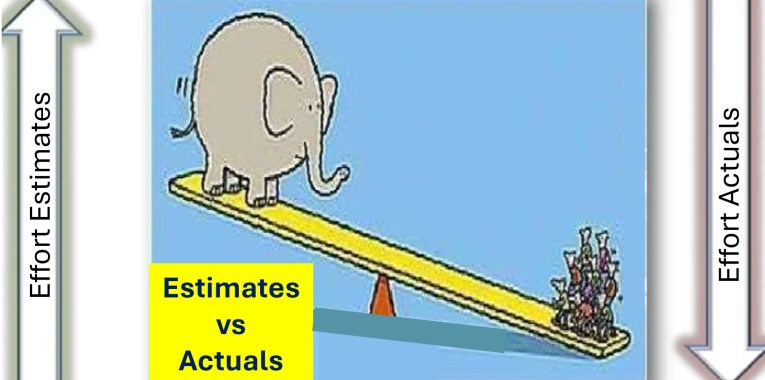
The KPI of forecast vs. actuals measures the accuracy of estimates by comparing predicted efforts with actual efforts expended. This metric is significant because:
- Performance Tracking: It helps track the performance of estimation practices over time, highlighting areas for improvement.
- Continuous Improvement: By analysing discrepancies between forecasts and actuals, teams can refine their estimation processes.
- Accountability: It holds project managers and teams accountable for their estimates, fostering a culture of precision and reliability.
- Stakeholder Confidence: Consistently meeting forecasted targets builds stakeholder confidence and supports long-term project planning.
Deadlines vs. Targets: The Right Perspective
While deadlines are essential for maintaining project momentum and ensuring timely delivery, treating effort estimates as strict deadlines can be problematic:
- Inherent Uncertainty: Estimates are inherently uncertain and subject to change due to unforeseen circumstances.
- Flexibility: Viewing estimates as targets rather than rigid deadlines allows for flexibility, accommodating changes and adjustments without compromising project quality.
- Realistic Expectations: Setting targets based on estimates helps in setting realistic expectations with stakeholders, reducing stress and pressure on the team.
Improving Estimation Accuracy
To improve the accuracy of estimates and align them more closely with project deadlines, consider the following methods:
- Historical Data Analysis: Use data from previous projects to inform current estimates, identifying patterns and common pitfalls.
- Regular Reviews: Conduct regular reviews and updates of estimates throughout the project lifecycle to account for changes and new information.
- Collaboration: Involve the entire team in the estimation process to leverage diverse perspectives and expertise.
- Training: Invest in training team members on estimation techniques and tools to enhance their skills and confidence.
- Use of Tools: Utilise estimation tools and software that can provide data-driven insights and improve estimation accuracy.
The Value to Business
Getting estimates and deadlines right provides immense value to businesses:
- Efficiency: Accurate estimates lead to better resource management and efficient project execution.
- Cost Savings: Reducing the risk of budget overruns and delays results in significant cost savings.
- Competitive Advantage: Reliable project delivery enhances the company’s reputation and competitiveness in the market.
- Employee Morale: Realistic targets and manageable deadlines contribute to higher employee satisfaction and productivity.
- Stakeholder Trust: Consistently delivering projects on time and within budget strengthens stakeholder trust and long-term relationships.
Conclusion
Effort estimates play a critical role in technology project management, but they should be treated as targets rather than strict deadlines. By using accurate estimation methods and regularly comparing forecasts with actuals, businesses can improve their project planning and execution. This approach not only enhances efficiency and cost savings but also builds stakeholder trust and supports sustainable business growth. Investing in improving estimation accuracy is a strategic move that pays dividends in the long run, ensuring successful project outcomes and a competitive edge in the technology landscape.
Also Read – The Art of IT Effort Estimation





 renierbotha ltd