
The Perils of Losing Perspective: Why Senior Leaders Must “Stay in the Helicopter” for Strategic Success

Introduction

Have you ever found yourself so deeply immersed in a hectic period that your operational duties blur the lines of strategic focus? In the fast-paced world of business, senior leadership often faces the challenge of balancing day-to-day operations with long-term strategic planning. This reminded me of a book I’ve read in 2016 – “Staying in the Helicopter: The Key to Sustained Strategic Success,” in which Richard Harrop, uses the metaphor of “staying in the helicopter” to emphasize the importance of maintaining a high-level perspective. This book has been invaluable in helping me understand the importance of maintaining a high-level perspective while managing the complexities of daily operations, ensuring that an organisation remains agile, innovative, and competitive. However, what happens when senior leaders get too involved in the minutiae of daily operations? This blog post explores the risks businesses face when their leaders “get out of the helicopter” and lose sight of the broader strategic picture.

Staying in the Helicopter – maintaining a strategic, high-level perspective

“Staying in the Helicopter: The Key to Sustained Strategic Success” by Richard Harrop is a business leadership book that emphasizes the importance of maintaining a strategic, high-level perspective to achieve long-term success. Harrop uses the metaphor of “staying in the helicopter” to illustrate the necessity for leaders to rise above daily operations and view their organization and its environment from a broader perspective.

Key themes of the book include:

  1. Strategic Vision: Encourages leaders to develop and maintain a clear, long-term vision for their organizations.
  2. Adaptability: Stresses the need for organizations to be flexible and adaptable in response to changing market conditions.
  3. Leadership Skills: Discusses the qualities and skills necessary for effective leadership, including decision-making, communication, and the ability to inspire and motivate others.
  4. Continuous Improvement: Advocates for a culture of continuous learning and improvement within organizations.
  5. Balanced Perspective: Emphasizes balancing short-term operational demands with long-term strategic goals.

Through practical advice, case studies, and personal anecdotes, Harrop provides insights and tools for leaders to enhance their strategic thinking and ensure sustained success in their organisations.

Risks of not staying in the helicopter

If senior leadership gets “out of the helicopter” and becomes overly focused on day-to-day operations, several risks to the business can arise:

  1. Loss of Strategic Vision: Without a high-level perspective, leaders may lose sight of the long-term goals and vision of the organization, leading to a lack of direction and strategic focus.
  2. Inability to Adapt: Being too immersed in daily operations can make it difficult to notice and respond to broader market trends and changes, reducing the organization’s ability to adapt to new challenges and opportunities.
  3. Missed Opportunities: Leaders might miss out on identifying new opportunities for growth, innovation, or strategic partnerships because they are too focused on immediate issues.
  4. Operational Myopia: Overemphasis on short-term operational issues can result in neglecting important strategic initiatives, such as research and development, marketing, and expansion plans.
  5. Resource Misallocation: Resources may be allocated inefficiently, focusing too much on immediate problems rather than investing in strategic projects that ensure long-term success.
  6. Employee Disengagement: Employees may feel directionless and unmotivated if they perceive that leadership lacks a clear vision or strategic direction, leading to decreased morale and productivity.
  7. Competitive Disadvantage: Competitors who maintain a strategic perspective can outmaneuver the organization, leading to a loss of market share and competitive edge.
  8. Risk Management Failures: A lack of high-level oversight can result in inadequate risk management, leaving the organization vulnerable to unforeseen threats and crises.
  9. Innovation Stagnation: Innovation may stagnate if leaders are too focused on maintaining the status quo rather than exploring new ideas and fostering a culture of creativity.
  10. Leadership Burnout: Senior leaders might experience burnout from being overly involved in day-to-day operations, which can impair their ability to lead effectively and make sound strategic decisions.

Maintaining a balance between operational oversight and strategic vision is crucial for sustainable success and long-term growth.

Conclusion

In summary, while attention to daily operations is vital for the smooth running of any organization, senior leaders must not lose sight of the bigger picture. Richard Harrop’s concept of “staying in the helicopter” serves as a critical reminder of the importance of strategic oversight. By maintaining a high-level perspective, leaders can ensure their organizations remain adaptable, innovative, and competitive. Failing to do so can lead to a host of risks, from missed opportunities to operational myopia and beyond. Balancing immediate operational demands with long-term strategic vision is essential for sustained success and growth in today’s dynamic business environment.
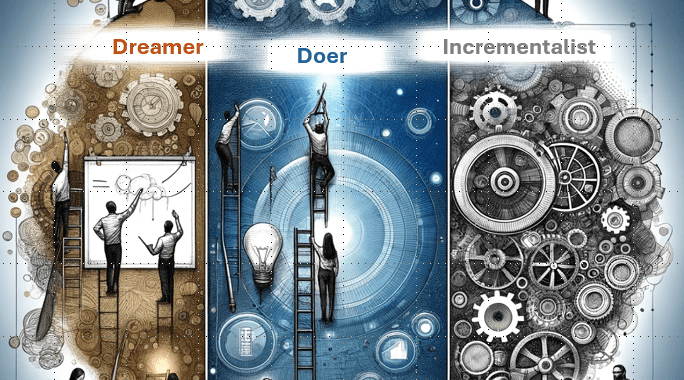

Optimising Team Dynamics: The Dreamer, Doer, and Incrementalist Framework

With over 30 years of experience in managing diverse teams, I’ve learnt that one of the key components of successful leadership is a deep understanding of your workforce’s character. Recognising the unique strengths and preferences of each individual not only enhances job satisfaction and personal development but also significantly boosts the overall productivity and harmony within the team. The Dream, Doer, and Incrementalist framework provides an invaluable tool in this regard, offering insights into effectively harnessing diverse talents and fostering an environment where innovative ideas, efficient execution, and continuous improvement thrive together.

The Dream, Doer, and Incrementalist framework offers a perspective on team dynamics and personal strengths within a professional environment. By analysing the characteristics, strengths, challenges, and synergistic potential of each type, organisations can optimise collaboration and enhance outcomes. This article delves into each of these aspects, providing a comprehensive understanding of how these personality types interact and contribute to success.

The Dreamer

Characteristics: Dreamers are visionary thinkers. They excel at big-picture thinking and are often the source of innovative ideas and ambitious goals. They thrive on possibilities and what could be, often pushing boundaries and challenging the status quo.

Strengths: The primary strength of Dreamers lies in their ability to envision and articulate a compelling future. They are great at motivating others and are often seen as charismatic leaders. Their creativity is a catalyst for innovation and inspiration within teams.

Challenges: Dreamers can sometimes struggle with the practical aspects of project execution. Their focus on visions can lead to difficulties in managing details or maintaining interest in the mundane aspects of implementation. They may also face challenges in setting realistic goals or timelines.

Examples: Visionary leaders like Steve Jobs or Elon Musk embody the Dreamer archetype, driving their companies towards groundbreaking innovations.

The Doer

Characteristics: Doers are action-oriented and pragmatic. They excel in environments where clear objectives and efficiency are prioritised. Doers are the workforce engines, turning ideas into reality through hard work and dedication.

Strengths: The primary strength of Doers lies in their ability to execute. They are dependable, often excel at managing resources, and can navigate the logistics of how to accomplish tasks effectively and efficiently.

Challenges: Doers may struggle with ambiguity and are less comfortable in situations where the goals are not clear or the pathway to them is not well defined. They may also be resistant to change and less receptive to abstract ideas that cannot be immediately acted upon.

Examples: Operations managers or project leads often fit the Doer profile, expertly translating strategic objectives into actionable plans and ensuring that goals are met on time.

The Incrementalist

Characteristics: Incrementalists are systematic thinkers who focus on gradual improvement. They excel at optimising processes and are adept at identifying and implementing small changes that cumulatively lead to significant improvements.

Strengths: Incrementalists bring a level of stability and continuous improvement to teams. They are great at problem-solving within existing frameworks and excel in environments where they can make iterative adjustments to enhance performance.

Challenges: Incrementalists may be perceived as overly cautious or resistant to radical change. Their preference for small, safe steps can sometimes hinder innovation or rapid adaptation in fast-paced environments.

Examples: Quality assurance managers or continuous improvement specialists who focus on refining processes and systems gradually are typical Incrementalists.

Collaboration and Team Dynamics

Dream and Doer: When Dreamers and Doers collaborate, they balance each other’s strengths. Dreamers provide the vision and motivation, while Doers handle the logistics and execution. This partnership can lead to high productivity and effective realisation of innovative ideas.

Dream and Incrementalist: This pairing can stabilise the radical ideas of the Dreamer with the practical, step-wise approach of the Incrementalist. It ensures that innovation is grounded in reality and is implemented progressively.

Doer and Incrementalist: Together, Doers and Incrementalists form an efficient and reliable team. They excel in environments that require high operational efficiency and risk management. However, this pairing might lack the creative spark provided by Dreamers.

All Three Together: When Dreamers, Doers, and Incrementalists work together, they form a powerful trio that can dream, plan, and refine continuously. This combination ensures that visionary ideas are not only executed efficiently but are also continuously improved upon.

Key Insights

Understanding the characteristics of Dreams, Doers, and Incrementalists allows organisations to form teams that can leverage diverse strengths. Effective management of these personalities requires recognising their unique contributions and challenges, and strategically pairing them to balance creativity, execution, and improvement. When these types are aligned with roles that suit their strengths, and when they are paired thoughtfully, they can significantly enhance team dynamics and drive successful outcomes.

Putting Out All Buckets When It Rains: Preparing for Future Droughts

In life, opportunities and challenges come in waves. Sometimes, we find ourselves amidst a downpour of chances, each one brimming with potential. Other times, we face droughts – periods where opportunities seem scarce and progress is hard to come by. I have always lived by the metaphor of “putting out all buckets when it rains – you never know when the next drought arrives” which perfectly encapsulates the need to seize opportunities and prepare for future uncertainties. This concept is crucial not only for personal growth but also for professional success and financial stability.

The Rain: Recognising Opportunities

Rain symbolises abundance and opportunities. It’s that promotion at work, the new client for your business, or the chance to learn a new skill. Recognising these moments is the first step. Often, we become complacent or assume that such opportunities will always be there. But like rain, they can be unpredictable and sporadic.

Key Actions:

  • Stay Alert: Always be on the lookout for opportunities, even if they seem small or insignificant.
  • Be Prepared: Equip yourself with the necessary skills and knowledge to take advantage of these opportunities when they arise.
  • Act Swiftly: Don’t procrastinate. When an opportunity presents itself, act quickly and decisively.

The Buckets: Maximising Potential

Putting out all buckets means making the most of every opportunity. Each bucket represents a different aspect of your life or work—financial savings, career advancement, personal development, or relationships. The more buckets you put out, the more rain you can collect.

Key Actions:

  • Diversify: Just as you wouldn’t rely on one bucket, don’t rely on a single source of opportunity. Diversify your efforts across various areas.
  • Invest Wisely: Put your time, energy, and resources into actions that yield the highest returns.
  • Build Resilience: Ensure that your buckets are sturdy. This means building strong foundations in your skills, relationships, and financial health.

The Drought: Preparing for Scarcity

Droughts are inevitable. These are the tough times when opportunities are few and far between. However, the rain you collected earlier can sustain you through these dry spells. Preparing for droughts means being proactive and planning for the future, even when everything seems to be going well.

Key Actions:

  • Save for a Rainy Day: Financially, this means building an emergency fund. Professionally, it could mean keeping your skills sharp and your network active.
  • Stay Adaptable: Be ready to pivot and adapt to new circumstances. Flexibility can be a crucial asset during tough times.
  • Reflect and Learn: Use the downtime to reflect on past actions and learn from them. This can help you make better decisions when opportunities arise again.

Balancing Rain and Drought: A Holistic Approach

Balancing the metaphorical rain and drought requires a holistic approach. It’s about understanding that life is cyclical and being prepared for both the highs and lows. Here’s how to maintain this balance:

Key Actions:

  • Mindset: Cultivate a mindset of abundance and preparedness. Understand that both rain and drought are temporary and cyclical.
  • Continuous Improvement: Never stop improving yourself. Whether it’s learning new skills, improving your health, or building better relationships, continuous improvement ensures that you’re always ready to seize opportunities.
  • Community: Surround yourself with a supportive community. Whether it’s friends, family, or professional networks, having a support system can help you weather any storm.

Business Context: Leveraging Opportunities and Mitigating Risks

In the business world, the metaphor of “putting out all buckets when it rains as you never know when the next drought arrives” is particularly relevant. Companies often experience cycles of growth and stagnation, influenced by market trends, economic conditions, and industry disruptions. Understanding how to maximise opportunities during prosperous times and preparing for inevitable challenges can mean the difference between long-term success and failure.

Recognising Business Opportunities

In a business context, rain symbolises favourable market conditions, emerging trends, and new opportunities for growth. Whether it’s a surge in demand for your products, a successful marketing campaign, or a favourable economic environment, recognising these moments and capitalising on them is crucial.

Key Actions:

  • Market Analysis: Regularly analyse market trends and consumer behaviour to identify new opportunities early.
  • Innovation: Invest in research and development to stay ahead of the competition and meet emerging market needs.
  • Agility: Foster an agile business model that can quickly adapt to new opportunities and changing market conditions.

Maximising Business Potential

Putting out all buckets in a business context means deploying resources strategically to maximise returns. This involves diversifying revenue streams, optimising operations, and investing in growth areas.

Key Actions:

  • Diversify Revenue Streams: Don’t rely on a single product or service. Explore new markets and expand your product line to mitigate risk.
  • Optimise Operations: Streamline processes to improve efficiency and reduce costs. This can free up resources to invest in new opportunities.
  • Build Strong Partnerships: Form strategic alliances and partnerships that can open new avenues for growth and innovation.

Preparing for Business Droughts

Economic downturns, market disruptions, and other challenges are inevitable in business. Preparing for these droughts ensures your company can survive and even thrive during tough times.

Key Actions:

  • Financial Reserves: Maintain a healthy cash reserve to navigate through economic downturns without compromising your operations.
  • Risk Management: Implement comprehensive risk management strategies to identify, assess, and mitigate potential risks.
  • Continuous Improvement: Invest in employee training and development to keep your workforce adaptable and resilient.

Balancing Growth and Stability

Balancing periods of growth and stability requires a strategic approach. It involves taking calculated risks while safeguarding the business against potential downturns.

Key Actions:

  • Strategic Planning: Develop long-term strategic plans that account for both growth and potential risks.
  • Scenario Planning: Use scenario planning to prepare for various market conditions and ensure the business can adapt to different situations.
  • Sustainable Practices: Incorporate sustainability into your business model to ensure long-term viability and resilience against market fluctuations.

Case Study: Successful Implementation

Consider a tech company that recognised the rising trend of remote work early on. During the “rain,” they invested heavily in developing robust telecommuting software, diversified their product offerings, and formed strategic partnerships with major corporations. They also maintained substantial financial reserves and implemented strong risk management practices. When the COVID-19 pandemic hit, and remote work became the norm, they were well-prepared. Their prior investments paid off, and they not only weathered the storm but also emerged as a market leader.

Conclusion

In business, as in life, opportunities and challenges are cyclical. By recognising opportunities, maximising potential, and preparing for downturns, companies can navigate both the prosperous and challenging times effectively. The metaphor of “putting out all buckets when it rains” underscores the importance of being proactive, strategic, and resilient. By doing so, businesses can ensure sustained growth and long-term success, regardless of market conditions.

Leaders Eat Last: Fostering Trust and Collaboration in the Workplace

Leadership styles can significantly impact the culture, morale, and productivity of an organisation. Among the myriad of leadership philosophies, one concept that stands out for its profound simplicity and transformative power is “Leaders Eat Last.” This principle, popularised by Simon Sinek in his book of the same name, serves as a powerful metaphor for the selfless attitude and actions of true leaders, focusing on creating an environment of trust and safety within organisations.

With the dynamics of the workplace continuously evolving, the principle of “Leaders Eat Last” emerges as a profound illustration of the “People Come First” philosophy in action. This leadership approach, championed by thinkers like Simon Sinek, underscores the importance of prioritising the well-being and development of employees as the cornerstone of effective leadership and organisational success. By placing people at the heart of leadership decisions, organisations can foster a culture of trust, collaboration, and shared success.

The Foundation of “People Come First”

The phrase “People Come First” encapsulates a leadership ethos that values the well-being, growth, and satisfaction of employees above all else. As covered in the blog post “Success?… People come first” (link here) in 2017, it’s a commitment to creating a work environment that respects individuals’ contributions and recognises their intrinsic value to the organisation’s success. In such cultures, leaders are seen not just as figures of authority but as caretakers of their team’s welfare and growth.

The Essence of “Leaders Eat Last

At its core, “Leaders Eat Last” is about prioritising the needs of the team over the individual needs of the leader. It’s a leadership approach that emphasises empathy, support, and the welfare of the team members. This concept is inspired by the military tradition where higher-ranking officers eat after their troops, symbolising their commitment to their team’s well-being above their own.

Leaders Eat Last: A Manifestation of Putting People First

“Leaders Eat Last” is a tangible manifestation of the “People Come First” philosophy. It’s about leaders demonstrating through their actions that they are deeply committed to the welfare of their team members. This approach signals to employees that their leaders are invested in their safety, growth, and well-being, effectively building a foundation of trust. Trust, in turn, fosters an environment where employees feel valued and secure, encouraging them to invest their energy and creativity back into the organisation.

Creating a Circle of Safety

A critical aspect of putting people first is creating what Sinek describes as a “Circle of Safety” — an environment where employees feel protected from internal and external threats. This sense of security enables team members to focus on innovation and collaboration rather than self-preservation. Leaders who prioritise their team’s needs above their own, even in small acts like eating last, reinforce this circle of safety, promoting a culture where people feel they truly come first.

Trust: The Linchpin of Organisational Success

The relationship between trust and organisational success cannot be overstated. When leaders put people first, they lay the groundwork for a culture of trust. This culture not only enhances communication and collaboration but also empowers employees to take ownership of their work and the organisation’s goals. The trust that emanates from a people-first approach creates a virtuous cycle of loyalty, innovation, and collective achievement.

Impacting Organisational Culture

Embracing a “People Come First” mentality through actions like “Leaders Eat Last” can profoundly influence an organisation’s culture. It nurtures an environment where employees feel genuinely cared for and respected, making the organisation more attractive to both current and potential talent. Such a culture encourages mentorship, lifelong learning, and a shared commitment to excellence, driving the organisation toward sustained success.

Navigating the Challenges

Implementing a people-first leadership approach requires more than aspirational rhetoric – it demands a sincere and consistent commitment from leaders at all levels. The challenge lies in genuinely embracing and living out the values of empathy, service, and sacrifice. Leaders must be prepared to listen actively, make tough decisions for the greater good, and remain steadfast in their dedication to their teams’ well-being, even when faced with adversity.

Conclusion

“Leaders Eat Last” serves as a powerful embodiment of the “People Come First” philosophy, illustrating how leadership that prioritises the well-being and development of employees can transform an organisation. By fostering a culture of trust, safety, and mutual respect, leaders can unlock the full potential of their teams, driving innovation, performance, and loyalty. As the workplace continues to evolve, the principles of putting people first and leading by example remain timeless guides to creating thriving organisations where people are truly valued and empowered to succeed.

Transformative IT: Lessons from “The Phoenix Project” on Embracing DevOps and Fostering Innovation

Synopsis

“The Phoenix Project: A Novel About IT, DevOps, and Helping Your Business Win” is a book by Gene Kim, Kevin Behr, and George Spafford that uses a fictional narrative to explore the real-world challenges faced by IT departments in modern enterprises. The story follows Bill Palmer, an IT manager at Parts Unlimited, an auto parts company on the brink of collapse due to its outdated and inefficient IT infrastructure.

The book is structured around Bill’s journey as he is unexpectedly promoted to VP of IT Operations and tasked with salvaging a critical project, code-named The Phoenix Project, which is massively over budget and behind schedule. Through his efforts to save the project and the company, Bill is introduced to the principles of DevOps, a set of practices that aim to unify software development (Dev) and software operation (Ops).

As Bill navigates a series of crises, he learns from a mysterious mentor named Erik, who introduces him to the “Three Ways”: The principles of flow (making work move faster through the system), feedback (creating short feedback loops to learn and adapt), and continual learning and experimentation. These principles guide Bill and his team in transforming their IT department from a bottleneck into a competitive advantage for Parts Unlimited.

“The Phoenix Project” is not just a story about IT and DevOps, it’s a tale about leadership, collaboration, and the importance of aligning technology with business objectives. It’s praised for its insightful depiction of the challenges faced by IT professionals and for offering practical solutions through the lens of a compelling narrative. The book has become essential reading for anyone involved in IT management, software development, and organisational change.

Learnings

“The Phoenix Project” offers numerous key learnings and benefits for IT professionals, encapsulating valuable lessons in IT management, DevOps practices, and organizational culture. Here are some of the most significant takeaways:

  • The Importance of DevOps: The book illustrates how integrating development and operations teams can lead to more efficient and effective processes, emphasizing collaboration, automation, continuous delivery, and quick feedback loops.
  • The Three Ways:
    • The First Way focuses on the flow of work from Development to IT Operations to the customer, encouraging the streamlining of processes and reduction of bottlenecks.
    • The Second Way emphasizes the importance of feedback loops. Quick and effective feedback can help in early identification and resolution of issues, leading to improved quality and customer satisfaction.
    • The Third Way is about creating a culture of continual experimentation, learning, and taking risks. Encouraging continuous improvement and innovation can lead to better processes and products.
  • Understanding and Managing Work in Progress (WIP): Limiting the amount of work in progress can improve focus, speed up delivery times, and reduce burnout among team members.
  • Automation: Automating repetitive tasks can reduce errors, free up valuable resources, and speed up the delivery of software updates.
  • Breaking Down Silos: Encouraging collaboration and communication between different departments (not just IT and development) can lead to a more cohesive and agile organization.
  • Focus on the Value Stream: Identifying and focusing on the value stream, or the steps that directly contribute to delivering value to the customer, can help in prioritizing work and eliminating waste.
  • Leadership and Culture: The book underscores the critical role of leadership in driving change and fostering a culture that values continuous improvement, collaboration, and innovation.
  • Learning from Failures: Encouraging a culture where failures are seen as opportunities for learning and growth can help organizations innovate and improve continuously.

For IT professionals, “The Phoenix Project” is more than just a guide to implementing DevOps practices, it’s a manifesto for a cultural shift towards more agile, collaborative, and efficient IT management approaches. It offers insights into how IT can transform from a cost center to a strategic partner capable of delivering significant business value.

Embracing Fractional Technology Leadership Roles: Unlocking Business Potential

In today’s fast-paced and ever-evolving business landscape, companies are increasingly turning to fractional technology leadership roles to drive innovation, streamline operations, and maintain a competitive edge. But what exactly are these roles, and what benefits do they offer to organisations? Let’s explore.

What are Fractional Technology Leadership Roles?

Fractional technology leadership roles involve hiring experienced tech leaders on a part-time or contract basis to fulfil critical leadership functions without the full-time commitment. These roles can include fractional Chief Information Officers (CIOs), Chief Technology Officers (CTOs), and other senior IT positions. Unlike traditional full-time roles, fractional leaders provide their expertise for a fraction of the time and cost, offering flexibility and specialised knowledge tailored to specific business needs.

Benefits of Fractional Technology Leadership

  1. Cost-Effective Expertise
    • Budget-Friendly: Small and medium-sized enterprises (SMEs) often struggle with the high costs associated with full-time C-suite executives. Fractional leaders provide top-tier expertise at a fraction of the cost, making it financially feasible for businesses to access high-level strategic guidance.
    • No Long-Term Commitment: Companies can engage fractional leaders on a project basis or for a specified period, eliminating the financial burden of long-term employment contracts, benefits, and bonuses.
  2. Flexibility and Scalability
    • Adaptable Engagements: Businesses can scale the involvement of fractional leaders up or down based on project demands, budget constraints, and strategic priorities. This flexibility ensures that companies can adapt to changing market conditions without the rigidity of permanent roles.
    • Specialised Skills: Organisations can tap into a diverse pool of talent with specialised skills tailored to their current needs, whether it’s implementing a new technology, managing a digital transformation, or enhancing cybersecurity measures.
  3. Accelerated Innovation and Growth
    • Fresh Perspectives: Fractional leaders bring fresh ideas and perspectives from their diverse experiences across industries. This can foster innovation and help companies identify new opportunities for growth and improvement.
    • Immediate Impact: With their extensive experience, fractional technology leaders can hit the ground running, delivering immediate value and accelerating the pace of technology-driven initiatives.
  4. Reduced Risk
    • Expert Guidance: Navigating the complexities of technology implementation and digital transformation can be daunting. Fractional leaders provide expert guidance, reducing the risk of costly mistakes and ensuring that projects are executed efficiently and effectively.
    • Crisis Management: In times of crisis or technological disruption, fractional leaders can step in to provide stability, strategic direction, and crisis management expertise, helping businesses navigate challenges with confidence.
  5. Focus on Core Business Functions
    • Delegate Complex Tasks: By entrusting technology leadership to fractional experts, business owners and executives can focus on core business functions and strategic goals, knowing that their technology initiatives are in capable hands.
    • Enhanced Productivity: With dedicated fractional leaders managing tech projects, internal teams can operate more efficiently, leading to enhanced productivity and overall business performance.

Unlock Your Business Potential with renierbotha Ltd

Are you ready to drive innovation, streamline operations, and maintain a competitive edge in today’s dynamic business environment? Look no further than renierbotha Ltd for exceptional fractional technology leadership services.

At renierbotha Ltd, we specialise in providing top-tier technology leaders on a part-time or contract basis, delivering the expertise you need without the full-time commitment. Our experienced fractional CIOs, CTOs, and senior IT leaders bring fresh perspectives, specialised skills, and immediate impact to your organisation, ensuring your technology initiatives are executed efficiently and effectively.

Why Choose renierbotha Ltd?

  • Cost-Effective Expertise: Access high-level strategic guidance at a fraction of the cost.
  • Flexibility and Scalability: Adapt our services to your project demands and strategic priorities.
  • Accelerated Innovation: Benefit from fresh ideas and rapid implementation of technology-driven initiatives.
  • Reduced Risk: Navigate the complexities of technology with expert guidance and crisis management.
  • Enhanced Focus: Delegate complex tech tasks to us, allowing you to concentrate on your core business functions.

Take the Next Step

Don’t let the challenges of technology hold your business back. Partner with renierbotha Ltd and unlock the full potential of fractional technology leadership. Contact us today to discuss how our tailored services can help your organisation thrive.

Contact Us Now

Conclusion

Fractional technology leadership roles offer a compelling solution for businesses seeking high-level expertise without the financial and logistical challenges of full-time executive hires. By leveraging the flexibility, specialised skills, and strategic insights of fractional leaders, companies can drive innovation, accelerate growth, and navigate the complexities of today’s technology landscape with confidence.

Embrace the future of technology leadership and unlock your business’s potential with fractional technology roles.

Experience the future of technology leadership with renierbotha Ltd. Let’s drive your business forward together!

Case Study: Driving Transformation and Innovation at Shawbrook Bank

Background:
Shawbrook Bank, a specialised savings and lending institution, faced the challenge of enhancing its service delivery, operational efficiency, and fostering a culture of innovation. In late 2019, Renier Botha, the Head of Delivery and Innovation (Central Functions), took charge to lead the bank’s central functions, including Risk & Regulatory, Compliance, Finance, Human Resources, Procurement, Cyber Security, and IT Infrastructure, towards achieving annual growth and service delivery targets.

Challenge:
Renier Botha was tasked with initiating and sustaining strategic changes across various departments. The objective was not just to meet the annual growth and service delivery targets but also to establish a culture of innovation and excellence within the bank.

Solution:
1. Strategic Change Leadership:
Renier Botha played a pivotal role in overseeing a £5.5m Central Functions strategic & continuous change portfolio. Under his guidance, 16 programmes, projects, and continuous change workstreams were executed, resulting in a 10.1% saving against the budget.

2. Talent Empowerment:
Botha’s key initiative involved building a highly skilled and customer-focused core change team. By empowering the team and ensuring knowledge retention, Shawbrook Bank could rely on a group of experts capable of driving change and innovation forward.

3. Vendor Management and Partnerships:
Effective negotiation of commercial and Service Level Agreements (SLAs) ensured strong relationships with vendors and flexible resource partners. This approach guaranteed specialised service delivery and viable solutions for the bank’s diverse needs.

4. Innovation and Automation:
The establishment of the Change Portfolio Management Office (PMO), under Renier Botha’s leadership, marked a significant milestone. Skilled staff, mentored by Botha, collected key performance metrics to produce real-time Management Information (MI). Automation and data-driven insights facilitated proactive governance, setting new standards for efficiency and decision-making.

5. Mentorship and Coaching:
Renier Botha took on the responsibility of coaching and mentoring technology and project management staff. This personalised approach not only helped individuals achieve their career objectives but also aligned their goals with the broader business strategy.

Results:

  • Operational Efficiency: Streamlining processes and embracing automation led to a substantial increase in operational efficiency. Issues that previously took over 30 days to resolve were now tackled within 2 days, ensuring uninterrupted services.
  • Innovation Culture: The bank’s culture shifted towards innovation, with the establishment of the Testing Capability initiative being a testament to this. By reducing regression testing efforts by 95%, continuous delivery became a reality, fostering a culture of innovation and rapid adaptation.
  • Recognition and Acclaim: Shawbrook Bank’s transformation efforts, especially the successful Ambit Enterprise upgrade, received accolades from the board, positioning the bank as a leader in managed delivery practices.

Conclusion:
Under the leadership of Renier Botha, the Head of Delivery and Innovation, Shawbrook Bank successfully reshaped its central functions. By embracing change and cultivating a culture of excellence and innovation, Shawbrook Bank not only met its growth and service delivery targets but also set new industry standards, positioning itself as a beacon of success and innovation in the competitive financial sector. Renier Botha’s strategic vision and hands-on leadership were instrumental in this transformative journey, making Shawbrook Bank a leader in the ever-evolving landscape of banking and finance.

12 Useful Psychological Hacks

#1. If you want to know about something from someone , ask them a question and when they are done answering , keep silent and maintain an eye contact. They will tell you some more stuff, almost everything.

#2. When you try to convince someone over something, make sure they are sitting and you are standing. This makes them believe you sooner.

#3. The key to confidence is walking into a room and assume that everyone already likes you.

#4. Refer to people you’ve just met by their name. People love being referred to by their name and it will establish a sense of trust and friendship right away. Example: “Nice to meet you Alex. So, Alex how do you know John?” And continue to repeat name throughout the conversation.

#5. If someone is attracted to you, their eyes start blinking more than usual during a conversation with you.

#6. Spot the difference between a fake smile and a real one. You can find out if someone is smiling for real or faking it by looking at their eyes. Wrinkles form near eye corners when the smile is genuine.

#7. Pay attention to people’s feet. To know if someone is interested in a conversation look at their feet, if they are pointing towards you, they are. If they are pointing sideways or any other direction, they aren’t. Feet don’t lie.

#8. When at a party or a meeting. When at a party or a meeting, crack a joke and observe the people who are laughing around you. People who feel close to each other will be looking at each other. This is useful for discerning out friendships and other relationships.

#9. The life hack to make people do what you want them to do. Offer someone a choice instead of a command. For example, instead of saying drink your milk to a toddler, ask which mug would he/she like to drink milk from. This gives the person a sense of control hence produces a higher chance of a better outcome.

#10 How to win an argument?. If the person arguing loses his temper and starts shouting, natural human tendency is to shout back. DON’T! Stay calm and reply in silence. Try it! It works.

#11. Mirror people’s body language to build up trust. If you subtly mimic the body language of the person you’re talking to, you can effectively build up trust with them. By mirroring the way they speak and how they move they’ll like you more, because, to them, it will seem as if you are pretty good compatible.

#12 Inception To plant a seed of idea in someone’s mind, ask them to not think of a particular thing at all. Let’s say I ask you to NOT think about motorbikes. What are you thinking of?

Top quotes on Change & Trust by Stephen Covey

7Habits-Covey

I’ve first read this book “7 Habits of Highly Effective People” in the 90’s – timeless inspiration!


  1. “There are three constants in life – change, choice and principles.”
  2. “Make time for planning; Wars are won in the general’s tent.”
  3. “Be proactive.” 
  4. “Begin with the end in mind.”
  5. “You have to decide what your highest priorities are and have the courage – pleasantly, smiling, nonapoloegetically – to say ‘no’ to other things. And the way to do that is by having a bigger ‘yes’ burning inside.”
  6. “Put first things first.”
  7. “Think win-win.”
  8. “Seek first to understand, and then to be understood.” 
  9. “Most people do not listen with the intent to understand. Most people listen with the intent to reply.”
  10. “If we keep doing what we’re doing, we’re going to keep getting what we’re getting.”
  11. “Trust is the glue of life. It’s the most essential ingredient in effective communication. It’s the foundational principle that holds all relationships.” 
  12. “Treat your employees exactly as you want them to treat your best customers.” 
  13. “The key is not to prioritise what’s on your schedule but to schedule your priorities.” Leadership is a choice, not a position.” 
  14. “I am not a product of my circumstances, I am a product of my decisions.” 
  15. “Strength lies in differences not in similarities.” 
  16. “Listen with your eyes for feelings.” 
  17. “The way we see the problem is the problem.” 
  18. “Most of us spend too much time on what is urgent and not enough time on what is important.” 
  19. “Accountability breeds response-ability.” 
  20. “Highly proactive people don’t blame circumstances, conditions or conditioning for their behaviour. Their behaviour of their own conscious choice.” 
  21. “Management is doing things right; leadership is doing the right things.” 
  22. “Be a light not a judge. Be a model not a choice. be part of the solution not part of the problem.” 
  23. “He who has a why can deal with any what or how.” Stephen Covey
  24. “Our ultimate freedom is the right and power anybody or anything outside ourselves will affect us.” 
  25. “The only thing that endures over time is the Law of the Farm. You must prepare the ground, plant the seed, cultivate, and water it if you expect to reap the harvest.”
  26. “A personal mission statement becomes the DNA for every other decision we make.” 
  27. “Courage is not the absence of fear but the awareness that something else is more important.” 
  28. “To achieve goals you’ve never achieved before you need to start doing things you’ve never done before.” 
  29. “Live out of your imagination, not your history.” 
  30. “Sow a thought, reap an action; sow an action, reap a habit; sow a habit, reap a character; sow a character, reap a destiny.” 
  31. “Every human has four endowments – self-awareness, conscience, independent will and creative imagination. These give us the ultimate human freedom. The power to choose, to respond, to change.” 
  32. “I teach people how to treat me by what I will allow.” 
  33. “Motivation is a fire from within. If someone else trie to light that fire under you, chances are it will burn very briefly.” 
  34. “You can change the fruit without changing the root.” 
  35. “Our character is basically a composite of our habits because they are consistent. Often unconscious patterns, they constantly, daily, express our character.” 
  36. “Be patient with yourself. Self-growth is tender; it’s holy ground. There’s no greater investment.” 
  37. “If I really want to improve my situation, I can work on the one thing over which I have control – myself.” 
  38. “Once you have a clear picture of your priorities that is values, goals, and high leverage activities, organise your life around them.”
  39. “What you do has greater impact than what you say.”


Also see quotes from Peter Drucker

3 positions of leadership – Leading from the front

We can learn much from horses about teamwork and leadership in business. In our workshops with horses, we share a leadership model that the horses use to create cohesive teamwork. It involves three positions of leadership and we will explore Leading from the front in more detail in this post.

Many of our clients have found this leadership model to be enlightening and have embraced and implemented it into their business with substantial success. The model is based on building relationships rather than a more traditional command and control style of leadership which does not engage and inspire employees. The success of the team is dependent on every team member taking responsibility for leadership and changing their position within the team according to what they believe is needed in each moment.

The model we use is adapted from a model developed by Klaus Ferdinand Hempfling. He observed that there are three different leadership roles in a herd of horses:

  • Leading from the front where the leader sets the pace, destination and direction
  • Leading from the side where leaders coach each other in a democratic leadership style and ensure everyone is moving forward together in the same direction
  • Leading from behind which has a check and balance style of leadership and drives the team forward to maintain momentum

Each member of the team is leading at different moments, and all are essential to the success of the team.

It might seem obvious that dragging or shoving half a ton of horse is impossible yet many employees feel as though they are on the receiving end of this behaviour in the workplace. When we work with horses, we are always working at a fine-tuning level of leadership to maximise leaders’ effectiveness so we reduce coercion and passivity and help leaders find that knife-edge of assertiveness when they are leading out of the comfort zone. As a result, they improve their ability to flex and adapt to what is needed in any given situation and are able to inspire their teams much more easily.

In this post, I share an extract from a book titled Leadership Beyond Measure which explores leading from the front in more detail.

Leading from the front
The alpha mare is the most dominant member of the herd and leads from the front. Her role is to set the pace, direction and destination. Since horses are a prey animal, they are on the alert for danger. Imagine a pack of wild dogs appears, the alpha mare will decide where the herd go, how they get there and how fast they go.

If the dogs are close by, she will set off at a gallop. If they are further away, she will set off at a walk. She will go as fast as is necessary to keep the herd safe. This way, the herd conserve their energy for when it is most needed. Many people in business are going at three hundred miles per hour constantly. That is exhausting, and more balance is essential to prevent burn-out and work-related stress.

In a workplace setting, the leader of the company and each team and department usually lead from the front. For example, the MD or CEO will set the strategy and vision for a company. A Project Manager defines clear goals and objectives for his project team. A leader of a team translates the vision and goals so everyone on their team has clear expectations. Everyone at some point will need to lead from the front.

If nobody takes the lead from the front or the vision and direction are not clear enough, the team gets diverted and disperses. This can ultimately lead to conflict in the team and causes increased workload as the team become ineffective. If you’ve ever sat in a meeting and listened to a discussion go round and round without a decision, you’ve experienced what happens when nobody is leading from the front.

And if you’ve ever sat in a meeting where everyone talks over the top of each other, then you’ve experienced what happens when everyone is trying to lead from the front!

One of the challenges of leading from the front is you can get so far ahead that you lose the team. It is essential to keep checking that all team members are coming with you and understand where they are going. A common mistake in organisations is to believe that the strategy and vision have been clearly communicated when they have not. If the team is not doing what you want them to do, the destination, pace and direction need to be clearer.

When leading from the front, the focus is in the direction you are heading. If you keep turning round and looking back, you create a stop/start behaviour in your team. It indicates doubt, a lack of self-belief and self-confidence. Leading from the front requires enormous trust in yourself and the team and a belief that people will execute the strategy you have set. Be purposeful, focused, committed and clear about where you are heading or the team may stall.

In today’s business environments of rapid transformation and change, leading from the front is critical to providing the clarity and vision that employees need in order to drive the business forward.

How clear is the vision in your business and team?

Next month, I’ll explore Leading from behind and how it is critical to drive the team forward in line with the vision and pace that has been articulated.

Jude Jennison is an international speaker, author and Horse Assisted Educator with a 16 year senior leadership career in a global IT organisation, where she led UK, European and global teams.

Jude helps senior leaders and executive teams develop embodied leadership skills that create tangible business results. By receiving a horse’s non-judgemental feedback, any leader can identify their leadership behaviours and transform themselves into a courageous and hugely influential non-verbal communicator.

For more information on our leadership development programmes,
contact us on 0800 170 1810 or visit our website www.theleadershipwhisperers.com

NED :: Non-Executive Director’s proposition

Are you aware of the substantive and measurable value a Non-Executive Director can bring to you and your business…?

Introduction

The Non-Executive Director, no longer a role that is associated just with large organisations. There is a growing awareness of the NED role and more and more organisations are appointing NEDs of various types, and specific specialities, often within technology and digital transformation, to enhance the effectiveness of their boards as standard practise.

With the pressure on organisations to compete globally, deal with digital transformation and respond to rapidly changing market conditions, new skills are needed at board level. This leads to the role of the NED diversifying and introduces a need to refresh the NEDs as circumstances change, bringing in new specialities, experience and challenge when the organisation needs it.

A good NED can, and should make a substantive and measurable contribution to the effectiveness of the board. Do not see a NED as a consulting advisor – a NED, within the remit of the role of a company director, play a full and active part in the success efforts of an organisation. Irrespective of the skills, experience and network contacts that NEDs will bring, they must above all, provide appropriate independent and constructive challenge to the board.

Both the organisation and the NED must understand the purpose of being a NED, within the specific organisation, for the role to be effective. This includes a clear understanding of what value the NED is expected to bring. A NED’s value goes beyond just the statutory requirements.

On appointment a Non-executive director can:

  • Broaden the horizons and experience of existing executive directors.
  • Facilitate the cross-fertilisation of ideas, particularly in terms of business strategy and planning.
  • Have a vital part to play in appraising and commenting on a company’s investment/expenditure plans.
  • Bring wisdom, perspective, contacts and credibility to your business.
  • Be the lighthouse that helps you find your way and steer clear of near and present dangers.

The role of the NED

All directors, including NEDs, are required to:

  • provide entrepreneurial leadership of the company
  • set the company’s vision, strategy and strategic objectives
  • set the company’s values and standards
  • ensure that its obligations to its shareholders and others are understood and met.

In addition, the role of the NED has the following key elements:

  • Strategy: NEDs should constructively challenge and help develop proposals on strategy.
  • Performance: NEDs should scrutinise the performance of management in meeting agreed goals and objectives and monitor the reporting of performance.
  • Risk: NEDs should satisfy themselves on the integrity of financial information and that financial controls and systems of risk management are robust and defensible.
  • People: NEDs are responsible for determining appropriate levels of remuneration of executive directors and have a prime role in appointing, and where necessary removing, executive directors, and in succession planning.

“In broad terms, the role of the NED, under the leadership of the chairman, is: to ensure that there is an effective executive team in place; to participate actively in the decision–takingprocess of the board; and to exercise appropriate oversight over execution of the agreed strategy by the executive team.”; Walker Report, 2009


A non-executive director will bring the follow benefits to your company:

  • strengthen the board and provide an independent viewpoint
  • contribute to the creation of a sound business plan, policy and strategy
  • review plans and budgets that will implement policy and strategy
  • be a confidential and trusted sounding board for the MD/CEO and keep the focus of the MD/CEO
  • have the experience to objectively assess the company’s overall performance
  • have the experience and confidence to stand firm when he or she believes the executive directors are acting in an inappropriate manner
  • ensure good corporate governance
  • provide outside experience of the workings of other companies and industries, and have beneficial sector contacts and experience gained in previous businesses
  • have the ability to clearly communicate with fellow directors
  • have the ability to gain the respect of the other directors
  • possess the tact and skill to work with the executive directors, providing support and encouragement where difficult decisions are being made
  • have contacts with third parties such as financial sources, grant providers and potential clients

Looking for a NED?

Now that you understand what a NED can do – What are you waiting for?

Contact Renier Botha if you are looking for an experienced director with strong technology and digital transformation skills.

Renier has demonstrable success in developing and delivering visionary business & technology strategies. His experience include Mergers & Acquisitions (M&A), major capital projects, growth, governance, compliance, risk management as well as business and organisation development. From startup to FTSE listed enterprise, the value Renier can bring as NED is substantive, driving business growth.