When Longevity Becomes a Liability: The Innovation Challenge of Long-Tenured Staff

Why Long-Tenure Staff May Hinder Innovation in Business

in the digital era, businesses are under constant pressure to innovate, adapt, and stay ahead of the competition. Technology is no longer just a supporting function; it is the backbone of modern business operations. Consequently, the IT department plays a pivotal role in driving innovation. However, many organisations are beginning to realise that long-tenure IT staff—while valuable in many ways—can sometimes act as a barrier to the innovation required for growth and success.

Here, we’ll explore why this phenomenon occurs and how businesses can balance institutional knowledge with fresh perspectives to foster innovation.

The Benefits of Long-Tenure IT Staff

Before diving into the challenges, it’s important to recognise the advantages long-tenured IT staff bring:

  1. Deep Institutional Knowledge: Long-tenured employees are often well-versed in a company’s systems, processes, and history. They understand the intricacies of legacy systems, organisational workflows, and the cultural nuances that drive decision-making.
  2. Reliability and Stability: Experienced IT staff often become the go-to experts for troubleshooting and maintaining the systems that keep businesses running smoothly.
  3. Strong Relationships: Over time, long-term employees build trust and rapport with other departments, vendors, and stakeholders.

While these qualities are beneficial for operational continuity, they can inadvertently create barriers to innovation.

The Innovation Problem with Long-Tenured IT Staff

  1. Comfort with the Status Quo Long-tenured IT professionals often grow comfortable with existing systems and processes. This familiarity can breed complacency or resistance to change. Phrases like “We’ve always done it this way” become a common refrain, stifling creative problem-solving and the adoption of cutting-edge solutions.
  2. Over-Reliance on Legacy Systems IT staff who have been with an organisation for a long time may have invested significant effort in developing or maintaining legacy systems. They may resist initiatives that threaten to replace or overhaul these systems, even when such changes are critical for innovation. This attachment can lead to technical debt and inhibit digital transformation.
  3. Skill Stagnation Technology evolves rapidly, and IT professionals must continually learn and adapt. However, long-tenured staff may prioritise maintaining existing systems over acquiring new skills, leaving the organisation at a disadvantage when adopting emerging technologies such as artificial intelligence, blockchain, or advanced data analytics.
  4. Criticism of Change to Protect Knowledge Long-tenured staff often perceive change as a threat to their hold on knowledge and influence within the organisation. New systems, tools, or processes might reduce the reliance on their expertise, potentially diminishing their perceived value. As a result, they may criticise or sabotage new initiatives to maintain their authority, hindering the adoption of innovations that could benefit the business.
  5. Conflicts with Other Staff and Held Grudges Over time, long-tenured employees may develop personal or professional conflicts with colleagues. These grudges can create tension and impede collaboration. For instance, they might resist new ideas proposed by newer staff, not because the ideas lack merit, but due to unresolved interpersonal issues. Such behaviour fosters a toxic environment that stifles innovation and discourages cross-functional teamwork.
  6. Groupthink and Insular Thinking Long-term employees often form tight-knit teams that share similar perspectives. While this cohesion can be beneficial, it can also lead to groupthink, where alternative ideas and outside-the-box thinking are dismissed. This insularity can prevent the organisation from exploring innovative approaches.
  7. Lack of Fresh Perspectives Innovation often comes from diverse perspectives and new ways of thinking. Long-tenured IT staff, steeped in a company’s established practices, may lack the external viewpoints needed to challenge norms and drive disruptive innovation.

Balancing Institutional Knowledge with Innovation

To foster a culture of innovation without losing the value of long-tenured staff, organisations should adopt a balanced approach:

  1. Encourage Lifelong Learning Provide long-tenured staff with access to training, certifications, and opportunities to learn emerging technologies. Encouraging continuous education can help them stay relevant and open to change.
  2. Infuse New Talent Actively recruit IT professionals with diverse experiences and fresh perspectives. These new hires can bring innovative ideas and challenge entrenched ways of thinking.
  3. Promote Cross-Functional Collaboration Innovation often arises from collaboration across departments. Encourage IT teams to work closely with other areas of the business, such as marketing, product development, and customer experience, to identify and implement creative solutions.
  4. Reward Risk-Taking and Experimentation Create a culture that rewards experimentation and tolerates failure. This will motivate both new and long-tenured employees to propose bold ideas and explore innovative technologies.
  5. Address Interpersonal Conflicts Organisations should prioritise conflict resolution strategies to address grudges or interpersonal issues. This could involve mediation, open discussions, or team-building exercises to rebuild trust and foster collaboration.
  6. Implement Reverse Mentorship Programmes Pair long-tenured staff with newer employees or younger professionals who can share fresh perspectives, tech trends, and innovative approaches. This two-way exchange benefits both parties and enhances the organisation’s overall agility.
  7. Embrace Agile Practices Adopting agile methodologies can help break down silos and encourage iterative innovation. This can be especially helpful in pushing long-tenured staff to embrace change and adapt to dynamic business needs.

Conclusion

While long-tenured IT staff are valuable for their institutional knowledge and operational stability, their comfort with the status quo, resistance to change, and interpersonal conflicts can inadvertently stifle innovation. Businesses must recognise these challenges and proactively address them by fostering a culture that balances experience with fresh perspectives. Encouraging lifelong learning, resolving conflicts, and embracing diverse viewpoints are essential steps to maintaining a forward-thinking IT team.

Ultimately, innovation isn’t just about technology—it’s about mindset. By addressing these barriers, organisations can empower their IT departments to become true catalysts for transformation, driving growth and competitiveness in today’s rapidly evolving landscape.

Handling Underqualified or Inexperienced Team Members in Leadership Positions

One of the most challenging dynamics in a software development project is when underqualified, underskilled, or inexperienced individuals are placed in positions of leadership. This can result in poor decision-making, lack of direction, and demotivated team members. It’s crucial to address this issue tactfully to protect the project’s success and maintain a collaborative environment.

The Challenges of Inexperienced Leadership

When unqualified leaders are part of the equation, several challenges may arise:

  • Poor Decision-Making: Inadequate technical or managerial knowledge can lead to unrealistic timelines, poor resource allocation, or misguided priorities.
  • Micromanagement or Overreach: Lacking confidence in their own skills, inexperienced leaders may micromanage, creating friction within the team.
  • Failure to Empower the Team: Leadership requires enabling others to excel, but an inexperienced leader may stifle creativity and productivity.
  • Erosion of Trust: If the team perceives the leader as incapable, respect and trust diminish, further undermining the leader’s authority.

Strategies for Navigating This Dynamic

  1. Focus on Collaboration, Not Authority Approach the situation with empathy and focus on collaboration rather than challenging their authority directly. Demonstrate your willingness to work together for the project’s benefit, which can alleviate tension and create a sense of partnership.
    • Example: If they make a questionable decision, frame your input as a suggestion: “I see where you’re coming from, but have you considered [alternative]?”
  2. Provide Constructive Feedback If the leader’s decisions or actions are harming the project, it’s essential to provide feedback. Focus on behaviors and outcomes rather than personal traits. Use examples to illustrate your points.
    • Example: “In our last sprint, we underestimated the time required for testing. I think we could avoid this next time by involving the QA team earlier in planning.”
  3. Support Their Growth Inexperienced leaders often struggle because they lack the necessary tools or mentorship. Offer your support:
    • Share relevant resources, like documentation or articles.
    • Suggest training or professional development opportunities.
    • Offer to mentor them in specific areas where you have expertise.
    By positioning yourself as a partner rather than a critic, you foster goodwill and mutual respect.
  4. Leverage Collective Expertise Encourage a team-driven approach to decision-making. This reduces the pressure on the leader and ensures better outcomes for the project.
    • Example: Use retrospectives, brainstorming sessions, or collaborative planning tools to democratize the decision-making process.
  5. Escalate Through the Proper Channels If the leader’s inexperience is causing significant harm to the project, escalate the issue to the appropriate stakeholders:
    • Present documented examples of the impact (missed deadlines, low morale, etc.).
    • Focus on solutions rather than blaming the individual.
    • Suggest implementing a mentoring system, co-leadership, or involving senior team members in decision-making.

Strengthening Leadership in the Organization

To prevent unqualified leaders from being placed in critical roles, organizations should:

  • Vet Leadership Roles Thoroughly: Implement more rigorous evaluation processes for leadership appointments, focusing on both technical and soft skills.
  • Foster a Mentorship Culture: Pair new leaders with experienced mentors to guide them through their responsibilities.
  • Invest in Leadership Training: Provide resources, courses, and workshops to help team members develop the skills necessary for leadership.
  • Encourage Honest Feedback: Create an environment where team members can provide feedback about leadership without fear of repercussions.

When the System Fails

If all efforts to address the issue fail and the unqualified leader remains in their role, you may need to:

  • Adapt Your Role: Focus on how you can contribute effectively despite the challenges.
  • Protect Team Morale: Foster camaraderie and collaboration within the team to minimize the impact of weak leadership.
  • Evaluate Long-Term Options: If poor leadership is a systemic issue within the organization, consider whether the environment aligns with your professional goals.

Conclusion

An inexperienced leader doesn’t have to doom a project. By taking proactive steps to support their growth, providing constructive feedback, and fostering team collaboration, you can mitigate the challenges posed by underqualified leadership. While addressing this issue requires tact and patience, it’s an opportunity to model the kind of leadership that inspires respect, drives success, and builds stronger teams for the future.

The Perils of Losing Perspective: Why Senior Leaders Must “Stay in the Helicopter” for Strategic Success

Introduction

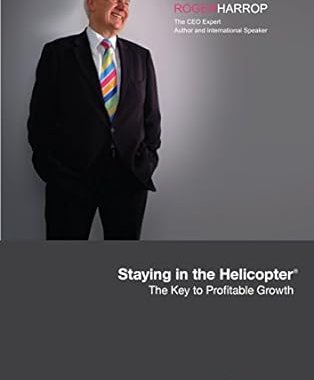
Have you ever found yourself so deeply immersed in a hectic period that your operational duties blur the lines of strategic focus? In the fast-paced world of business, senior leadership often faces the challenge of balancing day-to-day operations with long-term strategic planning. This reminded me of a book I’ve read in 2016 – “Staying in the Helicopter: The Key to Sustained Strategic Success,” in which Richard Harrop, uses the metaphor of “staying in the helicopter” to emphasize the importance of maintaining a high-level perspective. This book has been invaluable in helping me understand the importance of maintaining a high-level perspective while managing the complexities of daily operations, ensuring that an organisation remains agile, innovative, and competitive. However, what happens when senior leaders get too involved in the minutiae of daily operations? This blog post explores the risks businesses face when their leaders “get out of the helicopter” and lose sight of the broader strategic picture.

Staying in the Helicopter – maintaining a strategic, high-level perspective

“Staying in the Helicopter: The Key to Sustained Strategic Success” by Richard Harrop is a business leadership book that emphasizes the importance of maintaining a strategic, high-level perspective to achieve long-term success. Harrop uses the metaphor of “staying in the helicopter” to illustrate the necessity for leaders to rise above daily operations and view their organization and its environment from a broader perspective.

Key themes of the book include:

  1. Strategic Vision: Encourages leaders to develop and maintain a clear, long-term vision for their organizations.
  2. Adaptability: Stresses the need for organizations to be flexible and adaptable in response to changing market conditions.
  3. Leadership Skills: Discusses the qualities and skills necessary for effective leadership, including decision-making, communication, and the ability to inspire and motivate others.
  4. Continuous Improvement: Advocates for a culture of continuous learning and improvement within organizations.
  5. Balanced Perspective: Emphasizes balancing short-term operational demands with long-term strategic goals.

Through practical advice, case studies, and personal anecdotes, Harrop provides insights and tools for leaders to enhance their strategic thinking and ensure sustained success in their organisations.

Risks of not staying in the helicopter

If senior leadership gets “out of the helicopter” and becomes overly focused on day-to-day operations, several risks to the business can arise:

  1. Loss of Strategic Vision: Without a high-level perspective, leaders may lose sight of the long-term goals and vision of the organization, leading to a lack of direction and strategic focus.
  2. Inability to Adapt: Being too immersed in daily operations can make it difficult to notice and respond to broader market trends and changes, reducing the organization’s ability to adapt to new challenges and opportunities.
  3. Missed Opportunities: Leaders might miss out on identifying new opportunities for growth, innovation, or strategic partnerships because they are too focused on immediate issues.
  4. Operational Myopia: Overemphasis on short-term operational issues can result in neglecting important strategic initiatives, such as research and development, marketing, and expansion plans.
  5. Resource Misallocation: Resources may be allocated inefficiently, focusing too much on immediate problems rather than investing in strategic projects that ensure long-term success.
  6. Employee Disengagement: Employees may feel directionless and unmotivated if they perceive that leadership lacks a clear vision or strategic direction, leading to decreased morale and productivity.
  7. Competitive Disadvantage: Competitors who maintain a strategic perspective can outmaneuver the organization, leading to a loss of market share and competitive edge.
  8. Risk Management Failures: A lack of high-level oversight can result in inadequate risk management, leaving the organization vulnerable to unforeseen threats and crises.
  9. Innovation Stagnation: Innovation may stagnate if leaders are too focused on maintaining the status quo rather than exploring new ideas and fostering a culture of creativity.
  10. Leadership Burnout: Senior leaders might experience burnout from being overly involved in day-to-day operations, which can impair their ability to lead effectively and make sound strategic decisions.

Maintaining a balance between operational oversight and strategic vision is crucial for sustainable success and long-term growth.

Conclusion

In summary, while attention to daily operations is vital for the smooth running of any organization, senior leaders must not lose sight of the bigger picture. Richard Harrop’s concept of “staying in the helicopter” serves as a critical reminder of the importance of strategic oversight. By maintaining a high-level perspective, leaders can ensure their organizations remain adaptable, innovative, and competitive. Failing to do so can lead to a host of risks, from missed opportunities to operational myopia and beyond. Balancing immediate operational demands with long-term strategic vision is essential for sustained success and growth in today’s dynamic business environment.

The Dynamics of Managing IT Staff: Non-Technical Business Leaders vs. Business-Savvy Technical Leaders

Introduction

In today’s technology driven business environment, the interplay between technical and non-technical roles is crucial for the success of many companies, particularly in industries heavily reliant on IT. As companies increasingly depend on technology, the question arises: Should IT staff be managed by non-technical people, or is it more effective to have IT professionals who possess strong business acumen?

The question of whether non-technical people should manage IT staff is a significant one, as the answer can impact the efficiency and harmony of operations within an organisation. This blog post delves into the perspectives of both IT staff and business staff to explore the feasibility and implications of such managerial structures.

Understanding the Roles

IT Staff: Typically includes roles such as software developers, data and analytics professionals, system administrators, network engineers, and technical support specialists. These individuals are experts in their fields, possessing deep technical knowledge and skills.

Business Staff (Non-Technical Managers): Includes roles like cleint account managers, project managers, team leaders, sales, marketing and human resources and other managerial positions that may not require detailed technical expertise but focus on project delivery, client interaction, and meeting business objectives.

Undeniably, the relationship between technical and non-technical roles is pivotal but there are different perspectives on who is best suited to manage technical staff which introduces specific challenges but also benefits and advantages to the business as a whole.

Perspectives on Non-Technical Management of IT Staff

IT Staff’s Point of View

Challenges:

  • Miscommunication: Technical concepts and projects often involve a language of their own. Non-technical managers may lack the vocabulary and understanding needed to effectively communicate requirements or constraints to their IT teams.
  • Mismatched Expectations: Without a strong grasp of technical challenges and what is realistically achievable, non-technical managers might set unrealistic deadlines or fail to allocate sufficient resources, leading to stress and burnout among IT staff.
  • Inadequate Advocacy: IT staff might feel that non-technical managers are less capable of advocating for the team’s needs, such as the importance of technical debt reduction, to higher management or stakeholders.

Benefits:

  • Broader Perspective: Non-technical managers might bring a fresh perspective that focuses more on the business or customer impact rather than just the technical side.
  • Enhanced Focus on Professional Development: Managers with a non-technical background might prioritize soft skills and professional growth, helping IT staff develop in areas like communication and leadership.

Business Staff’s Point of View

Advantages:

  • Focus on Business Objectives: Non-technical managers are often more attuned to the company’s business strategies and can steer IT projects to align more closely with business goals.
  • Improved Interdepartmental Communication: Managers without deep technical expertise might be better at translating technical jargon into business language, which can help bridge gaps between different departments.

Challenges:

  • Dependency on Technical Leads: Non-technical managers often have to rely heavily on technical leads or senior IT staff to make key decisions, which can create bottlenecks or delay decision-making.
  • Potential Underestimation of Technical Challenges: There’s a risk of underestimating the complexity or time requirement for IT projects, which can lead to unrealistic expectations from stakeholders.

Best Practices for Non-Technical Management of IT Teams

  • Education and Learning: Non-technical managers should commit to learning basic IT concepts and the specific technologies their team works with to improve communication and understanding.
  • Hiring and Leveraging Technical Leads: Including skilled technical leads who can act as a bridge between the IT team and the non-technical manager can mitigate many challenges.
  • Regular Feedback and Communication: Establishing strong lines of communication through regular one-on-ones and team meetings can help address issues before they escalate.
  • Respecting Expertise: Non-technical managers should respect and trust the technical assessments provided by their team, especially on the feasibility and time frames of projects.

The Role of IT Professionals with Strong Business Acumen and Commercial Awareness

The evolving landscape of IT in business settings, has begun to emphasise the importance of IT professionals who not only possess technical expertise but also a strong understanding of business processes and commercial principles – technology professionals with financial intelligence and a strong commercial awareness. Such dual-capacity professionals can bridge the gap between technical solutions and business outcomes, effectively enhancing the strategic integration of IT into broader business goals.

Advantages of IT Staff with Business Skills

  • Enhanced Strategic Alignment: IT professionals with a business acumen can better understand and anticipate the needs of the business, leading to more aligned and proactive IT strategies. They are able to design and implement technology solutions that directly support business objectives, rather than just fulfilling technical requirements.
  • Improved Project Management: When IT staff grasp the broader business impact of their projects, they can manage priorities, resources, and timelines more effectively. This capability makes them excellent project managers who can oversee complex projects that require a balance of technical and business considerations.
  • Effective Communication with Stakeholders: Communication barriers often exist between technical teams and non-technical stakeholders. IT staff who are versed in business concepts can translate complex technical information into terms that are meaningful and impactful for business decision-makers, improving decision-making processes and project outcomes.
  • Better Risk Management: Understanding the business implications of technical decisions allows IT professionals to better assess and manage risks related to cybersecurity, data integrity, and system reliability in the context of business impact. This proactive risk management is crucial in protecting the company’s assets and reputation.
  • Leadership and Influence: IT professionals with strong business insights are often seen as leaders who can guide the direction of technology within the company. Their ability to align technology with business goals gives them a powerful voice in strategic decision-making processes.

Cultivating Business Acumen within IT Teams

Organizations can support IT staff in developing business acumen through cross-training, involvement in business operations, mentorship programs, and aligning performance metrics with business outcomes.

  • Training and Development: Encouraging IT staff to participate in cross-training programs or to pursue business-related education, such as MBA courses or workshops in business strategy and finance, can enhance their understanding of business dynamics.
  • Involvement in Business Operations: Involving IT staff in business meetings, strategy sessions, and decision-making processes (appart form being essential to be succesful in technology delivery alignment) can provide them with a deeper insight into the business, enhancing their ability to contribute effectively.
  • Mentorship Programs: Pairing IT professionals with business leaders within the organization as mentors can facilitate the transfer of business knowledge and strategic thinking skills.
  • Performance Metrics: Aligning performance metrics for IT staff with business outcomes, rather than just technical outputs, encourages them to focus on how their roles and projects impact the broader business objectives.

The Dynamics of Managing IT Staff: Non-Technical Managers vs. Tech-Savvy Business Leaders

In the intricate web of modern business operations, the relationship between technical and non-technical roles is crucial. This article explores both scenarios, highlighting the perspectives of IT and business staff, along with the advantages of having tech-savvy business leaders within IT.

Conclusion

Whether non-technical managers or IT staff with strong business acumen should lead IT teams depends largely on their ability to understand and integrate technical and business perspectives. Effective management in IT requires a balance of technical knowledge and business insight, and the right approach can differ based on the specific context of the organisation. By fostering understanding and communication between technical and non-technical realms, companies can harness the full potential of their IT capabilities to support business objectives.

IT professionals who develop business acumen and commercial awareness can significantly enhance the value they bring to their organisations. By understanding both the technical and business sides of the equation, they are uniquely positioned to drive innovations that are both technologically sound and commercially viable. This synergy not only improves the effectiveness of IT enablement but also elevates the strategic role of IT within the organisation.

A good book on the topic: What the numbers mean” by Renier Botha

As more and more companies become increasingly digitally driven, the trend is that smart companies are investing more in their digital strategies and the conversion of technology innovation into revenue earning products and services.

Leading businesses in this technology age, will be the technologist, the IT leaders of today is becoming the business leaders of the future.

This book provides a concise overview of the most important financial functions, statements, terms, practical application guidelines and performance measures.

You’ll learn the value that commercial awareness and financial intelligence bring to setting strategy, increasing productivity and efficiency and how it can support you in making more effective decisions.

Making your digital business resilient using AI

To staying relevant in a swift-moving digital marketplace, resilience isn’t merely about survival, it’s about flourishing. Artificial Intelligence (AI) stands at the vanguard of empowering businesses not only to navigate the complex tapestry of supply and demand but also to derive insights and foster innovation in ways previously unthinkable. Let’s explore how AI can transform your digital business into a resilient, future-proof entity.

Navigating Supply vs. Demand with AI

Balancing supply with demand is a perennial challenge for any business. Excess supply leads to wastage and increased costs, while insufficient supply can result in missed opportunities and dissatisfied customers. AI, with its predictive analytics capabilities, offers a potent tool for forecasting demand with great accuracy. By analysing vast quantities of data, AI algorithms can predict fluctuations in demand based on seasonal trends, market dynamics, and even consumer behaviour on social media. This predictive prowess allows businesses to optimise their supply chains, ensuring they have the appropriate amount of product available at the right time, thereby maximising efficiency and customer satisfaction.

Deriving Robust and Scientific Insights

In the era of information, data is plentiful, but deriving meaningful insights from this data poses a significant challenge. AI and machine learning algorithms excel at sifting through large data sets to identify patterns, trends, and correlations that might not be apparent to human analysts. This capability enables businesses to make decisions based on robust and scientific insights rather than intuition or guesswork. For instance, AI can help identify which customer segments are most profitable, which products are likely to become bestsellers, and even predict churn rates. These insights are invaluable for strategic planning and can significantly enhance a company’s competitive edge.

Balancing Innovation with Business as Usual (BAU)

While innovation is crucial for growth and staying ahead of the competition, businesses must also maintain their BAU activities. AI can play a pivotal role in striking this balance. On one hand, AI-driven automation can take over repetitive, time-consuming tasks, freeing up human resources to focus on more strategic, innovative projects. On the other hand, AI itself can be a source of innovation, enabling businesses to explore new products, services, and business models. For example, AI can help create personalised customer experiences, develop new delivery methods, or even identify untapped markets.

Fostering a Culture of Innovation

For AI to truly make an impact, it’s insufficient for it to be merely a tool that is used—it needs to be part of the company’s DNA. This means fostering a culture of innovation where experimentation is encouraged, failure is seen as a learning opportunity, and employees at all levels are empowered to think creatively. Access to innovation should not be confined to a select few; instead, an environment where everyone is encouraged to contribute ideas can lead to breakthroughs that significantly enhance business resilience.

In conclusion, making your digital business resilient in today’s volatile market requires a strategic embrace of AI. By leveraging AI to balance supply and demand, derive scientific insights, balance innovation with BAU, and foster a culture of innovation, businesses can not only withstand the challenges of today but also thrive in the uncertainties of tomorrow. The future belongs to those who are prepared to innovate, adapt, and lead with intelligence. AI is not just a tool in this journey; it is a transformative force that can redefine what it means to be resilient.

Unlocking Developer Potential: Strategies for Building High-Performing Tech Teams

Introduction

Attracting and retaining top developer talent is crucial for technology leaders, especially in a highly competitive landscape. With software innovation driving business growth, organisations with high-performing engineering cultures gain a significant advantage. Fostering this culture goes beyond perks; it requires a thoughtful approach to talent management that prioritises the developer experience.

This blog post explores strategies to enhance talent management and create an environment where developers thrive. By fostering psychological safety, investing in top-tier tools, and offering meaningful growth opportunities, we can boost innovation, productivity, and satisfaction. Let’s dive in and unlock the full potential of our development teams.

1. Understanding the Importance of Developer Experience

Before diving into specific tactics, it’s important to understand why prioritising developer experience matters:

  • Attracting Top Talent: In a competitive job market, developers can choose their employers. Organisations that offer opportunities for experimentation, stay abreast of the latest technologies, and focus on outcomes over outputs have an edge in attracting the best talent.
  • Boosting Productivity and Innovation: Supported, empowered, and engaged developers bring their best to work daily, resulting in higher productivity, faster problem-solving, and innovative solutions.
  • Reducing Turnover: Developers who feel valued and fulfilled are less likely to leave, improving retention rates and reducing the costs associated with constant hiring and training.

2. Fostering Psychological Safety

Psychological safety—the belief that one can speak up, take risks, and make mistakes without fear of punishment—is essential for high-performing teams. Here’s how to cultivate it:

  • Encourage Open Communication: Create an environment where developers feel safe sharing ideas, asking questions, and providing feedback. Use one-on-ones, team meetings, and anonymous surveys to solicit input.
  • Embrace Failure as Learning: Frame mistakes as learning opportunities rather than assigning blame. Encourage developers to share their failures and lessons learned.
  • Model Vulnerability: Leaders set the tone. By admitting mistakes and asking for help, we create space for others to do the same.

3. Investing in World-Class Tools

Providing the best tools boosts productivity, creativity, and job satisfaction. Focus on these areas:

  • Hardware and Software: Equip your team with high-performance computers, multiple monitors, and ergonomic peripherals. Regularly update software licences.
  • Development Environments: Offer cutting-edge IDEs, version control systems, and collaboration tools. Automate tasks like code formatting and testing.
  • Infrastructure: Ensure your development, staging, and production environments are reliable, scalable, and easy to work with. Embrace cloud technologies and infrastructure-as-code for rapid iteration and deployment.

4. Providing Meaningful Growth Opportunities

Developers thrive on challenge and growth. Here’s how to keep them engaged:

  • Tailored Learning Paths: Work with each developer to create a personalised learning plan aligned with their career goals. Provide access to online courses, face-to-face training, conferences, and mentorship.
  • Encourage Side Projects: Give developers time for passion projects to stretch their skills. Host hackathons or innovation days to spark new ideas.
  • Create Leadership Opportunities: Identify high-potential developers and offer chances to lead projects, mentor juniors, or present work to stakeholders.

5. Measuring and Iterating

Measure the impact of talent management efforts and continuously improve:

  • Developer Satisfaction: Survey your team regularly to gauge happiness, engagement, and psychological safety. Look for trends and areas for improvement.
  • Productivity Metrics: Track key performance indicators such as Objectives and Key Results (OKRs), cycle time, defect rates, and feature throughput. Celebrate successes and identify opportunities to streamline processes.
  • Retention Rates: Monitor turnover and conduct exit interviews to understand why developers leave. Use these insights to refine your approach.

6. Partnering with HR

Enhancing developer experience requires collaboration with HR:

  • Collaborate on Hiring: Work with recruiters to create compelling job descriptions and interview processes that highlight your commitment to the developer experience.
  • Align on Performance Management: Ensure that performance reviews, compensation, and promotions align with your talent management philosophy. Advocate for practices that reward innovation and growth.
  • Champion Diversity, Equality, and Inclusion: Partner with HR to create initiatives that foster a diverse and inclusive culture, driving innovation through multiple perspectives.

7. Building a Community of Practice

Build a sense of community among your developers:

  • Host Regular Events: Organise meetups, lunch-and-learns, or hackathons for knowledge sharing and collaboration.
  • Create Communication Channels: Use Slack, Microsoft Teams, or other tools for technical discussions and informal conversations.
  • Celebrate Successes: Regularly recognise and reward developers who exemplify your values or achieve significant milestones.

Conclusion

In conclusion, cultivating a high-performing tech team goes beyond simply hiring skilled developers, it requires a strategic and holistic approach to talent management. By prioritising psychological safety, investing in superior tools, and providing avenues for meaningful growth, organisations can not only attract top talent but also nurture a culture of innovation and satisfaction. Regular assessment of these strategies through feedback, performance metrics, and collaboration with HR can further refine and enhance the developer experience. By committing to these principles, technology leaders can build resilient, innovative teams that are well-equipped to drive business success in an ever-evolving digital landscape. Let’s take these insights forward and transform our development teams into powerful engines of growth and innovation.

Top quotes on Change & Trust by Stephen Covey

7Habits-Covey

I’ve first read this book “7 Habits of Highly Effective People” in the 90’s – timeless inspiration!


  1. “There are three constants in life – change, choice and principles.”
  2. “Make time for planning; Wars are won in the general’s tent.”
  3. “Be proactive.” 
  4. “Begin with the end in mind.”
  5. “You have to decide what your highest priorities are and have the courage – pleasantly, smiling, nonapoloegetically – to say ‘no’ to other things. And the way to do that is by having a bigger ‘yes’ burning inside.”
  6. “Put first things first.”
  7. “Think win-win.”
  8. “Seek first to understand, and then to be understood.” 
  9. “Most people do not listen with the intent to understand. Most people listen with the intent to reply.”
  10. “If we keep doing what we’re doing, we’re going to keep getting what we’re getting.”
  11. “Trust is the glue of life. It’s the most essential ingredient in effective communication. It’s the foundational principle that holds all relationships.” 
  12. “Treat your employees exactly as you want them to treat your best customers.” 
  13. “The key is not to prioritise what’s on your schedule but to schedule your priorities.” Leadership is a choice, not a position.” 
  14. “I am not a product of my circumstances, I am a product of my decisions.” 
  15. “Strength lies in differences not in similarities.” 
  16. “Listen with your eyes for feelings.” 
  17. “The way we see the problem is the problem.” 
  18. “Most of us spend too much time on what is urgent and not enough time on what is important.” 
  19. “Accountability breeds response-ability.” 
  20. “Highly proactive people don’t blame circumstances, conditions or conditioning for their behaviour. Their behaviour of their own conscious choice.” 
  21. “Management is doing things right; leadership is doing the right things.” 
  22. “Be a light not a judge. Be a model not a choice. be part of the solution not part of the problem.” 
  23. “He who has a why can deal with any what or how.” Stephen Covey
  24. “Our ultimate freedom is the right and power anybody or anything outside ourselves will affect us.” 
  25. “The only thing that endures over time is the Law of the Farm. You must prepare the ground, plant the seed, cultivate, and water it if you expect to reap the harvest.”
  26. “A personal mission statement becomes the DNA for every other decision we make.” 
  27. “Courage is not the absence of fear but the awareness that something else is more important.” 
  28. “To achieve goals you’ve never achieved before you need to start doing things you’ve never done before.” 
  29. “Live out of your imagination, not your history.” 
  30. “Sow a thought, reap an action; sow an action, reap a habit; sow a habit, reap a character; sow a character, reap a destiny.” 
  31. “Every human has four endowments – self-awareness, conscience, independent will and creative imagination. These give us the ultimate human freedom. The power to choose, to respond, to change.” 
  32. “I teach people how to treat me by what I will allow.” 
  33. “Motivation is a fire from within. If someone else trie to light that fire under you, chances are it will burn very briefly.” 
  34. “You can change the fruit without changing the root.” 
  35. “Our character is basically a composite of our habits because they are consistent. Often unconscious patterns, they constantly, daily, express our character.” 
  36. “Be patient with yourself. Self-growth is tender; it’s holy ground. There’s no greater investment.” 
  37. “If I really want to improve my situation, I can work on the one thing over which I have control – myself.” 
  38. “Once you have a clear picture of your priorities that is values, goals, and high leverage activities, organise your life around them.”
  39. “What you do has greater impact than what you say.”


Also see quotes from Peter Drucker

5 Whys

5 Whys” technique for Root Cause Analysis (RCA)

Do you have a recurring problem that keeps on coming back despite repeated actions to address it? This might be an indication that you are treating the symptoms of the problem and not the actual problem itself – you need to determine the root cause of the problem – you must conduct a root cause analysis.

Root cause analysis (RCA) is a systematic process for identifying “root causes” of problems and the appropriate response that effectively deals with it. RCA is based on the basic idea that effective management requires more than merely “putting out fires” through quick fixes for problems that develop, but finding a way to prevent them from occurring again or in the first place. A root cause analysis is a process used to identify the primary source of a problem.

An effective method to get to the bottom of a problem is to use the “5 Whys” that was initially developed as part of TPS (Toyota Production System) that gave birth to what we know today as Lean Six Sigma – discussed in more detail in the article on “Lean Six Sigma – Organisational Development and Change”.

5 Whys is an iterative interrogative (problem solving) technique used to explore the cause-and-effect relationships underlying a particular problem.

The primary goal of the technique is to determine the root cause (source) of a defect or problem by repeating the question “Why?”, five times. Each answer forms the basis of the next question.

Why five time? This derives from an anecdotal observation on the number of iterations needed to resolve the problem.

How to conduct the 5 Why technique:

  1. Write down the specific problem. Writing the issue helps you formalize the problem and describe it completely. It also helps a team focus on the same problem.
  2. Ask Why the problem happens and write the answer down below the problem.
  3. If the answer you just provided doesn’t identify the root cause of the problem that you wrote down in Step 1, ask Why again and write that answer down.
  4. Loop back to step 3 until the team is in agreement that the problem’s root cause is identified. Again, this may take fewer or more times than five Whys.

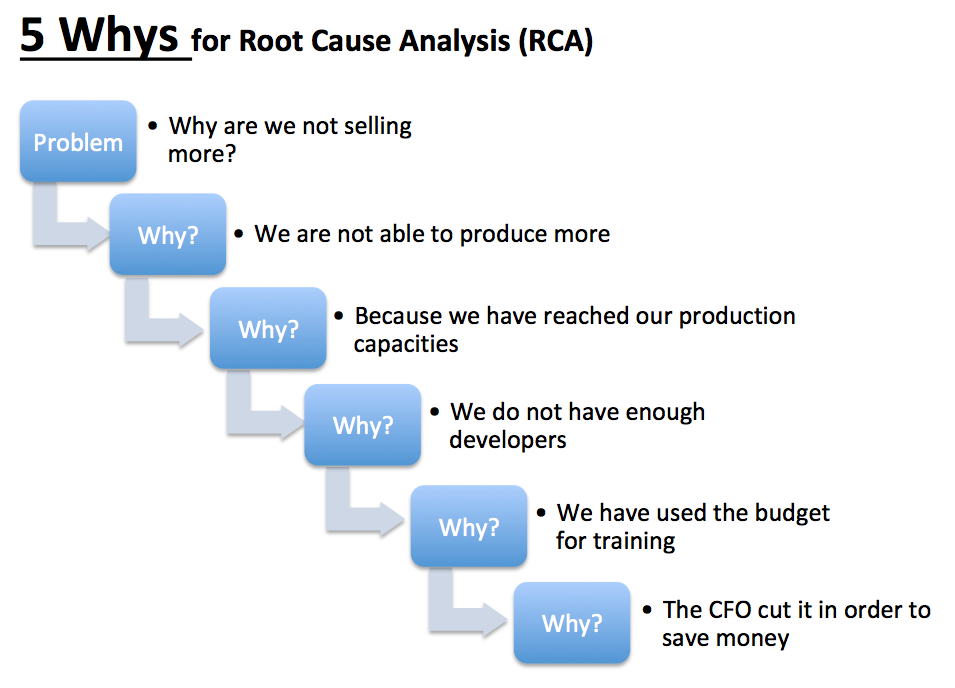
For example:

5Whys - RCA

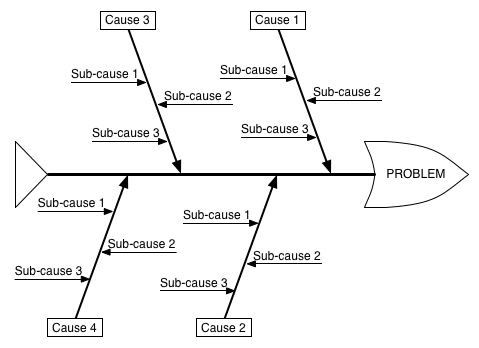
In business, only one cause for a problem is not the usual case. Using the 5 Whys in conjunction with the Fishbone Diagram (Ishikawa), that helps the exploration process to cover all potential inputs and hence potential causes of problems or defects.

fishbone-diag3

 The 5 Whys method can be used to uncover multiple root causes by repeating the process asking a different sequence of questions each time.


Effective Leadership Communication

We have all heard the saying: “Communication is the key to success!”

Leadership coaches and successful leaders all agree that when it comes to communication – A leader can never communicate enough! The communication gurus say that even when there is nothing to communicate, the leader should communicate that there is nothing to communicate…

I have been asked the questions: “ How do you communicate effectively to ensure that everyone in the team are on the same page?” and “How do you ensure that you address and manage people’s expectations?”

To answer this, I’ll start by over simplifying in saying that communication is simply the exchange of information between a sender and a receiver, through a specific medium. In electronic engineering information is transferred from a transmitter to a receiver as an electric signal in a controlled way, ensuring the receiver receives the same information that left the sender – effective communication. That is no different with humans. As a leader communicating to your team, you are distributing information amongst other humans, amongst people – and herein the challenge. People, unlike electronic senders and receivers (which are manufactured to be identical) are different, not one is alike. Hence will the interpretation of the information exchanged through communication  differ as well. The challenge to effective communication is to align the interpretation of the information into a common understanding between the communicator (speaker/sender) and the audience (listener/receiver).

The ways in which you can ensure that you are addressing and managing people’s expectations better, are in understanding the people better. A better understanding of people, paradoxically comes through effective communication – to ask questions and listen more than actually doing the talking (active listening).

Communication is more than just your words – it is also:

  • how you say it – tone of voice, passion, authenticity
  • why you say it – the message’s intention
  • when you say it – time of day or after a specific milestone or prior an event
  • what you say AND what you don’t to say – sometimes what you don’t say gives a clearer picture of what you want to say…
  • your body language – facial expression, gestures and posture communicate a lot of the unsaid word

Communication Empowers

Consuming information leads to knowledge and knowledge is power. Thus communication leads to empowerment.

The ‘One Minute Manager’ refers to empowerment as: “Empowerment is something someone gives you – leadership is what you do to make it work.”

Communication empowers people with knowledge – to be informed and to feel part of something bigger. How the communication is being delivered (leadership) will determine it’s outcome.

What is LeadershipMy definition: “Leadership is the art of leading a group of people or an organisation to execute a common task by providing a vision that they follow willingly through the inspiration received from the leader’s passion, knowledge, methodologies, approach, and ability to influence the interests of all members and stakeholders.”

How can you accomplish this if you cannot effectively communicate the vision in a way that people feel inspired to willingly take action towards achieving it? Effective communication is key…

You can have the best team mission with SMART objectives but if you cannot communicate it to your team, you will struggle to make progress. How well you can communicate your plan (unambiguously) will determine if your team will really mobilise and unite behind you and go the extra mile to make it happen. The ultimate success measure of effective communication is: “your plan becomes the team’s plan” – everybody on the same page!

People are not mind readers – they need clear instructions and clear information to make decisions and conduct their work, especially if the work is delivered within a team where coherence and a mutual output objective are of the essence. Ultimately, it is in your best interest to accept responsibility for getting what you need to succeed in the workplace. As leaders it is in your best interest and your responsibility to ensure that what’s needed to succeed, is effectively communicated to your work teams.

Consider This

You can improve the effectiveness of your communication through paying attention to the following aspects, each discussed in more detail below:

  • Know & Understand your audience
  • Motivational & Confidence building
  • Have a Plan
  • Make sure the communication subject is clear – stick to it
  • Be Direct
  • Be Authentic
  • Enough detail
  • Bi-directional communication is more impactful
  • Common Cause
  • Think before you speak
  • Emotional Intelligence
  • Get Assurance – get feedback, assure the message sent is the message received
  • Build Trust
  • Situational leadership – choose the communication style to suite the situation


Know & Understand the Audience

Being an effective communicator allows you to address the interests and concerns of your target audience whether it being your team, your customer or client, the stakeholders or an audience listening to your presentation. Knowing and understanding your audience help to ensure that your grab their attention when you communicate and that they feel your are addressing the message to them. To understand your audience better and to structure communication appropriately, you can ask questions like:

  • Who is the audience?
  • Why is that the audience? (sometimes this is obvious but by asking this question, really think about who should be getting this message and why? Why not?)
  • What are we trying to achieve?
  • What are your plans?
  • What are the expectations of me as the leader/presenter and of the people the team members/audience?
  • What will be the desired impact of your message? (Also think about the undesired outcomes and how you can proactively prevent that?)
  • What will be the impact of your plans to the business, the team and to the people personally? – Do not leave people with more questions than before.
  • Why can we productively work together? (Understanding this is key to structuring the message to utilise people’s strengths to bring acceptance and empowerment – a sense of belonging.)
  • How will we know we are doing a great job? (How will this be measured within the audience – everyone needs to understand the metrics.)
  • Are you using a language (terminology and jargon) that the audience can relate to? There is a difference in technology speak and business speak. Align the vocabulary to your target audience – i.e. when addressing business leaders do not use too much technical acronyms and terms, rather focus on outcomes and financial numbers.
  • Do you understand the audience’s needs?
  • How can you, as the leader, meet their needs?
  • How frequently do I need to communicate? (Constant)
  • What method, approach and medium (usually a combination of) will deliver the message best? (Face to face, one to one, round table, town hall, informal stand-up, email, presentation (power-point), graphs, bullet points, etc…)
  • To what level of detail do I need to go into, to describe clearly what I mean? (Post communication, everybody must have the same picture in their minds.)

Motivational and Confidence building

Communication should always be motivational and aim to build confidence within the audience – especially when bad news is being delivered. Ensure that you mention the performance of the team, the success resulting from the efforts. The positive future that awaits and the confidence that you have in the teams abilities to realise that future. Keep repremending content to the point and as short as possible and always follow it up with a positive prospect building trust and confidence.

Have a plan

If you are communicating change or progress, you must come prepared with a plan. Have a relevant understanding of the past, the present and the future. The plan is usually “how” the team will progress from where they have been, using what they have today to build the desired future. Progress against a plan must always be measurable to unsure continuous improvement.

Be clear on what is being communicated

Ensure that everyone is clear of the subject being communicated. Focus on the key message of the communication and present it in a direct and authentic way. Stick to the subject. Ensure that the message comes with the right context and content for the receiver to place it in the right perspective.

Be Direct

I believe in a direct approach – say it as it is. Have the guts to say what is needed. Speak about the hard things that no one talks about but everyone wants to hear. Address the elephant in the room, preferably before you are asked about it.

 Be Authentic

My believe is to always be truthful and authentic in delivering your message, be yourself – people see straight through anything else…

Enough detail

Ensure that you communicate just enough detail to ensure everyone has the same picture in his or her minds after you have communicated. Too much detail and people will loose interest. Too little detail and people will makeup their own inconsistent picture. Remember the story of the group of people that were told that there is a cat in the room next door… the storyteller waited for the picture to start forming and then asked each one of the audience to describe it. As you can imagine various different pictures were presented – a black cat, a ginger cat or is it a tiger?

Always be prepared to go into way more detail than what you expect – your ability to use detailed facts to support your message, especially when asked about it, will determine the credibility of your message.

Bi-directional

Successful communication always has to be two-way. You have to be a good listener as well. Be prepared to have collaboratively discussions – listen intently before you respond. Do not formulate your next response in your head instead of listening to what is being said or asked. Your team will have a wealth of knowledge and insight that might help to enhance the right picture. This means being able to have a meaningful discussion with people, understanding, assisting and facilitating the resolution of their problems, ensuring people know what to do and why they are doing it without you having to tell them how to do it. (See Success – people come first).

Effective communication is the continuous search and commitment to seek for a better understanding. Approach conversations from a learning perspective, an opportunity to get to know more rather than a one directional “tell” perspective.

Common Cause

For the message to hit home it must address a common cause – something that address the benefit of the team but also on an individual level. Either create a common cause in your communication or remind people of the common cause – why it is important to be part of something bigger rather than just you as an individual.

 Think before your speak

Stop and think things through before you act in haste, sending out an ill-considered communication. Think what needs to happen, what are the benefits, risks, what are the desired outcome… Then compile a well-considered and effective communication. Remember this – Once the message is out, you can never really take it back.

Emotional Intelligence

In the blog post on Emotional Intelligence, EQ is defined under five interconnected components:

  • Self-awareness
  • Self-regulation
  • Motivation
  • Empathy
  • Social skills

Use your own EI to assess the situation before your decide on the appropriate way to react and how what needs communicating. In short I say:” Trust your gut feeling.”

Get Assurance

Continuously test the effectiveness of your communication by asking people to relay to you what their interpretation is. Ask this questions at all levels – do not assume that the organisation structure will distribute the intended message to all that needs to hear it – go check for yourself. Get feedback. Get the assurance that people understand what you are communicating and that if people are remembering and acting on what has been communicated. If not – communicate again, again!

Build Trust

You want your communications to be trusted. How do you build trust? By doing what you say you are going to do and build relationships at all levels with integrity and honesty. When you are trusted, your communication is on-boarded more sincerely and you are taken seriously – building rapport.

Situational Communication (and Leadership)

There are many different leadership styles (read more here) as outlined in the list below:

  • Autocratic Leadership
  • Bureaucratic Leadership
  • Charismatic Leadership
  • Democratic/Participative Leadership
  • Laissez-Faire Leadership
  • People-Oriented/Relations-Oriented Leadership
  • Servant Leadership
  • Task-Oriented Leadership
  • Transactional Leadership
  • Transformational Leadership

The “One Minute Manager” summarised leadership into four basic styles:

  • Directing – The leader provides specific instructions and closely supervises the accomplishment. (Communicate mainly by telling people what needs to be done)
  • Coaching – The leader continuous to direct and closely supervise but also explains decisions, solicits suggestions and support progress made. (Communicate a directive or corrective after team collaboration)
  • Supporting – The leader facilitates and supports people’s efforts toward accomplishment and shares responsibility for decision making with them. (Communicate similarly to the Coaching style)
  • Delegating – The leader turns over responsibility for decision making and problem solving to subordinates. (Communicate collaboratively and inclusively)

Usually the leaders default communication style is directly related to the leadership style. An effective leader can adapt his management style and hence his communication style according to the situation, including consideration for the audience and the nature of the message to be communicated.

To Conclude

Remember and think about all the aspects mentioned for consideration, before you communicate. Be flexible and agile in your approach to communication – as a leader you must be able to fluently switch between different leadership and communication styles and mediums to ensure optimum results, in the moment. There is no one glove that fit them all, leadership is not a science – hence the art of leadership. You’ll know when you get it right – do more of those!

Every situation is different and hence can a single communication approach not be seen as superior to the other – there are no equals. I’ll conclude with this saying from the ‘One Minute Manager’: “There is nothing so unequal as the equal treatment of un-equals.”


Also Read:

Management Communication Plan

 

Bimodal Organisations

The continuous push towards business improvement combined with the digital revolution, that has changed the way the customer is engaging with business through the use of technology, have introduced the need for an agility in the delivery of IT services. This speed and agility in IT delivery, for the business to keep abreast of a fast evolving and innovative technology landscape and to gain an competitive advantage are not just required in the development and/or introduction of new technology into the business, but in the way “keep the lights on” IT operations are reliably delivered through stable platforms and processes enabling business growth as well.

IT Bimodal

We can agree that once systems and solutions are adopted and integrated into business operations, the business requirement for IT delivery changes with IT stability, reliability, availability and quality as key enablers to business performance optimisation. There are thus two very distinct and equally important ways or modes of delivering IT services that should seamlessly combine into the overall IT Service Operations contributing to business growth.

Gartner minted in 2016 the concept of IT Bimodal – the practise to manage two separate coherent modes of IT delivery.

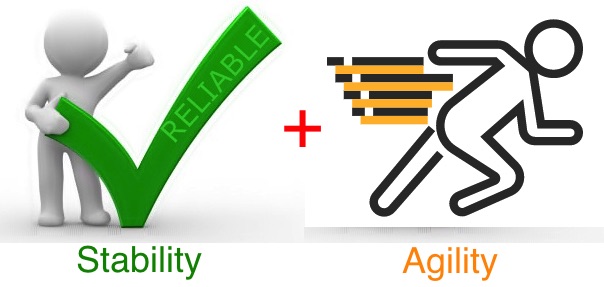
Mode 1: Focussed on Stability Mode 2: Focussed on Agility
Traditional Exploratory
Sequential Non-linear
Emphasis on: Safety & Accuracy Emphasis on: Agility and Speed

Each of the delivery modes has their own set of benefits and flaws depending on the business context – ultimately the best of both worlds must be adapted as the new way in which technology delivers into business value. Businesses require agility in change without compromising the stability of operations. Change to this new way and associated new Target Operating Model (TOM) is required.

Bimodal Organisation

This transformation is not just applicable to IT but the entire organisation. IT and “the business” are the two parts of the modern digital business. “The Business” needs to adapt and change their work style (operating model) towards digital as well. This transformation by both IT and “the business”, branded by Gartner as Bimodal, is the transformation towards a new business operating model (a new way of working) embracing a common goal of strategic alignment. Full integration of IT and business are the core of a successful digital organisation competing in the digital era.

The introduction of Agile development methodologies and DevOps, led to a transformation in how technology is being delivered into business operations. IT Service Management (ITSM) and the ITIL framework have matured the operational delivery of IT services, as a business (#ITaaBusiness) or within a business while Lean Six Sigma enables business process optimisation to ultimate quality delivery excellence. But these new “agile” ways of working, today mainly applied within IT, is not enough for the full bimodal transformation. Other aspects involving the overall organisation such as business governance and strategy, management structures and organisational architecture, people (Human Capital Management – HCM), skills, competencies, culture, change management, leadership and performance management as well as the formal management of business and technology innovation and integration, form additional service areas that have to be established or transformed.

How do organisations go about defining this new Bimodal TOM? – In come Bimodal Enablement Consulting Services in short BECS.

BECS – Bimodal Enablement Consulting Services

Gartner’s definition: “An emerging market that leverages a composite set of business and technology consulting services and IP assets to achieve faster more reliable and secure, as well as business aligned, solutions in support of strategic business initiatives.”

To establish a Bimodal enabled TOM, organisations need to architect/design the organisation to be customer centric, focussing on the value adding service delivered to the client/customer – a Service Oriented Organisation (SOO) designed using a Service Oriented Architecture (SOA). This set of customer services (external facing) should relay back to a comprehensive and integrated set of supporting and enabling business services (internal facing) that can quickly and effectively enable the business to innovate and rapidly adapt and deliver to changing customer needs and the use of technology within the digital era. This journey of change, that businesses needs to undergo, is exactly what digital transformation is about – not just focused on the technology, processes, quality and customer service, but on the business holistically, starting with the people working within the business and how they add value through the development and use of the right skills and tools, learning an applying it rapidly throughout the business value chain.

A customer centric delivery approach requires the development and adoption of new ways in which work are conducted – new management structures, building and enhancing A-teams (high performing individuals and teams, getting the job done), optimised processes and the right tool sets.

BECS must address the top bimodal drivers or goals, as identified by Gartner research:

  • Deliver greater IT value to the business
  • Shorten the time to deliver solutions
  • Enable digital business strategies
  • Accelerate IT innovation
  • Transform IT talent/culture/operations
  • Increase the interaction between business and IT
  • Embrace leading-edge technologies, tools and/or practices
  • Reduce IT costs (always a favourite)
  • Change the organisation’s culture

Take Action

Are you ready, aligned and actively engaging in the digital world?

Can you accelerate change and enable revenue growth with rock-solid service and business operations?

Are you actively practicing bimodal, continuously adapting to the changing digitally empowered customer demand?

The ultimate test to determine if you are bimodal: Every business process and every enterprise system needs to work without a blip, even as more innovation and disruptors are introduced to make the business more efficient and responsive.

It is time to be a bimodal organisation!

___________Renier Botha specialises in helping organisation to optimise their ability to better integrate technology and change into their main revenue channels – make contact today.

Related post: Success – People First; Performance ImprovementAGILE – What business executives need to know #1; AGILE – What business executives need to know #2; Lean Six Sigma; The Digital Transformation Necessity; Structure Tech for Success

Performance Improvement: Effective & Efficient

Performance is simply the action taken or process followed in doing a task or function.

Performance improvement – the continuous driver to be better, to grow, to achieve great things!

Directly related to business performance is the ability to change the business processes for greater effectiveness and efficiency increasing productivity while terms like specialisation, standardisation comes to mind followed by measurement, data analysis, statistical analysis, root cause analysis and finally process control and quality control and the overriding metric – customer satisfaction.

Remember the saying by Peter Drucker: “What gets measured, gets improved”…

Measuring performance involves the ability to measure the effectiveness of an initiative or action as well as the efficiency in which it is achieved. Similarly performance improvement involves the enhancement of effectiveness while optimising the efficiency.

Effective: Success in delivering a desired or intended result.

Efficient: Achieving maximum productivity through optimal use of resources with minimum waste or expense.

Depending on your business and your situation you must select or develop key performance indicators (KPIs) to calculate the effectiveness and efficiency of your activities – for business this is usually calculated in monetary terms. Once you understand your current performance you can set KPI targets and work on improvement initiatives.

I found this flow on Pinterest that gives a great overview of the processes involved in enhancing effectiveness and efficiency to increase business performance summarised in 5 habits of the mind:

  1. Know where time goes
  2. Focus on outward contribution
  3. Build on Strengths
  4. Concentrate on selected area that produce outstanding results
  5. Make effective decisions

Linking appropriate KPIs to this flow can measure progress and deliver improving results.

Effective_Efficient

Performance Management

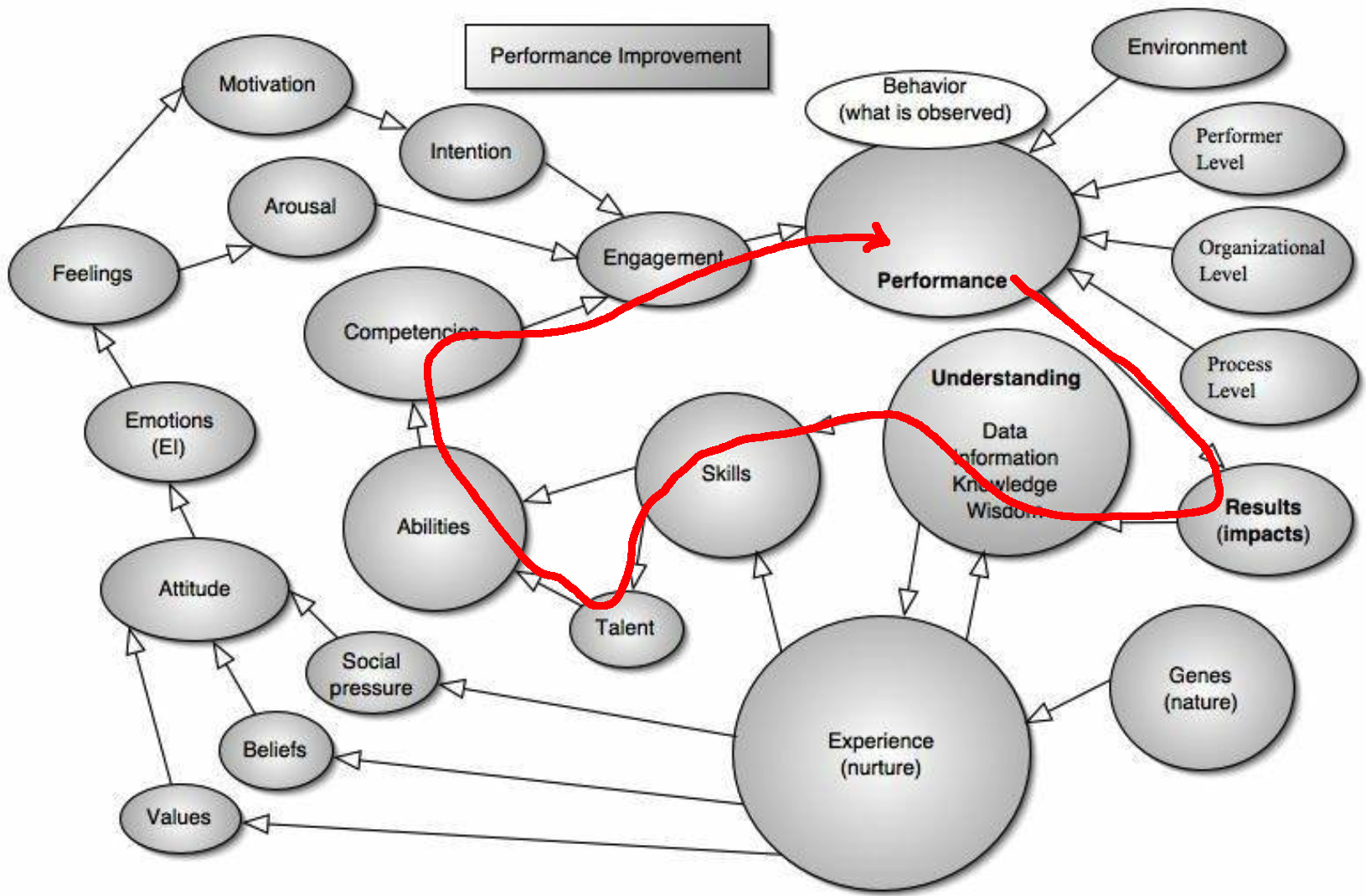
Performance (Effectiveness and Efficiency) can be influenced by various different factors – illustrated in the diagram below.

Performance_Improvement - CP.png

In using this diagram, a critical path (Shown in red above) can be drawn to improve performance in a specific area i.e. staff performance.

  1. First performance is defined,
  2. then measured to get a specific result (and understanding the impact it has overall).
  3. Understanding the results to determine which key skills, abilities and competeencies or lack there-of are contributing to the specific performance.
  4. Talent is needed to deliver performance – talent skills, abilities and competencies can be trained or recruited.
  5. Engagement is key – involve, motivate and empower your talent to respond and interact with the business – engagement brings a sense of happiness, which is a great motivator for creativity and performance.
  6. And the cycle repeats in never ending quality improvement loop.

This methodology can be adapted and used for performance improvement in any area of the business value chain.

Remember performance improvement is always reflected in the customer satisfaction. Satisfied customers engage with the business recurrently – hence revenue growth!

Let’s Talk – renierbotha Ltd specialises in the performance improvement of business and IT operations. Are you looking to achieve your goals faster? Create better business value? Build strategies to improve growth? We can help – make contact!

10 Peter Drucker Quotes that challenges Business Leadership thinking

Drucker is one of the best-known and most widely influential thinkers and writers on the subject of management theory and practice. In 1959, Drucker coined the term “knowledge worker,” and later in his life considered knowledge-worker productivity to be the next frontier of management.

  1. What gets measured gets improved.”
  2. “If you want something new, you have to stop doing something old.”
  3. “Doing the right thing is more important than doing the thing right.”
  4. “There is nothing quite so useless as doing with great efficiency something that should not be done at all.”
  5. Results are gained by exploiting opportunities, not by solving problems.”
  6. “So much of what we call management consists of making it difficult for people to work.”
  7. Meetings are by definition a concession to a deficient organization. For one either meets or one works. One cannot do both at the same time.”
  8. “People who don’t take risks generally make about two big mistakes a year. People who do take risks generally make about two big mistakes a year.”
  9. Long-range planning does not deal with the future decisions, but with the future of present decisions.”
  10. Management is doing things right. Leadership is doing the right things.”

Drucker – management thought leader

His Key Ideas

Drucker is considered the single most important thought leader in the world of management, and several ideas run through most of his writings:

  • Decentralization and simplification.[31] Drucker discounted the command and control model and asserted that companies work best when they are decentralized. According to Drucker, corporations tend to produce too many products, hire employees they don’t need (when a better solution would be outsourcing), and expand into economic sectors that they should avoid.
  • The concept of “knowledge worker” in his 1959 book The Landmarks of Tomorrow.[32] Since then, knowledge-based work has become increasingly important in businesses worldwide.
  • The prediction of the death of the “Blue Collar” worker.[33] The changing face of the US Auto Industry is a testimony to this prediction.
  • The concept of what eventually came to be known as “outsourcing.”[34] He used the example of “front room” and “back room” of each business: A company should be engaged in only the front room activities that are critical to supporting its core business. Back room activities should be handed over to other companies, for whom these tasks are the front room activities.
  • The importance of the nonprofit sector,[35] which he calls the third sector (private sector and the Government sector being the first two). Non-Government Organizations (NGOs) play crucial roles in the economies of countries around the world.
  • A profound skepticism of macroeconomic theory.[36] Drucker contended that economists of all schools fail to explain significant aspects of modern economies.
  • A lament that the sole focus of microeconomics is price, citing its lack of showing what products actually do for us,[37] thereby stimulating commercial interest in discovering how to calculate what products actually do for us; from their price.[38]
  • Respect for the worker. Drucker believed that employees are assets not liabilities. He taught that knowledgeable workers are the essential ingredients of the modern economy, and that a hybrid management model is the sole method of demonstrating an employee’s value to the organization. Central to this philosophy is the view that people are an organization’s most valuable resource, and that a manager’s job is both to prepare people to perform and give them freedom to do so.[39]
  • A belief in what he called “the sickness of government.” Drucker made nonpartisan claims that government is often unable or unwilling to provide new services that people need and/or want, though he believed that this condition is not intrinsic to the form of government. The chapter “The Sickness of Government”[40] in his book The Age of Discontinuity formed the basis of New Public Management,[41] a theory of public administration that dominated the discipline in the 1980s and 1990s.
  • The need for “planned abandonment.” Businesses and governments have a natural human tendency to cling to “yesterday’s successes” rather than seeing when they are no longer useful.[42]
  • A belief that taking action without thinking is the cause of every failure.
  • The need for community. Early in his career, Drucker predicted the “end of economic man” and advocated the creation of a “plant community”[43] where an individual’s social needs could be met. He later acknowledged that the plant community never materialized, and by the 1980s, suggested that volunteering in the nonprofit sector was the key to fostering a healthy society where people found a sense of belonging and civic pride.[44]
  • The need to manage business by balancing a variety of needs and goals, rather than subordinating an institution to a single value.[45][46] This concept of management by objectivesand self-control forms the keynote of his 1954 landmark The Practice of Management.[47]
  • A company’s primary responsibility is to serve its customers. Profit is not the primary goal, but rather an essential condition for the company’s continued existence and sustainability.[48]
  • A belief in the notion that great companies could stand among humankind’s noblest inventions.[49]
  • “Do what you do best and outsource the rest” is a business tagline first “coined and developed”[50] in the 1990s by Drucker.[51] The slogan was primarily used to advocate outsourcing as a viable business strategy. Drucker began explaining the concept of outsourcing as early as 1989 in his Wall Street Journal (WSJ) article entitled “Sell the Mailroom.”[52] In 2009 by way of recognition, Drucker was posthumously inducted into the Outsourcing Hall of Fame for his outstanding work in the field.[53]

From wikipedia: https://en.wikipedia.org/wiki/Peter_Drucker


Book Summary: “Staying in the Helicopter: The Key to Sustained Strategic Success” by Richard Harrop

“Staying in the Helicopter: The Key to Sustained Strategic Success” by Richard Harrop is a business leadership book that emphasises the importance of maintaining a strategic, high-level perspective to achieve long-term success. Harrop uses the metaphor of “staying in the helicopter” to illustrate the necessity for leaders to rise above daily operations and view their organisation and its environment from a broader perspective.

Key themes of the book include:

  • Strategic Vision: Encourages leaders to develop and maintain a clear, long-term vision for their organisations.
  • Adaptability: Stresses the need for organisations to be flexible and adaptable in response to changing market conditions.
  • Leadership Skills: Discusses the qualities and skills necessary for effective leadership, including decision-making, communication, and the ability to inspire and motivate others.
  • Continuous Improvement: Advocates for a culture of continuous learning and improvement within organisations.
  • Balanced Perspective: Emphasises balancing short-term operational demands with long-term strategic goals.

Through practical advice, case studies, and personal anecdotes, Harrop provides insights and tools for leaders to enhance their strategic thinking and ensure sustained success in their organisations.

As a senior business leader, I highly recommend reading “Staying in the Helicopter: The Key to Sustained Strategic Success” by Richard Harrop. This book has been invaluable in helping me understand the importance of maintaining a high-level perspective while managing the complexities of daily operations. Harrop’s practical advice and compelling case studies provide the tools needed to balance immediate demands with long-term vision, ensuring sustained success and growth. This guide has enhanced my strategic thinking and enabled me to lead my organisation with greater clarity and foresight.