DevOps – The Methodology

Understanding DevOps: Bridging the Gap Between Development and Operations

In the past 15 years, driven by demand on the effective development, depoloyment and support of software solutions, the DevOps methodology has emerged as a transformative approach seemlessly melting together software development and IT operations. It aims to enhance collaboration, streamline processes, and accelerate the delivery of high-quality software products. This blog post will delve into the core principles, benefits, and key practices of DevOps, providing a comprehensive overview of why this methodology has become indispensable for modern organisations.

What is DevOps?

DevOps is a cultural and technical movement that combines software development (Dev) and IT operations (Ops) with the goal of shortening the system development lifecycle and delivering high-quality software continuously. It emphasises collaboration, communication, and integration between developers and IT operations teams, fostering a unified approach to problem-solving and productivity.

Core Principles of DevOps

  • Collaboration and Communication:
    DevOps breaks down silos between development and operations teams, encouraging continuous collaboration and open communication. This alignment helps in understanding each other’s challenges and working towards common goals.
  • Continuous Integration and Continuous Delivery (CI/CD):
    CI/CD practices automate the integration and deployment process, ensuring that code changes are automatically tested and deployed to production. This reduces manual intervention, minimises errors, and speeds up the release cycle.
  • Infrastructure as Code (IaC):
    IaC involves managing and provisioning computing infrastructure through machine-readable scripts, rather than physical hardware configuration or interactive configuration tools. This practice promotes consistency, repeatability, and scalability.
  • Automation:
    Automation is a cornerstone of DevOps, encompassing everything from code testing to infrastructure provisioning. Automated processes reduce human error, increase efficiency, and free up time for more strategic tasks.
  • Monitoring and Logging:
    Continuous monitoring and logging of applications and infrastructure help in early detection of issues, performance optimisation, and informed decision-making. It ensures that systems are running smoothly and any anomalies are quickly addressed.
  • Security:
    DevSecOps integrates security practices into the DevOps pipeline, ensuring that security is an integral part of the development process rather than an afterthought. This proactive approach to security helps in identifying vulnerabilities early and mitigating risks effectively.

Benefits of DevOps

  • Faster Time-to-Market:
    By automating processes and fostering collaboration, DevOps significantly reduces the time taken to develop, test, and deploy software. This agility allows organisations to respond quickly to market changes and customer demands.
  • Improved Quality:
    Continuous testing and integration ensure that code is frequently checked for errors, leading to higher-quality software releases. Automated testing helps in identifying and fixing issues early in the development cycle.
  • Enhanced Collaboration:
    DevOps promotes a culture of shared responsibility and transparency, enhancing teamwork and communication between development, operations, and other stakeholders. This collective approach leads to better problem-solving and innovation.
  • Scalability and Flexibility:
    With practices like IaC and automated provisioning, scaling infrastructure becomes more efficient and flexible. Organisations can quickly adapt to changing requirements and scale their operations seamlessly.
  • Increased Efficiency:
    Automation of repetitive tasks reduces manual effort and allows teams to focus on more strategic initiatives. This efficiency leads to cost savings and better resource utilisation.
  • Greater Reliability:
    Continuous monitoring and proactive issue resolution ensure higher system reliability and uptime. DevOps practices help in maintaining stable and resilient production environments.

Key DevOps Practices

  1. Version Control:
    Using version control systems like Git to manage code changes ensures that all changes are tracked, reversible, and collaborative.
  2. Automated Testing:
    Implementing automated testing frameworks to continuously test code changes helps in identifying and addressing issues early.
  3. Configuration Management:
    Tools like Ansible, Puppet, and Chef automate the configuration of servers and environments, ensuring consistency across development, testing, and production environments.
  4. Continuous Deployment:
    Deploying code changes automatically to production environments after passing automated tests ensures that new features and fixes are delivered rapidly and reliably.
  5. Containerisation:
    Using containers (e.g., Docker) to package applications and their dependencies ensures consistency across different environments and simplifies deployment.
  6. Monitoring and Alerting:
    Implementing comprehensive monitoring solutions (e.g., Prometheus, Grafana) to track system performance and set up alerts for potential issues helps in maintaining system health.

Recommended Reading

For those looking to dive deeper into the principles and real-world applications of DevOps, several books offer valuable insights:

  • “The DevOps Handbook” by Gene Kim, Jez Humble, Patrick Debois, and John Willis:
    This book is a comprehensive guide to the DevOps methodology, offering practical advice and real-world case studies on how to implement DevOps practices effectively. It covers everything from continuous integration to monitoring and security, making it an essential resource for anyone interested in DevOps.
  • “The Phoenix Project” by Gene Kim, Kevin Behr, and George Spafford:
    Presented as a novel, this book tells the story of an IT manager tasked with saving a failing project. Through its engaging narrative, “The Phoenix Project” illustrates the challenges and benefits of adopting DevOps principles. It provides a compelling look at how organisations can transform their IT operations to achieve better business outcomes.
  • “The Unicorn Project” by Gene Kim:
    A follow-up to “The Phoenix Project,” this novel focuses on the perspective of a software engineer within the same organisation. It delves deeper into the technical and cultural aspects of DevOps, exploring themes of autonomy, mastery, and purpose. “The Unicorn Project” offers a detailed look at the developer’s role in driving DevOps transformation.

Conclusion

DevOps is more than just a set of practices, it’s a cultural shift that transforms how organisations develop, deploy, and manage software. By fostering collaboration, automation, and continuous improvement, DevOps helps organisations deliver high-quality software faster and more reliably. Embracing DevOps can lead to significant improvements in efficiency, productivity, and customer satisfaction, making it an essential methodology for any modern IT organisation.

By understanding and implementing the core principles and practices of DevOps, organisations can navigate the complexities of today’s technological landscape and achieve sustained success in their software development endeavours. Reading foundational books like “The DevOps Handbook,” “The Phoenix Project,” and “The Unicorn Project” can provide valuable insights and practical guidance on this transformative journey.

C4 Architecture Model – Detailed Explanation

The C4 model, developed by Simon Brown, is a framework for visualizing software architecture at various levels of detail. It emphasizes the use of hierarchical diagrams to represent different aspects and views of a system, providing a comprehensive understanding for various stakeholders. The model’s name, C4, stands for Context, Containers, Components, and Code, each representing a different level of architectural abstraction.

Levels of the C4 Model

1. Context (Level 1)

Purpose: To provide a high-level overview of the system and its environment.

  • The System Context diagram is a high-level view of your software system.
  • It shows your software system as the central part, and any external systems and users that your system interacts with.
  • It should be technology agnostic, and the focus on the people and software systems instead of low-level details.
  • The intended audience for the System Context Diagram is everybody. If you can show it to non-technical people and they are able to understand it, then you know you’re on the right track.

Key Elements:

  • System: The primary system under consideration.
  • External Systems: Other systems that the primary system interacts with.
  • Users: Human actors or roles that interact with the system.

Diagram Features:

  • Scope: Shows the scope and boundaries of the system within its environment.
  • Relationships: Illustrates relationships between the system, external systems, and users.
  • Simplification: Focuses on high-level interactions, ignoring internal details.

Example: An online banking system context diagram might show:

  • The banking system itself.
  • External systems like payment gateways, credit scoring agencies, and notification services.
  • Users such as customers, bank employees, and administrators.

More Extensive Detail:

  • Primary System: Represents the main application or service being documented.
  • Boundaries: Defines the limits of what the system covers.
  • Purpose: Describes the main functionality and goals of the system.
  • External Systems: Systems outside the primary system that interact with it.
  • Dependencies: Systems that the primary system relies on for specific functionalities (e.g., third-party APIs, external databases).
  • Interdependencies: Systems that rely on the primary system (e.g., partner applications).
  • Users: Different types of users who interact with the system.
  • Roles: Specific roles that users may have, such as Admin, Customer, Support Agent.
  • Interactions: The nature of interactions users have with the system (e.g., login, data entry, report generation).

2. Containers (Level 2)

When you zoom into one software system, you get to the Container diagram.

Purpose: To break down the system into its major containers, showing their interactions.

  • Your software system is comprised of multiple running parts – containers.
  • A container can be a:
    • Web application
    • Single-page application
    • Database
    • File system
    • Object store
    • Message broker
  • You can look at a container as a deployment unit that executes code or stores data.
  • The Container diagram shows the high-level view of the software architecture and the major technology choices.
  • The Container diagram is intended for technical people inside and outside of the software development team:
    • Operations/support staff
    • Software architects
    • Developers

Key Elements:

  • Containers: Executable units or deployable artifacts (e.g., web applications, databases, microservices).
  • Interactions: Communication and data flow between containers and external systems.

Diagram Features:

  • Runtime Environment: Depicts the containers and their runtime environments.
  • Technology Choices: Shows the technology stacks and platforms used by each container.
  • Responsibilities: Describes the responsibilities of each container within the system.

Example: For the online banking system:

  • Containers could include a web application, a mobile application, a backend API, and a database.
  • The web application might interact with the backend API for business logic and the database for data storage.
  • The mobile application might use a different API optimized for mobile clients.

More Extensive Detail:

  • Web Application:
    • Technology Stack: Frontend framework (e.g., Angular, React), backend language (e.g., Node.js, Java).
    • Responsibilities: User interface, handling user requests, client-side validation.
  • Mobile Application:
    • Technology Stack: Native (e.g., Swift for iOS, Kotlin for Android) or cross-platform (e.g., React Native, Flutter).
    • Responsibilities: User interface, handling user interactions, offline capabilities.
  • Backend API:
    • Technology Stack: Server-side framework (e.g., Spring Boot, Express.js), programming language (e.g., Java, Node.js).
    • Responsibilities: Business logic, data processing, integrating with external services.
  • Database:
    • Technology Stack: Type of database (e.g., SQL, NoSQL), specific technology (e.g., PostgreSQL, MongoDB).
    • Responsibilities: Data storage, data retrieval, ensuring data consistency and integrity.

3. Components (Level 3)

Next you can zoom into an individual container to decompose it into its building blocks.

Purpose: To further decompose each container into its key components and their interactions.

  • The Component diagram show the individual components that make up a container:
    • What each of the components are
    • The technology and implementation details
  • The Component diagram is intended for software architects and developers.

Key Elements:

  • Components: Logical units within a container, such as services, modules, libraries, or APIs.
  • Interactions: How these components interact within the container.

Diagram Features:

  • Internal Structure: Shows the internal structure and organization of each container.
  • Detailed Responsibilities: Describes the roles and responsibilities of each component.
  • Interaction Details: Illustrates the detailed interaction between components.

Example: For the backend API container of the online banking system:

  • Components might include an authentication service, an account management module, a transaction processing service, and a notification handler.
  • The authentication service handles user login and security.
  • The account management module deals with account-related operations.
  • The transaction processing service manages financial transactions.
  • The notification handler sends alerts and notifications to users.

More Extensive Detail:

  • Authentication Service:
    • Responsibilities: User authentication, token generation, session management.
    • Interactions: Interfaces with the user interface components, interacts with the database for user data.
  • Account Management Module:
    • Responsibilities: Managing user accounts, updating account information, retrieving account details.
    • Interactions: Interfaces with the authentication service for user validation, interacts with the transaction processing service.
  • Transaction Processing Service:
    • Responsibilities: Handling financial transactions, validating transactions, updating account balances.
    • Interactions: Interfaces with the account management module, interacts with external payment gateways.
  • Notification Handler:
    • Responsibilities: Sending notifications (e.g., emails, SMS) to users, managing notification templates.
    • Interactions: Interfaces with the transaction processing service to send transaction alerts, interacts with external notification services.

4. Code (Level 4)

Finally, you can zoom into each component to show how it is implemented with code, typically using a UML class diagram or an ER diagram.

Purpose: To provide detailed views of the codebase, focusing on specific components or classes.

  • This level is rarely used as it goes into too much technical detail for most use cases. However, there are supplementary diagrams that can be useful to fill in missing information by showcasing:
    • Sequence of events
    • Deployment information
    • How systems interact at a higher level
  • It’s only recommended for the most important or complex components.
  • Of course, the target audience are software architects and developers.

Key Elements:

  • Classes: Individual classes, methods, or functions within a component.
  • Relationships: Detailed relationships like inheritance, composition, method calls, or data flows.

Diagram Features:

  • Detailed Code Analysis: Offers a deep dive into the code structure and logic.
  • Code-Level Relationships: Illustrates how classes and methods interact at a code level.
  • Implementation Details: Shows specific implementation details and design patterns used.

Example: For the transaction processing service in the backend API container:

  • Classes might include Transaction, TransactionProcessor, Account, and NotificationService.
  • The TransactionProcessor class might have methods for initiating, validating, and completing transactions.
  • Relationships such as TransactionProcessor calling methods on the Account class to debit or credit funds.

More Extensive Detail:

  • Transaction Class:
    • Attributes: transactionId, amount, timestamp, status.
    • Methods: validate(), execute(), rollback().
    • Responsibilities: Representing a financial transaction, ensuring data integrity.
  • TransactionProcessor Class:
    • Attributes: transactionQueue, auditLog.
    • Methods: processTransaction(transaction), validateTransaction(transaction), completeTransaction(transaction).
    • Responsibilities: Processing transactions, managing transaction flow, logging transactions.
  • Account Class:
    • Attributes: accountId, balance, accountHolder.
    • Methods: debit(amount), credit(amount), getBalance().
    • Responsibilities: Managing account data, updating balances, providing account information.
  • NotificationService Class:
    • Attributes: notificationQueue, emailTemplate, smsTemplate.
    • Methods: sendEmailNotification(recipient, message), sendSMSNotification(recipient, message).
    • Responsibilities: Sending notifications to users, managing notification templates, handling notification queues.

Benefits of the C4 Model

  • Clarity and Focus:
    • Provides a clear separation of concerns by breaking down the system into different levels of abstraction.
    • Each diagram focuses on a specific aspect, avoiding information overload.
  • Consistency and Standardization:
    • Offers a standardized approach to documenting architecture, making it easier to maintain consistency across diagrams.
    • Facilitates comparison and review of different systems using the same visual language.
  • Enhanced Communication:
    • Improves communication within development teams and with external stakeholders by providing clear, concise, and visually appealing diagrams.
    • Helps in onboarding new team members by offering an easy-to-understand representation of the system.
  • Comprehensive Documentation:
    • Ensures comprehensive documentation of the system architecture, covering different levels of detail.
    • Supports various documentation needs, from high-level overviews to detailed technical specifications.

Practical Usage of the C4 Model

  • Starting with Context:
    • Begin with a high-level context diagram to understand the system’s scope, external interactions, and primary users.
    • Use this diagram to set the stage for more detailed diagrams.
  • Defining Containers:
    • Break down the system into its major containers, showing how they interact and are deployed.
    • Highlight the technology choices and responsibilities of each container.
  • Detailing Components:
    • For each container, create a component diagram to illustrate the internal structure and interactions.
    • Focus on how functionality is divided among components and how they collaborate.
  • Exploring Code:
    • If needed, delve into the code level for specific components to provide detailed documentation and analysis.
    • Use class or sequence diagrams to show detailed code-level relationships and logic.

Example Scenario: Online Banking System

Context Diagram:

  • System: Online Banking System
  • External Systems: Payment Gateway, Credit Scoring Agency, Notification Service
  • Users: Customers, Bank Employees, Administrators
  • Description: Shows how customers interact with the banking system, which in turn interacts with external systems for payment processing, credit scoring, and notifications.

Containers Diagram:

  • Containers: Web Application, Mobile Application, Backend API, Database
  • Interactions: The web application and mobile application interact with the backend API. The backend API communicates with the database and external systems.
  • Technology Stack: The web application might be built with Angular, the mobile application with React Native, the backend API with Spring Boot, and the database with PostgreSQL.

Components Diagram:

  • Web Application Components: Authentication Service, User Dashboard, Transaction Module
  • Backend API Components: Authentication Service, Account Management Module, Transaction Processing Service, Notification Handler
  • Interactions: The Authentication Service in both the web application and backend API handles user authentication and security. The Transaction Module in the web application interacts with the Transaction Processing Service in the backend API.

Code Diagram:

  • Classes: Transaction, TransactionProcessor, Account, NotificationService
  • Methods: The TransactionProcessor class has methods for initiating, validating, and completing transactions. The NotificationService class has methods for sending notifications.
  • Relationships: The TransactionProcessor calls methods on the Account class to debit or credit funds. It also calls the NotificationService to send transaction alerts.

Conclusion

The C4 model is a powerful tool for visualising and documenting software architecture. By providing multiple levels of abstraction, it ensures that stakeholders at different levels of the organisation can understand the system. From high-level overviews to detailed code analysis, the C4 model facilitates clear communication, consistent documentation, and comprehensive understanding of complex software systems.

Embracing Bimodal Model: A Data-Driven Journey for Modern Organisations

With data being the live blood of organisations the emphasis on data management places organisations on a continuous search for innovative approaches to harness and optimise the power of their data assets. In this pursuit, the bimodal model is a well established strategy that can be successfully employed by data-driven enterprises. This approach, which combines the stability of traditional data management with the agility of modern data practices, while providing a delivery methodology facilitating rapid innovation and resilient technology service provision.

Understanding the Bimodal Model

Gartner states: “Bimodal IT is the practice of managing two separate, coherent modes of IT delivery, one focused on stability and the other on agility. Mode 1 is traditional and sequential, emphasising safety and accuracy. Mode 2 is exploratory and nonlinear, emphasising agility and speed.

At its core, the bimodal model advocates for a dual approach to data management. Mode 1 focuses on the stable, predictable aspects of data, ensuring the integrity, security, and reliability of core business processes. This mode aligns with traditional data management practices, where accuracy and consistency are paramount. On the other hand, Mode 2 emphasizes agility, innovation, and responsiveness to change. It enables organizations to explore emerging technologies, experiment with new data sources, and adapt swiftly to evolving business needs.

Benefits of Bimodal Data Management

1. Optimised Performance and Stability: Mode 1 ensures that essential business functions operate smoothly, providing a stable foundation for the organization.

Mode 1 of the bimodal model is dedicated to maintaining the stability and reliability of core business processes. This is achieved through robust data governance, stringent quality controls, and established best practices in data management. By ensuring the integrity of data and the reliability of systems, organizations can optimise the performance of critical operations. This stability is especially crucial for industries where downtime or errors can have significant financial or operational consequences, such as finance, healthcare, and manufacturing.

Example: In the financial sector, a major bank implemented the bimodal model to enhance its core banking operations. Through Mode 1, the bank ensured the stability of its transaction processing systems, reducing system downtime by 20% and minimizing errors in financial transactions. This stability not only improved customer satisfaction but also resulted in a 15% increase in operational efficiency, as reported in the bank’s annual report.

2. Innovation and Agility: Mode 2 allows businesses to experiment with cutting-edge technologies like AI, machine learning, and big data analytics, fostering innovation and agility in decision-making processes.

Mode 2 is the engine of innovation within the bimodal model. It provides the space for experimentation with emerging technologies and methodologies. Businesses can leverage AI, machine learning, and big data analytics to uncover new insights, identify patterns, and make informed decisions. This mode fosters agility by encouraging a culture of continuous improvement and adaptation to technological advancements. It enables organizations to respond quickly to market trends, customer preferences, and competitive challenges, giving them a competitive edge in dynamic industries.

Example: A leading e-commerce giant adopted the bimodal model to balance stability and innovation in its operations. Through Mode 2, the company integrated machine learning algorithms into its recommendation engine. As a result, the accuracy of personalized product recommendations increased by 25%, leading to a 10% rise in customer engagement and a subsequent 12% growth in overall sales. This successful integration of Mode 2 practices directly contributed to the company’s market leadership in the highly competitive online retail space.

3. Enhanced Scalability: The bimodal approach accommodates the scalable growth of data-driven initiatives, ensuring that the organization can handle increased data volumes efficiently.

In the modern data landscape, the volume of data generated is growing exponentially. Mode 1 ensures that foundational systems are equipped to handle increasing data loads without compromising performance or stability. Meanwhile, Mode 2 facilitates the implementation of scalable technologies and architectures, such as cloud computing and distributed databases. This combination allows organizations to seamlessly scale their data infrastructure, supporting the growth of data-driven initiatives without experiencing bottlenecks or diminishing performance.

Example: A global technology firm leveraged the bimodal model to address the challenges of data scalability in its cloud-based services. In Mode 1, the company optimized its foundational cloud infrastructure, ensuring uninterrupted service during periods of increased data traffic. Simultaneously, through Mode 2 practices, the firm adopted containerization and microservices architecture, resulting in a 30% improvement in scalability. This enhanced scalability enabled the company to handle a 50% surge in user data without compromising performance, leading to increased customer satisfaction and retention.

4. Faster Time-to-Insights: By leveraging Mode 2 practices, organizations can swiftly analyze new data sources, enabling faster extraction of valuable insights for strategic decision-making.

Mode 2 excels in rapidly exploring and analyzing new and diverse data sources. This capability significantly reduces the time it takes to transform raw data into actionable insights. Whether it’s customer feedback, market trends, or operational metrics, Mode 2 practices facilitate agile and quick analysis. This speed in obtaining insights is crucial in fast-paced industries where timely decision-making is a competitive advantage.

Example: A healthcare organization implemented the bimodal model to expedite the analysis of patient data for clinical decision-making. Through Mode 2, the organization utilized advanced analytics and machine learning algorithms to process diagnostic data. The implementation led to a 40% reduction in the time required for diagnosis, enabling medical professionals to make quicker and more accurate decisions. This accelerated time-to-insights not only improved patient outcomes but also contributed to the organization’s reputation as a leader in adopting innovative healthcare technologies.

5. Adaptability in a Dynamic Environment: Bimodal data management equips organizations to adapt to market changes, regulatory requirements, and emerging technologies effectively.

In an era of constant change, adaptability is a key determinant of organizational success. Mode 2’s emphasis on experimentation and innovation ensures that organizations can swiftly adopt and integrate new technologies as they emerge. Additionally, the bimodal model allows organizations to navigate changing regulatory landscapes by ensuring that core business processes (Mode 1) comply with existing regulations while simultaneously exploring new approaches to meet evolving requirements. This adaptability is particularly valuable in industries facing rapid technological advancements or regulatory shifts, such as fintech, healthcare, and telecommunications.

Example: A telecommunications company embraced the bimodal model to navigate the dynamic landscape of regulatory changes and emerging technologies. In Mode 1, the company ensured compliance with existing telecommunications regulations. Meanwhile, through Mode 2, the organization invested in exploring and adopting 5G technologies. This strategic approach allowed the company to maintain regulatory compliance while positioning itself as an early adopter of 5G, resulting in a 25% increase in market share and a 15% growth in revenue within the first year of implementation.

Implementation Challenges and Solutions

Implementing a bimodal model in data management is not without its challenges. Legacy systems, resistance to change, and ensuring a seamless integration between modes can pose significant hurdles. However, these challenges can be overcome through a strategic approach that involves comprehensive training, fostering a culture of innovation, and investing in robust data integration tools.

1. Legacy Systems: Overcoming the Weight of Tradition

Challenge: Many organizations operate on legacy systems that are deeply ingrained in their processes. These systems, often built on older technologies, can be resistant to change, making it challenging to introduce the agility required by Mode 2.

Solution: A phased approach is crucial when dealing with legacy systems. Organizations can gradually modernize their infrastructure, introducing new technologies and methodologies incrementally. This could involve the development of APIs to bridge old and new systems, adopting microservices architectures, or even considering a hybrid cloud approach. Legacy system integration specialists can play a key role in ensuring a smooth transition and minimizing disruptions.

2. Resistance to Change: Shifting Organizational Mindsets

Challenge: Resistance to change is a common challenge when implementing a bimodal model. Employees accustomed to traditional modes of operation may be skeptical or uncomfortable with the introduction of new, innovative practices.

Solution: Fostering a culture of change is essential. This involves comprehensive training programs to upskill employees on new technologies and methodologies. Additionally, leadership plays a pivotal role in communicating the benefits of the bimodal model, emphasizing how it contributes to both stability and innovation. Creating cross-functional teams that include members from different departments and levels of expertise can also promote collaboration and facilitate a smoother transition.

3. Seamless Integration Between Modes: Ensuring Cohesion

Challenge: Integrating Mode 1 (stability-focused) and Mode 2 (innovation-focused) operations seamlessly can be complex. Ensuring that both modes work cohesively without compromising the integrity of data or system reliability is a critical challenge.

Solution: Implementing robust data governance frameworks is essential for maintaining cohesion between modes. This involves establishing clear protocols for data quality, security, and compliance. Organizations should invest in integration tools that facilitate communication and data flow between different modes. Collaboration platforms and project management tools that promote transparency and communication can bridge the gap between teams operating in different modes, fostering a shared understanding of goals and processes.

4. Lack of Skillset: Nurturing Expertise for Innovation

Challenge: Mode 2 often requires skills in emerging technologies such as artificial intelligence, machine learning, and big data analytics. Organizations may face challenges in recruiting or upskilling their workforce to meet the demands of this innovative mode.

Solution: Investing in training programs, workshops, and certifications can help bridge the skills gap. Collaboration with educational institutions or partnerships with specialized training providers can ensure that employees have access to the latest knowledge and skills. Creating a learning culture within the organization, where employees are encouraged to explore and acquire new skills, is vital for the success of Mode 2.

5. Overcoming Silos: Encouraging Cross-Functional Collaboration

Challenge: Siloed departments and teams can hinder the flow of information and collaboration between Mode 1 and Mode 2 operations. Communication breakdowns can lead to inefficiencies and conflicts.

Solution: Breaking down silos requires a cultural shift and the implementation of cross-functional teams. Encouraging open communication channels, regular meetings between teams from different modes, and fostering a shared sense of purpose can facilitate collaboration. Leadership should promote a collaborative mindset, emphasizing that both stability and innovation are integral to the organization’s success.

By addressing these challenges strategically, organizations can create a harmonious bimodal environment that combines the best of both worlds—ensuring stability in core operations while fostering innovation to stay ahead in the dynamic landscape of data-driven decision-making.

Case Studies: Bimodal Success Stories

Several forward-thinking organiSations have successfully implemented the bimodal model to enhance their data management capabilities. Companies like Netflix, Amazon, and Airbnb have embraced this approach, allowing them to balance stability with innovation, leading to improved customer experiences and increased operational efficiency.

Netflix: Balancing Stability and Innovation in Entertainment

Netflix, a pioneer in the streaming industry, has successfully implemented the bimodal model to revolutionize the way people consume entertainment. In Mode 1, Netflix ensures the stability of its streaming platform, focusing on delivering content reliably and securely. This includes optimizing server performance, ensuring data integrity, and maintaining a seamless user experience. Simultaneously, in Mode 2, Netflix harnesses the power of data analytics and machine learning to personalize content recommendations, optimize streaming quality, and forecast viewer preferences. This innovative approach has not only enhanced customer experiences but also allowed Netflix to stay ahead in a highly competitive and rapidly evolving industry.

Amazon: Transforming Retail with Data-Driven Agility

Amazon, a global e-commerce giant, employs the bimodal model to maintain the stability of its core retail operations while continually innovating to meet customer expectations. In Mode 1, Amazon focuses on the stability and efficiency of its e-commerce platform, ensuring seamless transactions and reliable order fulfillment. Meanwhile, in Mode 2, Amazon leverages advanced analytics and artificial intelligence to enhance the customer shopping experience. This includes personalized product recommendations, dynamic pricing strategies, and the use of machine learning algorithms to optimize supply chain logistics. The bimodal model has allowed Amazon to adapt to changing market dynamics swiftly, shaping the future of e-commerce through a combination of stability and innovation.

Airbnb: Personalizing Experiences through Data Agility

Airbnb, a disruptor in the hospitality industry, has embraced the bimodal model to balance the stability of its booking platform with continuous innovation in user experiences. In Mode 1, Airbnb ensures the stability and security of its platform, facilitating millions of transactions globally. In Mode 2, the company leverages data analytics and machine learning to personalize user experiences, providing tailored recommendations for accommodations, activities, and travel destinations. This approach not only enhances customer satisfaction but also allows Airbnb to adapt to evolving travel trends and preferences. The bimodal model has played a pivotal role in Airbnb’s ability to remain agile in a dynamic market while maintaining the reliability essential for its users.

Key Takeaways from Case Studies:

  1. Strategic Balance: Each of these case studies highlights the strategic balance achieved by these organizations through the bimodal model. They effectively manage the stability of core operations while innovating to meet evolving customer demands.
  2. Customer-Centric Innovation: The bimodal model enables organizations to innovate in ways that directly benefit customers. Whether through personalized content recommendations (Netflix), dynamic pricing strategies (Amazon), or tailored travel experiences (Airbnb), these companies use Mode 2 to create value for their users.
  3. Agile Response to Change: The case studies demonstrate how the bimodal model allows organizations to respond rapidly to market changes. Whether it’s shifts in consumer behavior, emerging technologies, or regulatory requirements, the dual approach ensures adaptability without compromising operational stability.
  4. Competitive Edge: By leveraging the bimodal model, these organizations gain a competitive edge in their respective industries. They can navigate challenges, seize opportunities, and continually evolve their offerings to stay ahead in a fast-paced and competitive landscape.

Conclusion

In the contemporary business landscape, characterised by the pivotal role of data as the cornerstone of organizational vitality, the bimodal model emerges as a strategic cornerstone for enterprises grappling with the intricacies of modern data management. Through the harmonious integration of stability and agility, organizations can unveil the full potential inherent in their data resources. This synergy propels innovation, enhances decision-making processes, and, fundamentally, positions businesses to achieve a competitive advantage within the dynamic and data-centric business environment. Embracing the bimodal model transcends mere preference; it represents a strategic imperative for businesses aspiring to not only survive but thrive in the digital epoch.

Also read – “How to Innovate to Stay Relevant

Scrum of Scrums

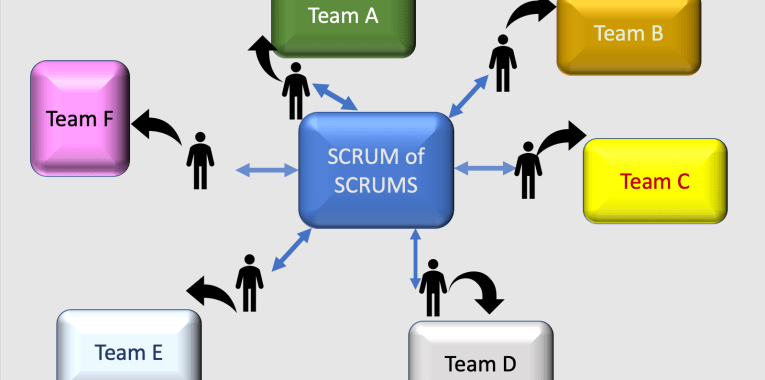
The Scrum of Scrums is a scaled agile framework used to coordinate the work of multiple Scrum teams working on the same product or project. It is a meeting or a communication structure that allows teams to discuss their progress, identify dependencies, and address any challenges that may arise during the development process. The Scrum of Scrums is often employed in large organisations where a single Scrum team may not be sufficient to deliver a complex product or project.

The primary purpose of the Scrum of Scrums is to facilitate coordination and communication among multiple Scrum teams. It ensures that all teams are aligned towards common goals and are aware of each other’s progress.

Here are some key aspects of the Scrum of Scrums:

Frequency:

  • The frequency of Scrum of Scrums meetings depends on the project’s needs, but they are often daily or multiple times per week to ensure timely issue resolution.
  • Shorter daily meetings focussing on progress, next steps and blockers can be substantiated by a longer weekly meeting covering an agenda of all projects and more detailed discussions.

Participants – Scrum Teams and Representatives:

  • In a large-scale project or programme, there are multiple Scrum teams working on different aspects of the product or project.
  • Each Scrum team is represented by one or more members (often the Scrum Masters or team leads) in the Scrum of Scrums meeting. Each team selects one or more representatives to attend the Scrum of Scrums meeting.
  • These representatives are typically Scrum Masters or team leads who can effectively communicate the status, challenges, and dependencies of their respective teams.
  • The purpose of these representatives is to share information about their team’s progress, discuss impediments, and collaborate on solutions.

Meeting Structure & Agenda:

  • The Scrum of Scrums meeting follows a structured agenda that may include updates on team progress, identification of impediments, discussion of cross-team dependencies, reviewing and updating the overall RAID log with associated mitigation action progress and and collaborative problem-solving.
  • A key focus of the Scrum of Scrums is identifying and addressing cross-team dependencies. Teams discuss how their work may impact or be impacted by the work of other teams, and they collaboratively find solutions to minimise bottlenecks and define a overall critical path / timeline for the project delivery.

Tools and Techniques:

  • While the Scrum of Scrums is often conducted through face-to-face meetings, organisations may use various tools and techniques for virtual collaboration, especially if teams are distributed geographically. Video conferencing, collaboration platforms, and digital boards are common aids.

Focus on Coordination:

  • The primary goal of the Scrum of Scrums is to facilitate communication and coordination among the different Scrum teams.
  • Teams discuss their plans, commitments, and any issues they are facing. This helps in identifying dependencies and potential roadblocks early on.

Problem Solving:

  • If there are impediments or issues that cannot be resolved within individual teams, the Scrum of Scrums provides a forum for collaborative problem-solving.
  • The focus is on finding solutions that benefit the overall project, rather than just individual teams.

Scaling Agile:

  • The Scrum of Scrums is in line with the agile principles of adaptability and collaboration. It allows organisations to scale agile methodologies effectively by maintaining the iterative and incremental nature of Scrum while accommodating the complexities of larger projects.

Information Flow: & Sharing

  • The Scrum of Scrums ensures that information flows smoothly between teams, preventing silos of knowledge and promoting transparency across the organisation.
  • The Scrum of Scrums provides a platform for teams to discuss impediments that go beyond the scope of individual teams. It fosters a collaborative environment where teams work together to solve problems and remove obstacles that hinder overall progress.
  • Transparency is a key element of agile development, and the Scrum of Scrums promotes it by ensuring that information flows freely between teams. This helps prevent misunderstandings, duplication of effort, and ensures that everyone is aware of the overall project status.

Adaptability:

  • The Scrum of Scrums is adaptable to the specific needs and context of the organisation. It can be tailored based on the size of the project, the number of teams involved, and the nature of the work being undertaken.
  • In summary, the Scrum of Scrums is a crucial component in the toolkit of agile methodologies for large-scale projects. It fosters collaboration, communication, and problem-solving across multiple Scrum teams, ensuring that the benefits of agile development are retained even in complex and extensive projects.

In Summary, the Scrum of Scrums is a crucial component in the toolkit of agile methodologies for large-scale projects. It fosters collaboration, communication, and problem-solving across multiple Scrum teams, ensuring that the benefits of agile development are retained even in complex and extensive projects.

It’s important to note that the Scrum of Scrums is just one of several techniques used for scaling agile. Other frameworks like SAFe (Scaled Agile Framework), LeSS (Large-Scale Scrum), and Nexus also provide structures for coordinating the work of multiple teams. The choice of framework depends on the specific needs and context of the organisation.