
Comprehensive Guide to Strategic Investment in IT and Data for Sustainable Business Growth and Innovation

In this post, Renier is exploring the critical importance of appropriate investment in technology, data and innovation for continued business growth and a strategy to stay relevant.

Introduction

This comprehensive guide explores the strategic importance of investing in information technology (IT) and data management to foster sustainable business growth and innovation. It delves into the risks of underinvestment and the significant advantages that proactive and thoughtful expenditure in these areas can bring to a company. Additionally, it offers actionable strategies for corporate boards to effectively navigate these challenges, ensuring that their organisations not only survive but thrive in the competitive modern business landscape.

The Perils of Underinvestment in IT: Navigating Risks and Strategies for Corporate Boards

In the digital age, information technology (IT) is not merely a support tool but a cornerstone of business strategy and operations. However, many companies still underinvest in their IT infrastructure, leading to severe repercussions. This section explores the risks associated with underinvestment in IT, the impact on businesses, and actionable strategies that company Boards can adopt to mitigate these risks and prevent potential crises.

The Impact of Underinvestment in IT

Underinvestment in IT can manifest in numerous ways, each capable of stifling business growth and operational efficiency. Primarily, outdated systems and technologies can lead to decreased productivity as employees struggle with inefficient processes and systems that do not meet contemporary standards. Furthermore, it exposes the company to heightened security risks such as data breaches and cyberattacks, as older systems often lack the capabilities to defend against modern threats.

Key Risks Introduced by Underinvestment

  • Operational Disruptions – With outdated IT infrastructure, businesses face a higher risk of system downtimes and disruptions. This not only affects daily operations but can also lead to significant financial losses and damage to customer relationships.
  • Security Vulnerabilities – Underfunded IT systems are typically less secure and more susceptible to cyber threats. This can compromise sensitive data and intellectual property, potentially resulting in legal and reputational harm.
  • Inability to Scale – Companies with poor IT investment often struggle to scale their operations efficiently to meet market demands or expand into new territories, limiting their growth potential.
  • Regulatory Non-Compliance – Many industries have strict regulations regarding data privacy and security. Inadequate IT infrastructure may lead to non-compliance, resulting in hefty fines and legal issues.

What Can Boards Do?

  • Prioritise IT in Strategic Planning – Boards must recognise IT as a strategic asset rather than a cost centre. Integrating IT strategy with business strategy ensures that technology upgrades and investments are aligned with business goals and growth trajectories.
  • Conduct Regular IT Audits – Regular audits can help Boards assess the effectiveness of current IT systems and identify areas needing improvement. This proactive approach aids in preventing potential issues before they escalate.
  • Invest in Cybersecurity – Protecting against cyber threats should be a top priority. Investment in modern cybersecurity technologies and regular security training for employees can shield the company from potential attacks.
  • Establish a Technology Committee – Boards could benefit from establishing a dedicated technology committee that can drive technology strategy, oversee technology risk management, and keep the Board updated on key IT developments and investments.
  • Foster IT Agility – Encouraging the adoption of agile IT practices can help organisations respond more rapidly to market changes and technological advancements. This includes investing in scalable cloud solutions and adopting a culture of continuous improvement.
  • Education and Leadership Engagement – Board members should be educated about the latest technology trends and the specific IT needs of their industry. Active engagement from leadership can foster an environment where IT is seen as integral to organisational success.

Maximising Potential: The Critical Need for Proper Data Utilisation in Organisations

In today’s modern business landscape, data is often referred to as the new oil—a vital asset that can drive decision-making, innovation, and competitive advantage. Despite its recognised value, many organisations continue to underinvest and underutilise data, missing out on significant opportunities and exposing themselves to increased risks. This section examines the consequences of not fully leveraging data, the risks associated with such underutilisation, and practical steps organisations can take to better harness the power of their data.

The Consequences of Underutilisation

Underutilising data can have far-reaching consequences for organisations, impacting everything from strategic planning to operational efficiency. Key areas affected include:

  • Inefficient Decision-Making – Without robust data utilisation, decisions are often made based on intuition or incomplete information, which can lead to suboptimal outcomes and missed opportunities.
  • Missed Revenue Opportunities – Data analytics can uncover trends and insights that drive product innovation and customer engagement. Organisations that fail to leverage these insights may fall behind their competitors in capturing market share.
  • Operational Inefficiencies – Data can optimise operations and streamline processes. Lack of proper data utilisation can result in inefficiencies, higher costs, and decreased productivity.

Risks Associated with Data Underutilisation

  • Competitive Disadvantage – Companies that do not invest in data analytics may lose ground to competitors who utilise data to refine their strategies and offerings, tailor customer experiences, and enter new markets more effectively.
  • Security and Compliance Risks – Underinvestment in data management can lead to poor data governance, increasing the risk of data breaches and non-compliance with regulations like GDPR and HIPAA, potentially resulting in legal penalties and reputational damage.
  • Strategic Misalignmen – Lack of comprehensive data insights can lead to strategic plans that are out of sync with market realities, risking long-term sustainability and growth.

Mitigating Risks and Enhancing Data Utilisation

  • Enhance Data Literacy Across the Organisation – Building data literacy across all levels of the organisation empowers employees to understand and use data effectively in their roles. This involves training programmes and ongoing support to help staff interpret and leverage data insights.
  • Invest in Data Infrastructure – To harness data effectively, robust infrastructure is crucial. This includes investing in secure storage, efficient data processing capabilities, and advanced analytics tools. Cloud-based solutions can offer scalable and cost-effective options.
  • Establish a Data Governance Framework – A strong data governance framework ensures data quality, security, and compliance. It should define who can access data, how it can be used, and how it is protected, ensuring consistency and reliability in data handling.
  • Foster a Data-Driven Culture – Encouraging a culture that values data-driven decision-making can be transformative. This involves leadership endorsing and modelling data use and recognising teams that effectively use data to achieve results.
  • Utilise Advanced Analytics and AI – Advanced analytics, machine learning, and AI can transform raw data into actionable insights. These technologies can automate complex data analysis tasks, predict trends, and offer deeper insights that human analysis might miss.
  • Regularly Review and Adapt Data Strategies – Data needs and technologies evolve rapidly. Regular reviews of data strategies and tools can help organisations stay current and ensure they are fully leveraging their data assets.

The Essential Role of Innovation in Business Success and Sustainability

Innovation refers to the process of creating new products, services, processes, or technologies, or significantly improving existing ones. It often involves applying new ideas or approaches to solve problems or meet market needs more effectively. Innovation can range from incremental changes to existing products to groundbreaking shifts that create whole new markets or business models.

Why is Innovation Important for a Business?

  • Competitive Advantage – Innovation helps businesses stay ahead of their competitors. By offering unique products or services, or by enhancing the efficiency of processes, companies can differentiate themselves in the marketplace. This differentiation is crucial for attracting and retaining customers in a competitive landscape.
  • Increased Efficiency – Innovation can lead to the development of new technologies or processes that improve operational efficiency. This could mean faster production times, lower costs, or more effective marketing strategies, all of which contribute to a better bottom line.
  • Customer Engagement and Satisfaction – Today’s consumers expect continual improvements and new experiences. Innovative businesses are more likely to attract and retain customers by meeting these expectations with new and improved products or services that enhance customer satisfaction and engagement.
  • Revenue Growth – By opening new markets and attracting more customers, innovation directly contributes to revenue growth. Innovative products or services often command premium pricing, and the novelty can attract customers more effectively than traditional marketing tactics.
  • Adaptability to Market Changes – Markets are dynamic, with consumer preferences, technology, and competitive landscapes constantly evolving. Innovation enables businesses to adapt quickly to these changes. Companies that lead in innovation can shape the direction of the market, while those that follow must adapt to changes shaped by others.
  • Attracting Talent – Talented individuals seek dynamic and progressive environments where they can challenge their skills and grow professionally. Innovative companies are more attractive to potential employees looking for such opportunities. By drawing in more skilled and creative employees, a business can further enhance its innovation capabilities.
  • Long-Term Sustainability – Continuous innovation is crucial for long-term business sustainability. By constantly evolving and adapting through innovation, businesses can foresee and react to changes in the environment, technology, and customer preferences, thus securing their future relevance and viability.
  • Regulatory Compliance and Social Responsibility – Innovation can also help businesses meet regulatory requirements more efficiently and contribute to social and environmental goals. For example, developing sustainable materials or cleaner technologies can address environmental regulations and consumer demands for responsible business practices.

In summary, innovation is essential for a business as it fosters growth, enhances competitiveness, and ensures ongoing relevance in a changing world. Businesses that consistently innovate are better positioned to thrive and dominate in their respective markets.

Strategic Investment in Technology, Product Development, and Data: Guidelines for Optimal Spending in Businesses

There isn’t a one-size-fits-all answer to how much a business should invest in technology, product development, innovation, and data as a percentage of its annual revenue. The appropriate level of investment can vary widely depending on several factors, including the industry sector, company size, business model, competitive landscape, and overall strategic goals. However, here are some general guidelines and considerations:

Strategic Considerations

  • Technology and Innovation – Companies in technology-driven industries or those facing significant digital disruption might invest a larger portion of their revenue in technology and innovation. For instance, technology and software companies typically spend between 10% and 20% of their revenue on research and development (R&D). For other sectors where technology is less central but still important, such as manufacturing or services, the investment might be lower, around 3-5%.
  • Product Development – Consumer goods companies or businesses in highly competitive markets where product lifecycle is short might spend a significant portion of revenue on product development to continually offer new or improved products. This could range from 4% to 10% depending on the industry specifics and the need for innovation.
  • Data – Investment in data management, analytics, and related technology also varies. For businesses where data is a critical asset for decision-making, such as in finance, retail, or e-commerce, investment might be higher. Typically, this could be around 1-5% of revenue, focusing on capabilities like data collection, storage, analysis, and security.
  • Growth Phase – Start-ups or companies in a growth phase might invest a higher percentage of their revenue in these areas as they build out their capabilities and seek to capture market share.
  • Maturity and Market Position – More established companies might spend a smaller proportion of revenue on innovation but focus more on improving efficiency and refining existing products and technologies.
  • Competitive Pressure – Companies under significant competitive pressure may increase their investment to ensure they remain competitive in the market.
  • Regulatory Requirements – Certain industries might require significant investment in technology and data to comply with regulatory standards, impacting how funds are allocated.

Benchmarking and Adaptation

It is crucial for businesses to benchmark against industry standards and leaders to understand how similar firms allocate their budget. Additionally, investment decisions should be regularly reviewed and adapted based on the company’s performance, market conditions, and technological advancements.

Ultimately, the key is to align investment in technology, product development, innovation, and data with the company’s strategic objectives and ensure these investments drive value and competitive advantage.

Conclusion

The risks associated with underinvestment in IT are significant, but they are not insurmountable. Boards play a crucial role in ensuring that IT receives the attention and resources it requires. By adopting a strategic approach to IT investment, Boards can not only mitigate risks but also enhance their company’s competitive edge and operational efficiency. Moving forward, the goal should be to view IT not just as an operational necessity but as a strategic lever for growth and innovation.

The underutilisation of data presents significant risks but also substantial opportunities for organisations willing to invest in and prioritise their data capabilities. By enhancing data literacy, investing in the right technologies, and fostering a culture that embraces data-driven insights, organisations can mitigate risks and position themselves for sustained success in an increasingly data-driven world.

In conclusion, strategic investment in IT, innovation and data is crucial for any organisation aiming to maintain competitiveness and drive innovation in today’s rapidly evolving market. By understanding the risks of underinvestment and implementing the outlined strategies, corporate boards can ensure that their companies leverage technology and data effectively. This approach will not only mitigate potential risks but also enhance operational efficiency, open new avenues for growth, and ultimately secure a sustainable future for their businesses.

Are you ready to elevate your organisation’s competitiveness and innovation? Consider the strategic importance of investing in IT and data. We encourage corporate boards and business leaders to take proactive steps: assess your current IT and data infrastructure, align investments with your strategic goals, and foster a culture that embraces technological advancement. Start today by reviewing the strategies outlined in this guide to ensure your business not only survives but thrives in the digital age. Act now to secure a sustainable and prosperous future for your organisation.
Mastering the Art of Risk Management: Navigating Business Uncertainties

In the fast-paced realm of business, uncertainties are inevitable. From market fluctuations to unforeseen challenges, every venture encounters risks that can potentially impact its success. To mitigate these risks effectively, businesses employ a strategic approach called Risk Management. In this blog, we will explore how risks in business are identified, documented within a risk register, and assessed using a risk score matrix, ultimately ensuring a resilient and adaptive business model.

Identifying Risks: The Foundation of Risk Management

Identifying risks is the first crucial step in the risk management process. Businesses need to be vigilant in recognising potential threats that could hinder their objectives. Risks can stem from various sources such as financial instability, technological vulnerabilities, legal issues, or even natural disasters. Through thorough analysis and scenario planning, businesses can anticipate these risks and prepare proactive strategies.

Documenting Risks: The Risk Register

Once risks are identified, it is imperative to document them systematically. The tool commonly used for this purpose is a Risk Register. A Risk Register is a detailed document that compiles all identified risks, their potential impact, and the strategies devised to mitigate them. Each risk is carefully categorised, providing a comprehensive overview for stakeholders. This document serves as a roadmap for risk management efforts, enabling businesses to stay organised and focused on addressing potential challenges. The Risk Register should align with the RIsk components within the project RAID Logs. The Risk Register should also be covered as a standard agenda item for Board meetings.

Assessing Risks: The Risk Score Matrix

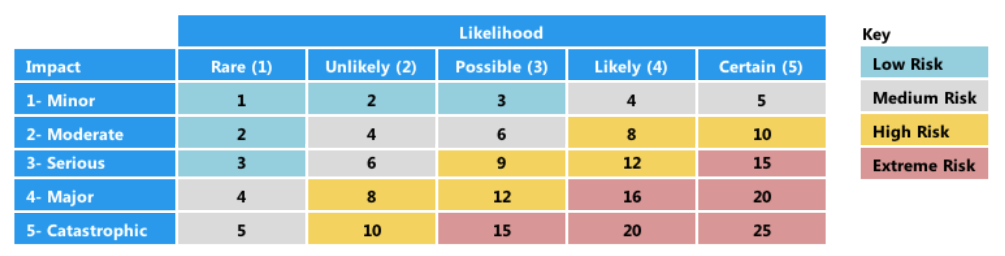
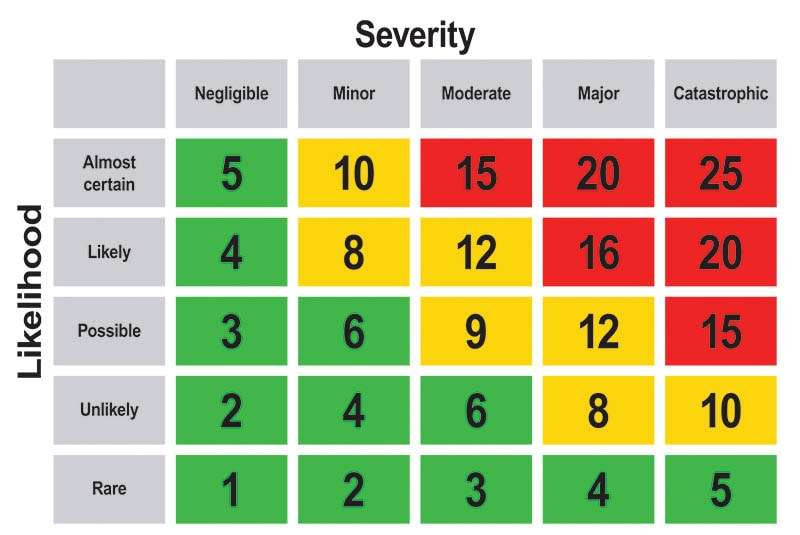
To prioritise risks within the Risk Register, businesses often employ a Risk Score Matrix. This matrix evaluates risks based on two essential factors: Likelihood and Severity.

  1. Likelihood: This factor assesses how probable it is for a specific risk to occur. Likelihood is usually categorised as rare, unlikely, possible, likely, or almost certain, each with a corresponding numerical value.
  2. Severity: Severity measures the potential impact a risk could have on the business if it materialises. Impact levels may range from insignificant to catastrophic, with corresponding numerical values.

Each of factors can rated on a scale from 1 to 5, where Likelihood and Severity respectively can be:

  • 1 – Rear / Negligible
  • 2 – Unlike / Minor
  • 3 – Posible / Moderate
  • 4 – Likely / Major
  • 5- Almost Certain / Catastrophic

By combining these two factors, a Risk Score is calculated for each identified risk. The formula typically used is:

Risk Score = Likelihood * Severity

This numerical value indicates the level of urgency in addressing the risk. The risk score can be color coded. An example of a risk score matrix is indicated below.

Risks with higher scores require immediate attention and robust mitigation strategies.

Effective Risk Mitigation Strategies

After assessing risks using the Risk Score Matrix, businesses can implement appropriate mitigation strategies. These strategies can include risk avoidance, risk reduction, risk transfer, or acceptance.

  1. Risk Avoidance: Involves altering business practices to sidestep the risk entirely. For instance, discontinuing a high-risk product or service.
  2. Risk Reduction: Implements measures to decrease the probability or impact of a risk. This might involve enhancing security systems or diversifying suppliers.
  3. Risk Transfer: Shifts the risk to another party, often through insurance or outsourcing. This strategy is common for risks that cannot be avoided but can be financially mitigated.
  4. Risk Acceptance: Acknowledges the risk and its potential consequences without taking specific actions. This approach is viable for low-impact risks or those with high mitigation costs.

Conclusion

In today’s volatile business environment, mastering the art of risk management is paramount. By diligently identifying risks, documenting them within a structured Risk Register, and assessing them using a Risk Score Matrix, businesses can navigate uncertainties with confidence. A proactive approach to risk management not only safeguards the business but also fosters resilience and adaptability, ensuring long-term success in an ever-changing market landscape. Remember, in the realm of business, preparation is the key to triumph over uncertainty.

Risk Management – for NEDs

Arguably the most significant adjustment to the NED role over the past seven years is that all NEDs must now be well versed in identifying and managing all forms of risk – operational, financial and reputational…

As a Chairman once described: “Risk is a massive issue now: You need to understand the risks and be clear about what the board is doing about mitigating those risk.”

So, how can you ensure that risks are being articulated appropriately and how can you probe into how risks are being mitigated, irrespective if risk management is well established within an industry or not? In the first part of this article I give some steer on how you can assess current risk management practises (governance) and the latter part covers some best practises.

Risk Maturity

If not already done within the company, you could do a Risk Maturity Assessment which gives an indication of the organisation’s engagement with risk management.

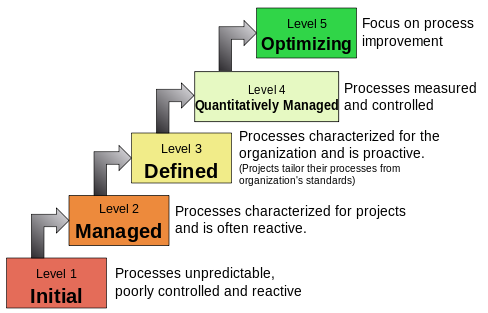
There are various models, usually with five levels of maturity (see the 5 Level Maturity Model in diagram below): from an immature Level 1 organisation where there are no formal risk management policies, processes or associated activities, tools or techniques, through a Level 2 managed organisation where policies are in place but risk reviews are generally reactive, all the ay up to the mature or ‘risk intelligent’ Level 5 enterprise where the risk management tone is set at the top and built into decision making, with risk management activities proactively embedded at all levels of the organisation.

Maturity - 5 Levels

     5 Level Maturity Model 

The outcome of such an assessment will give you clear indication of the risk management maturity level of the organisation. Dependant on how that aligns with the Shareholders’ and Board’s expected level, the needed change actions can be initiated to mature the organisation to the expected level. It will also give you measure of clarity of the rigour of process and review that is likely to have gone into the risk reporting that you see as a Board.

Risk Score/Rating Matrix

As risks are identified, logged in the Risk Register and then assessed based on likelihood of it happening and the impact to the business if it should happen, a Risk Scoring Matrix (with preferably a 5 point scal as per diagram below) is very useful to assign a Risk Score to each risk.

The higher the score the higher the priority of mitigating the risk should be.

RISK Matrix

Risk Score Matrix

As a NED you need to assess the completeness of the Key Risks in the Risk Register. Engaging with the executives prior board meetings goes a long way to get input and a feel for risks existing on the floor (day to day running/operations) of the business. You should also ask if there is something that you are talking about in every meeting that either is not on the risk register, or is rated as a low risk?  If that is true, then you need to explore why you are talking about it as a Board but management are not giving it greater focus.

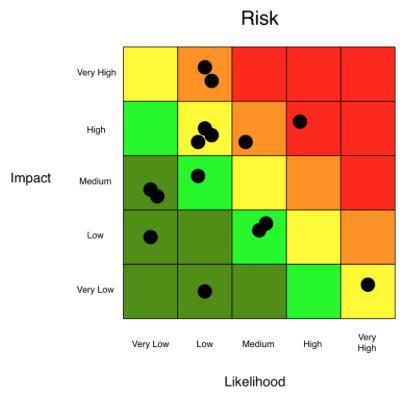
Risk Heat Chart

A heat chart (as per diagram below) enables a holistic view of risks with high scoring risks in the top right (coloured red) corner and low risks in the bottom left corner (coloured green).Risk-HeatMap

   Risk Heat Map

For a board to get an overview of what the key risks are, I don’t think you can beat a heat chart.

As a NED, you can use this to sense check: Are the risks in the top quadrants, the Red Risks, the ones that the Board feel are the highest risk? Are you talking about these risks regularly and challenging the business on what mitigating actions they are doing to reduce them?

Approach on Risk Review

The popular parlance these days is a ‘deep dive’ into the highest risks, usually undertaken by the Audit Committee.

Apart from the “deep dive’ into risks usually undertaken by the Audit Committee you, as a NED, want to do your own exploring, below is an approached…

1. Current Risk Score

What is the justification for the current rating – does this feel right? The impact should be measured by the potential impact of the risk on strategic objectives, and is usually quite easy to define, but likelihood can be more subjective.

Also known as the mitigated risk rating, the current rating should recognise mitigations or controls that are already in place, and how effective these are.

2. Target Risk Score

What is a reasonable target risk rating for this risk, ie where are we trying to get to?

As a Board, you need to set the risk appetite (which equates to target risk ratings).  This may vary by the type of risk, for example, targeting a very low risk rating might be necessary on something that is a matter of compliance or safety, but in commercial matters, the trade-off between risk and reward needs to be considered, so a higher risk appetite is likely to be acceptable.

There won’t be a limitless budget to spend on mitigating every risk to a minimal level, so as a Board you will have to decide what level of risk you are comfortable with; and where the balance sits between reducing the risk and the cost of mitigation.  Why would you spend more on mitigations than the financial impact of the risk crystallising?

3. Mitigating actions

How are you going to get to your target level of risk?  Planned mitigating actions should drive the risk rating to its target level.  This is a focus area for audit committee deep dives – what actions are planned, and will they be sufficient to bring you to your target risk rating?  Progress on these actions should be monitored regularly – if no progress, ask if this risk being taken seriously enough? Or is it not as big a risk as you first thought?

Good risk management should aid decision making, avoid or minimise losses, but also identify opportunities.

Let’s look now into Risk Mitigation in more detail…

Approach on Risk Mitigation

Risk mitigation can be defined as taking steps to reduce adverse effects and impact to the business while reducing the likelihood of the risk.

There are four types of risk mitigation strategies that hold unique to Business Continuity and Disaster Recovery. When mitigating risk, it’s important to develop a strategy that closely relates to and matches your company’s risk profile.

four types of risk mitigation

Risk Acceptance

Risk acceptance does not reduce any effects however it is still considered a strategy. This strategy is a common option when the cost of other risk management options such as avoidance or limitation may outweigh the cost of the risk itself. A company that doesn’t want to spend a lot of money on avoiding risks that do not have a high possibility of occurring will use the risk acceptance strategy.

Risk Avoidance

Risk avoidance is the opposite of risk acceptance. It is the action that avoids any exposure to the risk whatsoever. It’s important to note that risk avoidance is usually the most expensive of all risk mitigation options.

Risk Limitation/Reduction

Risk limitation is the most common risk management strategy used by businesses. This strategy limits a company’s exposure by taking some action. It is a strategy employing a bit of risk acceptance along with a bit of risk avoidance or an average of both. An example of risk limitation would be a company accepting that a disk drive may fail and avoiding a long period of failure by having backups.

Risk Transference

Risk transference is the involvement of handing risk off to a willing third party. For example, numerous companies outsource certain operations such as customer service, payroll services, etc. This can be beneficial for a company if a transferred risk is not a core competency of that company. It can also be used so a company can focus more on their core competencies.

All of these four risk mitgiation strategies require montioring. Vigilence is needed so that you can recognize and interrperet changes to the impact of that risk.


NED :: Non-Executive Director’s proposition

Are you aware of the substantive and measurable value a Non-Executive Director can bring to you and your business…?

Introduction

The Non-Executive Director, no longer a role that is associated just with large organisations. There is a growing awareness of the NED role and more and more organisations are appointing NEDs of various types, and specific specialities, often within technology and digital transformation, to enhance the effectiveness of their boards as standard practise.

With the pressure on organisations to compete globally, deal with digital transformation and respond to rapidly changing market conditions, new skills are needed at board level. This leads to the role of the NED diversifying and introduces a need to refresh the NEDs as circumstances change, bringing in new specialities, experience and challenge when the organisation needs it.

A good NED can, and should make a substantive and measurable contribution to the effectiveness of the board. Do not see a NED as a consulting advisor – a NED, within the remit of the role of a company director, play a full and active part in the success efforts of an organisation. Irrespective of the skills, experience and network contacts that NEDs will bring, they must above all, provide appropriate independent and constructive challenge to the board.

Both the organisation and the NED must understand the purpose of being a NED, within the specific organisation, for the role to be effective. This includes a clear understanding of what value the NED is expected to bring. A NED’s value goes beyond just the statutory requirements.

On appointment a Non-executive director can:

  • Broaden the horizons and experience of existing executive directors.
  • Facilitate the cross-fertilisation of ideas, particularly in terms of business strategy and planning.
  • Have a vital part to play in appraising and commenting on a company’s investment/expenditure plans.
  • Bring wisdom, perspective, contacts and credibility to your business.
  • Be the lighthouse that helps you find your way and steer clear of near and present dangers.

The role of the NED

All directors, including NEDs, are required to:

  • provide entrepreneurial leadership of the company
  • set the company’s vision, strategy and strategic objectives
  • set the company’s values and standards
  • ensure that its obligations to its shareholders and others are understood and met.

In addition, the role of the NED has the following key elements:

  • Strategy: NEDs should constructively challenge and help develop proposals on strategy.
  • Performance: NEDs should scrutinise the performance of management in meeting agreed goals and objectives and monitor the reporting of performance.
  • Risk: NEDs should satisfy themselves on the integrity of financial information and that financial controls and systems of risk management are robust and defensible.
  • People: NEDs are responsible for determining appropriate levels of remuneration of executive directors and have a prime role in appointing, and where necessary removing, executive directors, and in succession planning.

“In broad terms, the role of the NED, under the leadership of the chairman, is: to ensure that there is an effective executive team in place; to participate actively in the decision–takingprocess of the board; and to exercise appropriate oversight over execution of the agreed strategy by the executive team.”; Walker Report, 2009


A non-executive director will bring the follow benefits to your company:

  • strengthen the board and provide an independent viewpoint
  • contribute to the creation of a sound business plan, policy and strategy
  • review plans and budgets that will implement policy and strategy
  • be a confidential and trusted sounding board for the MD/CEO and keep the focus of the MD/CEO
  • have the experience to objectively assess the company’s overall performance
  • have the experience and confidence to stand firm when he or she believes the executive directors are acting in an inappropriate manner
  • ensure good corporate governance
  • provide outside experience of the workings of other companies and industries, and have beneficial sector contacts and experience gained in previous businesses
  • have the ability to clearly communicate with fellow directors
  • have the ability to gain the respect of the other directors
  • possess the tact and skill to work with the executive directors, providing support and encouragement where difficult decisions are being made
  • have contacts with third parties such as financial sources, grant providers and potential clients

Looking for a NED?

Now that you understand what a NED can do – What are you waiting for?

Contact Renier Botha if you are looking for an experienced director with strong technology and digital transformation skills.

Renier has demonstrable success in developing and delivering visionary business & technology strategies. His experience include Mergers & Acquisitions (M&A), major capital projects, growth, governance, compliance, risk management as well as business and organisation development. From startup to FTSE listed enterprise, the value Renier can bring as NED is substantive, driving business growth.