6 reasons why learning Rainbird is beneficial for your career

  1. You’ll be a better consultant

Rainbird’s human-centric automation is a unique emerging technology in the industry, and understanding how it works is a huge advantage – both in being able to sell a Rainbird solution to your clients, but also through being the gate-keeper for a desirable commodity.

  1. You’ll improve your analytical skills

The skills needed to break down what we call ‘subject matter expertise’ for Rainbird involve understanding a set of human inferences that are not widely understood in the wider RPA (robotic process automation) landscape or by automation consultancies. The nature of the subject matter itself is also very different: whilst the data on which human judgements are based has long been available as subject matter, human judgements, and how those judgements are reached, has never been subject matter for automation before. We’ve even had clients tell us that the process of mapping out their business logic has forced them into the invaluable exercise of confronting, and re-evaluating, their own thinking.

  1. You’ll look at things differently

Traditionally, RPA technologies require that decisions are broken down into formalised logic, requiring the removal of nuance and complete, unambiguous datasets and processes for successful implementation. Before Rainbird, there was an industry standard possible for if-this-then-that process automation; now, authors in Rainbird learn to structure their reasoning, a skill that is completely unfamiliar to most solution consultants.

  1. You’ll be able to do business with clients that no one else can help

Successfully replicating human reasoning, instead of relying on a decision tree, is industry-changing. Applying a new technology to use cases that we’ve never been able to automate before, due to the multi-faceted nature of human inference, provides an undeniable competitive edge.

  1. You’ll be a sought-after resource.

Maintenance of this emerging strand of unique automated reasoning technology is going to be a sought-after and exceptionally rare skill – you can capitalise on your Rainbird understanding as knowledge maps proliferate in the RPA marketplace.

  1. You’ll be able to maximise other technologies more scalably.

Infrastructure in process flow automation is maturing, with big players like Blue Prism and PEGA expanding in the space. Learning Rainbird – the only technology that can tie together these embedded process flow systems in the same way as human reasoning currently does – is crucial in maximising these flow techs scalably.

What is Artificial Intelligence: Definitions

The term “Artificial Intelligence was first coined by John McCarthy in 1956. He is one of the “founding fathers” of artificial intelligence, together with Marvin Minsky, Allen Newell and Herbert A. Simon

Artificial Intelligence today is bathed in controversiality and hype mainly due to a misconception that is created by media. AI means different things to different people.  Some called it “cognitive computing”, others “machine intelligence”. It seems to be difficult to give a definition of what AI really is.

Different Definitions:

Wikipedia: “Artificial intelligence (AI, also machine intelligence, MI) is intelligence demonstrated by machines, in contrast to the natural intelligence (NI) displayed by humans and other animals. In computer science AI research is defined as the study of “intelligent agents“: any device that perceives its environment and takes actions that maximize its chance of successfully achieving its goals. Colloquially, the term “artificial intelligence” is applied when a machine mimics “cognitive” functions that humans associate with other human minds, such as “learning” and “problem solving”.

English Oxford Living Dictionary:  “The theory and development of computer systems able to perform tasks normally requiring human intelligence, such as visual perception, speech recognition, decision-making, and translation between languages.”

Webster: ” A branch of computer science dealing with the simulation of intelligent behavior in computers. The capability of a machine to imitate intelligent human behavior.”

Google: “The theory and development of computer systems able to perform tasks normally requiring human intelligence, such as visual perception, speech recognition, decision making, and translation between languages.”

Quartz: “Artificial intelligence is software or a computer program with a mechanism to learn. It then uses that knowledge to make a decision in a new situation, as humans do. The researchers building this software try to write code that can read images, text, video, or audio, and learn something from it. Once a machine has learned, that knowledge can be put to use elsewhere.”

Rainbird: “A computer doing a task that was previously thought would require a human.”

In my own words, keeping it simple: “AI is using computers to do things that normally would have required human intelligence.”

In other words, we might say that AI is the ability of computers/machines to use human knowledge modelled into algorithms and relational data, to learn from human reasoning and the associated conclusions/decisions, and use what has been learned to make decisions like a human would.

Thus can specialist (expensive) human knowledge be stored and processed, to make the decision making ability/application available to other non-specialist people (who do not have that specialised knowledge), empowering them to, through the use of the AI system, make a specialised decision.

Unlike humans, where specialists are numbered and constrained by human limitations, can AI-powered machines scale, don’t need to rest and they can process massively large volumes of information, can conduct tasks and make reasoning decisions at a significantly higher frequency and lower error ratio than humans, all at once!

Value!?

“Creating value”; “delivering value”; “the value proposition”; “focus on value, not cost”; “price is a reflection of value” – just a few of the statements we are using on a daily basis.

But what is value?

Value comes in different forms and types and can be different for a business, it’s shareholders, clients/customers, suppliers, employees. For example: A business might define value in recurring business and it’s loyal customers; the Board might value the increase in assets on the balance sheet; Shareholders define value in the profitability of the business that convert into dividend payments or an increase in the share price; Suppliers sees value in market penetration;  Employees perceive value in an inviting work environment, culture, recognition and benefits received from their employer.

In previous posts, we covered “how to build a compelling value proposition” and what is “your value proposition“. Value was associated with what you offer (sell) into a buying market – a product or service that addresses a specific need and is of value in a commercial world. “Remember – you define your value proposition, but it’s true value is in the eyes of the beholder – your customer.”

So you are creating value for your customers in solving a specific problem or providing to a specific need in a way that makes your product of service desirable. So when you want to describe your value, it is important to think about the customer’s need first. Being customer centric in your product or service design ensures your business is aligned to deliver to a specific customer (market) need, in a profitable way – value to the customer drives business results in revenue. Excellent customer service ensures recurring customers, customer retention means future revenue growth. Satisfied customers talk about your product and service which brings revenue growth. Thus focussing on the customer value first will lead to the other types of value, as mentioned above.

But how can you define value for your customers? Well, by simply asking if your product or service helps the customer to:

  • make their life easier or better?
  • save them time?
  • save or make them money?
  • be happier?
  • be more positive?
  • be healthy?
  • be more productive?
  • improve their effectiveness and/or efficiency?
  • achieve their goals and objectives?
  • build relationships?
  • make more friends?
  • get more customers?
  • etc…?

Place yourself in your customer’s shoes – be a customer to your own product and service. How does it make you feel? Does it help you – in what way? Use the answers to these questions to continuously improve your value.

Action: Have a look at your value chain and identify how the different processes, teams and people, add value in different ways and how these combine, to focus your value proposition onto the customer.


Related Posts:

3 positions of leadership – Leading from the front

We can learn much from horses about teamwork and leadership in business. In our workshops with horses, we share a leadership model that the horses use to create cohesive teamwork. It involves three positions of leadership and we will explore Leading from the front in more detail in this post.

Many of our clients have found this leadership model to be enlightening and have embraced and implemented it into their business with substantial success. The model is based on building relationships rather than a more traditional command and control style of leadership which does not engage and inspire employees. The success of the team is dependent on every team member taking responsibility for leadership and changing their position within the team according to what they believe is needed in each moment.

The model we use is adapted from a model developed by Klaus Ferdinand Hempfling. He observed that there are three different leadership roles in a herd of horses:

  • Leading from the front where the leader sets the pace, destination and direction
  • Leading from the side where leaders coach each other in a democratic leadership style and ensure everyone is moving forward together in the same direction
  • Leading from behind which has a check and balance style of leadership and drives the team forward to maintain momentum

Each member of the team is leading at different moments, and all are essential to the success of the team.

It might seem obvious that dragging or shoving half a ton of horse is impossible yet many employees feel as though they are on the receiving end of this behaviour in the workplace. When we work with horses, we are always working at a fine-tuning level of leadership to maximise leaders’ effectiveness so we reduce coercion and passivity and help leaders find that knife-edge of assertiveness when they are leading out of the comfort zone. As a result, they improve their ability to flex and adapt to what is needed in any given situation and are able to inspire their teams much more easily.

In this post, I share an extract from a book titled Leadership Beyond Measure which explores leading from the front in more detail.

Leading from the front
The alpha mare is the most dominant member of the herd and leads from the front. Her role is to set the pace, direction and destination. Since horses are a prey animal, they are on the alert for danger. Imagine a pack of wild dogs appears, the alpha mare will decide where the herd go, how they get there and how fast they go.

If the dogs are close by, she will set off at a gallop. If they are further away, she will set off at a walk. She will go as fast as is necessary to keep the herd safe. This way, the herd conserve their energy for when it is most needed. Many people in business are going at three hundred miles per hour constantly. That is exhausting, and more balance is essential to prevent burn-out and work-related stress.

In a workplace setting, the leader of the company and each team and department usually lead from the front. For example, the MD or CEO will set the strategy and vision for a company. A Project Manager defines clear goals and objectives for his project team. A leader of a team translates the vision and goals so everyone on their team has clear expectations. Everyone at some point will need to lead from the front.

If nobody takes the lead from the front or the vision and direction are not clear enough, the team gets diverted and disperses. This can ultimately lead to conflict in the team and causes increased workload as the team become ineffective. If you’ve ever sat in a meeting and listened to a discussion go round and round without a decision, you’ve experienced what happens when nobody is leading from the front.

And if you’ve ever sat in a meeting where everyone talks over the top of each other, then you’ve experienced what happens when everyone is trying to lead from the front!

One of the challenges of leading from the front is you can get so far ahead that you lose the team. It is essential to keep checking that all team members are coming with you and understand where they are going. A common mistake in organisations is to believe that the strategy and vision have been clearly communicated when they have not. If the team is not doing what you want them to do, the destination, pace and direction need to be clearer.

When leading from the front, the focus is in the direction you are heading. If you keep turning round and looking back, you create a stop/start behaviour in your team. It indicates doubt, a lack of self-belief and self-confidence. Leading from the front requires enormous trust in yourself and the team and a belief that people will execute the strategy you have set. Be purposeful, focused, committed and clear about where you are heading or the team may stall.

In today’s business environments of rapid transformation and change, leading from the front is critical to providing the clarity and vision that employees need in order to drive the business forward.

How clear is the vision in your business and team?

Next month, I’ll explore Leading from behind and how it is critical to drive the team forward in line with the vision and pace that has been articulated.

Jude Jennison is an international speaker, author and Horse Assisted Educator with a 16 year senior leadership career in a global IT organisation, where she led UK, European and global teams.

Jude helps senior leaders and executive teams develop embodied leadership skills that create tangible business results. By receiving a horse’s non-judgemental feedback, any leader can identify their leadership behaviours and transform themselves into a courageous and hugely influential non-verbal communicator.

For more information on our leadership development programmes,
contact us on 0800 170 1810 or visit our website www.theleadershipwhisperers.com

Business Driven IT KPIs

KPIs (Key Performance Indicators) are a critical management tool to measure the success and progress of effort put in towards achieving goals and targets – to continually improve performance.

Every business set their specific KPIs to measure the criteria that drive the business success – these vary from business to business. One thing every modern business has in common though, is IT – the enabler that underpin operational processes and tools used to commerce daily. Setting KPIs that measure the success of IT operations does not just help IT leadership to continuously improve but also proof the value of IT to the business.

Here are ten IT KPIs that matter most to modern business

1. % of IT investment into business initiative (customer-facing services and business units)
How well does the IT strategy, reflected in the projects it is executing, align with the business strategy? This metrics can help to align IT spend with business strategy and potentially eliminate IT projects for IT that does not align directly with business objectives.

2. % Business/Customer facing Services meeting SLAs (Service Level Agreements)
IT is delivering service to customers; these are internal to the business but can also be delivered external to the business’ client/customers directly. Are these services meeting required expectations and quality – in the eye of the customer? What can be done to improve.

3. IT Spend vs Plan/Budget
Budgets are set for a purpose – it is a financial guideline that indicates the route to success. How is IT performing against budget, against plans? Are you over-spending against the set plans? Why? Is it because of a problem in the planning cycle or something else? If you are over-spending/under-spending, in which areas do this occur?

Knowing this metrics give you the insight to take corrective actions and bring IT spend inline with budgets.

4. IT spend by business unit
IT service consumptione is driven by user demand. How is IT costs affected by the user demands by business unit – are business units responsible to cover their IT cost, hence owning up to the overall business efficiency. This metrics put the spotlight on the fact that IT is not free and give business unit manager visibility of their IT consumption and spend.

5. % Split of IT investment to Run, Grow, Transform the business
This is an interesting one for the CIO. Businesses usually expects IT to spend more money in growing the business but reality is that the IT cost of running the business is driven by the demand from IT users with an increased cost implication. Business transformation, now a key topic in every board meeting, needs a dedicated budget to succeed. How do these three investment compare in comparison with business strategic priorities.

6. Application & Service TCO (Total Cost of Ownership)
What is the real cost of delivering IT services and application. Understanding the facts behind what makes up the total cost of IT and which applications/services are the most expensive, can help to identify initiatives to improve.

7. Infrastructure Unit Cost vs Target & Benchmarks
How do you measure the efficiency of your IT infrastructure and how does this compare with the industry benchmark? This is a powerful metrics to justify ROI (Return on Investment), IT’s value proposition, IT strategy and the associated budget.

8. % Projects on Time, Budget & Spec
Is the project portfolio under control? Which projects need remediation to get back on track and what can be learned from projects that do run smoothly?

9. % Project spend on customer-facing initiatives
How much is invested in IT projects in the business for the business (affecting the bottom line) in comparison with customer-centric projects that impacts the business’ top line.

10. Customer satisfaction scores for business/customer facing services

Measure the satisfaction of not just the internal business units that consume IT services but also the business’ customer’s satisfaction with customer-facing IT services. Understand what the customer wants and make the needed changes to IT operations to continuously improve customer satisfaction.

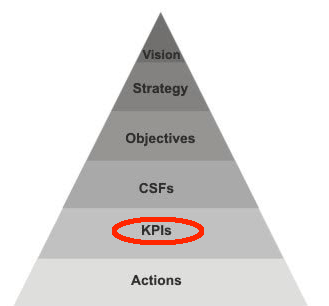
KPI vs Vision

In the famous words of Peter Drucker “What gets measured gets improved”, KPIs give you the insight to understand:

  • your customer
  • your market
  • your financial performance
  • your internal process efficiency
  • your employee performance

Insight brings understanding that leads to actions driving continuously improve.

NED :: Non-Executive Director’s proposition

Are you aware of the substantive and measurable value a Non-Executive Director can bring to you and your business…?

Introduction

The Non-Executive Director, no longer a role that is associated just with large organisations. There is a growing awareness of the NED role and more and more organisations are appointing NEDs of various types, and specific specialities, often within technology and digital transformation, to enhance the effectiveness of their boards as standard practise.

With the pressure on organisations to compete globally, deal with digital transformation and respond to rapidly changing market conditions, new skills are needed at board level. This leads to the role of the NED diversifying and introduces a need to refresh the NEDs as circumstances change, bringing in new specialities, experience and challenge when the organisation needs it.

A good NED can, and should make a substantive and measurable contribution to the effectiveness of the board. Do not see a NED as a consulting advisor – a NED, within the remit of the role of a company director, play a full and active part in the success efforts of an organisation. Irrespective of the skills, experience and network contacts that NEDs will bring, they must above all, provide appropriate independent and constructive challenge to the board.

Both the organisation and the NED must understand the purpose of being a NED, within the specific organisation, for the role to be effective. This includes a clear understanding of what value the NED is expected to bring. A NED’s value goes beyond just the statutory requirements.

On appointment a Non-executive director can:

  • Broaden the horizons and experience of existing executive directors.
  • Facilitate the cross-fertilisation of ideas, particularly in terms of business strategy and planning.
  • Have a vital part to play in appraising and commenting on a company’s investment/expenditure plans.
  • Bring wisdom, perspective, contacts and credibility to your business.
  • Be the lighthouse that helps you find your way and steer clear of near and present dangers.

The role of the NED

All directors, including NEDs, are required to:

  • provide entrepreneurial leadership of the company
  • set the company’s vision, strategy and strategic objectives
  • set the company’s values and standards
  • ensure that its obligations to its shareholders and others are understood and met.

In addition, the role of the NED has the following key elements:

  • Strategy: NEDs should constructively challenge and help develop proposals on strategy.
  • Performance: NEDs should scrutinise the performance of management in meeting agreed goals and objectives and monitor the reporting of performance.
  • Risk: NEDs should satisfy themselves on the integrity of financial information and that financial controls and systems of risk management are robust and defensible.
  • People: NEDs are responsible for determining appropriate levels of remuneration of executive directors and have a prime role in appointing, and where necessary removing, executive directors, and in succession planning.

“In broad terms, the role of the NED, under the leadership of the chairman, is: to ensure that there is an effective executive team in place; to participate actively in the decision–takingprocess of the board; and to exercise appropriate oversight over execution of the agreed strategy by the executive team.”; Walker Report, 2009


A non-executive director will bring the follow benefits to your company:

  • strengthen the board and provide an independent viewpoint
  • contribute to the creation of a sound business plan, policy and strategy
  • review plans and budgets that will implement policy and strategy
  • be a confidential and trusted sounding board for the MD/CEO and keep the focus of the MD/CEO
  • have the experience to objectively assess the company’s overall performance
  • have the experience and confidence to stand firm when he or she believes the executive directors are acting in an inappropriate manner
  • ensure good corporate governance
  • provide outside experience of the workings of other companies and industries, and have beneficial sector contacts and experience gained in previous businesses
  • have the ability to clearly communicate with fellow directors
  • have the ability to gain the respect of the other directors
  • possess the tact and skill to work with the executive directors, providing support and encouragement where difficult decisions are being made
  • have contacts with third parties such as financial sources, grant providers and potential clients

Looking for a NED?

Now that you understand what a NED can do – What are you waiting for?

Contact Renier Botha if you are looking for an experienced director with strong technology and digital transformation skills.

Renier has demonstrable success in developing and delivering visionary business & technology strategies. His experience include Mergers & Acquisitions (M&A), major capital projects, growth, governance, compliance, risk management as well as business and organisation development. From startup to FTSE listed enterprise, the value Renier can bring as NED is substantive, driving business growth.

Insightful Quotes on Artificial Intelligence

Artificial Intelligence (AI) today, is a practical reality. It captivated the minds of geniuses and materialised through science fiction as I grew up. During the past 70 years (post WWII) AI has evolved from a philosophical theory to a game changing emerging technology, transforming the way digital enhances value in every aspect of our daily lives.

Great minds have been challenged with the opportunities and possibilities that AI offers.  Here are some things said on the AI subject to date. Within these quotes, the conundrum in people’s minds become clear – does AI open up endless possibilities or inevitable doom?

“I believe that at the end of the century the use of words and general educated opinion will have altered so much that one will be able to speak of machines thinking without expecting to be contradicted.”; Alan Turing (1950)

“It seems probable that once the machine thinking method has started, it would not take long to outstrip our feeble powers… They would be able to converse with each other to sharpen their wits. At some stage therefore, we should have to expect the machines to take control.”; Alan Turing

“The study is to proceed on the basis of the conjecture that every aspect of learning or any other feature of intelligence can in principle be so precisely described that a machine can be made to simulate it. An attempt will be made to find how to make machines use language, form abstractions and concepts, solve kinds of problems now reserved for humans, and improve themselves.”; John McCarthy (1956)

“AI scientists tried to program computers to act like humans without first understanding what intelligence is and what it means to understand. They left out the most important part of building intelligent machines, the intelligence … before we attempt to build intelligent machines we have to first understand how the brain things, and there is nothing artificial about that.”; Jeff Hawkins

“The question of whether a computer can think is no more interesting than the question of whether a submarine can swim.”; Edsger Dijkstra

“Whether we are based on carbon or on silicon makes no fundamental difference; we should each be treated with appropriate respect.”; Arthur Clarke (2010)

“…everything that civilisation has to offer is a product of human intelligence. We cannot predict what we might achieve when this intelligence is magnified by the tools that AI may provide, but the eradication of war, disease, and poverty would be high on anyone’s list. Success in creating AI would be the biggest event in human history.”; Stephen Hawking and colleagues wrote in an article in the Independent

“Why give a robot an order to obey orders—why aren’t the original orders enough? Why command a robot not to do harm—wouldn’t it be easier never to command it to do harm in the first place? Does the universe contain a mysterious force pulling entities toward malevolence, so that a positronic brain must be programmed to withstand it? Do intelligent beings inevitably develop an attitude problem? …Now that computers really have become smarter and more powerful, the anxiety has waned. Today’s ubiquitous, networked computers have an unprecedented ability to do mischief should they ever go to the bad. But the only mayhem comes from unpredictable chaos or from human malice in the form of viruses. We no longer worry about electronic serial killers or subversive silicon cabals because we are beginning to appreciate that malevolence—like vision, motor coordination, and common sense—does not come free with computation but has to be programmed in. …Aggression, like every other part of human behavior we take for granted, is a challenging engineering problem!”; Steven Pinker – How the Mind Works

“Ask not what AI is changing, ask what AI is not changing.”; Warwick Oliver Co-Founder at hut3.ai (2018)

“Sometimes at night I worry about TAMMY. I worry that she might get tired of it all. Tired of running at sixty-six terahertz, tired of all those processing cycles, every second of every hour of every day. I worry that one of these cycles she might just halt her own subroutine and commit software suicide. And then I would have to do an error report, and I don’t know how I would even begin to explain that to Microsoft.”; Charles Yu

“As more and more artificial intelligence is entering into the world, more and more emotional intelligence must enter into leadership.”; Amit Ray

“We’ve been seeing specialized AI in every aspect of our lives, from medicine and transportation to how electricity is distributed, and it promises to create a vastly more productive and efficient economy …”; Barrack Obama

“Artificial intelligence is the future, not only for Russian, but for all of humankind. It comes with colossal opportunities, but also threats that are difficult to predict. Whoever becomes the leader in this sphere will become the ruler of the world.”; Vladimir Putin

“I think we should be very careful about artificial intelligence. If I had to guess at what our biggest existential threat is, I’d probably say that. So we need to be very careful.”; Elon Musk

“Whenever I hear people saying AI is going to hurt people in the future I think, yeah, technology can generally always be used for good and bad and you need to be careful about how you build it … if you’re arguing against AI then you’re arguing against safer cars that aren’t going to have accidents, and you’re arguing against being able to better diagnose people when they’re sick.”; Mark Zuckerberg

“Most of human and animal learning is unsupervised learning. If intelligence was a cake, unsupervised learning would be the cake, supervised learning would be the icing on the cake, and reinforcement learning would be the cherry on the cake. We know how to make the icing and the cherry, but we don’t know how to make the cake. We need to solve the unsupervised learning problem before we can even think of getting to true AI.”; Yan Lecun

“Artificial intelligence would be the ultimate version of Google. The ultimate search engine that would understand everything on the web. It would understand exactly what you wanted and it would give you the right thing. We’re nowhere near doing that now. However, we can get incrementally closer to that, and that is basically what we’re working on.”; Larry Page,  Co-Founder at Google (2000)

If you had all of the world’s information directly attached to your brain, or an artificial brain that was smarter than your brain, you’d be better off.” – Sergey Brin Co-Founder at Goolgle (2004)


DevOps: An Immersive Simulation

It’s 8:15 am on Thursday 5th April and I’m on the 360 bus to Imperial College, London. No — I’ve not decided to go back to college, I am attending a DevOps (a software engineering culture and practice that aims at unifying software development and software operation) simulation day being run by the fabulous guys from G2G3.

I’ve known the G2G3 team for several years now, having been on my very first ITSM (IT Service Management) simulation way back in 2010 when I worked for the NHS in Norfolk and I can honestly say that that first simulation blew me away! In fact, I was so impressed with that I have helped deliver almost 25 ITSM sims since that day, in partnership with G2G3.

Having worked with ITIL (IT Infrastructure Library) based operations teams for most of my career, I remember when DevOps first became “a thing”. I was sharing an office with the Application Manager at the time and I can honestly say that it seemed a very chaotic way of justifying throwing fixes/enhancements into a live service. This really conflicted with my traditional ITSM beliefs that you should try to stop fires happening in the first place, so as you can imagine, we had some lively conversations in the office.

Since then, DevOps has grown into the significant, best practice approach that it is today. DevOps has found its place alongside service management best practice, allowing the two to complement each other.

Anyway, back to the 360 bus — let me tell you a bit about the day…

On arrival, I met with Jaro and Chris from G2G3 who were leading the day. The participants consisted of a variety of people from different backgrounds, some trainers, some practitioners, but all with a shared interest in DevOps. Big shout out as well to the guys who came all the way from Brazil!!! Shows how good these sessions are!

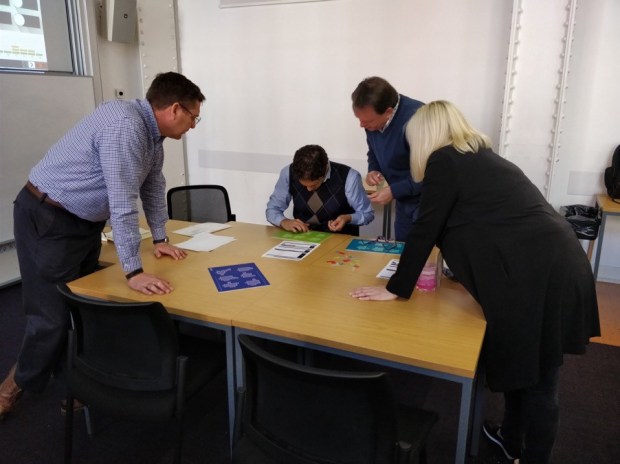
The day kicked off with us taking our places at the tables that are scattered around the room as we are given an explanation of how the sim works. I do not want to go into detail about what happens over the day, as you really need to approach these sessions with an open mind, rather than know the answers. What I can tell you is that the rest of the day consisted of rounds of activity, with each one followed by opportunities for learning and improving and planning. There are times when you find yourself doing something you would never normally do, amidst the chaos of the first round. This was summed up by my colleague, another service management professional, who had to admit that they “put it in untested”, much to the enjoyment of the rest of the room!

The day itself went by in a blur! People who you met at the beginning of the day, are now old friends that you go down the pub with at the end of the day! These new-found friends are also a fantastic pot of knowledge, with everyone able to share ideas and approaches.

The day was a rollercoaster of emotions — At the beginning of the day, I was apprehensive about whether I had enough knowledge of DevOps. Apprehension quickly changed to a general feeling of frustration and confusion through round one, as I tried to use my Tetris knowledge to develop products! I finished the day with a real sense of satisfaction — I had held my own and the whole team had been successful in developing products and delivering a profit for the business. There were some light-bulb moments for me along the way, in particular around needing to make sure that any developments should integrate with each other and also meet the user acceptance criteria. I also realised that DevOps is more structured than I thought with checkpoints along the way to ensure success. The unique way in which simulations are delivered serves to immerse people in a subject whilst encouraging them to change behaviours through self-discovery.

I have always received very good feedback for ITSM simulations, and I can see that the DevOps simulation will prove to be as successful.

Several of us also returned to Imperial College the next day to attend the Train the Trainer session for the DevOps simulation. This means that we can now offer tailored simulations either as an individual session or as part of a wider programme of change.

Simulations are always difficult to explain, without giving away the content of the day, but if you would like to find out more, please contact me onsandra.lewis@bedifrent.com


Written by Sandra Lewis — Difrent Service Mannagement Lead
@sandraattp | sandra.lewis@bedifrent.com | +44(0) 1753 752 220

5 Whys

5 Whys” technique for Root Cause Analysis (RCA)

Do you have a recurring problem that keeps on coming back despite repeated actions to address it? This might be an indication that you are treating the symptoms of the problem and not the actual problem itself – you need to determine the root cause of the problem – you must conduct a root cause analysis.

Root cause analysis (RCA) is a systematic process for identifying “root causes” of problems and the appropriate response that effectively deals with it. RCA is based on the basic idea that effective management requires more than merely “putting out fires” through quick fixes for problems that develop, but finding a way to prevent them from occurring again or in the first place. A root cause analysis is a process used to identify the primary source of a problem.

An effective method to get to the bottom of a problem is to use the “5 Whys” that was initially developed as part of TPS (Toyota Production System) that gave birth to what we know today as Lean Six Sigma – discussed in more detail in the article on “Lean Six Sigma – Organisational Development and Change”.

5 Whys is an iterative interrogative (problem solving) technique used to explore the cause-and-effect relationships underlying a particular problem.

The primary goal of the technique is to determine the root cause (source) of a defect or problem by repeating the question “Why?”, five times. Each answer forms the basis of the next question.

Why five time? This derives from an anecdotal observation on the number of iterations needed to resolve the problem.

How to conduct the 5 Why technique:

  1. Write down the specific problem. Writing the issue helps you formalize the problem and describe it completely. It also helps a team focus on the same problem.
  2. Ask Why the problem happens and write the answer down below the problem.
  3. If the answer you just provided doesn’t identify the root cause of the problem that you wrote down in Step 1, ask Why again and write that answer down.
  4. Loop back to step 3 until the team is in agreement that the problem’s root cause is identified. Again, this may take fewer or more times than five Whys.

For example:

5Whys - RCA

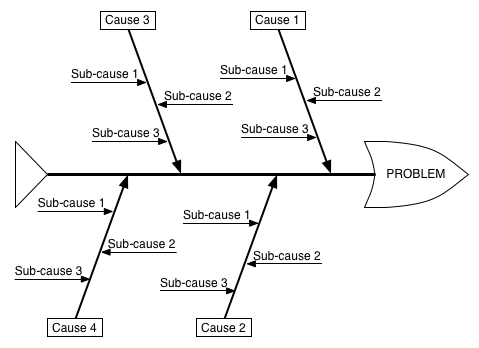
In business, only one cause for a problem is not the usual case. Using the 5 Whys in conjunction with the Fishbone Diagram (Ishikawa), that helps the exploration process to cover all potential inputs and hence potential causes of problems or defects.

fishbone-diag3

 The 5 Whys method can be used to uncover multiple root causes by repeating the process asking a different sequence of questions each time.


Building a Compelling Value Proposition

What does a professional, consultant, executive or entrepreneur have in common, seeing that business success is a common driver and key performance indicator – the need for a compelling value proposition.

In the blog post “Your Value Proposition” we discussed four simple elements of a value proposition being:

  • Need
  • Approach
  • Benefits
  • Competition

We concluded that in presenting your value proposition, it is your responsibility to adapt to situations as needed and to ensure that you can validate the actual need, have reassurance that the approach will work, know that the benefits as real and that you are a competitive player in the market. How well you can demonstrate agility in aligning the right value proposition to the customer, will determine your success in business.

In this conclusion lies the clue in how you could go about when building a compelling value proposition?

  • Validate the actual need
  • A workable approach
  • Real benefits
  • Being a competitive market player

Let’s recap on a Definition of a Value Statement: It is the positioning statement that you communicate to articulate the benefits that you provide for your target audience (customer) and how you do that uniquely well.

Where to start

The need is the most important part of the value statement, the need is the source of innovation and inspiration, the starting point that defines the problem you are trying to solve. Once you understand the real need – you are halfway there, as you’ll have an offset point, a target for your solution – an audience with a the need and interest to buy you product or service.

To identify and understand a real need, you need to do some research to gather some insight in the challenges your potential customers are facing. Asking targeted “what, why, how, who” questions to guide you in finding the real need with questions like:

  • what is the actual problem,
  • why is it a problem,
  • what are the outcome requirements,
  • what does good or outcome success really look like,
  • what is currently offered in the market,
  • what has been tried,
  • did it work,
  • what works and what does not work,
  • why does not work or work,
  • what is the root cause of the problem

Validating the need

Once you have established the real need you should ask a very important question: “Is the problem worth solving?”

Forbes mentions for 4Us – four questions you should ask when defining your value proposition:

  1. Is the problem Unworkable? (if not fixing it, is their measureable consequences i.e. someone will get fired)
  2. Is fixing the problem Unavoidable? (i.e. driven by new legislation, or a governance mandate)
  3. Is the problem Urgent? (an urgent problem has the attention of the decision makers, the C-suite)
  4. Is the problem Underserved? (absence of valid solutions currently in the market)

If you can answer ‘Yes’ to all four questions you are on the right track in defining a compelling value proposition.

Measure if your solution and associated approach is compelling

Understanding the real need enables you to define the solution – the product or services that will address the need and solve the defined problem.

Forbes mentions having a product or service that is simply faster, cheaper and better is not enough to make it compelling – you should evaluate it in 3D.

  1. Discontinuous innovation – looking at the problem differently and offering transformative benefits
  2. Defensible technology – does it introduce intellectual property that can be protected and create a barrier to entry, hence create a competitive advantage.
  3. Disruptive business model – delivers value in monetary terms to incubate business growth.

A solution with benefits in 3D is worth pursuing.

Ease of Integration

You must ensure that the solution can easily integrate into the life of the customer. Defining the solution in an easy understandable language goes a long way, but if you end up with a complicated, time-consuming and costly project trying to integrate your solution with the customer’s business you are introducing an unwanted barrier of entry. For example – as technologist we can get so caught up in the fascination of cutting edge technology, the technical jargon and functionality, that we loose sight of the actual business driver – understanding and addressing the customers need – the use of the technology must make things easier and better, not more difficult and worse.

When engineering your solution focus on integration with the minimum business operation disruption while still delivering increased business value. This is referred to as the Gain/Pain ratio: the gain your solution brings to the customer versus the effort and cost to the customer to integrate and adopt the solution.

Understand your own SWOT

Remember that you are the core to your value proposition – so keep in mind your own Strengths, Weaknesses, Opportunities and Threats – focus on your Strengths to realise your Opportunities.

Build the Value Proposition

Incorporating the findings – understanding, defining and validating the need, which is addressed by a compelling, easy to integrate solution and playing towards your own strengths – you are ready to build your value proposition.

The value proposition statement could read: For (target audience), who are dissatisfied with (the current alternatives), our product or service is a (your new brilliant service and product definition), that provides (key problem solving capability) and (the benefits to the audience) unlike (the product or service alternatives).

Last tip: Ensure that you capture what you really are about – be true to yourself and authentic in your presentation, people see straight through anything else.


Related Blog posts: Your Value Proposition; Value!?

Your Value Proposition

Your Value Proposition

Being in business means that you have something of value for sale, that is desired by someone else who is buying. Being in business isn’t just about running your own business, it also means that you are working within a commercial workplace where goods or services of value are being sold and delivered to a customer who is buying. These customers can be external to the business for example selling products and services to another business or to the public, or these customers can be internal if it is delivering value to another department or to your colleagues within the organisation or your workplace. Apart from providing your services to the customers, other people also benefit from your deliverables. These people are stakeholders and they can include your business partner, the board of directors, your manager or team leader, your team, the shareholders or even other businesses for example your vendors and suppliers who would all benefit from your success.

Even if you are not running your own business and are working for an organisation to earn your living, you are in business – the business of selling your own skills, experience and knowledge, which is of value to the company you are working for, in exchange for a salary or wages. The organisation hiring you is in essence your customer.

To be successful in business it is clear that you need to have something of value. Something of value means you have a defined product or services (skills, knowledge and experience) and a market with customers who value what you have on offer and are willing to exchange it for money. The customer must be aware of your product or service and more so must understand its value, before they will engage and buy. Creating this customer awareness is done through marketing, which is dependent on a clear definition of the product and it’s value to the target audience (the customers). This value definition is your value proposition.

Remember – you define your value proposition, but it’s true value is in the eyes of the beholder – your customer. Ultimately it is the benefits that your product and service bring to the customer that defines it’s value.

The value proposition is the backbone of the business – everything what your business is about evolves around delivering and continuously improving the value proposition. To gain new customers and to keep current customers and stakeholders involved and happy, you need to be crystal clear of your well defined value proposition.

Having a look at the value proposition examples of some of most successful companies like Uber, Apple, Slack, Digit, reveals that a good value proposition includes four elements:

  • Need
  • Approach
  • Benefits
  • Competition

Need – understand what your customer really wants, what do they need, what problems are they looking to solve. This is probably the most important part of the value proposition as without understanding the need, you’ll find it hard to define the solution (the product or services) that will satisfy the customers need in such a desirable way, that they are willing to spend money to get it.

Approach – having a solution to the customer’s need, your approach explains how you go about applying your solution (product or service) to satisfy the customer need – how the solution will solve their problem. The solution must be a direct fix for the problem. The approach you choose in delivering your solution must be the most effective means to apply your solution to the specific problem or customer need. Your approach will consist if specific components i.e. methodologies, solution architecture, prototyping, processes, templates, standards, etc, selected specifically to optimise the success in applying the solution (product or service) to the customer’s problem (need).

Benefits – focussed on the customer, what benefits would they get from using your services or products. Back to defining what value will you bring to the life of the customers when they are using your product or receiving your service. To understand this, you have to understand how the customer experiences your offering, answering fundamental questions like: “How much does this cost?”; and “Is the benefits worth the price?”. Benefits are tangible and measurable – usually in monetary terms. Benefits are not just ideas. Define the benefit in the terms the customer will relate to. Benefits should attract customers to what you offer.

Competition – what is your unique differentiator that sets you apart from your competition in the market. Again this should be approached from the customer’s perspective. How does your customer perceive your offering in relation to the other providers competing for their money. In what way does your offering differentiate from the competition i.e. quality, durability, reliability, guarantee and price.

Example: Let’s apply this to the Apple iPhone Value Proposition

Need: everyone uses smart phones – but it can be complicated to navigate. Your phone has become an accessory, and expression of your personality, a needed tool conducting our day to day lives.

Approach: Apple offers a unique user experience and design; it is not just a phone but also a lifestyle.

Benefits: Hassle free, superior operation – “It just works”. There is nothing quite like iPhone as every iPhone is built on the belief that a phone should be more than a collection of features. Exceptional design and state of the art engineering that oozes with built-in quality. Simple, elegant, beautiful and magical to use. (Just listen to their launch keynotes)

Competition: Genuinely unique iPhone features are highlighted on all marketing media i.e. security. Most of the iPhone features are not unique but experiencing the already known features on a iPhone is magical – that is what sets iPhone apart.

Using your Value Proposition

Breaking down your value proposition using the four elements mentioned above, puts you on the front foot to easily position all customer conversations towards insight and perspective of your proposition, to  the value you deliver for your customers and your stakeholders. Following through on all four elements during conversations takes the customer on a journey, a journey that makes it easier for them to relate to you and a clear holistically understanding your offering in context to the bigger picture. It also gives them the reassurance that you have the needed insight in what matters to them. Even if a prospect customer wants to focus on only one area for example the benefits aspects, you will be prepared for the engagement.

Keeping your value proposition front-mind during all customer and/or stakeholder engagements. This keeps you focussed on what’s important for business success – satisfied and happy customers.

To Conclude:

In real live you cannot predict the future, especially as you know that every situation is unique in it’s own right. In presenting your value proposition, it is your responsibility to have the agility to adapt to situations as needed, to ensure that you can validate the actual need, have reassurance that the approach will work, know that the benefits as real and that you are a competitive player in the market.

How well you can demonstrate agility in aligning the right value proposition to the customer, will determine your success in business.


Also read…

“How to Build a Compelling Business Proposition” for some valuable tips to consider in compiling value propositions.

Value!? – what is value and how do you define customer value.

Effective Leadership Communication

We have all heard the saying: “Communication is the key to success!”

Leadership coaches and successful leaders all agree that when it comes to communication – A leader can never communicate enough! The communication gurus say that even when there is nothing to communicate, the leader should communicate that there is nothing to communicate…

I have been asked the questions: “ How do you communicate effectively to ensure that everyone in the team are on the same page?” and “How do you ensure that you address and manage people’s expectations?”

To answer this, I’ll start by over simplifying in saying that communication is simply the exchange of information between a sender and a receiver, through a specific medium. In electronic engineering information is transferred from a transmitter to a receiver as an electric signal in a controlled way, ensuring the receiver receives the same information that left the sender – effective communication. That is no different with humans. As a leader communicating to your team, you are distributing information amongst other humans, amongst people – and herein the challenge. People, unlike electronic senders and receivers (which are manufactured to be identical) are different, not one is alike. Hence will the interpretation of the information exchanged through communication  differ as well. The challenge to effective communication is to align the interpretation of the information into a common understanding between the communicator (speaker/sender) and the audience (listener/receiver).

The ways in which you can ensure that you are addressing and managing people’s expectations better, are in understanding the people better. A better understanding of people, paradoxically comes through effective communication – to ask questions and listen more than actually doing the talking (active listening).

Communication is more than just your words – it is also:

  • how you say it – tone of voice, passion, authenticity
  • why you say it – the message’s intention
  • when you say it – time of day or after a specific milestone or prior an event
  • what you say AND what you don’t to say – sometimes what you don’t say gives a clearer picture of what you want to say…
  • your body language – facial expression, gestures and posture communicate a lot of the unsaid word

Communication Empowers

Consuming information leads to knowledge and knowledge is power. Thus communication leads to empowerment.

The ‘One Minute Manager’ refers to empowerment as: “Empowerment is something someone gives you – leadership is what you do to make it work.”

Communication empowers people with knowledge – to be informed and to feel part of something bigger. How the communication is being delivered (leadership) will determine it’s outcome.

What is LeadershipMy definition: “Leadership is the art of leading a group of people or an organisation to execute a common task by providing a vision that they follow willingly through the inspiration received from the leader’s passion, knowledge, methodologies, approach, and ability to influence the interests of all members and stakeholders.”

How can you accomplish this if you cannot effectively communicate the vision in a way that people feel inspired to willingly take action towards achieving it? Effective communication is key…

You can have the best team mission with SMART objectives but if you cannot communicate it to your team, you will struggle to make progress. How well you can communicate your plan (unambiguously) will determine if your team will really mobilise and unite behind you and go the extra mile to make it happen. The ultimate success measure of effective communication is: “your plan becomes the team’s plan” – everybody on the same page!

People are not mind readers – they need clear instructions and clear information to make decisions and conduct their work, especially if the work is delivered within a team where coherence and a mutual output objective are of the essence. Ultimately, it is in your best interest to accept responsibility for getting what you need to succeed in the workplace. As leaders it is in your best interest and your responsibility to ensure that what’s needed to succeed, is effectively communicated to your work teams.

Consider This

You can improve the effectiveness of your communication through paying attention to the following aspects, each discussed in more detail below:

  • Know & Understand your audience
  • Motivational & Confidence building
  • Have a Plan
  • Make sure the communication subject is clear – stick to it
  • Be Direct
  • Be Authentic
  • Enough detail
  • Bi-directional communication is more impactful
  • Common Cause
  • Think before you speak
  • Emotional Intelligence
  • Get Assurance – get feedback, assure the message sent is the message received
  • Build Trust
  • Situational leadership – choose the communication style to suite the situation


Know & Understand the Audience

Being an effective communicator allows you to address the interests and concerns of your target audience whether it being your team, your customer or client, the stakeholders or an audience listening to your presentation. Knowing and understanding your audience help to ensure that your grab their attention when you communicate and that they feel your are addressing the message to them. To understand your audience better and to structure communication appropriately, you can ask questions like:

  • Who is the audience?
  • Why is that the audience? (sometimes this is obvious but by asking this question, really think about who should be getting this message and why? Why not?)
  • What are we trying to achieve?
  • What are your plans?
  • What are the expectations of me as the leader/presenter and of the people the team members/audience?
  • What will be the desired impact of your message? (Also think about the undesired outcomes and how you can proactively prevent that?)
  • What will be the impact of your plans to the business, the team and to the people personally? – Do not leave people with more questions than before.
  • Why can we productively work together? (Understanding this is key to structuring the message to utilise people’s strengths to bring acceptance and empowerment – a sense of belonging.)
  • How will we know we are doing a great job? (How will this be measured within the audience – everyone needs to understand the metrics.)
  • Are you using a language (terminology and jargon) that the audience can relate to? There is a difference in technology speak and business speak. Align the vocabulary to your target audience – i.e. when addressing business leaders do not use too much technical acronyms and terms, rather focus on outcomes and financial numbers.
  • Do you understand the audience’s needs?
  • How can you, as the leader, meet their needs?
  • How frequently do I need to communicate? (Constant)
  • What method, approach and medium (usually a combination of) will deliver the message best? (Face to face, one to one, round table, town hall, informal stand-up, email, presentation (power-point), graphs, bullet points, etc…)
  • To what level of detail do I need to go into, to describe clearly what I mean? (Post communication, everybody must have the same picture in their minds.)

Motivational and Confidence building

Communication should always be motivational and aim to build confidence within the audience – especially when bad news is being delivered. Ensure that you mention the performance of the team, the success resulting from the efforts. The positive future that awaits and the confidence that you have in the teams abilities to realise that future. Keep repremending content to the point and as short as possible and always follow it up with a positive prospect building trust and confidence.

Have a plan

If you are communicating change or progress, you must come prepared with a plan. Have a relevant understanding of the past, the present and the future. The plan is usually “how” the team will progress from where they have been, using what they have today to build the desired future. Progress against a plan must always be measurable to unsure continuous improvement.

Be clear on what is being communicated

Ensure that everyone is clear of the subject being communicated. Focus on the key message of the communication and present it in a direct and authentic way. Stick to the subject. Ensure that the message comes with the right context and content for the receiver to place it in the right perspective.

Be Direct

I believe in a direct approach – say it as it is. Have the guts to say what is needed. Speak about the hard things that no one talks about but everyone wants to hear. Address the elephant in the room, preferably before you are asked about it.

 Be Authentic

My believe is to always be truthful and authentic in delivering your message, be yourself – people see straight through anything else…

Enough detail

Ensure that you communicate just enough detail to ensure everyone has the same picture in his or her minds after you have communicated. Too much detail and people will loose interest. Too little detail and people will makeup their own inconsistent picture. Remember the story of the group of people that were told that there is a cat in the room next door… the storyteller waited for the picture to start forming and then asked each one of the audience to describe it. As you can imagine various different pictures were presented – a black cat, a ginger cat or is it a tiger?

Always be prepared to go into way more detail than what you expect – your ability to use detailed facts to support your message, especially when asked about it, will determine the credibility of your message.

Bi-directional

Successful communication always has to be two-way. You have to be a good listener as well. Be prepared to have collaboratively discussions – listen intently before you respond. Do not formulate your next response in your head instead of listening to what is being said or asked. Your team will have a wealth of knowledge and insight that might help to enhance the right picture. This means being able to have a meaningful discussion with people, understanding, assisting and facilitating the resolution of their problems, ensuring people know what to do and why they are doing it without you having to tell them how to do it. (See Success – people come first).

Effective communication is the continuous search and commitment to seek for a better understanding. Approach conversations from a learning perspective, an opportunity to get to know more rather than a one directional “tell” perspective.

Common Cause

For the message to hit home it must address a common cause – something that address the benefit of the team but also on an individual level. Either create a common cause in your communication or remind people of the common cause – why it is important to be part of something bigger rather than just you as an individual.

 Think before your speak

Stop and think things through before you act in haste, sending out an ill-considered communication. Think what needs to happen, what are the benefits, risks, what are the desired outcome… Then compile a well-considered and effective communication. Remember this – Once the message is out, you can never really take it back.

Emotional Intelligence

In the blog post on Emotional Intelligence, EQ is defined under five interconnected components:

  • Self-awareness
  • Self-regulation
  • Motivation
  • Empathy
  • Social skills

Use your own EI to assess the situation before your decide on the appropriate way to react and how what needs communicating. In short I say:” Trust your gut feeling.”

Get Assurance

Continuously test the effectiveness of your communication by asking people to relay to you what their interpretation is. Ask this questions at all levels – do not assume that the organisation structure will distribute the intended message to all that needs to hear it – go check for yourself. Get feedback. Get the assurance that people understand what you are communicating and that if people are remembering and acting on what has been communicated. If not – communicate again, again!

Build Trust

You want your communications to be trusted. How do you build trust? By doing what you say you are going to do and build relationships at all levels with integrity and honesty. When you are trusted, your communication is on-boarded more sincerely and you are taken seriously – building rapport.

Situational Communication (and Leadership)

There are many different leadership styles (read more here) as outlined in the list below:

  • Autocratic Leadership
  • Bureaucratic Leadership
  • Charismatic Leadership
  • Democratic/Participative Leadership
  • Laissez-Faire Leadership
  • People-Oriented/Relations-Oriented Leadership
  • Servant Leadership
  • Task-Oriented Leadership
  • Transactional Leadership
  • Transformational Leadership

The “One Minute Manager” summarised leadership into four basic styles:

  • Directing – The leader provides specific instructions and closely supervises the accomplishment. (Communicate mainly by telling people what needs to be done)
  • Coaching – The leader continuous to direct and closely supervise but also explains decisions, solicits suggestions and support progress made. (Communicate a directive or corrective after team collaboration)
  • Supporting – The leader facilitates and supports people’s efforts toward accomplishment and shares responsibility for decision making with them. (Communicate similarly to the Coaching style)
  • Delegating – The leader turns over responsibility for decision making and problem solving to subordinates. (Communicate collaboratively and inclusively)

Usually the leaders default communication style is directly related to the leadership style. An effective leader can adapt his management style and hence his communication style according to the situation, including consideration for the audience and the nature of the message to be communicated.

To Conclude

Remember and think about all the aspects mentioned for consideration, before you communicate. Be flexible and agile in your approach to communication – as a leader you must be able to fluently switch between different leadership and communication styles and mediums to ensure optimum results, in the moment. There is no one glove that fit them all, leadership is not a science – hence the art of leadership. You’ll know when you get it right – do more of those!

Every situation is different and hence can a single communication approach not be seen as superior to the other – there are no equals. I’ll conclude with this saying from the ‘One Minute Manager’: “There is nothing so unequal as the equal treatment of un-equals.”


Also Read:

Management Communication Plan


Bimodal Organisations

The continuous push towards business improvement combined with the digital revolution, that has changed the way the customer is engaging with business through the use of technology, have introduced the need for an agility in the delivery of IT services. This speed and agility in IT delivery, for the business to keep abreast of a fast evolving and innovative technology landscape and to gain an competitive advantage are not just required in the development and/or introduction of new technology into the business, but in the way “keep the lights on” IT operations are reliably delivered through stable platforms and processes enabling business growth as well.

IT Bimodal

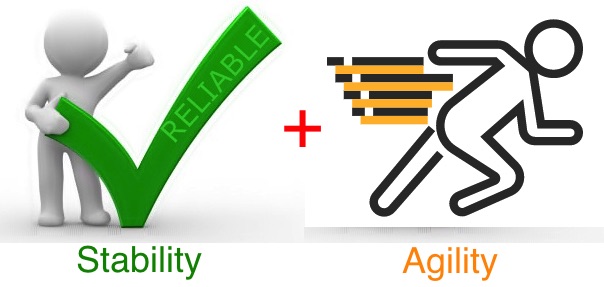
We can agree that once systems and solutions are adopted and integrated into business operations, the business requirement for IT delivery changes with IT stability, reliability, availability and quality as key enablers to business performance optimisation. There are thus two very distinct and equally important ways or modes of delivering IT services that should seamlessly combine into the overall IT Service Operations contributing to business growth.

Gartner minted in 2016 the concept of IT Bimodal – the practise to manage two separate coherent modes of IT delivery.

Mode 1: Focussed on Stability Mode 2: Focussed on Agility
Traditional Exploratory
Sequential Non-linear
Emphasis on: Safety & Accuracy Emphasis on: Agility and Speed

Each of the delivery modes has their own set of benefits and flaws depending on the business context – ultimately the best of both worlds must be adapted as the new way in which technology delivers into business value. Businesses require agility in change without compromising the stability of operations. Change to this new way and associated new Target Operating Model (TOM) is required.

Bimodal Organisation

This transformation is not just applicable to IT but the entire organisation. IT and “the business” are the two parts of the modern digital business. “The Business” needs to adapt and change their work style (operating model) towards digital as well. This transformation by both IT and “the business”, branded by Gartner as Bimodal, is the transformation towards a new business operating model (a new way of working) embracing a common goal of strategic alignment. Full integration of IT and business are the core of a successful digital organisation competing in the digital era.

The introduction of Agile development methodologies and DevOps, led to a transformation in how technology is being delivered into business operations. IT Service Management (ITSM) and the ITIL framework have matured the operational delivery of IT services, as a business (#ITaaBusiness) or within a business while Lean Six Sigma enables business process optimisation to ultimate quality delivery excellence. But these new “agile” ways of working, today mainly applied within IT, is not enough for the full bimodal transformation. Other aspects involving the overall organisation such as business governance and strategy, management structures and organisational architecture, people (Human Capital Management – HCM), skills, competencies, culture, change management, leadership and performance management as well as the formal management of business and technology innovation and integration, form additional service areas that have to be established or transformed.

How do organisations go about defining this new Bimodal TOM? – In come Bimodal Enablement Consulting Services in short BECS.

BECS – Bimodal Enablement Consulting Services

Gartner’s definition: “An emerging market that leverages a composite set of business and technology consulting services and IP assets to achieve faster more reliable and secure, as well as business aligned, solutions in support of strategic business initiatives.”

To establish a Bimodal enabled TOM, organisations need to architect/design the organisation to be customer centric, focussing on the value adding service delivered to the client/customer – a Service Oriented Organisation (SOO) designed using a Service Oriented Architecture (SOA). This set of customer services (external facing) should relay back to a comprehensive and integrated set of supporting and enabling business services (internal facing) that can quickly and effectively enable the business to innovate and rapidly adapt and deliver to changing customer needs and the use of technology within the digital era. This journey of change, that businesses needs to undergo, is exactly what digital transformation is about – not just focused on the technology, processes, quality and customer service, but on the business holistically, starting with the people working within the business and how they add value through the development and use of the right skills and tools, learning an applying it rapidly throughout the business value chain.

A customer centric delivery approach requires the development and adoption of new ways in which work are conducted – new management structures, building and enhancing A-teams (high performing individuals and teams, getting the job done), optimised processes and the right tool sets.

BECS must address the top bimodal drivers or goals, as identified by Gartner research:

  • Deliver greater IT value to the business
  • Shorten the time to deliver solutions
  • Enable digital business strategies
  • Accelerate IT innovation
  • Transform IT talent/culture/operations
  • Increase the interaction between business and IT
  • Embrace leading-edge technologies, tools and/or practices
  • Reduce IT costs (always a favourite)
  • Change the organisation’s culture

Take Action

Are you ready, aligned and actively engaging in the digital world?

Can you accelerate change and enable revenue growth with rock-solid service and business operations?

Are you actively practicing bimodal, continuously adapting to the changing digitally empowered customer demand?

The ultimate test to determine if you are bimodal: Every business process and every enterprise system needs to work without a blip, even as more innovation and disruptors are introduced to make the business more efficient and responsive.

It is time to be a bimodal organisation!

___________Renier Botha specialises in helping organisation to optimise their ability to better integrate technology and change into their main revenue channels – make contact today.

Related post: Success – People First; Performance ImprovementAGILE – What business executives need to know #1; AGILE – What business executives need to know #2; Lean Six Sigma; The Digital Transformation Necessity; Structure Tech for Success

Performance Improvement: Effective & Efficient

Performance is simply the action taken or process followed in doing a task or function.

Performance improvement – the continuous driver to be better, to grow, to achieve great things!

Directly related to business performance is the ability to change the business processes for greater effectiveness and efficiency increasing productivity while terms like specialisation, standardisation comes to mind followed by measurement, data analysis, statistical analysis, root cause analysis and finally process control and quality control and the overriding metric – customer satisfaction.

Remember the saying by Peter Drucker: “What gets measured, gets improved”…

Measuring performance involves the ability to measure the effectiveness of an initiative or action as well as the efficiency in which it is achieved. Similarly performance improvement involves the enhancement of effectiveness while optimising the efficiency.

Effective: Success in delivering a desired or intended result.

Efficient: Achieving maximum productivity through optimal use of resources with minimum waste or expense.

Depending on your business and your situation you must select or develop key performance indicators (KPIs) to calculate the effectiveness and efficiency of your activities – for business this is usually calculated in monetary terms. Once you understand your current performance you can set KPI targets and work on improvement initiatives.

I found this flow on Pinterest that gives a great overview of the processes involved in enhancing effectiveness and efficiency to increase business performance summarised in 5 habits of the mind:

  1. Know where time goes
  2. Focus on outward contribution
  3. Build on Strengths
  4. Concentrate on selected area that produce outstanding results
  5. Make effective decisions

Linking appropriate KPIs to this flow can measure progress and deliver improving results.

Effective_Efficient

Performance Management

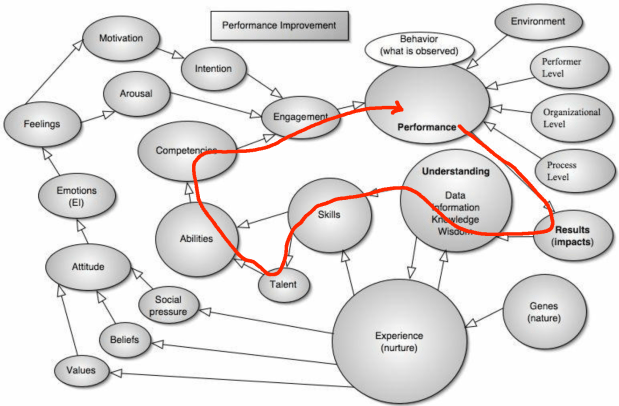
Performance (Effectiveness and Efficiency) can be influenced by various different factors – illustrated in the diagram below.

Performance_Improvement - CP.png

In using this diagram, a critical path (Shown in red above) can be drawn to improve performance in a specific area i.e. staff performance.

  1. First performance is defined,
  2. then measured to get a specific result (and understanding the impact it has overall).
  3. Understanding the results to determine which key skills, abilities and competeencies or lack there-of are contributing to the specific performance.
  4. Talent is needed to deliver performance – talent skills, abilities and competencies can be trained or recruited.
  5. Engagement is key – involve, motivate and empower your talent to respond and interact with the business – engagement brings a sense of happiness, which is a great motivator for creativity and performance.
  6. And the cycle repeats in never ending quality improvement loop.

This methodology can be adapted and used for performance improvement in any area of the business value chain.

Remember performance improvement is always reflected in the customer satisfaction. Satisfied customers engage with the business recurrently – hence revenue growth!

Let’s Talk – renierbotha Ltd specialises in the performance improvement of business and IT operations. Are you looking to achieve your goals faster? Create better business value? Build strategies to improve growth? We can help – make contact!

Lean Six Sigma – Organisational Development and Change

Directly related to business performance is the ability to change the business processes for greater efficiency and productivity while terms like specialisation, standardisation comes to mind followed by measurement, data analysis, statistical analysis, root cause analysis and finally process control and quality control.

Remember the saying by Peter Drucker: “What gets measured, gets improved”…

Improvement initiatives bring change.

A brief history of organisational change

Change management has evolved from Organisational Development OD – focused on helping people to manage change and to stay alive post the world war in the 1940S. That lead to Change Management thinking in the 70s and 80s and in parallel project management as another management process, was developed. These processes saw change as linear and hence can it be managed tightly. It starts with a burning platform and a vision to resolve the problem followed by the change journey of solving problems and overcoming obstacles. In the late 80s Appreciative Inquiry emerged changing the focus of change to “best that can be” and driving “what should be” rather than “what is wrong” and driving the “fix it”. The 1990s and 2000s brought more collaborative models and tools to manage change and solve problems and performance coaching got commonly accepted and used.

The drive to improve business performance gave life to various methodologies and frameworks for example:

  • Toyota Production System (TPS), the origins of Lean Thinking, included the prominent problem solving tools through the “five why’s”, continuous improvement, “Just in Time” production and the elimination of waste.
  • Business Process Re-engineering (BPR) which encouraged the outsourcing and off-shoring of work deemed to be non essential or too costly to perform.
  • Balance Scorecard which aims to provide a well-balanced view of the health of an organization through key performance metrics representing the financial, operational, human and environmental aspects of the business performance.
  • Project Management methodologies and frameworks: PMI, Prince2, Agile SCRUM, LEAN, KANBAN
  • Quality Control frameworks, methodologies and standards: ISO9001, Six Sigma
  • Information Technology Service Management (ITSM) frameworks: ITIL


Six Sigma

Six Sigma is a quality improvement approach that seeks to improve the quality of process outputs by identifying and removing the causes of defects and minimizing variability in the delivery processes. This is done through a set of quality tools management tools and statistics.

Another definition – the ability of processes to deliver a very high percentage of the output within a defined specification derived from customer specifications. A key KPI is the defect % and the process to reduce that to be within specification of tolerance – where a defect is defined as any process output that does deliver to customer requirements.

Running a process at Six Sigma quality is defined as defect levels below 3.4 defects per 1M cycles of the process!

Six Sigma principles:

  • Continuous efforts to achieve stable and predictable process outputs are vital for business success.
  • Operational business processes can be measured, analysed, improved and controlled.
  • Achieving sustained quality improvement requires commitment from the entire organization, particularly from the top management.

Each Six Sigma project has a five step sequence (DMAIC):

DMAICProblem solving approach:

D – Defining

M – Measuring

A – Analysing

I – Improving

C – Controlling

  1. Defining the problem, and setting a project goal.
  2. Measuring current process performance and collecting relevant data potential root causes.
  3. Analysing the data to investigate and verify cause-and-effect relationships. Determine what the relationships are attempt to ensure that all factors have been considered. The analysis should reveal a root cause of the defect under investigation.
  4. Improving and optimizing the current process by introducing changes that reduce or solve the impact of the identified root cause.
  5. Controlling/Monitoring the newly changed process to ensure no deviation from the expected results occur and that the new process is stable.


LEAN Thinking

You are lean when all you resources are used to deliver value to the end customer – nothing else. This value has to flow through the value chain without any interruptions. All activities not directly supporting in the creation and delivery of this value is considered as waste and therefore reviewed for potential elimination.

Another definition: Lean is focused on getting the rights things to the right place at the right time in the right quantity while achieving a perfect workflow that is dictated by the customers demand to deliver the goods just in time.

LEAN – Five Principles:

Lean_principles

  1. Specify value from the customer’s point of view. Start by recognizing that only a small percentage of overall time, effort and resources in a organization actually adds value to the customer.
  2. Identify and map the value chain. This is the te entire set of activities across all part of the organization involved in delivering a product or service to the customer. Where possible eliminate the steps that do not create value
  3. Create flow – your product and service should flow to the customer without any interruptions, detours or waiting – delivering customer value.
  4. Respond to customer demand (also referred to as pull). Understand the demand and optimize the process to deliver to this demand – ensuring you deliver only what the customer wants and when they want it – just in time production.
  5. Pursue perfection – all the steps link together as waste is identified – in layers as one waste rectification can expose another – and eliminated by changing / optimizing the process to ensure all assets add value to the customer.

LEAN Tools:

  • Five S (5S): A process of keeping the workplace ready for use exercising a discipline of 5 workplace practices beginning with S.
    • Sort
    • Set in order
    • Shine
    • Standardise
    • Sustain

5S optimally prepare the workplace to perform optimum tasks in the future including the idea of visual management.

  • Seven Wastes: Waste is any activity that consumes resources but do not not creates value for the customer. The purpose of seven wastes is to identify and eliminate waste in processes hence delivery greater customer value.                                              7 Catagories of Waste: Defects, Overproduction, Unnecessary transportation, Waiting, Inventory, Unnecessary Motion, Over-processing
  • Takt Time: The average rate at which a deliverable item is required to meet the customer demand. It is used to create the balance in the process between supply and demand and to help calculate the resources required to efficiently process a process just in time.
  • SMED
  • Kaizen
  • Value-Stream Mapping

Underlining the success of Lean is a culture of respect of people – at all levels. As Lean is a whole-system management methodology that requires a overall culture change to be successful – starting at the top.


Lean Six Sigma

General Electric (GE) adopted Six Sigma in the 1980’s – combining that with the principals adopted by the Toyota Production System (TPS), the origins of Lean Thinking provide the methodology of LEAN SIX SIGMA.

It is a complementary combination between the best of both worlds – Lean Thinking, which is focused on process flow and waste elimination and Six Sigma, which is focused on process variation and defects – driving business operational excellence.


Other relevant posts: Executive Overview of Agile #1 and #2

Let’s Talk – Are you looking to achieve your goals faster? Create better business value? Build strategies to improve growth? We can help – make contact!

Executive Summary of 4 commonly used Agile Methodologies

AGILE – What business executives need to know #2: Overview of 4 most commonly used Agile Methodologies

In the first article in this series we focussed on an overview of what Agile software development is and referred to the Agile SCRUM methodology to describe the agile principles.

Let’s recap – Wikipedia describes Agile Software Development as an approach to software development under which requirements and solutions evolve through the collaborative effort of self-organizing cross functional teams and their customers / end users.  It advocates adaptive planning, evolutionary development, early delivery, and continuous improvement, and it encourages rapid and flexible response to change. For an overview see the first blog post…

Several agile delivery methodologies are in use for example: Adaptive Software Development (ASD); Agile Nodelling; Agile Unified Process (AUP); Disciplined Agile Delivery; Dynamic Systems Development Method (DSDM); Extreme Programming (XP); Feature-Driven Development (FDD); Lean Software Development (LEAN); Kanban; Rapid Application Development (RAD); Scrum; Scrumban.

This article covers a brief overview of the four most frequently used Agile Methodologies:

  • Scrum
  • Extreme Programming (XP)
  • Lean
  • Kanban


SCRUM

Using Scrum framework the project work is broken down into user stories (basic building blocks of agile projects – these are functional requirements explained in an in business context) which are collated in the backlog (work to be done). Stories, from the backlog, are grouped into sprints (development iteration) based on story functionality dependencies, priorities and resource capacity. The resource capacity is determined by the speed (velocity) at which the team can complete stories, which are categorised into levels of complexity and effort required to complete. Iterations are completed with fully functional deliverables for each story until all the needed stories are completed for functional solutions.

SCRUM

Scrum is based on three pillars:

  • Transparency – providing full visibility on the project progress and a clear understanding of project objectives to the project team but more importantly to the stakeholders responsible for the outcome of the project.
  • Inspection – Frequent and repetitive checks on project progress and milestones as work progresses towards the project goal. The focus of these inspections is to identify problems and differences from the project objectives as well as to identify if the objectives have changed.
  • Adaptation – Responding to the outcome of the inspections to adapt the project to realign in addressing problems and change in objectives.

Through the SCRUM methodology, four opportunities for Inspection and Adaptation are provided:

  • Sprint Retrospective
  • Daily Scrum meeting
  • Sprint review meeting
  • Sprint planning meeting

A Scrum team is made of a Product Owner, a Scrum Master and the Development Team.

Scrum activity can be summarised within the following events:

  • Sprint – a fixed time development iteration
  • Sprint Planning meetings
  • Daily Scrum meetings (Stand-Up meetings)
  • Sprint Review meetings
  • Sprint Retrospectives


XP – EXTREME PROGRAMMING

XP

Extreme Programming (XP) provides a set of technically rigorous, team-oriented practices such as Test Driven Development, Continuous Integration, and Pairing that empower teams to deliver high quality software, iteratively.


LEAN

LEAN

Lean grew from out of the Toyota manufacturing Production System (TPS). Some key elements of this methodology are:

  • Optimise the whole
  • Eliminate waste
  • Build quality in
  • Learn constantly
  • Deliver fast
  • Engage everybody
  • Keep improving

Lean five principles:

  1. Specify value from the customer’s point of view. Start by recognizing that only a small percentage of overall time, effort and resources in a organization actually adds value to the customer.
  2. Identify and map the value chain. This is the te entire set of activities across all part of the organization involved in delivering a product or service to the customer. Where possible eliminate the steps that do not create value
  3. Create flow – your product and service should flow to the customer without any interruptions, detours or waiting – delivering customer value.
  4. Respond to customer demand (also referred to as pull). Understand the demand and optimize the process to deliver to this demand – ensuring you deliver only what the customer wants and when they want it – just in time production.
  5. Pursue perfection – all the steps link together waste is identified – in layers as one waste rectification can expose another – and eliminated by changing / optimizing the process to ensure all assets add value to the customer.


KANBAN

Kanban is focussed the visual presentation and management of work on a kanban board to better balance the understanding of the volume of work with the available resources and the delivery workflow.

KANBAN

Six general work practices are exercised in kanban:

  • Visualisation
  • Limiting work in Progress (WIP)
  • Flow management
  • Making policies explicit
  • Using feedback loops to ensure customer and quality alignment
  • Collaborative & experimental evolution of process and solutions

By limiting WIP you are minimising waste through the elimination of multi tasking and context switching.

There is no prescription of the number of steps to follow but it should align with the natural evolution of the changes being made in resolving a problem or completing a specific peace of work.

It focuses on delivering to customer expectations and needs by promoting team collaboration including the customer.


A Pragmatic approach

These techniques together provide a powerful, compelling and effective software development approach that brings the needed flexibility / agility into the software development lifecycle.

Combining and borrowing components from different methodologies to find the optimum delivery method that will deliver to the needs of the organisation is key. Depending on the specific business needs/situation, these components are combined to optimise the design, development and deployment of the software.

Helpful references:

A good overview of different agile methodologies can be found on this slideshare at .

Further Reading:

-> What Is Agile? A Philosophy That Develops Through Practice from Umar Ali

Let’s Talk – Are you looking to achieve your goals faster? Create better business value? Build strategies to improve growth? We can help – make contact!

10 Peter Drucker Quotes that challenges Business Leadership thinking

Drucker is one of the best-known and most widely influential thinkers and writers on the subject of management theory and practice. In 1959, Drucker coined the term “knowledge worker,” and later in his life considered knowledge-worker productivity to be the next frontier of management.

  1. What gets measured gets improved.”
  2. “If you want something new, you have to stop doing something old.”
  3. “Doing the right thing is more important than doing the thing right.”
  4. “There is nothing quite so useless as doing with great efficiency something that should not be done at all.”
  5. Results are gained by exploiting opportunities, not by solving problems.”
  6. “So much of what we call management consists of making it difficult for people to work.”
  7. Meetings are by definition a concession to a deficient organization. For one either meets or one works. One cannot do both at the same time.”
  8. “People who don’t take risks generally make about two big mistakes a year. People who do take risks generally make about two big mistakes a year.”
  9. Long-range planning does not deal with the future decisions, but with the future of present decisions.”
  10. Management is doing things right. Leadership is doing the right things.”

Drucker – management thought leader

His Key Ideas

Drucker is considered the single most important thought leader in the world of management, and several ideas run through most of his writings:

  • Decentralization and simplification.[31] Drucker discounted the command and control model and asserted that companies work best when they are decentralized. According to Drucker, corporations tend to produce too many products, hire employees they don’t need (when a better solution would be outsourcing), and expand into economic sectors that they should avoid.
  • The concept of “knowledge worker” in his 1959 book The Landmarks of Tomorrow.[32] Since then, knowledge-based work has become increasingly important in businesses worldwide.
  • The prediction of the death of the “Blue Collar” worker.[33] The changing face of the US Auto Industry is a testimony to this prediction.
  • The concept of what eventually came to be known as “outsourcing.”[34] He used the example of “front room” and “back room” of each business: A company should be engaged in only the front room activities that are critical to supporting its core business. Back room activities should be handed over to other companies, for whom these tasks are the front room activities.
  • The importance of the nonprofit sector,[35] which he calls the third sector (private sector and the Government sector being the first two). Non-Government Organizations (NGOs) play crucial roles in the economies of countries around the world.
  • A profound skepticism of macroeconomic theory.[36] Drucker contended that economists of all schools fail to explain significant aspects of modern economies.
  • A lament that the sole focus of microeconomics is price, citing its lack of showing what products actually do for us,[37] thereby stimulating commercial interest in discovering how to calculate what products actually do for us; from their price.[38]
  • Respect for the worker. Drucker believed that employees are assets not liabilities. He taught that knowledgeable workers are the essential ingredients of the modern economy, and that a hybrid management model is the sole method of demonstrating an employee’s value to the organization. Central to this philosophy is the view that people are an organization’s most valuable resource, and that a manager’s job is both to prepare people to perform and give them freedom to do so.[39]
  • A belief in what he called “the sickness of government.” Drucker made nonpartisan claims that government is often unable or unwilling to provide new services that people need and/or want, though he believed that this condition is not intrinsic to the form of government. The chapter “The Sickness of Government”[40] in his book The Age of Discontinuity formed the basis of New Public Management,[41] a theory of public administration that dominated the discipline in the 1980s and 1990s.
  • The need for “planned abandonment.” Businesses and governments have a natural human tendency to cling to “yesterday’s successes” rather than seeing when they are no longer useful.[42]
  • A belief that taking action without thinking is the cause of every failure.
  • The need for community. Early in his career, Drucker predicted the “end of economic man” and advocated the creation of a “plant community”[43] where an individual’s social needs could be met. He later acknowledged that the plant community never materialized, and by the 1980s, suggested that volunteering in the nonprofit sector was the key to fostering a healthy society where people found a sense of belonging and civic pride.[44]
  • The need to manage business by balancing a variety of needs and goals, rather than subordinating an institution to a single value.[45][46] This concept of management by objectivesand self-control forms the keynote of his 1954 landmark The Practice of Management.[47]
  • A company’s primary responsibility is to serve its customers. Profit is not the primary goal, but rather an essential condition for the company’s continued existence and sustainability.[48]
  • A belief in the notion that great companies could stand among humankind’s noblest inventions.[49]
  • “Do what you do best and outsource the rest” is a business tagline first “coined and developed”[50] in the 1990s by Drucker.[51] The slogan was primarily used to advocate outsourcing as a viable business strategy. Drucker began explaining the concept of outsourcing as early as 1989 in his Wall Street Journal (WSJ) article entitled “Sell the Mailroom.”[52] In 2009 by way of recognition, Drucker was posthumously inducted into the Outsourcing Hall of Fame for his outstanding work in the field.[53]

From wikipedia: https://en.wikipedia.org/wiki/Peter_Drucker


Costs reduction initiatives: Retain resources – incubate value innovation

Why is it that technology is always perceived as being too expensive? Do organisations really understand the underlining value technology brings to the business as a foundational enabler? If the answer is yes, then why the continued pressure on Technology Executives to reduce cost? It is interesting that when it comes to cutting cost, business and financial leaders always look at cutting technology resource head count instead of seriously evaluating opportunities to improve productivity and efficiency through value innovation.

In accounting terms there are only two main actions to improve the bottom line – increase Revenue and/or reduce Cost. In technology business operations these two factors can be influenced by several initiatives of which reduction of staff is one option. This should be the last resort, in my view. Despite the known facts that cutting heads in IT, in essence, is cutting intellectual property, knowledge and experience that resides within your team, is it still at top on the list for CFOs, other Executives and Board Members when the cost reduction discussion comes up!

Before we look at reducing the workforce delivering the technology services and products forming the enabling foundation for any organisation, surely we should look at viable alternatives, value innovative initiatives, forthcoming from our staff. Empower your staff to be an incubator for innovation.

Technology operations are all about providing services at a specific level as defined in SLAs (Service Level Agreements) for example:

  • IT infrastructure hosting email, website, file depositories and intranets,
  • Software Development of products the organisation sell to clients and/or use in-house,
  • Implementation, Integration and Customisation projects where software products are deployed,
  • Help/Service Desk supporting IT end-users, etc.

These services are all provided by technologist, by people, and People Come First (Read more…) Focussing on a professional, efficient and happy team by understanding the needs of every individual, goes a long way in ensuring the appropriate initiatives are forthcoming from your staff to make technology more proficient.

One of the key responsibilities of a technology executive is the efficient management of the resources. This is especially important when technology companies/departments are delivering services where the resources are the biggest expense on the technology P&L (Profit & Loss account or Income statement – Read more…).

Resources, as a high expense, reinforce the importance of proper Resource Management in business governance. Resource Management is not only about ensuring the right staff numbers with the right skills sets are available to deliver to business expectation and demand, but it is also about creating the right environment and support to ensure your staff flourish, grow and freely contribute. In my experience are ‘Resource Managers’ far too undervalued by business leaders not understanding the value of the role. Business leaders should work closely with the Resource Managers to ensure their staff is not seen as major expense but as a key asset contributing not only to current business operations but also future business growth and bottom line improvement initiatives.

Business are investing a lot in building teams of highly skilled and motivated people that feel valued and part of something special. These people are driving a clear and larger than themselves vision, that delivers results leading to recognition and self fulfilment. These people are full of innovative ideas on how to improve the business value proposition.

When it comes to resource management, incubating value driven innovation:

  • Ensure you have the right staff. Optimise your recruitment process to ensure that you have a robust framework for bringing the right people for your organisation onboard.
  • Keep your staff happy, mentally stimulated and intellectually engaged in all business processes and services. Make sure they are informed and are actively participating in the decisions driving the business forward.
  • Give them opportunities to learn in their delivery. Good people has a natural urge to continuous improvement – facilitate it.
  • Create communities where staff can learn and share knowledge on a formal and informal basis.
  • Plan your resourcing levels better. Ensure you have the right staff capacity with the right skills to deliver the services to the business demand and expectation.
  • Use flexible resourcing models combining permanent, temporary contracted and outsourced resources.
  • Continuously capture task and productivity data.
  • Utilise analytics, mine the productivity information to give your insight in areas/services costing the most and why. Act on these insights!
  • Build a framework you can use in planning resource capacity forecasting. Work closely with the business to understand the sales pipeline and product development strategy to ensure you optimise your resource capacity with the demand. There is nothing more disruptive to any organisation than constant resource level fluctuation (increase/hiring and decrease/firing) due to poor strategic and project planning.
  • Identify your key resources and nurture them, retain them at all cost – they are the knowledge keepers of your IP (intellectual property). It is cheaper to implement initiatives to retain staff than it is to replace them!
  • People want to feel part of something and if they are happy in their community contributing to a future and in the process they are improving themselves, they are much more likely to stay. Recruitment fees, where staff retention % are low, are a large contributor to cost.

Any cost saving initiative has a fundamentally key measure that needs to answer true: “What is the value to the business?” Revenue and cost do not always define the true value…

What is the true value your staff bring to the success of your business? Have you asked them and really involved them to work with you on ideas to improve business value through innovation rather than cost cutting?

One last point – when you have done your value analysis and it does come to letting staff go, remember this: treat them fare – you never know when you will need them again.


Are you under pressure to cut cost? renierbotha ltd specialises in the fine tuning IT operations for optimum business value – Make contact!

Case Study – Renier Botha’s Game-Changing Leadership at Systems Powering Healthcare (2015-2017)

Posted on November 1, 2017

Introduction:
Back in December 2015, Renier Botha stepped in as the big boss—Managing Director and Head of Service at Systems Powering Healthcare, aka SPHERE. This place is all about delivering top-notch IT services and infrastructure to a whole lot of NHS healthcare workers—over 10,000 to be exact. Let’s dive into how Botha totally revamped SPHERE in his two year tenure, turning it into a powerhouse through his sharp strategic moves, cool innovations, and rock-solid leadership.

Facing the Music and Setting Goals:
Right off the bat, Botha was up against some big challenges. He had to shift SPHERE from an old-school cost-plus model to a snazzy commercial-service-catalogue model while also trying to attract more clients. His main to-dos were to get the company on stable footing, map out a strategic game plan, and make sure they were all about putting customers first.

Key Moves and Wins:

  1. Strategic Master Plan: Botha wasted no time. Within the first three months, he whipped up a six-year strategic plan that laid out all the key investments and milestones to get SPHERE to grow and thrive.
  2. From Startup to Star: Managing a team of 75, Botha steered SPHERE from its startup phase to become a well-known medium-sized business, hitting their three-year targets way ahead of schedule – in just two years!
  3. Tech Makeover: One of his big programmes was pouring £42M into beefing up SPHERE’s tech – think better networks, better hosting, the works. This move was all about making sure they could keep up and stay ahead in the long run.
  4. Service Delivery Shake-up: Botha brought in a new, customer-focused operating model and rolled out Service-Now to up their tech game. This not only made things run smoother but also saved a ton of money, giving them a killer return on investment.
  5. Financial Growth: Under his guidance, SPHERE’s dough rolled in 42% thicker thanks to smart mergers, acquisitions, and raking in new clients. They also managed to save the NHS about £3m a year with their shared service gig.
  6. Cost-Cutting Genius: He managed to slash the “Cost per IT User” by 24% in two years, showing just how much bang for the buck SPHERE could offer.
  7. Big Win: Thanks to a revamped service catalogue, SPHERE nailed a whopping £10m contract to provide IT services for Northumbria Healthcare NHS Foundation Trust.
  8. Happy Campers: Botha didn’t just focus on the numbers; he also built a workplace where people actually wanted to stick around. Employee retention jumped from 82% to a whopping 98% by the end of his run.

Conclusion:
Renier Botha’s time at SPHERE shows just what can happen when you mix visionary leadership with a knack for making smart moves in healthcare IT. He not only met the big challenges head-on but also made sure that SPHERE became a go-to example of how IT can seriously improve healthcare services. His story isn’t just about a job well done; it’s about setting a whole new standard in the industry.

The Digital Transformation Necessity

Listening to every keynote, panel discussion or reading articles relating to business sustainability through technology, one message is repeated over and over again – Digital Transformation is imperative for all businesses!

Although this message is coming through loudly, is it not always clear to business leaders and the workforce, exactly what digital transformation really is and what it means for their organisation.

In explaining digital transformation as the benefit and value that technology can enable within the business through technology innovation including IT buzz words like: Cloud, Automation, Dev-Ops, Artificial Intelligence (AI), Machine Learning, Internet of Things (IoT), Single Sign-On, Data Mining & Big Data, Bit Chain – does not really make the need for digital transformation any clearer.

One thing is clear though – we are living in a hyper-connected world where technology and more specifically, digital devices, are the glue linking together people and information in new ways we can hardly comprehend. In this statement, is the clue of what digital transformation entails…

What is digital transformation?

We can define digital transformation as the fundamental changes in the manner in which business and organisational operations are conducted, to adapt to the changes and to leverage the opportunities, caused by the use of digital devices and their accelerated impact on the way we live.

Digital devices, operate on digital signals running through electronic circuits to collect, store, manipulate, interpret and display information. These digital electronic integrated circuits (ICs) evolved since 1947, when the functional transistor was invented, into what we know today as computers. All digital devices are, at its core, a computer of some sorts used by humans to interact with information.

Transformation on the other hand implies a fundamental change in the way things used to be (converting something from one state to another) – it enables new creativity and innovation inspired by technology evolution, bringing change that introduces a new way, a different way to do things, rather than just enhancing or improving an old or current way.

To simplify it, you could say that digital transformation is the profound changes in the way business is conducted, to adapt to the changes in society caused by the continuous evolvement of computers.

A typical example of digital transformation is the “paperless office” – fundamentally changing the way we preserve information by storing it in digital format rather than writing it down on paper. This concept has profound implications in our commerce interaction expectations if you are comparing the speed in which information can be recalled and processed through digital means vs paper files, archives and libraries…

Who should lead the Digital Transformation?

Computers are hardly breaking news anymore as it is widely used within business where technology has become an integral enabling part of any organisation. Modern digital devices i.e. tablets, smart phones, the IoT, smart watches and other smart wearable devices, are changing the way we live and interact in commerce and hence the way we, as the consumer society, expect business to be conducted. Digital transformation is thus more about the change in business operations – processes and systems – than just the adoption of new technologies. Due to the importance of technology in organisations and the key role IT plays in the organisation’s ability to adapt to the society’s changing needs, it is the role of the CIO to lead the Digitial Transformation initiatives.

Digital Transformation matters because…

Any business change is costly and businesses might avoid change, for that very reason. Howard King of The Guardian, (Nov’13) puts it this way: “Businesses don’t transform by choice because it is expensive and risky. Businesses go through transformation when they have failed to evolve.” He continues in saying that evolving businesses never necessarily need to transform as they are continually focussed on their clients. This evolution ensures the key drivers of transformation namely: changing customer demand, changing technology and changing competition, never coincide in such a way that the business operating model can no longer service it’s customers. When it does, the business reaches a tipping point that requires transformation within the business, to adapt and re-align or tip over the edge.

The pace, at which digital devices have evolved, changed the way we interact with information and has become an intrinsic and material part of daily live. This has left organisations, which did not evolve with the technology, at a tipping point. For businesses approaching or reaching this tipping point it might be too late to evolve and hence Digital Transformation becomes a necessity for survival.

Emerging, disruptive technology driven, companies are changing industries leaving competitor companies with one choice – adapt, through digital transformation, or face the consequences of slowly loosing market share and eventually…

What does a typical Digital Transformation strategy involve?

As every organisation delivers their products and services (the value proposition to it’s clients and customers) in a different way, so will the digital transformation within one company differ from the other.

To define a transformation strategy and the associate change programme, one must look at the value chain of the organisation. Each element within the value chain can, and in most cases must, contribute to the scope:

  • Infrastructure
  • People – Leadership and the overall Workforce
  • Technology
  • Supply Chain
  • Procurement
  • Operations
  • Manufacturing (Engineering)
  • Fulfillment
  • Marketing
  • Sales
  • Service Delivery
  • Business Market (Client’s & Customers)

For each of the business value chain components, one must question the impact of the key transformation drivers:

  • Change in Customer Demand
  • Change in Technology
  • Change in Competition

Understanding these impacts will outline what needs to change, which generally comes down to:

  • Transform the Customer Experience
  • Transform the Operational Processes
  • Transform the Business Model

Note that IT is not singled out in the above – this is because IT is the catalyst that should overall enable these transformation initiatives.

The following examples of Digital Transformation Frameworks can also be helpful in defining the strategy:

Change brings uncertainty… Address it!

Transformation, by definition, brings change and a typical digital transformation programme will dramatically change the organisation. This change will especially affect a key business asset within the value chain – the people working within the business – “Success?.. People come First!”.

It will also dramatically effect, if not completely change, the organisation’s culture. Culture comes from the top – make sure that the board and executives are promoting the transformation and are willing to change themselves, as change is always desired until it is required of one-self.

Empower the workforce to understand the reasons why transformation is needed. Involve everyone to actively contribute to the innovative rethinking of their roles – how does digital technologies impact their daily work experience? Articulate the core business focus (what is the value proposition to the clients and customers) and ask, how can enabling digital technologies be used in support of achieving value excellence?

Find ways to make the necessity of the change a positive win for everyone, as supporting the people through the transformation is just as important as the digital technology you are trying to embrace.

To Conclude

Digital organisations outperform organisations doing digital – making Digital Transformation the last survival action for organisations that have not evolved with digital technology.

Transformation is a dramatic change and hence must the people aspect and business culture be treated with extreme care and sensitivity. A strong CIO is needed to drive the transformation programme with full buy-in from the rest of the executives and the whole workforce.

A well executed digital transformation strategy will re-align the business with the growing digital demands of it’s customers, by addressing the needed adoption of technology innovation across the business value chain resulting in an agile business ready for a fast evolving digital future.

Let’s Talk – Are you looking to achieve your goals faster? Create better business value? Build strategies to improve growth? We can help – make contact!

IT Due Diligence – is IT an asset or liability?

Information Technology is an integral part of any organisation and enables the operations of enterprises. Through supporting business operations, IT collates and analyses business data to provide the management information required in making timely and effective decisions. IT can even be the product/service around which enterprises are built. Information is a key business asset. But IT can also be the skeleton in the closet. Technology assets can turn into liabilities costing more and/or introducing risks that are not anticipated. This makes IT a key priority consideration in strategy development, corporate governance and business risk mitigation as well as merger and acquisition (M&A) transactions.

Despite the obvious importance of IT within any organisation, do business executives, who are mostly more focused on the financial and legal aspects, often overlook it. The appropriate attention is not given to the IT diligence as part of corporate governance or during the due diligence in M&A initiatives. This might be due to the continuous limited understanding of the technology discipline amongst business executives and/or the absence of the right expertise within an organisation to conduct the needed IT review. Another contributing statistic is that IT due diligence rarely is the make or break factor in business deals, which in a lot of cases, result in unwanted surprises presented to directors. That is why IT should be part of the scope of business strategy development and be one of the key contributors in M&A negotiations, influencing the deal and price.

The key reason for IT due diligence is to ensure visibility to the directors of concerns relating to IT operations in order to develop addressing strategies and mitigating actions. Investors should also use this information in assessing a potential business asset and it’s associated opportunity versus risk.

A due diligence exercise will cover at least the following main IT considerations: Systems, Projects & Change, Data, Security and IT Service Provision. Each of these considerations should be reviewed covering at least the following four elements: People, Process, Technology and Value.

Meaningful IT due diligence can be accomplished by practitioners who can ask the right questions stemming from the appropriate industry experience and domain knowledge. The art of due diligence is in formulating the right questions around key investment and/or corporate success drivers and interpreting the answers to inform the true state of affairs and it’s associated business enablement ability, future opportunity contributions and the associated business risk. Mostly, this diligence informs on the present and future role and influence of IT assets within the overall business success, for example:

  • Product, service and information Ownership – does the business really own what IT claims to be the property and assets of the business in relation to it’s true value and the balance sheet?
  • Reliability – can the business rely on its technology, now and in the future?
  • Sustainability – does the business have the ability to sustain its IT asset and visa versa?
  • Scalability – can the technology assets keep up with the business’ growth plans?
  • Adaptability – how easy can the technology asset integrate or be adapted to integrate with other systems and new emerging technologies in the future?
  • Compliance – does an IT asset introduce unwanted risk through non-compliance? For example, the introduction of new legislation to address the continuous increase in cyber and information security concerns might have a significant impact on the legality of an IT asset that might result in serious financial risk and penalties, if not addressed.
  • Finance – how much are IT assets likely to cost the business and what contributions will these expenses have on the financial success of the organisation?

A typical IT due diligence exercise could cover the following areas of IT operations (Some of these areas might not always be applicable in all organisations.):

  • Clarity on the Business Value Chain
  • IT Staff
    • IT Organisation Structure
    • Leadership
    • Qualifications & Skills
  • Certifications & Standards i.e. ISO9001 (Quality), ISO17001 (Security), ITIL (Service Management) or ISO20000 (ITSM)
  • Products and Services
  • Documentation
  • Software Development Processes & Methodologies
  • Service Management
  • Software applications and Services utilized
  • IT Infrastructure
    • Hardware
    • IP Network Infrastructure
    • Hosting Environments
  • Business Continuity
    • Service Availability
    • Systems Up-time
    • Backup and Recovery
    • Disaster Prevention & Recovery
  • Security
    • Cyber & Information Security
    • Network Security
    • IT Services & Systems Access
    • Physical Access
  • Governance
    • Operating Model
    • Policies
    • Procedures
    • Risk Management
    • Performance & KPIs
  • Projects & delivery methodologies
  • Compliance
  • Legal
    • SLAs
    • Supplier & 3rd party Service/Support Agreements
  • Intellectual Property
  • Quality Assurance & Improvement
  • Financial
  • Client and/or Customers

Understanding this information is vital in corporate governance, strategy formulation and capital investment decisions ensuring business critical assets are sustained and developed appropriately for a viable ongoing business concern.

The content of an IT due diligence report should focus on the objectives of the due diligence review, outlining priority findings with recommendations that present a clear call to action addressing the key issues found. A typical report should contain:

  • The objectives of the IT due diligence review
  • An executive summary with the key take aways
  • Key findings and the associated risk
  • Recommendations

The review findings and recommendations should be acted upon through appropriate remediation projects and a clear transition & support plan with inclusion into IT & business strategy. The business benefits can only be realised if these post review projects and transition, are successfully integrated into the organisation.

Let’s Talk – Are you looking to achieve your goals faster? Create better business value? Build strategies to improve growth? We can help – make contact!

Leadership definition

What is Leadership? How do you define Leadership in a concise sentence?

According to Forbes a leader has got nothing to do with title, seniority or position within an organisation, personal attributes and management are definitely not leadership.

So what is leadership then?

Some thought leaders of our time define leadership as…

Peter Drucker: “The only definition of a leader is someone who has followers.”

Warren Bennis: “Leadership is the capacity to translate vision into reality.”

Bill Gates: “As we look ahead into the next century, leaders will be those who empower others.”

John Maxwell: “Leadership is influence – nothing more, nothing less.”

“Leadership is the art of leading others to deliberately create a result
that wouldn’t have happened otherwise.”

Forbes: “Leadership is a process of social influence, which maximizes the efforts of others, towards the achievement of a goal.”

Wikipedia: Leadership is “a process of social influence in which one person can enlist the aid and support of others in the accomplishment of a common task“.

My definition: “Leadership is the art of leading a group of people or an organization to execute a common task by providing a vision that they follow willingly through the inspiration received from the leader’s passion , knowledge, methodologies, approach and ability to influence the interests of all members and stakeholders.”

What CEOs are looking for in their CIO

During the CIO-Dialogue 6 held in Brighton in November 2012, I had the privilege to listen to Simon La Fosse presenting. Simon, CEO of La Fosse Associates, is a specialist technology executive search and head-hunter with 25 years experience in the recruitment market.

What does a CEO really want from his CIO?… Simon presented the head-hunters perspective followed by a lively discussion. This presentation had a profoundly positive impact on my confidence especially after pondering on the key aspects that was highlighted (listed below) and measuring yourself to identify areas of strength and where I can improve.

What I took away from the interaction…

The CEO is looking for a CIO that he can build a professional relationship with. Someone they can trust to help them through the disruption technology is continuously causing in business.

The CIO must not be too involved in the daily operations as they have to see the bigger picture and spot opportunities through interaction with peers and bring those to the CEO in clear, concise, precise and commercial terms. To be able to do this the CIO needs a fantastic leadership team in place. Smart people that know how to do their job (see ‘Success?… People Come First’) and bring valuable feedback and management information to the CIO in support of the business. A leadership team that will give the CIO the time to focus on the bigger picture. Measuring your management team with the same criteria is important as your team in essence are the channel that will get the job done.

Key aspects that are personality trades and skills

that the CIO must possess to satisfy the CEO’s requirements…

  1. Emotional Intelligence – Someone that understands and who can manage emotions. Emotions bridge thought, feeling and actions and affect many aspects of a person and hence teams. There are three aspects of the effect of emotions: Physical, Behavioural and Cognitive. How tuned in is your intuition to understand and manage emotions? Emotional intelligence is about two key principles: firstly it is about awareness, identifying and understanding emotions and secondly it is about using and managing emotions. Emotional intelligence is a key trade in the success of influence and motivation of people. How emotionally intelligent are you?
  2. Ambition – CIOs have to have a desire for achievement, success, honor and the willingness to strive for it’s attainment. Ambitions drives change for the better which is should be a constant in any CIOs strategy and objectives.
  3. Advocacy – Supporting the CIO in his business vision, mission and strategy and continuously recommending technology innovative ideas and plans in support of the his technology team to drive the success of the CIOs objectives.
  4. Influence – Gravitas within his personality to be a compelling force in the organisation that effects peoples actions, behaviour, opinions, decisions for the better good of the business.
  5. Assertiveness – Be confidently self assured and positive in his communication, strategy and decisions to build the confidence in others that the right things are going to happen. Someone that can stand his ground without being aggressive.
  6. Authenticity – You get hired for the person you are. Be truthful to yourself and others and do not wear a mask at work.
  7. Results – CEO are looking for results, getting the job done by not taking too high risk.
  8. Simplicity – Do your thinking before hand and present to the CEO in a compelling way. Exercise the art of taking a complex subject and present it in a simple compelling way that enable the CEO to make knowledgeable and quick decisions.
  9. Commerciality – Continuously keep an eye on the business commercials. Look for ways to improve the bottom line. How can you improve the revenue and reduce the cost? Question if the status quo are still relevant. Constantly drive improvements. Keep coming back with savings.
  10. Dissatisfaction – Always look for ways to improve without demoralising your team. Evaluate and embrace innovative ideas.
  11. Leadership – Leadership is the art of leading a group of people or an organization to execute a common task by providing a vision that they follow willingly through the inspiration received from the leader’s passion , knowledge, methodologies, and ability to influence the interests of all members and stakeholders. (see ‘Leadership by Definition‘) Do not just lead your technology team – lead from the top, also lead your piers – lead sideways. Be accountable and responsible.
  12. Values – The basis for ethical action and believes. Values defines your sense for right and wrong. Values influence attitudes and behaviours. Ethical personal and cultural values are very important. Understand the business ethics and the values of your CEO.
  13. Culture fit – Specifically referring to organisational culture which is the behaviour of the people working within the organisation. You must be getting on with people. Understand when the culture is changing and influence the change to the desired outcome.
  14. Sector Knowledge – Know your subject (technology) in relation to the business but more importantly know your organisation’s product, their market and the opposition.
  15. Supplier Relationships – Know the industry to bring options in supplier selection. Understand how the CEO wants this to be managed. Build meaningful and, more importantly, business valuable relationships. Aggressively manage the suppliers by always comparing and looking for the best value delivery – this is not always the cheapest option…
  16. International Experience – We live a multi-cultural society where a dynamic mixture of races, languages and culture are working together in a global environment. The CIO must be confident and at ease in his environment through cultural understanding, exposure and experience gained through international exposure.
  17. Agility – You must ensure that you and your organisation have the ability to rapidly respond to change without disrupting the stability to operations on a continuous basis.
  18. Trust – The CEO is relying on the CIO and visa versa. Trust involves two parties with a ‘trustee’ and a ‘trustor’ – The trustor is reliant on the actions of the trustee. In the CEO and CIO relationship the trust is mutual to each other. Trust is the believe that the other will do as expected to ensure a positive outcome of a situation with an unknown outcome in the future. Trust is so key that if you loose the trust of the CEO, move on.
  19. Accountability – According to Wiki is Accountability the acknowledgment and assumption of responsibility for actions, products, decisions, and policies including the administration, governance, and implementation within the scope of the role or employment position and encompassing the obligation to report, explain and be answerable for resulting consequences. The CEO has to know that the CIO will take accountability for the actions of his devision. CIOs have to take accountability with comments like: “leave this to us/ IT”, “it is our issue, we’ll sort it out”.
  20. Complexity – Technology is complex but the CEO relies on the CIO to keep things simple. The CEO has lots on his mind and relies on the CIO to be short, precise and to the point explaining a complex situation or proposition in simple terms.
  21. Surprise – Most CEO will agree with this, they just do not like surprises! Keep them informed so no situation or communication turns into a surprise.

A view additional trades and skills – from my perspective…

  1. Visionary – Have the ability to read the current trends and envision the future. Have a clear and specific view of the future incorporating the advances in technology and social or political arrangements. Bring those views to the CIO to incorporate in his vision for the business.
  2. Motivator – The ability to get the best out of people through your ability to understand, manage and work with people. This links in closely with Leadership and Emotional Intelligence. You must be able to motivate and keep your teams motivated to ensure optimum productivity and delivery to expectations.
  3. Coach & Mentor – Build a relationship with your staff and piers to help encourages the lending of assistance, guidance and help. Nurture relationships of learning, open dialogue and challenge to drive towards greater knowledge, experience that ultimately leads to increased wisdom which in turn achieve the goals of the business.
  4. Catalyst for Innovation – Encourage and reward the continuous renewing, changing and creating of move effective products, operational processes and business models to adapt to a changing environment. This links in with agility mentioned above.
  5. Integrator – Be the person that ensures the forming components of an organisation, for example the different departments, sub systems, infrastructure, governance groups and teams, etc. sufficiently integrate with each other forming a single unit driving towards the same business objectives. Technology can and should provide the glue between the different components. To accomplish this, a very good understanding of the bigger picture of the organisation is needed. Innovation with different parts of the business will not deliver it full value without effective integration into the revenue streams of the business.

What other trades and skills do you feel is key for a CIO to fulfil the expectations of the CEO?

Let’s Talk – Are you looking to achieve your goals faster? Create better business value? Build strategies to improve growth? We can help – make contact!

Decision Making – Technique or Gut-feel

Lessons in live, just like opportunities, sometimes come from the strangest sources or situations.

As I was driving from London to Canterbury University to meet an old colleague and friend, I tuned in to the radio station ‘Magic’.  The presenter announced that it was time to give away some money to a lucky family for holiday spending money in a dial-in competition. The concept of the competition is that the presenter has a particular item in mind which the contestants must determine. The presenters provides a clue through asking a relevant question to which the answer is this particular item he has in mind. Contestants dial in and can ask two questions to determine what the item is the presenter has in mind, after which a final answer must be provided.

The relevant question was: “I am going to the beach to enjoy a lovely sunny day of sea and sand, what am I taking with me?” Now usually I would start solving a mystery question like this by means of elimination narrowing down the field of possibilities and thus zooming in onto the correct answer. For example asking an initial question like: “Do I use this item in the water or on the beach sand?” Dependent on the answer of either water or sand you’ll start narrowing things down by questioning if you use the item to play, can you eat or drink the item, etc. The catch is though that you can only ask two questions and then have to guess the correct answer. So you have to carefully think of which two questions to ask, while the clock is ticking…

An eleven-year-old boy won £1800 for his family in summer vacation spending money in playing the game? Instead of applying a problem solving technique like elimination, he went directly to obvious answers, which he phrased as questions. His first question was: “Is it a spade?” to which the presenter answered: “No, it is not a spade…”. His second question was: “Is it a bucket?” “Yes! It is a bucket, you just won your family £1800 in cash!” The presenter answered in delight.

This was making me think as I participated in my mind making up questions to determine the correct answer myself – by means of elimination… “Is it something that you use in the sea? No! Is it something you use on the sand? Yes, on the sand, right. Oh, my two questions are up, now I have to guess…”

What has just happened – the 11-year-old boy, who probably had no official training in problem solving techniques or skills, solved the mystery in two questions without having to guess an answer at the end.

As a director I am facing hundreds of questions and problems (sometimes mysteries) every day. Surely there is a lesson or two I could take away from this…?

Lesson 1 – go straight for the obvious, the chances are the answer is right in front of you and if you are right you save a lot of precious time.

Lesson 2 – sometimes you do not have to analyse the situation, applying sophisticated techniques and methodologies to make the right decision just go with your gut, take small steps, adapt as you go and recover quickly as needed. Almost like the Lean software development methodology that uses the concept “Fail Early, Fail Fast, Fail Often” to ensure measurable progress is rapidly delivered that aligns with end user expectation.

Now, you could argue that the boy was just lucky, which he was, but going for the obvious, keeping things simple, in most cases provides you with the right answer without spending wasted time and energy. If you tend to make things more complicated than they are, remember the old saying in engineering and development ring true, KISS – Keep It Simple Stupid!

AGILE Software Development – What business executives need to know

AGILE Software Development – What business executives need to know

As a business executive how much do you really know about the Agile approach to software development? As the leaders within the company responsible for using technology innovation as an enabler to accelerate the business operations and improve the companies results, do you really understand your role and involvement in the technology development methodology used in your organisation? How can you direct the team if you do not understand the principals of the software development game?

All executives in businesses using an agile approach for software development must understand the basic principals, rules, practices and concepts of “Agile”. With an understanding of the methodology the software development team is following, a better understanding and appreciation of the team and their efforts are reached improving your ability to lead and direct the people involved across the business.

This series of Blog Posts provides an executive summary of the “Agile Software Development Approach” to get your tow in the water.

Agility is expected in modern software development and the customers assume that through appropriate planning, solutions are build with the ability to anticipate changes and to realign over time, as requirements and needs are changing.

Agile comes from the Latin word ‘agere’ which means “to do” – it means the ability to progress and change direction quickly and effectively while remaining in full control.

Software development delivering products and solutions, usually come about through the same phases within the business:

  • A need – The business has a particular demand and/or requirement and need a new software product or changes and enhancements to existing software solutions to address this demand and deliver value to the client and/or customers.
  • Funds – Budgets are drawn up and the business secures the availability of funds required to deliver the new project
  • Project Acceptance – The business stakeholders approves the software development project and it is chartered.
  • A Plan – Project Planning and Management is the fist but also a continuous key exercise in any project.
  • Execution – Build it!
  • Acceptance and Go-Live – The business accepts the software as fit for purpose, addressing the need and it is released into production.
  • Support – The provision of operational and technical support to keep the new software working after deployment into production.

In addressing this business need, software technology development teams follow a typical cycle – The Software Development Cycle:

Requirements –> Design & Architecture –> Functional Specifications & Use Cases –> Acceptance Criteria –> Technical Specifications –> Code Engineering –> Testing –> Deploy –> User Acceptance –> Production –> Support –> Requirements for a new cycle

SWDev_Trad_Agile

In traditional software development, individual specialised groups of Business Analyst, Testers, Architects, Designers, Developers and Network Engineers completing each step by working through the full scope of the project before it is handed over to the next step. A lot of effort is spent in each of the steps and more time is spent in handing over documentation and knowledge from one step to the other until the project is done.

In agile software development, the entire project team, consisting of members from specialised groups, is responsible to complete small increments of working software that deliver value to the business. Collaboration, across the whole company and the end user, client or customer during the development of each increment, ensures the need is met. The full Software Development Lifecycle is followed in the development of each increment, which is concluded with a release of working software into production. Change is the only constant in today’s world, so the project planning is done one increment and release at a time starting with high-level functionality. More incremental releases are completed adding more detail to the functionality until the full project scope has been completed or until the business is satisfied that the need has been addressed.

Agile project management is not meant to replace formal project management methodologies, but to compliment it.

Agile Software Development’s Prime Goal: High value, high quality software, delivered quickly and frequently!

Agile Manifesto

Agile is all about – expecting change through rapid feedback and interaction though-out the project; the ability to adapt and anticipate change events, delivering scalable components that address the stakeholder’s needs; parallel cycles of work delivery with good communication and progress feedback; keeping it simple assuming the lowest cost and simplest solution is the best; demonstrating the progress after each cycle and evaluate improvements to feedback into the next cycle.

Agile Framework

Being agile is all about being flexible and adaptable to continuous change. Agile project management can help to manage change consistently and effectively. It is all about thinking lean and making optimum use of resources as well as looking after the team though continuous interaction, coaching and mentoring to increase the performance.

Inception – Setting the project up for success

During inception all members of the team collaborate and define the outcomes of the project and what success looks like. The team grasps an understanding of the business requirements, meet the stakeholders, and compile a prioritised list of the features and functionality required broken down as “user stories”. The high level solution design and underlining technical architecture are compiled followed by an estimating exercise defining the high-level effort required to deliver the project scope.

Iteration 0 – Preparation that enables the team to be productive from Iteration 1

In this iteration preparations of the team’s workspace, tools and infrastructure are completed.

Execution – The execution consists of a series releases that each consists of a series of time-boxed iterations – also called sprints – where the software increments are planned, built (coded and tested), deployed and demonstrated to the stakeholders.

image003

Closing – Was the business need met by this project delivery? Ensure everyone understands how the new changes introduced by the project will work in operations with appropriate handovers from the project team to the operational teams. The team does a retrospective to discuss the ‘Lessons Learned’ – What has worked well? What caused difficulties? What value and benefits were added? How accurate was the estimates? What should be done differently next time? These answers are an important feedback loop to continuous improvement.

Cycling through the iterations, the focus is on continuous improvement of the functionality, productivity and efficiency to optimize the use of funds and reduce waste. Through this constant cycle of adapting and learning, excellence becomes an reality.

Agile Methodologies: The next post give an executive overview of four of the most commonly used Agile Methodologies.

Let’s Talk – Are you looking to achieve your goals faster? Create better business value? Build strategies to improve growth? We can help – make contact!

Career Plan – Life Plan

Having a career game-plan is so key in today’s ever changing and challenging employment environments!

With a global economy balancing on a knife’s edge for the last 10 years the meaning of ‘job security’ is somewhat of a myth. Never get yourself in the mindset that you are irreplaceable – we all are replaceable.

Five and half years ago a colleague and I recognised the need and importance of a career game plan. We realised that life is too short to not be actively planning where you want to be in your career in the future. Taking responsibility for your own destiny and happiness is a key aspect of feeling accomplished. Planning your future is taking responsibility for your own happiness. Quotes that holds true – “Planning is a waste of time, but not planning is planning to fail!”, “Plans are worthless, but planning is everything!” “A Plan never executed, holds no learning and hence no value!”

Realise this – the company you are employed by, will ever, at most, provide you with a certain level of opportunities that will assist you in your personal and career growth, there after – it is up to you to take the action to progress.

My life reality – 90% of my awake life, and more than often while I am sleeping as well, are spend working. Working to build your future either as an employee, an employer, a business owner, entrepreneur, etc. With this high percentage of my life spent working, it is understandable that my feelings towards the execution of my work defines the biggest part of who I am. The conclusion is that my career plan in essence IS my life plan

I came across a very insightful and thought provoking article written by JT O’Donnel . In this article JT gives two examples of people progressing their careers. One is progressing with a career plan to stay secure within employment working towards the employers growth (working for an employer) and the other with career plan of personal growth working towards her life/career goals (working with an employer) – Working for an employer vs Working with an employer.

Which one are you…?

Success?.. People come first!

Successful business, enabled through technology delivery, is a combination of a large amount of different factors of which smart people is a key ingredient. People make projects and business initiatives successful. People do the work. In technology, people define requirements, document the features, engineer the solution, write the code, develop the solution, build and configure the infrastructure, test the product, deploy the system into production and provide the technical after sales support services. It is people building the marketing collateral, following up on sales leads, completing proposal documents and presenting pitches. People work in teams doing the work as their job. At the head of every team is a leader who’s primary job should be the team.

Every single person, as an individual but also as a member of the team, has different needs. Fulfilling these needs is a large part of making people happy, effective and productive that results in successful work delivery.

The other part of success resides in the knowledge of and delivery capability in the different tasks that are executed within teams. These tasks can be grouped into distinct disciplines and every discipline has a key role to play in the team. Getting the team to work in synergy results in successes that defines the individual and the team. The ability to help people fulfill their needs, leads to successful work delivery and ultimately defines the successes of the leaders.

For a leader, knowing enough of each discipline within a successful team is essential – but what is enough knowledge when it comes to management?

In my view, enough is the knowledge and experience required to enable a manager to add value to each discipline, to facilitate decision-making and to align the ‘to do’ and ‘business as usual’ with the business vision, mission, objectives and strategy. This means being able to have a meaningful discussion with people, understanding, assisting and facilitating the resolution of their problems, ensuring people know what to do and why they are doing it without you having to tell them how to do it.

Smart people are hired because they are the experts in what they do. Your expertise as a manager should be management. If you have to tell people constantly how to do their jobs you have a serious problem – either you do not have the right people in the right roles that can be trusted to get the job done, and/or you do not have what it takes as a manager to get the best out of your staff…?

Smart people know how to do their jobs – why is a leader/manager needed then? People and teams require a leader to reinforce a purpose, to not just break down the tasks at hand into to-do’s but also to explain to them why it needs doing in the journey of accomplishing the purpose. Leaders are always there for their team during the execution of their role and support them in their actions, help them when the answer is not obvious. Understanding not just the disciplines but also each individual person within the team, will ensure the leader can facilitate individual needs fulfilment while keeping an eye on the teams deliverables to achieve the expected target.

Good leaders make decisions on the tough challenging questions and situations of which the answers and outcome are not obvious. They do this by using not only their own knowledge and experience but also the continuous input from the people in the team, applying the art of management. There is no right or wrong answer to these tough questions as every situation might be different – hence the art of management as it is not an exact science.

Want to be a success? For me it comes down to this fundamental point – People make or break a business. Smart people are a key ingredient to any successful business – no smart people, no business… People come first!

Let’s Talk – Are you looking to achieve your goals faster? Create better business value? Build strategies to improve growth? We can help – make contact!

Originally Published on 12 July 2013

Leadership Styles

1. Autocratic Leadership
Autocratic leadership is an extreme form of transactional leadership, where leaders have a lot of power over their people. Staff and team members have little opportunity to make suggestions, even if these would be in the team’s or the organization’s best interest.

The benefit of autocratic leadership is that it’s incredibly efficient. Decisions are made quickly, and work gets done efficiently. The downside is that most people resent being treated this way. Therefore, autocratic leadership can often lead to high levels of absenteeism and high staff turnover. However, the style can be effective for some routine and unskilled jobs: in these situations, the advantages of control may outweigh the disadvantages.

Autocratic leadership is often best used in crises, when decisions must be made quickly and without dissent. For instance, the military often uses an autocratic leadership style; top commanders are responsible for quickly making complex decisions, which allows troops to focus their attention and energy on performing their allotted tasks and missions.

2. Bureaucratic Leadership
Bureaucratic leaders work “by the book.” They follow rules rigorously, and ensure that their people follow procedures precisely. This is an appropriate leadership style for work involving serious safety risks (such as working with machinery, with toxic substances, or at dangerous heights) or where large sums of money are involved. Bureaucratic leadership is also useful in organizations where employees do routine tasks (as in manufacturing).

The downside of this leadership style is that it’s ineffective in teams and organizations that rely on flexibility, creativity, or innovation.
Much of the time, bureaucratic leaders achieve their position because of their ability to conform to and uphold rules, not because of their qualifications or expertise. This can cause resentment when team members don’t value their expertise or advice.

3. Charismatic Leadership
A charismatic leadership style can resemble transformational leadership because these leaders inspire enthusiasm in their teams and are energetic in motivating others to move forward. This ability to create excitement and commitment is an enormous benefit.

The difference between charismatic leaders and transformational leaders lies in their intention. Transformational leaders want to transform their teams and organizations. Charismatic leaders are often focused on themselves, and may not want to change anything.

The downside to charismatic leaders is that they can believe more in themselves than in their teams. This can create the risk that a project or even an entire organization might collapse if the leader leaves. A charismatic leader might believe that she can do no wrong, even when others are warning her about the path she’s on; and this feeling of invincibility can ruin a team or an organisation.

Also, in the followers’ eyes, success is directly connected to the presence of the charismatic leader. As such, charismatic leadership carries great responsibility, and it needs a long-term commitment from the leader.

4. Democratic/Participative Leadership
Democratic leaders make the final decisions, but they include team members in the decision-making process. They encourage creativity, and team members are often highly engaged in projects and decisions.
There are many benefits of democratic leadership. Team members tend to have high job satisfaction and are productive because they’re more involved in decisions. This style also helps develop people’s skills. Team members feel in control of their destiny, so they’re motivated to work hard by more than just a financial reward.

Because participation takes time, this approach can slow decision-making, but the result is often good. The approach can be most suitable when working as a team is essential, and when quality is more important than efficiency or productivity.

The downside of democratic leadership is that it can often hinder situations where speed or efficiency is essential. For instance, during a crisis, a team can waste valuable time gathering people’s input. Another downside is that some team members might not have the knowledge or expertise to provide high quality input.

5. Laissez-Faire Leadership
This French phrase means “leave it be,” and it describes leaders who allow their people to work on their own. This type of leadership can also occur naturally, when managers don’t have sufficient control over their work and their people.

Laissez-faire leaders may give their teams complete freedom to do their work and set their own deadlines. They provide team support with resources and advice, if needed, but otherwise don’t get involved.
This leadership style can be effective if the leader monitors performance and gives feedback to team members regularly. It is most likely to be effective when individual team members are experienced, skilled, self-starters.

The main benefit of laissez-faire leadership is that giving team members so much autonomy can lead to high job satisfaction and increased productivity.

The downside is that it can be damaging if team members don’t manage their time well or if they don’t have the knowledge, skills, or motivation to do their work effectively.

6. People-Oriented/Relations-Oriented Leadership
With people-oriented leadership, leaders are totally focused on organizing, supporting, and developing the people on their teams. This is a participatory style and tends to encourage good teamwork and creative collaboration. This is the opposite of task-oriented leadership.
People-oriented leaders treat everyone on the team equally. They’re friendly and approachable, they pay attention to the welfare of everyone in the group, and they make themselves available whenever team members need help or advice.

The benefit of this leadership style is that people-oriented leaders create teams that everyone wants to be part of. Team members are often more productive and willing to take risks, because they know that the leader will provide support if they need it.

The downside is that some leaders can take this approach too far; they may put the development of their team above tasks or project directives.

7. Servant Leadership
This term, created by Robert Greenleaf in the 1970s, describes a leader often not formally recognized as such. When someone at any level within an organization leads simply by meeting the needs of the team, he or she can be described as a “servant leader.”

Servant leaders often lead by example. They have high integrity and lead with generosity. In many ways, servant leadership is a form of democratic leadership because the whole team tends to be involved in decision making. However, servant leaders often “lead from behind,” preferring to stay out of the limelight and letting their team accept recognition for their hard work.

Supporters of the servant leadership model suggest that it’s a good way to move ahead in a world where values are increasingly important, and where servant leaders can achieve power because of their values, ideals, and ethics. This is an approach that can help to create a positive corporate culture and can lead to high morale among team members.

However, other people believe that in competitive leadership situations, people who practice servant leadership can find themselves left behind by leaders using other leadership styles. This leadership style also takes time to apply correctly: it’s ill-suited in situations where you have to make quick decisions or meet tight deadlines.

Although you can use servant leadership in many situations, it’s often most practical in politics, or in positions where leaders are elected to serve a team, committee, organisation, or community.

8. Task-Oriented Leadership
Task-oriented leaders focus only on getting the job done and can be autocratic. They actively define the work and the roles required, put structures in place, and plan, organize, and monitor work. These leaders also perform other key tasks, such as creating and maintaining standards for performance.

The benefit of task-oriented leadership is that it ensures that deadlines are met, and it’s especially useful for team members who don’t manage their time well.

However, because task-oriented leaders don’t tend to think much about their team’s well-being, this approach can suffer many of the flaws of autocratic leadership, including causing motivation and retention problems.

9. Transactional Leadership
This leadership style starts with the idea that team members agree to obey their leader when they accept a job. The “transaction” usually involves the organization paying team members in return for their effort and compliance. The leader has a right to “punish” team members if their work doesn’t meet an appropriate standard.

Although this might sound controlling and paternalistic, transactional leadership offers some benefits. For one, this leadership style clarifies everyone’s roles and responsibilities. Another benefit is that, because transactional leadership judges team members on performance, people who are ambitious or who are motivated by external rewards – including compensation – often thrive.

The downside of this leadership style is that team members can do little to improve their job satisfaction. It can feel stifling, and it can lead to high staff turnover.

Transactional leadership is really a type of management, not a true leadership style, because the focus is on short-term tasks. It has serious limitations for knowledge-based or creative work. However, it can be effective in other situations.

10. Transformational Leadership
Transformation leadership is often the best leadership style to use in business situations.
Transformational leaders are inspiring because they expect the best from everyone on their team as well as themselves. This leads to high productivity and engagement from everyone in their team.
The downside of transformational leadership is that while the leader’s enthusiasm is passed onto the team, he or she can need to be supported by “detail people.”

That’s why, in many organisations, both transactional and transformational leadership styles are useful. Transactional leaders (or managers) ensure that routine work is done reliably, while transformational leaders look after initiatives that add new value.
It’s also important to use other leadership styles when necessary – this will depend on the people you’re leading and the situation that you’re in.

Book Summary: “Staying in the Helicopter: The Key to Sustained Strategic Success” by Richard Harrop

“Staying in the Helicopter: The Key to Sustained Strategic Success” by Richard Harrop is a business leadership book that emphasises the importance of maintaining a strategic, high-level perspective to achieve long-term success. Harrop uses the metaphor of “staying in the helicopter” to illustrate the necessity for leaders to rise above daily operations and view their organisation and its environment from a broader perspective.

Key themes of the book include:

  • Strategic Vision: Encourages leaders to develop and maintain a clear, long-term vision for their organisations.
  • Adaptability: Stresses the need for organisations to be flexible and adaptable in response to changing market conditions.
  • Leadership Skills: Discusses the qualities and skills necessary for effective leadership, including decision-making, communication, and the ability to inspire and motivate others.
  • Continuous Improvement: Advocates for a culture of continuous learning and improvement within organisations.
  • Balanced Perspective: Emphasises balancing short-term operational demands with long-term strategic goals.

Through practical advice, case studies, and personal anecdotes, Harrop provides insights and tools for leaders to enhance their strategic thinking and ensure sustained success in their organisations.

As a senior business leader, I highly recommend reading “Staying in the Helicopter: The Key to Sustained Strategic Success” by Richard Harrop. This book has been invaluable in helping me understand the importance of maintaining a high-level perspective while managing the complexities of daily operations. Harrop’s practical advice and compelling case studies provide the tools needed to balance immediate demands with long-term vision, ensuring sustained success and growth. This guide has enhanced my strategic thinking and enabled me to lead my organisation with greater clarity and foresight.

Case Study: IT Transformation and Operational Excellence at Regus

Background:

Regus, a global leader in providing flexible workspaces and business solutions, faced the challenge of enhancing its IT systems and professional services to meet the growing demands of a dynamic market. To address this, Regus appointed Renier Botha from renierbotha Ltd, as the Global Head of Systems and Professional Services on a contractual basis. Renier’s objective was to lead the IT Systems and Professional Services teams, ensuring the delivery of a comprehensive portfolio of IT programmes and projects, and maintaining high availability of operational IT systems across 25 countries.

Challenges:

  1. Diverse Geographical Presence: Regus operated in 25 countries, each with unique IT needs and challenges, requiring a cohesive global strategy.
  2. Legacy Systems: Outdated legacy systems led to technical debt, hindering operational efficiency and scalability.
  3. Operational Costs: High operational costs required optimisation without compromising service quality.

Solution:

Renier Botha, with his expertise, initiated a transformative approach focusing on efficient IT service delivery, cost optimisation, and integration of modern technologies.

Achievements:

  1. Strategic Leadership: Renier led a team of 105 multi-disciplined technologists across 25 countries. His strategic vision and effective team management ensured streamlined operations and standardised services globally.
  2. IT Department Transformation: Renier developed a comprehensive IT Department transformation plan. By modelling technology requirements into a service delivery framework, the plan accomplished an annual operational saving of £3.6m. This was achieved through process optimisation, resource reallocation, and leveraging cost-effective technologies.
  3. Oracle Sales Cloud Deployment: Renier successfully programme managed the deployment of Oracle Sales Cloud, a £7m initiative covering 32 projects and workstreams. This integration of Enterprise Resource Planning (ERP) and Customer Relations Management (CRM) solutions replaced legacy systems, reducing technical debt and improving operational agility.

Results:

  1. Operational Efficiency: The implementation of the IT transformation plan significantly enhanced operational efficiency. Standardised processes and optimised resource allocation led to streamlined operations, reducing costs and improving productivity.
  2. Modernised IT Infrastructure: The deployment of Oracle Sales Cloud and integration of ERP and CRM solutions modernised Regus’ IT infrastructure. This enhanced system performance, scalability, and flexibility, enabling Regus to adapt swiftly to market changes and customer demands.
  3. Cost Optimisation: Through strategic planning and efficient resource allocation, Renier achieved an annual operational saving of £3.6m. These savings were reinvested into innovation and further enhancing customer experience, ensuring long-term sustainability.

Conclusion:

Renier Botha’s tenure as the Global Head of Systems and Professional Services at Regus exemplifies how strategic leadership, meticulous planning, and effective team management can drive transformative change within a global organisation. By optimising operational efficiency, integrating modern technologies, and achieving significant cost savings, Renier not only enhanced Regus’ IT capabilities but also positioned the company for sustained growth in a competitive market. His achievements stand as a testament to the impact of visionary leadership on organisational success and operational excellence.

Mastering Cashflow Management: Essential Strategies for Sustaining Financial Health

Cashflow management is a critical component of any successful business strategy. It involves the process of monitoring, analysing, and optimising the flow of money in and out of your business. Effective cashflow management ensures that your business has the liquidity needed to meet its obligations, invest in opportunities, and avoid financial distress. Here’s what good cashflow management entails and how you can achieve it.

Understanding Cashflow Management

Cashflow is the net amount of cash moving into and out of a business at any given time. Positive cashflow indicates that a company’s liquid assets are increasing, enabling it to settle debts, reinvest in the business, return money to shareholders, and provide a buffer against future financial challenges. Conversely, negative cashflow means a business’s liquid assets are decreasing.

The Importance of Good Cashflow Management

  • Operational Stability: Ensures you can cover daily expenses such as salaries, rent, and utilities.
  • Investment Opportunities: Provides the capital needed to invest in new projects or technologies.
  • Debt Management: Helps you manage and reduce debt by ensuring timely repayments.
  • Financial Planning: Facilitates better planning and forecasting for future growth.
  • Crisis Mitigation: Acts as a buffer against unforeseen financial setbacks.

Key Strategies for Good Cashflow Management

  • Regular Monitoring and Forecasting
    • Cashflow Statements: Regularly prepare and review cashflow statements to understand your financial position.
    • Forecasting: Create cashflow forecasts to predict future cash needs and identify potential shortfalls.
  • Optimise Receivables
    • Invoicing: Send invoices promptly and follow up on overdue payments.
    • Payment Terms: Offer incentives for early payments and establish clear payment terms.
    • Credit Management: Perform credit checks on new customers and set credit limits.
  • Manage Payables
    • Negotiation: Negotiate favourable terms with suppliers to extend payment periods without incurring penalties.
    • Prioritisation: Prioritise critical expenses and defer non-essential payments if necessary.
  • Control Overheads
    • Cost Control: Regularly review and cut unnecessary expenses. Implement cost-saving measures such as energy efficiency or outsourcing non-core activities.
    • Budgeting: Stick to a strict budget and avoid impulsive spending.
  • Maintain Adequate Reserves
    • Emergency Fund: Set aside a portion of your profits into a reserve fund to cover unexpected expenses or cash shortfalls.
    • Liquidity Management: Ensure that you have enough liquid assets to cover short-term obligations.
  • Diversify Revenue Streams
    • Product/Service Diversification: Expand your product or service offerings to create multiple revenue streams.
    • Market Expansion: Enter new markets to spread risk and increase revenue opportunities.
  • Leverage Technology
    • Accounting Software: Use accounting software to automate cashflow tracking and reporting.
    • Financial Tools: Implement financial management tools for better insights and decision-making.
  • Access to Credit
    • Credit Lines: Establish lines of credit with banks to provide a safety net during cashflow shortages.
    • Investor Relations: Maintain good relationships with investors and financial institutions for potential funding.

    Achieving Good Cashflow Management

    Achieving good cashflow management requires discipline, strategic planning, and continuous monitoring. Here’s a step-by-step approach:

    • Assess Your Current Cashflow: Start by reviewing your current cashflow situation. Identify patterns, peak periods, and potential issues.
    • Set Clear Goals: Define what you want to achieve with your cashflow management. This could be reducing debt, saving for expansion, or stabilising operational finances.
    • Create a Cashflow Forecast: Based on historical data and future projections, create a detailed cashflow forecast.
    • Implement Controls: Put in place controls for monitoring and managing cashflow. This includes regular reviews, adjusting strategies as needed, and using technology for accurate tracking.
    • Engage Stakeholders: Ensure that all relevant parties, including employees, suppliers, and investors, are aware of your cashflow management strategies and goals.
    • Review and Adapt: Continuously review your cashflow and adjust your strategies based on the changing business environment.

    Good cashflow management is the lifeblood of a thriving business. By implementing these strategies, you can ensure that your business remains financially healthy, resilient, and poised for growth.

    Structure Technology for Success – using SOA

    How do you structure your technology department for success?

    What is your definition of success?

    Business success is usually measured in monetary terms – does the business make a profit, does the business grow?

    What_about_ROI

    What is the value contribution on IT within the business?

    Are the IT staff financially intelligent & commercially aware?

    Renier spoke at Meet-Up about how you can design your IT function, using Service Orientated Architecture (SOA) to design a Service Orientated Organisation (SOO), to directly  contribute to the business success.

    Slide Presentation pdf: Structure Technology for Success

    Slide Share via LinkedIn: Structure technology for success

    Also Read:

    Management Communication Plan

    https://www.pmi.org/learning/library/secrets-running-project-status-meetings-7009

    A good project Communications Management Plan ensures that you have effective communications throughout the life of your project. Everyone knows that 80% of a Project Manager’s time is spent communicating; therefore, to be an effective Project Manager you must have good communications skills. Our Communications Management Plan template helps you to think through the communication requirements for your project and plan for the most effective communications. This template is based on the communications guidelines according to the fourth edition of the PMBOK.

    If you like this Communications Management Plan Template please do share with your colleagues.

    COMMUNICATIONS MANAGEMENT PLAN TEMPLATE

    Introduction

    The purpose of the Communications Management Plan is to define the communication requirements for the project and how information will be distributed. The Communications Management Plan defines the following:

    • What information will be communicated—to include the level of detail and format
    • How the information will be communicated—in meetings, email, telephone, web portal, etc.
    • When information will be distributed—the frequency of project communications both formal and informal
    • Who is responsible for communicating project information
    • Communication requirements for all project stakeholders
    • What resources the project allocates for communication
    • How any sensitive or confidential information is communicated and who must authorize this
    • How changes in communication or the communication process are managed
    • The flow of project communications
    • Any constraints, internal or external, which affect project communications
    • Any standard templates, formats, or documents the project must use for communicating
    • An escalation process for resolving any communication-based conflicts or issues

    This Communications Management Plan sets the communications framework for this project. It will serve as a guide for communications throughout the life of the project and will be updated as communication needs change. This plan identifies and defines the roles of persons involved in this project. It also includes a communications matrix which maps the communication requirements of this project. An in-depth guide for conducting meetings details both the communications rules and how the meetings will be conducted, ensuring successful meetings. A project team directory is included to provide contact information for all stakeholders directly involved in the project.

    Communications Management Approach

    Approximately 80% of a Project Manager’s time is spent communicating. Think about it – as a Project Manager you are spending most of your time measuring and reporting on the performance of the project, composing and reading emails, conducting meetings, writing the project plan, meeting with team members, overseeing work being performed, meeting with clients over lunch and many more activities related to your projects.

    You should give considerable thought to how you want to manage communications on this project. By having a solid communications management approach you’ll find that many project management problems can be avoided. In this section give an overview of your communications management approach.

    The Project Manager will take a proactive role in ensuring effective communications on this project. The communications requirements are documented in the Communications Matrix presented in this document. The Communications Matrix will be used as the guide for what information to communicate, who is to do the communicating, when to communicate it and to whom to communicate.

    As with most project plans, updates or changes may be required as the project progresses or changes are approved. Changes or updates may be required due to changes in personnel, scope, budget, or other reasons. Additionally, updates may be required as the project matures and additional requirements are needed. The project manager is responsible for managing all proposed and approved changes to the communications management plan. Once the change is approved, the project manager will update the plan and supporting documentation and will distribute the updates to the project team and all stakeholders. This methodology is consistent with the project’s Change Management Plan and ensures that all project stakeholders remain aware and informed of any changes to communications management.

    Communications Management Constraints

    All projects are subject to limitations and constraints as they must be within scope and adhere to budget, scheduling, and resource requirements. Project planning and documentation are no exception to this rule. There may also be legislative, regulatory, technology, or organizational policy requirements which must be followed as part of communications management. These constraints must be clearly understood and communicated to all stakeholders. While communications management is arguably one of the most important aspects of project management, it must be done in an effective manner and within the constraints of the allocated budget, time, and resources.

    All project communication activities will occur within the project’s approved budget, schedule, and resource allocations. The project manager is responsible for ensuring that communication activities are performed by the project team and without external resources which will result in exceeding the authorized budget. Communication activities will occur in accordance with the frequencies detailed in the Communication Matrix in order to ensure the project adheres to schedule constraints. Any deviation of these timelines may result in excessive costs or schedule delays and must be approved by the project sponsor.

    ABC Corp. organizational policy states that where applicable, standardized formats and templates must be used for all formal project communications. The details of these policy requirements are provided in the section titled “Standardization of Communication” in this document.

    ABC Corp. organizational policy also states that only a Vice President or higher level employee may authorize the distribution of confidential information. The project manager is responsible for ensuring that approval is requested and obtained prior to the distribution of any confidential information regarding this project.

    Stakeholder Communication Requirements

    Most projects consist of a broad range of stakeholders all of whom may have differing interests and influence on the project. As such, it is important for project teams to determine the communication requirements of these stakeholders in order to more effectively communicate project information. There are a number of methods for determining stakeholder communication requirements; however, it is imperative that they are completely understood in order to effectively manage their interest, expectations, and influence and ensure a successful project.

    As part of identifying all project stakeholders, the project manager will communicate with each stakeholder in order to determine their preferred frequency and method of communication. This feedback will be maintained by the project manager in the project’s Stakeholder Register. Standard project communications will occur in accordance with the Communication Matrix; however, depending on the identified stakeholder communication requirements, individual communication is acceptable and within the constraints outlined for this project.

    In addition to identifying communication preferences, stakeholder communication requirements must identify the project’s communication channels and ensure that stakeholders have access to these channels. If project information is communicated via secure means or through internal company resources, all stakeholders, internal and external, must have the necessary access to receive project communications.

    Once all stakeholders have been identified and communication requirements are established, the project team will maintain this information in the project’s Stakeholder Register and use this, along with the project communication matrix as the basis for all communications.

    Roles

    Project Sponsor
    The project sponsor is the champion of the project and has authorized the project by signing the project charter. This person is responsible for the funding of the project and is ultimately responsible for its success. Since the Project Sponsor is at the executive level communications should be presented in summary format unless the Project Sponsor requests more detailed communications.

    Program Manager
    The Program Manager oversees the project at the portfolio level and owns most of the resources assigned to the project. The Program Manager is responsible for overall program costs and profitability as such they require more detailed communications than the Project Sponsor.

    Key Stakeholders
    Normally Stakeholders includes all individuals and organizations who are impacted by the project. For this project we are defining a subset of the stakeholders as Key Stakeholders. These are the stakeholders with whom we need to communicate with and are not included in the other roles defined in this section. The Key Stakeholders includes executive management with an interest in the project and key users identified for participation in the project.

    Change Control Board
    Also knows as the Change Authorisation Board or CAB, the Change Control Board is a designated group which reviews technical specifications and authorizes changes within the organizations infrastructure. Technical design documents, user impact analysis and implementation strategies are typical of the types of communication this group requires.

    Customer
    You should identify the customer if the project is the result of a solicitation. In such a case, the customer will be involved in reviewing prototypes, approval of designs and implementation stages and acceptance of the final project the project generates.

    The customer for this project is . As the customer who will be accepting the final deliverable of this project they will be informed of the project status including potential impacts to the schedule for the final deliverable or the product itself.

    Project Manager
    The Project Manager has overall responsibility for the execution of the project. The Project Manager manages day to day resources, provides project guidance and monitors and reports on the projects metrics as defined in the Project Management Plan. As the person responsible for the execution of the project, the Project Manager is the primary communicator for the project distributing information according to this Communications Management Plan.

    Project Team (Working Groups)
    The Project Team is comprised of all persons who have a role performing work on the project. The project team needs to have a clear understanding of the work to be completed and the framework in which the project is to be executed. Since the Project Team is responsible for completing the work for the project they played a key role in creating the Project Plan including defining its schedule and work packages. The Project Team requires a detailed level of communications which is achieved through day to day interactions with the Project Manager and other team members along with weekly team meetings. Depending on the nature of the work, the project team can be organised into Working Groups.

    Steering Committee
    The Steering Committee includes management representing the departments which make up the organization. The Steering Committee provides strategic oversight for changes which impact the overall organization. The purpose of the Steering Committee is to ensure that changes within the organization are effected in such a way that it benefits the organization as a whole. The Steering Committee requires communication on matters which will change the scope of the project and its deliverables.

    Technical Lead
    The Technical Lead is a person on the Project Team who is designated to be responsible for ensuring that all technical aspects of the project are addressed and that the project is implemented in a technically sound manner. The Technical Lead is responsible for all technical designs, overseeing the implementation of the designs and developing as-build documentation. The Technical Lead requires close communications with the Project Manager and the Project Team.

    Project Team Directory

    The following table presents contact information for all persons identified in this communications management plan. The email addresses and phone numbers in this table will be used to communicate with these people.

    Role Name Title Organization/ Department Email Phone
    Project Sponsor A. White VP of Technology IT a.white@abc.com (555) 555-1212
    Program Manager B. Brown PMO Manager PMO b.brown@abc.com (555) 555-1213
    Project Manager C. Black Project Manager PMO c.black@abc.com (555) 555-1212
    Project Stakeholders See Stakeholder Register See Stakeholder Register See Stakeholder Register See Stakeholder Register See Stakeholder Register
    Customer J. Doe XYZ Corp. Manager IT j.doe@xyz.com (555) 555-8121
    Project Team
    Technical Lead

    Communication Methods and Technologies

    Many times, the methods and technologies used to communicate are just as important of a consideration as the information being communicated. Imagine a large project with many stakeholders who all have different technological capabilities. Some may have access to a share drive while others do not. Some may have access to video teleconferencing and others only have telephone and email capabilities. In order to be effective, project information must be communicated to everyone involved by some method using available technology. Determining communication methods and what technologies are available should be part of determining stakeholder communication requirements.

    The project team will determine, in accordance with ABC Corp. organizational policy, the communication methods and technologies based on several factors to include: stakeholder communication requirements, available technologies (internal and external), and organizational policies and standards.

    ABC Corp. maintains a SharePoint platform within the PMO which all projects use to provide updates, archive various reports, and conduct project communications. This platform enables senior management, as well as stakeholders with compatible technology, to access project data and communications at any point in time. SharePoint also provides the ability for stakeholders and project team members to collaborate on project work and communication.

    For stakeholders who do not have the ability to access SharePoint, a web site will also be established for the project. Access to the website will be controlled with a username and password. Any stakeholders identified who are not able to access SharePoint will be issued a unique username and password in order to access the web site. The project manager is responsible for ensuring all project communications and documentation are copied to the web site and that the content mirrors what is contained on the SharePoint platform.

    ABC Corp. maintains software licenses for MS Project software. All project teams are responsible for developing, maintaining, and communicating schedules using this software. PERT Charts are the preferred format for communicating schedules to stakeholders. The project schedule will be maintained on both the SharePoint platform and the project website.

    All project communication and documentation, in addition to being maintained on the SharePoint platform and project website, will be archived on the internal ABC Corp. shared drive which resides in the PMO program directory. Organizational naming conventions for files and folder will be applied to all archived work.

    Communications Matrix

    The following table identifies the communications requirements for this project.

    Communications Matrix example :: Download the file here…
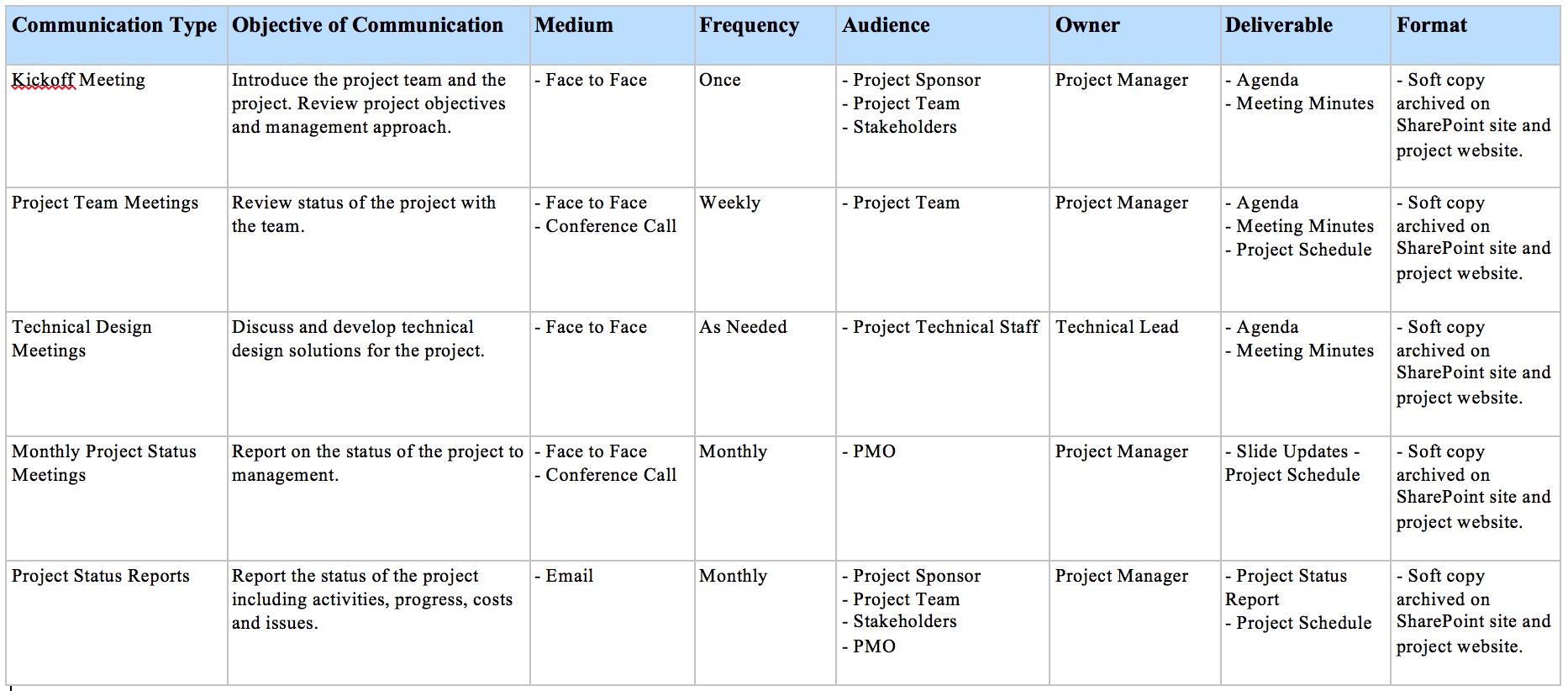
    Communication Matrix

    Report Drumbeat example :: Download the file here…
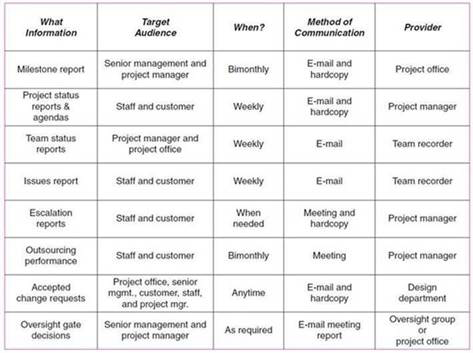
    Report Drumbeat


    Communication Flowchart

    Flowcharts provide a visual representation of a process or processes which often allow a better understanding of how the process is intended to work. Project communications may be extremely complex depending on the size and scope of the project and the number of stakeholders. A flowchart provides all stakeholders with a better understanding of the steps involved with the distribution of all project communications.

    The communication flowchart below was created to aid in project communication. This flowchart provides a framework for the project team to follow for this project. However, there may be occasions or situations which fall outside of the communication flowchart where additional clarification is necessary. In these situations the Project Manager is responsible for discussing the communication with the Project Sponsor and making a determination on how to proceed.

    Communications Flowchart

    Guidelines for Meetings

    Meeting Agenda
    Meeting Agenda will be distributed 5 business days in advance of the meeting. The Agenda should identify the presenter for each topic along with a time limit for that topic. The first item in the agenda should be a review of action items from the previous meeting.

    Meeting Minutes
    Meeting minutes will be distributed within 2 business days following the meeting. Meeting minutes will include the status of all items from the agenda along with new action items and the Parking Lot list.

    Action Items
    Action Items are recorded in both the meeting agenda and minutes. Action items will include both the action item along with the owner of the action item. Meetings will start with a review of the status of all action items from previous meetings and end with a review of all new action items resulting from the meeting. The review of the new action items will include identifying the owner for each action item.

    Meeting Chair Person
    The Chair Person is responsible for distributing the meeting agenda, facilitating the meeting and distributing the meeting minutes. The Chair Person will ensure that the meeting starts and ends on time and that all presenters adhere to their allocated time frames.

    Note Taker
    The Note Taker is responsible for documenting the status of all meeting items, maintaining a Parking Lot item list and taking notes of anything else of importance during the meeting. The Note Taker will give a copy of their notes to the Chair Person at the end of the meeting as the Chair Person will use the notes to create the Meeting Minutes.

    Time Keeper
    The Time Keeper is responsible for helping the facilitator adhere to the time limits set in the meeting agenda. The Time Keeper will let the presenter know when they are approaching the end of their allocated time. Typically a quick hand signal to the presenter indicating how many minutes remain for the topic is sufficient.

    Parking Lot
    The Parking Lot is a tool used by the facilitator to record and defer items which aren’t on the meeting agenda; however, merit further discussion at a later time or through another forum.

    A parking lot record should identify an owner for the item as that person will be responsible for ensuring follow-up. The Parking Lot list is to be included in the meeting minutes.

    Communication Standards

    Standardization is a proven way to simplify the complexities of project management communications. Many organizations develop and use standard templates or formats for the various communication tools used throughout projects. Standard templates and formats may be applied to certain types of project meetings or specific types of communication (i.e. emails, status reports, etc.). By using standardization, organizations can help ensure that its project teams and stakeholders have a thorough understanding of what is expected and achieve consistent and effective communications.

    In addition to standard templates and/or formats, organizations may standardize file naming or sharing conventions. An organization may use SharePoint or some other type of Web Portal/Network tool (blogs, message boards, etc.) as a standard platform from which to share information and communicate. Additionally, an organization may have standard file naming conventions for their stored data on their internal share drives. Many of these tools and new technologies are used in today’s projects with team members and stakeholders often spread over wide geographic areas. Standardization provides a level of simplicity to an organization’s communication platforms and improves effectiveness and efficiency.

    For this project, ABC Corp. will utilize standard organizational formats and templates for all formal project communications. Formal project communications are detailed in the project’s communication matrix and include:

    Kickoff Meeting – project team will utilize ABC Corp. standard templates for meeting agenda and meeting minutes. Additionally, any slides presented will use the ABC Corp. standard slideshow template.

    Project Team Meetings – project team will utilize ABC Corp. standard templates for meeting agenda and meeting minutes. Additionally, any slides presented will use the ABC Corp. standard slideshow template.

    Technical Design Meetings – project team will utilize ABC Corp. standard templates for meeting agenda and meeting minutes. Additionally, any slides presented will use the ABC Corp. standard slideshow template.

    Monthly Project Status Meetings – project team will utilize ABC Corp. standard templates for meeting agenda and meeting minutes. Additionally, any slides presented will use the ABC Corp. standard slideshow template.

    Project Status Reports – project team will utilize ABC Corp. standard templates for meeting agenda and meeting minutes. Additionally the standard project status report document, available on the share drive, will be used to provide project status.

    Informal project communications should be professional and effective but there is no standard template or format that must be used.

    Communication Escalation Process

    As issues or complications arise with regards to project communications it may become necessary to escalate the issue if a resolution cannot be achieved within the project team. Project stakeholders may have many different conflicting interests in a given project. While escalations are a normal part of project management, there must be a documented process that defines how those escalations will take place.

    Efficient and timely communication is the key to successful project completion. As such, it is imperative that any disputes, conflicts, or discrepancies regarding project communications are resolved in a way that is conducive to maintaining the project schedule, ensuring the correct communications are distributed, and preventing any ongoing difficulties. In order to ensure projects stay on schedule and issues are resolved, ABC Corp. will use its standard escalation model to provide a framework for escalating communication issues. The table below defines the priority levels, decision authorities, and timeframes for resolution.

    Priority Definition Decision Authority Timeframe for Resolution
    Priority 1 Major impact to project or business operations. If not resolved quickly there will be a significant adverse impact to revenue and/or schedule. Vice President or higher Within 4 hours
    Priority 2 Medium impact to project or business operations which may result in some adverse impact to revenue and/or schedule. Project Sponsor Within one business day
    Priority 3 Slight impact which may cause some minor scheduling difficulties with the project but no impact to business operations or revenue. Project Manager Within two business days
    Priority 4 Insignificant impact to project but there may be a better solution. Project Manager Work continues and any recommendations are submitted via the project change control process

    ** NOTE: Any communication including sensitive and/or confidential information will require escalation to VP level or higher for approval prior to external distribution.

    Glossary of Communication Terminology

    Term Definition
    Communication The effective sending and receiving of information. Ideally, the information received should match the information sent. It is the responsibility of the sender to ensure this takes place.
    Stakeholder Individuals or groups involved in the project or whose interests may be affected by the project’s execution or outcome.
    Communications Management Plan Portion of the overall Project Management Plan which details how project communications will be conducted, who will participate in communications, frequency of communications, and methods of communications.
    Escalation The process which details how conflicts and issues will be passed up the management chain for resolution as well as the timeframe to achieve resolution


    Also Read:

    Effective Leadership Communication

    PMI – Secrets of Running Project Status meetings



    Managing Outsourced Relationships – an in-source approach

    IT outsourcing is big business and a provide real business value, financial savings and resource flexibility.

    But is cheaper really better?

    Dilbert Outsourcing

    You cannot outsource a mess! Get your own house in order first before engage in a outsourcing partnership and managing IT vendors.

    You should not outsource your core business proposition! Determine what your business is about and excel in the delivery of that – everything that is not core can be candidates for outsourcing.

    Renier Botha spoke at the CIO Dialogue in Brighton about the value and risk associated with IT outsourcing. He introduced an insource Service Orientated (SOA) approach to outsourcing to mitigate the risks and ensure the appropriate governance delivering the right quality and customer service are achieved.

    Slide Presentation pdf: Managing Outsourced Relationships

    Slide Share via LinkedIn: Managing Outsourced Relationships

    Renier’s Biog for the Conference:

    CIO-Dialogue8 Biog


    Allegiant Air Loyalty – Case Study

    Consulting to Cloud Troopers as the Interim Head of Loyalty Products & Programmes – Renier directed the design, software development and implementation of the points based Allegiant Airlines Loyalty and Rewards Programme to fully leverage the Allegiant services and brand strength to provide new revenue streams and increase the effectiveness of others. The Allegiant Rewards programme is based on a co-branded credit card provided by an American Bank.


    Guest Blog by Brian Sumers – 1 Sep 2016

    Allegiant Air knows less about its most loyal customers than it would like. Its new co-branded credit card could help change that. But will anyone apply for it?

    Despite being among the world’s most consistently profitable airlines, Allegiant Air knows relatively little about its customers, though it has learned, through surveys and from Mastercard that they have an average household income slightly above $100,000 and prefer to eat at Olive Garden and shop at TJ Maxx.

    The problem is that Allegiant’s customers fly the airline infrequently, with about 80 percent booking one or two tickets per year. And since Allegiant has not had a frequent flyer program, it has fewer opportunities than other airlines to learn about its customers.

    But Allegiant, which has reported 53 consecutive profitable quarters, believes it has finally solved its problem. Almost two decades after its first flight, the airline on Thursday launched a co-branded credit card — a Bank of America Mastercard — the first for Allegiant, a niche carrier that prefers routes other airlines avoid, such as St. Cloud, Minnesota to Phoenix, Minot, North Dakota to Las Vegas and Belleville, Illinois to Jacksonville. Allegiant will enter a market saturated with travel-themed cards from nearly every airline and hotel company, but it is hopeful the new card will give it more insights into its passengers.

    “I am surprised it has taken them this long,” said Jay Sorensen, president of IdeaWorks Company and an authority on airline ancillary revenue schemes. “But what is unique about Allegiant is their base of business is probably very distinct from the traditional airlines. It is an interesting position.”

    Credit card deals can be lucrative, and when American re-upped deals with Barclays and Citi in July, it said they could produce $1.5 billion in pre-tax revenue over two and a half years. Allegiant is tiny compared to American — the discounter had 85 aircraft at the end of June — but its deal should be lucrative, too.

    “We think it is going to be valuable piece of business,” said Brian Davis, Allegiant’s vice president for marketing and sales, declining to give exact numbers. “We see our peers and the revenue generated from programs like this.”

    The card comes as Allegiant, long an iconoclast in the U.S. airline industry, starts to look more like its competitors, all of whom have long had co-branded credit cards and loyalty programs. Allegiant, which had bought only used planes, recently placed its first order for new aircraft from Airbus. And, despite mostly flying between small and medium sized markets for most of its history, Allegiant is expanding at larger ones, including Newark, New Jersey. It is even starting to compete with larger airlines on some routes after having long avoided direct competition.

    Still, with its co-branded credit card, Allegiant is trying something different. Unlike every other U.S. airline, Allegiant will not award points for travel. Instead, only card-holders, who will pay a $59 annual fee, will earn them. They’ll receive three points for each dollar they spend on Allegiant, two for spending on dining, and one for all other purchases. They can use points for discounts on travel, and the 15,000 points that come as a sign-up bonus can be redeemed for $150 off the price of any ticket. As sweeteners, cardholders receive a free drink when flying Allegiant, as well as discounts on hotel packages. (Allegiant hopes this will help it sell more packages.)

    There’s no chance for travelers to redeem for business class airfare to Asia, but Davis said Allegiant’s customers have little interest in complicated redemption schemes.

    “Those are built around travelers who travel a ton, and it is worth their time to learn about the rules,” he said. “If you only travel once a year, you’re not going to tolerate a lot of rules and conditions.”

    Monitoring customer habits

    When card members start spending, Allegiant will have access to more data about its core customers. Bank of America will not share information about individuals, but it will give the airline macro-level insights it does not have today.

    “To the extent that people use it as their primary card, you have opened up the window to a lot more data,” Sorensen said. “That data can include, ‘Are they buying products from your competitors? And where are they using the card?”

    This is a big deal for Davis. If a customer books a ticket using any credit card on Allegiant, he can learn some details about where else those customers shop, but a branded credit card will give Allegiant access to more aggregate data about what key customers want.

    “If through this card, we learn our customers have a really strong affinity for a particular chain of restaurant, then I hope in the next year or two I would hope we would reach out to that restaurant chain about a [tie-in,]” Davis said.

    Sorensen said an airline can use data to tailor offers to customers. Allegiant makes considerable revenue on vacation packages, but presumably many of its customers buy hotels independently on Orbitz or another site. If Allegiant can learn more about where its card-holders are staying, it will know more about which hotels to show in prominent positions on its website.

    Allegiant also expects to use the card to maintain a year-round relationship with its most loyal customers. Today, it emails customers with deals, but it wants to have other reasons to contact them.

    “For the first time, many customers will have a reason to stay connected with us for the other 51 weeks of the year,” Davis said. The goal is to “expand the company’s relationship” with customers, he said.

    A challenge to attract card members

    Many airlines first start a frequent flyer program and then add a credit card. They create the programs in this order because a carrier with millions of customers in a database has a natural market for its cards.

    “It will be a handicap,” Sorensen said. “A general rule of thumb is that once you have a million or more people in a frequent flyer program, then you can start talking to a bank.”

    But Allegiant expects to have something other airlines do not — motivated flight attendants. On every flight, they will make announcements and give out paper applications. They will ask passengers to fill them out and will collect them before landing. The on-plane collection is important, Davis said, because the airline fears customers will forget to mail them in.

    With the card, Allegiant expects to the same people who buy the bulk of the airline’s tickers — the female head-of-householders. The airline says its core customer is Christie, 48, a married former school teacher with two kids living in Sioux Falls, South Dakota. Her husband is co-owner of the local insurance company. “Christie has always been in charge of booking vacations for the family and hates wasting time and money,” Allegiant says in internal documents.

    Ultimately, though, the card’s success may on how aggressively flight attendants sell it. Other airlines also ask flight attendants to promote cards with limited success, but Allegiant is optimistic its employees, who already earn commissions for other on-plane sales, will be motivated. The flight attendant responsible for each credit card approval will receive a $30 commission.

    “At legacy airlines, there is almost always pushback,” Sorensen said. “Flight attendants say, ‘We’re not sales people.’ Hopefully, Allegiant is an airline where the flight attendants understand they are sales people.”

    Original Article from Skift click here

    Cash Flow Statement

    The Cash Flow Statement shows how successful cash is managed within a business. It tracks how much cash is received and paid out for the particular period of the statement. It is important to understand that the Cash Flow Statement reflects only the movement of cash and shows the cash amounts that have moved up (increased) or down (decreased).

    Depends on the Cash Flow item tracked showing a upwards/increase or downwards/decrease movement, can the Cash Flow value be positive if cash is increased or negative if cash is decreased.

    The Cash Flow Statement usually shows the tracking of cash movement in three distinct sections:

    • Operating Cash Flow (Operational Cash Flow)
    • Cash Flow before Financing 
    • Cash Flow from Financing

    A business with a positive overall cashflow (OCM) is a healthy business.

    CashFlow-F1

    In the Book “What the Numbers Mean“, Renier provides a detailed overview of the three financial statements that makes up the set of business accounts. With the Income Statement, The Balance Sheet and Cash Flow Statement you have a full picture of the financial performance and well being of an organisation. The Income Statement (P&L) shows you the profit within an accounting period but profit is not cash and profit does not pay debt only cash does. The Balance Sheet shows you the activities linked to asset investment but does not show how cash rich a business is. The Cash Flow statement is key in linking up the P&L and Balance Sheet from a cash perspective. Cash is the hard currency of business – Cash is King!

    What-the-numbers-mean-1

    You can obtain a copy of the book “What the Numbers Mean” from LeanPub here…

    LeanpubLogo1200x610_300ppi


    Also Read…

    How to choose a Tech Stack

    WHITE PAPER – How to choose a Technology Stack

    What is a Technology Stack?

    A technology stack (Tech Stack) is a set of software code that is made up of modules used in software products and programming languages to build (develop/code) a software application.

    The lower in a Tech Stack you go the closer you get to the hardware, for example a Operating System is the part of the tech stack that provide an interface between the computer user and the computer hardware, it communicates directly with the computer hardware. The higher you go in a Tech Stack the more specific and specialized the functionality becomes for example a DBMS (Database Management System) that provides the interface and platform to manipulate, store, manage and administrate data into databases.

    Choosing a Primary Tech Stack usually involves the choice of the Operating System, programming languages, standard development libraries, frameworks, DBMS and a support community. The Primary Tech Stack will be used by most of the developers and software engineers in building the software product/application but several Secondary Tech Stacks may be used in support of the Primary Tech Stack to fulfill specific specialized requirements.

    There are lots of different, competing technologies made up of different tech stacks, to build a website or software application with. A software application usually consist of the following main components: the Front End of the site/application (what the end users see on the screen and will be interacting with), the Admin Portal (that the application/program administrators or back office personal will use as an interface to administer and manage the application or site), the Middleware, Logical Layer or Application Layer (that performs all the ‘automatic’ actions and is the heart of the application doing all the calculations, processing and data manipulation), and the Database where all data used within the application or site is stored. Each of these components making up an application or website can be developed with a different software product or programming language but preferably within the same Tech Stack to reduce the complexity of supporting the application/site.

    How do you choose a technology stack, what factors and key technical aspect should be considered to avoid the wrong choices?

    When choosing your tech stack it is important to choose components that designed to easily integrate – the frontend technology must integrate with the admin, logic and database. The integration of the different application components is illustrated in the hand drawn diagram.

    TechStack_Integration

    The challenge today is choosing a Tech Stack, which supports current trends, and also future proofs your technology solution for the future. You can only focus your choice towards the Tech Stack that will be appropriate and the best fit for your business today and with that realize that the Tech Stack might change in the future as technology evolves – in other words there is no such thing as a fully future proof tech stack.

    Considerations and Factors to keep in mind when choosing your Tech Stack

      • Development Lapse Time / Time to Market: How long will it take to develop an application in one tech stack vs the other. If the tech stack give you access to frameworks and platforms it will reduce the development lapse time and hence your time to market (in other word the application can be developed quicker).
      • Compatibility: Will the new technology work with exiting tools and software used within the business? Can you reuse previous developed software code in the new tech stack? Integrating the new tech stack into your existing environment, will it cause disruption or large quantities of rework of existing systems and infrastructure?
      • Cutting Edge: The more cutting edge the technology the more bumps their will be on the road ahead as the cutting edge still has some way to go to maturity and stability.
      • Productivity: If you already have a development team in-house, are they qualified to work with the tech stack? DO the developers have any issues with the new tech stack? What issues and pain did you and your development team have with the previous tech stack – are those addressed in the new?
      • Engineering Talent Availability: Is the right people available to support the tech stack you intend to use? The right people will be across the board including, architects, tech leads, senior developers, developers, database developers / administrators, etc. Will it be easy to find these people? This is linked to the popularity of the tech stack – the more popular the more talent will be available. Where (in which location) will you need the talent – what is the availability of the talent in your preferred location, the location where you want to build you in-house and offshore teams?
      • Recruitment and Retention: How ill you recruit the talent for the tech stack? Will what you have to offer (salary, working environment, training, personal growth, business prospects and growth, etc.) be attractive to the market of professional knowledge workers (technologist)? Make sure that can recruit and retain your technology staff to support your tech stack, otherwise it might be an expensive choice.
      • Expertise: What level of expertise on the new tech stack do you have within your (in-house or outsourced, on-shore, near-shore or off-shore). Make sure that you have staff that are well experienced with the tech stack and ensure that they understand your business drivers and your requirements. Ensure that within your team you enough experts (at the right levels i.e. Tech Leads & Snr Developers) that thoroughly understand the tech stack intrinsically.
      • Maintenance & Support: Different programming languages promote different style for example Object Oriented (OO), Strongly Type (Functional) and Dynamic styles. As the complexity and the magnitude of the technology solution increase and/or the team that develop the solution is large then OO style programming languages bring a lot of value. Strongly typed languages and their frameworks like C++, C#, Java and Scala support better tools while Dynamic one like PHP, Pyhton, Ruby, Javascript take less development time. The trends based on the above is that strongly type OO languages are mainly used in enterprise solutions where code base size, team size and maintenance matters. Another factor to consider is the standards and methodology followed by developers in writing the code. Some software development methodologies introduce very robust quality assurance and code validation that delivers a very superior, bug free solutions that are easier to support. A well-written technology solution is also adequately documented to ensure maintainability and supportability. Other factors like team knowledge, expertise and the availability of resources/talent (as mentioned in other points in this section) to form a solution support team must also be kept in the equation.
      • Scalable: Scalability refers to the ability of a solution to easily adapt to service more users, process more data within a specific timeframe without increasing the overall software and development cost. Hardware is mostly directly related to the scalability for example the more the solution scale the more hardware might be needed to support the technology solution. Scaling can take place horizontally – that is adding more hardware (servers) to the overall solution or vertically which increases the ability to process more data and/or request/users on a particular server. Will the tech stack scale to meet your requirements in performance? How easy is it to scale the solution horizontally? How does the tech stack compare with others in vertical scaling? If you know your solution will be receiving high traffic (lots of users) or will be processing loads of data the choice of your tech stack becomes very important. The difference in the scalability of two tech stack can be seen in timing and compairing the systems’ response in processing the same about of user requests or data for example:
        • Ruby is 30 x slower than C
        • PHP is only 8 x slower than C
        • Java is a mere 2 x slower than C
      • Community: How strong is the community for your selected tech stack? A strong community is a key factor is selecting a tech stack as an active and devoted community ensures the following:
        • Availability of Documentation
        • Fast response to bugs, issues and problems. Response and support to resolution of issues that might appear to be specific to your solution
        • Availability of issue and problem solutions and the source code to copy/paste speeds up the resolution
        • Continuous updating of the basic framework, increasing the availability modules and libraries, producing new releases that results in a more stable tech stack
        • Availability of resources/talent understanding the tech stack
      • Quality of Tools: Ensure the tech stack provide adequate tools to the development and support teams to use for example IDEs (Integrated Development Environment), Debuggers, Build Tools, etc. Adequate tools will ensure you have an empowered and engaged development team that can get the job done.
      • Licensing: Tech stacks are licensed differently – either Open Source or Commercial licensing applies. Open Source tech stack has grown tremendously over the past view years. Statistics show that on the internet, more open source tech stack driven solutions (solutions based on the LAMP stack consisting of Linux, Apache, MySQL and PHP) are present than commercial tech stack based solutions like Microsoft consisting of Windows server, IIS, SQL Server and .NET. When deciding on a tech stack it is important to understand the different licensing types and the associated cost to the license to use the software not just for development but commercially in the mainstream production environments of your business. Open Source licenses are usually cheaper than commercial licenses. Make sure that you understand the type of license the tech stack components are under and that you have the associated budget.
      • Hardware Resource Hungry: What level (quantity and specification) of hardware will the tech stack require to run your application effectively according to expectations and requirements? Some tech stacks require several different servers to run a single application dependent on the complexity. This should be taken into consideration especially in conjunction with the budget constraints. Tech stack and Hardware requirements are dependent on the performance and uptime requirements of the operational technology solution. A solution that needs to be up and running every second of the every day and/or are procession large volumes of data in the shortest possible time, will have a higher dependency on the hardware with infrastructure design incorporating the resilience against hardware and connectivity failures. Hardware is not directly dependent on the tech stack for redundancy but some tech stacks are better suited for high availability with build in capabilities, than others.
      • Popularity: See point on Talent Availability and Documentation
      • Future Proof: This is a relative concept because none of us have a crystal ball to gage exactly what the future will hold in order to choose our tech stack accordingly. How long into the future are you looking to proof your application, recognizing that technology is rapidly changing and no single tech stack has ever been and will ever be available and around for ever. Even tech stacks like Microsoft that has been around for twenty plus years has changed within and the older tech stacks from Microsoft are absolute while newer options are introduced every two to three years – sometimes without appropriate backwards compatibility. Your tech stack must be agile (adapt to change), backwards compatible, scalable (to accommodate your business and market growth), from a reputable supplier (a supplier that is credit worthy and likely to be around for the future) and popular. Popularity is very important and the community following, embracing and developing a tech stack will ensure the availability of talent and support resources to ensure your application build in a particular tech stack can be supported long into the future.
      • Documentation: Are the appropriate documentation available for the tech stack to completely enable your team to utilize the power of the tech stack? Documentation includes printed manuals, internet information resources, sample code, module and libraries, community forums where issues and problems are discussed and resolved with solution code that can easily be copied/pasted.
      • Maturity/Stability: What is the latest released version of the tech stack. A mature tech stack with release versions will be much more stable than a version 1 release, for example.
    • Company Constraints: Is your tech stack choice affected by certain constraint within your business i.e. if you are looking to develop a native mobile application for iPhone or iPad who have no other choice but Objective C for your programming language. Do you have access to a DevOps team (operations team ensuring the software development and operational infrastructure seamlessly integrate)? If not you might want to consider a PaaS option and use the stack it supports. Other constraints can be: legal requirements like PCI DSS (Credit Card and Personal Information security legislation and requirements), budget and operational costs.


    What are the popular choices in Tech Stacks?

    Operating Systems
    ·       Microsoft Windows

    ·       Apple OS X

    ·       Linux

    ·       Mobile

    ·       iOS

    ·       Android


    Programming Language Associated Web Framework
    Java ·       Spring/Hibernate

    ·       Struts

    ·       Tapestry

    ·       Play! (Scala)

    Javascript ·       JQuery

    ·       Sencha

    ·       YUI

    ·       Dojo

    PHP ·       CodeIgniter

    ·       Zend

    ·       Cake

    ·       Symfony

    Python ·       Django

    ·       web2py

    ·       TurboGears

    ·       Zope

    Ruby ·       Rails

    ·       Sinatra

    C# ·       ASP.NET


    Web/Application Servers
    ·       Apache

    ·       Tomcat

    ·       Netty

    ·       Ngnix

    ·       Unicorn

    ·       Passenger

    ·       IIS

    ·       Microsoft Windows


    Databases
    ·       Microsoft SQL Server

    ·       MySQL

    ·       Postgres

    ·       Oracle


    Cloud PaaS (Platform as a Service)
    ·       Heroku

    ·       CloudFoundry

    ·       Microsoft Azure

    ·       Redhat Openshift

    ·       EngineYard


    Let’s Talk – Are you looking to achieve your goals faster? Create better business value? Build strategies to improve growth? We can help – make contact!


    Source & Reference List:

    Balance Sheet

    The Balance Sheet is a snapshot in time showing everything the business owns – its assets – and everything a business owes – its liabilities at a specific time.

    It reflects the financial status of the organisation at the close of business on a specific day. When reading the balance sheet the date is very important in the interpretation of the financials as the time of the year might impact how good the balance sheet looks for example at the end of a sales promotion.

    Balance sheets are usually drawn up at the end of a month or once a year – at the end of a financial year.

    The balance sheet is divided into a left and right side. The totals of the left side (Total of Assets) is equal to the total of the right side (Total of Liabilities + Shareholder Funds), hence it being called the balance sheet.

    BalanceSheet-F1

    The balance sheet reflects the financial information in three very specific sections namely:

    • Assets – what the business owns
      • Fixed Assets – also referred to as Long Term Assets
      • Current Assets – also referred to as Short Term Assets
    • Liabilities – What the business owes
      • Fixed Liabilities – also referred to as Long Term Liabilities
      • Current Liabilities – also referred to as Short Term Liabilities
    • Shareholder’s Funds– the money invested in the business by its shareholders or owners, also referred to Owners Funds or Equity.

    BalanceSheet-F2


    In the Book “What the Numbers Mean“, Renier provides a detail overview of the financial records reflected in each of the three sections within the Balance Sheet.  He also covers the relation between the Balance Sheet and The Income Statement and concepts like “Goodwill”, “Bad Debt” and stock valuation concepts based on “FIFO” and “LIFO”.

    What-the-numbers-mean-1

    You can obtain a copy of the book “What the Numbers Mean” from LeanPub here…

    LeanpubLogo1200x610_300ppi

    Also Read…

    Profit & Loss (P&L) or Income Statement

    The Income Statement, also referred to as the Profit and Loss (P&L) account, reflects the earnings of a company.

    P&L_F1

    Earnings are the net outcome of a company’s operations and are the amount on which corporate tax is due, also referred to as Profit (which are reflected as six different profit levels within the Income Statement).

    Revenue (also known as income, sales or billings) is the income that a business generate selling its core means of business, its product. Revenue is also referred to as the ‘Top Line’ due to its position in the Income Statement.

    Expenses are all the cost an organisation incurs in conducting it’s daily operations ie salaries, rent, cost of stock/product, etc.

    The Income Statement are divided into six profit areas, each showing a specific level of profit namely:

    • Gross Profit (GP)
    • Net Contribution
    • Operating Profit (OP)
    • Profit Before Tax (PBT)
    • Net Profit / Profit After Tax (PAT)
    • Retained Profit (RP)


    In the Book “What the Numbers Mean“, Renier provides a detailed overview of each of the profit areas within the Income Statement. He also covers concepts like “Top Line” and “Bottom Line” as well as key Finacial performance KPIs like Gross Margin, Net Contribution and Operating Profit and how this P&L information can be used in daily operational management to improve efficiency and profitability.

    What-the-numbers-mean-1

    You can obtain a copy of the book “What the Numbers Mean” from LeanPub here…

    LeanpubLogo1200x610_300ppi

    Also Read…

    The Art of IT Effort Estimation

    Why Estimate at all?

    Estimation is an essential part of any project methodology. Estimation is used for a number of purposes:

    • To justify the project enabling the costs to be compared with the anticipated benefits and to enable informed comparisons to be made between different technical or functional options.
    • To enforce the discipline needed to make the project succeed.
    • To secure the resources required to successfully deliver the project.
    • To ensure that the support impact of the project is fully understood.
    • To inform and improve the software development process.

    What is estimation and why is it so important

    Projects are planned and managed within scope, time, and cost constraints. These constraints are referred to as the Project Management Triangle.  Each side represents a constraint.  One side of the triangle cannot be changed without impacting the others. The time constraint refers to the amount of time available to complete a project. The cost constraint refers to the budgeted amount available for the project. The scope constraint refers to what must be done to produce the project’s end result.

    These three constraints are often competing constraints: increased scope typically means increased time and increased cost, a tight time constraint could mean increased costs and reduced scope, and a tight budget could mean increased time and reduced scope.

    PM 3 Constraints

    What are the challenges

    • Lack of communication between…a…b…c
    • Lack of training in basic knowledge and techniques of estimation
    • Inability to do estimations based on – cost – time – scope
    • Project failure through time over runs and faulty estimation

    Where are we going wrong?

    • Every day, project managers and business leaders make decisions based on estimates of the dynamics of the project management triangle.
    • Since each decision can determine whether a project succeeds or fails, accurate estimates are critical.
    • Projects launched without a rigorous initial estimate are five times more probable of experiencing delays and cancellations.
    • Even projects with sound initial estimates are doomed if they are not guided by informed decisions within the constraints of the triangle.
    • If you are working under a fixed budget (cost constraint), then an inaccurate estimate of the number of product features you can produce (scope) within a fixed period of time (schedule) will doom your project.
    • Inaccurate estimates across your projects de-optimize your portfolio.
    • Estimates are always questioned when estimates are given with knowledge – no estimation template is being used

    How can we improve?

    1.  Outsource the project estimation function to an outside qualified consultant for each project to be able to gain viable and realistic project estimations that can be achieved.
    2.  Education of in-house project managers and technical leads so that we are able to collectively able to provide clear methodologies on how to estimate accurately.

    This can be done through an onsite workshop/course  – onsite is cost effective as company will pay one block fee for the attendees instead of delegates going offsite and attending a workshop where individual fees are applicable.

    My personal recommendation is option B – as this option will allow us to retain skills in house to be able to produce accurate estimates

    What are the long term benefits

    Well crafted estimate creates many benefits:

    • alignment between business objectives and technical estimates
    • more informed business decision making
    • reliable project delivery dates
    • improved communication between management and the project team
    • controlled project costs, and
    • satisfied customers

    Conclusion

    The UK is facing ever tightening economic restraints. This means the quality of work is now, more than ever, of the utmost importance. To stay competitive in a shrinking marketplace, this company cannot afford to get a reputation in the industry for non-performance and bringing in projects over budget and outside estimated time frames. Credibility is the basis on which we build our reputation. In the eyes of clients credibility = successful projects. For us the success of all projects rest on the correct and precise estimation from the start of a project based on best practices, realistic expectations and transparency.