Leading Digital Transformation Initiatives

Day 4 of Renier Botha’s 10-Day Blog Series on Navigating the Future: The Evolving Role of the CTO

For almost all modern companies, digital transformation is no longer a choice but a necessity. Modernizing IT infrastructure and driving innovation are crucial for organizations aiming to stay competitive and relevant. Leading successful digital transformation initiatives requires a strategic approach, a clear vision, and the ability to navigate complex changes. This comprehensive blog post will provide insights into effective digital transformation strategies that streamline operations and foster growth.

Understanding Digital Transformation

Digital transformation involves integrating digital technology into all areas of a business, fundamentally changing how organizations operate and deliver value to customers. It encompasses a broad range of initiatives, including cloud computing, data analytics, artificial intelligence (AI), machine learning (ML), Internet of Things (IoT), and more.

Why Digital Transformation Matters

  • Enhanced Efficiency: Automating processes and leveraging data analytics improve operational efficiency and decision-making.
  • Improved Customer Experience: Personalized and seamless customer interactions drive satisfaction and loyalty.
  • Innovation and Growth: New business models and revenue streams emerge from technological advancements.
  • Competitive Advantage: Staying ahead of the competition requires continuous adaptation and innovation.

Key Components of Digital Transformation

Successful digital transformation initiatives typically involve several key components:

1. Cloud Computing

Cloud computing offers scalability, flexibility, and cost savings. It enables organizations to access computing resources on-demand, eliminating the need for significant upfront investments in hardware and software.

Example: Capital One has embraced cloud computing to modernize its IT infrastructure, resulting in improved agility and reduced costs. The bank migrated its applications to AWS, enabling faster deployment of new services and enhanced customer experiences.

2. Data Analytics and Big Data

Harnessing the power of data analytics and big data allows organizations to gain valuable insights, drive decision-making, and optimize operations. By analyzing large datasets, businesses can identify trends, predict customer behavior, and make data-driven decisions.

Example: Procter & Gamble uses data analytics to optimize its supply chain and improve product development. By analyzing data from various sources, P&G can predict demand, manage inventory, and reduce costs.

3. Artificial Intelligence and Machine Learning

AI and ML technologies enable organizations to automate tasks, enhance customer interactions, and improve decision-making processes. These technologies can analyze vast amounts of data, recognize patterns, and provide actionable insights.

Example: Netflix leverages AI and ML to deliver personalized content recommendations to its users. By analyzing viewing habits and preferences, Netflix can suggest relevant content, increasing user engagement and satisfaction.

4. Internet of Things (IoT)

IoT technologies connect devices and collect data, enabling organizations to monitor and manage assets in real-time. This connectivity enhances operational efficiency, reduces downtime, and supports predictive maintenance.

Example: General Electric (GE) uses IoT to monitor and maintain its industrial equipment. The company’s Predix platform collects data from sensors embedded in machines, allowing GE to predict maintenance needs and reduce operational disruptions.

5. Digital Culture and Workforce

A successful digital transformation requires a cultural shift within the organization. Employees must embrace new technologies and adapt to changing workflows. Providing training and fostering a culture of innovation are essential for driving transformation.

Example: Microsoft transformed its corporate culture under CEO Satya Nadella, emphasizing collaboration, continuous learning, and a growth mindset. This cultural shift has been instrumental in Microsoft’s successful digital transformation.

Strategies for Leading Digital Transformation

Leading digital transformation initiatives involves strategic planning, effective execution, and continuous improvement. Here are some strategies for CTOs to consider:

1. Develop a Clear Vision and Strategy

A successful digital transformation starts with a clear vision and strategy. Define the objectives, goals, and desired outcomes of the transformation. Align the strategy with the organization’s overall business goals and ensure buy-in from all stakeholders.

2. Engage Leadership and Stakeholders

Leadership commitment is crucial for driving digital transformation. Engage senior leaders and stakeholders to champion the initiative and allocate necessary resources. Foster a collaborative environment where everyone understands the importance of transformation and their role in its success.

3. Focus on Customer Experience

Customer experience should be at the heart of digital transformation. Understand customer needs and preferences, and leverage technology to deliver personalized and seamless experiences. Collect feedback and continuously improve customer interactions.

4. Invest in Technology and Infrastructure

Invest in the right technologies and infrastructure to support digital transformation. This includes cloud computing, data analytics platforms, AI/ML tools, and IoT devices. Ensure that the infrastructure is scalable and secure to accommodate future growth.

5. Foster a Culture of Innovation

Encourage a culture of innovation by promoting experimentation, learning, and collaboration. Provide employees with the tools and training they need to embrace new technologies and processes. Recognize and reward innovative ideas and initiatives.

6. Implement Agile Methodologies

Agile methodologies enable organizations to respond quickly to changing market conditions and customer needs. Adopt agile practices to streamline development processes, improve collaboration, and accelerate time-to-market for new products and services.

7. Monitor and Measure Progress

Regularly monitor and measure the progress of digital transformation initiatives. Use key performance indicators (KPIs) to track success and identify areas for improvement. Continuously refine strategies based on data-driven insights and feedback.

Real-World Examples of Digital Transformation

Example 1: Amazon

Amazon’s digital transformation journey has been characterized by continuous innovation and a customer-centric approach. The company has leveraged cloud computing, AI, and data analytics to revolutionize e-commerce and supply chain management. Amazon Web Services (AWS) has become a leading cloud platform, enabling businesses worldwide to transform their operations.

Example 2: Domino’s Pizza

Domino’s Pizza has embraced digital transformation to enhance customer experience and streamline operations. The company’s “AnyWare” platform allows customers to order pizza through various digital channels, including smartwatches, voice assistants, and social media. Domino’s has also implemented AI-powered chatbots and real-time order tracking to improve customer satisfaction.

Example 3: Siemens

Siemens has undergone a digital transformation to become a leader in industrial automation and smart manufacturing. The company’s MindSphere platform connects industrial equipment and collects data for analysis, enabling predictive maintenance and optimized production processes. Siemens’ digital initiatives have improved efficiency and reduced downtime in manufacturing operations.

Conclusion

Digital transformation is a critical driver of modernizing IT infrastructure and fostering innovation. By leveraging technologies such as cloud computing, data analytics, AI, ML, and IoT, organizations can streamline operations, enhance customer experiences, and drive growth. Leading successful digital transformation initiatives requires a clear vision, leadership commitment, a culture of innovation, and continuous monitoring and improvement.

As the business landscape continues to evolve, organizations must embrace digital transformation to remain competitive and relevant. By adopting strategic approaches and leveraging technological advancements, leaders can navigate the complexities of transformation and achieve lasting success.

Read more blog post on Digital Transformation here : https://renierbotha.com/tag/digital-transformation/

Stay tuned as we continue to explore critical topics in our 10-day blog series, “Navigating the Future: A 10-Day Blog Series on the Evolving Role of the CTO” by Renier Botha.

Visit www.renierbotha.com for more insights and expert advice.

CEO’s guide to digital transformation : Building AI-readiness. 

Digital Transformation remains a necessity which, based on the pace of technology evolution, becomes a continuous improvement exercise. In the blog post “The Digital Transformation Necessity” we covered digital transformation as the benefit and value that technology can enable within the business through technology innovation including IT buzz words like: Cloud Service, Automation, Dev-Ops, Artificial Intelligence (AI) inclusinve of Machine Learning & Data Science, Internet of Things (IoT), Big Data, Data Mining and Block Chain. Amongst these AI has emerged as a crucial factor for future success. However, the path to integrating AI into a company’s operations can be fraught with challenges. This post aims to guide CEOs to an understanding of how to navigate these waters: from recognising where AI can be beneficial, to understanding its limitations, and ultimately, building a solid foundation for AI readiness.

How and Where AI Can Help

AI has the potential to transform businesses across all sectors by enhancing efficiency, driving innovation, and creating new opportunities for growth. Here are some areas where AI can be particularly beneficial:

  1. Data Analysis and Insights: AI excels at processing vast amounts of data quickly, uncovering patterns, and generating insights that humans may overlook. This capability is invaluable in fields like market research, financial analysis, and customer behaviour studies.
  2. Support Strategy & Operations: Optimised data driven decision making can be a supporting pillar for strategy and operational execution.
  3. Automation of Routine Tasks: Tasks that are repetitive and time-consuming can often be automated with AI, freeing up human resources for more strategic activities. This includes everything from customer service chatbots to automated quality control in manufacturing and the use of use of roboticsc and Robotic Process Automation (RPA).
  4. Enhancing Customer Experience: AI can provide personalised experiences to customers by analysing their preferences and behaviours. Recommendations on social media, streaming services and targeted marketing are prime examples.
  5. Innovation in Products and Services: By leveraging AI, companies can develop new products and services or enhance existing ones. For instance, AI can enable smarter home devices, advanced health diagnostics, and more efficient energy management systems.

Where Not to Use AI

While AI has broad applications, it’s not a panacea. Understanding where not to deploy AI is crucial for effective digital transformation:

  1. Complex Decision-Making Involving Human Emotions: AI, although making strong strides towards causel awareness, struggles with tasks that require empathy, moral judgement, and understanding of nuanced human emotions. Areas involving ethical decisions or complex human interactions are better left to humans.
  2. Highly Creative Tasks: While AI can assist in the creative process, the generation of original ideas, art, and narratives that deeply resonate with human experiences is still a predominantly human domain.
  3. When Data Privacy is a Concern: AI systems require data to learn and make decisions. In scenarios where data privacy regulations or ethical considerations are paramount, companies should proceed with caution.
  4. Ethical and Legislative restrictions: AI requires access to data which are heavily protected by legislation

How to Know When AI is Not Needed

Implementing AI without a clear purpose can lead to wasted resources and potential backlash. Here are indicators that AI might not be necessary:

  1. When Traditional Methods Suffice: If a problem can be efficiently solved with existing methods or technology, introducing AI might complicate processes without adding value.
  2. Lack of Quality Data: AI models require large amounts of high-quality data. Without this, AI initiatives are likely to fail or produce unreliable outcomes.
  3. Unclear ROI: If the potential return on investment (ROI) from implementing AI is uncertain or the costs outweigh the benefits, it’s wise to reconsider.

Building AI-Readiness

Building AI readiness involves more than just investing in technology, it requires a holistic approach:

  1. Fostering a Data-Driven Culture: Encourage decision-making based on data across all levels of the organisation. This involves training employees to interpret data and making data easily accessible.
  2. Investing in Talent and Training: Having the right talent is critical for AI initiatives. Invest in hiring AI specialists and provide training for existing staff to develop AI literacy.
  3. Developing a Robust IT Infrastructure: A reliable IT infrastructure is the backbone of successful AI implementation. This includes secure data storage, high-performance computing resources, and scalable cloud services.
  4. Ethical and Regulatory Compliance: Ensure that your AI strategies align with ethical standards and comply with all relevant regulations. This includes transparency in how AI systems make decisions and safeguarding customer privacy.
  5. Strategic Partnerships: Collaborate with technology providers, research institutions, and other businesses to stay at the forefront of AI developments.

For CEOs, the journey towards AI integration is not just about adopting new technology but transforming their organisations to thrive in the digital age. By understanding where AI can add value, recognising its limitations, and building a solid foundation for AI readiness, companies can harness the full potential of this transformative technology.

AI in practice for the enterprise: Navigating the Path to Success

In just a few years, Artificial Intelligence (AI) has emerged as a transformative force for businesses across sectors. Its potential to drive innovation, efficiency, and competitive advantage is undeniable. Yet, many enterprises find themselves grappling with the challenge of harnessing AI’s full potential. This blog post delves into the critical aspects that can set businesses up for success with AI, exploring the common pitfalls, the risks of staying on the sidelines, and the foundational pillars necessary for AI readiness.

Why Many Enterprises Struggle to Use AI Effectively

Despite the buzz around AI, a significant number of enterprises struggle to integrate it effectively into their operations. The reasons are manifold:

  • Lack of Clear Strategy: Many organisations dive into AI without a strategic framework, leading to disjointed efforts and initiatives that fail to align with business objectives.
  • Data Challenges: AI thrives on data. However, issues with data quality, accessibility, and integration can severely limit AI’s effectiveness. Many enterprises are sitting on vast amounts of unstructured data, which remains untapped due to these challenges.
  • Skill Gap: There’s a notable skill gap in the market. The demand for AI expertise far outweighs the supply, leaving many enterprises scrambling to build or acquire the necessary talent.
  • Cultural Resistance: Implementing AI often requires significant cultural and operational shifts. Resistance to change can stifle innovation and slow down AI adoption.

The Risks of Ignoring AI

In the digital age, failing to leverage AI can leave enterprises at a significant disadvantage. Here are some of the critical opportunities missed:

  • Lost Competitive Edge: Competitors who effectively utilise AI can gain a significant advantage in terms of efficiency, customer insights, and innovation, leaving others behind.
  • Inefficiency: Without AI, businesses may continue to rely on manual, time-consuming processes, leading to higher costs and lower productivity.
  • Missed Insights: AI has the power to unlock deep insights from data. Without it, enterprises miss out on opportunities to make informed decisions and anticipate market trends.

Pillars of Data and AI Readiness

To harness the power of AI, enterprises need to build on the following foundational pillars:

  • Data Governance and Quality: Establishing strong data governance practices ensures that data is accurate, accessible, and secure. Quality data is the lifeblood of effective AI systems.
  • Strategic Alignment: AI initiatives must be closely aligned with business goals and integrated into the broader digital transformation strategy.
  • Talent and Culture: Building or acquiring AI expertise is crucial. Equally important is fostering a culture that embraces change, innovation, and continuous learning.
  • Technology Infrastructure: A robust and scalable technology infrastructure, including cloud computing and data analytics platforms, is essential to support AI initiatives.

Best Practices for AI Success

To maximise the benefits of AI, enterprises should consider the following best practices:

  • Start with a Pilot: Begin with manageable, high-impact projects. This approach allows for learning and adjustments before scaling up.
  • Focus on Data Quality: Invest in systems and processes to clean, organise, and enrich data. High-quality data is essential for training effective AI models.
  • Embrace Collaboration: AI success often requires collaboration across departments and with external partners. This approach ensures a diversity of skills and perspectives.
  • Continuous Learning and Adaptation: The AI landscape is constantly evolving. Enterprises must commit to ongoing learning and adaptation to stay ahead.

Conclusion

While integrating AI into enterprise operations presents challenges, the potential rewards are too significant to ignore. By understanding the common pitfalls, the risks of inaction, and the foundational pillars of AI readiness, businesses can set themselves up for success. Embracing best practices will not only facilitate the effective use of AI but also ensure that enterprises remain competitive in the digital era.

Streamlining Success: How a Single Page Can Shape Your Strategic Vision

In the 2015 conference in Barcelona, Gartner introduced me to the One-Page strategy. Still today, nine years later, a One-Page Strategy, is an exceedingly effective instrument for organisations aiming to streamline their strategic planning process and succinctly communicate their vision, goals, and initiatives.

This innovative approach condenses the essence of a company’s strategic plan onto a single, easily digestible page. It serves not only as a strategic compass for decision-makers but also as a rallying point for the entire organisation. In this blog post, we’ll delve into the use and benefits of a One-Page Strategy, highlighting why it has become a favoured tool among forward-thinking leaders.

A strategy is only ever as good as the information available at the time when we create it.

Simplifying Complexity

In today’s fast-paced business environment, complexity is a given. However, the challenge lies not in the complexity itself but in managing and communicating it effectively. The One-Page Strategy addresses this by distilling complex strategic plans into their most essential elements. This simplification process forces leaders to prioritise and focus on what truly matters, making strategic objectives clearer to every member of the organisation.

Enhancing Communication

Publishing your strategy is not the same as communicating your strategy. A good communicated strategy has a far better chance to success as it inspires, excites and motivates. In 2018 I wrote about effective leadership communication – click here to read the post.

One of the most significant benefits of a One-Page Strategy is its role in improving communication within an organisation. A document that is concise and accessible ensures that everyone, from top executives to entry-level employees, understands the strategic direction of the company. This clarity fosters alignment and ensures that all efforts are directed towards common goals, thereby enhancing organisational coherence and efficiency.

Good strategy communication takes the audience through three levels:

  • Understanding – the audience know what the strategy is
  • Support – the audience think the strategy is good and support it
  • Commitment – the audience is willing to play their part to work with you to achieve the strategy

Facilitating Decision Making

By clearly outlining the organisation’s strategic priorities, a One-Page Strategy serves as a valuable reference for decision-making. It helps leaders and teams evaluate new opportunities and challenges through the lens of their strategic objectives, ensuring that resources are allocated efficiently and that actions are aligned with long-term goals.

Encouraging Engagement and Accountability

A clear and concise strategy document is more likely to be read, understood, and embraced by the entire organisation. When employees understand how their work contributes to the broader strategic objectives, they are more engaged and motivated. Moreover, a One-Page Strategy promotes accountability by making it easier to track progress against key metrics and milestones.

Streamlining the Strategic Review Process

The dynamic nature of today’s business environment necessitates frequent strategic reviews. A One-Page Strategy makes these reviews more manageable and focused. Instead of wading through voluminous strategic plans, leaders can quickly assess progress, adapt to changes, and make necessary adjustments, keeping the organisation agile and responsive.

Key Components of a Successful Strategy

A successful technology strategy is pivotal for organisations aiming to leverage technology for competitive advantage, innovation, and efficiency. The key components of a successful technology strategy encompass a holistic approach that aligns with the organisation’s business goals, anticipates future trends, and ensures adaptability to change. Here are the essential elements:

1. Alignment with Business Objectives

The technology strategy must be closely aligned with the organisation’s overall business strategy and objectives. This alignment ensures that technological investments and initiatives directly support the organisation’s goals, such as market growth, customer satisfaction, and operational efficiency.

2. Stakeholder Engagement

Involvement from stakeholders across the organisation is crucial for the development and implementation of a successful technology strategy. This includes engaging leadership, IT staff, end-users, and even customers to gather insights, expectations, and requirements, ensuring the strategy meets the needs of all parties involved.

3. Technology Assessment

A comprehensive assessment of current technology assets, infrastructure, and capabilities helps identify areas of strength, as well as gaps that need to be addressed. This assessment should consider hardware, software, data management practices, and cybersecurity measures.

4. Future Trends and Innovation

A forward-looking perspective that accounts for emerging technologies and industry trends is vital. This component involves exploring and potentially adopting innovative technologies (e.g., AI, blockchain, IoT) that can drive competitive advantage and address future challenges.

5. Scalability and Flexibility

The strategy should provide a framework that is both scalable and flexible, allowing the organisation to adapt to changes in the business environment, technological advancements, or shifts in customer demand without significant disruptions.

6. Risk Management and Security

Identifying, assessing, and mitigating risks associated with technological investments and operations is essential. This includes cybersecurity threats, data privacy concerns, and compliance with relevant regulations.

7. Talent and Skills Development

Investing in the right talent and continuously developing the skills of the existing workforce to keep pace with technological advancements ensures the organisation can effectively implement and utilise new technologies.

8. Implementation Roadmap

A clear and detailed implementation roadmap outlines the steps, timelines, and resources required to achieve the strategic objectives. This roadmap should include milestones, key performance indicators (KPIs), and a governance model to monitor progress and make adjustments as necessary.

9. Budget and Resource Allocation

A realistic and well-defined budget ensures that the necessary financial and human resources are available to support the technology strategy. It should account for both immediate needs and long-term investments in innovation.

10. Continuous Evaluation and Adaptation

Finally, a mechanism for ongoing evaluation and adaptation of the technology strategy is critical. This allows the organisation to respond to new opportunities, technological breakthroughs, and market changes, ensuring the strategy remains relevant and effective over time.

Incorporating these key components into a technology strategy can help organisations navigate the complexities of digital transformation, stay ahead of technological trends, and achieve sustainable success in an increasingly competitive landscape.

Conclusion

The One-Page Strategy is not a replacement for a detailed strategy document but it’s a powerful strategic tool that encapsulates the essence of an organisation’s strategic vision and plans. By simplifying complexity, enhancing communication, facilitating decision-making, encouraging engagement, and streamlining the strategic review process, it offers a myriad of benefits. As organisations continue to navigate the uncertainties and opportunities of the digital age, adopting a One-Page Strategy could well be the key to staying focused, agile, and aligned in pursuit of their long-term goals.

Driving Digital Transformation: Insights from ‘Project to Product’

Synopsis

“Project to Product: How to Survive and Thrive in the Age of Digital Disruption with the Flow Framework” by Mik Kersten presents a revolutionary approach for organisations navigating the complex landscape of digital transformation. The book addresses a critical challenge faced by many companies: the shift from traditional project-based work models to product-centric models in order to better adapt to the fast-paced, technology-driven market.

Kersten introduces the Flow Framework™ as a solution to this challenge. The framework is designed to bridge the gap between the business and IT, enabling organisations to thrive in the digital age by focusing on value delivery rather than just project completion. The author argues that in the era of software becoming a crucial part of every aspect of the business, companies need to transform their management and development practices to stay competitive.

The book is divided into several parts, beginning with an analysis of why the traditional project management approaches are failing to meet the demands of modern digital business. Kersten then delves into the details of the Flow Framework™, explaining its core components: Flow Items, Flow Metrics, and Flow Distribution. These elements help organisations to measure and manage the flow of business value from ideation to customer delivery.

“Project to Product” emphasises the importance of focusing on products rather than projects, advocating for a shift in how teams are organised, how work is prioritised, and how success is measured. By adopting the Flow Framework™, businesses can improve their software delivery performance, enhance strategic decision-making, and ultimately, increase their competitiveness in the digital era.

The book provides actionable insights, real-world examples, and practical advice for leaders and practitioners aiming to transform their organisations by moving from project to product. Mik Kersten draws from his extensive experience in the field to guide readers through the journey of digital transformation, making “Project to Product” an essential read for anyone involved in software development, IT management, or organisational change.

The Flow Framework Explained

The Flow Framework™, introduced by Mik Kersten in “Project to Product,” is a strategic model designed to aid organisations in navigating the complexities of digital transformation. It aims to shift the focus from traditional project-centric operations to a product-centric approach, aligning IT and software development processes with business outcomes. The framework is particularly geared towards enhancing how businesses deliver value in an era dominated by digital technologies. Here’s a breakdown of its key components and principles:

Core Components

  • Flow Items: These are the work items that move through the IT value stream, categorised into Features (new business value), Defects (quality issues), Risks (security, compliance, and technical debt), and Debts (technical debt reduction). The categorisation helps organisations prioritise and track the value delivery.
  • Flow Metrics: The framework introduces four key metrics to manage and measure the flow of work:
    • Flow Time: Measures the time taken from work initiation to delivery, providing insight into the overall responsiveness of the value stream.
    • Flow Velocity: Measures the number of flow items completed over a given period, indicating the speed of value delivery.
    • Flow Efficiency: Assesses the proportion of time flow items spend in active work versus waiting or blocked, highlighting process efficiency and waste.
    • Flow Load: Tracks the work in progress within the system, ensuring teams are not overburdened and can maintain a sustainable pace.
  • Flow Distribution: This component analyses the distribution of flow items across the different categories (Features, Defects, Risks, Debts), helping teams to balance their efforts and ensure a focus on delivering customer value while maintaining system health and compliance.

Principles

  • Product-Centric: Shifts the focus from managing projects to nurturing products, aligning IT work with business outcomes and customer value.
  • Feedback and Adaptation: Encourages rapid feedback loops within and between IT and business, fostering continuous improvement and adaptation to change.
  • Value Stream Management: Emphasises the importance of visualising and managing the entire value stream from idea to delivery, identifying bottlenecks and opportunities for optimisation.

Benefits

By implementing the Flow Framework™, organisations can achieve several key benefits:

  • Improved visibility into IT operations and their impact on business outcomes.
  • Enhanced alignment between IT and business strategies.
  • Increased efficiency and speed of software delivery.
  • Better prioritisation of work, focusing on delivering customer value.
  • A more agile and responsive IT organisation, capable of adapting to changes in the market and technology landscape.

The Flow Framework™ offers a comprehensive approach to managing and measuring IT and software development work, making it an essential tool for organisations looking to thrive in the digital age.

Key Learnings & Benefits

From “Project to Product” readers can derive several key learnings and benefits, particularly relevant to leaders and practitioners navigating digital transformations within their organisations. The book not only introduces the Flow Framework™ but also delves into the necessity of evolving from project-oriented to product-oriented IT and software development approaches. Here are the core takeaways and benefits:

Key Learnings:

  1. Shift from Project to Product: One of the main themes of the book is the critical shift that organisations must make from focusing on projects to concentrating on products. This shift enables a closer alignment with business outcomes and customer value.
  2. Introduction to the Flow Framework™: The book presents the Flow Framework™ as a methodology to enable this transition, providing a language and set of metrics for business and IT to communicate effectively and drive value delivery.
  3. Understanding Value Stream Management: Kersten emphasises the importance of value stream management, encouraging organisations to visualise and optimise the flow of value from idea to delivery. This is vital for identifying bottlenecks and improving delivery speed and quality.
  4. Emphasis on Continuous Feedback: The book highlights the necessity of establishing feedback loops to swiftly and efficiently adapt to changes, ensuring that product development is aligned with customer needs and market demands.
  5. Cultural Transformation: “Project to Product” underlines the need for a cultural shift within organisations, fostering an environment that supports continual learning, collaboration, and innovation.

Benefits:

  1. Enhanced Visibility and Alignment: By adopting the principles outlined in the book, organisations can achieve greater visibility into their IT operations and ensure that they are closely aligned with their business goals.
  2. Increased Efficiency and Agility: The Flow Framework™ helps organisations streamline their processes, reducing waste and enabling them to respond more quickly to market changes and customer needs.
  3. Improved Decision-Making: With clear metrics and a focus on value delivery, leaders can make more informed decisions about where to allocate resources and how to prioritise work.
  4. Competitive Advantage: Organisations that successfully shift from project to product and implement the Flow Framework™ can gain a significant competitive advantage by being more innovative, agile, and customer-focused.
  5. Sustainable Transformation: The book provides a roadmap for sustainable digital transformation, helping organisations navigate the challenges of the digital age and emerge more resilient and adaptable.

“Project to Product” offers valuable insights for any leader or practitioner involved in software development, IT management, or organisational change, providing a practical framework for navigating the complexities of digital transformation and driving long-term value.

Case Study: Renier Botha’s Leadership in Rivus’ Digital Strategy Implementation

Introduction

Rivus Fleet Solutions, a leading provider of fleet management services, embarked on a significant digital transformation to enhance its operational efficiencies and customer services. Renier Botha, a seasoned IT executive, played a crucial role in this transformation, focusing on three major areas: upgrading key database infrastructure, leading innovative product development, and managing critical transition projects. This case study explores how Botha’s efforts have propelled Rivus towards a more digital future.

Background

Renier Botha, known for his expertise in digital strategy and IT management, took on the challenge of steering Rivus through multiple complex digital initiatives. The scope of his work covered:

  1. Migration of Oracle 19c enterprise database,
  2. Development of a cross-platform mobile application, and
  3. Management of the service transition project with BT & Openreach.

Oracle 19c Enterprise Upgrade Migration

Objective: Upgrade the core database systems to Oracle 19c to ensure enhanced performance, improved security, and extended support.

Approach:
Botha employed a robust programme management approach to handle the complexities of upgrading the enterprise-wide database system. This involved:

  • Detailed planning and risk management to mitigate potential downtime,
  • Coordination with internal IT teams and external Oracle consultants,
  • Comprehensive testing phases to ensure system compatibility and performance stability.

Outcome:
The successful migration to Oracle 19c provided Rivus with a more robust and secure database environment, enabling better data management and scalability options for future needs. This foundational upgrade was crucial for supporting other digital initiatives within the company.

Cross-Platform Mobile Application Development

Objective: Develop a mobile application to facilitate seamless digital interaction between Rivus and its customers, enhancing service accessibility and efficiency.

Approach:
Botha led the product development team through:

  • Identifying key user requirements by engaging with stakeholders,
  • Adopting agile methodologies for rapid and iterative development,
  • Ensuring cross-platform compatibility to maximise user reach.

Outcome:
The new mobile application promissed to significantly transformed how customers interacted with Rivus, providing them with the ability to manage fleet services directly from their devices. This not only improved customer satisfaction but also streamlined Rivus’ operational processes.

BT & Openreach Exit Project Management

Objective: Manage the transition of fleet technology services of BT & Openreach ensuring minimal service disruption.

Approach:
This project was complex, involving intricate service agreements and technical dependencies. Botha’s strategy included:

  • Detailed project planning and timeline management,
  • Negotiations and coordination with multiple stakeholders from BT, Openreach, and internal teams,
  • Focusing on knowledge transfer and system integrations.

Outcome:
The project was completed efficiently, allowing Rivus to transition control of critical services succesfully and without business disruption.

Conclusion

Renier Botha’s strategic leadership in these projects has been pivotal for Rivus. By effectively managing the Oracle 19c upgrade, he laid a solid technological foundation. The development of the cross-platform mobile app under his guidance directly contributed to improved customer engagement and operational efficiency. Finally, his adept handling of the BT & Openreach transition solidified Rivus’ operational independence. Collectively, these achievements represent a significant step forward in Rivus’ digital strategy, demonstrating Botha’s profound impact on the company’s technological advancement.

Data as the Currency of Technology: Unlocking the Potential of the Digital Age

Introduction

In the digital age, data has emerged as the new currency that fuels technological advancements and shapes the way societies function. The rapid proliferation of technology has led to an unprecedented surge in the generation, collection, and utilization of data. Data, in various forms, has become the cornerstone of technological innovation, enabling businesses, governments, and individuals to make informed decisions, enhance efficiency, and create personalised experiences.

This blog post delves into the multifaceted aspects of data as the currency of technology, exploring its significance, challenges, and the transformative impact it has on our lives.

1. The Rise of Data: A Historical Perspective

The evolution of data as a valuable asset can be traced back to the early days of computing. However, the exponential growth of digital information in the late 20th and early 21st centuries marked a paradigm shift. The advent of the internet, coupled with advances in computing power and storage capabilities, laid the foundation for the data-driven era we live in today. From social media interactions to online transactions, data is constantly being generated, offering unparalleled insights into human behaviour and societal trends.

2. Data in the Digital Economy

In the digital economy, data serves as the lifeblood of businesses. Companies harness vast amounts of data to gain competitive advantages, optimise operations, and understand consumer preferences. Through techniques involving Data Engineering, Data Analytics and Data Science, businesses extract meaningful patterns and trends from raw data, enabling them to make strategic decisions, tailor marketing strategies, and improve customer satisfaction. Data-driven decision-making not only enhances profitability but also fosters innovation, paving the way for ground-breaking technologies like artificial intelligence and machine learning.

3. Data and Personalisation

One of the significant impacts of data in the technological landscape is its role in personalisation. From streaming services to online retailers, platforms leverage user data to deliver personalised content and recommendations. Algorithms analyse user preferences, browsing history, and demographics to curate tailored experiences. Personalisation not only enhances user engagement but also creates a sense of connection between individuals and the digital services they use, fostering brand loyalty and customer retention.

4. Data and Governance

While data offers immense opportunities, it also raises concerns related to privacy, security, and ethics. The proliferation of data collection has prompted debates about user consent, data ownership, and the responsible use of personal information. Governments and regulatory bodies are enacting laws such as the General Data Protection Regulation (GDPR) in Europe and the California Consumer Privacy Act (CCPA) in the United States to safeguard individuals’ privacy rights. Balancing innovation with ethical considerations is crucial to building a trustworthy digital ecosystem.

5. Challenges in Data Utilization

Despite its potential, the effective utilization of data is not without challenges. The sheer volume of data generated daily poses issues related to storage, processing, and analysis. Additionally, ensuring data quality and accuracy is paramount, as decisions based on faulty or incomplete data can lead to undesirable outcomes. Moreover, addressing biases in data collection and algorithms is crucial to prevent discrimination and promote fairness. Data security threats, such as cyber-attacks and data breaches, also pose significant risks, necessitating robust cybersecurity measures to safeguard sensitive information.

6. The Future of Data-Driven Innovation

Looking ahead, data-driven innovation is poised to revolutionize various sectors, including healthcare, transportation, and education. In healthcare, data analytics can improve patient outcomes through predictive analysis and personalized treatment plans. In transportation, data facilitates the development of autonomous vehicles, optimizing traffic flow and enhancing road safety. In education, personalized learning platforms adapt to students’ needs, improving educational outcomes and fostering lifelong learning.

Conclusion

Data, as the currency of technology, underpins the digital transformation reshaping societies globally. Its pervasive influence permeates every aspect of our lives, from personalized online experiences to innovative solutions addressing complex societal challenges. However, the responsible use of data is paramount, requiring a delicate balance between technological advancement and ethical considerations. As we navigate the data-driven future, fostering collaboration between governments, businesses, and individuals is essential to harness the full potential of data while ensuring a fair, secure, and inclusive digital society. Embracing the power of data as a force for positive change will undoubtedly shape a future where technology serves humanity, enriching lives and driving progress.

RPA – Robotic Process Automation

Robotic process automation (RPA), also referred to as software robots, is a form of business process automation (BPA) – also now as Business Automation or Digital Transformation – where complex business processes are automated using technology enabled tools harnessing the power of Artificial intelligence (AI).

Robotic process automation (RPA) can be a fast, low-risk starting point for automating repettitive processes that depend on legacy systems. Software bots can pull data from these manually operated systems (most of the time without an API) into digital processes, ensuring faster and more efficient and accurate (less user error) outcomes. 

Workflow vs RPA

In traditional workflow automation tools, a system developer produces a list of actions/steps to automate a task and define the interface to the back-end system using either internal application programming interfaces (APIs) or dedicated scripting language. RPA systems, in contrast, compile the action list by watching the user perform that task in the application’s graphical user interface (GUI), and then perform the automation by repeating those tasks directly in the GUI, as if it is manually operated.

Automated Testing vs RPA

RPA tools have strong technical similarities to graphical user interface testing tools. Automated testing tools also automate interactions with the GUI by repeating a set of actions performed by a user. RPA tools differ from such systems in that they allow data to be handled in and between multiple applications, for instance, receiving email containing an invoice, extracting the data, and then typing that into a financial accounting system.

RPA Utilisation

Used the right way, though, RPA can be a useful tool in your digital transformation toolkit. Instead of wasting time on repetitive tasks, your people are freed up to focus on customers or subject expertise bringing product & services to market quicker and provide customer outcomes quickly – all adds up to real tangible business results.

Now, let’s be honest about what RPA doesn’t do – It does not transform your organisation by itself, and it’s not a fix for enterprise-wide broken processes and systems. For that, you’ll need digital process automation (DPA).

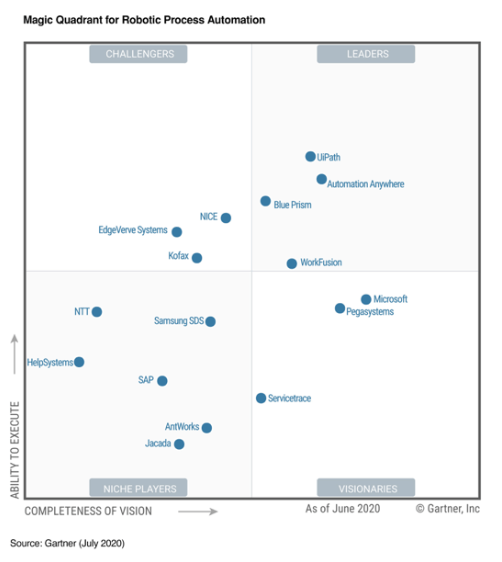
Gartner’s Magic Quadrant: RPA Tools

The RPA market is rapidly growing as incumbent vendors jockey for market position and evolve their offerings. In the second year of this Magic Quadrant, the bar has been raised for market viability, relevance, growth, revenue and how vendors set the vision for their RPA offerings in a fluid market.

Choosing the right RPA tool for your business is vital. The 16 vendors that made it into the 2020 Gartner report is marked in the appropriate quadrant below.

The Automation Journey

To stay in the race, you have to start fast. Robotic process automation (RPA) is non-invasive and lightning fast. You see value and make an immediate impact.

Part of the journey is not just making a good start with RPA implementations but to put the needed governance around this technology enabler. Make sure you can maintain the automated processes to quickly adapt to changes, integrate with new applications, align with continuously changing business processes while making sure that you can control the change and clearly communicate it to all needed audiences.

To ensure that you continuously monitor the RPA performance you must be able to measure success. Data gathered throughout the RPA journey and then converted through analytics into meaningful management information (MI). MI that enables quick and effective decisions – that’s how you finish the journey.

Some end-to-end RPA tools cover most of the above change management and business governance aspects – keep that in mind when selecting the right tool for your organisation.

So, do you want to stay ahead of your competition? Start by giving your employees robots that help them throughout the day.

Give your employees a robot

Imagine if, especially in the competitive and demanding times we live today, you could give back a few minutes of time of every employee’s day. You can if you free them from wrangling across systems and process siloes for information. How? Software robots that automate the desktop tasks that frustrate your people and slow them down. These bots collaborate with your employees to bridge systems and process siloes. They do work like tabbing, searching, and copying and pasting – so your people can focus on your customers.

RPA injects instant ROI into your business.

Also read:

An Operating Model that Delivers

Every organisation that I have worked with around the world, whether it is in London, Johannesburg, Sydney, Singapore, Dallas, Kuala Lumpir, Las-Vegas, Nairobi or New York, there was always reference to a Target Operating Model (TOM) when business leaders spoke about business strategy and performance. Yes, the TOM – the ever eluding state of euphoria when all business operations work together in harmony to deliver the business vision…sometime in the near foreseen future.

Most business transformation programmes are focussed to deliver a target operating model – transforming the business by introducing a new way of working that better aligns the business offering with it’s customer’s changing expectation. Millions in business change budgets have been invested in TOM design projects and 1000s of people have worked in these TOM projects of which some have delivered against the promise.

With the TOM as the defined deliverable, the targeted operational state and the outcome of the business transformation programme, it is very important that the designed TOM are actually fit for purpose. The TOM also has to lend itself to be easily adjustable in order to contribute to the agility of an organisation. The way the business is operating must be able to adapt to an ever changing technology driven world and the associated workforce. The quick evolving digital world is probably the main catalyst for transformation in organisations today – read “The Digital Transformation Necessity” for further insights…

Operating Model (OM)

The Operating Model uses key inputs from the Business Model and Strategy.

The Business Model focuses on the business’ customers, the associated product and service offerings – how the organisation creates value for it’s cliental – and the commercial proposition. Within the business model the business’s revenue streams and how those are contributing to the business value chain to generate profits, are decried. In other words, the Business Model envisages the What within the organisation.

Within the Business Strategy the plan to achieve specific goals are defined, as well as the metrics required to measure how successfully these are achieved. The business goals are achieved through the daily actions as defined within the Operating Model.

Typically an Operating Model takes the What from the Business Model in conjunction with the business strategy, and defines the Why, What, How, Who and With. It is the way in which the business model and strategy is executed by conducting the day to day business operations. Execution is key as no business can be successful by just having a business strategy, the execution of the operating model delivering the business strategy is the operative ingredient of success.

In order to document and describe how an organisation functions, the Operating model usually includes business capabilities and associated processes, the products and/or services being delivered, the roles and responsibilities of people within the business and how these are organised and governed within the business, the metrics defined to manage, monitor and control the performance of the organisation and then the underpinning Technology, Information Systems and Tools the business uses in delivering it’s services and/or products.

Analogy: A good analogy to describe the Operating Model is to compare it to the engine of F1 car. In 2016 the Mercedes Silver Arrow (the fastest car, driven by Lewis Hamilton (arguably the fastest driver), did not win because of engine and reliability problems. Instead the World Championship was won by Nico Rosberg, who had a better performing engine over the whole season. Nico benefited from a better operating model – he had the processes, data, systems and the people (including himself) to win. The mechanical failures that Lewis suffered, mostly not through fault of his own, were a result of failures somewhere within his operating model.

Target Operating Model (TOM)

The Target Operating Model (TOM) is a future state version of the Operating Model. To derive the TOM, the existing Operating Model is compared with the desired future state keeping the key aspects of an operating model in mind: Why, What, How, Where, Who and With. The TOM also cover two additional key aspects: the When & Where defined within the transformation programme to evolve from current to future states.

The difference between the “as is” Operating Model and the “to be” Target Operating Model, indicates the gap that the business must bridge in the execution of its Transformation Model/Strategy – the When and Where. To achieve the Target Operating Model usually require large transformation effort, executed as change & transformation programmes and projects.

ToBe (TOM) – AsIs (OM) = Transformation Model (TM)

Why >> Business Vision & Mission

What >> Business Model (Revenue channels through Products and Services – the Value Chain)

How >> Business Values & Processes & Metrics

Who >> Roles & Responsibilities (RACI)

With >> Tools, Technology and Information

Where & When >> Transformation Model/Strategy

Defining the TOM

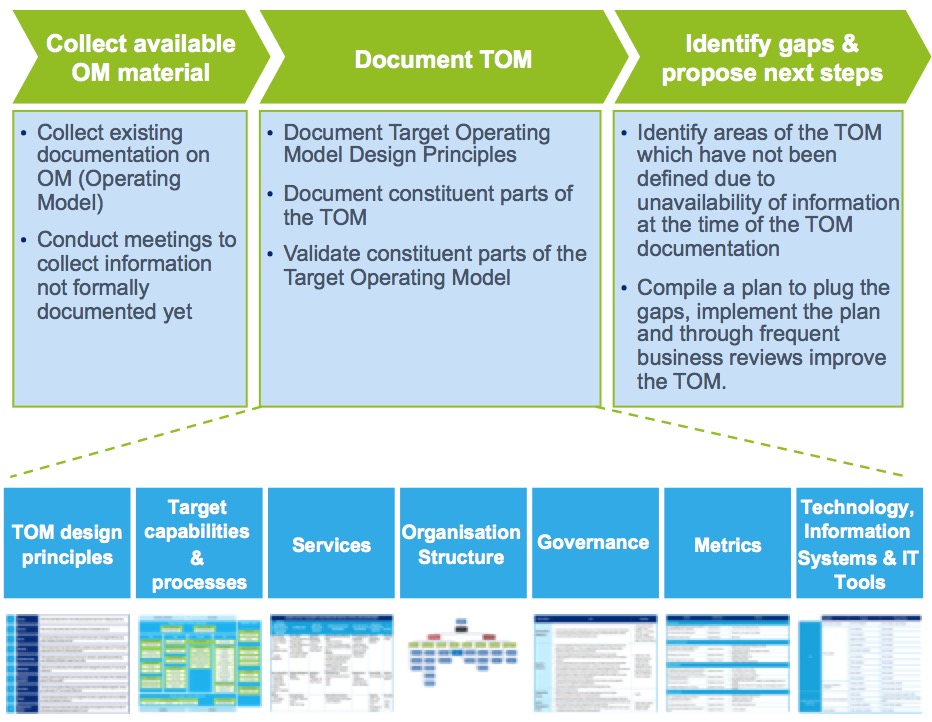
A methodology to compile the Target Operating Model (TOM) is summarised by the three steps shown in the diagram below:

TOM Methodology
Inputs to the methodology:

  • Business Model
  • Business Strategy
  • Current Operating Model
  • Formaly documented information, processes, resource models, strategies, statistics, metrics…
  • Information gathered through interviews, meetings, workshops…

Methodology produces TOM Outputs:

  • Business capabilities and associated processes
  • Clearly defined and monetised catalogue of the products and/or services being delivered
  • Organisation structure indicating roles and responsibilities of people within the business and how these are organised and governed
  • Metrics specifically defined to manage, monitor and control the performance of the organisation
  • Underpinning Technology, Information Systems and Tools the business uses in delivering it’s services and/or products

The outputs from this methodology covers each key aspect needed for a TOM that will deliver on the desired business outcomes. Understanding these desired outcomes and the associated goals and milestones to achieve them, is hence a fundamental prerequisite in compiling a TOM.

To Conclude

An achievable Target Operating Model, that delivers, is dependant on the execution of an overall business transformation strategy that aligns the business’ vision, mission and strategy with a future desired state in which the business should function.

Part of the TOM is this Business Transformation Model that outlines the transformation programme plan, which functionally syncs the current with the future operating states. It also outlines the execution phases required to deliver the desired outcomes, in the right place at the right time, while having the agility to continuously adapt to changes.

Only if an organisation has a strategically aligned and agile Target Operating Model in place that can achieve this, is the business in a position to successfully navigate its journey to the benefits and value growth it desires.

renierbotha Ltd has a demonstrable track record of compiling and delivering visionary Target Operating Models.

If you know that your business has to transform to stay relevant – Get in touch!


Originally written by Renier Botha in 2016 when, as Managing Director, he was pivotal in delivering the TOM for Systems Powering Healthcare Ltd.

How to Innovate to stay Relevant

Staying relevant! The biggest challenge we all face – staying relevant within our market. Relevance to your customers is what keeps you in business.

With the world changing as rapidly as it does today, mainly due to the profound influence of technology on our lives, the expectations of the consumer is changing at pace. They have access to an increasing array of choice, not just in how they spend their money but also in how they are communicating and interacting – change fueled by a digital revolution. The last thing that anyone can afford, in this fast paced race, is losing relevance – that will cost us customers or worse…

Is what you are selling today, adaptable to the continuous changing ecosystems? Does your strategy reflect that agility? How can you ensure that your business stays relevant in the digital age? We have all heard about digital transformation as a necessity, but even then, how can you ensure that you are evolving as fast as your customers and stay relevant within your market?

Business, who has a culture of continuous evolvement, aligning their products and services with the digital driven customer, is the business that stays relevant. This is the kind of business that does not require a digital transformation to realign with customer’s demand to secure their future. A customer centric focus and a culture of continuous evolution within the business, throughout the business value chain, is what assure relevance. Looking at these businesses, their ability/agility to get innovation into production, rapidly, is a core success criterion.

Not having a strategy to stay relevant is a very high and real risk to business. Traditionally we deal with risk by asking “Why?”. For continuous improvement/evolution and agility, we should instead be asking “Why not?” and by that, introduce opportunities for pilots, prototypes, experimentation and proof of concepts. Use your people as an incubator for innovation.

Sure, you have a R&D team and you are continuously finding new ways to deliver your value proposition – but getting your innovative ideas into production is cumbersome, just to discover that it is already aged and possibly absolute in a year a two. R&D is expensive and time consuming and there are no guarantees that your effort will result in a working product or desired service. Just because you have the ability to build something, does not mean that you have to build something. Focusing the scares and expensive resources on the right initiatives makes sense, right! This is why many firms are shifting from a project-minded (short term) approach to a longer-term product-minded investment and management approach.

So, how do you remain customer centric, use your staff as incubators of innovation, select the ideas that will improve your market relevance and then rapidly develop those ideas into revenue earners while shifting to a product-minded investment approach?

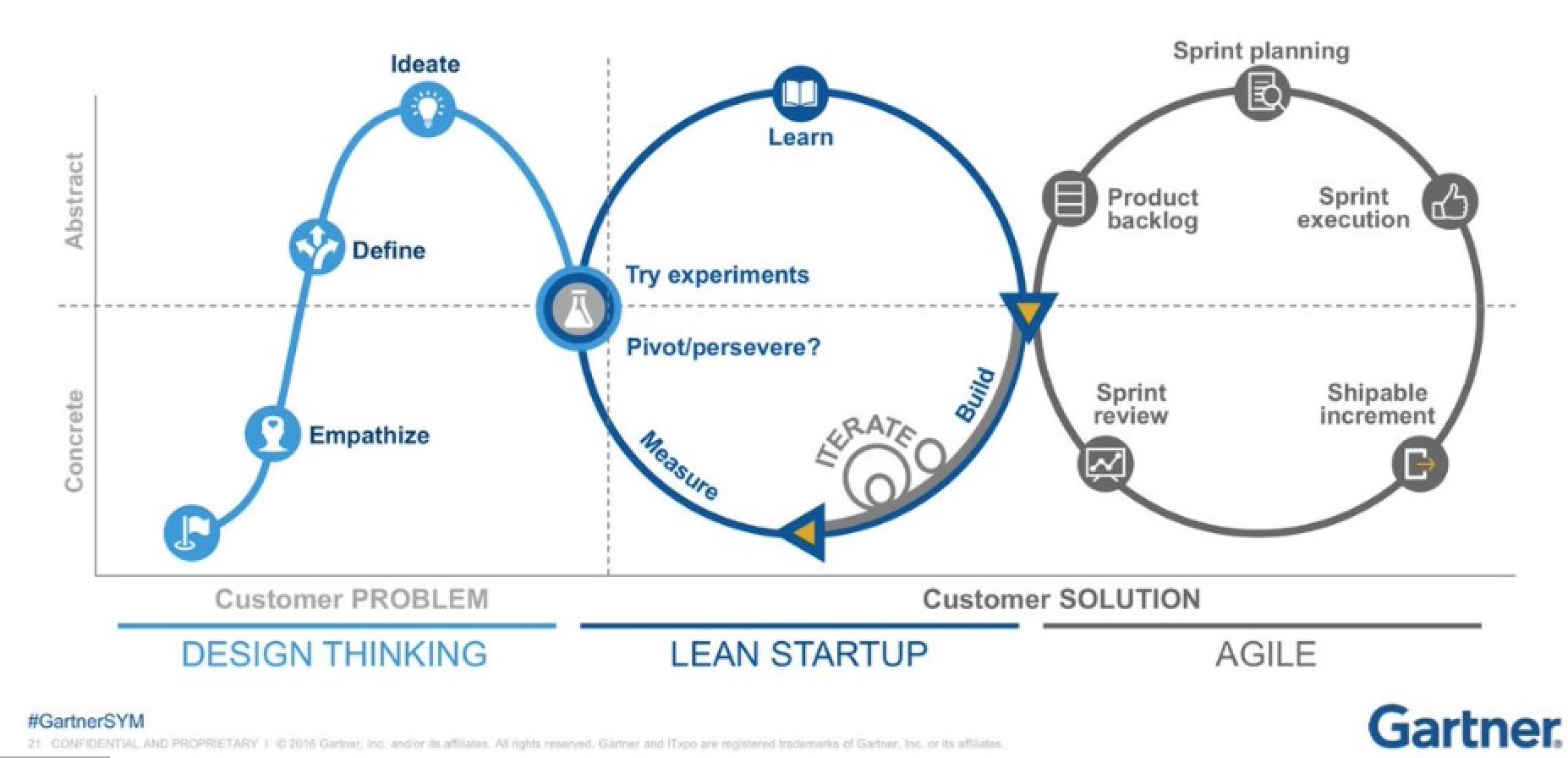
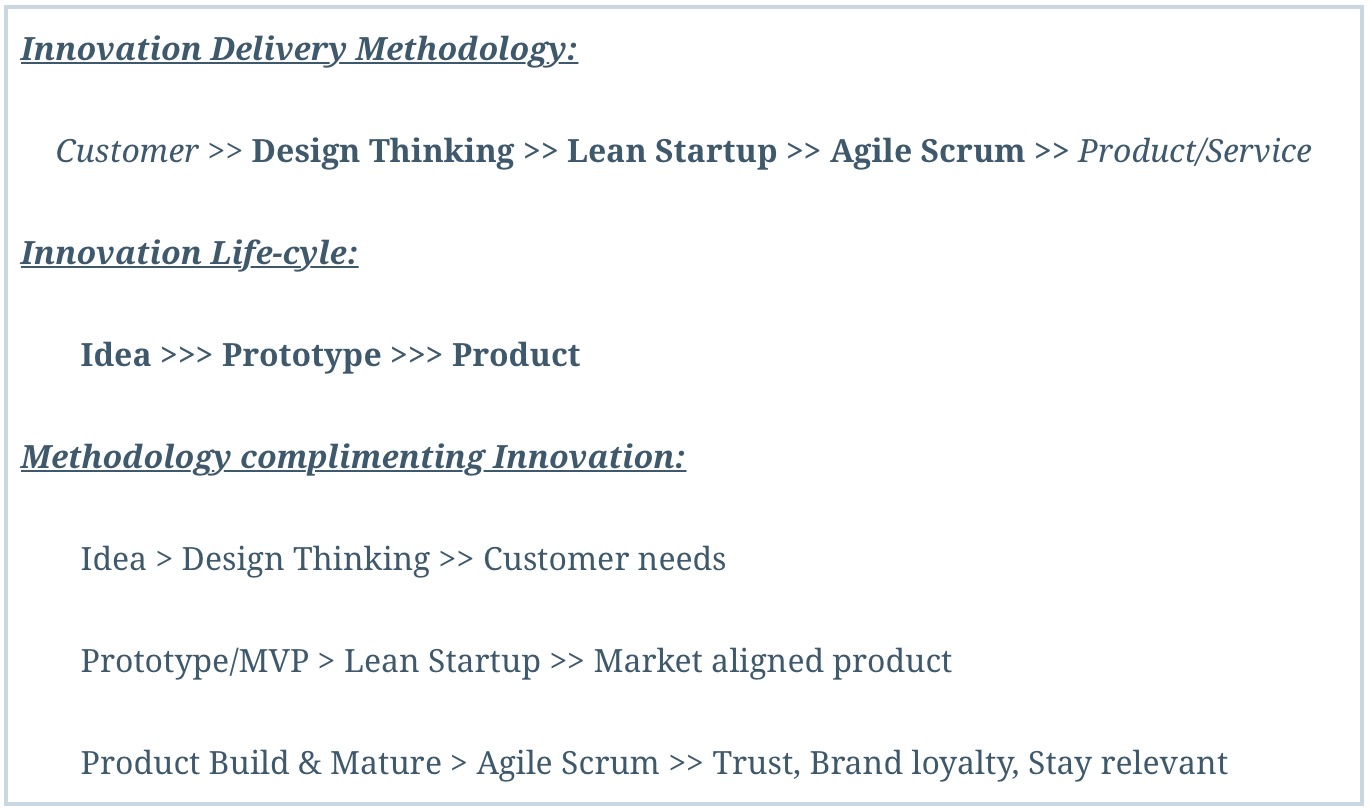
You could combine Design Thinking with Lean Startup and Agile Delivery…

In 2016, I was attending the Gartner Symposium where Gartner brought these concepts together very well in this illustration:

Gartner - Design-Lean-Agile 2

Instead of selecting and religiously follow one specific delivery methodology, use the best of multiple worlds to get the optimum output through the innovation lifecycle.

Design-Lean-Agile 1

Using Design Thinking (Empathise >> Define >> Ideate >> Prototype) puts the customer at the core of customer centric innovation and product/service development. Starting by empathising with the customers and defining their most pressing issues and problems, before coming up with a variety of ideas to potentially solve the problems. Each idea is considered before developing a prototype. This dramatically reduces the risk of innovation initiatives, by engaging with what people (the customer) really need and want before actually investing further in development.

Lean Startup focuses on getting a product market fit, by moving a Prototype or MVP (minimum viable product) through a cycle of Build >> Measure >> Learn. This ensures a thorough knowledge of the user of the product/service is gained through an active and measureable engagement with the customer. Customer experience and feedback is captured and used to learn and adapt resulting in an improved MVP, better aligned to the target market, after every cycle.

Finally Agile Scrum, continuing the customer centric theme, involves multiple stakeholders, especially users (customers), in every step in maturing the MVP to a product they will be happy to use. This engagement enhances transparency, which in turn grow the trust between the business (Development Team) and the customer (user) who are vested in the product’s/service’s success. Through an iterative approach, new features and changes can be delivered in an accurate and predictable timeline quickly and according to stakeholder’s priorities. This continuous product/service evolvement, with full stakeholder engagement, builds brand loyalty and ensures market relevance.

Looking at a typical innovation lifecycle you could identify three distinct stages: Idea, Prototype/MVP (Minimal Viable Product) and Product. Each of these innovation stages are complimented by some key value, gained from one of the three delivery methodologies:

Design-Lean-Agile 2

All of these methodologies, engage the stakeholders (especially the customer & user) in continuous feedback loops, measuring progress and capturing feedback to adapt and continuously improve, so maximum value creation is achieved.

No one wants to spend a lot of resource and time delivering something that adds little value and create no impact. Using this innovation methodology and associated tools, you will be building better products and service, in the eye of the user – and that’s what matters. You’ll be actively building and unlocking the potential of you’re A-team, to be involved in creating impact and value while cultivating a culture of continuous improvement.

The same methodology works very well for digital transformation programmes.

At the very least, you should be experimenting with these delivery approaches to find the sweat spot methodology for you.

Experiment to stay relevant!

Let’s Talk – renierbotha.com – Are you looking to develop an innovation strategy to be more agile and stay relevant? Do you want to achieve your goals faster? Create better business value? Build strategies to improve growth?

We can help – make contact!

Read similar articles for further insight in our Blog.

Bimodal Organisations

The continuous push towards business improvement combined with the digital revolution, that has changed the way the customer is engaging with business through the use of technology, have introduced the need for an agility in the delivery of IT services. This speed and agility in IT delivery, for the business to keep abreast of a fast evolving and innovative technology landscape and to gain an competitive advantage are not just required in the development and/or introduction of new technology into the business, but in the way “keep the lights on” IT operations are reliably delivered through stable platforms and processes enabling business growth as well.

IT Bimodal

We can agree that once systems and solutions are adopted and integrated into business operations, the business requirement for IT delivery changes with IT stability, reliability, availability and quality as key enablers to business performance optimisation. There are thus two very distinct and equally important ways or modes of delivering IT services that should seamlessly combine into the overall IT Service Operations contributing to business growth.

Gartner minted in 2016 the concept of IT Bimodal – the practise to manage two separate coherent modes of IT delivery.

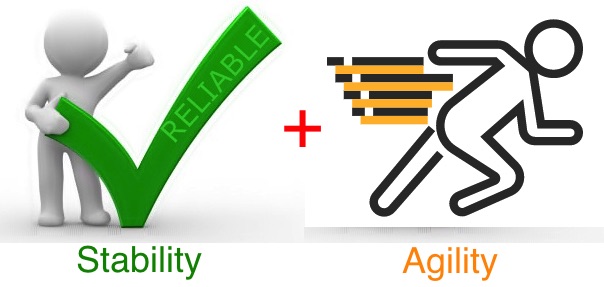
Mode 1: Focussed on Stability Mode 2: Focussed on Agility
Traditional Exploratory
Sequential Non-linear
Emphasis on: Safety & Accuracy Emphasis on: Agility and Speed

Each of the delivery modes has their own set of benefits and flaws depending on the business context – ultimately the best of both worlds must be adapted as the new way in which technology delivers into business value. Businesses require agility in change without compromising the stability of operations. Change to this new way and associated new Target Operating Model (TOM) is required.

Bimodal Organisation

This transformation is not just applicable to IT but the entire organisation. IT and “the business” are the two parts of the modern digital business. “The Business” needs to adapt and change their work style (operating model) towards digital as well. This transformation by both IT and “the business”, branded by Gartner as Bimodal, is the transformation towards a new business operating model (a new way of working) embracing a common goal of strategic alignment. Full integration of IT and business are the core of a successful digital organisation competing in the digital era.

The introduction of Agile development methodologies and DevOps, led to a transformation in how technology is being delivered into business operations. IT Service Management (ITSM) and the ITIL framework have matured the operational delivery of IT services, as a business (#ITaaBusiness) or within a business while Lean Six Sigma enables business process optimisation to ultimate quality delivery excellence. But these new “agile” ways of working, today mainly applied within IT, is not enough for the full bimodal transformation. Other aspects involving the overall organisation such as business governance and strategy, management structures and organisational architecture, people (Human Capital Management – HCM), skills, competencies, culture, change management, leadership and performance management as well as the formal management of business and technology innovation and integration, form additional service areas that have to be established or transformed.

How do organisations go about defining this new Bimodal TOM? – In come Bimodal Enablement Consulting Services in short BECS.

BECS – Bimodal Enablement Consulting Services

Gartner’s definition: “An emerging market that leverages a composite set of business and technology consulting services and IP assets to achieve faster more reliable and secure, as well as business aligned, solutions in support of strategic business initiatives.”

To establish a Bimodal enabled TOM, organisations need to architect/design the organisation to be customer centric, focussing on the value adding service delivered to the client/customer – a Service Oriented Organisation (SOO) designed using a Service Oriented Architecture (SOA). This set of customer services (external facing) should relay back to a comprehensive and integrated set of supporting and enabling business services (internal facing) that can quickly and effectively enable the business to innovate and rapidly adapt and deliver to changing customer needs and the use of technology within the digital era. This journey of change, that businesses needs to undergo, is exactly what digital transformation is about – not just focused on the technology, processes, quality and customer service, but on the business holistically, starting with the people working within the business and how they add value through the development and use of the right skills and tools, learning an applying it rapidly throughout the business value chain.

A customer centric delivery approach requires the development and adoption of new ways in which work are conducted – new management structures, building and enhancing A-teams (high performing individuals and teams, getting the job done), optimised processes and the right tool sets.

BECS must address the top bimodal drivers or goals, as identified by Gartner research:

  • Deliver greater IT value to the business
  • Shorten the time to deliver solutions
  • Enable digital business strategies
  • Accelerate IT innovation
  • Transform IT talent/culture/operations
  • Increase the interaction between business and IT
  • Embrace leading-edge technologies, tools and/or practices
  • Reduce IT costs (always a favourite)
  • Change the organisation’s culture

Take Action

Are you ready, aligned and actively engaging in the digital world?

Can you accelerate change and enable revenue growth with rock-solid service and business operations?

Are you actively practicing bimodal, continuously adapting to the changing digitally empowered customer demand?

The ultimate test to determine if you are bimodal: Every business process and every enterprise system needs to work without a blip, even as more innovation and disruptors are introduced to make the business more efficient and responsive.

It is time to be a bimodal organisation!

___________Renier Botha specialises in helping organisation to optimise their ability to better integrate technology and change into their main revenue channels – make contact today.

Related post: Success – People First; Performance ImprovementAGILE – What business executives need to know #1; AGILE – What business executives need to know #2; Lean Six Sigma; The Digital Transformation Necessity; Structure Tech for Success

The Digital Transformation Necessity

Listening to every keynote, panel discussion or reading articles relating to business sustainability through technology, one message is repeated over and over again – Digital Transformation is imperative for all businesses!

Although this message is coming through loudly, is it not always clear to business leaders and the workforce, exactly what digital transformation really is and what it means for their organisation.

In explaining digital transformation as the benefit and value that technology can enable within the business through technology innovation including IT buzz words like: Cloud, Automation, Dev-Ops, Artificial Intelligence (AI), Machine Learning, Internet of Things (IoT), Single Sign-On, Data Mining & Big Data, Bit Chain – does not really make the need for digital transformation any clearer.

One thing is clear though – we are living in a hyper-connected world where technology and more specifically, digital devices, are the glue linking together people and information in new ways we can hardly comprehend. In this statement, is the clue of what digital transformation entails…

What is digital transformation?

We can define digital transformation as the fundamental changes in the manner in which business and organisational operations are conducted, to adapt to the changes and to leverage the opportunities, caused by the use of digital devices and their accelerated impact on the way we live.

Digital devices, operate on digital signals running through electronic circuits to collect, store, manipulate, interpret and display information. These digital electronic integrated circuits (ICs) evolved since 1947, when the functional transistor was invented, into what we know today as computers. All digital devices are, at its core, a computer of some sorts used by humans to interact with information.

Transformation on the other hand implies a fundamental change in the way things used to be (converting something from one state to another) – it enables new creativity and innovation inspired by technology evolution, bringing change that introduces a new way, a different way to do things, rather than just enhancing or improving an old or current way.

To simplify it, you could say that digital transformation is the profound changes in the way business is conducted, to adapt to the changes in society caused by the continuous evolvement of computers.

A typical example of digital transformation is the “paperless office” – fundamentally changing the way we preserve information by storing it in digital format rather than writing it down on paper. This concept has profound implications in our commerce interaction expectations if you are comparing the speed in which information can be recalled and processed through digital means vs paper files, archives and libraries…

Who should lead the Digital Transformation?

Computers are hardly breaking news anymore as it is widely used within business where technology has become an integral enabling part of any organisation. Modern digital devices i.e. tablets, smart phones, the IoT, smart watches and other smart wearable devices, are changing the way we live and interact in commerce and hence the way we, as the consumer society, expect business to be conducted. Digital transformation is thus more about the change in business operations – processes and systems – than just the adoption of new technologies. Due to the importance of technology in organisations and the key role IT plays in the organisation’s ability to adapt to the society’s changing needs, it is the role of the CIO to lead the Digitial Transformation initiatives.

Digital Transformation matters because…

Any business change is costly and businesses might avoid change, for that very reason. Howard King of The Guardian, (Nov’13) puts it this way: “Businesses don’t transform by choice because it is expensive and risky. Businesses go through transformation when they have failed to evolve.” He continues in saying that evolving businesses never necessarily need to transform as they are continually focussed on their clients. This evolution ensures the key drivers of transformation namely: changing customer demand, changing technology and changing competition, never coincide in such a way that the business operating model can no longer service it’s customers. When it does, the business reaches a tipping point that requires transformation within the business, to adapt and re-align or tip over the edge.

The pace, at which digital devices have evolved, changed the way we interact with information and has become an intrinsic and material part of daily live. This has left organisations, which did not evolve with the technology, at a tipping point. For businesses approaching or reaching this tipping point it might be too late to evolve and hence Digital Transformation becomes a necessity for survival.

Emerging, disruptive technology driven, companies are changing industries leaving competitor companies with one choice – adapt, through digital transformation, or face the consequences of slowly loosing market share and eventually…

What does a typical Digital Transformation strategy involve?

As every organisation delivers their products and services (the value proposition to it’s clients and customers) in a different way, so will the digital transformation within one company differ from the other.

To define a transformation strategy and the associate change programme, one must look at the value chain of the organisation. Each element within the value chain can, and in most cases must, contribute to the scope:

  • Infrastructure
  • People – Leadership and the overall Workforce
  • Technology
  • Supply Chain
  • Procurement
  • Operations
  • Manufacturing (Engineering)
  • Fulfillment
  • Marketing
  • Sales
  • Service Delivery
  • Business Market (Client’s & Customers)

For each of the business value chain components, one must question the impact of the key transformation drivers:

  • Change in Customer Demand
  • Change in Technology
  • Change in Competition

Understanding these impacts will outline what needs to change, which generally comes down to:

  • Transform the Customer Experience
  • Transform the Operational Processes
  • Transform the Business Model

Note that IT is not singled out in the above – this is because IT is the catalyst that should overall enable these transformation initiatives.

The following examples of Digital Transformation Frameworks can also be helpful in defining the strategy:

Change brings uncertainty… Address it!

Transformation, by definition, brings change and a typical digital transformation programme will dramatically change the organisation. This change will especially affect a key business asset within the value chain – the people working within the business – “Success?.. People come First!”.

It will also dramatically effect, if not completely change, the organisation’s culture. Culture comes from the top – make sure that the board and executives are promoting the transformation and are willing to change themselves, as change is always desired until it is required of one-self.

Empower the workforce to understand the reasons why transformation is needed. Involve everyone to actively contribute to the innovative rethinking of their roles – how does digital technologies impact their daily work experience? Articulate the core business focus (what is the value proposition to the clients and customers) and ask, how can enabling digital technologies be used in support of achieving value excellence?

Find ways to make the necessity of the change a positive win for everyone, as supporting the people through the transformation is just as important as the digital technology you are trying to embrace.

To Conclude

Digital organisations outperform organisations doing digital – making Digital Transformation the last survival action for organisations that have not evolved with digital technology.

Transformation is a dramatic change and hence must the people aspect and business culture be treated with extreme care and sensitivity. A strong CIO is needed to drive the transformation programme with full buy-in from the rest of the executives and the whole workforce.

A well executed digital transformation strategy will re-align the business with the growing digital demands of it’s customers, by addressing the needed adoption of technology innovation across the business value chain resulting in an agile business ready for a fast evolving digital future.

Let’s Talk – Are you looking to achieve your goals faster? Create better business value? Build strategies to improve growth? We can help – make contact!