
The Ultimate Guide to Product Operations: Navigating the Emerging Field

Introduction

Product Operations, often referred to as Product Ops, is a relatively new yet increasingly vital role within technology companies, particularly those experiencing rapid growth. While operations functions like Sales Operations (Sales Ops) and Marketing Operations (Marketing Ops) have been well-established for years, Product Ops is just beginning to gain traction. However, for companies scaling their operations, the presence of a dedicated Product Ops team can be the difference between seamless expansion and significant operational challenges.

This comprehensive guide delves into the role of Product Ops, its importance within an organization, how it functions, and why it is becoming indispensable. We will also explore the different models of Product Ops, its core responsibilities, and how to get started with implementing this function in your organization.

Understanding Product Operations

At its core, Product Ops is the intersection of Product Management, Engineering, and Customer Success. It acts as a bridge, ensuring that these departments are aligned and working together efficiently to support the Research and Development (R&D) team as well as the go-to-market strategies. The role of Product Ops involves streamlining communication, refining processes, and fostering better alignment during the entire product lifecycle—from development to launch and subsequent iterations.

However, the definition and responsibilities of Product Ops can vary significantly depending on the organization. This variation is largely due to the novelty of the role and the specific needs of different teams and businesses. Despite these differences, there are three primary models of Product Ops that have emerged:

  1. Outcomes-driven Model: In this model, Product Ops focuses on gathering insights and scoping out business needs at the very beginning of the product development process. This often involves going out into the field, talking to users, and understanding their needs. Product Ops plays a critical role in launch execution, working closely with operations counterparts globally to ensure that the go-to-market strategy is effective. Uber is a prime example of a company that uses an outcomes-driven approach in its Product Ops function.
  2. Efficiency-focused Model: Here, the primary objective of Product Ops is to deliver more value to users more quickly. This model emphasizes strengthening product feedback loops, operationalizing products, and scaling product knowledge across the organization. Stripe employs this efficiency-focused model, where Product Ops ensures that the product delivers maximum value at the fastest pace possible.
  3. Customer-centric Model: In this model, Product Ops is heavily involved in the customer experience, providing insights that span the entire customer journey through the lens of the product. Theresa Baker’s role at Comcast exemplifies this approach, where Product Ops focuses on understanding and enhancing the end-to-end customer experience for their Digital Home product.

Where Does Product Ops Fit in an Organization?

Product Ops is typically embedded within the Product Management team or positioned in an adjacent function that reports directly to the Head of Product. The role serves as a shared resource across the product management organization, driving initiatives that enhance product efficiency, effectiveness, and alignment with broader business objectives.

The Dual Nature of Product Ops: Role and Skillset

Product Ops is not just a job title; it’s also a critical skill set that can benefit any product professional. Some organizations view Product Ops as a specific role that needs to be filled, while others see it as a capability that should be developed across the entire product team. Ideally, product-led organizations should have a designated Product Ops leader, but they should also encourage all product team members to cultivate an operational mindset.

The demand for Product Ops professionals is on the rise. A search on LinkedIn reveals nearly 5,700 users with the title “Product Operations,” an 8% increase in the last year alone. Even more striking is the 80% year-over-year increase in LinkedIn users listing Product Operations as a skill. This surge indicates that while the role is still evolving, its importance is being increasingly recognized across the industry.

The Growing Importance of Product Ops

Several key factors contribute to the rising prominence of Product Ops:

  1. Heightened Customer Expectations: Today’s customers demand seamless, personalized experiences. Product Ops ensures that the product meets these expectations by optimizing the development process and enhancing the customer experience from trial and purchase through onboarding, expansion, and referrals.
  2. The Proliferation of Operations Roles: The success of other operational roles, such as Sales Ops and Marketing Ops, has paved the way for Product Ops. As companies recognize the value of operations in driving efficiency and effectiveness, they are beginning to apply these principles to product development.
  3. Availability of Product Usage Data: The explosion of data has made it essential for organizations to have dedicated roles focused on analyzing and acting on this information. Product Ops plays a crucial role in turning product usage data into actionable insights that inform decision-making.
  4. Product-Led Growth: Companies that adopt a product-led growth strategy—where the product itself is the primary driver of customer acquisition, retention, and expansion—tend to outperform their peers. These companies are more likely to employ a Product Ops leader or even an entire team to ensure that their product development and go-to-market strategies are optimized for success.

Core Responsibilities of Product Ops

The responsibilities of Product Ops can be broadly categorized into five key areas:

  1. Tools Management: Product Ops is responsible for managing the product team’s tech stack, including tool selection, integration, and maintenance. This role involves overseeing relationships with vendors and ensuring that the tools are used effectively across the organization. Product Ops also establishes best practices for tool usage, ensuring that the team operates efficiently and effectively.
  2. Data Management and Analysis: With the proliferation of tools comes an increase in available data. Product Ops ensures that this data is clean, organized, and easily accessible, providing a strong foundation for data-driven decision-making. Product Ops plays a critical role in collecting, analyzing, and synthesizing data from multiple sources to inform product strategy and improve product outcomes. This includes reconciling usage data with customer feedback, performing data analysis, and providing insights to necessary stakeholders.
  3. Experimentation: One of the key benefits of having a dedicated Product Ops role is the ability to run more experiments with less friction. Product Ops tracks all active experiments, ensuring they do not overlap or interfere with each other. This role also streamlines the sequencing and implementation of experiments, establishing workflows, documentation, and segmentation of user populations to ensure clean and accurate data collection.
  4. Strategy and Cross-Team Collaboration: Product Ops acts as a strategic partner to teams across the organization, driving collaboration around product initiatives. This role involves aligning with teams like Revenue Operations (RevOps), Development Operations (DevOps), Customer Success, Marketing, and Sales to ensure that product data informs broader business decisions. Product Ops also scales product knowledge across the organization, acting as a central resource for product information, new learnings, and roadmap updates.
  5. Trusted Advisor to Leadership: As companies scale, the need for informed decision-making becomes critical. Product Ops serves as a trusted advisor to Chief Product Officers (CPOs), VPs of Product, and other R&D leaders, providing data-driven insights that guide strategic decisions. This role involves advising on the product roadmap, supplying product health data to the executive team, and ensuring that product decisions align with overall business objectives.

The Impact of Product Ops on the Organization

The introduction of a Product Ops function can significantly impact the organization in several ways:

  • Shifts in Ownership: Product Ops takes on many of the administrative and organizational tasks that Product Managers previously handled, allowing them to focus more on product strategy and development. This shift includes gathering and organizing data, running experimentation processes, collecting customer feedback, and training and enabling other teams.
  • Improved Cross-Team Communication: By serving as the product expert for other teams, Product Ops establishes clearer communication channels and ensures that everyone knows where to find the information they need. This improves communication around the product and enhances collaboration across the organization.
  • Increased Efficiency: Better communication leads to greater efficiency. When teams have access to the right information at the right time, they can make decisions more quickly and effectively. Additionally, by relieving Product Managers of operational tasks, Product Ops enables them to build and release products faster.
  • Connecting Product to the Bottom Line: Product Ops helps organizations connect product decisions with their overall business strategy, driving key business objectives and positively impacting the bottom line. For example, at Comcast, the Product Ops team helps identify product enhancements that reduce support calls or technician visits, leading to operational savings.

The Future of Product Ops

As more companies adopt data-driven approaches and recognize the value of product-led growth, the role of Product Ops is expected to continue evolving and growing in importance. The future of Product Ops may involve the merging of different analytical and operational functions, creating a more comprehensive product operations team.

Industry experts predict that the number of tools available for Product Ops will increase, mirroring the maturity of tools in Sales Ops. Additionally, the role may become more strategic, with Product Ops leaders acting as mini Chief Operating Officers (COOs) within product teams.

Getting Started with Product Ops

For organizations looking to implement a Product Ops function, the best approach is to start small and demonstrate results. Begin by identifying a few key areas where Product Ops can add value, such as managing the tech stack, improving data quality, or streamlining experimentation processes. As the function proves its worth, it can be scaled to take on additional responsibilities.

It’s also important to hire or develop the right talent for Product Ops. Successful Product Ops professionals are analytical, comfortable with systems, collaborative, great communicators, entrepreneurial, and have strong business acumen. They should also have a solid understanding of product management and leadership skills, even if they do not have direct reports.

Conclusion

Product Ops is an emerging function that is quickly becoming a cornerstone of successful product-led organizations. As technology companies scale, the need for a dedicated function to manage the complexities of product development, data analysis, and cross-team collaboration becomes increasingly apparent. Product Ops fills this gap, providing the necessary infrastructure to ensure that products are developed efficiently, aligned with customer needs, and contribute to the overall business strategy.

The Long-Term Vision for Product Ops

Looking ahead, the evolution of Product Ops will likely involve deeper integration with other operational roles and a more pronounced influence on strategic decision-making within organizations. Here are some key trends and developments that could shape the future of Product Ops:

  1. Greater Emphasis on Data-Driven Decision Making: As companies continue to accumulate vast amounts of data, the role of Product Ops in synthesizing this information into actionable insights will become even more critical. This will likely lead to the development of more sophisticated data tools and methodologies, enabling Product Ops teams to provide even more granular and impactful recommendations.
  2. Integration with Emerging Technologies: The rise of artificial intelligence (AI) and machine learning (ML) will offer new opportunities for Product Ops to enhance their data analysis capabilities. By leveraging AI and ML, Product Ops can automate routine tasks, identify patterns and trends that may not be immediately apparent, and make more accurate predictions about product performance and customer behavior.
  3. Expansion of the Product Ops Skill Set: As the role of Product Ops expands, so too will the skill set required to succeed in this field. Future Product Ops professionals will need to be well-versed not only in data analysis and product management but also in emerging technologies, customer experience strategies, and advanced project management techniques.
  4. Cross-Functional Leadership: Product Ops is poised to become a key player in cross-functional leadership, bridging the gap between product teams and other departments such as marketing, sales, and customer success. As the role becomes more strategic, Product Ops leaders may find themselves involved in broader organizational decisions, influencing everything from go-to-market strategies to company-wide operational efficiencies.
  5. Product Ops as a Strategic Partner: The evolution of Product Ops into a strategic partner means that this function will not only support product development but also shape the direction of the company’s growth. This shift will require Product Ops teams to develop a deep understanding of the business landscape, competitive dynamics, and customer expectations, allowing them to contribute to high-level strategic planning.
  6. Educational and Professional Development Opportunities: As the importance of Product Ops continues to grow, educational institutions and professional organizations are likely to develop specialized programs and certifications to prepare the next generation of Product Ops leaders. These programs could cover a wide range of topics, from data science and analytics to product strategy and customer experience management.

Getting Started: Building Your Product Ops Function

For organizations considering the implementation of a Product Ops function, here are some practical steps to get started:

  1. Assess Your Current Needs: Begin by evaluating where your current product processes are experiencing friction or inefficiencies. Identify areas where improved alignment, data analysis, or process optimization could have the most significant impact. This assessment will help you determine the specific responsibilities and focus areas for your Product Ops team.
  2. Define the Scope and Structure: Based on your needs assessment, define the scope of your Product Ops function. Will it primarily focus on data management, experimentation, or cross-team collaboration? Consider the structure of the team—will it be a small, centralized group, or will Product Ops professionals be embedded within different product teams?
  3. Start Small and Scale: Start by implementing Product Ops on a small scale, focusing on one or two key areas where you can quickly demonstrate value. As the function proves its worth, you can expand the team’s responsibilities and scale the function across the organization.
  4. Hire or Develop the Right Talent: Look for individuals who possess the core skills needed for Product Ops: strong analytical abilities, comfort with systems, excellent communication skills, and a collaborative mindset. Consider providing training or professional development opportunities to help your team members grow into their roles.
  5. Establish Clear Processes and Best Practices: Develop clear processes and best practices for the Product Ops function. This includes defining workflows for data collection and analysis, setting up tools and systems for experimentation, and creating communication channels between Product Ops and other departments.
  6. Measure and Iterate: Continuously measure the impact of your Product Ops function and be prepared to iterate on your approach. Use key performance indicators (KPIs) such as product delivery predictability, feature adoption rates, and customer satisfaction scores to assess the effectiveness of Product Ops and make data-driven adjustments as needed.

Final Thoughts

The rise of Product Ops represents a significant shift in how technology companies approach product development and operational efficiency. By centralizing and optimizing key processes, Product Ops enables organizations to build better products, respond more effectively to customer needs, and achieve sustainable growth.

As the role of Product Ops continues to evolve, it will undoubtedly become a strategic pillar within the most successful organizations. Those who invest in developing a robust Product Ops function today will be well-positioned to navigate the complexities of tomorrow’s business landscape, ensuring that their products—and their companies—thrive in an increasingly competitive market.

Whether you are just starting to explore Product Ops or looking to refine an existing function, this guide provides the foundational knowledge and actionable insights needed to succeed. Embrace the potential of Product Ops, and watch as it transforms your product team into a powerhouse of efficiency, innovation, and customer satisfaction.

Join the Product Ops Revolution

Ready to elevate your product operations to the next level? Explore the Radical Product Thinking: Vision Setting course today, or request a demo to see how we can help your team achieve operational excellence. Together, we can build great products and drive transformative success in the digital era.


Beyond Timelines and Budgets: The Vital Quest for Purpose in Innovation

Building for Impact: The Essential Lesson from Eric Ries

We live in fast evolving world! Within this world of innovation and entrepreneurship, Eric Ries’ poignant question resonates deeply: “What if we found ourselves building something that nobody wanted? In that case, what did it matter if we did it on time and on budget?” This question, at the heart of Ries’ philosophy in the Lean Startup methodology, serves as a critical reminder of the importance of not just building, but building something that matters.

The Pitfall of Misplaced Priorities

In the pursuit of success, it’s easy to get caught up in the metrics that traditionally define progress: adherence to timelines, staying within budget, and completing tasks with precision. Whilst these aspects are undoubtedly important, they risk becoming the sole focus, overshadowing the fundamental question of whether the project or product in development truly meets a need or solves a real problem. Ries challenges us to shift our focus from simply completing tasks to ensuring that what we are building has inherent value and demand.

The Lean Startup Approach

At the core of the Lean Startup methodology is the concept of building, measuring, and learning in rapid, iterative cycles. This approach encourages entrepreneurs and innovators to validate their ideas and assumptions through continuous feedback from their target audience. The goal is to learn what customers really want and need before investing too much time, energy, and resources into a product or service that may not find its market. This philosophy not only saves valuable resources but also steers projects in a direction more likely to achieve meaningful impact.

Illustrating the Impact with Case Studies

  • Dropbox: Before Dropbox became a household name, its founder Drew Houston realised the importance of validating the market need for a cloud storage solution. Initially, instead of fully developing the product, he created a simple video demonstrating how Dropbox would work. The overwhelming positive response to this video was a clear indication of market demand, guiding the team to proceed with confidence. This early validation saved significant resources and positioned Dropbox to meet its users’ real needs effectively.
  • Zappos: Zappos, now a leading online shoe and clothing retailer, began with a simple experiment to test market demand. Founder Nick Swinmurn initially posted pictures of shoes from local stores online without actually holding any inventory. When a pair was ordered, he would purchase it from the store and ship it to the customer. This lean approach to validating customer interest in buying shoes online allowed Zappos to scale confidently, knowing there was a genuine demand for their business model.
  • Pebble Technology: Pebble Technology’s approach to validating the demand for their smartwatch is a modern example of leveraging community support through crowdfunding. Before mass-producing their product, Pebble launched a Kickstarter campaign to gauge interest. The campaign not only surpassed its funding goal but also became one of the most successful Kickstarter campaigns at the time. This validation through crowdfunding underscored the market’s desire for their product, enabling Pebble to proceed with a clear indication of customer demand.

The Importance of Building Something Wanted

The essence of Ries’ question underscores a fundamental truth in both business and personal endeavours: the importance of purpose and relevance. Building something that nobody wants is akin to solving a problem that doesn’t exist—it may be an impressive feat of engineering, creativity, or organisation, but it misses the mark on making a difference in the world. The measure of success, therefore, should not only be in the completion of the project itself but in its ability to address real needs and improve lives.

Embracing Flexibility and Adaptation

Adopting a mindset that prioritises impact over mere completion requires a willingness to be flexible and adapt to feedback. It means being prepared to pivot when data shows that the original plan isn’t meeting the needs of the market. This adaptability is crucial in navigating the unpredictable waters of innovation, where the true north is the value created for others.

Measuring and Evaluating the Relevance

Measuring and evaluating the relevance of a product or service is crucial for ensuring that it meets the actual needs of its intended users and can achieve success in the marketplace. This process involves several strategies and tools designed to gather feedback, analyze market trends, and adjust to user expectations. Below are additional insights on how to effectively carry out this evaluation.

  • 1. Customer Feedback and Engagement
    • Surveys and Questionnaires: Regularly conduct surveys to gather insights directly from your users about their experiences, preferences, and any unmet needs. Tailor these tools to collect specific information that can guide product development and improvement.
    • User Interviews: Conduct in-depth interviews with users to understand their pain points, the context in which they use your product, and their satisfaction levels. These interviews can uncover detailed insights not evident through surveys or data analysis alone.
    • Social Media and Online Forums: Monitor social media platforms and online forums related to your industry. These channels are rich sources of unsolicited feedback and can reveal how users perceive your product and what they wish it could do.
  • Usability Testing
    • Prototype Testing: Before full-scale production, use prototypes to test how potential users interact with your product. Observing users as they navigate a prototype can highlight usability issues and areas for improvement.
    • A/B Testing: Implement A/B testing to compare different versions of your product or its features. This method can help identify which variations perform better in terms of user engagement, satisfaction, and conversion rates.
  • Analyzing Market Trends
    • Competitor Analysis: Keep a close watch on your competitors and their offerings. Understanding their strengths and weaknesses can help you identify gaps in the market and opportunities for differentiation.
    • Market Research Reports: Leverage industry reports and market research to stay informed about broader trends that could impact the relevance of your product. This includes shifts in consumer behavior, technological advancements, and regulatory changes.
  • Metrics and Analytics
    • Usage Metrics: Track how users are interacting with your product through metrics such as daily active users (DAUs), session length, and feature usage rates. These indicators can help you understand which aspects of your product are most valuable to users.
    • Churn Rate: Monitor your churn rate closely to understand how many users stop using your product over a given period. A high churn rate can signal issues with product relevance or user satisfaction.
    • Customer Lifetime Value (CLV): Calculating the CLV provides insights into the long-term value of maintaining a relationship with your customers. This metric helps assess whether your product continues to meet users’ needs over time.
  • Feedback Loops and Continuous Improvement
    • Implement Continuous Feedback Loops: Establish mechanisms to continuously gather and act on feedback. This could involve regular updates based on user input, as well as ongoing testing and iteration of your product.
    • Pivot When Necessary: Be prepared to pivot your product strategy if significant feedback indicates that your product does not meet market needs as expected. Pivoting can involve changing your target audience, adjusting key features, or even redefining your value proposition.

The Ultimate Goal: Making a Difference

Ultimately, the question posed by Eric Ries invites us to reflect on why we embark on the projects we choose. Are we building to simply see our plans materialise, or are we driven by a desire to make a tangible difference in the world? The true reward lies not in the accolades for completing a project on time and within budget but in the knowledge that what we have built serves a greater purpose.

As we navigate the complexities of bringing new ideas to life, let us keep this lesson at the forefront of our minds. By ensuring that what we build is truly wanted and needed, we not only enhance our chances of success but also contribute to a world where innovation and impact go hand in hand.

In conclusion, effectively measuring and evaluating the relevance of a product or service is an ongoing process that requires a combination of direct user engagement, market analysis, and data-driven insights. By staying attuned to the needs and feedback of your users and being willing to adapt based on what you learn, you can ensure that your product remains relevant and successful in meeting the evolving demands of the market.

Transformative IT: Lessons from “The Phoenix Project” on Embracing DevOps and Fostering Innovation

Synopsis

“The Phoenix Project: A Novel About IT, DevOps, and Helping Your Business Win” is a book by Gene Kim, Kevin Behr, and George Spafford that uses a fictional narrative to explore the real-world challenges faced by IT departments in modern enterprises. The story follows Bill Palmer, an IT manager at Parts Unlimited, an auto parts company on the brink of collapse due to its outdated and inefficient IT infrastructure.

The book is structured around Bill’s journey as he is unexpectedly promoted to VP of IT Operations and tasked with salvaging a critical project, code-named The Phoenix Project, which is massively over budget and behind schedule. Through his efforts to save the project and the company, Bill is introduced to the principles of DevOps, a set of practices that aim to unify software development (Dev) and software operation (Ops).

As Bill navigates a series of crises, he learns from a mysterious mentor named Erik, who introduces him to the “Three Ways”: The principles of flow (making work move faster through the system), feedback (creating short feedback loops to learn and adapt), and continual learning and experimentation. These principles guide Bill and his team in transforming their IT department from a bottleneck into a competitive advantage for Parts Unlimited.

“The Phoenix Project” is not just a story about IT and DevOps, it’s a tale about leadership, collaboration, and the importance of aligning technology with business objectives. It’s praised for its insightful depiction of the challenges faced by IT professionals and for offering practical solutions through the lens of a compelling narrative. The book has become essential reading for anyone involved in IT management, software development, and organisational change.

Learnings

“The Phoenix Project” offers numerous key learnings and benefits for IT professionals, encapsulating valuable lessons in IT management, DevOps practices, and organizational culture. Here are some of the most significant takeaways:

  • The Importance of DevOps: The book illustrates how integrating development and operations teams can lead to more efficient and effective processes, emphasizing collaboration, automation, continuous delivery, and quick feedback loops.
  • The Three Ways:
    • The First Way focuses on the flow of work from Development to IT Operations to the customer, encouraging the streamlining of processes and reduction of bottlenecks.
    • The Second Way emphasizes the importance of feedback loops. Quick and effective feedback can help in early identification and resolution of issues, leading to improved quality and customer satisfaction.
    • The Third Way is about creating a culture of continual experimentation, learning, and taking risks. Encouraging continuous improvement and innovation can lead to better processes and products.
  • Understanding and Managing Work in Progress (WIP): Limiting the amount of work in progress can improve focus, speed up delivery times, and reduce burnout among team members.
  • Automation: Automating repetitive tasks can reduce errors, free up valuable resources, and speed up the delivery of software updates.
  • Breaking Down Silos: Encouraging collaboration and communication between different departments (not just IT and development) can lead to a more cohesive and agile organization.
  • Focus on the Value Stream: Identifying and focusing on the value stream, or the steps that directly contribute to delivering value to the customer, can help in prioritizing work and eliminating waste.
  • Leadership and Culture: The book underscores the critical role of leadership in driving change and fostering a culture that values continuous improvement, collaboration, and innovation.
  • Learning from Failures: Encouraging a culture where failures are seen as opportunities for learning and growth can help organizations innovate and improve continuously.

For IT professionals, “The Phoenix Project” is more than just a guide to implementing DevOps practices, it’s a manifesto for a cultural shift towards more agile, collaborative, and efficient IT management approaches. It offers insights into how IT can transform from a cost center to a strategic partner capable of delivering significant business value.

Solution Design & Architecture (SD&A) – Consider this…

When it comes to the design and architecture of enterprise level software solutions, what comes to mind?

What is Solution Design & Architecture:

SolutionDesign and Architecture (SD&A) is an in-depth IT scoping and review process that bridges the gap between your current IT environments, technologies, and the customer and business needs in order to deliver maximum return-on-investment. A proper design and architecture document also documents the approach, methodology and required steps to deliver the solution.

SD&A are actually two distinct disciplines. Solution Architect’s, with a balanced mixed of technical and business skills, write up the technical design of an environment and work out how to achieve a solution from a technical perspective. Solution Designers put the solution together and price it up based from assistance from the architect.

A solutions architect needs significant people and process skills. They are often in front of management, trying to explain a complex problem in laymen’s terms. They have to find ways to say the same thing using different words for different types of audiences, and they also need to really understand the business’ processes in order to create a cohesive vision of a usable product.

Solution Architect focuses on: 

  • market opportunity
  • technology and requirements
  • business goals
  • budget
  • project timeline
  • resourcing
  • ROI
  • how technology can be used to solve a given business problem 
  • which framework, platform, or tech-stack can be used to create a solution 
  • how the application will look, what the modules will be, and how they interact with each other 
  • how things will scale for the future and how they will be maintained 
  • figuring out the risk in third-party frameworks/platforms 
  • finding a solution to a business problem

Here are some of the main responsibilities of a solutions architect:

Ultimately, the Solution Architect is responsible for the vision that underlies the solution and the execution of that vision into the solution.

  • Creates and leads the process of integrating IT systems for them to meet an organization’s requirements.
  • Conducts a system architecture evaluation and collaborates with project management and IT development teams to improve the architecture.
  • Evaluates project constraints to find alternatives, alleviate risks, and perform process re-engineering if required.
  • Updates stakeholders on the status of product development processes and budgets.
  • Notifies stakeholders about any issues connected to the architecture.
  • Fixes technical issues as they arise.
  • Analyses the business impact that certain technical choices may have on a client’s business processes.
  • Supervises and guides development teams.
  • Continuously researches emerging technologies and proposes changes to the existing architecture.

Solution Architecture Document:

The Solution Architecture provides an architectural description of a software solution and application. It describes the systems and it’s features based on the technical aspects, business goals, and integration points. It is intended to address a solution to the business needs and provides the foundation/map of the solution requirements driving the software build scope.

High level Benefits of Solution Architecture:

  • Builds a comprehensive delivery approach
  • Stakeholder alignment
  • Ensures a longer solution lifespan with the market
  • Ensures business ROI
  • Optimises the delivery scope and associated effectiveness
  • Easier and more organised implementation
  • Provides a good understanding of the overall development environment
  • Problems and associated solutions can be foreseen

Some aspects to consider:

When doing an enterprise level solution architecture, build and deployment, a few key aspects come to mind that should be build into the solution by design and not as an after thought…

  • Solution Architecture should a continuous part of the overall innovation delivery methodology – Solution Architecture is not a once-off exercise but is imbedded in the revolving SDLC. Cyclically evolve and deliver the solution with agility that can quickly adapt to business change with solution architecture forming the foundation (map and sanity check) before the next evolution cycle. Combine the best of several delivery methodologies to ensure optimum results in bringing the best innovation to revenue channels in the shortest possible timeframe. Read more on this subject here.
  • People – Ensure the right people with the appropriate knowledge, skills and abilities within the delivery team. Do not forget that people (users and customers) will use the system – not technologists.
  • Risk – as the solution architecture evolves, it will introduce technology and business risks that must be added to the project risk register and addressed to mitigation in accordance with the business risk appetite.
  • Choose the right software development tech stack that is well established and easily supported while scalable and powerful enough to deliver a feature rich solution that can be integrated into complex operational estates. Most tech-stacks has Solution Frameworks that outline key design options and decision when doing solution architecture. Choosing the right tech-stack is one of the most fundamental ways to future-proof the technology solution. You can read more on choosing the right tech stack here.
  • Modular approach – using a service oriented architecture (SOA) model to ensure the solution can be functionally scaled, up and down to align with feature required, by using independently functioning modules of macro and micro-services. Each service must be clearly defined with input, process, output parameters that aligns with the integration standard established for the platform. This SOA also assist in overall information security enhancements and fault finding in case something goes wrong. It also makes the developed platform more agile to adapt to continuous business environment and market changes with less overall impact and system changes.
  • Customer data at the heart of a solution – Be clear on Master vs Slave customer and data records and ensure the needed integration between master and slave data within inter-connecting systems and platforms, with the needed security applied to ensure privacy and data integrity. Establish a Single Customer and Data Views (single version of the truth) from the design off-set. Ensure personal identifiable data is handled within the solution according to the regulations as outlined in the Data Protection Act and recently introduced GDPR and data anonymisation and retention policy guidelines.
  • Platform Hosting & Infrastructure – What is the intended hosting framework, will it by private or public cloud, running in AWS or Azure – all important decisions that can drastically impact the solution architecture.
  • Scalability – who is the intended audience for the different modules and associated macro services within the solution – how many consecutive users, transactions, customer sessions, reports, dashboards, data imports & processing, data transfers, etc…? As required, ensure the solution architecture accommodate the capability for the system to monitor usage and automatically scale horizontally (more processing/data (hardware) nodes running in parallel without dropping user sessions) and vertically (adding more power to a hardware node).
  • Information and Cyber Security – A tiered architecture ensure physical differentiation between user and customer facing interfaces, system logic and processing algorithms and the storage components of a solution. Various security precautions, guidelines and best practices should be imbedded within the software development by design. This should be articulated within the solution architecture, infrastructure and service software code. Penetration Testing and the associated platform hardening requirements should feed back into the solution architecture enhancement as required.
  • Identity Management – Single Sign On (SSO) user management and application roles to assign access to different modules, features and functionality to user groups and individuals.
  • Integration – data exchange, multi-channel user interface, compute and storage components of the platform, how the different components inter-connects through secure connection with each other, other applications and systems (API and gateway) within the business operations estate and to external systems.
  • Customer Centric & Business Readiness – from a customer and end-user perspective what’s needed to ensure easy adoption (familiarity) and business ramp-up to establish a competent level of efficiency before the solution is deployed and go-live. UX, UI, UAT, Automated Regression Testing, Training Material, FAQs, Communication, etc…
  • Enterprise deployment – Involvement of all IT and business disciplines i.e. Business readiness (covered above), Network, Compute, Cyber Security, DevOps. Make sure non-functional Dev-Ops related requirements are covered in the same manner as
  • Application Support – Involve the support team during product build to ensure they have input and understanding of the solution to provide SLA driven support at to business and IT operations when the solution goes live. 
  • Business Continuity – what is required from an IT infrastructure and platform/solution capability perspective to ensure the system is always available (online) to enable continuous business operations?

Speak to Renier about your solution architecture requirements. With more than 20 years of enterprise technology product development experience, we can support your team toward delivery excellence.

Also Read:

Executive Summary of 4 commonly used Agile Methodologies

AGILE – What business executives need to know #2: Overview of 4 most commonly used Agile Methodologies

In the first article in this series we focussed on an overview of what Agile software development is and referred to the Agile SCRUM methodology to describe the agile principles.

Let’s recap – Wikipedia describes Agile Software Development as an approach to software development under which requirements and solutions evolve through the collaborative effort of self-organizing cross functional teams and their customers / end users.  It advocates adaptive planning, evolutionary development, early delivery, and continuous improvement, and it encourages rapid and flexible response to change. For an overview see the first blog post…

Several agile delivery methodologies are in use for example: Adaptive Software Development (ASD); Agile Nodelling; Agile Unified Process (AUP); Disciplined Agile Delivery; Dynamic Systems Development Method (DSDM); Extreme Programming (XP); Feature-Driven Development (FDD); Lean Software Development (LEAN); Kanban; Rapid Application Development (RAD); Scrum; Scrumban.

This article covers a brief overview of the four most frequently used Agile Methodologies:

  • Scrum
  • Extreme Programming (XP)
  • Lean
  • Kanban


SCRUM

Using Scrum framework the project work is broken down into user stories (basic building blocks of agile projects – these are functional requirements explained in an in business context) which are collated in the backlog (work to be done). Stories, from the backlog, are grouped into sprints (development iteration) based on story functionality dependencies, priorities and resource capacity. The resource capacity is determined by the speed (velocity) at which the team can complete stories, which are categorised into levels of complexity and effort required to complete. Iterations are completed with fully functional deliverables for each story until all the needed stories are completed for functional solutions.

SCRUM

Scrum is based on three pillars:

  • Transparency – providing full visibility on the project progress and a clear understanding of project objectives to the project team but more importantly to the stakeholders responsible for the outcome of the project.
  • Inspection – Frequent and repetitive checks on project progress and milestones as work progresses towards the project goal. The focus of these inspections is to identify problems and differences from the project objectives as well as to identify if the objectives have changed.
  • Adaptation – Responding to the outcome of the inspections to adapt the project to realign in addressing problems and change in objectives.

Through the SCRUM methodology, four opportunities for Inspection and Adaptation are provided:

  • Sprint Retrospective
  • Daily Scrum meeting
  • Sprint review meeting
  • Sprint planning meeting

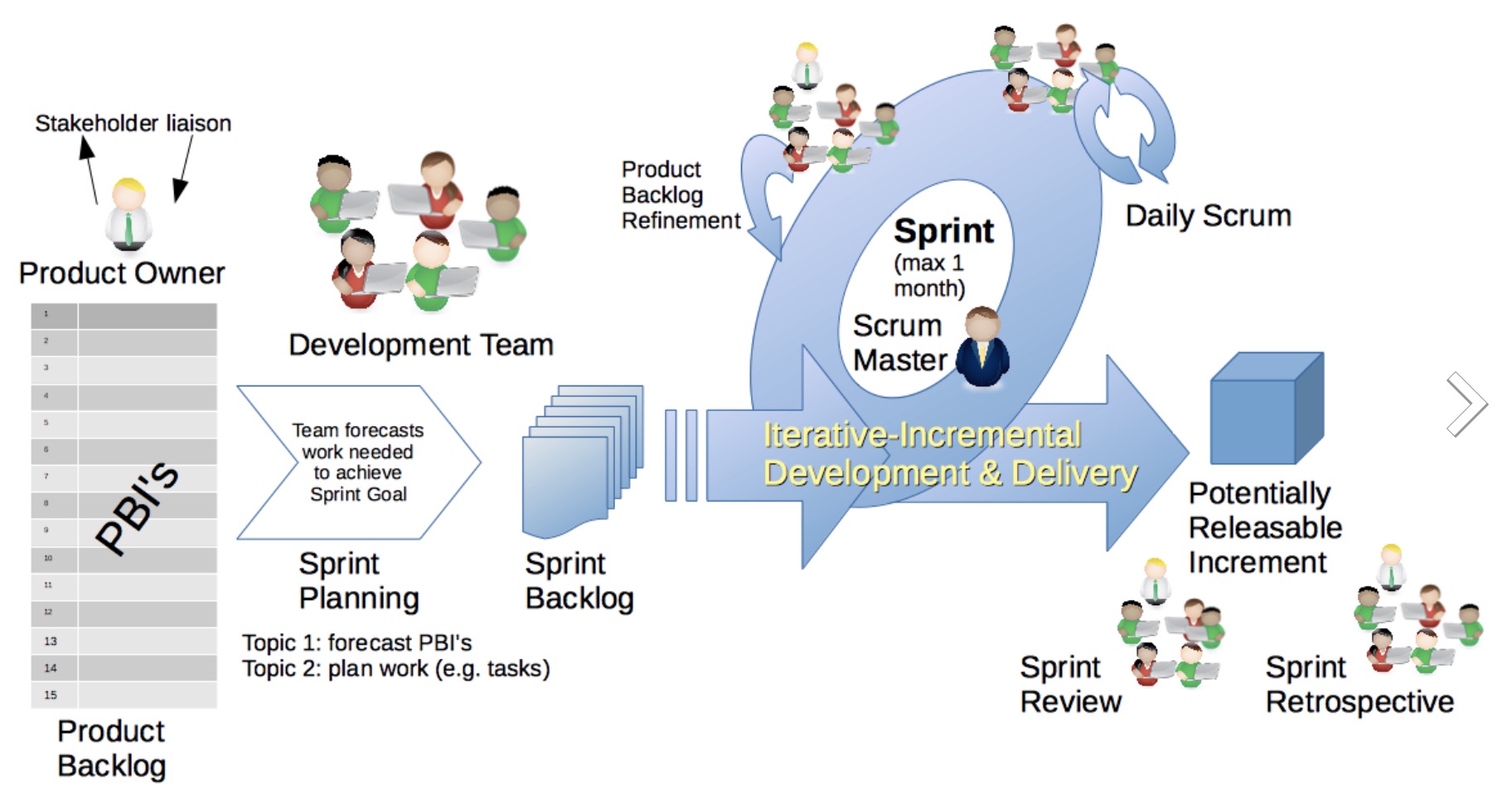
A Scrum team is made of a Product Owner, a Scrum Master and the Development Team.

Scrum activity can be summarised within the following events:

  • Sprint – a fixed time development iteration
  • Sprint Planning meetings
  • Daily Scrum meetings (Stand-Up meetings)
  • Sprint Review meetings
  • Sprint Retrospectives


XP – EXTREME PROGRAMMING

XP

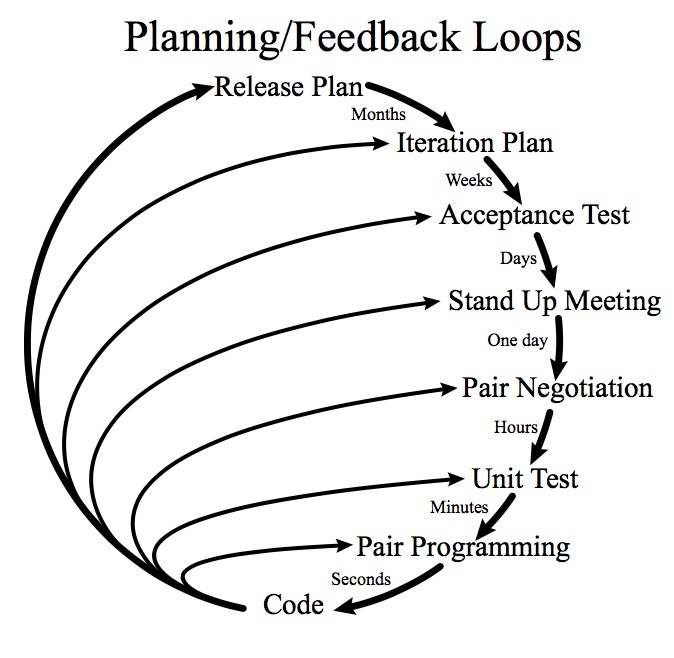
Extreme Programming (XP) provides a set of technically rigorous, team-oriented practices such as Test Driven Development, Continuous Integration, and Pairing that empower teams to deliver high quality software, iteratively.


LEAN

LEAN

Lean grew from out of the Toyota manufacturing Production System (TPS). Some key elements of this methodology are:

  • Optimise the whole
  • Eliminate waste
  • Build quality in
  • Learn constantly
  • Deliver fast
  • Engage everybody
  • Keep improving

Lean five principles:

  1. Specify value from the customer’s point of view. Start by recognizing that only a small percentage of overall time, effort and resources in a organization actually adds value to the customer.
  2. Identify and map the value chain. This is the te entire set of activities across all part of the organization involved in delivering a product or service to the customer. Where possible eliminate the steps that do not create value
  3. Create flow – your product and service should flow to the customer without any interruptions, detours or waiting – delivering customer value.
  4. Respond to customer demand (also referred to as pull). Understand the demand and optimize the process to deliver to this demand – ensuring you deliver only what the customer wants and when they want it – just in time production.
  5. Pursue perfection – all the steps link together waste is identified – in layers as one waste rectification can expose another – and eliminated by changing / optimizing the process to ensure all assets add value to the customer.


KANBAN

Kanban is focussed the visual presentation and management of work on a kanban board to better balance the understanding of the volume of work with the available resources and the delivery workflow.

KANBAN

Six general work practices are exercised in kanban:

  • Visualisation
  • Limiting work in Progress (WIP)
  • Flow management
  • Making policies explicit
  • Using feedback loops to ensure customer and quality alignment
  • Collaborative & experimental evolution of process and solutions

By limiting WIP you are minimising waste through the elimination of multi tasking and context switching.

There is no prescription of the number of steps to follow but it should align with the natural evolution of the changes being made in resolving a problem or completing a specific peace of work.

It focuses on delivering to customer expectations and needs by promoting team collaboration including the customer.


A Pragmatic approach

These techniques together provide a powerful, compelling and effective software development approach that brings the needed flexibility / agility into the software development lifecycle.

Combining and borrowing components from different methodologies to find the optimum delivery method that will deliver to the needs of the organisation is key. Depending on the specific business needs/situation, these components are combined to optimise the design, development and deployment of the software.

Helpful references:

A good overview of different agile methodologies can be found on this slideshare at .

Further Reading:

-> What Is Agile? A Philosophy That Develops Through Practice from Umar Ali

Let’s Talk – Are you looking to achieve your goals faster? Create better business value? Build strategies to improve growth? We can help – make contact!

The 7 Deadly Sins Of Product Development

Guest Blog: Travis Jacobs via LinkedIn

1.   The Pregnant Woman Theory

If one woman can make a baby in 9 months, then 9 women can make a baby in 30 days.  Now you may laugh, but this is the most common problem in developing a new product. Throwing more resources at the problem and praying it goes away does not solve anything.

2.   Stepping Over A Stack Of $100 Bills To Pick Up A Penny

We can’t spend $10 on an off the shelf tool but we can spend $1,000 to develop our own, which doesn’t work and causes more problems than it solves.

Spending countless hours in useless meetings and then having a meeting to discuss why everything is overbudget and behind schedule.

3.   Champagne On A Beer Budget

Expecting everything for free and having It done yesterday. This is a very common occurrence especially when subcontractors are hired.

I want to hire an Engineer with 3 PhD’s, and 30 years of experience for minimum wage

4.   The Scalpel Is Only As Good As The Surgeon Who Uses It, Not All Tools Are Created Equally.

A Scalpel is a commodity, the surgeon who uses it to save your life is not.

Not all tools are created equally, choose the right tool for the right job, not just because that tool Is the cheapest and the “sales guy” said it would “work”.

5.   You Never Run Out Of Things That Go Wrong

There will always be an endless supply of challenges and things that go wrong. Pretending there aren’t any problems doesn’t make them go away.

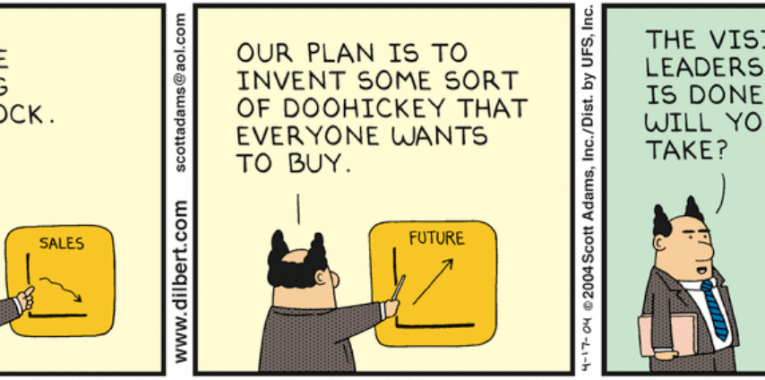
6.   A Plan Is Just A List Of Stuff That Didn’t Happen & Everything Takes Longer, And Costs More Than You Planned

The battle plan is the first casualty of war, as soon as the first shot is fired the plan goes out the window. Likewise, when the first problem is encountered when developing a new product, the plan and the Gantt Chart go out the window.

7.   Good, Fast, Cheap… Pick Any Two

We never have time to do it right, but we always have time to do it over….. and over….. and over…..

I hear time and time again. Just get it done right now, we’ll fix it later. The problem is that later never comes, and the product is only “fixed” after a very expensive product recall. By then it is too late and significant market share has been lost as well as the reputation of the brand. Trying to save a few bucks in product development can cost millions in product recalls.

iRedeem Product Development – Case Study

iRedeem Product Overview

iRedeem is an online redemption programme enabling members of a loyalty or membership programme to spend their loyalty currency on a range of exciting travel, lifestyle and leisure rewards.

Built on leading e-commerce technology and with a network of global partners iRedeem currently serves blue chip companies across the globe, offering them a personalised customer experience. You can incorporate your own inventory to provide greater redemption choice and reduce distressed inventory.

Also read the case study… iRedeem – A Global Airline Case Study

Innovation Rewarded

Engineering News – Innovation Reward

Innovation is crucial to industry and economic growth. That is why the South-African Department of Trade and Industry (DTI) has introduced the SPII (Support Programme for Industrial Innovation) initiative to support companies in the develop of new products.

The winners of the 7th SPII Awards was announced in Kimberley in Sep’04…

Customer Feedback Systems won the small enterprise category with its innovative CFS Version 2 Service Tracka project.

The CFS Version 2 “Service Tracka” product is an electronic tool designed to obtain useful and reliable service information with little inconvenience to the customer providing the information. Feedback Systems GM Renier Botha says direct-customer, real-time market intelligence and operational information is an indispensable tool for any business, particularly those involving a large number of individual customers. “Traditional methods include direct or telephone interviews and the completion of forms by customers – all methods that are expensive and time-consuming,” he notes.

With the CFS Version 2 Service Tracka, electronic input devices are located at tills or at strategic positions within a queuing system. The customer enters his responses to questions, without assistance, into the input device. The data is then hosted and managed by CFS and, upon input, is immediately written to a database and results delivered electronically to the client as often as daily. “This enables the client to focus on driving service improvement,” Botha explains.

The CFS system has a number of enhanced features, including a card reader for linking to loyalty programmes, the location of ‘intelligence’ in the central controller, which reduces input device costs, and the activation of the input devices from the central controller, which allows for the reduction of fictitious entries. The provision of question template updates by means of programmable chips in the lid also allows updates to be made before and after deployment of the input devices making question changes easy. Local customers include banks, hotel groups, healthcare, retailers and the South African Revenue Service.

Feedback Systems started developing the CFS Version 2 Service Tracka system at the end of 2001.

The product was subsequently released on the market at the end of January the next year. Today, the company has sold some 4 500 of these systems across South Africa.

Feedback Systems also has distributors located in Zimbabwe (servicing African countries, such as Tanzania, Kenya and Namibia), Australia, Singapore (servicing South East Asia), Dubai (servicing the Middle East) and London (servicing Europe). “We have a total of about 2 000 Service Tracka systems operating in these countries,” Botha says.

The company is also currently negotiating a distributorship deal for the US.

Read the full articel here… Engineering News – Innovation Reward