
Mastering Client and Stakeholder Management in Software Development Projects

Best Practices in Managing Your Client/Stakeholder During a Software Development Project

Managing clients and stakeholders effectively can be the linchpin of a successful software development project. Clear communication and effective management techniques can transform what could be a chaotic project into a well-oiled machine. Here are some best practices to ensure you and your clients or stakeholders are always on the same page:

1. Establish Clear Communication Channels

  • Kickoff Meetings: Start with a comprehensive kickoff meeting to align expectations. Discuss the scope, goals, timelines, and deliverables.
  • Regular Updates: Schedule regular update meetings to discuss progress, challenges, and next steps. Use video calls, emails, or project management tools to keep everyone informed.

2. Define Roles and Responsibilities

  • RACI Matrix: Create a RACI (Responsible, Accountable, Consulted, Informed) matrix to clearly outline who is responsible for what. This reduces confusion and ensures accountability.
  • Documentation: Keep detailed documentation of roles, responsibilities, and project milestones. This acts as a reference point throughout the project lifecycle.

3. Set Realistic Expectations

  • Scope Management: Clearly define the project scope and make sure all parties agree to it. Avoid scope creep by having a change management process in place.
  • Timeline and Budget: Be transparent about timelines and budgets. Provide realistic estimates and highlight potential risks that could affect them.

4. Use Agile Methodologies

  • Sprint Planning: Break down the project into manageable sprints. Use sprint planning meetings to set objectives and ensure that everyone is aligned.
  • Feedback Loops: Implement regular feedback loops to incorporate client or stakeholder feedback early and often. This helps in making necessary adjustments before it’s too late.

5. Prioritise Transparency and Honesty

  • Progress Reports: Share regular progress reports that include both successes and challenges. Honesty about setbacks can build trust and facilitate quicker problem-solving.
  • Open Dialogue: Encourage an open dialogue where clients and stakeholders feel comfortable sharing their concerns and suggestions.

6. Employ Robust Project Management Tools

  • Software Tools: Utilise project management tools like Jira, Trello, or Asana for tracking progress, assigning tasks, and managing deadlines. These tools can improve collaboration and transparency.
  • Dashboards: Create dashboards to visualise project metrics and KPIs. This provides a real-time snapshot of the project’s health.

7. Build Strong Relationships

  • Regular Check-Ins: Beyond formal meetings, have regular check-ins to understand client or stakeholder sentiments. Personal interactions can go a long way in building trust.
  • Empathy and Understanding: Show empathy and understanding towards your clients’ and stakeholders’ needs and constraints. A good relationship fosters better collaboration.

8. Resolve Conflicts Promptly

  • Conflict Resolution Plan: Have a plan in place for resolving conflicts swiftly. This includes identifying the issue, discussing it openly, and finding a mutually agreeable solution.
  • Mediation: If conflicts escalate, consider involving a neutral third party for mediation.

9. Celebrate Milestones and Achievements

  • Acknowledgement: Recognise and celebrate project milestones and individual achievements. This boosts morale and keeps everyone motivated.
  • Client Involvement: Involve clients and stakeholders in these celebrations to show appreciation for their contributions and support.

Conclusion

Effectively managing clients and stakeholders is not just about keeping them happy; it’s about building a partnership that drives the project towards success. By establishing clear communication, setting realistic expectations, employing agile methodologies, and fostering strong relationships, you can ensure that your software development project is a triumph for everyone involved.

Feel free to tweak these practices based on your unique project needs and client dynamics. Happy managing!

The Epiphany Moment of Euphoria in a Data Estate Development Project

In our technology-driven world, engineers pave the path forward, and there are moments of clarity and triumph that stand comparable to humanity’s greatest achievements. Learning at a young age from these achievements shape our way of thinking and can be a source of inspiration that enhances the way we solve problems in our daily lives. For me, one of these profound inspirations stems from an engineering marvel: the Paul Sauer Bridge over the Storms River in Tsitsikamma, South Africa – which I first visited in 1981. This arch bridge, completed in 1956, represents more than just a physical structure. It embodies a visionary approach to problem-solving, where ingenuity, precision, and execution converge seamlessly.

The Paul Sauer Bridge across the Storms River Gorge in South Africa.

The bridge’s construction involved a bold method: engineers built two halves of the arch on opposite sides of the gorge. Each section was erected vertically and then carefully pivoted downward to meet perfectly in the middle, completing the 100m span, 120m above the river. This remarkable feat of engineering required foresight, meticulous planning, and flawless execution – a true epiphany moment of euphoria when the pieces fit perfectly.

Now, imagine applying this same philosophy to building data estate solutions. Like the bridge, these solutions must connect disparate sources, align complex processes, and culminate in a seamless result where data meets business insights.

This blog explores how to achieve this epiphany moment in data projects by drawing inspiration from this engineering triumph.

The Parallel Approach: Top-Down and Bottom-Up

Building a successful data estate solution, I believe requires a dual approach, much like the simultaneous construction of both sides of the Storms River Bridge:

  1. Top-Down Approach:
    • Start by understanding the end goal: the reports, dashboards, and insights that your organization needs.
    • Focus on business requirements such as wireframe designs, data visualization strategies, and the decisions these insights will drive.
    • Use these goals to inform the types of data needed and the transformations required to derive meaningful insights.
  2. Bottom-Up Approach:
    • Begin at the source: identifying and ingesting the right raw data from various systems.
    • Ensure data quality through cleaning, validation, and enrichment.
    • Transform raw data into structured and aggregated datasets that are ready to be consumed by reports and dashboards.

These two streams work in parallel. The Top-Down approach ensures clarity of purpose, while the Bottom-Up approach ensures robust engineering. The magic happens when these two streams meet in the middle – where the transformed data aligns perfectly with reporting requirements, delivering actionable insights. This convergence is the epiphany moment of euphoria for every data team, validating the effort invested in discovery, planning, and execution.

When the Epiphany Moment Isn’t Euphoric

While the convergence of Top-Down and Bottom-Up approaches can lead to an epiphany moment of euphoria, there are times when this anticipated triumph falls flat. One of the most common reasons is discovering that the business requirements cannot be met as the source data is insufficient, incomplete, or altogether unavailable to meet the reporting requirements. These moments can feel like a jarring reality check, but they also offer valuable lessons for navigating data challenges.

Why This Happens

  1. Incomplete Understanding of Data Requirements:
    • The Top-Down approach may not have fully accounted for the granular details of the data needed to fulfill reporting needs.
    • Assumptions about the availability or structure of the data might not align with reality.
  2. Data Silos and Accessibility Issues:
    • Critical data might reside in silos across different systems, inaccessible due to technical or organizational barriers.
    • Ownership disputes or lack of governance policies can delay access.
  3. Poor Data Quality:
    • Data from source systems may be incomplete, outdated, or inconsistent, requiring significant remediation before use.
    • Legacy systems might not produce data in a usable format.
  4. Shifting Requirements:
    • Business users may change their reporting needs mid-project, rendering the original data pipeline insufficient.

The Emotional and Practical Fallout

Discovering such issues mid-development can be disheartening:

  • Teams may feel a sense of frustration, as their hard work in data ingestion, transformation, and modeling seems wasted.
  • Deadlines may slip, and stakeholders may grow impatient, putting additional pressure on the team.
  • The alignment between business and technical teams might fracture as miscommunications come to light.

Turning Challenges into Opportunities

These moments, though disappointing, are an opportunity to re-evaluate and recalibrate your approach. Here are some strategies to address this scenario:

1. Acknowledge the Problem Early

  • Accept that this is part of the iterative process of data projects.
  • Communicate transparently with stakeholders, explaining the issue and proposing solutions.

2. Conduct a Gap Analysis

  • Assess the specific gaps between reporting requirements and available data.
  • Determine whether the gaps can be addressed through technical means (e.g., additional ETL work) or require changes to reporting expectations.

3. Explore Alternative Data Sources

  • Investigate whether other systems or third-party data sources can supplement the missing data.
  • Consider enriching the dataset with external or public data.

4. Refine the Requirements

  • Work with stakeholders to revisit the original reporting requirements.
  • Adjust expectations to align with available data while still delivering value.

5. Enhance Data Governance

  • Develop clear ownership, governance, and documentation practices for source data.
  • Regularly audit data quality and accessibility to prevent future bottlenecks.

6. Build for Scalability

  • Future-proof your data estate by designing modular pipelines that can easily integrate new sources.
  • Implement dynamic models that can adapt to changing business needs.

7. Learn and Document the Experience

  • Treat this as a learning opportunity. Document what went wrong and how it was resolved.
  • Use these insights to improve future project planning and execution.

The New Epiphany: A Pivot to Success

While these moments may not bring the euphoria of perfect alignment, they represent an alternative kind of epiphany: the realisation that challenges are a natural part of innovation. Overcoming these obstacles often leads to a more robust and adaptable solution, and the lessons learned can significantly enhance your team’s capabilities.

In the end, the goal isn’t perfection – it’s progress. By navigating the difficulties of misalignment, incomplete or unavailable data with resilience and creativity, you’ll lay the groundwork for future successes and, ultimately, more euphoric epiphanies to come.

Steps to Ensure Success in Data Projects

To reach this transformative moment, teams must adopt structured practices and adhere to principles that drive success. Here are the key steps:

1. Define Clear Objectives

  • Identify the core business problems you aim to solve with your data estate.
  • Engage stakeholders to define reporting and dashboard requirements.
  • Develop a roadmap that aligns with organisational goals.

2. Build a Strong Foundation

  • Invest in the right infrastructure for data ingestion, storage, and processing (e.g., cloud platforms, data lakes, or warehouses).
  • Ensure scalability and flexibility to accommodate future data needs.

3. Prioritize Data Governance

  • Implement data policies to maintain security, quality, and compliance.
  • Define roles and responsibilities for data stewardship.
  • Create a single source of truth to avoid duplication and errors.

4. Embrace Parallel Development

  • Top-Down: Start designing wireframes for reports and dashboards while defining the key metrics and KPIs.
  • Bottom-Up: Simultaneously ingest and clean data, applying transformations to prepare it for analysis.
  • Use agile methodologies to iterate and refine both streams in sync.

5. Leverage Automation

  • Automate data pipelines for faster and error-free ingestion and transformation.
  • Use tools like ETL frameworks, metadata management platforms, and workflow orchestrators.

6. Foster Collaboration

  • Establish a culture of collaboration between business users, analysts, and engineers.
  • Encourage open communication to resolve misalignments early in the development cycle.

7. Test Early and Often

  • Validate data accuracy, completeness, and consistency before consumption.
  • Conduct user acceptance testing (UAT) to ensure the final reports meet business expectations.

8. Monitor and Optimize

  • After deployment, monitor the performance of your data estate.
  • Optimize processes for faster querying, better visualization, and improved user experience.

Most Importantly – do not forget that the true driving force behind technological progress lies not just in innovation but in the people who bring it to life. Investing in the right individuals and cultivating a strong, capable team is paramount. A team of skilled, passionate, and collaborative professionals forms the backbone of any successful venture, ensuring that ideas are transformed into impactful solutions. By fostering an environment where talent can thrive – through mentorship, continuous learning, and shared vision – organisations empower their teams to tackle complex challenges with confidence and creativity. After all, even the most groundbreaking technologies are only as powerful as the minds and hands that create and refine them.

Conclusion: Turning Vision into Reality

The Storms River Bridge stands as a symbol of human achievement, blending design foresight with engineering excellence. It teaches us that innovation requires foresight, collaboration, and meticulous execution. Similarly, building a successful data estate solution is not just about connecting systems or transforming data – it’s about creating a seamless convergence where insights meet business needs. By adopting a Top-Down and Bottom-Up approach, teams can navigate the complexities of data projects, aligning technical execution with business needs.

When the two streams meet – when your transformed data delivers perfectly to your reporting requirements – you’ll experience your own epiphany moment of euphoria. It’s a testament to the power of collaboration, innovation, and relentless dedication to excellence.

In both engineering and technology, the most inspiring achievements stem from the ability to transform vision into reality. The story of the Paul Sauer Bridge teaches us that innovation requires foresight, collaboration, and meticulous execution. Similarly, building a successful data estate solution is not just about connecting systems or transforming data, it’s about creating a seamless convergence where insights meet business needs.

The journey isn’t always smooth. Challenges like incomplete data, shifting requirements, or unforeseen obstacles can test our resilience. However, these moments are an opportunity to grow, recalibrate, and innovate further. By adopting structured practices, fostering collaboration, and investing in the right people, organizations can navigate these challenges effectively.

Ultimately, the epiphany moment in data estate development is not just about achieving alignment, it’s about the collective people effort, learning, and perseverance that make it possible. With a clear vision, a strong foundation, and a committed team, you can create solutions that drive success and innovation, ensuring that every challenge becomes a stepping stone toward greater triumphs.

Top 10 Strategic Technology Trends for 2025 -Aligning Your Technology Strategy

A Guide for Forward-Thinking CIOs

As 2025 approaches, organisations must prepare for a wave of technological advancements that will shape the business landscape. This year’s Gartner Top Strategic Technology Trends serves as a roadmap for CIOs and IT leaders, guiding them to navigate a future marked by both opportunity and challenge. These trends reveal new ways to overcome obstacles in productivity, security, and innovation, helping organisations embrace a future driven by responsible innovation.

Planning for the Future: Why These Trends Matter

CIOs and IT leaders face unprecedented social and economic shifts. To thrive in this environment, they need to look beyond immediate challenges and position themselves for long-term success. Gartner’s Top Strategic Technology Trends for 2025 encapsulates the transformative technologies reshaping how organisations operate, compete, and grow. Each trend provides a pathway towards enhanced operational efficiency, security, and engagement, serving as powerful tools for navigating the future.

Using Gartner’s Strategic Technology Trends to Shape Tomorrow

Gartner has organised this year’s trends into three main themes: AI imperatives and risks, new frontiers of computing, and human-machine synergy. Each theme presents a unique perspective on technology’s evolving role in business and society, offering strategic insights to help organisations innovate responsibly.


Theme 1: AI Imperatives and Risks – Balancing Innovation with Safety

1. Agentic AI

Agentic AI represents the next generation of autonomous systems capable of planning and acting to achieve user-defined goals. By creating virtual agents that work alongside human employees, businesses can improve productivity and efficiency.

  • Benefits: Virtual agents augment human work, enhance productivity, and streamline operations.
  • Challenges: Agentic AI requires strict guardrails to align with user intentions and ensure responsible use.

2. AI Governance Platforms

AI governance platforms are emerging to help organisations manage the ethical, legal, and operational facets of AI, providing transparency and building trust.

  • Benefits: Enables policy management for responsible AI, enhances transparency, and builds accountability.
  • Challenges: Consistency in AI governance can be difficult due to varied guidelines across regions and industries.

3. Disinformation Security

As misinformation and cyber threats increase, disinformation security technologies are designed to verify identity, detect harmful narratives, and protect brand reputation.

  • Benefits: Reduces fraud, strengthens identity validation, and protects brand reputation.
  • Challenges: Requires adaptive, multi-layered security strategies to stay current against evolving threats.

Theme 2: New Frontiers of Computing – Expanding the Possibilities of Technology

4. Post-Quantum Cryptography (PQC)

With quantum computing on the horizon, PQC technologies are essential for protecting data from potential decryption by quantum computers.

  • Benefits: Ensures data protection against emerging quantum threats.
  • Challenges: PQC requires rigorous testing and often needs to replace existing encryption algorithms, which can be complex and costly.

5. Ambient Invisible Intelligence

This technology integrates unobtrusively into the environment, enabling real-time tracking and sensing while enhancing the user experience.

  • Benefits: Enhances efficiency and visibility with low-cost, intuitive technology.
  • Challenges: Privacy concerns must be addressed, and user consent obtained, for certain data uses.

6. Energy-Efficient Computing

Driven by the demand for sustainability, energy-efficient computing focuses on greener computing practices, optimised architecture, and renewable energy.

  • Benefits: Reduces carbon footprint, meets sustainability goals, and addresses regulatory and commercial pressures.
  • Challenges: Requires substantial investment in new hardware, training, and tools, which can be complex and costly to implement.

7. Hybrid Computing

Hybrid computing blends multiple computing methods to solve complex problems, offering a flexible approach for various applications.

  • Benefits: Unlocks new levels of AI performance, enables real-time personalisation, and supports automation.
  • Challenges: The complexity of these systems and the need for specialised skills can present significant hurdles.

Theme 3: Human-Machine Synergy – Bridging Physical and Digital Worlds

8. Spatial Computing

Spatial computing utilises AR and VR to create immersive digital experiences, reshaping sectors like gaming, healthcare, and e-commerce.

  • Benefits: Enhances user experience with immersive interactions, meeting demands in gaming, education, and beyond.
  • Challenges: High costs, complex interfaces, and data privacy concerns can limit adoption.

9. Polyfunctional Robots

With the ability to switch between tasks, polyfunctional robots offer flexibility, enabling faster return on investment without significant infrastructure changes.

  • Benefits: Provides scalability and flexibility, reduces reliance on specialised labour, and improves ROI.
  • Challenges: Lack of industry standards on price and functionality makes adoption unpredictable.

10. Neurological Enhancement

Neurological enhancement technologies, such as brain-machine interfaces, have the potential to enhance cognitive abilities, creating new opportunities for personalised education and workforce productivity.

  • Benefits: Enhances human skills, improves safety, and supports longevity in the workforce.
  • Challenges: Ethical concerns, high costs, and security risks associated with direct brain interaction present significant challenges.

Embrace the Future with Responsible Innovation

As 2025 nears, these technological trends provide organisations with the strategic insights needed to navigate a rapidly evolving landscape. Whether adopting AI-powered agents, protecting against quantum threats, or integrating human-machine interfaces, these trends offer a framework for responsible and innovative growth. Embracing them will allow CIOs and IT leaders to shape a future where technology serves as a bridge to more efficient, ethical, and impactful business practices.

Ready to Dive Deeper?

Partnering with RenierBotha Ltd (reierbotha.com) provides your organisation with the expertise needed to seamlessly align your technology strategy with emerging trends that will shape the future of business. With a focus on driving digital transformation through strategic planning, RenierBotha Ltd helps organisations incorporate top technology advancements into their digital ambitions, ensuring that each step is optimised for impact, scalability, and long-term success. By leveraging our deep industry knowledge, innovative approaches, and tailored solutions, RenierBotha Ltd empowers your team to navigate complex challenges, integrate cutting-edge technologies, and lead responsibly in a rapidly evolving digital landscape. Together, we can shape a future where technology and business strategies converge to unlock sustainable growth, resilience, and a competitive edge.

Blockchain Technology: Beyond Cryptocurrency

Day 9 of Renier Botha’s 10-Day Blog Series on Navigating the Future: The Evolving Role of the CTO

Blockchain technology has gained widespread recognition as the foundation of cryptocurrencies like Bitcoin. However, its potential extends far beyond digital currencies. Blockchain offers enhanced security, transparency, and traceability, making it a transformative tool for various industries. This comprehensive blog post provides advice and actionable insights for Chief Technology Officers (CTOs) on leveraging blockchain technology beyond cryptocurrency, featuring quotes from industry leaders and real-world examples.

Understanding Blockchain Technology

Blockchain is a decentralized digital ledger that records transactions across multiple computers in a secure, transparent, and immutable manner. Each block contains a list of transactions, and once a block is added to the chain, the information is permanent and cannot be altered.

Quote: “Blockchain is the tech. Bitcoin is merely the first mainstream manifestation of its potential.” – Marc Kenigsberg, Founder of BitcoinChaser

Benefits of Blockchain Technology

  • Enhanced Security: Blockchain’s decentralized nature and cryptographic hashing make it highly secure against tampering and fraud.
  • Transparency: Transactions are recorded on a public ledger, ensuring transparency and accountability.
  • Traceability: Blockchain provides a clear audit trail for every transaction, improving traceability and reducing the risk of errors.
  • Efficiency: By automating processes and eliminating intermediaries, blockchain can streamline operations and reduce costs. Smart contracts can automate the issuance and redemption of loyalty points, reducing administrative overhead and errors.
  • Trust: Blockchain builds trust among parties by ensuring the integrity and authenticity of transactions.

Applications of Blockchain Beyond Cryptocurrency

1. Supply Chain Management

Blockchain can revolutionize supply chain management by providing real-time visibility and traceability of products. It ensures that every step of the supply chain is recorded, from raw materials to the final product, enhancing transparency and reducing fraud.

Example: Walmart uses blockchain technology to track the origin of food products. By scanning a QR code, consumers can access detailed information about the product’s journey, ensuring safety and quality.

Actionable Advice for CTOs:

  • Evaluate Blockchain Platforms: Assess different blockchain platforms (e.g., Hyperledger, Ethereum) to find the one that best suits your supply chain needs.
  • Collaborate with Partners: Work with suppliers, manufacturers, and logistics providers to integrate blockchain into the supply chain.
  • Implement Pilot Projects: Start with pilot projects to test the technology and refine processes before scaling up.

2. Healthcare

Blockchain can enhance the security and interoperability of healthcare records, ensuring that patient data is accurate, accessible, and secure. It can also streamline the management of medical supply chains and clinical trials.

Example: Medicalchain is a platform that uses blockchain to securely store and share electronic health records (EHRs). Patients control access to their records, and healthcare providers can view a single, accurate version of the patient’s medical history.

Actionable Advice for CTOs:

  • Focus on Data Security: Implement robust encryption and access controls to protect patient data on the blockchain.
  • Promote Interoperability: Ensure that blockchain systems can integrate with existing EHR systems and other healthcare applications.
  • Engage Stakeholders: Collaborate with healthcare providers, patients, and regulators to ensure compliance and address concerns.

3. Finance and Banking

Beyond cryptocurrencies, blockchain can streamline financial transactions, reduce fraud, and enhance transparency in banking. Applications include cross-border payments, trade finance, and smart contracts.

Example: JPMorgan Chase developed its blockchain platform, Quorum, to facilitate secure and efficient transactions. Quorum supports the bank’s Interbank Information Network (IIN), which reduces payment delays and enhances transaction transparency.

Actionable Advice for CTOs:

  • Explore Use Cases: Identify financial processes that can benefit from blockchain, such as cross-border payments and trade finance.
  • Develop Smart Contracts: Use smart contracts to automate and secure financial agreements, reducing the need for intermediaries.
  • Ensure Compliance: Work with legal and regulatory teams to ensure that blockchain implementations comply with financial regulations.

4. Real Estate

Blockchain can simplify real estate transactions by providing a transparent and immutable record of property ownership and transfers. It can also streamline processes like title searches, escrow, and financing.

Example: Propy is a real estate platform that uses blockchain to facilitate property transactions. The platform allows buyers, sellers, and agents to complete transactions securely and transparently, reducing the time and costs associated with traditional methods.

Actionable Advice for CTOs:

  • Implement Digital Titles: Use blockchain to create and manage digital property titles, ensuring transparency and reducing fraud.
  • Streamline Transactions: Develop blockchain-based platforms to automate real estate transactions, from listing to closing.
  • Collaborate with Stakeholders: Work with real estate agents, title companies, and regulators to adopt blockchain solutions.

5. Voting Systems

Blockchain can enhance the security and transparency of voting systems, ensuring that votes are accurately recorded and counted. It can also provide a tamper-proof record of election results.

Example: Voatz is a mobile voting platform that uses blockchain to secure voting records. The platform has been used in several pilot projects, including West Virginia’s mobile voting initiative for military personnel overseas.

Actionable Advice for CTOs:

  • Focus on Security: Implement strong encryption and authentication measures to protect voter data and ensure the integrity of the voting process.
  • Pilot Projects: Start with small-scale pilot projects to test blockchain voting systems and address any issues before broader implementation.
  • Engage Stakeholders: Collaborate with election officials, voters, and cybersecurity experts to ensure the system’s reliability and acceptance.

6. Loyalty Systems and Transactions

Blockchain technology can revolutionize loyalty programs by enhancing security, transparency, and efficiency. By using blockchain, companies can create tamper-proof records of loyalty points and transactions, providing a seamless and trustworthy experience for customers.

Example: Singapore Airlines launched KrisPay, a blockchain-based loyalty wallet, allowing members to convert air miles into digital tokens and spend them at partner merchants seamlessly. This approach not only enhances user experience but also improves security and reduces costs associated with managing loyalty points.

Actionable Advice for CTOs:

  • Evaluate Blockchain Platforms: Assess blockchain platforms that can be integrated with your existing loyalty systems.
  • Develop Smart Contracts: Create smart contracts to automate the management of loyalty points and transactions.
  • Collaborate with Partners: Work with merchants and partners to expand the acceptance of blockchain-based loyalty points.

Overcoming Challenges in Blockchain Adoption

While blockchain offers numerous benefits, its adoption comes with challenges that CTOs must address:

  1. Scalability: Blockchain networks can experience scalability issues as transaction volumes increase. CTOs should explore solutions like sharding and layer-2 protocols to enhance scalability.
  2. Interoperability: Ensuring that different blockchain systems can work together is crucial for widespread adoption. Standards and protocols should be developed to facilitate interoperability.
  3. Regulatory Compliance: Navigating the regulatory landscape is essential for blockchain adoption. CTOs must stay informed about regulations and work with legal teams to ensure compliance.
  4. Skill Gaps: The demand for blockchain expertise is high, and there may be a shortage of skilled professionals. CTOs should invest in training and development programs to build internal capabilities.

Conclusion

Blockchain technology holds immense potential beyond cryptocurrency, offering enhanced security, transparency, and traceability across various industries. By leveraging blockchain, organizations can streamline operations, reduce costs, and build trust with stakeholders.

For CTOs, the journey to blockchain adoption involves identifying relevant use cases, investing in the right infrastructure, collaborating with industry partners, prioritizing security, and overcoming challenges related to scalability, interoperability, regulatory compliance, and skill gaps. Real-world examples from supply chain management, healthcare, finance, real estate, loyalty and voting systems demonstrate the transformative power of blockchain technology.

As blockchain continues to evolve, staying ahead of the curve requires strategic planning, continuous innovation, and a commitment to embracing new technologies. By doing so, organizations can unlock the full potential of blockchain and drive sustainable growth in an increasingly connected world.

Stay tuned as we continue to explore critical topics in our 10-day blog series, “Navigating the Future: A 10-Day Blog Series on the Evolving Role of the CTO” by Renier Botha. Visit www.renierbotha.com for more insights and expert advice.

Unleashing the Power of 5G and Edge Computing

Day 8 of Renier Botha’s 10-Day Blog Series on Navigating the Future: The Evolving Role of the CTO

The advent of 5G and edge computing is set to revolutionize the technology landscape, offering unprecedented speed, low latency, and enhanced data processing capabilities. These technologies promise to drive innovation, support emerging applications, and significantly impact various industries. This comprehensive blog post explores how 5G and edge computing can be leveraged to transform business operations, featuring insights from industry leaders and real-world examples.

Understanding 5G and Edge Computing

What is 5G?

5G is the fifth generation of wireless technology, offering faster speeds, higher bandwidth, and lower latency than its predecessors. It is designed to connect virtually everyone and everything, including machines, objects, and devices.

Quote: “5G will enable a new era of connectivity, powering everything from smart cities to autonomous vehicles and advanced manufacturing.” – Hans Vestberg, CEO of Verizon

What is Edge Computing?

Edge computing involves processing data closer to the source of data generation, such as IoT devices, rather than relying solely on centralized cloud servers. This approach reduces latency, decreases bandwidth usage, and improves response times.

Quote: “Edge computing brings computation and data storage closer to the devices where it’s being gathered, rather than relying on a central location that can be thousands of miles away.” – Satya Nadella, CEO of Microsoft

Benefits of 5G and Edge Computing

  • Reduced Latency: With data processed closer to the source, latency is significantly reduced, enabling real-time applications and enhancing user experiences.
  • Enhanced Data Processing: Edge computing allows for efficient data processing, reducing the load on central servers and ensuring faster insights.
  • Increased Bandwidth: 5G provides higher bandwidth, supporting more devices and data-intensive applications.
  • Improved Reliability: Both technologies enhance network reliability, ensuring consistent performance even in remote or challenging environments.
  • Support for Emerging Technologies: 5G and edge computing are foundational for emerging innovations such as autonomous vehicles, smart cities, and advanced manufacturing.

Strategies for Leveraging 5G and Edge Computing

1. Identify Use Cases

Determine specific use cases where 5G and edge computing can deliver the most value. Focus on applications that require low latency, high bandwidth, and real-time data processing.

Example: In healthcare, 5G and edge computing can enable remote surgeries and real-time monitoring of patient vitals, improving outcomes and expanding access to care.

2. Invest in Infrastructure

Build the necessary infrastructure to support 5G and edge computing. This includes deploying edge nodes, upgrading network components, and ensuring seamless integration with existing systems.

Example: Verizon has invested heavily in its 5G infrastructure, deploying small cells and edge computing nodes across major cities to ensure robust and reliable coverage.

3. Collaborate with Industry Partners

Partner with technology providers, telecom companies, and industry experts to leverage their expertise and resources. Collaboration can accelerate deployment and ensure successful integration.

Quote: “Collaboration is key to unlocking the full potential of 5G and edge computing. By working together, we can drive innovation and create new opportunities for businesses and consumers.” – Ajit Pai, Former Chairman of the FCC

4. Prioritize Security

Implement robust security measures to protect data and ensure the integrity of edge devices and networks. This includes encryption, authentication, and regular security audits.

Example: IBM’s Edge Application Manager provides a secure platform for managing and deploying edge applications, ensuring data integrity and protecting against cyber threats.

5. Leverage Data Analytics

Utilize data analytics to derive insights from the vast amounts of data generated by edge devices. Real-time analytics can drive informed decision-making and optimize operations.

Example: Siemens uses edge computing and data analytics to monitor and optimize its industrial equipment. By analyzing data at the edge, Siemens can predict maintenance needs and improve operational efficiency.

Real-World Examples of 5G and Edge Computing

Example 1: Autonomous Vehicles

Autonomous vehicles rely on real-time data processing to navigate and make decisions. 5G and edge computing enable ultra-low latency and high-speed data transfer, ensuring safe and efficient operation. Companies like Tesla and Waymo are leveraging these technologies to enhance the capabilities of their autonomous fleets.

Example 2: Smart Cities

Smart cities use 5G and edge computing to manage infrastructure, improve public services, and enhance the quality of life for residents. Barcelona, for instance, employs these technologies to optimize traffic management, reduce energy consumption, and enhance public safety through real-time surveillance and data analysis.

Example 3: Manufacturing

In manufacturing, 5G and edge computing support advanced automation and predictive maintenance. Bosch utilizes these technologies to monitor equipment in real-time, predict failures, and optimize production processes, leading to reduced downtime and increased efficiency.

Example 4: Gaming

The gaming industry benefits from 5G and edge computing by delivering immersive experiences with minimal latency. NVIDIA’s GeForce Now platform leverages edge computing to provide high-performance cloud gaming, ensuring smooth gameplay and real-time interactions.

Conclusion

5G and edge computing represent a transformative shift in how data is processed and transmitted, offering unparalleled speed, low latency, and enhanced capabilities. By leveraging these technologies, organizations can drive innovation, improve operational efficiency, and unlock new business opportunities.

To successfully integrate 5G and edge computing, businesses should identify relevant use cases, invest in infrastructure, collaborate with industry partners, prioritize security, and leverage data analytics. Real-world examples from healthcare, autonomous vehicles, smart cities, manufacturing, and gaming demonstrate the vast potential of these technologies.

As 5G and edge computing continue to evolve, staying ahead of the curve will require strategic planning, continuous innovation, and a commitment to embracing new technologies. By doing so, organizations can harness the power of 5G and edge computing to drive success and shape the future.

Stay tuned as we continue to explore critical topics in our 10-day blog series, “Navigating the Future: A 10-Day Blog Series on the Evolving Role of the CTO” by Renier Botha.

Visit www.renierbotha.com for more insights and expert advice.

Leading Digital Transformation Initiatives

Day 4 of Renier Botha’s 10-Day Blog Series on Navigating the Future: The Evolving Role of the CTO

For almost all modern companies, digital transformation is no longer a choice but a necessity. Modernizing IT infrastructure and driving innovation are crucial for organizations aiming to stay competitive and relevant. Leading successful digital transformation initiatives requires a strategic approach, a clear vision, and the ability to navigate complex changes. This comprehensive blog post will provide insights into effective digital transformation strategies that streamline operations and foster growth.

Understanding Digital Transformation

Digital transformation involves integrating digital technology into all areas of a business, fundamentally changing how organizations operate and deliver value to customers. It encompasses a broad range of initiatives, including cloud computing, data analytics, artificial intelligence (AI), machine learning (ML), Internet of Things (IoT), and more.

Why Digital Transformation Matters

  • Enhanced Efficiency: Automating processes and leveraging data analytics improve operational efficiency and decision-making.
  • Improved Customer Experience: Personalized and seamless customer interactions drive satisfaction and loyalty.
  • Innovation and Growth: New business models and revenue streams emerge from technological advancements.
  • Competitive Advantage: Staying ahead of the competition requires continuous adaptation and innovation.

Key Components of Digital Transformation

Successful digital transformation initiatives typically involve several key components:

1. Cloud Computing

Cloud computing offers scalability, flexibility, and cost savings. It enables organizations to access computing resources on-demand, eliminating the need for significant upfront investments in hardware and software.

Example: Capital One has embraced cloud computing to modernize its IT infrastructure, resulting in improved agility and reduced costs. The bank migrated its applications to AWS, enabling faster deployment of new services and enhanced customer experiences.

2. Data Analytics and Big Data

Harnessing the power of data analytics and big data allows organizations to gain valuable insights, drive decision-making, and optimize operations. By analyzing large datasets, businesses can identify trends, predict customer behavior, and make data-driven decisions.

Example: Procter & Gamble uses data analytics to optimize its supply chain and improve product development. By analyzing data from various sources, P&G can predict demand, manage inventory, and reduce costs.

3. Artificial Intelligence and Machine Learning

AI and ML technologies enable organizations to automate tasks, enhance customer interactions, and improve decision-making processes. These technologies can analyze vast amounts of data, recognize patterns, and provide actionable insights.

Example: Netflix leverages AI and ML to deliver personalized content recommendations to its users. By analyzing viewing habits and preferences, Netflix can suggest relevant content, increasing user engagement and satisfaction.

4. Internet of Things (IoT)

IoT technologies connect devices and collect data, enabling organizations to monitor and manage assets in real-time. This connectivity enhances operational efficiency, reduces downtime, and supports predictive maintenance.

Example: General Electric (GE) uses IoT to monitor and maintain its industrial equipment. The company’s Predix platform collects data from sensors embedded in machines, allowing GE to predict maintenance needs and reduce operational disruptions.

5. Digital Culture and Workforce

A successful digital transformation requires a cultural shift within the organization. Employees must embrace new technologies and adapt to changing workflows. Providing training and fostering a culture of innovation are essential for driving transformation.

Example: Microsoft transformed its corporate culture under CEO Satya Nadella, emphasizing collaboration, continuous learning, and a growth mindset. This cultural shift has been instrumental in Microsoft’s successful digital transformation.

Strategies for Leading Digital Transformation

Leading digital transformation initiatives involves strategic planning, effective execution, and continuous improvement. Here are some strategies for CTOs to consider:

1. Develop a Clear Vision and Strategy

A successful digital transformation starts with a clear vision and strategy. Define the objectives, goals, and desired outcomes of the transformation. Align the strategy with the organization’s overall business goals and ensure buy-in from all stakeholders.

2. Engage Leadership and Stakeholders

Leadership commitment is crucial for driving digital transformation. Engage senior leaders and stakeholders to champion the initiative and allocate necessary resources. Foster a collaborative environment where everyone understands the importance of transformation and their role in its success.

3. Focus on Customer Experience

Customer experience should be at the heart of digital transformation. Understand customer needs and preferences, and leverage technology to deliver personalized and seamless experiences. Collect feedback and continuously improve customer interactions.

4. Invest in Technology and Infrastructure

Invest in the right technologies and infrastructure to support digital transformation. This includes cloud computing, data analytics platforms, AI/ML tools, and IoT devices. Ensure that the infrastructure is scalable and secure to accommodate future growth.

5. Foster a Culture of Innovation

Encourage a culture of innovation by promoting experimentation, learning, and collaboration. Provide employees with the tools and training they need to embrace new technologies and processes. Recognize and reward innovative ideas and initiatives.

6. Implement Agile Methodologies

Agile methodologies enable organizations to respond quickly to changing market conditions and customer needs. Adopt agile practices to streamline development processes, improve collaboration, and accelerate time-to-market for new products and services.

7. Monitor and Measure Progress

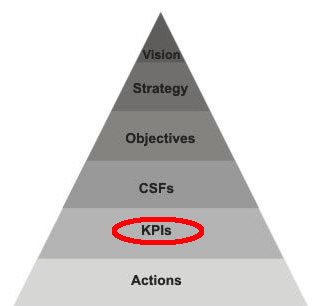
Regularly monitor and measure the progress of digital transformation initiatives. Use key performance indicators (KPIs) to track success and identify areas for improvement. Continuously refine strategies based on data-driven insights and feedback.

Real-World Examples of Digital Transformation

Example 1: Amazon

Amazon’s digital transformation journey has been characterized by continuous innovation and a customer-centric approach. The company has leveraged cloud computing, AI, and data analytics to revolutionize e-commerce and supply chain management. Amazon Web Services (AWS) has become a leading cloud platform, enabling businesses worldwide to transform their operations.

Example 2: Domino’s Pizza

Domino’s Pizza has embraced digital transformation to enhance customer experience and streamline operations. The company’s “AnyWare” platform allows customers to order pizza through various digital channels, including smartwatches, voice assistants, and social media. Domino’s has also implemented AI-powered chatbots and real-time order tracking to improve customer satisfaction.

Example 3: Siemens

Siemens has undergone a digital transformation to become a leader in industrial automation and smart manufacturing. The company’s MindSphere platform connects industrial equipment and collects data for analysis, enabling predictive maintenance and optimized production processes. Siemens’ digital initiatives have improved efficiency and reduced downtime in manufacturing operations.

Conclusion

Digital transformation is a critical driver of modernizing IT infrastructure and fostering innovation. By leveraging technologies such as cloud computing, data analytics, AI, ML, and IoT, organizations can streamline operations, enhance customer experiences, and drive growth. Leading successful digital transformation initiatives requires a clear vision, leadership commitment, a culture of innovation, and continuous monitoring and improvement.

As the business landscape continues to evolve, organizations must embrace digital transformation to remain competitive and relevant. By adopting strategic approaches and leveraging technological advancements, leaders can navigate the complexities of transformation and achieve lasting success.

Read more blog post on Digital Transformation here : https://renierbotha.com/tag/digital-transformation/

Stay tuned as we continue to explore critical topics in our 10-day blog series, “Navigating the Future: A 10-Day Blog Series on the Evolving Role of the CTO” by Renier Botha.

Visit www.renierbotha.com for more insights and expert advice.

Cloud Computing: Strategies for Scalability and Flexibility

Day 3 of Renier Botha’s 10-Day Blog Series on Navigating the Future: The Evolving Role of the CTO

Cloud computing has transformed the way businesses operate, offering unparalleled scalability, flexibility, and cost savings. However, as organizations increasingly rely on cloud technologies, they also face unique challenges. This blog post explores hybrid and multi-cloud strategies that CTOs can adopt to maximize the benefits of cloud computing while navigating its complexities. We will also include insights from industry leaders and real-world examples to illustrate these concepts.

The Benefits of Cloud Computing

Cloud computing allows businesses to access and manage data and applications over the internet, eliminating the need for on-premises infrastructure. The key benefits include:

  • Scalability: Easily scale resources up or down based on demand, ensuring optimal performance without overprovisioning.
  • Flexibility: Access applications and data from anywhere, supporting remote work and collaboration.
  • Cost Savings: Pay-as-you-go pricing models reduce capital expenditures on hardware and software.
  • Resilience: Ensure continuous operation and rapid recovery from disruptions by leveraging robust, redundant cloud infrastructure and advanced failover mechanisms.
  • Disaster Recovery: Cloud services offer robust backup and disaster recovery solutions.
  • Innovation: Accelerate the deployment of new applications and services, fostering innovation and competitive advantage.

Challenges of Cloud Computing

Despite these advantages, cloud computing presents several challenges:

  • Security and Compliance: Ensuring data security and regulatory compliance in the cloud.
  • Cost Management: Controlling and optimizing cloud costs.
  • Vendor Lock-In: Avoiding dependency on a single cloud provider.
  • Performance Issues: Managing latency and ensuring consistent performance.

Hybrid and Multi-Cloud Strategies

To address these challenges and harness the full potential of cloud computing, many organizations are adopting hybrid and multi-cloud strategies.

Hybrid Cloud Strategy

A hybrid cloud strategy combines on-premises infrastructure with public and private cloud services. This approach offers greater flexibility and control, allowing businesses to:

  • Maintain Control Over Critical Data: Keep sensitive data on-premises while leveraging the cloud for less critical workloads.
  • Optimize Workloads: Run workloads where they perform best, whether on-premises or in the cloud.
  • Improve Disaster Recovery: Use cloud resources for backup and disaster recovery while maintaining primary operations on-premises.

Quote: “Hybrid cloud is about having the freedom to choose the best location for your workloads, balancing the need for control with the benefits of cloud agility.” – Arvind Krishna, CEO of IBM

Multi-Cloud Strategy

A multi-cloud strategy involves using multiple cloud services from different providers. This approach helps organizations avoid vendor lock-in, optimize costs, and enhance resilience. Benefits include:

  • Avoiding Vendor Lock-In: Flexibility to switch providers based on performance, cost, and features.
  • Cost Optimization: Choose the most cost-effective services for different workloads.
  • Enhanced Resilience: Distribute workloads across multiple providers to improve availability and disaster recovery.

Quote: “The future of cloud is multi-cloud. Organizations are looking for flexibility and the ability to innovate without being constrained by a single vendor.” – Thomas Kurian, CEO of Google Cloud

Real-World Examples

Example 1: Netflix

Netflix is a prime example of a company leveraging a multi-cloud strategy. While AWS is its primary cloud provider, Netflix also uses Google Cloud and Azure to enhance resilience and avoid downtime. By distributing its workloads across multiple clouds, Netflix ensures high availability and performance for its global user base.

Example 2: General Electric (GE)

GE employs a hybrid cloud strategy to optimize its industrial operations. By keeping critical data on-premises and using the cloud for analytics and IoT applications, GE balances control and agility. This approach has enabled GE to improve predictive maintenance, reduce downtime, and enhance operational efficiency.

Example 3: Capital One

Capital One uses a hybrid cloud strategy to meet regulatory requirements while benefiting from cloud scalability. Sensitive financial data is stored on-premises, while less sensitive workloads are run in the cloud. This strategy allows Capital One to innovate rapidly while ensuring data security and compliance.

Implementing Hybrid and Multi-Cloud Strategies

To successfully implement hybrid and multi-cloud strategies, CTOs should consider the following steps:

  1. Assess Workloads: Identify which workloads are best suited for on-premises, public cloud, or private cloud environments.
  2. Select Cloud Providers: Choose cloud providers based on their strengths, cost, and compatibility with your existing infrastructure.
  3. Implement Cloud Management Tools: Use cloud management platforms to monitor and optimize multi-cloud environments.
  4. Ensure Security and Compliance: Implement robust security measures and ensure compliance with industry regulations.
  5. Train Staff: Provide training for IT staff to manage and optimize hybrid and multi-cloud environments effectively.

The Three Major Cloud Providers: Microsoft Azure, AWS, and GCP

When selecting cloud providers, many organizations consider the three major players in the market: Microsoft Azure, Amazon Web Services (AWS), and Google Cloud Platform (GCP). Each of these providers offers unique strengths and capabilities.

Microsoft Azure

Microsoft Azure is known for its seamless integration with Microsoft’s software ecosystem, making it a popular choice for businesses already using Windows Server, SQL Server, and other Microsoft products.

  • Strengths: Strong enterprise integration, extensive hybrid cloud capabilities, comprehensive AI and ML tools.
  • Use Case: Johnson Controls uses Azure for its OpenBlue platform, integrating IoT and AI to enhance building management and energy efficiency.

Quote: “Microsoft Azure is a trusted cloud platform for enterprises, enabling seamless integration with existing Microsoft tools and services.” – Satya Nadella, CEO of Microsoft

Amazon Web Services (AWS)

AWS is the largest and most widely adopted cloud platform, known for its extensive range of services, scalability, and reliability. It offers a robust infrastructure and a vast ecosystem of third-party integrations.

  • Strengths: Wide range of services, scalability, strong developer tools, global presence.
  • Use Case: Airbnb uses AWS to handle its massive scale of operations, leveraging AWS’s compute and storage services to manage millions of bookings and users.

Quote: “AWS enables businesses to scale and innovate faster, providing the most comprehensive and broadly adopted cloud platform.” – Andy Jassy, CEO of Amazon

Google Cloud Platform (GCP)

GCP is recognized for its strong capabilities in data analytics, machine learning, and artificial intelligence. Google’s expertise in these areas makes GCP a preferred choice for data-intensive and AI-driven applications.

  • Strengths: Superior data analytics and AI capabilities, Kubernetes (container management), competitive pricing.
  • Use Case: Spotify uses GCP for its data analytics and machine learning needs, processing massive amounts of data to deliver personalized music recommendations.

Quote: “Google Cloud Platform excels in data analytics and AI, providing businesses with the tools to harness the power of their data.” – Thomas Kurian, CEO of Google Cloud

Conclusion

Cloud computing offers significant benefits in terms of scalability, flexibility, and cost savings. However, to fully realize these benefits and overcome associated challenges, CTOs should adopt hybrid and multi-cloud strategies. By doing so, organizations can optimize workloads, avoid vendor lock-in, enhance resilience, and drive innovation.

As Diane Greene, former CEO of Google Cloud, aptly puts it, “Cloud is not a destination, it’s a journey.” For CTOs, this journey involves continuously evolving strategies to leverage the full potential of cloud technologies while addressing the dynamic needs of their organizations.

Read more blog post on Cloud Infrastructure here : https://renierbotha.com/tag/cloud/

Stay tuned as we continue to explore critical topics in our 10-day blog series, “Navigating the Future: A 10-Day Blog Series on the Evolving Role of the CTO” by Renier Botha.

Visit www.renierbotha.com for more insights and expert advice.

Strengthening Cybersecurity in an Era of Increasing Threats

Day 2 of Renier Botha’s 10-Day Blog Series on Navigating the Future: The Evolving Role of the CTO

Daily the frequency and sophistication of cyber-attacks are rising at an alarming rate. As businesses become increasingly reliant on digital technologies, the need for robust cybersecurity measures has never been more critical. For Chief Technology Officers (CTOs), safeguarding sensitive data and maintaining trust is a top priority. This blog post explores the latest strategies to strengthen cybersecurity and provides insights from industry leaders along with real-world examples.

The Growing Cybersecurity Threat

Cyber-attacks are evolving rapidly, targeting organizations of all sizes and across various sectors. The cost of cybercrime is expected to reach $10.5 trillion annually by 2025, according to a report by Cybersecurity Ventures. As Satya Nadella, CEO of Microsoft, remarked, “Cybersecurity is the central challenge of the digital age.”

Key Cybersecurity Challenges

  • Advanced Persistent Threats (APTs): These prolonged and targeted cyber-attacks aim to steal data or sabotage systems. APTs are challenging to detect and mitigate due to their sophisticated nature.
  • Ransomware: This malicious software encrypts a victim’s data, demanding a ransom for its release. High-profile ransomware attacks, like the one on Colonial Pipeline, have highlighted the devastating impact of such threats.
  • Phishing and Social Engineering: Cybercriminals use deceptive tactics to trick individuals into divulging sensitive information. Phishing attacks have become more sophisticated, making them harder to identify.

Strategies for Strengthening Cybersecurity

To combat these threats, CTOs must implement comprehensive and proactive cybersecurity strategies. Here are some of the latest approaches:

1. Zero Trust Architecture

Zero Trust is a security model that assumes that threats can come from both outside and inside the network. It operates on the principle of “never trust, always verify.” Every request for access is authenticated, authorized, and encrypted before being granted.

“Zero Trust is the future of security,” says John Kindervag, the creator of the Zero Trust model. Implementing Zero Trust requires segmenting the network, enforcing strict access controls, and continuously monitoring for anomalies.

2. Multi-Factor Authentication (MFA)

MFA adds an extra layer of security by requiring users to provide multiple forms of verification before accessing systems. This significantly reduces the risk of unauthorized access, even if login credentials are compromised.

For example, Google reported a 99.9% reduction in automated phishing attacks when MFA was implemented. MFA should be used alongside strong password policies and regular user training.

3. Advanced Threat Detection and Response

Leveraging AI and machine learning for threat detection can help identify and respond to cyber threats more quickly and accurately. These technologies analyze vast amounts of data to detect patterns and anomalies that may indicate a cyber-attack.

IBM’s Watson for Cyber Security uses AI to analyze and respond to threats in real-time. By correlating data from various sources, it can identify and mitigate threats faster than traditional methods.

4. Endpoint Protection

With the rise of remote work, securing endpoints (laptops, smartphones, tablets) has become crucial. Endpoint protection platforms (EPP) and endpoint detection and response (EDR) solutions help secure devices against malware, ransomware, and other threats.

CrowdStrike’s Falcon platform, for instance, provides real-time endpoint protection, detecting and preventing breaches before they cause damage.

5. Employee Training and Awareness

Human error remains one of the weakest links in cybersecurity. Regular training and awareness programs can help employees recognize and respond to potential threats.

Kevin Mitnick, a renowned cybersecurity expert, states, “Companies spend millions of dollars on firewalls, encryption, and secure access devices, and it’s money wasted because none of these measures address the weakest link in the security chain: the people who use, administer, and operate computer systems.”

6. Regular Security Audits and Penetration Testing

Conducting regular security audits and penetration testing helps identify vulnerabilities before cybercriminals can exploit them. This proactive approach ensures that security measures are up to date and effective.

7. Executive Ownership and Board-Level Focus

To ensure cybersecurity is prioritized, executive ownership and adding security as a board agenda point are crucial. This top-down approach emphasizes the importance of cybersecurity across the entire organization.

“Cybersecurity must be a priority at the highest levels of an organization. Leadership commitment is key to creating a culture of security,” says Mary Barra, CEO of General Motors.

Actionable Advice for CTOs:

  • Assign Executive Ownership: Designate a C-suite executive responsible for cybersecurity to ensure accountability and focus.
  • Board Involvement: Regularly update the board on cybersecurity risks, strategies, and progress. Incorporate cybersecurity as a standing agenda item in board meetings.
  • Develop a Cybersecurity Framework: Create a comprehensive cybersecurity framework that aligns with business objectives and regulatory requirements.
  • Encourage Cross-Department Collaboration: Ensure that cybersecurity is integrated across all departments, promoting a unified approach to risk management.

By implementing these strategies, organizations can build a robust cybersecurity posture that not only protects their assets but also fosters trust and confidence among stakeholders.

The cybersecurity firm, FireEye, emphasizes the importance of penetration testing: “Penetration testing should be part of any mature cybersecurity program. It provides an opportunity to identify and fix security weaknesses before they can be exploited.”

Real-World Examples

Example 1: Maersk

In 2017, Maersk, a global shipping giant, was hit by the NotPetya ransomware attack, causing over $300 million in damages. The attack disrupted operations across 76 ports worldwide. Maersk responded by rebuilding its entire IT infrastructure, emphasizing the importance of robust backup and disaster recovery plans.

Example 2: Equifax

The 2017 Equifax data breach exposed the personal information of 147 million people. The breach was attributed to unpatched vulnerabilities in their web application. In response, Equifax implemented comprehensive security measures, including a bug bounty program and enhanced patch management processes.

Example 3: Target

In 2013, Target suffered a data breach that compromised 40 million credit and debit card accounts. The breach was traced to network credentials stolen from a third-party vendor. Target has since invested heavily in cybersecurity, adopting advanced threat detection systems and implementing stricter access controls for vendors.

Conclusion

Strengthening cybersecurity in an era of increasing threats requires a multifaceted approach. By adopting strategies such as Zero Trust Architecture, Multi-Factor Authentication, advanced threat detection, and comprehensive employee training, CTOs can protect their organizations from evolving cyber threats.

As Brad Smith, President of Microsoft, aptly puts it, “Cybersecurity is an urgent challenge for everyone. We need to come together to address this and ensure that we create a safer digital world for all.”

Read more blog posts on Cyber and information Security here : https://renierbotha.com/tag/security/

Stay tuned as we continue to explore these critical topics in our 10-day blog series, “Navigating the Future: A 10-Day Blog Series on the Evolving Role of the CTO” by Renier Botha.

Visit www.renierbotha.com for more insights and expert advice.

Mastering Data Cataloguing: A Comprehensive Guide for Modern Businesses

Introduction: The Importance of Data Cataloguing in Modern Business

With big data now mainstream, managing vast amounts of information has become a critical challenge for businesses across the globe. Effective data management transcends mere data storage, focusing equally on accessibility and governability. “Data cataloguing is critical because it not only organizes data but also makes it accessible and actionable,” notes Susan White, a renowned data management strategist. This process is a vital component of any robust data management strategy.

Today, we’ll explore the necessary steps to establish a successful data catalogue. We’ll also highlight some industry-leading tools that can help streamline this complex process. “A well-implemented data catalogue is the backbone of data-driven decision-making,” adds Dr. Raj Singh, an expert in data analytics. “It provides the transparency needed for businesses to effectively use their data, ensuring compliance and enhancing operational efficiency.”

By integrating these expert perspectives, we aim to provide a comprehensive overview of how data cataloguing can significantly benefit your organization, supporting more informed decision-making and strategic planning.

Understanding Data Cataloguing

Data cataloguing involves creating a central repository that organises, manages, and maintains an organisation’s data to make it easily discoverable and usable. It not only enhances data accessibility but also supports compliance and governance, making it an indispensable tool for businesses.

Step-by-Step Guide to Data Cataloguing

1. Define Objectives and Scope

Firstly, identify what you aim to achieve with your data catalogue. Goals may include compliance, improved data discovery, or better data governance. Decide on the scope – whether it’s for the entire enterprise or specific departments.

2. Gather Stakeholder Requirements

Involve stakeholders such as data scientists, IT professionals, and business analysts early in the process. Understanding their needs – from search capabilities to data lineage – is crucial for designing a functional catalogue.

3. Choose the Right Tools

Selecting the right tools is critical for effective data cataloguing. Consider platforms like Azure Purview, which offers extensive metadata management and governance capabilities within the Microsoft ecosystem. For those embedded in the Google Cloud Platform, Google Cloud Data Catalog provides powerful search functionalities and automated schema management. Meanwhile, AWS Glue Data Catalog is a great choice for AWS users, offering seamless integration with other AWS services. More detail on tooling below.

4. Develop a Data Governance Framework

Set clear policies on who can access and modify the catalogue. Standardise how metadata is collected, stored, and updated to ensure consistency and reliability.

5. Collect and Integrate Data

Document all data sources and use automation tools to extract metadata. This step reduces manual errors and saves significant time.

6. Implement Metadata Management

Decide on the types of metadata to catalogue (technical, business, operational) and ensure consistency in its description and format.

  • Business Metadata: This type of metadata provides context to data by defining commonly used terms in a way that is independent of technical implementation. The Data Management Body of Knowledge (DMBoK) notes that business metadata primarily focuses on the nature and condition of the data, incorporating elements related to Data Governance.
  • Technical Metadata: This metadata supplies computer systems with the necessary information about data’s format and structure. It includes details such as physical database tables, access restrictions, data models, backup procedures, mapping specifications, data lineage, and more.
  • Operational Metadata: As defined by the DMBoK, operational metadata pertains to the specifics of data processing and access. This includes information such as job execution logs, data sharing policies, error logs, audit trails, maintenance plans for multiple versions, archiving practices, and retention policies.

7. Populate the Catalogue

Use automated tools (see section on tooling below) and manual processes to populate the catalogue. Regularly verify the integrity of the data to ensure accuracy.

8. Enable Data Discovery and Access

A user-friendly interface is key to enhancing engagement and making data discovery intuitive. Implement robust security measures to protect sensitive information.

9. Train Users

Provide comprehensive training and create detailed documentation to help users effectively utilise the catalogue.

10. Monitor and Maintain

Keep the catalogue updated with regular reviews and revisions. Establish a feedback loop to continuously improve functionality based on user input.

11. Evaluate and Iterate

Use metrics to assess the impact of the catalogue and make necessary adjustments to meet evolving business needs.

Data Catalogue’s Value Proposition

Data catalogues are critical assets in modern data management, helping businesses harness the full potential of their data. Here are several real-life examples illustrating how data catalogues deliver value to businesses across various industries:

  • Financial Services: Improved Compliance and Risk Management – A major bank implemented a data catalogue to manage its vast data landscape, which includes data spread across different systems and geographies. The data catalogue enabled the bank to enhance its data governance practices, ensuring compliance with global financial regulations such as GDPR and SOX. By providing a clear view of where and how data is stored and used, the bank was able to effectively manage risks and respond to regulatory inquiries quickly, thus avoiding potential fines and reputational damage.
  • Healthcare: Enhancing Patient Care through Data Accessibility – A large healthcare provider used a data catalogue to centralise metadata from various sources, including electronic health records (EHR), clinical trials, and patient feedback systems. This centralisation allowed healthcare professionals to access and correlate data more efficiently, leading to better patient outcomes. For instance, by analysing a unified view of patient data, researchers were able to identify patterns that led to faster diagnoses and more personalised treatment plans.
  • Retail: Personalisation and Customer Experience Enhancement – A global retail chain implemented a data catalogue to better manage and analyse customer data collected from online and in-store interactions. With a better-organised data environment, the retailer was able to deploy advanced analytics to understand customer preferences and shopping behaviour. This insight enabled the retailer to offer personalised shopping experiences, targeted marketing campaigns, and optimised inventory management, resulting in increased sales and customer satisfaction.
  • Telecommunications: Network Optimisation and Fraud Detection – A telecommunications company utilised a data catalogue to manage data from network traffic, customer service interactions, and billing systems. This comprehensive metadata management facilitated advanced analytics applications for network optimisation and fraud detection. Network engineers were able to predict and mitigate network outages before they affected customers, while the fraud detection teams used insights from integrated data sources to identify and prevent billing fraud effectively.
  • Manufacturing: Streamlining Operations and Predictive Maintenance – In the manufacturing sector, a data catalogue was instrumental for a company specialising in high-precision equipment. The catalogue helped integrate data from production line sensors, machine logs, and quality control to create a unified view of the manufacturing process. This integration enabled predictive maintenance strategies that reduced downtime by identifying potential machine failures before they occurred. Additionally, the insights gained from the data helped streamline operations, improve product quality, and reduce waste.

These examples highlight how a well-implemented data catalogue can transform data into a strategic asset, enabling more informed decision-making, enhancing operational efficiencies, and creating a competitive advantage in various industry sectors.

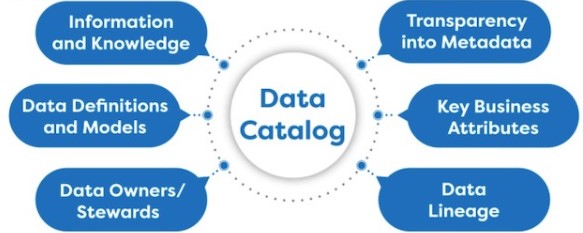
A data catalog is an organized inventory of data assets in an organization, designed to help data professionals and business users find and understand data. It serves as a critical component of modern data management and governance frameworks, facilitating better data accessibility, quality, and understanding. Below, we discuss the key components of a data catalog and provide examples of the types of information and features that are typically included.

Key Components of a Data Catalog

  1. Metadata Repository
    • Description: The core of a data catalog, containing detailed information about various data assets.
    • Examples: Metadata could include the names, types, and descriptions of datasets, data schemas, tables, and fields. It might also contain tags, annotations, and extended properties like data type, length, and nullable status.
  2. Data Dictionary
    • Description: A descriptive list of all data items in the catalog, providing context for each item.
    • Examples: For each data element, the dictionary would provide a clear definition, source of origin, usage guidelines, and information about data sensitivity and ownership.
  3. Data Lineage
    • Description: Visualization or documentation that explains where data comes from, how it moves through systems, and how it is transformed.
    • Examples: Lineage might include diagrams showing data flow from one system to another, transformations applied during data processing, and dependencies between datasets.
  4. Search and Discovery Tools
    • Description: Mechanisms that allow users to easily search for and find data across the organization.
    • Examples: Search capabilities might include keyword search, faceted search (filtering based on specific attributes), and full-text search across metadata descriptions.
  5. User Interface
    • Description: The front-end application through which users interact with the data catalog.
    • Examples: A web-based interface that provides a user-friendly dashboard to browse, search, and manage data assets.
  6. Access and Security Controls
    • Description: Features that manage who can view or edit data in the catalog.
    • Examples: Role-based access controls that limit users to certain actions based on their roles, such as read-only access for some users and edit permissions for others.
  7. Integration Capabilities
    • Description: The ability of the data catalog to integrate with other tools and systems in the data ecosystem.
    • Examples: APIs that allow integration with data management tools, BI platforms, and data lakes, enabling automated metadata updates and interoperability.
  8. Quality Metrics
    • Description: Measures and indicators related to the quality of data.
    • Examples: Data quality scores, reports on data accuracy, completeness, consistency, and timeliness.
  9. Usage Tracking and Analytics
    • Description: Tools to monitor how and by whom the data assets are accessed and used.
    • Examples: Logs and analytics that track user queries, most accessed datasets, and patterns of data usage.
  10. Collaboration Tools
    • Description: Features that facilitate collaboration among users of the data catalog.
    • Examples: Commenting capabilities, user forums, and shared workflows that allow users to discuss data, share insights, and collaborate on data governance tasks.
  11. Organisational Framework and Structure
    • The structure of an organisation itself is not typically a direct component of a data catalog. However, understanding and aligning the data catalog with the organizational structure is crucial for several reasons:
      • Role-Based Access Control: The data catalog often needs to reflect the organizational hierarchy or roles to manage permissions effectively. This involves setting up access controls that align with job roles and responsibilities, ensuring that users have appropriate access to data assets based on their position within the organization.
      • Data Stewardship and Ownership: The data catalog can include information about data stewards or owners who are typically assigned according to the organizational structure. These roles are responsible for the quality, integrity, and security of the data, and they often correspond to specific departments or business units.
      • Customization and Relevance: The data catalog can be customized to meet the specific needs of different departments or teams within the organization. For instance, marketing data might be more accessible and prominently featured for the marketing department in the catalog, while financial data might be prioritized for the finance team.
      • Collaboration and Communication: Understanding the organizational structure helps in designing the collaboration features of the data catalog. It can facilitate better communication and data sharing practices among different parts of the organization, promoting a more integrated approach to data management.
    • In essence, while the organisational structure isn’t stored as a component in the data catalog, it profoundly influences how the data catalog is structured, accessed, and utilised. The effectiveness of a data catalog often depends on how well it is tailored and integrated into the organizational framework, helping ensure that the right people have the right access to the right data at the right time.

Example of a Data Catalog in Use

Imagine a large financial institution that uses a data catalog to manage its extensive data assets. The catalog includes:

  • Metadata Repository: Contains information on thousands of datasets related to transactions, customer interactions, and compliance reports.
  • Data Dictionary: Provides definitions and usage guidelines for key financial metrics and customer demographic indicators.
  • Data Lineage: Shows the flow of transaction data through various security and compliance checks before it is used for reporting.
  • Search and Discovery Tools: Enable analysts to find and utilize specific datasets for developing insights into customer behavior and market trends.
  • Quality Metrics: Offer insights into the reliability of datasets used for critical financial forecasting.

By incorporating these components, the institution ensures that its data is well-managed, compliant with regulations, and effectively used to drive business decisions.

Tiveness of a data catalog often depends on how well it is tailored and integrated into the organisational framework, helping ensure that the right people have the right access to the right data at the right time.

Tooling

For organizations looking to implement data cataloging in cloud environments, the major cloud providers – Azure, Google Cloud Platform (GCP), and Amazon Web Services (AWS) – each offer their own specialised tools.

Here’s a comparison table that summarises the key features, descriptions, and use cases of data cataloging tools offered by Azure, Google Cloud Platform (GCP), and Amazon Web Services (AWS):

FeatureAzure PurviewGoogle Cloud Data CatalogAWS Glue Data Catalog
DescriptionA unified data governance service that automates the discovery of data and cataloging. It helps manage and govern on-premise, multi-cloud, and SaaS data.A fully managed and scalable metadata management service that enhances data discovery and understanding within Google Cloud.A central repository that stores structural and operational metadata, integrating with other AWS services.
Key Features– Automated data discovery and classification.
– Data lineage for end-to-end data insight.
– Integration with Azure services like Azure Data Lake, SQL Database, and Power BI.
– Metadata storage for Google Cloud and external data sources.
– Advanced search functionality using Google Search technology.
– Automatic schema management and discovery.
– Automatic schema discovery and generation.
– Serverless design, scales with data.
– Integration with AWS services like Amazon Athena, Amazon EMR, and Amazon Redshift.
Use CaseBest for organizations deeply integrated into the Microsoft ecosystem, seeking comprehensive governance and compliance capabilities.Ideal for businesses using multiple Google Cloud services, needing a simple, integrated approach to metadata management.Suitable for AWS-centric environments that require a robust, scalable solution for ETL jobs and data querying.
Data Catalogue Tooling Comparison

This table provides a quick overview to help you compare the offerings and decide which tool might be best suited for your organizational needs based on the environment you are most invested in.

Conclusion

Implementing a data catalogue can dramatically enhance an organisation’s ability to manage data efficiently. By following these steps and choosing the right tools, businesses can ensure their data assets are well-organised, easily accessible, and securely governed. Whether you’re part of a small team or a large enterprise, embracing these practices can lead to more informed decision-making and a competitive edge in today’s data-driven world.

Ensuring Organisational Success: The Importance of Data Quality and Master Data Management

Understanding Data Quality: The Key to Organisational Success

With data as the live blood of mdoern technology driven organisations, the quality of data can make or break a business. High-quality data ensures that organisations can make informed decisions, streamline operations, and enhance customer satisfaction. Conversely, poor data quality can lead to misinformed decisions, operational inefficiencies, and a negative impact on the bottom line. This blog post delves into what data quality is, why it’s crucial, and how to establish robust data quality systems within an organisation, including the role of Master Data Management (MDM).

What is Data Quality?

Data quality refers to the condition of data based on factors such as accuracy, completeness, consistency, reliability, and relevance. High-quality data accurately reflects the real-world constructs it is intended to model and is fit for its intended uses in operations, decision making, and planning.

Key dimensions of data quality include:

  • Accuracy: The extent to which data correctly describes the “real-world” objects it is intended to represent.
  • Completeness: Ensuring all required data is present without missing elements.
  • Consistency: Data is consistent within the same dataset and across multiple datasets.
  • Timeliness: Data is up-to-date and available when needed.
  • Reliability: Data is dependable and trusted for use in business operations.
  • Relevance: Data is useful and applicable to the context in which it is being used.
  • Accessibility: Data should be easily accessible to those who need it, without unnecessary barriers.
  • Uniqueness: Ensuring that each data element is recorded once within a dataset.

Why is Data Quality Important?

The importance of data quality cannot be overstated. Here are several reasons why it is critical for organisations:

  • Informed Decision-Making: High-quality data provides a solid foundation for making strategic business decisions. It enables organisations to analyse trends, forecast outcomes, and make data-driven decisions that drive growth and efficiency.
  • Operational Efficiency: Accurate and reliable data streamline operations by reducing errors and redundancy. This efficiency translates into cost savings and improved productivity.
  • Customer Satisfaction: Quality data ensures that customer information is correct and up-to-date, leading to better customer service and personalised experiences. It helps in building trust and loyalty among customers.
  • Regulatory Compliance: Many industries have stringent data regulations. Maintaining high data quality helps organisations comply with legal and regulatory requirements, avoiding penalties and legal issues.
  • Competitive Advantage: Organisations that leverage high-quality data can gain a competitive edge. They can identify market opportunities, optimise their strategies, and respond more swiftly to market changes.

Establishing Data Quality in an Organisation

To establish and maintain high data quality, organisations need a systematic approach. Here are steps to ensure robust data quality:

  1. Define Data Quality Standards: Establish clear definitions and standards for data quality that align with the organisation’s goals and regulatory requirements. This includes defining the dimensions of data quality and setting benchmarks for each. The measurement is mainly based on the core data quality domains: Accuracy, Timeliness, Completeness, Accessibility, Consistency, and Uniqueness.
  2. Data Governance Framework: Implement a data governance framework that includes policies, procedures, and responsibilities for managing data quality. This framework should outline how data is collected, stored, processed, and maintained.
  3. Data Quality Assessment: Regularly assess the quality of your data. Use data profiling tools to analyse datasets and identify issues related to accuracy, completeness, and consistency.
  4. Data Cleaning and Enrichment: Implement processes for cleaning and enriching data. This involves correcting errors, filling in missing values, and ensuring consistency across datasets.
  5. Automated Data Quality Tools: Utilise automated tools and software that can help in monitoring and maintaining data quality. These tools can perform tasks such as data validation, deduplication, and consistency checks.
  6. Training and Awareness: Educate employees about the importance of data quality and their role in maintaining it. Provide training on data management practices and the use of data quality tools.
  7. Continuous Improvement: Data quality is not a one-time task but an ongoing process. Continuously monitor data quality metrics, address issues as they arise, and strive for continuous improvement.
  8. Associated Processes: In addition to measuring and maintaining the core data quality domains, it’s essential to include the processes of discovering required systems and data, implementing accountability, and identifying and fixing erroneous data. These processes ensure that the data quality efforts are comprehensive and cover all aspects of data management.

The Role of Master Data Management (MDM)

Master Data Management (MDM) plays a critical role in ensuring data quality. MDM involves the creation of a single, trusted view of critical business data across the organisation. This includes data related to customers, products, suppliers, and other key entities.

The blog post Master Data Management covers this topic in detail.

Key Benefits of MDM:

  • Single Source of Truth: MDM creates a unified and consistent set of master data that serves as the authoritative source for all business operations and analytics.
  • Improved Data Quality: By standardising and consolidating data from multiple sources, MDM improves the accuracy, completeness, and consistency of data.
  • Enhanced Compliance: MDM helps organisations comply with regulatory requirements by ensuring that data is managed and governed effectively.
  • Operational Efficiency: With a single source of truth, organisations can reduce data redundancy, streamline processes, and enhance operational efficiency.
  • Better Decision-Making: Access to high-quality, reliable data from MDM supports better decision-making and strategic planning.

Implementing MDM:

  1. Define the Scope: Identify the key data domains (e.g., customer, product, supplier) that will be managed under the MDM initiative.
  2. Data Governance: Establish a data governance framework that includes policies, procedures, and roles for managing master data.
  3. Data Integration: Integrate data from various sources to create a unified master data repository.
  4. Data Quality Management: Implement processes and tools for data quality management to ensure the accuracy, completeness, and consistency of master data.
  5. Ongoing Maintenance: Continuously monitor and maintain master data to ensure it remains accurate and up-to-date.

Data Quality Tooling

To achieve high standards of data quality, organisations must leverage automation and advanced tools and technologies that streamline data processes, from ingestion to analysis. Leading cloud providers such as Azure, Google Cloud Platform (GCP), and Amazon Web Services (AWS) offer a suite of specialised tools designed to enhance data quality. These tools facilitate comprehensive data governance, seamless integration, and robust data preparation, empowering organisations to maintain clean, consistent, and actionable data. In this section, we will explore some of the key data quality tools available in Azure, GCP, and AWS, and how they contribute to effective data management.

Azure

  1. Azure Data Factory: A cloud-based data integration service that allows you to create data-driven workflows for orchestrating and automating data movement and data transformation.
  2. Azure Purview: A unified data governance solution that helps manage and govern on-premises, multicloud, and software-as-a-service (SaaS) data.
  3. Azure Data Catalogue: A fully managed cloud service that helps you discover and understand data sources in your organisation.
  4. Azure Synapse Analytics: Provides insights with an integrated analytics service to analyse large amounts of data. It includes data integration, enterprise data warehousing, and big data analytics.

Google Cloud Platform (GCP)

  1. Cloud Dataflow: A fully managed service for stream and batch processing that provides data quality features such as deduplication, enrichment, and data validation.
  2. Cloud Dataprep: An intelligent data service for visually exploring, cleaning, and preparing structured and unstructured data for analysis.
  3. BigQuery: A fully managed data warehouse that enables scalable analysis over petabytes of data. It includes features for data cleansing and validation.
  4. Google Data Studio: A data visualisation tool that allows you to create reports and dashboards from your data, making it easier to spot data quality issues.

Amazon Web Services (AWS)

  1. AWS Glue: A fully managed ETL (extract, transform, load) service that makes it easy to prepare and load data for analytics. It includes data cataloguing and integration features.
  2. Amazon Redshift: A fully managed data warehouse that includes features for data quality management, such as data validation and transformation.
  3. AWS Lake Formation: A service that makes it easy to set up a secure data lake in days. It includes features for data cataloguing, classification, and cleaning.
  4. Amazon DataBrew: A visual data preparation tool that helps you clean and normalise data without writing code.

These tools provide comprehensive capabilities for ensuring data quality across various stages of data processing, from ingestion and transformation to storage and analysis. They help organisations maintain high standards of data quality, governance, and compliance.

Conclusion

In an era where data is a pivotal asset, ensuring its quality is paramount. High-quality data empowers organisations to make better decisions, improve operational efficiency, and enhance customer satisfaction. By establishing rigorous data quality standards and processes, and leveraging Master Data Management (MDM), organisations can transform their data into a valuable strategic asset, driving growth and innovation.

Investing in data quality is not just about avoiding errors, it’s about building a foundation for success in an increasingly competitive and data-driven world.

C4 Architecture Model – Detailed Explanation

The C4 model, developed by Simon Brown, is a framework for visualizing software architecture at various levels of detail. It emphasizes the use of hierarchical diagrams to represent different aspects and views of a system, providing a comprehensive understanding for various stakeholders. The model’s name, C4, stands for Context, Containers, Components, and Code, each representing a different level of architectural abstraction.

Levels of the C4 Model

1. Context (Level 1)

Purpose: To provide a high-level overview of the system and its environment.

  • The System Context diagram is a high-level view of your software system.
  • It shows your software system as the central part, and any external systems and users that your system interacts with.
  • It should be technology agnostic, and the focus on the people and software systems instead of low-level details.
  • The intended audience for the System Context Diagram is everybody. If you can show it to non-technical people and they are able to understand it, then you know you’re on the right track.

Key Elements:

  • System: The primary system under consideration.
  • External Systems: Other systems that the primary system interacts with.
  • Users: Human actors or roles that interact with the system.

Diagram Features:

  • Scope: Shows the scope and boundaries of the system within its environment.
  • Relationships: Illustrates relationships between the system, external systems, and users.
  • Simplification: Focuses on high-level interactions, ignoring internal details.

Example: An online banking system context diagram might show:

  • The banking system itself.
  • External systems like payment gateways, credit scoring agencies, and notification services.
  • Users such as customers, bank employees, and administrators.

More Extensive Detail:

  • Primary System: Represents the main application or service being documented.
  • Boundaries: Defines the limits of what the system covers.
  • Purpose: Describes the main functionality and goals of the system.
  • External Systems: Systems outside the primary system that interact with it.
  • Dependencies: Systems that the primary system relies on for specific functionalities (e.g., third-party APIs, external databases).
  • Interdependencies: Systems that rely on the primary system (e.g., partner applications).
  • Users: Different types of users who interact with the system.
  • Roles: Specific roles that users may have, such as Admin, Customer, Support Agent.
  • Interactions: The nature of interactions users have with the system (e.g., login, data entry, report generation).

2. Containers (Level 2)

When you zoom into one software system, you get to the Container diagram.

Purpose: To break down the system into its major containers, showing their interactions.

  • Your software system is comprised of multiple running parts – containers.
  • A container can be a:
    • Web application
    • Single-page application
    • Database
    • File system
    • Object store
    • Message broker
  • You can look at a container as a deployment unit that executes code or stores data.
  • The Container diagram shows the high-level view of the software architecture and the major technology choices.
  • The Container diagram is intended for technical people inside and outside of the software development team:
    • Operations/support staff
    • Software architects
    • Developers

Key Elements:

  • Containers: Executable units or deployable artifacts (e.g., web applications, databases, microservices).
  • Interactions: Communication and data flow between containers and external systems.

Diagram Features:

  • Runtime Environment: Depicts the containers and their runtime environments.
  • Technology Choices: Shows the technology stacks and platforms used by each container.
  • Responsibilities: Describes the responsibilities of each container within the system.

Example: For the online banking system:

  • Containers could include a web application, a mobile application, a backend API, and a database.
  • The web application might interact with the backend API for business logic and the database for data storage.
  • The mobile application might use a different API optimized for mobile clients.

More Extensive Detail:

  • Web Application:
    • Technology Stack: Frontend framework (e.g., Angular, React), backend language (e.g., Node.js, Java).
    • Responsibilities: User interface, handling user requests, client-side validation.
  • Mobile Application:
    • Technology Stack: Native (e.g., Swift for iOS, Kotlin for Android) or cross-platform (e.g., React Native, Flutter).
    • Responsibilities: User interface, handling user interactions, offline capabilities.
  • Backend API:
    • Technology Stack: Server-side framework (e.g., Spring Boot, Express.js), programming language (e.g., Java, Node.js).
    • Responsibilities: Business logic, data processing, integrating with external services.
  • Database:
    • Technology Stack: Type of database (e.g., SQL, NoSQL), specific technology (e.g., PostgreSQL, MongoDB).
    • Responsibilities: Data storage, data retrieval, ensuring data consistency and integrity.

3. Components (Level 3)

Next you can zoom into an individual container to decompose it into its building blocks.

Purpose: To further decompose each container into its key components and their interactions.

  • The Component diagram show the individual components that make up a container:
    • What each of the components are
    • The technology and implementation details
  • The Component diagram is intended for software architects and developers.

Key Elements:

  • Components: Logical units within a container, such as services, modules, libraries, or APIs.
  • Interactions: How these components interact within the container.

Diagram Features:

  • Internal Structure: Shows the internal structure and organization of each container.
  • Detailed Responsibilities: Describes the roles and responsibilities of each component.
  • Interaction Details: Illustrates the detailed interaction between components.

Example: For the backend API container of the online banking system:

  • Components might include an authentication service, an account management module, a transaction processing service, and a notification handler.
  • The authentication service handles user login and security.
  • The account management module deals with account-related operations.
  • The transaction processing service manages financial transactions.
  • The notification handler sends alerts and notifications to users.

More Extensive Detail:

  • Authentication Service:
    • Responsibilities: User authentication, token generation, session management.
    • Interactions: Interfaces with the user interface components, interacts with the database for user data.
  • Account Management Module:
    • Responsibilities: Managing user accounts, updating account information, retrieving account details.
    • Interactions: Interfaces with the authentication service for user validation, interacts with the transaction processing service.
  • Transaction Processing Service:
    • Responsibilities: Handling financial transactions, validating transactions, updating account balances.
    • Interactions: Interfaces with the account management module, interacts with external payment gateways.
  • Notification Handler:
    • Responsibilities: Sending notifications (e.g., emails, SMS) to users, managing notification templates.
    • Interactions: Interfaces with the transaction processing service to send transaction alerts, interacts with external notification services.

4. Code (Level 4)

Finally, you can zoom into each component to show how it is implemented with code, typically using a UML class diagram or an ER diagram.

Purpose: To provide detailed views of the codebase, focusing on specific components or classes.

  • This level is rarely used as it goes into too much technical detail for most use cases. However, there are supplementary diagrams that can be useful to fill in missing information by showcasing:
    • Sequence of events
    • Deployment information
    • How systems interact at a higher level
  • It’s only recommended for the most important or complex components.
  • Of course, the target audience are software architects and developers.

Key Elements:

  • Classes: Individual classes, methods, or functions within a component.
  • Relationships: Detailed relationships like inheritance, composition, method calls, or data flows.

Diagram Features:

  • Detailed Code Analysis: Offers a deep dive into the code structure and logic.
  • Code-Level Relationships: Illustrates how classes and methods interact at a code level.
  • Implementation Details: Shows specific implementation details and design patterns used.

Example: For the transaction processing service in the backend API container:

  • Classes might include Transaction, TransactionProcessor, Account, and NotificationService.
  • The TransactionProcessor class might have methods for initiating, validating, and completing transactions.
  • Relationships such as TransactionProcessor calling methods on the Account class to debit or credit funds.

More Extensive Detail:

  • Transaction Class:
    • Attributes: transactionId, amount, timestamp, status.
    • Methods: validate(), execute(), rollback().
    • Responsibilities: Representing a financial transaction, ensuring data integrity.
  • TransactionProcessor Class:
    • Attributes: transactionQueue, auditLog.
    • Methods: processTransaction(transaction), validateTransaction(transaction), completeTransaction(transaction).
    • Responsibilities: Processing transactions, managing transaction flow, logging transactions.
  • Account Class:
    • Attributes: accountId, balance, accountHolder.
    • Methods: debit(amount), credit(amount), getBalance().
    • Responsibilities: Managing account data, updating balances, providing account information.
  • NotificationService Class:
    • Attributes: notificationQueue, emailTemplate, smsTemplate.
    • Methods: sendEmailNotification(recipient, message), sendSMSNotification(recipient, message).
    • Responsibilities: Sending notifications to users, managing notification templates, handling notification queues.

Benefits of the C4 Model

  • Clarity and Focus:
    • Provides a clear separation of concerns by breaking down the system into different levels of abstraction.
    • Each diagram focuses on a specific aspect, avoiding information overload.
  • Consistency and Standardization:
    • Offers a standardized approach to documenting architecture, making it easier to maintain consistency across diagrams.
    • Facilitates comparison and review of different systems using the same visual language.
  • Enhanced Communication:
    • Improves communication within development teams and with external stakeholders by providing clear, concise, and visually appealing diagrams.
    • Helps in onboarding new team members by offering an easy-to-understand representation of the system.
  • Comprehensive Documentation:
    • Ensures comprehensive documentation of the system architecture, covering different levels of detail.
    • Supports various documentation needs, from high-level overviews to detailed technical specifications.

Practical Usage of the C4 Model

  • Starting with Context:
    • Begin with a high-level context diagram to understand the system’s scope, external interactions, and primary users.
    • Use this diagram to set the stage for more detailed diagrams.
  • Defining Containers:
    • Break down the system into its major containers, showing how they interact and are deployed.
    • Highlight the technology choices and responsibilities of each container.
  • Detailing Components:
    • For each container, create a component diagram to illustrate the internal structure and interactions.
    • Focus on how functionality is divided among components and how they collaborate.
  • Exploring Code:
    • If needed, delve into the code level for specific components to provide detailed documentation and analysis.
    • Use class or sequence diagrams to show detailed code-level relationships and logic.

Example Scenario: Online Banking System

Context Diagram:

  • System: Online Banking System
  • External Systems: Payment Gateway, Credit Scoring Agency, Notification Service
  • Users: Customers, Bank Employees, Administrators
  • Description: Shows how customers interact with the banking system, which in turn interacts with external systems for payment processing, credit scoring, and notifications.

Containers Diagram:

  • Containers: Web Application, Mobile Application, Backend API, Database
  • Interactions: The web application and mobile application interact with the backend API. The backend API communicates with the database and external systems.
  • Technology Stack: The web application might be built with Angular, the mobile application with React Native, the backend API with Spring Boot, and the database with PostgreSQL.

Components Diagram:

  • Web Application Components: Authentication Service, User Dashboard, Transaction Module
  • Backend API Components: Authentication Service, Account Management Module, Transaction Processing Service, Notification Handler
  • Interactions: The Authentication Service in both the web application and backend API handles user authentication and security. The Transaction Module in the web application interacts with the Transaction Processing Service in the backend API.

Code Diagram:

  • Classes: Transaction, TransactionProcessor, Account, NotificationService
  • Methods: The TransactionProcessor class has methods for initiating, validating, and completing transactions. The NotificationService class has methods for sending notifications.
  • Relationships: The TransactionProcessor calls methods on the Account class to debit or credit funds. It also calls the NotificationService to send transaction alerts.

Conclusion

The C4 model is a powerful tool for visualising and documenting software architecture. By providing multiple levels of abstraction, it ensures that stakeholders at different levels of the organisation can understand the system. From high-level overviews to detailed code analysis, the C4 model facilitates clear communication, consistent documentation, and comprehensive understanding of complex software systems.

The Dynamics of Managing IT Staff: Non-Technical Business Leaders vs. Business-Savvy Technical Leaders

Introduction

In today’s technology driven business environment, the interplay between technical and non-technical roles is crucial for the success of many companies, particularly in industries heavily reliant on IT. As companies increasingly depend on technology, the question arises: Should IT staff be managed by non-technical people, or is it more effective to have IT professionals who possess strong business acumen?

The question of whether non-technical people should manage IT staff is a significant one, as the answer can impact the efficiency and harmony of operations within an organisation. This blog post delves into the perspectives of both IT staff and business staff to explore the feasibility and implications of such managerial structures.

Understanding the Roles

IT Staff: Typically includes roles such as software developers, data and analytics professionals, system administrators, network engineers, and technical support specialists. These individuals are experts in their fields, possessing deep technical knowledge and skills.

Business Staff (Non-Technical Managers): Includes roles like cleint account managers, project managers, team leaders, sales, marketing and human resources and other managerial positions that may not require detailed technical expertise but focus on project delivery, client interaction, and meeting business objectives.

Undeniably, the relationship between technical and non-technical roles is pivotal but there are different perspectives on who is best suited to manage technical staff which introduces specific challenges but also benefits and advantages to the business as a whole.

Perspectives on Non-Technical Management of IT Staff

IT Staff’s Point of View

Challenges:

  • Miscommunication: Technical concepts and projects often involve a language of their own. Non-technical managers may lack the vocabulary and understanding needed to effectively communicate requirements or constraints to their IT teams.
  • Mismatched Expectations: Without a strong grasp of technical challenges and what is realistically achievable, non-technical managers might set unrealistic deadlines or fail to allocate sufficient resources, leading to stress and burnout among IT staff.
  • Inadequate Advocacy: IT staff might feel that non-technical managers are less capable of advocating for the team’s needs, such as the importance of technical debt reduction, to higher management or stakeholders.

Benefits:

  • Broader Perspective: Non-technical managers might bring a fresh perspective that focuses more on the business or customer impact rather than just the technical side.
  • Enhanced Focus on Professional Development: Managers with a non-technical background might prioritize soft skills and professional growth, helping IT staff develop in areas like communication and leadership.

Business Staff’s Point of View

Advantages:

  • Focus on Business Objectives: Non-technical managers are often more attuned to the company’s business strategies and can steer IT projects to align more closely with business goals.
  • Improved Interdepartmental Communication: Managers without deep technical expertise might be better at translating technical jargon into business language, which can help bridge gaps between different departments.

Challenges:

  • Dependency on Technical Leads: Non-technical managers often have to rely heavily on technical leads or senior IT staff to make key decisions, which can create bottlenecks or delay decision-making.
  • Potential Underestimation of Technical Challenges: There’s a risk of underestimating the complexity or time requirement for IT projects, which can lead to unrealistic expectations from stakeholders.

Best Practices for Non-Technical Management of IT Teams

  • Education and Learning: Non-technical managers should commit to learning basic IT concepts and the specific technologies their team works with to improve communication and understanding.
  • Hiring and Leveraging Technical Leads: Including skilled technical leads who can act as a bridge between the IT team and the non-technical manager can mitigate many challenges.
  • Regular Feedback and Communication: Establishing strong lines of communication through regular one-on-ones and team meetings can help address issues before they escalate.
  • Respecting Expertise: Non-technical managers should respect and trust the technical assessments provided by their team, especially on the feasibility and time frames of projects.

The Role of IT Professionals with Strong Business Acumen and Commercial Awareness

The evolving landscape of IT in business settings, has begun to emphasise the importance of IT professionals who not only possess technical expertise but also a strong understanding of business processes and commercial principles – technology professionals with financial intelligence and a strong commercial awareness. Such dual-capacity professionals can bridge the gap between technical solutions and business outcomes, effectively enhancing the strategic integration of IT into broader business goals.

Advantages of IT Staff with Business Skills

  • Enhanced Strategic Alignment: IT professionals with a business acumen can better understand and anticipate the needs of the business, leading to more aligned and proactive IT strategies. They are able to design and implement technology solutions that directly support business objectives, rather than just fulfilling technical requirements.
  • Improved Project Management: When IT staff grasp the broader business impact of their projects, they can manage priorities, resources, and timelines more effectively. This capability makes them excellent project managers who can oversee complex projects that require a balance of technical and business considerations.
  • Effective Communication with Stakeholders: Communication barriers often exist between technical teams and non-technical stakeholders. IT staff who are versed in business concepts can translate complex technical information into terms that are meaningful and impactful for business decision-makers, improving decision-making processes and project outcomes.
  • Better Risk Management: Understanding the business implications of technical decisions allows IT professionals to better assess and manage risks related to cybersecurity, data integrity, and system reliability in the context of business impact. This proactive risk management is crucial in protecting the company’s assets and reputation.
  • Leadership and Influence: IT professionals with strong business insights are often seen as leaders who can guide the direction of technology within the company. Their ability to align technology with business goals gives them a powerful voice in strategic decision-making processes.

Cultivating Business Acumen within IT Teams

Organizations can support IT staff in developing business acumen through cross-training, involvement in business operations, mentorship programs, and aligning performance metrics with business outcomes.

  • Training and Development: Encouraging IT staff to participate in cross-training programs or to pursue business-related education, such as MBA courses or workshops in business strategy and finance, can enhance their understanding of business dynamics.
  • Involvement in Business Operations: Involving IT staff in business meetings, strategy sessions, and decision-making processes (appart form being essential to be succesful in technology delivery alignment) can provide them with a deeper insight into the business, enhancing their ability to contribute effectively.
  • Mentorship Programs: Pairing IT professionals with business leaders within the organization as mentors can facilitate the transfer of business knowledge and strategic thinking skills.
  • Performance Metrics: Aligning performance metrics for IT staff with business outcomes, rather than just technical outputs, encourages them to focus on how their roles and projects impact the broader business objectives.

The Dynamics of Managing IT Staff: Non-Technical Managers vs. Tech-Savvy Business Leaders

In the intricate web of modern business operations, the relationship between technical and non-technical roles is crucial. This article explores both scenarios, highlighting the perspectives of IT and business staff, along with the advantages of having tech-savvy business leaders within IT.

Conclusion

Whether non-technical managers or IT staff with strong business acumen should lead IT teams depends largely on their ability to understand and integrate technical and business perspectives. Effective management in IT requires a balance of technical knowledge and business insight, and the right approach can differ based on the specific context of the organisation. By fostering understanding and communication between technical and non-technical realms, companies can harness the full potential of their IT capabilities to support business objectives.

IT professionals who develop business acumen and commercial awareness can significantly enhance the value they bring to their organisations. By understanding both the technical and business sides of the equation, they are uniquely positioned to drive innovations that are both technologically sound and commercially viable. This synergy not only improves the effectiveness of IT enablement but also elevates the strategic role of IT within the organisation.

A good book on the topic: What the numbers mean” by Renier Botha

As more and more companies become increasingly digitally driven, the trend is that smart companies are investing more in their digital strategies and the conversion of technology innovation into revenue earning products and services.

Leading businesses in this technology age, will be the technologist, the IT leaders of today is becoming the business leaders of the future.

This book provides a concise overview of the most important financial functions, statements, terms, practical application guidelines and performance measures.

You’ll learn the value that commercial awareness and financial intelligence bring to setting strategy, increasing productivity and efficiency and how it can support you in making more effective decisions.

Navigating the Labyrinth: A Comprehensive Guide to Data Management for Executives

As a consultant focussed to helping organisations maximise their efficiency and strategic advantage, I cannot overstate the importance of effective data management. “Navigating the Labyrinth: An Executive Guide to Data Management” by Laura Sebastian-Coleman is an invaluable resource that provides a detailed and insightful roadmap for executives to understand the complexities and significance of data management within their organisations. The book’s guidance is essential for ensuring that your data is accurate, accessible, and actionable, thus enabling better decision-making and organisational efficiency. Here’s a summary of the key points covered in this highly recommended book covering core data management practices.

Introduction

Sebastian-Coleman begins by highlighting the importance of data in the modern business environment. She compares data to physical or financial assets, underscoring that it requires proper management to extract its full value.

Part I: The Case for Data Management

The book makes a compelling case for the necessity of data management. Poor data quality can lead to significant business issues, including faulty decision-making, inefficiencies, and increased costs. Conversely, effective data management provides a competitive edge by enabling more precise analytics and insights.

Part II: Foundations of Data Management

The foundational concepts and principles of data management are thoroughly explained. Key topics include:

  • Data Governance: Establishing policies, procedures, and standards to ensure data quality and compliance.
  • Data Quality: Ensuring the accuracy, completeness, reliability, and timeliness of data.
  • Metadata Management: Managing data about data to improve its usability and understanding.
  • Master Data Management (MDM): Creating a single source of truth for key business entities like customers, products, and employees.

Part III: Implementing Data Management

Sebastian-Coleman offers practical advice on implementing data management practices within an organisation. She stresses the importance of having a clear strategy, aligning data management efforts with business objectives, and securing executive sponsorship. The book also covers:

  • Data Management Frameworks: Structured approaches to implementing data management.
  • Technology and Tools: Leveraging software and tools to support data management activities.
  • Change Management: Ensuring that data management initiatives are adopted and sustained across the organisation.

Part IV: Measuring Data Management Success

Measuring and monitoring the success of data management initiatives is crucial. The author introduces various metrics and KPIs (Key Performance Indicators) that organisations can use to assess data quality, governance, and overall data management effectiveness.

Part V: Case Studies and Examples

The book includes real-world case studies and examples to illustrate how different organisations have successfully implemented data management practices. These examples provide practical insights and lessons learned, demonstrating the tangible benefits of effective data management.

Conclusion

Sebastian-Coleman concludes by reiterating the importance of data management as a strategic priority for organisations. While the journey to effective data management can be complex and challenging, the rewards in terms of improved decision-making, efficiency, and competitive advantage make it a worthwhile endeavour.

Key Takeaways for Executives

  1. Strategic Importance: Data management is essential for leveraging data as a strategic asset.
  2. Foundational Elements: Effective data management relies on strong governance, quality, and metadata practices.
  3. Implementation: A clear strategy, proper tools, and change management are crucial for successful data management initiatives.
  4. Measurement: Regular assessment through metrics and KPIs is necessary to ensure the effectiveness of data management.
  5. Real-world Application: Learning from case studies and practical examples can guide organisations in their data management efforts.

In conclusion, “Navigating the Labyrinth” is an essential guide that equips executives and data professionals with the knowledge and tools needed to manage data effectively. By following the structured and strategic data management practices outlined in the book, your organisation can unlock the full potential of its data, leading to improved business outcomes. I highly recommend this book for any executive looking to understand and improve their data management capabilities and to better understand the importance of data management within their organisation, as it provides essential insights and practical guidance to navigate the complexities of this crucial field.

AI Missteps: Navigating the Pitfalls of Business Integration

AI technology has been at the forefront of innovation, offering businesses unprecedented opportunities for efficiency, customer engagement, and data analysis. However, the road to integrating AI into business operations is fraught with challenges, and not every endeavour ends in success. In this blog post, we will explore various instances where AI has gone or done wrong in the business context, delve into the reasons for these failures, and provide real examples to illustrate these points.

1. Misalignment with Business Objectives

One common mistake businesses make is pursuing AI projects without a clear alignment to their core objectives or strategic goals. This misalignment often leads to investing in technology that, whilst impressive, does not contribute to the company’s bottom line or operational efficiencies.

Example: IBM Watson Health

IBM Watson Health is a notable example. Launched with the promise of revolutionising the healthcare industry by applying AI to massive data sets, it struggled to meet expectations. Despite the technological prowess of Watson, the initiative faced challenges in providing actionable insights for healthcare providers, partly due to the complexity and variability of medical data. IBM’s ambitious project encountered difficulties in scaling and delivering tangible results to justify its investment, leading to the sale of Watson Health assets in 2021.

2. Lack of Data Infrastructure

AI systems require vast amounts of data to learn and make informed decisions. Businesses often underestimate the need for a robust data infrastructure, including quality data collection, storage, and processing capabilities. Without this foundation, AI projects can falter, producing inaccurate results or failing to operate at scale.

Example: Amazon’s AI Recruitment Tool

Amazon developed an AI recruitment tool intended to streamline the hiring process by evaluating CVs. However, the project was abandoned when the AI exhibited bias against female candidates. The AI had been trained on CVs submitted to the company over a 10-year period, most of which came from men, reflecting the tech industry’s gender imbalance. This led to the AI penalising CVs that included words like “women’s” or indicated attendance at a women’s college, showcasing how poor data handling can derail AI projects.

3. Ethical and Bias Concerns

AI systems can inadvertently perpetuate or even exacerbate biases present in their training data, leading to ethical concerns and public backlash. Businesses often struggle with implementing AI in a way that is both ethical and unbiased, particularly in sensitive applications like hiring, law enforcement, and credit scoring.

Example: COMPAS in the US Justice System

The Correctional Offender Management Profiling for Alternative Sanctions (COMPAS) is an AI system used by US courts to assess the likelihood of a defendant reoffending. Studies and investigations have revealed that COMPAS predictions are biased against African-American individuals, leading to higher risk scores compared to their white counterparts, independent of actual recidivism rates. This has sparked significant controversy and debate about the use of AI in critical decision-making processes.

4. Technological Overreach

Sometimes, businesses overestimate the current capabilities of AI technology, leading to projects that are doomed from the outset due to technological limitations. Overambitious projects can drain resources, lead to public embarrassment, and erode stakeholder trust.

Example: Facebook’s Trending Topics

Facebook’s attempt to automate its Trending Topics feature with AI led to the spread of fake news and inappropriate content. The AI was supposed to curate trending news without human bias, but it lacked the nuanced understanding of context and veracity, leading to widespread criticism and the eventual discontinuation of the feature.

Conclusion

The path to successfully integrating AI into business operations is complex and challenging. The examples mentioned highlight the importance of aligning AI projects with business objectives, ensuring robust data infrastructure, addressing ethical and bias concerns, and maintaining realistic expectations of technological capabilities. Businesses that approach AI with a strategic, informed, and ethical mindset are more likely to navigate these challenges successfully, leveraging AI to drive genuine innovation and growth.

Making your digital business resilient using AI

To staying relevant in a swift-moving digital marketplace, resilience isn’t merely about survival, it’s about flourishing. Artificial Intelligence (AI) stands at the vanguard of empowering businesses not only to navigate the complex tapestry of supply and demand but also to derive insights and foster innovation in ways previously unthinkable. Let’s explore how AI can transform your digital business into a resilient, future-proof entity.

Navigating Supply vs. Demand with AI

Balancing supply with demand is a perennial challenge for any business. Excess supply leads to wastage and increased costs, while insufficient supply can result in missed opportunities and dissatisfied customers. AI, with its predictive analytics capabilities, offers a potent tool for forecasting demand with great accuracy. By analysing vast quantities of data, AI algorithms can predict fluctuations in demand based on seasonal trends, market dynamics, and even consumer behaviour on social media. This predictive prowess allows businesses to optimise their supply chains, ensuring they have the appropriate amount of product available at the right time, thereby maximising efficiency and customer satisfaction.

Deriving Robust and Scientific Insights

In the era of information, data is plentiful, but deriving meaningful insights from this data poses a significant challenge. AI and machine learning algorithms excel at sifting through large data sets to identify patterns, trends, and correlations that might not be apparent to human analysts. This capability enables businesses to make decisions based on robust and scientific insights rather than intuition or guesswork. For instance, AI can help identify which customer segments are most profitable, which products are likely to become bestsellers, and even predict churn rates. These insights are invaluable for strategic planning and can significantly enhance a company’s competitive edge.

Balancing Innovation with Business as Usual (BAU)

While innovation is crucial for growth and staying ahead of the competition, businesses must also maintain their BAU activities. AI can play a pivotal role in striking this balance. On one hand, AI-driven automation can take over repetitive, time-consuming tasks, freeing up human resources to focus on more strategic, innovative projects. On the other hand, AI itself can be a source of innovation, enabling businesses to explore new products, services, and business models. For example, AI can help create personalised customer experiences, develop new delivery methods, or even identify untapped markets.

Fostering a Culture of Innovation

For AI to truly make an impact, it’s insufficient for it to be merely a tool that is used—it needs to be part of the company’s DNA. This means fostering a culture of innovation where experimentation is encouraged, failure is seen as a learning opportunity, and employees at all levels are empowered to think creatively. Access to innovation should not be confined to a select few; instead, an environment where everyone is encouraged to contribute ideas can lead to breakthroughs that significantly enhance business resilience.

In conclusion, making your digital business resilient in today’s volatile market requires a strategic embrace of AI. By leveraging AI to balance supply and demand, derive scientific insights, balance innovation with BAU, and foster a culture of innovation, businesses can not only withstand the challenges of today but also thrive in the uncertainties of tomorrow. The future belongs to those who are prepared to innovate, adapt, and lead with intelligence. AI is not just a tool in this journey; it is a transformative force that can redefine what it means to be resilient.

CEO’s guide to digital transformation : Building AI-readiness. 

Digital Transformation remains a necessity which, based on the pace of technology evolution, becomes a continuous improvement exercise. In the blog post “The Digital Transformation Necessity” we covered digital transformation as the benefit and value that technology can enable within the business through technology innovation including IT buzz words like: Cloud Service, Automation, Dev-Ops, Artificial Intelligence (AI) inclusinve of Machine Learning & Data Science, Internet of Things (IoT), Big Data, Data Mining and Block Chain. Amongst these AI has emerged as a crucial factor for future success. However, the path to integrating AI into a company’s operations can be fraught with challenges. This post aims to guide CEOs to an understanding of how to navigate these waters: from recognising where AI can be beneficial, to understanding its limitations, and ultimately, building a solid foundation for AI readiness.

How and Where AI Can Help

AI has the potential to transform businesses across all sectors by enhancing efficiency, driving innovation, and creating new opportunities for growth. Here are some areas where AI can be particularly beneficial:

  1. Data Analysis and Insights: AI excels at processing vast amounts of data quickly, uncovering patterns, and generating insights that humans may overlook. This capability is invaluable in fields like market research, financial analysis, and customer behaviour studies.
  2. Support Strategy & Operations: Optimised data driven decision making can be a supporting pillar for strategy and operational execution.
  3. Automation of Routine Tasks: Tasks that are repetitive and time-consuming can often be automated with AI, freeing up human resources for more strategic activities. This includes everything from customer service chatbots to automated quality control in manufacturing and the use of use of roboticsc and Robotic Process Automation (RPA).
  4. Enhancing Customer Experience: AI can provide personalised experiences to customers by analysing their preferences and behaviours. Recommendations on social media, streaming services and targeted marketing are prime examples.
  5. Innovation in Products and Services: By leveraging AI, companies can develop new products and services or enhance existing ones. For instance, AI can enable smarter home devices, advanced health diagnostics, and more efficient energy management systems.

Where Not to Use AI

While AI has broad applications, it’s not a panacea. Understanding where not to deploy AI is crucial for effective digital transformation:

  1. Complex Decision-Making Involving Human Emotions: AI, although making strong strides towards causel awareness, struggles with tasks that require empathy, moral judgement, and understanding of nuanced human emotions. Areas involving ethical decisions or complex human interactions are better left to humans.
  2. Highly Creative Tasks: While AI can assist in the creative process, the generation of original ideas, art, and narratives that deeply resonate with human experiences is still a predominantly human domain.
  3. When Data Privacy is a Concern: AI systems require data to learn and make decisions. In scenarios where data privacy regulations or ethical considerations are paramount, companies should proceed with caution.
  4. Ethical and Legislative restrictions: AI requires access to data which are heavily protected by legislation

How to Know When AI is Not Needed

Implementing AI without a clear purpose can lead to wasted resources and potential backlash. Here are indicators that AI might not be necessary:

  1. When Traditional Methods Suffice: If a problem can be efficiently solved with existing methods or technology, introducing AI might complicate processes without adding value.
  2. Lack of Quality Data: AI models require large amounts of high-quality data. Without this, AI initiatives are likely to fail or produce unreliable outcomes.
  3. Unclear ROI: If the potential return on investment (ROI) from implementing AI is uncertain or the costs outweigh the benefits, it’s wise to reconsider.

Building AI-Readiness

Building AI readiness involves more than just investing in technology, it requires a holistic approach:

  1. Fostering a Data-Driven Culture: Encourage decision-making based on data across all levels of the organisation. This involves training employees to interpret data and making data easily accessible.
  2. Investing in Talent and Training: Having the right talent is critical for AI initiatives. Invest in hiring AI specialists and provide training for existing staff to develop AI literacy.
  3. Developing a Robust IT Infrastructure: A reliable IT infrastructure is the backbone of successful AI implementation. This includes secure data storage, high-performance computing resources, and scalable cloud services.
  4. Ethical and Regulatory Compliance: Ensure that your AI strategies align with ethical standards and comply with all relevant regulations. This includes transparency in how AI systems make decisions and safeguarding customer privacy.
  5. Strategic Partnerships: Collaborate with technology providers, research institutions, and other businesses to stay at the forefront of AI developments.

For CEOs, the journey towards AI integration is not just about adopting new technology but transforming their organisations to thrive in the digital age. By understanding where AI can add value, recognising its limitations, and building a solid foundation for AI readiness, companies can harness the full potential of this transformative technology.

You have been doing your insights wrong: The Imperative Shift to Causal AI

We stand on the brink of a paradigm shift. Traditional AI, with its heavy reliance on correlation-based insights, has undeniably transformed industries, driving efficiencies and fostering innovations that once seemed beyond our reach. However, as we delve deeper into AI’s potential, a critical realisation dawns upon us: we have been doing AI wrong. The next frontier? Causal AI. This approach, focused on understanding the ‘why’ behind data, is not just another advancement; it’s a necessary evolution. Let’s explore why adopting Causal AI today is better late than never.

The Limitation of Correlation in AI

Traditional AI models thrive on correlation, mining vast datasets to identify patterns and predict outcomes. While powerful, this approach has a fundamental flaw: correlation does not always/necessarily imply causation. These models often fail to grasp the underlying causal relationships that drive the patterns they detect, leading to inaccuracies or misguided decisions when the context shifts. Imagine a healthcare AI predicting patient outcomes without understanding the causal factors behind the symptoms. The result? Potentially life-threatening recommendations based on superficial associations. This underscores the necessity for extensive timelines in the meticulous examination and understanding of pharmaceuticals during clinical trials. Historically, the process has spanned years to solidify the comprehension of cause-and-effect relationships. Businesses, constrained by time, cannot afford such protracted periods. Causal AI emerges as a pivotal solution in contexts where A/B testing is impractical, offering significant enhancements to A/B testing and experimentation methodologies within organisations.

The Rise of Causal AI: Understanding the ‘Why’

Causal AI represents a paradigm shift, focusing on understanding the causal relationships between variables rather than mere correlations. It seeks to answer not just what is likely to happen, but why it might happen, enabling more robust predictions, insights, and decisions. By incorporating causality, AI can model complex systems more accurately, anticipate changes in dynamics, and provide explanations for its predictions, fostering trust and transparency.

Four key Advantages of Causal AI

1. Improved Decision-Making: Causal AI provides a deeper understanding of the mechanisms driving outcomes, enabling better-informed decisions. In business, for instance, it can reveal not just which factors are associated with success, but which ones cause it, guiding strategic planning and resource allocation. For example It can help in scenarios where A/B testing is not feasible or can enhance the robustness of A/B testing.

2. Enhanced Predictive Power: By understanding causality, AI models can make more accurate predictions under varying conditions, including scenarios they haven’t encountered before. This is invaluable in dynamic environments where external factors frequently change.

3. Accountability and Ethics: Causal AI’s ability to explain its reasoning addresses the “black box” critique of traditional AI, enhancing accountability and facilitating ethical AI implementations. This is critical in sectors like healthcare and criminal justice, where decisions have profound impacts on lives.

4. Preparedness for Unseen Challenges: Causal models can better anticipate the outcomes of interventions, a feature especially useful in policy-making, strategy and crisis management. They can simulate “what-if” scenarios, helping leaders prepare for and mitigate potential future crises.

Making the Shift: Why It’s Better Late Than Never

The transition to Causal AI requires a re-evaluation of existing data practices, an investment in new technologies, and a commitment to developing or acquiring new expertise. While daunting, the benefits far outweigh the costs. Adopting Causal AI is not just about keeping pace with technological advances; it’s about redefining what’s possible, making decisions with a deeper understanding of causality, enhancing the intelligence of machine learning models by integrating business acumen, nuances of business operations and contextual understanding behind the data, and ultimately achieving outcomes that are more ethical, effective, and aligned with our objectives.

Conclusion

As we stand at this crossroads, the choice is clear: continue down the path of correlation-based AI, with its limitations and missed opportunities, or embrace the future with Causal AI. The shift towards understanding the ‘why’—not just the ‘what’—is imperative. It’s a journey that demands our immediate attention and effort, promising a future where AI’s potential is not just realised but expanded in ways we have yet to imagine. The adoption of Causal AI today is not just advisable; it’s essential. Better late than never.

AI in practice for the enterprise: Navigating the Path to Success

In just a few years, Artificial Intelligence (AI) has emerged as a transformative force for businesses across sectors. Its potential to drive innovation, efficiency, and competitive advantage is undeniable. Yet, many enterprises find themselves grappling with the challenge of harnessing AI’s full potential. This blog post delves into the critical aspects that can set businesses up for success with AI, exploring the common pitfalls, the risks of staying on the sidelines, and the foundational pillars necessary for AI readiness.

Why Many Enterprises Struggle to Use AI Effectively

Despite the buzz around AI, a significant number of enterprises struggle to integrate it effectively into their operations. The reasons are manifold:

  • Lack of Clear Strategy: Many organisations dive into AI without a strategic framework, leading to disjointed efforts and initiatives that fail to align with business objectives.
  • Data Challenges: AI thrives on data. However, issues with data quality, accessibility, and integration can severely limit AI’s effectiveness. Many enterprises are sitting on vast amounts of unstructured data, which remains untapped due to these challenges.
  • Skill Gap: There’s a notable skill gap in the market. The demand for AI expertise far outweighs the supply, leaving many enterprises scrambling to build or acquire the necessary talent.
  • Cultural Resistance: Implementing AI often requires significant cultural and operational shifts. Resistance to change can stifle innovation and slow down AI adoption.

The Risks of Ignoring AI

In the digital age, failing to leverage AI can leave enterprises at a significant disadvantage. Here are some of the critical opportunities missed:

  • Lost Competitive Edge: Competitors who effectively utilise AI can gain a significant advantage in terms of efficiency, customer insights, and innovation, leaving others behind.
  • Inefficiency: Without AI, businesses may continue to rely on manual, time-consuming processes, leading to higher costs and lower productivity.
  • Missed Insights: AI has the power to unlock deep insights from data. Without it, enterprises miss out on opportunities to make informed decisions and anticipate market trends.

Pillars of Data and AI Readiness

To harness the power of AI, enterprises need to build on the following foundational pillars:

  • Data Governance and Quality: Establishing strong data governance practices ensures that data is accurate, accessible, and secure. Quality data is the lifeblood of effective AI systems.
  • Strategic Alignment: AI initiatives must be closely aligned with business goals and integrated into the broader digital transformation strategy.
  • Talent and Culture: Building or acquiring AI expertise is crucial. Equally important is fostering a culture that embraces change, innovation, and continuous learning.
  • Technology Infrastructure: A robust and scalable technology infrastructure, including cloud computing and data analytics platforms, is essential to support AI initiatives.

Best Practices for AI Success

To maximise the benefits of AI, enterprises should consider the following best practices:

  • Start with a Pilot: Begin with manageable, high-impact projects. This approach allows for learning and adjustments before scaling up.
  • Focus on Data Quality: Invest in systems and processes to clean, organise, and enrich data. High-quality data is essential for training effective AI models.
  • Embrace Collaboration: AI success often requires collaboration across departments and with external partners. This approach ensures a diversity of skills and perspectives.
  • Continuous Learning and Adaptation: The AI landscape is constantly evolving. Enterprises must commit to ongoing learning and adaptation to stay ahead.

Conclusion

While integrating AI into enterprise operations presents challenges, the potential rewards are too significant to ignore. By understanding the common pitfalls, the risks of inaction, and the foundational pillars of AI readiness, businesses can set themselves up for success. Embracing best practices will not only facilitate the effective use of AI but also ensure that enterprises remain competitive in the digital era.

Embracing the “Think Product” Mindset in Software Development

In the realm of software development, shifting from a project-centric to a product-oriented mindset can be a game-changer for both developers and businesses alike. This paradigm, often encapsulated in the phrase “think product,” urges teams to design and build software solutions with the flexibility, scalability, and vision of a product intended for a broad audience. This approach not only enhances the software’s utility and longevity but also maximises the economies of scale, making the development process more efficient and cost-effective in the long run.

The Core of “Think Product”

The essence of “think product” lies in the anticipation of future needs and the creation of solutions that are not just tailored to immediate requirements but are adaptable, scalable, and capable of evolving over time. This involves embracing best practices such as reusability, modularity, service orientation, generality, client-agnosticism, and parameter-driven design.

Reusability: The Building Blocks of Efficiency

Reusability is about creating software components that can be easily repurposed across different projects or parts of the same project. This approach minimises duplication of effort, fosters consistency, and speeds up the development process. By focusing on reusability, developers can construct a library of components, functions, and services that serve as a versatile toolkit for building new solutions more swiftly and efficiently.

Modularity: Independence and Integration

Modularity involves designing software in self-contained units or modules that can operate independently but can be integrated seamlessly to form a larger system. This facilitates easier maintenance, upgrades, and scalability, as changes can be made to individual modules without impacting the entire system. Modularity also enables parallel development, where different teams work on separate modules simultaneously, thus accelerating the development cycle.

Service Orientation: Flexibility and Scalability

Service-oriented architecture (SOA) emphasises creating software solutions as a collection of services that communicate and operate together. This approach enhances flexibility, as services can be reused, replaced, or scaled independently of each other. It also promotes interoperability, making it easier to integrate with external systems and services.

Generality: Beyond Specific Use Cases

Designing software with generality in mind means creating solutions that are not overly specialised to a specific task or client. Instead, they are versatile enough to accommodate a range of requirements. This broader applicability maximises the potential user base and market relevance of the software, contributing to its longevity and success.

Client Agnosticism: Serving a Diverse Audience

A client-agnostic approach ensures that software solutions are compatible across various platforms, devices, and user environments. This universality makes the product accessible to a wider audience, enhancing its marketability and usability across different contexts.

Parameter-Driven Design: Flexibility at Its Core

Parameter-driven design allows software behaviour and features to be customised through external parameters or configuration files, rather than hardcoded values. This adaptability enables the software to cater to diverse user needs and scenarios without requiring significant code changes, making it more versatile and responsive to market demands.

Cultivating the “Think Product” Mindset

Adopting a “think product” mindset necessitates a cultural shift within the development team and the broader organisation. It involves embracing long-term thinking, prioritising quality and scalability, and being open to feedback and adaptation. This mindset encourages continuous improvement, innovation, and a focus on delivering value to a wide range of users.

By integrating best practices like reusability, modularity, service orientation, generality, client agnosticism, and parameter-driven design, developers can create software solutions that stand the test of time. These practices not only contribute to the creation of superior products but also foster a development ecosystem that is more sustainable, efficient, and prepared to meet the challenges of an ever-evolving technological landscape.

The Importance of Standardisation and Consistency in Software Development Environments

Ensuring that software development teams have appropriate hardware and software specifications as part of their tooling is crucial for businesses for several reasons:

  1. Standardisation and Consistency: Beyond individual productivity and innovation, establishing standardised hardware, software and work practice specifications across the development team is pivotal for ensuring consistency, interoperability, and efficient collaboration. Standardisation can help in creating a unified development environment where team members can seamlessly work together, share resources, and maintain a consistent workflow. This is particularly important in large or distributed teams, where differences in tooling can lead to compatibility issues, hinder communication, and slow down the development process. Moreover, standardising tools and platforms simplifies training and onboarding for new team members, allowing them to quickly become productive. It also eases the management of licences, updates, and security patches, ensuring that the entire team is working with the most up-to-date and secure software versions. By fostering a standardised development environment, businesses can minimise technical discrepancies that often lead to inefficiencies, reduce the overhead associated with managing diverse systems, and ensure that their development practices are aligned with industry standards and best practices. This strategic approach not only enhances operational efficiency but also contributes to the overall quality and security of the software products developed.
  2. Efficiency and Productivity: Proper tools tailored to the project’s needs can significantly boost the productivity of a development team. Faster and more powerful hardware can reduce compile times, speed up test runs, and facilitate the use of complex development environments or virtualisation technologies, directly impacting the speed at which new features or products can be developed and released.
  3. Quality and Reliability: The right software tools and hardware can enhance the quality and reliability of the software being developed. This includes tools for version control, continuous integration/continuous deployment (CI/CD), automated testing, and code quality analysis. Such tools help in identifying and fixing bugs early, ensuring code quality, and facilitating smoother deployment processes, leading to more reliable and stable products.
  4. Innovation and Competitive Edge: Access to the latest technology and cutting-edge tools can empower developers to explore innovative solutions and stay ahead of the competition. This could be particularly important in fields that are rapidly evolving, such as artificial intelligence (AI), where the latest hardware accelerations (e.g., GPUs for machine learning tasks) can make a significant difference in the feasibility and speed of developing new algorithms or services.
  5. Scalability and Flexibility: As businesses grow, their software needs evolve. Having scalable and flexible tooling can make it easier to adapt to changing requirements without significant disruptions. This could involve cloud-based development environments that can be easily scaled up or down, or software that supports modular and service-oriented architectures.
  6. Talent Attraction and Retention: Developers often prefer to work with modern, efficient tools and technologies. Providing your team with such resources can be a significant factor in attracting and retaining top talent. Skilled developers are more likely to join and stay with a company that invests in its technology stack and cares about the productivity and satisfaction of its employees.
  7. Cost Efficiency: While investing in high-quality hardware and software might seem costly upfront, it can lead to significant cost savings in the long run. Improved efficiency and productivity mean faster time-to-market, which can lead to higher revenues. Additionally, reducing the incidence of bugs and downtime can decrease the cost associated with fixing issues post-release. Also, utilising cloud services and virtualisation can optimise resource usage and reduce the need for physical hardware upgrades.
  8. Security: Appropriate tooling includes software that helps ensure the security of the development process and the final product. This includes tools for secure coding practices, vulnerability scanning, and secure access to development environments. Investing in such tools can help prevent security breaches, which can be incredibly costly in terms of both finances and reputation.

In conclusion, the appropriate hardware and software specifications are not just a matter of having the right tools for the job; they’re about creating an environment that fosters productivity, innovation, and quality, all of which are key to maintaining a competitive edge and ensuring long-term business success.

Building Bridges in Tech: The Power of Practice Communities in Data Engineering, Data Science, and BI Analytics

Technology team practice communities, for example those within a Data Specialist organisation focused on Business Intelligence (BI) Analytics & Reporting, Data Engineering and Data Science, play a pivotal role in fostering innovation, collaboration, and operational excellence within organisations. These communities, often comprised of professionals from various departments and teams, unite under the common goal of enhancing the company’s technological capabilities and outputs. Let’s delve into the purpose of these communities and the value they bring to a data specialist services provider.

Community Unity

At the heart of practice communities is the principle of unity. By bringing together professionals from data engineering, data science, and BI Analytics & Reporting, companies can foster a sense of belonging and shared purpose. This unity is crucial for cultivating trust, facilitating open communication and collaboration across different teams, breaking down silos that often hinder progress and innovation. When team members feel connected to a larger community, they are more likely to contribute positively and share knowledge, leading to a more cohesive and productive work environment.

Standardisation

Standardisation is another key benefit of establishing technology team practice communities. With professionals from diverse backgrounds and areas of expertise coming together, companies can develop and implement standardised practices, tools, and methodologies. This standardisation ensures consistency in work processes, data management, and reporting, significantly improving efficiency and reducing errors. By establishing best practices across data engineering, data science, and BI Analytics & Reporting, companies can ensure that their technology initiatives are scalable and sustainable.

Collaboration

Collaboration is at the core of technology team practice communities. These communities provide a safe platform for professionals to share ideas, challenges, and solutions, fostering an environment of continuous learning and improvement. Through regular meetings, workshops, and forums, members can collaborate on projects, explore new technologies, and share insights that can lead to breakthrough innovations. This collaborative culture not only accelerates problem-solving but also promotes a more dynamic and agile approach to technology development.

Mission to Build Centres of Excellence

The ultimate goal of technology team practice communities is to build centres of excellence within the company. These centres serve as hubs of expertise and innovation, driving forward the company’s technology agenda. By concentrating knowledge, skills, and resources, companies can create a competitive edge, staying ahead of technological trends and developments. Centres of excellence also act as incubators for talent development, nurturing the next generation of technology leaders who can drive the company’s success.

Value to the Company

The value of establishing technology team practice communities is multifaceted. Beyond enhancing collaboration and standardisation, these communities contribute to a company’s ability to innovate and adapt to change. They enable faster decision-making, improve the quality of technology outputs, and increase employee engagement and satisfaction. Furthermore, by fostering a culture of excellence and continuous improvement, companies can better meet customer needs and stay competitive in an ever-evolving technological landscape.

In conclusion, technology team practice communities, encompassing data engineering, data science, and BI Analytics & Reporting, are essential for companies looking to harness the full potential of their technology teams. Through community unity, standardisation, collaboration, and a mission to build centres of excellence, companies can achieve operational excellence, drive innovation, and secure a competitive advantage in the marketplace. These communities not only elevate the company’s technological capabilities but also cultivate a culture of learning, growth, and shared success.

AI Revolution 2023: Transforming Businesses with Cutting-Edge Innovations and Ethical Challenges


Introduction

The blog post Artificial Intelligence Capabilities written in Nov’18 discusses the significance and capabilities of AI in the modern business world. It emphasises that AI’s real business value is often overshadowed by hype, unrealistic expectations, and concerns about machine control.

The post clarifies AI’s objectives and capabilities, defining AI simply as using computers to perform tasks typically requiring human intelligence. It outlines AI’s three main goals: capturing information, determining what is happening, and understanding why it is happening. I used an example of a lion chase to illustrate how humans and machines process information differently, highlighting that machines, despite their advancements, still struggle with understanding context as humans do (causality).

Additionally, it lists eight AI capabilities in use at the time: Image Recognition, Speech Recognition, Data Search, Data Patterns, Language Understanding, Thought/Decision Process, Prediction, and Understanding.

Each capability, like Image Recognition and Speech Recognition, is explained in terms of its function and technological requirements. The post emphasises that while machines have made significant progress, they still have limitations compared to human reasoning and understanding.

The landscape of artificial intelligence (AI) capabilities has evolved significantly since that earlier focus on objectives like capturing information, determining events, and understanding causality. In 2023, AI has reached impressive technical capabilities and has become deeply integrated into various aspects of everyday life and business operations.

2023 AI technical capabilities and daily use examples

Generative AI’s Breakout: AI in 2023 has been marked by the explosive growth of generative AI tools. Companies like OpenAI have revolutionised how businesses approach tasks that traditionally required human creativity and intelligence. Advanced models like GPT-4 and DALL-E 2, which have demonstrated remarkable humanlike outputs, significantly impacting the way businesses operate in the generation of unique content, design graphics, or even code software more efficiently, thereby reducing operational costs and enhancing productivity. For example, organisations are using generative AI in product and service development, risk and supply chain management, and other business functions. This shift has allowed companies to optimise product development cycles, enhance existing products, and create new AI-based products, leading to increased revenue and innovative business models​​​​.

AI in Data Management and Analytics: The use of AI in data management and analytics has revolutionised the way businesses approach data-driven decision-making. AI algorithms and machine learning models are adept at processing large volumes of data rapidly, identifying patterns and insights that would be challenging for humans to discern. These technologies enable predictive analytics, where AI models can forecast trends and outcomes based on historical data. In customer analytics, AI is used to segment customers, predict buying behaviours, and personalise marketing efforts. Financial institutions leverage AI in risk assessment and fraud detection, analysing transaction patterns to identify anomalies that may indicate fraudulent activities. In healthcare, AI-driven data analytics assists in diagnosing diseases, predicting patient outcomes, and optimizing treatment plans. In the realm of supply chain and logistics, AI algorithms forecast demand, optimise inventory levels, and improve delivery routes. The integration of AI with big data technologies also enhances real-time analytics, allowing businesses to respond swiftly to changing market dynamics. Moreover, AI contributes to the democratisation of data analytics by providing tools that require less technical expertise. Platforms like Microsoft Fabric and Power BI, integrate AI (Microsoft Copilot) to enable users to generate insights through natural language queries, making data analytics more accessible across organizational levels. Microsoft Fabric, with its integration of Azure AI, represents a significant advancement in the realm of AI and analytics. This innovative platform, as of 2023, offers a unified solution for enterprises, covering a range of functions from data movement to data warehousing, data science, real-time analytics, and business intelligence. The integration with Azure AI services, especially the Azure OpenAI Service, enables the deployment of powerful language models, which facilitates a variety of AI applications such as data cleansing, content generation, summarisation, and natural language to code translation, auto-completion and quality assurance. Overall, AI in data management covering data engineering, analytics and science not only improves efficiency and accuracy but also drives innovation and strategic planning in various industries.

Regulatory Developments: The AI industry is experiencing increased regulation. For example, the U.S. has introduced guidelines to protect personal data and limit surveillance, and the EU is working on the AI Act, potentially the world’s first broad standard for AI regulation. These developments are likely to make AI systems more transparent, with an emphasis on disclosing data usage, limitations, and biases​​.

AI in Recruitment and Equality: AI is increasingly being used in recruitment processes. LinkedIn, a leader in professional networking and recruitment, has been utilising AI to enhance their recruitment processes. AI algorithms help filter through vast numbers of applications to identify the most suitable candidates. However, there’s a growing concern about potential discrimination, as AI systems can inherit biases from their training data, leading to a push for more impartial data sets and algorithms. The UK’s Equality Act 2010 and the General Data Protection Regulation in Europe regulate such automated decision-making, emphasising the importance of unbiased and fair AI use in recruitment​​. Moreover, LinkedIn has been working on AI systems that aim to minimise bias in recruitment, ensuring a more equitable and diverse hiring process.

AI in Healthcare: AI’s application in healthcare is growing rapidly. It ranges from analysing patient records to aiding in drug discovery and patient monitoring through to the resource demand and supply management of healthcare professionals. The global market for AI in healthcare, valued at approximately $11 billion in 2021, is expected to rise significantly. This includes using AI for real-time data acquisition from patient health records and in medical robotics, underscoring the need for safeguards to protect sensitive data​​. Companies like Google Health and IBM Watson Heath are utilizing AI to revolutionise healthcare with AI algorithms being used to analyse medical images for diagnostics, predict patient outcomes, and assist in drug discovery. Google’s AI system for diabetic retinopathy screening has shown to be effective in identifying patients at risk, thereby aiding in early intervention and treatment.

AI for Face Recognition: AI-powered face recognition technology is widely used, from banking apps to public surveillance. Face recognition technology is widely used in various applications, from unlocking smartphones to enhancing security systems. Apple’s Face ID technology, used in iPhones and iPads, is an example of AI-powered face recognition providing both convenience and security to users. Similarly, banks and financial institutions are using face recognition for secure customer authentication in mobile banking applications. However, this has raised concerns about privacy and fundamental rights. The EU’s forthcoming AI Act is expected to regulate such technologies, highlighting the importance of responsible and ethical AI usage​​.

AI’s Role in Scientific Progress: AI models like PaLM and Nvidia’s reinforcement learning agents have been used to accelerate scientific developments, from controlling hydrogen fusion to improving chip designs. This showcases AI’s potential to not only aid in commercial ventures but also to contribute significantly to scientific and technological advancements​​. AI’s impact on scientific progress can be seen in projects like AlphaFold by DeepMind (a subsidiary of Alphabet, Google’s parent company). AlphaFold’s AI-driven predictions of protein structures have significant implications for drug discovery and understanding diseases at a molecular level, potentially revolutionising medical research.

AI in Retail and E-commerce: Amazon’s use of AI in its recommendation system exemplifies how AI can drive sales and improve customer experience. The system analyses customer data to provide personalized product recommendations, significantly enhancing the shopping experience and increasing sales.

AI’s ambition of causality – the 3rd AI goal

AI’s ambition to evolve towards understanding and establishing causality represents a significant leap beyond its current capabilities in pattern recognition and prediction. Causality, unlike mere correlation, involves understanding the underlying reasons why events occur, which is a complex challenge for AI. This ambition stems from the need to make more informed and reliable decisions based on AI analyses.

For instance, in healthcare, an AI that understands causality could distinguish between factors that contribute to a disease and those that are merely associated with it. This would lead to more effective treatments and preventative strategies. In business and economics, AI capable of causal inference could revolutionise decision-making processes by accurately predicting the outcomes of various strategies, taking into account complex, interdependent factors. This would allow companies to make more strategic and effective decisions.

The journey towards AI understanding causality involves developing algorithms that can not only process vast amounts of data but also recognise and interpret the intricate web of cause-and-effect relationships within that data. This is a significant challenge because it requires the AI to have a more nuanced understanding of the world, akin to human-like reasoning. The development of such AI would mark a significant milestone in the field, bridging the gap between artificial intelligence and human-like intelligence – then it will know why the lion is chasing and why the human is running away – achieving the third AI goal.

In conclusion

AI in 2023 is not only more advanced but also more embedded in various sectors than ever before. Its rapid development brings both significant opportunities and challenges. The examples highlight the diverse applications of AI across different industries, demonstrating its potential to drive innovation, optimise operations, and create value in various business contexts.

For organisations, leveraging AI means balancing innovation with responsible use, ensuring ethical standards, and staying ahead in a rapidly evolving regulatory landscape. The potential for AI to transform industries, drive growth, and contribute to scientific progress is immense, but it requires a careful and informed approach to harness these benefits effectively.

The development of AI capable of understanding causality represents a significant milestone, as it would enable AI to have a nuanced, human-like understanding of complex cause-and-effect relationships, fundamentally enhancing its decision-making capabilities.

Looking forward to see where this technology will be in 2028…?

Case Study: Renier Botha’s Leadership in Rivus’ Digital Strategy Implementation

Introduction

Rivus Fleet Solutions, a leading provider of fleet management services, embarked on a significant digital transformation to enhance its operational efficiencies and customer services. Renier Botha, a seasoned IT executive, played a crucial role in this transformation, focusing on three major areas: upgrading key database infrastructure, leading innovative product development, and managing critical transition projects. This case study explores how Botha’s efforts have propelled Rivus towards a more digital future.

Background

Renier Botha, known for his expertise in digital strategy and IT management, took on the challenge of steering Rivus through multiple complex digital initiatives. The scope of his work covered:

  1. Migration of Oracle 19c enterprise database,
  2. Development of a cross-platform mobile application, and
  3. Management of the service transition project with BT & Openreach.

Oracle 19c Enterprise Upgrade Migration

Objective: Upgrade the core database systems to Oracle 19c to ensure enhanced performance, improved security, and extended support.

Approach:
Botha employed a robust programme management approach to handle the complexities of upgrading the enterprise-wide database system. This involved:

  • Detailed planning and risk management to mitigate potential downtime,
  • Coordination with internal IT teams and external Oracle consultants,
  • Comprehensive testing phases to ensure system compatibility and performance stability.

Outcome:
The successful migration to Oracle 19c provided Rivus with a more robust and secure database environment, enabling better data management and scalability options for future needs. This foundational upgrade was crucial for supporting other digital initiatives within the company.

Cross-Platform Mobile Application Development

Objective: Develop a mobile application to facilitate seamless digital interaction between Rivus and its customers, enhancing service accessibility and efficiency.

Approach:
Botha led the product development team through:

  • Identifying key user requirements by engaging with stakeholders,
  • Adopting agile methodologies for rapid and iterative development,
  • Ensuring cross-platform compatibility to maximise user reach.

Outcome:
The new mobile application promissed to significantly transformed how customers interacted with Rivus, providing them with the ability to manage fleet services directly from their devices. This not only improved customer satisfaction but also streamlined Rivus’ operational processes.

BT & Openreach Exit Project Management

Objective: Manage the transition of fleet technology services of BT & Openreach ensuring minimal service disruption.

Approach:
This project was complex, involving intricate service agreements and technical dependencies. Botha’s strategy included:

  • Detailed project planning and timeline management,
  • Negotiations and coordination with multiple stakeholders from BT, Openreach, and internal teams,
  • Focusing on knowledge transfer and system integrations.

Outcome:
The project was completed efficiently, allowing Rivus to transition control of critical services succesfully and without business disruption.

Conclusion

Renier Botha’s strategic leadership in these projects has been pivotal for Rivus. By effectively managing the Oracle 19c upgrade, he laid a solid technological foundation. The development of the cross-platform mobile app under his guidance directly contributed to improved customer engagement and operational efficiency. Finally, his adept handling of the BT & Openreach transition solidified Rivus’ operational independence. Collectively, these achievements represent a significant step forward in Rivus’ digital strategy, demonstrating Botha’s profound impact on the company’s technological advancement.

Data is the currency of technology

Many people don’t realize that data acts as a sort of digital currency. They tend to imagine paper dollars or online monetary transfers when they think of currency. Data fits the bill—no pun intended—because you can use it to exchange economic value.

In today’s world, data is the most valuable asset that a company can possess. It is the fuel that powers the digital economy and drives innovation. The amount of data generated every day is staggering, and it is growing at an exponential rate. According to a report by IBM, 90% of the data in the world today has been created in the last two years. This explosion of data has led to a new era where data is considered as valuable as gold or oil. There is an escalating awareness of the value within data, and more specifically the practical knowledge and insights that result from transformative data engineering, analytics and data science.

In the field of business, data-driven insights have assumed a pivotal role in informing and directing decision-making processes – the data-driven organisation. Data is the lifeblood of technology companies. It is what enables them to create new products and services, optimise their operations, and make better decisions. Companies irrespective of size, that adopt the discipline of data science, undertake a transformative process enabling them to capitalise on data value to enhance operational efficiencies, understand customer behaviour, identify new market opportunities to gain an competitive advantage.

  1. Innovation: One of the most significant benefits of data is its ability to drive innovation. Companies that have access to large amounts of data can use it to develop new products and services that meet the needs of their customers. For example, Netflix uses data to personalise its recommendations for each user based on their viewing history. This has helped Netflix become one of the most successful streaming services in the world.
  2. Science and Education: In the domain of scientific enquiry and education, data science is the principal catalyst for the revelation of profound universal truths and knowledge.
  3. Operational optimisation & Efficiency: Data can also be used to optimise operations and improve efficiency. For example, companies can use data to identify inefficiencies in their supply chain and make improvements that reduce costs and increase productivity. Walmart uses data to optimise its supply chain by tracking inventory levels in real-time. This has helped Walmart reduce costs and improve its bottom line.
  4. Data-driven decisions: Another benefit of data is its ability to improve decision-making. Companies that have access to large amounts of data can use it to make better decisions based on facts rather than intuition. For example, Google uses data to make decisions about which features to add or remove from its products. This has helped Google create products that are more user-friendly and meet the needs of its customers.
  5. Artificial Intelligence: Data is the fuel that powers AI. According to Forbes, AI systems can access and analyse large datasets so, if businesses are to take advantage of the explosion of data as the fuel powering digital transformation, they’re going to need to artificial intelligence and machine learning to help transform data effectively, so they can deliver experiences people have never seen before or imagined. Data is a crucial component of AI and organizations should focus on building a strong foundation for their data in order to extract maximum value from AI. Generative AI is a type of artificial intelligence that can learn from existing artifacts to generate new, realistic artifacts that reflect the characteristics of the training data but don’t repeat it. It can produce a variety of novel content, such as images, video, music, speech, text, software code and product designs. According to McKinsey, the value of generative data lies within your data – properly prepared, it is the most important thing your organisation brings to AI and where your organisation should spend the most time to extract the most value.
  6. Commercial success: The language of business is money and business success is measured in the commercial achievement on the organisation. Data is an essential component in measuring business success. Business success metrics are quantifiable measurements that business leaders track to see if their strategies are working effectively. Success metrics are also known as key performance indicators (KPIs). There is no one-size-fits-all success metric, most teams use several different metrics to determine success. Establishing and measuring success metrics is an important skill for business leaders to develop so that they can monitor and evaluate their team’s performance. Data can be used to create a business score card, an informed report that allows businesses to analyse and compare information that they can use to measure their success. An effective data strategy allows businesses to focus on specific data points, which represent processes that impact the company’s success (critical success criteria). The three main financial statements that businesses can use to measure their success are the income statement, balance sheet, and cash flow statement. The income statement measures the profitability of a business during a certain time period by showing its profits and losses. Operational data combined/aligned with the content of the financial statements enable business to measure, in monetary terms, the key success indicators to drive business success.
  7. Strategic efficacy: Data can also be used to assess strategy efficacy. If a business is implementing a new strategy or tactic, it can use data to gauge whether or not it’s working. If the business measured its metrics before implementing a new strategy, it can use those metrics as a benchmark. As it implements the new strategy, it can compare those new metrics to its benchmark and see how they stack up.

In conclusion, data is an essential component in business success. Data transformed into meaningful and practical knowledge and insights resulting from transformative data engineering, analytics and data science is a key business enabler. This makes data a currency for the technology driven business. Companies that can harness the power of data are the ones that will succeed in today’s digital economy.
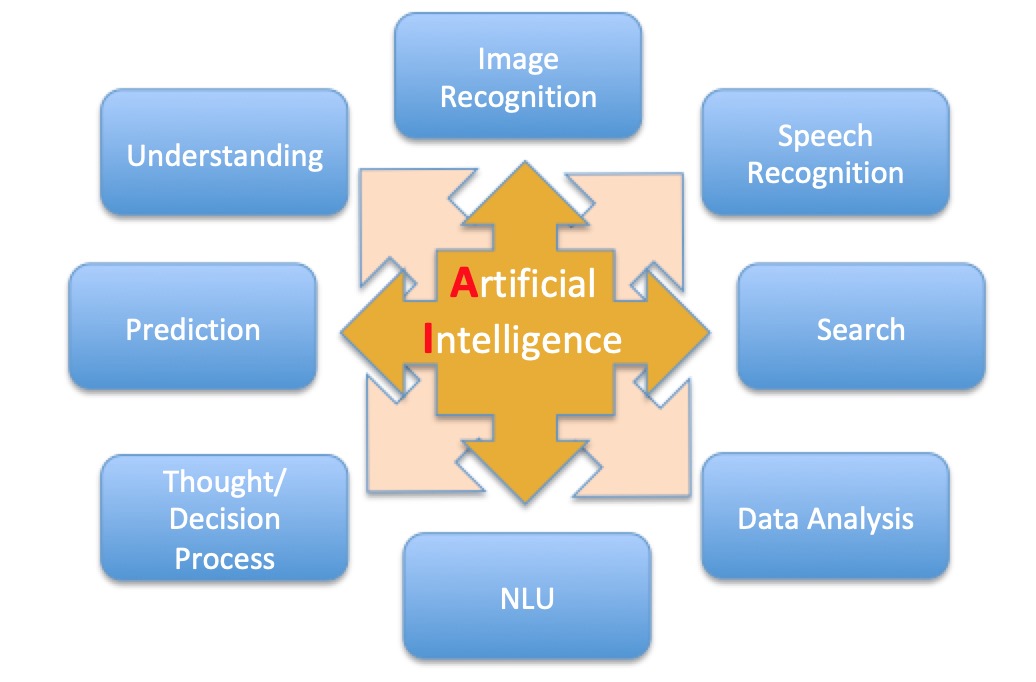
Data insight brings understanding that leads to actions driving continuous improvement, resulting in business success.

Also read…

Business Driven IT KPIs

Embracing Fractional Technology Leadership Roles: Unlocking Business Potential

In today’s fast-paced and ever-evolving business landscape, companies are increasingly turning to fractional technology leadership roles to drive innovation, streamline operations, and maintain a competitive edge. But what exactly are these roles, and what benefits do they offer to organisations? Let’s explore.

What are Fractional Technology Leadership Roles?

Fractional technology leadership roles involve hiring experienced tech leaders on a part-time or contract basis to fulfil critical leadership functions without the full-time commitment. These roles can include fractional Chief Information Officers (CIOs), Chief Technology Officers (CTOs), and other senior IT positions. Unlike traditional full-time roles, fractional leaders provide their expertise for a fraction of the time and cost, offering flexibility and specialised knowledge tailored to specific business needs.

Benefits of Fractional Technology Leadership

  1. Cost-Effective Expertise
    • Budget-Friendly: Small and medium-sized enterprises (SMEs) often struggle with the high costs associated with full-time C-suite executives. Fractional leaders provide top-tier expertise at a fraction of the cost, making it financially feasible for businesses to access high-level strategic guidance.
    • No Long-Term Commitment: Companies can engage fractional leaders on a project basis or for a specified period, eliminating the financial burden of long-term employment contracts, benefits, and bonuses.
  2. Flexibility and Scalability
    • Adaptable Engagements: Businesses can scale the involvement of fractional leaders up or down based on project demands, budget constraints, and strategic priorities. This flexibility ensures that companies can adapt to changing market conditions without the rigidity of permanent roles.
    • Specialised Skills: Organisations can tap into a diverse pool of talent with specialised skills tailored to their current needs, whether it’s implementing a new technology, managing a digital transformation, or enhancing cybersecurity measures.
  3. Accelerated Innovation and Growth
    • Fresh Perspectives: Fractional leaders bring fresh ideas and perspectives from their diverse experiences across industries. This can foster innovation and help companies identify new opportunities for growth and improvement.
    • Immediate Impact: With their extensive experience, fractional technology leaders can hit the ground running, delivering immediate value and accelerating the pace of technology-driven initiatives.
  4. Reduced Risk
    • Expert Guidance: Navigating the complexities of technology implementation and digital transformation can be daunting. Fractional leaders provide expert guidance, reducing the risk of costly mistakes and ensuring that projects are executed efficiently and effectively.
    • Crisis Management: In times of crisis or technological disruption, fractional leaders can step in to provide stability, strategic direction, and crisis management expertise, helping businesses navigate challenges with confidence.
  5. Focus on Core Business Functions
    • Delegate Complex Tasks: By entrusting technology leadership to fractional experts, business owners and executives can focus on core business functions and strategic goals, knowing that their technology initiatives are in capable hands.
    • Enhanced Productivity: With dedicated fractional leaders managing tech projects, internal teams can operate more efficiently, leading to enhanced productivity and overall business performance.

Unlock Your Business Potential with renierbotha Ltd

Are you ready to drive innovation, streamline operations, and maintain a competitive edge in today’s dynamic business environment? Look no further than renierbotha Ltd for exceptional fractional technology leadership services.

At renierbotha Ltd, we specialise in providing top-tier technology leaders on a part-time or contract basis, delivering the expertise you need without the full-time commitment. Our experienced fractional CIOs, CTOs, and senior IT leaders bring fresh perspectives, specialised skills, and immediate impact to your organisation, ensuring your technology initiatives are executed efficiently and effectively.

Why Choose renierbotha Ltd?

  • Cost-Effective Expertise: Access high-level strategic guidance at a fraction of the cost.
  • Flexibility and Scalability: Adapt our services to your project demands and strategic priorities.
  • Accelerated Innovation: Benefit from fresh ideas and rapid implementation of technology-driven initiatives.
  • Reduced Risk: Navigate the complexities of technology with expert guidance and crisis management.
  • Enhanced Focus: Delegate complex tech tasks to us, allowing you to concentrate on your core business functions.

Take the Next Step

Don’t let the challenges of technology hold your business back. Partner with renierbotha Ltd and unlock the full potential of fractional technology leadership. Contact us today to discuss how our tailored services can help your organisation thrive.

Contact Us Now

Conclusion

Fractional technology leadership roles offer a compelling solution for businesses seeking high-level expertise without the financial and logistical challenges of full-time executive hires. By leveraging the flexibility, specialised skills, and strategic insights of fractional leaders, companies can drive innovation, accelerate growth, and navigate the complexities of today’s technology landscape with confidence.

Embrace the future of technology leadership and unlock your business’s potential with fractional technology roles.

Experience the future of technology leadership with renierbotha Ltd. Let’s drive your business forward together!

Case Study: Renier Botha’s Transformational Work at BCA and Constellation Automotive Group

Overview

Renier Botha’s tenure at BCA (British Car Auctions), part of the Constellation Automotive Group, highlights his strategic and operational expertise in leveraging technology to enhance business functions. His initiatives have significantly influenced BCA’s financial and operational landscapes, aligning them with modern e-commerce and compliance frameworks.

Project Objectives

The overarching goal of Botha’s projects at BCA was to enable the financial teams with innovative and integrated cloud-based tools that automate and streamline financial operations and e-commerce. Key objectives included:

  • Enhancing expense management through cloud platforms.
  • Integrating diverse IT estates into a unified service offering.
  • Ensuring compliance with new tax legislation.
  • Streamlining vehicle documentation processes.
  • Improving operational efficiency through technology alignment.

Key Projects and Achievements

1. Deployment of Chrome River Expense Management

Botha managed the enterprise-wide deployment of the Chrome River Expense Management cloud platform. This initiative provided BCA’s financial teams with advanced tools to automate expense reporting and approvals, thereby reducing manual interventions and enhancing operational efficiency.

2. System Integration Strategy with MuleSoft

Under Botha’s guidance, BCA adopted MuleSoft as their API management, automation, and integration toolset. This critical move facilitated the integration of previously disconnected IT estates, creating a cohesive and efficient environment that supported robust service delivery across the organisation.

3. Making Tax Digital Project

Botha played a pivotal role in managing the delivery of the Making Tax Digital project, a key legislative requirement. His leadership ensured that BCA’s systems were fully compliant with new tax regulations, thereby avoiding potential legal and financial repercussions.

4. Vehicle Life Cycle Services Dashboard Project

Another significant achievement was the delivery of the Vehicle Life Cycle Services Dashboard replacement project. This was part of the preparation for an extensive ERP migration aimed at modernising the core operational systems.

5. Integration with VW Financial Services

Botha successfully implemented the integration of VW Financial Services and BCA finance estates. This project enabled the secure automation of vehicle documentation exchanges, which is crucial for maintaining data integrity and streamlining vehicle sales processes.

6. Portfolio Management Office Development

Finally, Botha supported the growth and maturity of BCA’s Portfolio Management Office. He introduced new working practices that aligned technology delivery with business operations, optimising efficiency and effectiveness across projects.

Impact and Outcomes

The initiatives led by Botha have transformed BCA’s financial and operational frameworks. Key impacts include:

  • Increased Operational Efficiency: Automated systems reduced manual workload, allowing staff to focus on more strategic tasks.
  • Enhanced Compliance and Security: Projects like Making Tax Digital and the integration with VW Financial Services ensured that BCA stayed compliant with legislative mandates and enhanced data security.
  • Improved Decision-Making: The new systems and integrations provided BCA’s management with real-time data and analytics, supporting better decision-making processes.

Conclusion

Renier Botha’s strategic vision and execution at BCA have significantly boosted the company’s technological capabilities, aligning them with modern business practices and legislative requirements. His work not only streamlined operations but also set a foundation for future innovations and improvements, demonstrating the critical role of integrated technology solutions in today’s automotive and financial sectors.

Case Study: Renier Botha’s Leadership in the Winning NHS Professionals Tender Bid for Beyond

Introduction

Renier Botha, a seasoned technology leader, spearheaded Beyond’s successful response to a Request for Proposal (RFP) from NHS Professionals (NHSP) for outsourced data services. This case study examines the strategic approaches, leadership, and technical expertise employed by Botha and his team in securing this critical project.

Context and Challenge

NHSP sought to outsource its data engineering services to enhance data science and reporting capabilities. The challenge was multifaceted, requiring a deep understanding of NHSP’s current data operations, stringent data governance and GDPR compliance, and the integration of advanced cloud technologies.

Strategy and Implementation

1. Stakeholder Engagement:
Botha led the initial stages by conducting key stakeholder interviews and meetings to gauge the current state and expectations. This hands-on approach ensured alignment between NHSP’s needs and Beyond’s proposal.

2. Gap Analysis:
By understanding the existing Data Engineering function, Botha identified inefficiencies and gaps. His team offered strategic recommendations for process improvements, directly addressing NHSP’s operational challenges.

3. Infrastructure Assessment:
Botha’s review of the current data processing systems uncovered dependencies that could impact future scalability and integration. This was crucial for designing a solution that was not only compliant with current standards but also adaptable to future technological advancements.

4. Data Governance Review:
Given the critical importance of data security in healthcare, Botha prioritised a thorough review of data governance practices, ensuring all proposed solutions were GDPR compliant.

5. Future State Architecture:
Utilising cloud technologies, Botha proposed a high-level architecture and design for NHSP’s future data estate. This included a blend of strategic and BAU tasks aimed at transforming NHSP’s data handling capabilities.

6. Team and Service Delivery Design:
Botha defined the composition of the Data Engineering team necessary to deliver on NHSP’s objectives. This included detailed job descriptions and a clear division of responsibilities, ensuring a match between team capabilities and service delivery goals.

7. KPIs and Service Levels:
Critical to the project’s success was the definition of KPIs and proposed service levels. Botha’s strategic vision included measurable outcomes to track progress and ensure accountability.

8. RFP Response and Roadmap:
Botha’s provided a detailed response to the RFP, outlining a clear and actionable data engineering roadmap for the first two years of service, broken down into six-month intervals. This detailed planning demonstrated a strong understanding of NHSP’s needs and showcased Beyond’s commitment to service excellence.

9. Technical Support:
Beyond also supported NHSP with system architecture queries, ensuring that all technical aspects were addressed comprehensively.

Results and Impact

Under Botha’s leadership, Beyond won the NHSP contract by effectively demonstrating a profound understanding of the project requirements and crafting a tailored, forward-thinking solution. The strategic approach not only aligned with NHSP’s operational goals but also positioned them for future scalability and innovation.

Conclusion

Botha’s expertise in data engineering and project management was pivotal in Beyond’s success. By meticulously planning and executing each phase of the RFP response, he not only led his team to a significant business win but also contributed to the advancement of data management practices within NHSP. This project serves as a benchmark in effective stakeholder management, strategic planning, and technical execution in the field of data engineering services.

Digital Strategy & the Board

Digital Strategy is a plan that uses digital resources to achieve one or more objectives. With Technology changing at a very fast pace, Organisations have many digital resources to choose from.

Digital Resources can be defined as materials that have been conceived and created digitally or by converting analogue materials to a digital format for example:

  • Utilising the internet for commerce (web-shops, customer service portals, etc…)
  • Secure working for all employees from anywhere via VPN
  • Digital documents, scanning paper copies and submitting online correspondence to customers i.e. online statements and payment facilities via customer portals
  • Digital resources via Knowledge Base, Wiki, Intranet site and Websites
  • Automation – use digital solutions like robotics and AI to complete repetitive tasks more efficiently
  • Utilising social media for market awareness, customer engagement and advertising

A Digital Strategy is typically a plan that helps the business to transform it’s course of action, operations and activities into a digital nature by utilising available applicable technology.

Many directors know that digital strategies, and there related spending, can be difficult to understand. From blockchain and virtual reality to artificial intelligence, no business can afford to fall behind with the latest technological innovations that are redefining how businesses connect with their customers, employees, and myriad of other stakeholders. Read this post that covers “The Digital Transformation Necessity“…

As a Board Director what are the crucial factors that the Board should consider when building a digital strategy?

Here are five critical aspects, in more detail, and the crucial things to be conscious of when planning a digital transformation strategy as part of a board.

Stakeholders

A stakeholder, by definition, is usually an individual or a group impacted by the outcome of a project. While in previous roles you may have worked with stakeholders at senior management level, when planning a digital strategy, it’s important to remember that your stakeholders could also include customers, employees or anyone that could be affected by a new digital initiative.

Digital strategies work from the top down, if you’re looking to roll out a digital transformation project, you need to consider how it will affect every person inside or outside of your business.

Investment

Digital transformation almost always involves capital and technology-intensive investments. It is not uncommon for promising transformation projects to stall because of a lack of funds, or due to technology infrastructure that cannot cope with increased demands.

Starting a budgeting process right at the start of planning a digital transformation project is essential. This helps ensure that the scope of a project does not grow beyond the capabilities of an enterprise to fund it. A realistic budgeting and funding approach is crucial because a stalled transformation project creates disruption, confusion and brings little value to a business.

Communications

From the get-go, any digital strategy, regardless of size, should be founded on clear and constant communication between all stakeholders involved in a project. This ensures everyone is in the loop on the focus of the project, their specific roles within it, and which processes are going to change. In addition, continuous communication helps build a spirit of shared success and ensures everyone has the information they need to address any frustrations or challenges that may occur as time passes. When developing an effective communication plan, Ian’s advice is to hardly mention the word digital at all.

The best digital strategies explain what digital can do and also explain the outcomes. Successful communication around digital strategies uses language that everyone can understand, plain English, no buzzwords, no crazy acronyms and no silly speak.

Also read “Effective Leadership Communication” which covers how you can communicate effectively to ensure that everyone in the team are on the same page.

Technology

While there are many technologies currently seeing rapid growth and adoption, it doesn’t necessarily mean that you will need to implement all of them in your business. The choice of technology depends upon the process you are trying to optimise. Technology, as a matter of fact, is just a means to support your idea and the associated business processes.

People often get overwhelmed with modern technologies and try to implement all of them in their current business processes. The focus should be on finding the technologies that rightly fit your business objectives and implement them effectively.

Never assume that rolling out a piece of technology is just going to work. When embarking on a digital project, deciding what not to do is just as important as deciding what to do. Look at whether a piece of technology can actually add value to your business or if it’s just a passing trend. Each digital project should hence be presented to Board with a business case that outlines the business value, return on investment and the associated benefits and risks, for board consideration.

Measurement

No strategy is complete without a goal and a Digital Strategy is no different. To measure the effectiveness of your plan you will need to set up some key performance indicators (KPIs). These metrics will demonstrate the effectiveness of the plan and will also guide your future decision making. You will need to set up smart goals that have clear achievable figures along with a timeline. These goals will guide and optimise the entire execution of a transformation project and ensure that the team does not lose focus.

Any decent strategy should say where we are now, where we want to get to and how we’re going to get there, but also, more importantly, how are we going to monitor and track against our progress.

Also Read

Humans are smarter than any type of AI – for now…

Despite all the technological advancements, can machines today only achieve the first two of the thee AI objectives. AI capabilities are at least equalling and in most cases exceeding humans in capturing information and determining what is happening. When it comes to real understanding, machines still fall short – but for how long?

In the blog post, “Artificial Intelligence Capabilities”, we explored the three objectives of AI and its capabilities – to recap:

AI-8Capabilities

  • Capturing Information
    • 1. Image Recognition
    • 2. Speech Recognition
    • 3. Data Search
    • 4. Data Patterns
  • Determine what is happening
    • 5. Language Understanding
    • 6. Thought/Decision Process
    • 7. Prediction
  • Understand why it is happening
    • 8. Understanding

To execute these capabilities, AI are leaning heavily on three technology areas (enablers):

  • Data collecting devices i.e. mobile phones and IoT
  • Processing Power
  • Storage

AI rely on large amounts of data that requires storage and powerful processors to analyse data and calculate results through complex argorythms – resources that were very expensive until recent years. With technology enhancements in machine computing power following Moore’s law and the now mainstream availability of cloud computing & storage, in conjunction with the fact that there are more mobile phones on the planet than humans, really enabled AI to come to forefront of innovation.

AI_takes_over

AI at the forefront of Innovation – Here is some interesting facts to demonstrate this point:

  • Amazon uses machine learning systems to recommend products to customers on its e-commerce platform. AI help’s it determine which deals to offer and when, and influences many aspects of the business.
  • A PwC report estimates that AI will contribute $15.7 trillion to the global economy by 2030. AI will make products and services better, and it’s expected to boost GDP’S globally.
  • The self-driving car market is expected to be worth $127 billion worldwide by 2027. AI is at the heart of the technology to make this happen. NVIDIA created its own computer — the Drive PX Pegasus — specifically for driverless cars and powered by the company’s AI and GPUs. It starts shipping this year, and 25 automakers and tech companies have already placed orders.
  • Scientists believed that we are still years away from AI being able to win at the ancient game of Go, regarded as the most complex human game. Recently Google’s AI recently beat the world’s best Go player.

To date computer hardware followed a growth curve called Moore’s law, in which power and efficiency double every two years. Combine this with recent improvements in software algorithms and the growth is becoming more explosive. Some researchers expect artificial intelligence systems to be only one-tenth as smart as a human by 2035. Things may start to get a little awkward around 2060 when AI could start performing nearly all the tasks humans do — and doing them much better.

Using AI in your business

Artificial intelligence has so much potential across so many different industries, it can be hard for businesses, looking to profit from it, to know where to start.

By understanding the AI capabilities, this technology becomes more accessible to businesses who want to benefit from it. With this knowledge you can now take the next step:

  1. Knowing your business, identify the right AI capabilities to enhance and/or transform your business operations, products and/or services.
  2. Look at what AI vendors with a critical eye, understanding what AI capabilities are actually offered within their products.
  3. Understand the limitations of AI and be realistic if alternative solutions won’t be a better fit.

In a future post we’ll explore some real life examples of the AI capabilities in action.


Also read:

Case Study: Renier Botha’s Role as Non-Executive Director at KAMOHA Tech

Introduction

In this case study, we examine the strategic contributions of Renier Botha, a Non-Executive Director (NED) at KAMOHA Tech, a company specialising in Robotic Process Automation (RPA) and IT Service Management (ITSM). Botha’s role involves guiding the company through corporate governance and product development to establish KAMOHA Tech as a standalone IT service provider.

Background of KAMOHA Tech

KAMOHA Tech operates within the rapidly evolving IT industry, focusing on RPA and ITSM solutions. These technologies are crucial for businesses looking to automate processes and enhance their IT service offerings, thereby increasing efficiency and reducing costs.

Role and Responsibilities of Renier Botha

Renier Botha joined KAMOHA Tech with a wealth of experience in IT governance and service management. His primary responsibilities as a NED include:

  • Corporate Governance: Ensuring that KAMOHA Tech adheres to the highest standards of corporate governance, which is essential for the company’s credibility and long-term success. Botha’s oversight ensures that the company’s operations are transparent and align with shareholder interests.
  • Strategic Guidance on Product and Service Development: Botha plays a pivotal role in shaping the strategic direction of KAMOHA Tech’s product offerings in RPA and ITSM. His expertise helps in identifying market needs and aligning the product development to meet these demands.
  • Mentoring and Leadership: As a NED, Botha also provides mentoring to the executive team, offering insights and advice drawn from his extensive experience in the IT industry. His guidance is crucial in steering the company through phases of growth and innovation.

Impact of Botha’s Involvement

Botha’s contributions have had a significant impact on KAMOHA Tech’s trajectory:

  • Enhanced Governance Practices: Under Botha’s guidance, KAMOHA Tech has strengthened its governance frameworks, which has improved investor confidence and positioned the company as a reliable partner in the IT industry.
  • Product Innovation and Market Fit: Botha’s strategic insights into the RPA and ITSM sectors have enabled KAMOHA Tech to innovate and develop products that are well-suited to the market’s needs. This has been crucial in distinguishing KAMOHA Tech from competitors and capturing a larger market share.
  • Sustainable Growth: Botha’s emphasis on sustainable practices and long-term strategic planning has positioned KAMOHA Tech for sustainable growth. His influence ensures that the company does not only focus on immediate gains but also invests in long-term capabilities.

Challenges and Solutions

Despite the successes, Botha’s role involves navigating challenges such as:

  • Adapting to Market Changes: The IT industry is known for its rapid changes. Botha’s experience has been instrumental in helping the company quickly adapt to these changes by foreseeing industry trends and aligning the company’s strategy accordingly.
  • Balancing Innovation with Governance: Ensuring that innovation does not come at the expense of governance has been a delicate balance. Botha has managed this by setting clear boundaries and ensuring that all innovations adhere to established governance protocols.

Conclusion

Renier Botha’s role as a Non-Executive Director at KAMOHA Tech highlights the importance of experienced leadership in navigating the complexities of the IT sector. His strategic guidance in corporate governance and product development has not only enhanced KAMOHA Tech’s market position but has also set a foundation for its future growth. As KAMOHA Tech continues to evolve, Botha’s ongoing influence will be pivotal in maintaining its trajectory towards becoming an independent and robust IT service provider.

Cyber-Security 101 for Business Owners

Running a business require skill with multiple things happening simultaneously that require your attention. One of those critical things is cyber-security – critical today to have your focus on.

In the digital world today, all businesses have a dependency on the Internet in one way or the other… For SMEs (Small Medium Enterprise) that uses the Internet exclusively as their sales channel the Internet is not only a source of opportunity but the lifeblood of the organisation. An enterprise has the ability, through the Internet, to operate 24×7 with digitally an enabled workforce bringing unprecedented business value.

Like any opportunity though, this also comes with a level of risk that must be mitigated and continuously governed, not just by the board but also by every member within the team. Some of these risks can have a seriously detrimental impact to the business, ranging from financial and data loss to downtime and reputational damage. It is therefore your duty ensuring your IT network is fully protected and secure to protect your business.

Statistics show that cybercrime is exponentially rising. This is mainly due to enhancements in technology enabling and giving access to inexpensive but sophisticated tools. Used by experienced and inexperienced cyber criminals alike, this is causing havoc across networks resulting in business downtime that costs the economy millions every year.

If your business is not trading for 100 hours, what is the financial and reputational impact? That could be the downtime caused by, for example, a ransomware attack – yes, that’s almost 5 days of no business, costly for any business!

Understanding the threat

Cyber threats take many forms and is an academic subject on it’s own. So where do you start?

First you need to understand the threat before you can take preventative action.

Definition: Cyber security or information technology security are the techniques of protecting computers, networks, programs and data from unauthorized access or attacks that are aimed for exploitation.

A good start is to understand the following cyber threats:

  • Malware
  • Worms
  • Trojans
  • IoT (Internet of Things)
  • Crypto-jacking

Malware

Definition:Malware (a portmanteau for malicious software) is any software intentionally designed to cause damage to a computer, server, client, or computer network.

During 2nd Q’18, the VPNFilter malware reportedly infected more than half a million small business routers and NAS devices and malware is still one of the top risks for SMEs. With the ability of data exfiltration back to the attackers, businesses are at risk of the loss of sensitive information such as usernames and passwords.

Potentially these attacks can remain hidden and undetected. Businesses can overcome these styles of attacks by employing an advanced threat prevention solution for their endpoints (i.e. user PCs). A layered approach with multiple detection techniques will give businesses full attack chain protection as well as reducing the complexity and costs associated with the deployment of multiple individual solutions.

Worms

Definition:A computer worm is a standalone malware computer program that replicates itself in order to spread to other computers. Often, it uses a computer network to spread itself, relying on security failures on the target computer to access it.

Recent attacks, including WannaCry and Trickbot, used worm functionality to spread malware. The worm approach tends to make more noise and can be detected faster, but it has the ability to affect a large number of victims very quickly.For businesses, this may mean your entire team can be impacted (spreading to every endpoint in the network) before the attack can be stopped.

Approximately 20% of UK businesses that had been infected with malware had to cease business operations immediately resulting in lost revenue.

Internet of Things (IoT)

Definition:The Internet of things (IoT) is the network of devices such as vehicles, and home appliances that contain electronics, software, actuators, and connectivity.

More devices are able to connect directly to the web, which has a number of benefits, including greater connectivity, meaning better data and analytics. However, various threats and business risks are lurking in the use of these devices, including data loss, data manipulation and unauthorised access to devices leading to access to the network, etc.

To mitigate this threat, devices should have strict authentication, limited access and heavily monitored device-to-device communications. Crucially, these devices will need to be encrypted – a responsibility that is likely to be driven by third-party security providers but should to be enforced by businesses as part of their cyber-security policies and standard operating procedures.

Cryptojacking

Definition:Cryptojacking is defined as the secret use of your computing device to mine cryptocurrency. Cryptojacking used to be confined to the victim unknowingly installing a program that secretly mines cryptocurrency.

With the introduction and rise in popularity and value of crypto currencies, cryptojacking emerged as a cyber-security threat. On the surface, cryptomining may not seem particularly malicious or damaging, however, the costs that it can incur are. If the cryptomining script gets into servers, it can send energy bills through the roof or, if you find it has reached your cloud servers, can hike up usage bills (the biggest commercial concern for IT operations utilising cloud computing). It can also pose a potential threat to your computer hardware from overloading CPUs.

A recent survey, 1 in 3 of all UK businesses were hit by cryptojacking with statistics rising.

Mitigating the risk 

With these few simple and easy steps you can make a good start in protecting your business:

  • Education: At the core of any cyber-security protection plan, there needs to be an education campaign for all in the business. They must understand the gravity of the threat posed – regular training sessions can help here. And this shouldn’t be viewed as a one-off box-ticking exercise then forgotten about. Having rolling, regularly updated training sessions will ensure that staff members are aware of the changing threats and how they can best be avoided.
  • Endpoint protection: Adopt a layered approach to cyber security and deploy endpoint protection that monitor processes in real-time and seek out suspicious patterns, enhancing threat hunting capabilities that eliminate threats (quarantine or delete), and reducing the downtime and impact of attacks.
  • Lead by example: Cyber-security awareness should come from the top down. The time is long gone where cyber-security has been the domain of IT teams. If you are a business stakeholder, you need to lead by example by promoting and practicing a security-first mindset.

Different Software Testing – Explained

Testing of software and application is an integral part of the software development and deployment lifecycle. But with so many different types of tests to choose from when compiling your test approach, which are best suited for your requirements?

In this post 45 different tests are explained.

Software Application Testing are conducted within two domains: Functional and Non-Functional Testing.

Functional testing is a software testing process used within softwaredevelopment in which software is tested to ensure that it conforms with all requirements. Functional testing is a way of checking software to ensure that it has all the required functionality that’s specified within its functional requirements.

Functional testing types include:

  • Unit testing
  • Integration testing
  • System testing
  • Sanity testing
  • Smoke testing
  • Interface testing
  • Regression testing
  • Beta/Acceptance testing

Non-functional testing is defined as a type of Software testing to check non-functional aspects (performance, usability, reliability, etc) of a software application. It is designed to test the readiness of a system as per nonfunctional parameters which are never addressed by functional testing.

Non-functional testing types include:

  • Performance Testing
  • Load testing
  • Stress testing
  • Volume testing
  • Security testing
  • Compatibility testing
  • Install testing
  • Recovery testing
  • Reliability testing
  • Usability testing
  • Compliance testing
  • Localization testing

45 Different types of testing – explained

  1. Alpha Testing

It is the most common type of testing used in the Software industry. The objective of this testing is to identify all possible issues or defects before releasing it into the market or to the user. Alpha testing is carried out at the end of the software development phase but before the Beta Testing. Still, minor design changes may be made as a result of such testing. Alpha testing is conducted at the developer’s site. In-house virtual user environment can be created for this type of testing.

  1. Acceptance Testing

An acceptance test is performed by the client and verifies whether the end to end the flow of the system is as per the business requirements or not and if it is as per the needs of the end user. Client accepts the software only when all the features and functionalities work as expected. It is the last phase of the testing, after which the software goes into production. This is also called as User Acceptance Testing (UAT).

  1. Ad-hoc Testing

The name itself suggests that this testing is performed on an ad-hoc basis i.e. with no reference to test case and also without any plan or documentation in place for such type of testing. The objective of this testing is to find the defects and break the application by executing any flow of the application or any random functionality.

Ad-hoc testing is an informal way of finding defects and can be performed by anyone in the project. It is difficult to identify defects without a test case but sometimes it is possible that defects found during ad-hoc testing might not have been identified using existing test cases.

  1. Accessibility Testing

The aim of accessibility testing is to determine whether the software or application is accessible for disabled people or not. Here disability means deaf, color blind, mentally disabled, blind, old age and other disabled groups. Various checks are performed such as font size for visually disabled, color and contrast for color blindness etc.

  1. Beta Testing

Beta Testing is a formal type of software testing which is carried out by the customer. It is performed in Real Environment before releasing the product to the market for the actual end users. Beta testing is carried out to ensure that there are no major failures in the software or product and it satisfies the business requirements from an end-user perspective. Beta testing is successful when the customer accepts the software.

Usually, this testing is typically done by end-users or others. It is the final testing done before releasing an application for commercial purpose. Usually, the Beta version of the software or product released is limited to a certain number of users in a specific area. So end user actually uses the software and shares the feedback to the company. Company then takes necessary action before releasing the software to the worldwide.

  1. Back-end Testing

Whenever an input or data is entered on front-end application, it stores in the database and the testing of such database is known as Database Testing or Backend testing. There are different databases like SQL Server, MySQL, and Oracle etc. Database testing involves testing of table structure, schema, stored procedure, data structure and so on.

In back-end testing GUI is not involved, testers are directly connected to the database with proper access and testers can easily verify data by running a few queries on the database. There can be issues identified like data loss, deadlock, data corruption etc during this back-end testing and these issues are critical to fixing before the system goes live into the production environment

  1. Browser Compatibility Testing

It is a subtype of Compatibility Testing (which is explained below) and is performed by the testing team.

Browser Compatibility Testing is performed for web applications and it ensures that the software can run with the combination of different browser and operating system. This type of testing also validates whether web application runs on all versions of all browsers or not.

  1. Backward Compatibility Testing

It is a type of testing which validates whether the newly developed software or updated software works well with older version of the environment or not.

Backward Compatibility Testing checks whether the new version of the software works properly with file format created by older version of the software; it also works well with data tables, data files, data structure created by older version of that software. If any of the software is updated then it should work well on top of the previous version of that software.

  1. Black Box Testing

Internal system design is not considered in this type of testing. Tests are based on the requirements and functionality.

Detailed information about the advantages, disadvantages, and types of Black box testing can be seen here.

  1. Boundary Value Testing

This type of testing checks the behavior of the application at the boundary level.

Boundary value Testing is performed for checking if defects exist at boundary values. Boundary value testing is used for testing a different range of numbers. There is an upper and lower boundary for each range and testing is performed on these boundary values.

If testing requires a test range of numbers from 1 to 500 then Boundary Value Testing is performed on values at 0, 1, 2, 499, 500 and 501.

  1. Branch Testing

It is a type of white box testing and is carried out during unit testing. Branch Testing, the name itself suggests that the code is tested thoroughly by traversing at every branch.

  1. Comparison Testing

Comparison of a product’s strength and weaknesses with its previous versions or other similar products is termed as Comparison Testing.

  1. Compatibility Testing

It is a testing type in which it validates how software behaves and runs in a different environment, web servers, hardware, and network environment. Compatibility testing ensures that software can run on a different configuration, different database, different browsers and their versions. Compatibility testing is performed by the testing team.

  1. Component Testing

It is mostly performed by developers after the completion of unit testing. Component Testing involves testing of multiple functionalities as a single code and its objective is to identify if any defect exists after connecting those multiple functionalities with each other.

  1. End-to-End Testing

Similar to system testing, End-to-end testing involves testing of a complete application environment in a situation that mimics real-world use, such as interacting with a database, using network communications, or interacting with other hardware, applications, or systems if appropriate.

  1. Equivalence Partitioning

It is a testing technique and a type of Black Box Testing. During this equivalence partitioning, a set of group is selected and a few values or numbers are picked up for testing. It is understood that all values from that group generate the same output. The aim of this testing is to remove redundant test cases within a specific group which generates the same output but not any defect.

Suppose, application accepts values between -10 to +10 so using equivalence partitioning the values picked up for testing are zero, one positive value, one negative value. So the Equivalence Partitioning for this testing is: -10 to -1, 0, and 1 to 10.

  1. Example Testing

It means real-time testing. Example testing includes the real-time scenario, it also involves the scenarios based on the experience of the testers.

  1. Exploratory Testing

Exploratory Testing is an informal testing performed by the testing team. The objective of this testing is to explore the application and looking for defects that exist in the application. Sometimes it may happen that during this testing major defect discovered can even cause system failure.

During exploratory testing, it is advisable to keep a track of what flow you have tested and what activity you did before the start of the specific flow.

An exploratory testing technique is performed without documentation and test cases.

  1. Functional Testing

This type of testing ignores the internal parts and focuses only on the output to check if it is as per the requirement or not. It is a Black-box type testing geared to the functional requirements of an application. For detailed information about Functional Testing click here.

  1. Graphical User Interface (GUI) Testing

The objective of this GUI testing is to validate the GUI as per the business requirement. The expected GUI of the application is mentioned in the Detailed Design Document and GUI mockup screens.

The GUI testing includes the size of the buttons and input field present on the screen, alignment of all text, tables and content in the tables.

It also validates the menu of the application, after selecting different menu and menu items, it validates that the page does not fluctuate and the alignment remains same after hovering the mouse on the menu or sub-menu.

  1. Gorilla Testing

Gorilla Testing is a testing type performed by a tester and sometimes by developer the as well. In Gorilla Testing, one module or the functionality in the module is tested thoroughly and heavily. The objective of this testing is to check the robustness of the application.

  1. Happy Path Testing

The objective of Happy Path Testing is to test an application successfully on a positive flow. It does not look for negative or error conditions. The focus is only on the valid and positive inputs through which application generates the expected output.

  1. Incremental Integration Testing

Incremental Integration Testing is a Bottom-up approach for testing i.e continuous testing of an application when a new functionality is added. Application functionality and modules should be independent enough to test separately. This is done by programmers or by testers.

  1. Install/Uninstall Testing

Installation and uninstallation testing is done on full, partial, or upgrade install/uninstall processes on different operating systems under different hardware or software environment.

  1. Integration Testing

Testing of all integrated modules to verify the combined functionality after integration is termed as Integration Testing. Modules are typically code modules, individual applications, client and server applications on a network, etc. This type of testing is especially relevant to client/server and distributed systems.

  1. Load Testing

It is a type of non-functional testing and the objective of Load testing is to check how much of load or maximum workload a system can handle without any performance degradation.

Load testing helps to find the maximum capacity of the system under specific load and any issues that cause the software performance degradation. Load testing is performed using tools like JMeter, LoadRunner, WebLoad, Silk performer etc.

  1. Monkey Testing

Monkey testing is carried out by a tester assuming that if the monkey uses the application then how random input, values will be entered by the Monkey without any knowledge or understanding of the application. The objective of Monkey Testing is to check if an application or system gets crashed by providing random input values/data. Monkey Testing is performed randomly and no test cases are scripted and it is not necessary to

Monkey Testing is performed randomly and no test cases are scripted and it is not necessary to be aware of the full functionality of the system.

  1. Mutation Testing

Mutation Testing is a type of white box testing in which the source code of one of the program is changed and verifies whether the existing test cases can identify these defects in the system. The change in the program source code is very minimal so that it does not impact the entire application, only the specific area having the impact and the related test cases should able to identify those errors in the system.

  1. Negative Testing

Testers having the mindset of “attitude to break” and using negative testing they validate that if system or application breaks. A negative testing technique is performed using incorrect data, invalid data or input. It validates that if the system throws an error of invalid input and behaves as expected.

  1. Non-Functional Testing

It is a type of testing for which every organization having a separate team which usually called as Non-Functional Test (NFT) team or Performance team.

Non-functional testing involves testing of non-functional requirements such as Load Testing, Stress Testing, Security, Volume, Recovery Testing etc. The objective of NFT testing is to ensure whether the response time of software or application is quick enough as per the business requirement.

It should not take much time to load any page or system and should sustain during peak load.

  1. Performance Testing

This term is often used interchangeably with ‘stress’ and ‘load’ testing. Performance Testing is done to check whether the system meets the performance requirements. Different performance and load tools are used to do this testing.

  1. Recovery Testing

It is a type of testing which validates that how well the application or system recovers from crashes or disasters.

Recovery testing determines if the system is able to continue the operation after a disaster. Assume that application is receiving data through the network cable and suddenly that network cable has been unplugged. Sometime later, plug the network cable; then the system should start receiving data from where it lost the connection due to network cable unplugged.

  1. Regression Testing

Testing an application as a whole for the modification in any module or functionality is termed as Regression Testing. It is difficult to cover all the system in Regression Testing, so typically automation testing tools are used for these types of testing.

  1. Risk-Based Testing (RBT)

In Risk Based Testing, the functionalities or requirements are tested based on their priority. Risk-based testing includes testing of highly critical functionality, which has the highest impact on business and in which the probability of failure is very high. The priority decision is based on the business need, so once priority is set for all functionalities then high priority functionality or test cases are executed first followed by medium and then low priority functionalities.

The low priority functionality may be tested or not tested based on the available time. The Risk-based testing is carried out if there is insufficient time available to test entire software and software needs to be implemented on time without any delay. This approach is followed only by the discussion and approval of the client and senior management of the organization.

  1. Sanity Testing

Sanity Testing is done to determine if a new software version is performing well enough to accept it for a major testing effort or not. If an application is crashing for the initial use then the system is not stable enough for further testing. Hence a build or an application is assigned to fix it.

  1. Security Testing

It is a type of testing performed by a special team of testers. A system can be penetrated by any hacking way.

Security Testing is done to check how the software or application or website is secure from internal and external threats. This testing includes how much software is secure from the malicious program, viruses and how secure and strong the authorization and authentication processes are.

It also checks how software behaves for any hackers attack and malicious programs and how software is maintained for data security after such a hacker attack.

  1. Smoke Testing

Whenever a new build is provided by the development team then the software testing team validates the build and ensures that no major issue exists. The testing team ensures that build is stable and a detailed level of testing is carried out further. Smoke Testing checks that no show stopper defect exists in the build which will prevent the testing team to test the application in detail.

If testers find that the major critical functionality is broken down at the initial stage itself then testing team can reject the build and inform accordingly to the development team. Smoke Testing is carried out to a detailed level of any functional or regression testing.

  1. Static Testing

Static Testing is a type of testing which is executed without any code. The execution is performed on the documentation during the testing phase. It involves reviews, walkthrough, and inspection of the deliverables of the project. Static testing does not execute the code instead of the code syntax, naming conventions are checked.

The static testing is also applicable for test cases, test plan, design document. It is necessary to perform static testing by the testing team as the defects identified during this type of testing are cost-effective from the project perspective.

  1. Stress Testing

This testing is done when a system is stressed beyond its specifications in order to check how and when it fails. This is performed under heavy load like putting large number beyond storage capacity, complex database queries, continuous input to the system or database load.

  1. System Testing

Under System Testing technique, the entire system is tested as per the requirements. It is a Black-box type testing that is based on overall requirement specifications and covers all the combined parts of a system.

  1. Unit Testing

Testing an individual software component or module is termed as Unit Testing. It is typically done by the programmer and not by testers, as it requires a detailed knowledge of the internal program design and code. It may also require developing test driver modules or test harnesses.

  1. Usability Testing

Under Usability Testing, User-friendliness check is done. Application flow is tested to know if a new user can understand the application easily or not, Proper help documented if a user gets stuck at any point. Basically, system navigation is checked in this testing.

  1. Vulnerability Testing

The testing which involves identifying of weakness in the software, hardware and the network is known as Vulnerability Testing. Malicious programs, the hacker can take control of the system, if it is vulnerable to such kind of attacks, viruses, and worms.

So it is necessary to check if those systems undergo Vulnerability Testing before production. It may identify critical defects, flaws in the security.

  1. Volume Testing

Volume testing is a type of non-functional testing performed by the performance testing team.

The software or application undergoes a huge amount of data and Volume Testing checks the system behavior and response time of the application when the system came across such a high volume of data. This high volume of data may impact the system’s performance and speed of the processing time.

  1. White Box Testing

White Box testing is based on the knowledge about the internal logic of an application’s code.

It is also known as Glass box Testing. Internal software and code working should be known for performing this type of testing. Under this tests are based on the coverage of code statements, branches, paths, conditions etc.

Artificial Intelligence Capabilities

AI is one of the most popular talked about technologies today. For business, this technology introduces capabilities that innovative business and technology leadership can utilise to introduce new dimensions and abilities within service and product design and delivery.

Unfortunately, a lot of the real business value is locked up behind the terminology hype, inflated expectations and insecure warnings of machine control.

It is impossible to get the value from something that is not understood. So lets cut through the hype and focus to understand AI’s objectives and the key capabilities that this exciting technology enables.

There are many definitions of AI as discussed in the blog post “What is Artificial Intelligence: Definitions“.

Keeping it simple: “AI is using computers to do things that normally would have required human intelligence.” With this definition in mind, there are basically three things that AI is aiming to achieve.

3 AI Objectives

  • Capturing Information
  • Determine what is happening
  • Understand why it is happening

Lets use an example to demonstrate this…

As humans we are constantly gathering data through our senses which is converted by our brain into information which is interpreted for understanding and potential action. You can for example identify an object through site, turn it into information and identify the object instantly as, for example, a lion. In conjunction, additional data associated with the object at the present time, for example the lion is running after a person yelling for help, enables us to identify danger and to take immediate action…

For a machine, this process is very complex and requires large amounts of data, programming/training and processing power. Today, technology is so advanced that small computers like smart phones can capture a photo, identify a face and link it to a name. This is achieved not just through the power the smart phone but through the capabilities of AI, made available through services like facebook supported by an IT platform including, a fast internet connection, cloud computing power and storage.

To determine what is happening the machine might use Natural Language Understanding (NLU) to extract the words from a sound file and try to determine meaning or intent, hence working out that the person is running away from a lion and shouting for you to run away as well.

Why the lion is chasing and why the person is running away, is not known by the machine. Although the machine can capture information and determine what is happening, it does not understand why it is happening within full context – it is merely processing data. This reasoning ability, to bring understanding to a situation, is something that the human brain does very well.

Dispite all the technological advancements, can machines today only achieve the first two of the thee AI objectives. With this in mind, let’s explore the eight AI capabilities relevant and ready for use, today.

8 AI Capabilities

AI-8Capabilities

  • Capturing Information
    • 1. Image Recognition
    • 2. Speech Recognition
    • 3. Data Search
    • 4. Data Patterns
  • Determine what is happening
    • 5. Language Understanding
    • 6. Thought/Decision Process
    • 7. Prediction
  • Understand why it is happening
    • 8. Understanding

1. Image Recognition

This is the capability for a machine to identify/recognise an image. This is based on Machine Learning and requires millions of images to train the machine requiring lots of storage and fast processing power.

2. Speech Recognition

The machine takes a sound file and encodes it into text.

3. Search

The machine identifies words or sentences which are matched with relevant content within a large about of data. Once these word matches are found it can trigger further AI capabilities.

4. Patterns

Machines can process and spot patterns in large amounts of data which can be combinations of sound, image or text. This surpasses the capability of humans, literally seeing the woods from the trees.

5. Language Understanding

The AI capability to understand human language is called Natural Language Understanding or NLU.

6. Thought/Decision Processing

Knowledge Maps connects concepts (i.e. person, vehicle) with instances (i.e. John, BMW) and relationships (i.e. favourite vehicle). Varying different relationships by weight and/or probabilities of likelihood cn fine tune the system to make recommendations when interacted with. Knowledge Maps are not decision trees as the entry point of interaction can be at any point within the knowledge map as long as a clear goal has been defined (i.e. What is John’s favourite vehicle?)

7. Prediction

Predictive analytics is not a new concept and the AI prediction capability basically takes a view on historic data patterns and matches it with a new piece of data to predict a similar outcome based on the past.

8. Understanding

Falling under the third objective of AI – Understand what is happening, this capability is not currently commercially available.

To Conclude

In understanding the capabilities of AI you can now look beyond the hype, be realistic and identify which AI capabilities are right to enhance your business.

In a future blog post, we’ll examine some real live examples of how these AI capabilities can be used to bring business value.

Also read:

The Rise of the Bots

Guest Blog from Robert Bertora @ Kamoha Tech – Original article here

The dawn of the rising bots is upon us. If you do not know what a Bot is, it’s the abbreviated form for the word Robot, and it is a term that is now commonly used to describe automated software programs that are capable of performing tasks on computers that traditionally were reserved for human beings. Bots are software and Robots are Hardware, all Robots need Bots to power their reasoning or “brain” so to speak. Today the Golden Goose is to build Artificial Intelligence (commonly known as AI) directly into the Bots, and the goal is, for these Bots to be able to learn on their own, either from being trained, or from their own experience of making mistakes. There is after all no evidence to suggest that the human mind is anything more than a machine, and therefore no reason for us to believe that we can’t build similar intelligent machines incorporating AI.

These days Bots are everywhere, you may not realise it so here are a few examples that come to mind:

Trading Bots: Trading Bots have existed for many years, at least 20 years if not more and are capable of watching financial markets that trade in anything from currency to company shares. Not only do they watch these markets, but they can perform trades just like any other Human Trader. What is more, is that they can reason out, and execute a trade in milliseconds, leaving a Human Trader in the dust.

Harvesting Bots were originally created by computer gamers who were tired of performing repetitive tasks in the games they played. Instead of sitting at their computer or consoles for hours killing foe for resources such as mana or gold, one could simply load up a Bot to do this tedious part of gameplay for you. While you slept, the Bot was “harvesting” game resources for you, and in the morning your mana and gold reserves would be nicely topped up and ready for you to spend in game on more fun stuff, like buying upgraded weapons or defences!

Without Harvesting Bots and their widespread proliferation in the gaming community we are all very unlikely to have ever heard of Crypto Currencies, you see it can be argued that these would never have been invented in the first place. Crypto Currencies and Block Chain technologies rely in part on the foundations set by the computer gaming Harvesting Bots. The Harvesting Bot concept was needed by the Crypto Currency Pioneers who used it to solve their problem of mimicking the mining of gold in the real world. They evolved the Harvesting Bot into Mining Bots which are capable of mining for crypto coins from the electronic Block Chain(s). You may have heard of people mining for Bitcoins and other Crypto coins, using mining Rigs and the Bots; the Rigs being the powerful computer hardware they need to run the Mining Bots.

What about Chat Bots? have you ever heard of these? These Bots replace the function of humans in customer service chat rooms online. There are two kinds of Chat Bots, the really simple ones, and the NLP (Neuro Linguistic Programming) ones which are capable of processing Natural Language.

Simple Chat Bots follow a question, answer, yes/no kind of flow. These Chatbots offer you a choice of actions or questions that you can click on, in order to give you a preprogramed answer or to take you through a preprogramed flow with preprogramed answers. You may have encountered these online, but if not, you will have certainly encountered this concept in Telephone Automation Systems that large companies use as part of their customer service functions.

NLP Chat Bots are able to take your communication in natural language (English, French etc..), making intelligent reasoning as to what you are saying or asking, and then formulating responses again in natural language that when done well may seem like you are chatting with another human online. This type of Chatbot displays what we call artificial intelligence and should be able to learn new responses or behaviours based on training and or experience of making mistakes and learning from these. At KAMOHA TECH, we develop industry agnostic NLP Bots on our KAMOHA Bot Engine incorporating AI and Neural Network coding techniques. Our industry agnostic Bot engine is used to deploy into almost any sector. Just as one could deploy a human into almost any job sector (with the right training and experience) so too we can do this with our industry agnostic artificially intelligent KAMOHA Bots.

Siri, Cortana and Alexa are all Bots which are integrated to many more systems across the internet, giving them seemingly endless access to resources in order to provide answers to our more trivial human questions, like “what’s the weather like in LA?”. These Bots are capable of responding not only to text NLP but also to voice natural language inputs.

Future Bots are currently being developed, Driverless vehicles: powered by Bots, any Robot (taking human or animal form) that you may see in the media or online in YouTube videos are and will be powered by their “AI brain” or Bot so to speak. Fridges that automatically place your online grocery shopping order – powered by Bots, buildings that maintain themselves: powered by Bots. Bot Doctors that can diagnose patients, Lawyer Bots, Banker Bots, Bots that can-do technical design, image recognition, Bots that can run your company? … Bots Bots Bots!

People have embraced new Technology for the last 100 years, almost without question, just as they did for most of Medical Science. Similar to certain branches of Medical Science, Technology has its bad boys though, that stray deeply into the Theological, Social, Moral and even Legal territories. Where IVF was 40-50 years ago, so too are our Artificially Intelligent Bots: pushing the boundaries, of normalities and our moral beliefs. Will Bots replace our jobs? What will become of humans? Are we making Robots in our own image? Are we the new Gods? Will Robots be our slaves? Will they break free and murder us all? A myriad of open ended questions and like a can of worms or pandora’s box, the lid was lifted decades ago. Just as sure as we developed world economies and currency in a hodgepodge of muddling through the millennia we are set to do the same with Bots; we will get there in the end.

It’s not beyond my imagination to say that if Bots replace human workers in substantial volume, then legislation will be put in place to tax these Bots as part of company corporation tax, and to protect human workers it is likely that these taxes will be higher than that of humans. If a bot does the work of 50 people? How do you tax that? Interesting times, interesting questions. My one recommendation to any one reading this, is do not fear change, do not fear the unknown, and have faith in the Human ability to make things work.

Love them or hate them Bots are on the rise, they will only get smarter and their usages will be as diverse as our own human capabilities. Brave new world.

Click on the image below to see our bots:

Business Driven IT KPIs

KPIs (Key Performance Indicators) are a critical management tool to measure the success and progress of effort put in towards achieving goals and targets – to continually improve performance.

Every business set their specific KPIs to measure the criteria that drive the business success – these vary from business to business. One thing every modern business has in common though, is IT – the enabler that underpin operational processes and tools used to commerce daily. Setting KPIs that measure the success of IT operations does not just help IT leadership to continuously improve but also proof the value of IT to the business.

Here are ten IT KPIs that matter most to modern business

1. % of IT investment into business initiative (customer-facing services and business units)
How well does the IT strategy, reflected in the projects it is executing, align with the business strategy? This metrics can help to align IT spend with business strategy and potentially eliminate IT projects for IT that does not align directly with business objectives.

2. % Business/Customer facing Services meeting SLAs (Service Level Agreements)
IT is delivering service to customers; these are internal to the business but can also be delivered external to the business’ client/customers directly. Are these services meeting required expectations and quality – in the eye of the customer? What can be done to improve.

3. IT Spend vs Plan/Budget
Budgets are set for a purpose – it is a financial guideline that indicates the route to success. How is IT performing against budget, against plans? Are you over-spending against the set plans? Why? Is it because of a problem in the planning cycle or something else? If you are over-spending/under-spending, in which areas do this occur?

Knowing this metrics give you the insight to take corrective actions and bring IT spend inline with budgets.

4. IT spend by business unit
IT service consumptione is driven by user demand. How is IT costs affected by the user demands by business unit – are business units responsible to cover their IT cost, hence owning up to the overall business efficiency. This metrics put the spotlight on the fact that IT is not free and give business unit manager visibility of their IT consumption and spend.

5. % Split of IT investment to Run, Grow, Transform the business
This is an interesting one for the CIO. Businesses usually expects IT to spend more money in growing the business but reality is that the IT cost of running the business is driven by the demand from IT users with an increased cost implication. Business transformation, now a key topic in every board meeting, needs a dedicated budget to succeed. How do these three investment compare in comparison with business strategic priorities.

6. Application & Service TCO (Total Cost of Ownership)
What is the real cost of delivering IT services and application. Understanding the facts behind what makes up the total cost of IT and which applications/services are the most expensive, can help to identify initiatives to improve.

7. Infrastructure Unit Cost vs Target & Benchmarks
How do you measure the efficiency of your IT infrastructure and how does this compare with the industry benchmark? This is a powerful metrics to justify ROI (Return on Investment), IT’s value proposition, IT strategy and the associated budget.

8. % Projects on Time, Budget & Spec
Is the project portfolio under control? Which projects need remediation to get back on track and what can be learned from projects that do run smoothly?

9. % Project spend on customer-facing initiatives
How much is invested in IT projects in the business for the business (affecting the bottom line) in comparison with customer-centric projects that impacts the business’ top line.

10. Customer satisfaction scores for business/customer facing services

Measure the satisfaction of not just the internal business units that consume IT services but also the business’ customer’s satisfaction with customer-facing IT services. Understand what the customer wants and make the needed changes to IT operations to continuously improve customer satisfaction.

KPI vs Vision

In the famous words of Peter Drucker “What gets measured gets improved”, KPIs give you the insight to understand:

  • your customer
  • your market
  • your financial performance
  • your internal process efficiency
  • your employee performance

Insight brings understanding that leads to actions driving continuously improve.

Bimodal Organisations

The continuous push towards business improvement combined with the digital revolution, that has changed the way the customer is engaging with business through the use of technology, have introduced the need for an agility in the delivery of IT services. This speed and agility in IT delivery, for the business to keep abreast of a fast evolving and innovative technology landscape and to gain an competitive advantage are not just required in the development and/or introduction of new technology into the business, but in the way “keep the lights on” IT operations are reliably delivered through stable platforms and processes enabling business growth as well.

IT Bimodal

We can agree that once systems and solutions are adopted and integrated into business operations, the business requirement for IT delivery changes with IT stability, reliability, availability and quality as key enablers to business performance optimisation. There are thus two very distinct and equally important ways or modes of delivering IT services that should seamlessly combine into the overall IT Service Operations contributing to business growth.

Gartner minted in 2016 the concept of IT Bimodal – the practise to manage two separate coherent modes of IT delivery.

Mode 1: Focussed on Stability Mode 2: Focussed on Agility
Traditional Exploratory
Sequential Non-linear
Emphasis on: Safety & Accuracy Emphasis on: Agility and Speed

Each of the delivery modes has their own set of benefits and flaws depending on the business context – ultimately the best of both worlds must be adapted as the new way in which technology delivers into business value. Businesses require agility in change without compromising the stability of operations. Change to this new way and associated new Target Operating Model (TOM) is required.

Bimodal Organisation

This transformation is not just applicable to IT but the entire organisation. IT and “the business” are the two parts of the modern digital business. “The Business” needs to adapt and change their work style (operating model) towards digital as well. This transformation by both IT and “the business”, branded by Gartner as Bimodal, is the transformation towards a new business operating model (a new way of working) embracing a common goal of strategic alignment. Full integration of IT and business are the core of a successful digital organisation competing in the digital era.

The introduction of Agile development methodologies and DevOps, led to a transformation in how technology is being delivered into business operations. IT Service Management (ITSM) and the ITIL framework have matured the operational delivery of IT services, as a business (#ITaaBusiness) or within a business while Lean Six Sigma enables business process optimisation to ultimate quality delivery excellence. But these new “agile” ways of working, today mainly applied within IT, is not enough for the full bimodal transformation. Other aspects involving the overall organisation such as business governance and strategy, management structures and organisational architecture, people (Human Capital Management – HCM), skills, competencies, culture, change management, leadership and performance management as well as the formal management of business and technology innovation and integration, form additional service areas that have to be established or transformed.

How do organisations go about defining this new Bimodal TOM? – In come Bimodal Enablement Consulting Services in short BECS.

BECS – Bimodal Enablement Consulting Services

Gartner’s definition: “An emerging market that leverages a composite set of business and technology consulting services and IP assets to achieve faster more reliable and secure, as well as business aligned, solutions in support of strategic business initiatives.”

To establish a Bimodal enabled TOM, organisations need to architect/design the organisation to be customer centric, focussing on the value adding service delivered to the client/customer – a Service Oriented Organisation (SOO) designed using a Service Oriented Architecture (SOA). This set of customer services (external facing) should relay back to a comprehensive and integrated set of supporting and enabling business services (internal facing) that can quickly and effectively enable the business to innovate and rapidly adapt and deliver to changing customer needs and the use of technology within the digital era. This journey of change, that businesses needs to undergo, is exactly what digital transformation is about – not just focused on the technology, processes, quality and customer service, but on the business holistically, starting with the people working within the business and how they add value through the development and use of the right skills and tools, learning an applying it rapidly throughout the business value chain.

A customer centric delivery approach requires the development and adoption of new ways in which work are conducted – new management structures, building and enhancing A-teams (high performing individuals and teams, getting the job done), optimised processes and the right tool sets.

BECS must address the top bimodal drivers or goals, as identified by Gartner research:

  • Deliver greater IT value to the business
  • Shorten the time to deliver solutions
  • Enable digital business strategies
  • Accelerate IT innovation
  • Transform IT talent/culture/operations
  • Increase the interaction between business and IT
  • Embrace leading-edge technologies, tools and/or practices
  • Reduce IT costs (always a favourite)
  • Change the organisation’s culture

Take Action

Are you ready, aligned and actively engaging in the digital world?

Can you accelerate change and enable revenue growth with rock-solid service and business operations?

Are you actively practicing bimodal, continuously adapting to the changing digitally empowered customer demand?

The ultimate test to determine if you are bimodal: Every business process and every enterprise system needs to work without a blip, even as more innovation and disruptors are introduced to make the business more efficient and responsive.

It is time to be a bimodal organisation!

___________Renier Botha specialises in helping organisation to optimise their ability to better integrate technology and change into their main revenue channels – make contact today.

Related post: Success – People First; Performance ImprovementAGILE – What business executives need to know #1; AGILE – What business executives need to know #2; Lean Six Sigma; The Digital Transformation Necessity; Structure Tech for Success

Case Study – Renier Botha’s Game-Changing Leadership at Systems Powering Healthcare (2015-2017)

Posted on November 1, 2017

Introduction:
Back in December 2015, Renier Botha stepped in as the big boss—Managing Director and Head of Service at Systems Powering Healthcare, aka SPHERE. This place is all about delivering top-notch IT services and infrastructure to a whole lot of NHS healthcare workers—over 10,000 to be exact. Let’s dive into how Botha totally revamped SPHERE in his two year tenure, turning it into a powerhouse through his sharp strategic moves, cool innovations, and rock-solid leadership.

Facing the Music and Setting Goals:
Right off the bat, Botha was up against some big challenges. He had to shift SPHERE from an old-school cost-plus model to a snazzy commercial-service-catalogue model while also trying to attract more clients. His main to-dos were to get the company on stable footing, map out a strategic game plan, and make sure they were all about putting customers first.

Key Moves and Wins:

  1. Strategic Master Plan: Botha wasted no time. Within the first three months, he whipped up a six-year strategic plan that laid out all the key investments and milestones to get SPHERE to grow and thrive.
  2. From Startup to Star: Managing a team of 75, Botha steered SPHERE from its startup phase to become a well-known medium-sized business, hitting their three-year targets way ahead of schedule – in just two years!
  3. Tech Makeover: One of his big programmes was pouring £42M into beefing up SPHERE’s tech – think better networks, better hosting, the works. This move was all about making sure they could keep up and stay ahead in the long run.
  4. Service Delivery Shake-up: Botha brought in a new, customer-focused operating model and rolled out Service-Now to up their tech game. This not only made things run smoother but also saved a ton of money, giving them a killer return on investment.
  5. Financial Growth: Under his guidance, SPHERE’s dough rolled in 42% thicker thanks to smart mergers, acquisitions, and raking in new clients. They also managed to save the NHS about £3m a year with their shared service gig.
  6. Cost-Cutting Genius: He managed to slash the “Cost per IT User” by 24% in two years, showing just how much bang for the buck SPHERE could offer.
  7. Big Win: Thanks to a revamped service catalogue, SPHERE nailed a whopping £10m contract to provide IT services for Northumbria Healthcare NHS Foundation Trust.
  8. Happy Campers: Botha didn’t just focus on the numbers; he also built a workplace where people actually wanted to stick around. Employee retention jumped from 82% to a whopping 98% by the end of his run.

Conclusion:
Renier Botha’s time at SPHERE shows just what can happen when you mix visionary leadership with a knack for making smart moves in healthcare IT. He not only met the big challenges head-on but also made sure that SPHERE became a go-to example of how IT can seriously improve healthcare services. His story isn’t just about a job well done; it’s about setting a whole new standard in the industry.

Systems Powering Healthcare – Corporate Video

SPHERE (Systems Powering Healthcare Ltd) is an IT Service Provider delivering IT Service Management and shared IT infrastructure services to the healthcare sector. In March 2015, the Chelsea & Westminster NHS Foundation Trust and the Royal Marsden NHS Foundation Trust moved to a shared service model for common IT functions through the formation of SPHERE (Systems Powering Healthcare Ltd). SPHERE, is a company jointly and wholly owned by Chelsea & Westminster Hospital and the Royal Marsden NHS Foundation Trusts – it represents a collaboration and pooling of resources between the Trusts to deliver improved IT services to its members.

https://www.systemspoweringhealthcare.com

Structure Technology for Success – using SOA

How do you structure your technology department for success?

What is your definition of success?

Business success is usually measured in monetary terms – does the business make a profit, does the business grow?

What_about_ROI

What is the value contribution on IT within the business?

Are the IT staff financially intelligent & commercially aware?

Renier spoke at Meet-Up about how you can design your IT function, using Service Orientated Architecture (SOA) to design a Service Orientated Organisation (SOO), to directly  contribute to the business success.

Slide Presentation pdf: Structure Technology for Success

Slide Share via LinkedIn: Structure technology for success

Also Read: