
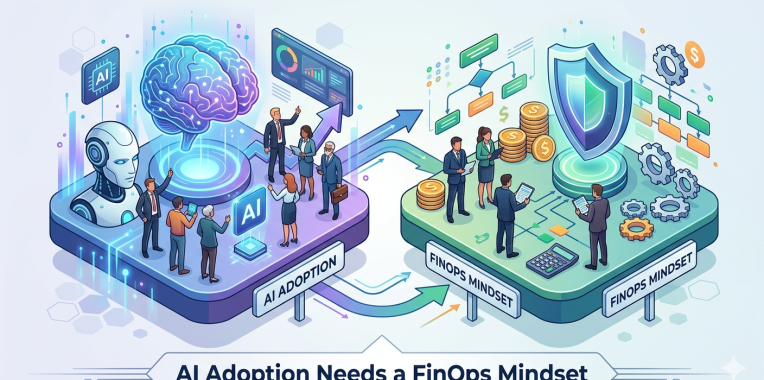
For the past few years, Artificial Intelligence has been marketed as the ultimate productivity accelerator. From software development and customer service to marketing and operations, organizations have embraced AI tools at an unprecedented pace. The promise has been compelling: faster delivery, improved efficiency, and reduced operational costs.
However, a new reality is emerging.
Many organizations are discovering that while AI can dramatically improve productivity, it can also generate significant and often unexpected costs when left unmanaged. The challenge is no longer whether to use AI, but how to use it efficiently and sustainably.
In many ways, this mirrors the early days of cloud computing adoption. Organizations rushed to migrate workloads to the cloud, attracted by flexibility, scalability, and speed. While the benefits were real, many soon discovered that uncontrolled consumption could lead to spiraling costs. This gave rise to the FinOps movement, helping organizations balance innovation with financial accountability.
Today, AI is following a remarkably similar path.
The Hidden Cost of AI
Modern AI tools consume vast amounts of computing resources. Every prompt, code generation request, document analysis, and autonomous workflow consumes processing power and incurs costs.
As organizations scale AI adoption across hundreds or thousands of employees, these costs can quickly escalate. What starts as a productivity experiment can become a substantial line item in the technology budget.
This does not mean AI has failed. On the contrary, AI continues to deliver measurable value. The lesson is that AI consumption must be managed with the same discipline that organizations apply to cloud computing, infrastructure, and software licensing.
Lessons from the Cloud Journey
When cloud computing first became mainstream, many organizations viewed it as a simple replacement for traditional infrastructure. The assumption was that cloud would automatically reduce costs.
The reality was more nuanced.
Organizations gained agility, scalability, and faster innovation, but many also experienced unexpected increases in spending due to overprovisioning, duplicate environments, idle resources, and lack of governance. FinOps emerged as the framework that enabled businesses to maximize cloud value while controlling costs.
The same pattern is now emerging with AI. Early adopters focused on access and experimentation. Mature organizations are beginning to focus on optimization, governance, and measurable return on investment.
Enter AI FinOps
Financial Operations (FinOps) emerged as a discipline to help organizations manage and optimize cloud spending. The same principles are now becoming essential for AI adoption.
AI FinOps focuses on balancing three key objectives:
- Maximizing business value
- Controlling costs
- Ensuring responsible and sustainable usage
The goal is not to limit innovation. The goal is to ensure that every dollar spent on AI generates measurable business outcomes.
Practical AI FinOps Principles
1. Match the Model to the Task
Not every task requires the most powerful and expensive AI model.
Simple content generation, summarization, classification, and routine support activities can often be handled by smaller, lower-cost models. Premium models should be reserved for complex reasoning, advanced coding, strategic analysis, or high-value decision support.
2. Measure Usage
Organizations cannot optimize what they cannot measure.
AI consumption should be tracked across departments, teams, and business units. Visibility into usage patterns helps identify inefficiencies, duplicate activities, and opportunities for optimization.
3. Define Business Outcomes
AI initiatives should be tied to clear business metrics.
Examples include:
- Reduced development cycle times
- Improved customer satisfaction
- Increased sales conversion rates
- Lower operational costs
- Enhanced employee productivity
Without measurable outcomes, it becomes difficult to justify ongoing AI investment.
4. Prevent Uncontrolled Agent Usage
Autonomous AI agents can be powerful productivity tools, but they can also consume significant resources if left unchecked.
Organizations should establish governance policies, usage limits, and approval processes for large-scale autonomous workflows.
5. Create Shared Accountability
AI spending should not be viewed solely as an IT expense.
Business leaders, finance teams, technology teams, and end users should all understand the cost implications of AI usage and share responsibility for maximizing value.
From Experimentation to Optimization
The first wave of cloud adoption was about migration. The second wave was about optimization.
AI is entering the same phase.
The first wave of AI adoption was driven by excitement and experimentation. Organizations rushed to explore possibilities and gain competitive advantages. The next phase will focus on extracting maximum business value while maintaining financial discipline.
Successful organizations will not necessarily be those that spend the most on AI. They will be the ones that deploy AI strategically, manage consumption intelligently, and consistently align investment with measurable business outcomes.
The Road Ahead
Cloud computing transformed how organizations consume technology. AI is transforming how organizations consume intelligence.
Both technologies share a common lesson: innovation without visibility and accountability can become expensive.
Just as FinOps became essential to successful cloud adoption, AI FinOps will become a critical capability for organizations seeking to scale AI responsibly. The future belongs to organizations that combine innovation with governance, agility with accountability, and experimentation with measurable value.
The question is no longer whether your organization should adopt AI.
The question is whether your organization is prepared to manage AI with the same financial discipline and operational maturity that successful organizations apply to cloud computing.
 renierbotha ltd