
AI Has Moved From Opportunity to Accountability
In 2025, CEOs worried about being left behind by AI. In 2026, their concern is far more serious: being held accountable for the results.
AI is no longer viewed as a promising innovation. It has become a business mandate, deeply embedded in operations, revenue expectations, strategic decision-making, and boardroom discussions. The pressure on executives has not diminished, it has intensified.
A striking 80% of CEOs say their position could be at risk if their organization fails to achieve measurable business outcomes from AI by the end of 2026. At the same time, 56% admit that competitors have implemented AI strategies they believe are more effective than their own, revealing growing uncertainty among business leaders.
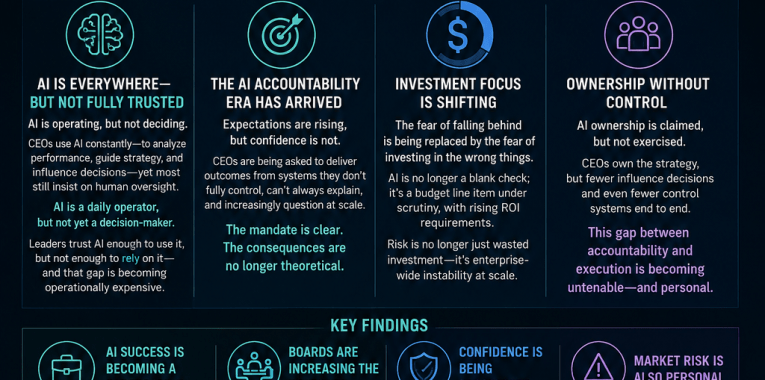
AI Is Everywhere – But Not Fully Trusted
The latest findings expose a major contradiction in enterprise AI adoption: AI is increasingly involved in day-to-day operations, yet leaders remain reluctant to hand over decision-making authority.
CEOs use AI to analyze performance, shape strategy, and influence critical decisions. However, most still insist on strong human oversight. AI has become a valuable operator, but not yet a trusted decision-maker.
This trust gap is becoming costly. Organizations rely on AI enough to make it indispensable, but not enough to let it act independently. As a result, businesses often sacrifice speed and efficiency in favor of control and accountability.
The Era of AI Accountability Has Arrived
The challenge facing CEOs is becoming increasingly personal. Expectations continue to rise, but confidence is not keeping pace.
Leaders are expected to deliver business results from systems they do not always fully understand, cannot consistently explain, and often struggle to govern at scale. While many executives still believe AI can transform industries and create competitive advantage, confidence in their ability to manage that transformation is beginning to erode.
Investment Focus Is Shifting
The fear of missing out on AI is being replaced by a new concern: investing in the wrong AI initiatives.
As spending accelerates, CEOs are becoming more disciplined and demanding clearer returns on investment. AI is no longer treated as an unlimited innovation budget. Every investment must now demonstrate measurable value.
At the same time, organizations face growing risks from vendor dependence, opaque cost structures, and AI systems that are scaling faster than governance frameworks can keep up. The threat is no longer wasted spending, it is enterprise-wide instability.
Ownership Without Control
One of the most significant findings is the growing disconnect between accountability and authority.
While CEOs overwhelmingly claim ownership of AI strategy, far fewer are involved in key implementation decisions, and even fewer maintain end-to-end control over AI systems.
As AI moves from experimentation into production, this gap is becoming increasingly difficult to sustain. Accountability remains concentrated at the top, while operational control is often fragmented across multiple teams and vendors.
Key Findings
AI Success Is Becoming a Career Issue
- 80% of CEOs say their role could be at risk if AI fails to deliver measurable business value by the end of 2026.
- 87% would stake their job on achieving meaningful outcomes from their AI programs.
- 77% believe a CEO is likely to be removed in 2026 because of a failed AI strategy or an AI-driven crisis.
Boards Are Increasing the Pressure
- 62% of CEOs report active board pressure to deliver measurable AI-driven business results.
- AI has become a permanent boardroom agenda item rather than a future-oriented strategic discussion.
Confidence Is Being Reassessed
- Although 80% trust their organization’s AI governance frameworks, confidence in deploying AI agents at scale is declining.
- The percentage of CEOs who describe themselves as “extremely confident” in deploying AI agents has dropped from 41% in 2025 to 31% in 2026.
- Confidence has not collapsed, but it has become more cautious and realistic.
Market Risk Is Also Personal
- More than one-third (35%) of CEOs believe their position would be significantly threatened if the AI market bubble were to burst.
- AI is no longer viewed solely as a technology investment; it is increasingly seen as a leadership and market risk.
The Defining Challenge of 2026
The central tension facing enterprise leaders is clear: AI is driving growth, innovation, and competitive advantage, while simultaneously becoming one of the largest sources of organizational risk.
Success in the next phase of AI adoption will not belong to the companies that deploy AI the fastest. It will belong to those that can govern it effectively, measure its impact accurately, and defend their decisions under increasing scrutiny.
For CEOs, the objective is straightforward: deliver results. The difficulty lies in navigating a rapidly evolving technology landscape where expectations continue to rise, certainty continues to decline, and careers may depend on getting it right.

