Case Study: Renier Botha’s Leadership in Rivus’ Digital Strategy Implementation

Introduction

Rivus Fleet Solutions, a leading provider of fleet management services, embarked on a significant digital transformation to enhance its operational efficiencies and customer services. Renier Botha, a seasoned IT executive, played a crucial role in this transformation, focusing on three major areas: upgrading key database infrastructure, leading innovative product development, and managing critical transition projects. This case study explores how Botha’s efforts have propelled Rivus towards a more digital future.

Background

Renier Botha, known for his expertise in digital strategy and IT management, took on the challenge of steering Rivus through multiple complex digital initiatives. The scope of his work covered:

  1. Migration of Oracle 19c enterprise database,
  2. Development of a cross-platform mobile application, and
  3. Management of the service transition project with BT & Openreach.

Oracle 19c Enterprise Upgrade Migration

Objective: Upgrade the core database systems to Oracle 19c to ensure enhanced performance, improved security, and extended support.

Approach:
Botha employed a robust programme management approach to handle the complexities of upgrading the enterprise-wide database system. This involved:

  • Detailed planning and risk management to mitigate potential downtime,
  • Coordination with internal IT teams and external Oracle consultants,
  • Comprehensive testing phases to ensure system compatibility and performance stability.

Outcome:
The successful migration to Oracle 19c provided Rivus with a more robust and secure database environment, enabling better data management and scalability options for future needs. This foundational upgrade was crucial for supporting other digital initiatives within the company.

Cross-Platform Mobile Application Development

Objective: Develop a mobile application to facilitate seamless digital interaction between Rivus and its customers, enhancing service accessibility and efficiency.

Approach:
Botha led the product development team through:

  • Identifying key user requirements by engaging with stakeholders,
  • Adopting agile methodologies for rapid and iterative development,
  • Ensuring cross-platform compatibility to maximise user reach.

Outcome:
The new mobile application promissed to significantly transformed how customers interacted with Rivus, providing them with the ability to manage fleet services directly from their devices. This not only improved customer satisfaction but also streamlined Rivus’ operational processes.

BT & Openreach Exit Project Management

Objective: Manage the transition of fleet technology services of BT & Openreach ensuring minimal service disruption.

Approach:
This project was complex, involving intricate service agreements and technical dependencies. Botha’s strategy included:

  • Detailed project planning and timeline management,
  • Negotiations and coordination with multiple stakeholders from BT, Openreach, and internal teams,
  • Focusing on knowledge transfer and system integrations.

Outcome:
The project was completed efficiently, allowing Rivus to transition control of critical services succesfully and without business disruption.

Conclusion

Renier Botha’s strategic leadership in these projects has been pivotal for Rivus. By effectively managing the Oracle 19c upgrade, he laid a solid technological foundation. The development of the cross-platform mobile app under his guidance directly contributed to improved customer engagement and operational efficiency. Finally, his adept handling of the BT & Openreach transition solidified Rivus’ operational independence. Collectively, these achievements represent a significant step forward in Rivus’ digital strategy, demonstrating Botha’s profound impact on the company’s technological advancement.


Digital Strategy & the Board

Digital Strategy is a plan that uses digital resources to achieve one or more objectives. With Technology changing at a very fast pace, Organisations have many digital resources to choose from.

Digital Resources can be defined as materials that have been conceived and created digitally or by converting analogue materials to a digital format for example:

  • Utilising the internet for commerce (web-shops, customer service portals, etc…)
  • Secure working for all employees from anywhere via VPN
  • Digital documents, scanning paper copies and submitting online correspondence to customers i.e. online statements and payment facilities via customer portals
  • Digital resources via Knowledge Base, Wiki, Intranet site and Websites
  • Automation – use digital solutions like robotics and AI to complete repetitive tasks more efficiently
  • Utilising social media for market awareness, customer engagement and advertising

A Digital Strategy is typically a plan that helps the business to transform it’s course of action, operations and activities into a digital nature by utilising available applicable technology.

Many directors know that digital strategies, and there related spending, can be difficult to understand. From blockchain and virtual reality to artificial intelligence, no business can afford to fall behind with the latest technological innovations that are redefining how businesses connect with their customers, employees, and myriad of other stakeholders. Read this post that covers “The Digital Transformation Necessity“…

As a Board Director what are the crucial factors that the Board should consider when building a digital strategy?

Here are five critical aspects, in more detail, and the crucial things to be conscious of when planning a digital transformation strategy as part of a board.

Stakeholders

A stakeholder, by definition, is usually an individual or a group impacted by the outcome of a project. While in previous roles you may have worked with stakeholders at senior management level, when planning a digital strategy, it’s important to remember that your stakeholders could also include customers, employees or anyone that could be affected by a new digital initiative.

Digital strategies work from the top down, if you’re looking to roll out a digital transformation project, you need to consider how it will affect every person inside or outside of your business.

Investment

Digital transformation almost always involves capital and technology-intensive investments. It is not uncommon for promising transformation projects to stall because of a lack of funds, or due to technology infrastructure that cannot cope with increased demands.

Starting a budgeting process right at the start of planning a digital transformation project is essential. This helps ensure that the scope of a project does not grow beyond the capabilities of an enterprise to fund it. A realistic budgeting and funding approach is crucial because a stalled transformation project creates disruption, confusion and brings little value to a business.

Communications

From the get-go, any digital strategy, regardless of size, should be founded on clear and constant communication between all stakeholders involved in a project. This ensures everyone is in the loop on the focus of the project, their specific roles within it, and which processes are going to change. In addition, continuous communication helps build a spirit of shared success and ensures everyone has the information they need to address any frustrations or challenges that may occur as time passes. When developing an effective communication plan, Ian’s advice is to hardly mention the word digital at all.

The best digital strategies explain what digital can do and also explain the outcomes. Successful communication around digital strategies uses language that everyone can understand, plain English, no buzzwords, no crazy acronyms and no silly speak.

Also read “Effective Leadership Communication” which covers how you can communicate effectively to ensure that everyone in the team are on the same page.

Technology

While there are many technologies currently seeing rapid growth and adoption, it doesn’t necessarily mean that you will need to implement all of them in your business. The choice of technology depends upon the process you are trying to optimise. Technology, as a matter of fact, is just a means to support your idea and the associated business processes.

People often get overwhelmed with modern technologies and try to implement all of them in their current business processes. The focus should be on finding the technologies that rightly fit your business objectives and implement them effectively.

Never assume that rolling out a piece of technology is just going to work. When embarking on a digital project, deciding what not to do is just as important as deciding what to do. Look at whether a piece of technology can actually add value to your business or if it’s just a passing trend. Each digital project should hence be presented to Board with a business case that outlines the business value, return on investment and the associated benefits and risks, for board consideration.

Measurement

No strategy is complete without a goal and a Digital Strategy is no different. To measure the effectiveness of your plan you will need to set up some key performance indicators (KPIs). These metrics will demonstrate the effectiveness of the plan and will also guide your future decision making. You will need to set up smart goals that have clear achievable figures along with a timeline. These goals will guide and optimise the entire execution of a transformation project and ensure that the team does not lose focus.

Any decent strategy should say where we are now, where we want to get to and how we’re going to get there, but also, more importantly, how are we going to monitor and track against our progress.

Also Read

An Operating Model that Delivers

Every organisation that I have worked with around the world, whether it is in London, Johannesburg, Sydney, Singapore, Dallas, Kuala Lumpir, Las-Vegas, Nairobi or New York, there was always reference to a Target Operating Model (TOM) when business leaders spoke about business strategy and performance. Yes, the TOM – the ever eluding state of euphoria when all business operations work together in harmony to deliver the business vision…sometime in the near foreseen future.

Most business transformation programmes are focussed to deliver a target operating model – transforming the business by introducing a new way of working that better aligns the business offering with it’s customer’s changing expectation. Millions in business change budgets have been invested in TOM design projects and 1000s of people have worked in these TOM projects of which some have delivered against the promise.

With the TOM as the defined deliverable, the targeted operational state and the outcome of the business transformation programme, it is very important that the designed TOM are actually fit for purpose. The TOM also has to lend itself to be easily adjustable in order to contribute to the agility of an organisation. The way the business is operating must be able to adapt to an ever changing technology driven world and the associated workforce. The quick evolving digital world is probably the main catalyst for transformation in organisations today – read “The Digital Transformation Necessity” for further insights…

Operating Model (OM)

The Operating Model uses key inputs from the Business Model and Strategy.

The Business Model focuses on the business’ customers, the associated product and service offerings – how the organisation creates value for it’s cliental – and the commercial proposition. Within the business model the business’s revenue streams and how those are contributing to the business value chain to generate profits, are decried. In other words, the Business Model envisages the What within the organisation.

Within the Business Strategy the plan to achieve specific goals are defined, as well as the metrics required to measure how successfully these are achieved. The business goals are achieved through the daily actions as defined within the Operating Model.

Typically an Operating Model takes the What from the Business Model in conjunction with the business strategy, and defines the Why, What, How, Who and With. It is the way in which the business model and strategy is executed by conducting the day to day business operations. Execution is key as no business can be successful by just having a business strategy, the execution of the operating model delivering the business strategy is the operative ingredient of success.

In order to document and describe how an organisation functions, the Operating model usually includes business capabilities and associated processes, the products and/or services being delivered, the roles and responsibilities of people within the business and how these are organised and governed within the business, the metrics defined to manage, monitor and control the performance of the organisation and then the underpinning Technology, Information Systems and Tools the business uses in delivering it’s services and/or products.

Analogy: A good analogy to describe the Operating Model is to compare it to the engine of F1 car. In 2016 the Mercedes Silver Arrow (the fastest car, driven by Lewis Hamilton (arguably the fastest driver), did not win because of engine and reliability problems. Instead the World Championship was won by Nico Rosberg, who had a better performing engine over the whole season. Nico benefited from a better operating model – he had the processes, data, systems and the people (including himself) to win. The mechanical failures that Lewis suffered, mostly not through fault of his own, were a result of failures somewhere within his operating model.

Target Operating Model (TOM)

The Target Operating Model (TOM) is a future state version of the Operating Model. To derive the TOM, the existing Operating Model is compared with the desired future state keeping the key aspects of an operating model in mind: Why, What, How, Where, Who and With. The TOM also cover two additional key aspects: the When & Where defined within the transformation programme to evolve from current to future states.

The difference between the “as is” Operating Model and the “to be” Target Operating Model, indicates the gap that the business must bridge in the execution of its Transformation Model/Strategy – the When and Where. To achieve the Target Operating Model usually require large transformation effort, executed as change & transformation programmes and projects.

ToBe (TOM) – AsIs (OM) = Transformation Model (TM)

Why >> Business Vision & Mission

What >> Business Model (Revenue channels through Products and Services – the Value Chain)

How >> Business Values & Processes & Metrics

Who >> Roles & Responsibilities (RACI)

With >> Tools, Technology and Information

Where & When >> Transformation Model/Strategy

Defining the TOM

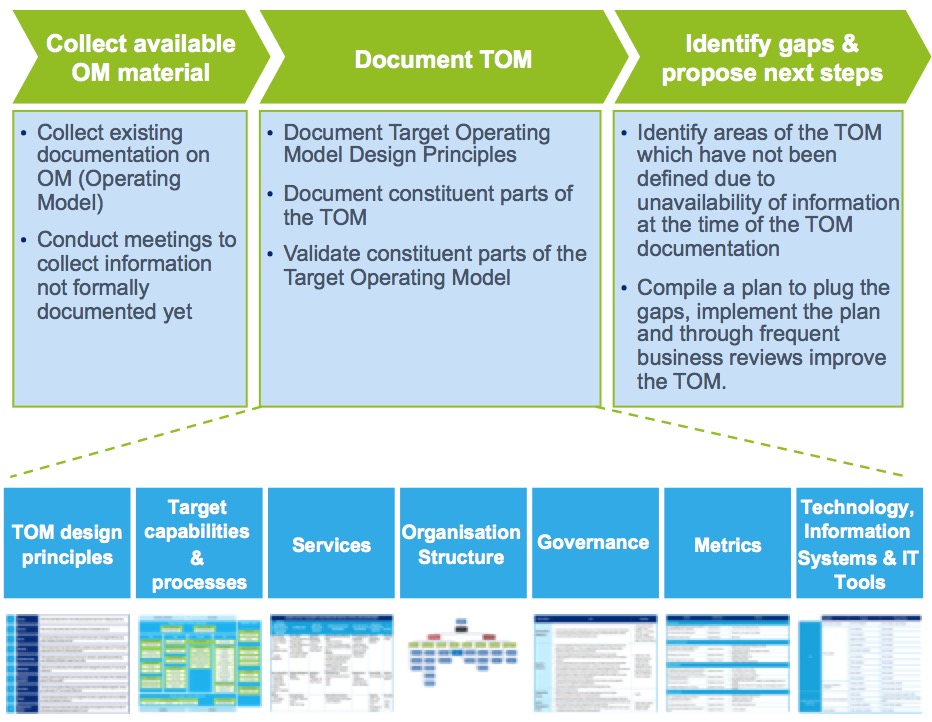
A methodology to compile the Target Operating Model (TOM) is summarised by the three steps shown in the diagram below:

TOM Methodology
Inputs to the methodology:

  • Business Model
  • Business Strategy
  • Current Operating Model
  • Formaly documented information, processes, resource models, strategies, statistics, metrics…
  • Information gathered through interviews, meetings, workshops…

Methodology produces TOM Outputs:

  • Business capabilities and associated processes
  • Clearly defined and monetised catalogue of the products and/or services being delivered
  • Organisation structure indicating roles and responsibilities of people within the business and how these are organised and governed
  • Metrics specifically defined to manage, monitor and control the performance of the organisation
  • Underpinning Technology, Information Systems and Tools the business uses in delivering it’s services and/or products

The outputs from this methodology covers each key aspect needed for a TOM that will deliver on the desired business outcomes. Understanding these desired outcomes and the associated goals and milestones to achieve them, is hence a fundamental prerequisite in compiling a TOM.

To Conclude

An achievable Target Operating Model, that delivers, is dependant on the execution of an overall business transformation strategy that aligns the business’ vision, mission and strategy with a future desired state in which the business should function.

Part of the TOM is this Business Transformation Model that outlines the transformation programme plan, which functionally syncs the current with the future operating states. It also outlines the execution phases required to deliver the desired outcomes, in the right place at the right time, while having the agility to continuously adapt to changes.

Only if an organisation has a strategically aligned and agile Target Operating Model in place that can achieve this, is the business in a position to successfully navigate its journey to the benefits and value growth it desires.

renierbotha Ltd has a demonstrable track record of compiling and delivering visionary Target Operating Models.

If you know that your business has to transform to stay relevant – Get in touch!


Originally written by Renier Botha in 2016 when, as Managing Director, he was pivotal in delivering the TOM for Systems Powering Healthcare Ltd.

Empowering Healthcare through Strategic Leadership: Systems Powering Healthcare Case Study (2015-2017)

Introduction:
In December 2015, Renier Botha assumed the role of Managing Director (CEO) & Head of Service (CIO) at Systems Powering Healthcare (SPHERE), an IT specialist organisation providing essential IT infrastructure and shared IT services to over 10,000 healthcare workers in the NHS. This case study delves into Botha’s transformative journey, focusing on his strategic vision, innovative solutions, and steadfast leadership that reshaped SPHERE into a thriving and client-focused enterprise.

Challenges and Objectives:
When Botha took charge, SPHERE faced the challenge of transitioning from a cost-plus model to a commercial-service-catalogue model while expanding its clientele. His primary objectives included stabilising the newly founded business, developing a strategic roadmap, and establishing a customer-centric approach to service delivery.

Strategic Initiatives and Achievements:

  1. Strategic Planning: Within the initial three months, Botha meticulously crafted a six-year strategic business plan for SPHERE. This plan outlined clear annual investment and service delivery milestones, providing a roadmap for the organisation’s growth and development.
  2. Operational Excellence: Botha directed a workforce of 75 employees, overseeing the execution of the strategic plan. Under his leadership, SPHERE transformed from a startup to an established medium-sized enterprise, achieving its third-year targets by the end of the second financial year.
  3. IT Infrastructure Transformation: Botha led a comprehensive IT estate refresh strategy, investing £42M in core capabilities like IP Networks, Service Hosting, End User Computing, and more. This initiative not only modernised SPHERE’s infrastructure but also ensured long-term sustainability and efficiency.
  4. Service Delivery Innovation: Botha introduced a customer-centric Target Operating Model (TOM) and implemented Service-Now as the supporting ERP toolset. This digital transformation not only increased business maturity but also resulted in a five-year £2.4m NPV saving and a remarkable ROI of 493%.
  5. Financial Growth: Through strategic M&A, business transformation, and the onboarding of new clients, SPHERE’s revenue grew by 42%. This growth not only secured significant ROI for shareholders but also saved the NHS approximately £3m per annum through a shared service solution.
  6. Operational Efficiency: Botha defined and achieved the “Cost per IT User” KPI, showcasing SPHERE’s value proposition. The strategic business plan led to an 11% reduction in the Cost per IT User in 2016 and a further 13% reduction in 2017, surpassing the target KPI by 12%.
  7. Commercial Success: Botha developed a compelling commercial Service Catalogue, instrumental in winning a £10m tender bid to become an IT Service Provider to Northumbria Healthcare NHS Foundation Trust.
  8. Cultural Transformation: Through a focus on commercial awareness, customer-centricity, and employee empowerment, Botha fostered a high-performing team. Staff retention rates increased from 82% in early 2016 to an impressive 98% by the end of 2017.

Conclusion:
Renier Botha’s strategic foresight, operational acumen, and emphasis on innovation and client satisfaction transformed Systems Powering Healthcare into a robust, client-focused organisation. His leadership not only steered SPHERE through critical transitions but also positioned it as a beacon of efficiency and excellence within the healthcare technology sector. This case study exemplifies the profound impact of visionary leadership on organisational growth and success.

Case Study: IT Transformation and Operational Excellence at Regus

Background:

Regus, a global leader in providing flexible workspaces and business solutions, faced the challenge of enhancing its IT systems and professional services to meet the growing demands of a dynamic market. To address this, Regus appointed Renier Botha from renierbotha Ltd, as the Global Head of Systems and Professional Services on a contractual basis. Renier’s objective was to lead the IT Systems and Professional Services teams, ensuring the delivery of a comprehensive portfolio of IT programmes and projects, and maintaining high availability of operational IT systems across 25 countries.

Challenges:

  1. Diverse Geographical Presence: Regus operated in 25 countries, each with unique IT needs and challenges, requiring a cohesive global strategy.
  2. Legacy Systems: Outdated legacy systems led to technical debt, hindering operational efficiency and scalability.
  3. Operational Costs: High operational costs required optimisation without compromising service quality.

Solution:

Renier Botha, with his expertise, initiated a transformative approach focusing on efficient IT service delivery, cost optimisation, and integration of modern technologies.

Achievements:

  1. Strategic Leadership: Renier led a team of 105 multi-disciplined technologists across 25 countries. His strategic vision and effective team management ensured streamlined operations and standardised services globally.
  2. IT Department Transformation: Renier developed a comprehensive IT Department transformation plan. By modelling technology requirements into a service delivery framework, the plan accomplished an annual operational saving of £3.6m. This was achieved through process optimisation, resource reallocation, and leveraging cost-effective technologies.
  3. Oracle Sales Cloud Deployment: Renier successfully programme managed the deployment of Oracle Sales Cloud, a £7m initiative covering 32 projects and workstreams. This integration of Enterprise Resource Planning (ERP) and Customer Relations Management (CRM) solutions replaced legacy systems, reducing technical debt and improving operational agility.

Results:

  1. Operational Efficiency: The implementation of the IT transformation plan significantly enhanced operational efficiency. Standardised processes and optimised resource allocation led to streamlined operations, reducing costs and improving productivity.
  2. Modernised IT Infrastructure: The deployment of Oracle Sales Cloud and integration of ERP and CRM solutions modernised Regus’ IT infrastructure. This enhanced system performance, scalability, and flexibility, enabling Regus to adapt swiftly to market changes and customer demands.
  3. Cost Optimisation: Through strategic planning and efficient resource allocation, Renier achieved an annual operational saving of £3.6m. These savings were reinvested into innovation and further enhancing customer experience, ensuring long-term sustainability.

Conclusion:

Renier Botha’s tenure as the Global Head of Systems and Professional Services at Regus exemplifies how strategic leadership, meticulous planning, and effective team management can drive transformative change within a global organisation. By optimising operational efficiency, integrating modern technologies, and achieving significant cost savings, Renier not only enhanced Regus’ IT capabilities but also positioned the company for sustained growth in a competitive market. His achievements stand as a testament to the impact of visionary leadership on organisational success and operational excellence.