
Global AI Confessions: CEO Edition 2026

AI Has Moved From Opportunity to Accountability

In 2025, CEOs worried about being left behind by AI. In 2026, their concern is far more serious: being held accountable for the results.

AI is no longer viewed as a promising innovation. It has become a business mandate, deeply embedded in operations, revenue expectations, strategic decision-making, and boardroom discussions. The pressure on executives has not diminished, it has intensified.

A striking 80% of CEOs say their position could be at risk if their organization fails to achieve measurable business outcomes from AI by the end of 2026. At the same time, 56% admit that competitors have implemented AI strategies they believe are more effective than their own, revealing growing uncertainty among business leaders.

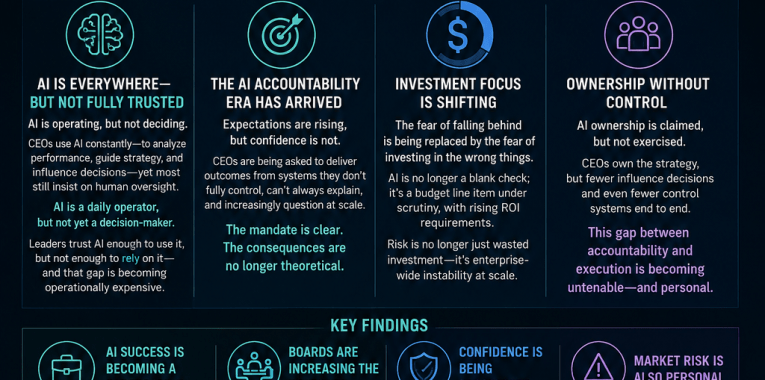
AI Is Everywhere – But Not Fully Trusted

The latest findings expose a major contradiction in enterprise AI adoption: AI is increasingly involved in day-to-day operations, yet leaders remain reluctant to hand over decision-making authority.

CEOs use AI to analyze performance, shape strategy, and influence critical decisions. However, most still insist on strong human oversight. AI has become a valuable operator, but not yet a trusted decision-maker.

This trust gap is becoming costly. Organizations rely on AI enough to make it indispensable, but not enough to let it act independently. As a result, businesses often sacrifice speed and efficiency in favor of control and accountability.

The Era of AI Accountability Has Arrived

The challenge facing CEOs is becoming increasingly personal. Expectations continue to rise, but confidence is not keeping pace.

Leaders are expected to deliver business results from systems they do not always fully understand, cannot consistently explain, and often struggle to govern at scale. While many executives still believe AI can transform industries and create competitive advantage, confidence in their ability to manage that transformation is beginning to erode.

Investment Focus Is Shifting

The fear of missing out on AI is being replaced by a new concern: investing in the wrong AI initiatives.

As spending accelerates, CEOs are becoming more disciplined and demanding clearer returns on investment. AI is no longer treated as an unlimited innovation budget. Every investment must now demonstrate measurable value.

At the same time, organizations face growing risks from vendor dependence, opaque cost structures, and AI systems that are scaling faster than governance frameworks can keep up. The threat is no longer wasted spending, it is enterprise-wide instability.

Ownership Without Control

One of the most significant findings is the growing disconnect between accountability and authority.

While CEOs overwhelmingly claim ownership of AI strategy, far fewer are involved in key implementation decisions, and even fewer maintain end-to-end control over AI systems.

As AI moves from experimentation into production, this gap is becoming increasingly difficult to sustain. Accountability remains concentrated at the top, while operational control is often fragmented across multiple teams and vendors.

Key Findings

AI Success Is Becoming a Career Issue

  • 80% of CEOs say their role could be at risk if AI fails to deliver measurable business value by the end of 2026.
  • 87% would stake their job on achieving meaningful outcomes from their AI programs.
  • 77% believe a CEO is likely to be removed in 2026 because of a failed AI strategy or an AI-driven crisis.

Boards Are Increasing the Pressure

  • 62% of CEOs report active board pressure to deliver measurable AI-driven business results.
  • AI has become a permanent boardroom agenda item rather than a future-oriented strategic discussion.

Confidence Is Being Reassessed

  • Although 80% trust their organization’s AI governance frameworks, confidence in deploying AI agents at scale is declining.
  • The percentage of CEOs who describe themselves as “extremely confident” in deploying AI agents has dropped from 41% in 2025 to 31% in 2026.
  • Confidence has not collapsed, but it has become more cautious and realistic.

Market Risk Is Also Personal

  • More than one-third (35%) of CEOs believe their position would be significantly threatened if the AI market bubble were to burst.
  • AI is no longer viewed solely as a technology investment; it is increasingly seen as a leadership and market risk.

The Defining Challenge of 2026

The central tension facing enterprise leaders is clear: AI is driving growth, innovation, and competitive advantage, while simultaneously becoming one of the largest sources of organizational risk.

Success in the next phase of AI adoption will not belong to the companies that deploy AI the fastest. It will belong to those that can govern it effectively, measure its impact accurately, and defend their decisions under increasing scrutiny.

For CEOs, the objective is straightforward: deliver results. The difficulty lies in navigating a rapidly evolving technology landscape where expectations continue to rise, certainty continues to decline, and careers may depend on getting it right.

Decoding the CEO’s Wishlist: What CEOs Seek in Their CTOs

The key difference between a Chief Information Officer (CIO) and a Chief Technology Officer (CTO) lies in their strategic focus and responsibilities within an organisation. A CIO primarily oversees the management and strategic use of information and data, ensuring that IT systems align with business objectives, enhancing operational efficiency, managing risk, and ensuring data security and compliance. On the other hand, a CTO concentrates on technology innovation and product development, exploring emerging technologies, driving technical vision, leading prototyping efforts, and collaborating externally to enhance the organisation’s products or services. While both roles are essential, CIOs are primarily concerned with internal IT operations, while CTOs focus on technological advancement, product innovation, and external partnerships to maintain the organisation’s competitive edge.

In 2017, I’ve written a post “What CEOs are looking for in their CIO” after an inspirational presentation by Simon La Fosse, CEO of Le Fosse Associates, a specialist technology executive search and head-hunter with more than 30 years experience in the recruitment market. The blog post was really well received on LinkedIn resulting in an influencer badge. In this post I am focussing on the role of the CTO (Chief Technology Officer).

In this digital age and ever-evolving landscape of the corporate world, the role of CTO stands as a linchpin for innovation, efficiency, and strategic progress. As businesses traverse the digital frontier, the significance of a visionary and adept CTO cannot be overstated. Delving deeper into the psyche of CEOs, let’s explore, in extensive detail, the intricate tapestry of qualities, skills, and expertise they ardently seek in their technology leaders.

1. Visionary Leadership:

CEOs yearn for CTOs with the acumen to envision not just the immediate technological needs but also the future landscapes. A visionary CTO aligns intricate technological strategies with the overarching business vision, ensuring that every innovation, every line of code, propels the company towards a future brimming with possibilities.

2. Innovation and Creativity:

Innovation is not just a buzzword; it’s the lifeblood of any progressive company. CEOs pine for CTOs who can infuse innovation into the organisational DNA. Creative thinking coupled with technical know-how enables CTOs to anticipate industry shifts, explore cutting-edge technologies, and craft ingenious solutions that leapfrog competitors.

3. Strategic Thinking and Long-Term Planning:

Strategic thinking is the cornerstone of successful CTOs. CEOs crave technology leaders who possess the sagacity to foresee the long-term ramifications of their decisions. A forward-looking CTO formulates and executes comprehensive technology plans, meticulously aligned with the company’s growth and scalability objectives.

4. Profound Technical Proficiency:

The bedrock of a CTO’s role is their technical prowess. CEOs actively seek CTOs who possess not just a surface-level understanding but a profound mastery of diverse technologies. From software development methodologies to data analytics, cybersecurity to artificial intelligence, a comprehensive technical acumen is non-negotiable.

5. Inspirational Team Leadership and Collaboration:

Building and leading high-performance tech teams is an art. CEOs admire CTOs who inspire their teams to transcend boundaries, fostering a culture of collaboration, innovation, and mutual respect. Effective mentoring and leadership ensure that the collective genius of the team can be harnessed for groundbreaking achievements.

6. Exceptional Communication Skills:

CTOs are conduits between the intricate realm of technology and the broader organisational spectrum. CEOs value CTOs who possess exceptional communication skills, capable of articulating complex technical concepts in a manner comprehensible to both technical and non-technical stakeholders. Clear communication streamlines decision-making processes, ensuring alignment with broader corporate goals.

7. Problem-Solving Aptitude and Resilience:

In the face of adversity, CEOs rely on their CTOs to be nimble problem solvers. Whether it’s tackling technical challenges, optimising intricate processes, or mitigating risks, CTOs must exhibit not just resilience but creative problem-solving skills. The ability to navigate through complexities unearths opportunities in seemingly insurmountable situations.

8. Profound Business Acumen:

Understanding the business implications of technological decisions is paramount. CEOs appreciate CTOs who grasp the financial nuances of their choices. A judicious balance between innovation and fiscal responsibility ensures that technological advancements are not just visionary but also pragmatic, translating into tangible business growth.

9. Adaptive Learning and Technological Agility:

The pace of technological evolution is breathtaking. CEOs seek CTOs who are not just adaptive but proactive in their approach to learning. CTOs who stay ahead of the curve, continuously updating their knowledge, can position their companies as trailblazers in the ever-changing technological landscape.

10. Ethical Leadership and Social Responsibility:

In an era marked by digital ethics awareness, CEOs emphasise the importance of ethical leadership in technology. CTOs must uphold the highest ethical standards, ensuring data privacy, security, and the responsible use of technology. Social responsibility, in the form of sustainable practices and community engagement, adds an extra layer of appeal.

In conclusion, the modern CTO is not merely a technical expert; they are strategic partners who contribute significantly to the overall success of the organisation. By embodying these qualities, CTOs can not only meet but exceed the expectations of CEOs, driving their companies to new heights in the digital age.