
IT Executive Guide for Strategic Planning

Strategic planning is an essential process for IT executives aiming to align their function’s goals with the broader enterprise objectives. A well-crafted strategic plan allows IT leaders to drive impactful change, support business growth, and ensure their function remains agile in a rapidly evolving business environment. This comprehensive guide delves into the key steps, best practices, and tools necessary for developing a strategic IT plan that not only aligns with business goals but also adapts to future challenges.

1. Verify the Business Context

Understanding the Enterprise Mission and Goals

The first critical step in the strategic planning process is to thoroughly understand and verify the business context within which your function operates. This involves confirming the enterprise’s mission and goals and ensuring that your IT function’s objectives are aligned with the overarching business strategy. This alignment is crucial because the IT function must support and enhance the overall business strategy to drive success.

Key Questions to Explore:

  • Long-term Business Objectives: What are the key business objectives for the next one, two, and five years? Understanding these goals will help you shape your IT strategy to support long-term success.
  • Core Strategies: What are the organisation’s core strategies to achieve these goals? Identifying these strategies will allow you to ensure that your IT initiatives are aligned with business priorities.
  • Execution Plans: How does the organisation plan to execute these strategies? This understanding will help you anticipate the resources and capabilities your IT function will need to support these plans effectively.
  • Challenges and Obstacles: What are the current challenges facing the organisation? Recognising potential obstacles will allow you to proactively address them in your strategic planning.

Documenting the Business Context:

Once you have gathered the necessary information, document both the business context and its likely impact on your IT function. This documentation should capture the enterprise’s strategic priorities and how they influence your function’s objectives. This step ensures that your IT strategy is rooted in a deep understanding of the business environment.

Tools and Techniques:

  • Business-Partner Conversation Guide: Utilise this guide to structure your discussions with key business leaders. This ensures that you are capturing all relevant information about their strategies, objectives, and challenges.
  • Emerging Trends Scoping Framework: Apply this framework to identify and prepare for trends that could significantly impact the business in the future. This might include technological advancements, regulatory changes, or shifts in consumer behaviour.
  • Scenario Planning Preparation: Engage in scenario planning to align with business partners on potential future developments. This allows your IT strategy to remain flexible and responsive to changing circumstances.

By verifying the business context, you ensure that your IT function’s goals are not developed in a vacuum but are closely aligned with the broader enterprise strategy.

2. Assess Your Function’s Capabilities

Evaluating Your Function’s Ability to Deliver

With a clear understanding of the business context, the next step is to assess your IT function’s ability to deliver on its goals. This involves a comprehensive evaluation of your current capabilities, identifying gaps, and developing a plan to address those gaps. This assessment is crucial because the success of your IT strategy hinges on your function’s ability to execute its objectives effectively.

Steps to Conduct a Capabilities Assessment:

  1. Identify Key Objectives and Activities: Start by identifying the critical objectives and activities within your IT function that support the overall business strategy. These might include areas such as cybersecurity, data management, or digital transformation.
  2. Evaluate Current Performance: Assess how well your function is currently performing these activities. This includes evaluating the maturity of your processes, the effectiveness of your technologies, and the skills of your team.
  3. Identify Capability Gaps: Determine where there are gaps in your current capabilities that could hinder your ability to deliver on strategic objectives. These gaps could be related to technology, skills, processes, or resources.
  4. Develop a Maturity Roadmap: Based on your assessment, create a roadmap that outlines the steps needed to mature your capabilities over time. This roadmap should prioritise the most critical gaps and detail the actions required to address them.

Tools and Techniques:

  • Gartner IT Score: This is a powerful maturity assessment tool designed to measure the effectiveness of your IT operating model. It helps you understand your current maturity level, identify target maturity levels based on your enterprise’s digital ambition, and develop a transformation plan to achieve these targets.
  • Capabilities Scoring Tool: Use this tool to score the maturity and criticality of your IT capabilities. This allows you to focus on the most important areas for improvement and ensure your function is well-positioned to support the organisation’s strategic goals.

Outcome of the Assessment:

The goal of this capabilities assessment is to ensure that your IT function is fully equipped to support the organisation’s strategic objectives. By identifying and addressing capability gaps, you can enhance your function’s ability to deliver impactful results and drive the success of the broader business strategy.

3. Strategically Manage Functional Budgets

Prioritising Investments and Managing Costs

Budget management is a critical component of strategic planning, particularly in an environment where IT leaders are often expected to do more with less. Strategic budget management involves making informed decisions about where to allocate resources, prioritising investments that will drive the most significant impact, and ensuring that your function operates as efficiently as possible.

Key Principles of Budget Management:

  • Reallocate Funding: Continuously assess your budget to identify areas where resources can be reallocated from lower-priority projects to higher-impact initiatives. This ensures that your spending aligns with strategic priorities.
  • Fund Growth Investments: Use cost savings from less critical activities to fund growth initiatives. This approach allows you to invest in new opportunities without increasing overall spending.
  • Utilise Unallocated Funds: Maintain some flexibility in your budget by keeping a portion of funds unallocated. This allows you to respond quickly to emerging opportunities or challenges.

Collaboration with the CFO:

Effective budget management requires a strong partnership with the CFO. Understanding the CFO’s priorities—such as profitability, cost optimisation, and capital allocation—will help you align your budget strategy with the broader financial goals of the organisation.

Tools and Techniques:

  • Budget Benchmarking: Regularly benchmark your budget and spending efficiency against industry peers. This provides insights into where you might be able to optimise costs or reallocate resources for better results.
  • Cost Optimisation Framework: This framework helps you visualise and refine cost optimisation ideas by assessing their benefit, cost, risk, and viability. It provides stakeholders with a clear understanding of the relative merits of different spending decisions.
  • BuySmart Tool: When new technology purchases are necessary, use this tool to evaluate vendors and make confident buying decisions. This ensures that your technology investments are well-aligned with strategic goals and offer the best value for the organisation.

Outcome of Strategic Budget Management:

By managing your budget strategically, you can ensure that your IT function is well-funded to support critical initiatives while operating efficiently. This approach allows you to maximise the impact of your investments and contribute to the organisation’s growth and success.

4. Measure Your Progress

Selecting and Using Metrics

Measuring progress is essential to understanding whether your strategic plan is achieving its intended outcomes. To effectively measure progress, it’s important to select the right metrics—those that provide meaningful insights into your function’s performance and its contribution to the overall business strategy.

Understanding Measures vs. Metrics:

  • Measures: These are observable business outcomes that indicate whether your action plans are effective. For example, an increase in market share or a reduction in operational costs.
  • Metrics: These are the data points that quantify those measures. For instance, the percentage increase in market share or the specific amount saved through cost reduction initiatives.

Choosing the Right Metrics:

When selecting metrics, consider the following criteria:

  • Alignment with Strategic Priorities: Ensure that your metrics are directly related to the key objectives of your strategic plan. This alignment ensures that the metrics provide relevant insights.
  • Simplicity and Focus: Avoid overloading your strategic plan with too many metrics. Focus on a few key metrics that are simple to measure and directly tied to strategic outcomes.
  • SMART Criteria: Ensure that each metric is Specific, Measurable, Actionable, Relevant, and Timely. This ensures that the metrics are practical and can be used to drive action.
  • Trigger Actions: Identify which metrics will trigger specific actions as predetermined by your strategic plan. This ensures that the metrics are not just for tracking purposes but also for guiding decision-making.

Revisiting and Realigning Metrics:

As business conditions change, it’s important to revisit your metrics and ensure they remain aligned with your strategic goals. This ongoing review allows you to adapt your strategic plan as needed to stay on track.

Tools and Techniques:

  • Gartner Digital Execution Scorecard™: This tool provides a comprehensive set of benchmarks to measure your digital strategy’s performance. It helps you identify gaps between your current performance and your strategic objectives, prioritise IT initiatives, and communicate your digital roadmap effectively.
  • Metrics Selection Guide: Use this guide to help you select the most appropriate metrics for your strategic plan, ensuring they provide actionable insights that drive performance improvement.

Outcome of Measuring Progress:

By carefully selecting and monitoring the right metrics, you can ensure that your strategic plan is effectively driving the desired outcomes. This ongoing measurement allows you to make data-driven decisions, adjust your strategy as needed, and demonstrate the value of your IT function to the broader organisation.

5. Document Your Strategy

Creating a Clear and Concise Strategic Plan

The final step in the strategic planning process is to document your strategy in a clear and concise manner. A well-documented strategy serves as a roadmap for your IT function, outlining the initiatives and investments needed to achieve your strategic objectives. It also facilitates communication with stakeholders, ensuring that everyone is aligned on the path forward.

Importance of a Well-Documented Strategy

A well-documented strategy serves multiple purposes:

  1. Clarity and Alignment: It provides a clear and concise roadmap that outlines the strategic initiatives your IT function will pursue, ensuring that all team members and stakeholders understand the direction and goals.
  2. Communication: A documented strategy is an essential tool for communicating your plans to business partners, the executive team, and other stakeholders. It allows you to present a cohesive narrative that links IT initiatives directly to business objectives.
  3. Accountability: By clearly outlining the strategic actions, timelines, and metrics, a documented strategy helps hold your team accountable for executing the plan and achieving the desired outcomes.

Creating a One-Page Strategic Plan

To maximise the effectiveness of your strategy, it’s often recommended to distil the core elements of your plan into a one-page document. This summary should include the most critical aspects of your strategy in a format that is easy to understand and share.

Key Components of a One-Page Strategic Plan:

  1. Business Objectives: Clearly state the overarching business objectives that your IT strategy is designed to support. These should be directly aligned with the enterprise’s strategic goals, such as increasing market share, enhancing customer experience, or improving operational efficiency.
  2. IT Capabilities and Initiatives: Detail the specific IT capabilities that will be developed or enhanced to achieve these business objectives. For each capability, outline the corresponding initiatives that will be undertaken. For example, if the objective is to improve customer experience, an IT initiative might involve implementing a new customer data platform.
  3. Strategic Actions and Timeline: Break down the strategic actions into specific initiatives, each with a clear timeline. This should include key milestones for each quarter, ensuring that progress can be tracked and adjusted as needed. For instance, you might schedule the rollout of a new cloud-based platform in Q1, followed by user training in Q2.
  4. Key Dependencies and Risks: Identify any dependencies that could impact the success of your initiatives, such as the need for cross-functional collaboration or external vendor support. Additionally, document potential risks and mitigation strategies to ensure that your team is prepared to address challenges as they arise.
  5. Metrics and KPIs: Include the key performance indicators (KPIs) that will be used to measure the success of each initiative. These should be aligned with the metrics identified in the previous step, providing a clear link between actions taken and the outcomes achieved. For example, a KPI might be a 10% reduction in order fulfilment time as a result of warehouse automation.

Tools and Techniques:

  • Strategic Planning Templates: Use customisable templates to structure your one-page plan. These templates can help you organise your thoughts and ensure that all critical elements are included.
  • Document Review by Experts: Consider submitting your strategic plan for review by industry experts, such as those provided by Gartner. This can provide valuable feedback and ensure that your strategy is robust and well-aligned with best practices.

Outcome of a Documented Strategy:

By documenting your strategy in a clear, concise, and visually accessible format, you ensure that your IT function has a well-defined roadmap that is easy to communicate and execute. This documentation not only aids in internal alignment but also enhances collaboration with other business units and the executive team, ultimately driving the successful implementation of your strategic initiatives.

Conclusion

Strategic planning is a dynamic and continuous process that requires IT executives to be both visionary and pragmatic. By following the five proven best practices outlined in this guide, IT leaders can develop and execute a strategic plan that is tightly aligned with business goals, adaptable to change, and capable of delivering significant impact.

Key Takeaways:

  1. Verify the Business Context: Understand and align your IT function’s goals with the broader enterprise strategy by engaging with business leaders and leveraging strategic frameworks.
  2. Assess Your Function’s Capabilities: Conduct a rigorous assessment of your IT capabilities, identify gaps, and develop a maturity roadmap to ensure your function is equipped to meet strategic objectives.
  3. Strategically Manage Functional Budgets: Prioritise investments that will drive growth and efficiency, and collaborate closely with the CFO to align budget strategies with financial goals.
  4. Measure Your Progress: Select and monitor SMART metrics that provide actionable insights into your function’s performance and progress toward strategic goals.
  5. Document Your Strategy: Create a clear, concise, and visually accessible strategic plan that can be easily communicated to stakeholders and effectively guide the execution of your IT initiatives.

By leveraging the right tools and frameworks, such as those provided by Gartner, IT executives can not only develop a robust strategic plan but also ensure its successful implementation. This approach will enable IT leaders to drive transformation, support business growth, and navigate the challenges of an increasingly complex and fast-paced business environment.

Strategic Steps for Implementing Generative AI in Your Enterprise

Generative AI (GenAI) has rapidly become a focal point of technological innovation, capturing the attention of enterprises across the globe. While the majority of organisations are still exploring the potential of AI, a select few have already mastered its deployment across various business units, achieving remarkable success. According to Gartner, these AI-savvy organisations represent just 10% of those currently experimenting with AI. However, their experiences provide invaluable insights for those looking to harness GenAI’s power effectively. This blog post outlines a strategic four-step approach to help enterprises implement GenAI in a manner that is both valuable and feasible.

1. Establish Your Vision for GenAI

The foundation of any successful GenAI implementation is a clear and strategic vision. Begin by defining how GenAI will contribute to your enterprise’s overarching goals. Consider the specific benefits you expect GenAI to deliver and how these will be measured. A well-articulated vision aligns your GenAI initiatives with your enterprise’s mission, ensuring that AI efforts are purposeful and integrated into broader business strategies.

For example, if your enterprise aims to enhance customer satisfaction, GenAI can play a crucial role by enabling advanced customer behaviour analytics or deploying virtual customer assistants. By linking GenAI objectives directly to enterprise goals, you foster organisation-wide fluency and pave the way for innovation that yields measurable returns.

2. Remove Barriers to Capturing Value

Once the vision is established, it’s essential to identify and eliminate any organisational barriers that could impede the realisation of GenAI’s potential. These barriers may include regulatory challenges, reputational risks, or competency gaps. Addressing these issues early on is crucial to maximising the value of your GenAI initiatives.

Strategic concerns, such as aligning AI projects with corporate goals, should be documented and addressed through a portfolio approach to AI opportunities. Metrics that serve as proxies for financial and risk outcomes should be selected to provide credibility and guide project maturity. Establishing formal accountability structures, such as a RACI (Responsible, Accountable, Consulted, and Informed) matrix, can further bolster AI results by clarifying roles and responsibilities throughout the AI strategy development and execution process.

By proactively addressing these barriers, you not only mitigate potential risks but also ensure that your GenAI initiatives are aligned with your organisation’s broader goals, increasing the likelihood of success.

3. Assess and Mitigate Risks

Implementing GenAI introduces a unique set of risks that need to be carefully assessed and mitigated. These risks can be broadly categorised into regulatory, reputational, and competency-related concerns. Each of these carries its own set of challenges:

  • Regulatory Risks: As AI technologies evolve, so too does the regulatory landscape. It is critical to stay informed about relevant regulations and ensure that your GenAI projects comply with these requirements. Establishing a collaborative framework between AI practitioners and legal, risk, and security teams can help evaluate the feasibility of AI use cases while maintaining compliance.
  • Reputational Risks: AI systems can be vulnerable to both intentional and unintentional misuse, potentially harming your organisation’s reputation. Implementing robust security measures across your enterprise, ensuring data integrity, and continuously monitoring AI models can help safeguard against these risks.
  • Competency Risks: The rapid pace of AI innovation can create a gap between your organisation’s current technical capabilities and what is required to effectively deploy GenAI. To bridge this gap, align your AI strategy with your cloud strategy, modernise data and analytics infrastructures, and consider creating programmes that foster incremental innovation and reduce technical debt.

By systematically identifying and addressing these risks, you can protect your organisation from potential setbacks and ensure that your GenAI initiatives are both safe and effective.

4. Prioritise Adoption Based on Value and Feasibility

Not all GenAI initiatives are created equal. To maximise the impact of your AI strategy, it is crucial to prioritise projects that offer the greatest value and are most feasible to implement. Begin by evaluating each potential project against a set of criteria, such as technical feasibility, alignment with your organisation’s mission, and the availability of necessary skills and resources.

Rate each project on its feasibility and value, and use these scores to rank initiatives. Projects that score high on both scales are ideal candidates for immediate pursuit, as they are likely to deliver significant business value with a reasonable chance of success. Conversely, projects with low feasibility, despite their potential value, may need to be reconsidered or postponed until the necessary conditions are in place.

By taking a methodical approach to prioritisation, you can ensure that your resources are directed towards the most promising GenAI initiatives, leading to more effective and impactful AI adoption.

Conclusion: A Strategic Approach to GenAI Implementation

Successfully implementing Generative AI in your enterprise requires more than just technical expertise—it demands a strategic approach that aligns AI initiatives with your business goals, removes barriers to value capture, mitigates risks, and prioritises projects based on their potential impact. By following the four steps outlined in this guide—establishing a clear vision, removing obstacles, assessing risks, and prioritising initiatives—you can set the stage for a GenAI strategy that drives real, measurable benefits for your organisation.

As with any transformative technology, the key to success lies in careful planning and execution. By learning from the experiences of AI pioneers and applying these best practices, your enterprise can navigate the complexities of GenAI adoption and unlock its full potential to drive innovation and growth.

The Perils of Losing Perspective: Why Senior Leaders Must “Stay in the Helicopter” for Strategic Success

Introduction

Have you ever found yourself so deeply immersed in a hectic period that your operational duties blur the lines of strategic focus? In the fast-paced world of business, senior leadership often faces the challenge of balancing day-to-day operations with long-term strategic planning. This reminded me of a book I’ve read in 2016 – “Staying in the Helicopter: The Key to Sustained Strategic Success,” in which Richard Harrop, uses the metaphor of “staying in the helicopter” to emphasize the importance of maintaining a high-level perspective. This book has been invaluable in helping me understand the importance of maintaining a high-level perspective while managing the complexities of daily operations, ensuring that an organisation remains agile, innovative, and competitive. However, what happens when senior leaders get too involved in the minutiae of daily operations? This blog post explores the risks businesses face when their leaders “get out of the helicopter” and lose sight of the broader strategic picture.

Staying in the Helicopter – maintaining a strategic, high-level perspective

“Staying in the Helicopter: The Key to Sustained Strategic Success” by Richard Harrop is a business leadership book that emphasizes the importance of maintaining a strategic, high-level perspective to achieve long-term success. Harrop uses the metaphor of “staying in the helicopter” to illustrate the necessity for leaders to rise above daily operations and view their organization and its environment from a broader perspective.

Key themes of the book include:

  1. Strategic Vision: Encourages leaders to develop and maintain a clear, long-term vision for their organizations.
  2. Adaptability: Stresses the need for organizations to be flexible and adaptable in response to changing market conditions.
  3. Leadership Skills: Discusses the qualities and skills necessary for effective leadership, including decision-making, communication, and the ability to inspire and motivate others.
  4. Continuous Improvement: Advocates for a culture of continuous learning and improvement within organizations.
  5. Balanced Perspective: Emphasizes balancing short-term operational demands with long-term strategic goals.

Through practical advice, case studies, and personal anecdotes, Harrop provides insights and tools for leaders to enhance their strategic thinking and ensure sustained success in their organisations.

Risks of not staying in the helicopter

If senior leadership gets “out of the helicopter” and becomes overly focused on day-to-day operations, several risks to the business can arise:

  1. Loss of Strategic Vision: Without a high-level perspective, leaders may lose sight of the long-term goals and vision of the organization, leading to a lack of direction and strategic focus.
  2. Inability to Adapt: Being too immersed in daily operations can make it difficult to notice and respond to broader market trends and changes, reducing the organization’s ability to adapt to new challenges and opportunities.
  3. Missed Opportunities: Leaders might miss out on identifying new opportunities for growth, innovation, or strategic partnerships because they are too focused on immediate issues.
  4. Operational Myopia: Overemphasis on short-term operational issues can result in neglecting important strategic initiatives, such as research and development, marketing, and expansion plans.
  5. Resource Misallocation: Resources may be allocated inefficiently, focusing too much on immediate problems rather than investing in strategic projects that ensure long-term success.
  6. Employee Disengagement: Employees may feel directionless and unmotivated if they perceive that leadership lacks a clear vision or strategic direction, leading to decreased morale and productivity.
  7. Competitive Disadvantage: Competitors who maintain a strategic perspective can outmaneuver the organization, leading to a loss of market share and competitive edge.
  8. Risk Management Failures: A lack of high-level oversight can result in inadequate risk management, leaving the organization vulnerable to unforeseen threats and crises.
  9. Innovation Stagnation: Innovation may stagnate if leaders are too focused on maintaining the status quo rather than exploring new ideas and fostering a culture of creativity.
  10. Leadership Burnout: Senior leaders might experience burnout from being overly involved in day-to-day operations, which can impair their ability to lead effectively and make sound strategic decisions.

Maintaining a balance between operational oversight and strategic vision is crucial for sustainable success and long-term growth.

Conclusion

In summary, while attention to daily operations is vital for the smooth running of any organization, senior leaders must not lose sight of the bigger picture. Richard Harrop’s concept of “staying in the helicopter” serves as a critical reminder of the importance of strategic oversight. By maintaining a high-level perspective, leaders can ensure their organizations remain adaptable, innovative, and competitive. Failing to do so can lead to a host of risks, from missed opportunities to operational myopia and beyond. Balancing immediate operational demands with long-term strategic vision is essential for sustained success and growth in today’s dynamic business environment.

Comprehensive Guide to Strategic Investment in IT and Data for Sustainable Business Growth and Innovation

In this post, Renier is exploring the critical importance of appropriate investment in technology, data and innovation for continued business growth and a strategy to stay relevant.

Introduction

This comprehensive guide explores the strategic importance of investing in information technology (IT) and data management to foster sustainable business growth and innovation. It delves into the risks of underinvestment and the significant advantages that proactive and thoughtful expenditure in these areas can bring to a company. Additionally, it offers actionable strategies for corporate boards to effectively navigate these challenges, ensuring that their organisations not only survive but thrive in the competitive modern business landscape.

The Perils of Underinvestment in IT: Navigating Risks and Strategies for Corporate Boards

In the digital age, information technology (IT) is not merely a support tool but a cornerstone of business strategy and operations. However, many companies still underinvest in their IT infrastructure, leading to severe repercussions. This section explores the risks associated with underinvestment in IT, the impact on businesses, and actionable strategies that company Boards can adopt to mitigate these risks and prevent potential crises.

The Impact of Underinvestment in IT

Underinvestment in IT can manifest in numerous ways, each capable of stifling business growth and operational efficiency. Primarily, outdated systems and technologies can lead to decreased productivity as employees struggle with inefficient processes and systems that do not meet contemporary standards. Furthermore, it exposes the company to heightened security risks such as data breaches and cyberattacks, as older systems often lack the capabilities to defend against modern threats.

Key Risks Introduced by Underinvestment

  • Operational Disruptions – With outdated IT infrastructure, businesses face a higher risk of system downtimes and disruptions. This not only affects daily operations but can also lead to significant financial losses and damage to customer relationships.
  • Security Vulnerabilities – Underfunded IT systems are typically less secure and more susceptible to cyber threats. This can compromise sensitive data and intellectual property, potentially resulting in legal and reputational harm.
  • Inability to Scale – Companies with poor IT investment often struggle to scale their operations efficiently to meet market demands or expand into new territories, limiting their growth potential.
  • Regulatory Non-Compliance – Many industries have strict regulations regarding data privacy and security. Inadequate IT infrastructure may lead to non-compliance, resulting in hefty fines and legal issues.

What Can Boards Do?

  • Prioritise IT in Strategic Planning – Boards must recognise IT as a strategic asset rather than a cost centre. Integrating IT strategy with business strategy ensures that technology upgrades and investments are aligned with business goals and growth trajectories.
  • Conduct Regular IT Audits – Regular audits can help Boards assess the effectiveness of current IT systems and identify areas needing improvement. This proactive approach aids in preventing potential issues before they escalate.
  • Invest in Cybersecurity – Protecting against cyber threats should be a top priority. Investment in modern cybersecurity technologies and regular security training for employees can shield the company from potential attacks.
  • Establish a Technology Committee – Boards could benefit from establishing a dedicated technology committee that can drive technology strategy, oversee technology risk management, and keep the Board updated on key IT developments and investments.
  • Foster IT Agility – Encouraging the adoption of agile IT practices can help organisations respond more rapidly to market changes and technological advancements. This includes investing in scalable cloud solutions and adopting a culture of continuous improvement.
  • Education and Leadership Engagement – Board members should be educated about the latest technology trends and the specific IT needs of their industry. Active engagement from leadership can foster an environment where IT is seen as integral to organisational success.

Maximising Potential: The Critical Need for Proper Data Utilisation in Organisations

In today’s modern business landscape, data is often referred to as the new oil—a vital asset that can drive decision-making, innovation, and competitive advantage. Despite its recognised value, many organisations continue to underinvest and underutilise data, missing out on significant opportunities and exposing themselves to increased risks. This section examines the consequences of not fully leveraging data, the risks associated with such underutilisation, and practical steps organisations can take to better harness the power of their data.

The Consequences of Underutilisation

Underutilising data can have far-reaching consequences for organisations, impacting everything from strategic planning to operational efficiency. Key areas affected include:

  • Inefficient Decision-Making – Without robust data utilisation, decisions are often made based on intuition or incomplete information, which can lead to suboptimal outcomes and missed opportunities.
  • Missed Revenue Opportunities – Data analytics can uncover trends and insights that drive product innovation and customer engagement. Organisations that fail to leverage these insights may fall behind their competitors in capturing market share.
  • Operational Inefficiencies – Data can optimise operations and streamline processes. Lack of proper data utilisation can result in inefficiencies, higher costs, and decreased productivity.

Risks Associated with Data Underutilisation

  • Competitive Disadvantage – Companies that do not invest in data analytics may lose ground to competitors who utilise data to refine their strategies and offerings, tailor customer experiences, and enter new markets more effectively.
  • Security and Compliance Risks – Underinvestment in data management can lead to poor data governance, increasing the risk of data breaches and non-compliance with regulations like GDPR and HIPAA, potentially resulting in legal penalties and reputational damage.
  • Strategic Misalignmen – Lack of comprehensive data insights can lead to strategic plans that are out of sync with market realities, risking long-term sustainability and growth.

Mitigating Risks and Enhancing Data Utilisation

  • Enhance Data Literacy Across the Organisation – Building data literacy across all levels of the organisation empowers employees to understand and use data effectively in their roles. This involves training programmes and ongoing support to help staff interpret and leverage data insights.
  • Invest in Data Infrastructure – To harness data effectively, robust infrastructure is crucial. This includes investing in secure storage, efficient data processing capabilities, and advanced analytics tools. Cloud-based solutions can offer scalable and cost-effective options.
  • Establish a Data Governance Framework – A strong data governance framework ensures data quality, security, and compliance. It should define who can access data, how it can be used, and how it is protected, ensuring consistency and reliability in data handling.
  • Foster a Data-Driven Culture – Encouraging a culture that values data-driven decision-making can be transformative. This involves leadership endorsing and modelling data use and recognising teams that effectively use data to achieve results.
  • Utilise Advanced Analytics and AI – Advanced analytics, machine learning, and AI can transform raw data into actionable insights. These technologies can automate complex data analysis tasks, predict trends, and offer deeper insights that human analysis might miss.
  • Regularly Review and Adapt Data Strategies – Data needs and technologies evolve rapidly. Regular reviews of data strategies and tools can help organisations stay current and ensure they are fully leveraging their data assets.

The Essential Role of Innovation in Business Success and Sustainability

Innovation refers to the process of creating new products, services, processes, or technologies, or significantly improving existing ones. It often involves applying new ideas or approaches to solve problems or meet market needs more effectively. Innovation can range from incremental changes to existing products to groundbreaking shifts that create whole new markets or business models.

Why is Innovation Important for a Business?

  • Competitive Advantage – Innovation helps businesses stay ahead of their competitors. By offering unique products or services, or by enhancing the efficiency of processes, companies can differentiate themselves in the marketplace. This differentiation is crucial for attracting and retaining customers in a competitive landscape.
  • Increased Efficiency – Innovation can lead to the development of new technologies or processes that improve operational efficiency. This could mean faster production times, lower costs, or more effective marketing strategies, all of which contribute to a better bottom line.
  • Customer Engagement and Satisfaction – Today’s consumers expect continual improvements and new experiences. Innovative businesses are more likely to attract and retain customers by meeting these expectations with new and improved products or services that enhance customer satisfaction and engagement.
  • Revenue Growth – By opening new markets and attracting more customers, innovation directly contributes to revenue growth. Innovative products or services often command premium pricing, and the novelty can attract customers more effectively than traditional marketing tactics.
  • Adaptability to Market Changes – Markets are dynamic, with consumer preferences, technology, and competitive landscapes constantly evolving. Innovation enables businesses to adapt quickly to these changes. Companies that lead in innovation can shape the direction of the market, while those that follow must adapt to changes shaped by others.
  • Attracting Talent – Talented individuals seek dynamic and progressive environments where they can challenge their skills and grow professionally. Innovative companies are more attractive to potential employees looking for such opportunities. By drawing in more skilled and creative employees, a business can further enhance its innovation capabilities.
  • Long-Term Sustainability – Continuous innovation is crucial for long-term business sustainability. By constantly evolving and adapting through innovation, businesses can foresee and react to changes in the environment, technology, and customer preferences, thus securing their future relevance and viability.
  • Regulatory Compliance and Social Responsibility – Innovation can also help businesses meet regulatory requirements more efficiently and contribute to social and environmental goals. For example, developing sustainable materials or cleaner technologies can address environmental regulations and consumer demands for responsible business practices.

In summary, innovation is essential for a business as it fosters growth, enhances competitiveness, and ensures ongoing relevance in a changing world. Businesses that consistently innovate are better positioned to thrive and dominate in their respective markets.

Strategic Investment in Technology, Product Development, and Data: Guidelines for Optimal Spending in Businesses

There isn’t a one-size-fits-all answer to how much a business should invest in technology, product development, innovation, and data as a percentage of its annual revenue. The appropriate level of investment can vary widely depending on several factors, including the industry sector, company size, business model, competitive landscape, and overall strategic goals. However, here are some general guidelines and considerations:

Strategic Considerations

  • Technology and Innovation – Companies in technology-driven industries or those facing significant digital disruption might invest a larger portion of their revenue in technology and innovation. For instance, technology and software companies typically spend between 10% and 20% of their revenue on research and development (R&D). For other sectors where technology is less central but still important, such as manufacturing or services, the investment might be lower, around 3-5%.
  • Product Development – Consumer goods companies or businesses in highly competitive markets where product lifecycle is short might spend a significant portion of revenue on product development to continually offer new or improved products. This could range from 4% to 10% depending on the industry specifics and the need for innovation.
  • Data – Investment in data management, analytics, and related technology also varies. For businesses where data is a critical asset for decision-making, such as in finance, retail, or e-commerce, investment might be higher. Typically, this could be around 1-5% of revenue, focusing on capabilities like data collection, storage, analysis, and security.
  • Growth Phase – Start-ups or companies in a growth phase might invest a higher percentage of their revenue in these areas as they build out their capabilities and seek to capture market share.
  • Maturity and Market Position – More established companies might spend a smaller proportion of revenue on innovation but focus more on improving efficiency and refining existing products and technologies.
  • Competitive Pressure – Companies under significant competitive pressure may increase their investment to ensure they remain competitive in the market.
  • Regulatory Requirements – Certain industries might require significant investment in technology and data to comply with regulatory standards, impacting how funds are allocated.

Benchmarking and Adaptation

It is crucial for businesses to benchmark against industry standards and leaders to understand how similar firms allocate their budget. Additionally, investment decisions should be regularly reviewed and adapted based on the company’s performance, market conditions, and technological advancements.

Ultimately, the key is to align investment in technology, product development, innovation, and data with the company’s strategic objectives and ensure these investments drive value and competitive advantage.

Conclusion

The risks associated with underinvestment in IT are significant, but they are not insurmountable. Boards play a crucial role in ensuring that IT receives the attention and resources it requires. By adopting a strategic approach to IT investment, Boards can not only mitigate risks but also enhance their company’s competitive edge and operational efficiency. Moving forward, the goal should be to view IT not just as an operational necessity but as a strategic lever for growth and innovation.

The underutilisation of data presents significant risks but also substantial opportunities for organisations willing to invest in and prioritise their data capabilities. By enhancing data literacy, investing in the right technologies, and fostering a culture that embraces data-driven insights, organisations can mitigate risks and position themselves for sustained success in an increasingly data-driven world.

In conclusion, strategic investment in IT, innovation and data is crucial for any organisation aiming to maintain competitiveness and drive innovation in today’s rapidly evolving market. By understanding the risks of underinvestment and implementing the outlined strategies, corporate boards can ensure that their companies leverage technology and data effectively. This approach will not only mitigate potential risks but also enhance operational efficiency, open new avenues for growth, and ultimately secure a sustainable future for their businesses.

Are you ready to elevate your organisation’s competitiveness and innovation? Consider the strategic importance of investing in IT and data. We encourage corporate boards and business leaders to take proactive steps: assess your current IT and data infrastructure, align investments with your strategic goals, and foster a culture that embraces technological advancement. Start today by reviewing the strategies outlined in this guide to ensure your business not only survives but thrives in the digital age. Act now to secure a sustainable and prosperous future for your organisation.

AI in practice for the enterprise: Navigating the Path to Success

In just a few years, Artificial Intelligence (AI) has emerged as a transformative force for businesses across sectors. Its potential to drive innovation, efficiency, and competitive advantage is undeniable. Yet, many enterprises find themselves grappling with the challenge of harnessing AI’s full potential. This blog post delves into the critical aspects that can set businesses up for success with AI, exploring the common pitfalls, the risks of staying on the sidelines, and the foundational pillars necessary for AI readiness.

Why Many Enterprises Struggle to Use AI Effectively

Despite the buzz around AI, a significant number of enterprises struggle to integrate it effectively into their operations. The reasons are manifold:

  • Lack of Clear Strategy: Many organisations dive into AI without a strategic framework, leading to disjointed efforts and initiatives that fail to align with business objectives.
  • Data Challenges: AI thrives on data. However, issues with data quality, accessibility, and integration can severely limit AI’s effectiveness. Many enterprises are sitting on vast amounts of unstructured data, which remains untapped due to these challenges.
  • Skill Gap: There’s a notable skill gap in the market. The demand for AI expertise far outweighs the supply, leaving many enterprises scrambling to build or acquire the necessary talent.
  • Cultural Resistance: Implementing AI often requires significant cultural and operational shifts. Resistance to change can stifle innovation and slow down AI adoption.

The Risks of Ignoring AI

In the digital age, failing to leverage AI can leave enterprises at a significant disadvantage. Here are some of the critical opportunities missed:

  • Lost Competitive Edge: Competitors who effectively utilise AI can gain a significant advantage in terms of efficiency, customer insights, and innovation, leaving others behind.
  • Inefficiency: Without AI, businesses may continue to rely on manual, time-consuming processes, leading to higher costs and lower productivity.
  • Missed Insights: AI has the power to unlock deep insights from data. Without it, enterprises miss out on opportunities to make informed decisions and anticipate market trends.

Pillars of Data and AI Readiness

To harness the power of AI, enterprises need to build on the following foundational pillars:

  • Data Governance and Quality: Establishing strong data governance practices ensures that data is accurate, accessible, and secure. Quality data is the lifeblood of effective AI systems.
  • Strategic Alignment: AI initiatives must be closely aligned with business goals and integrated into the broader digital transformation strategy.
  • Talent and Culture: Building or acquiring AI expertise is crucial. Equally important is fostering a culture that embraces change, innovation, and continuous learning.
  • Technology Infrastructure: A robust and scalable technology infrastructure, including cloud computing and data analytics platforms, is essential to support AI initiatives.

Best Practices for AI Success

To maximise the benefits of AI, enterprises should consider the following best practices:

  • Start with a Pilot: Begin with manageable, high-impact projects. This approach allows for learning and adjustments before scaling up.
  • Focus on Data Quality: Invest in systems and processes to clean, organise, and enrich data. High-quality data is essential for training effective AI models.
  • Embrace Collaboration: AI success often requires collaboration across departments and with external partners. This approach ensures a diversity of skills and perspectives.
  • Continuous Learning and Adaptation: The AI landscape is constantly evolving. Enterprises must commit to ongoing learning and adaptation to stay ahead.

Conclusion

While integrating AI into enterprise operations presents challenges, the potential rewards are too significant to ignore. By understanding the common pitfalls, the risks of inaction, and the foundational pillars of AI readiness, businesses can set themselves up for success. Embracing best practices will not only facilitate the effective use of AI but also ensure that enterprises remain competitive in the digital era.

Streamlining Success: How a Single Page Can Shape Your Strategic Vision

In the 2015 conference in Barcelona, Gartner introduced me to the One-Page strategy. Still today, nine years later, a One-Page Strategy, is an exceedingly effective instrument for organisations aiming to streamline their strategic planning process and succinctly communicate their vision, goals, and initiatives.

This innovative approach condenses the essence of a company’s strategic plan onto a single, easily digestible page. It serves not only as a strategic compass for decision-makers but also as a rallying point for the entire organisation. In this blog post, we’ll delve into the use and benefits of a One-Page Strategy, highlighting why it has become a favoured tool among forward-thinking leaders.

A strategy is only ever as good as the information available at the time when we create it.

Simplifying Complexity

In today’s fast-paced business environment, complexity is a given. However, the challenge lies not in the complexity itself but in managing and communicating it effectively. The One-Page Strategy addresses this by distilling complex strategic plans into their most essential elements. This simplification process forces leaders to prioritise and focus on what truly matters, making strategic objectives clearer to every member of the organisation.

Enhancing Communication

Publishing your strategy is not the same as communicating your strategy. A good communicated strategy has a far better chance to success as it inspires, excites and motivates. In 2018 I wrote about effective leadership communication – click here to read the post.

One of the most significant benefits of a One-Page Strategy is its role in improving communication within an organisation. A document that is concise and accessible ensures that everyone, from top executives to entry-level employees, understands the strategic direction of the company. This clarity fosters alignment and ensures that all efforts are directed towards common goals, thereby enhancing organisational coherence and efficiency.

Good strategy communication takes the audience through three levels:

  • Understanding – the audience know what the strategy is
  • Support – the audience think the strategy is good and support it
  • Commitment – the audience is willing to play their part to work with you to achieve the strategy

Facilitating Decision Making

By clearly outlining the organisation’s strategic priorities, a One-Page Strategy serves as a valuable reference for decision-making. It helps leaders and teams evaluate new opportunities and challenges through the lens of their strategic objectives, ensuring that resources are allocated efficiently and that actions are aligned with long-term goals.

Encouraging Engagement and Accountability

A clear and concise strategy document is more likely to be read, understood, and embraced by the entire organisation. When employees understand how their work contributes to the broader strategic objectives, they are more engaged and motivated. Moreover, a One-Page Strategy promotes accountability by making it easier to track progress against key metrics and milestones.

Streamlining the Strategic Review Process

The dynamic nature of today’s business environment necessitates frequent strategic reviews. A One-Page Strategy makes these reviews more manageable and focused. Instead of wading through voluminous strategic plans, leaders can quickly assess progress, adapt to changes, and make necessary adjustments, keeping the organisation agile and responsive.

Key Components of a Successful Strategy

A successful technology strategy is pivotal for organisations aiming to leverage technology for competitive advantage, innovation, and efficiency. The key components of a successful technology strategy encompass a holistic approach that aligns with the organisation’s business goals, anticipates future trends, and ensures adaptability to change. Here are the essential elements:

1. Alignment with Business Objectives

The technology strategy must be closely aligned with the organisation’s overall business strategy and objectives. This alignment ensures that technological investments and initiatives directly support the organisation’s goals, such as market growth, customer satisfaction, and operational efficiency.

2. Stakeholder Engagement

Involvement from stakeholders across the organisation is crucial for the development and implementation of a successful technology strategy. This includes engaging leadership, IT staff, end-users, and even customers to gather insights, expectations, and requirements, ensuring the strategy meets the needs of all parties involved.

3. Technology Assessment

A comprehensive assessment of current technology assets, infrastructure, and capabilities helps identify areas of strength, as well as gaps that need to be addressed. This assessment should consider hardware, software, data management practices, and cybersecurity measures.

4. Future Trends and Innovation

A forward-looking perspective that accounts for emerging technologies and industry trends is vital. This component involves exploring and potentially adopting innovative technologies (e.g., AI, blockchain, IoT) that can drive competitive advantage and address future challenges.

5. Scalability and Flexibility

The strategy should provide a framework that is both scalable and flexible, allowing the organisation to adapt to changes in the business environment, technological advancements, or shifts in customer demand without significant disruptions.

6. Risk Management and Security

Identifying, assessing, and mitigating risks associated with technological investments and operations is essential. This includes cybersecurity threats, data privacy concerns, and compliance with relevant regulations.

7. Talent and Skills Development

Investing in the right talent and continuously developing the skills of the existing workforce to keep pace with technological advancements ensures the organisation can effectively implement and utilise new technologies.

8. Implementation Roadmap

A clear and detailed implementation roadmap outlines the steps, timelines, and resources required to achieve the strategic objectives. This roadmap should include milestones, key performance indicators (KPIs), and a governance model to monitor progress and make adjustments as necessary.

9. Budget and Resource Allocation

A realistic and well-defined budget ensures that the necessary financial and human resources are available to support the technology strategy. It should account for both immediate needs and long-term investments in innovation.

10. Continuous Evaluation and Adaptation

Finally, a mechanism for ongoing evaluation and adaptation of the technology strategy is critical. This allows the organisation to respond to new opportunities, technological breakthroughs, and market changes, ensuring the strategy remains relevant and effective over time.

Incorporating these key components into a technology strategy can help organisations navigate the complexities of digital transformation, stay ahead of technological trends, and achieve sustainable success in an increasingly competitive landscape.

Conclusion

The One-Page Strategy is not a replacement for a detailed strategy document but it’s a powerful strategic tool that encapsulates the essence of an organisation’s strategic vision and plans. By simplifying complexity, enhancing communication, facilitating decision-making, encouraging engagement, and streamlining the strategic review process, it offers a myriad of benefits. As organisations continue to navigate the uncertainties and opportunities of the digital age, adopting a One-Page Strategy could well be the key to staying focused, agile, and aligned in pursuit of their long-term goals.

Data is the currency of technology

Many people don’t realize that data acts as a sort of digital currency. They tend to imagine paper dollars or online monetary transfers when they think of currency. Data fits the bill—no pun intended—because you can use it to exchange economic value.

In today’s world, data is the most valuable asset that a company can possess. It is the fuel that powers the digital economy and drives innovation. The amount of data generated every day is staggering, and it is growing at an exponential rate. According to a report by IBM, 90% of the data in the world today has been created in the last two years. This explosion of data has led to a new era where data is considered as valuable as gold or oil. There is an escalating awareness of the value within data, and more specifically the practical knowledge and insights that result from transformative data engineering, analytics and data science.

In the field of business, data-driven insights have assumed a pivotal role in informing and directing decision-making processes – the data-driven organisation. Data is the lifeblood of technology companies. It is what enables them to create new products and services, optimise their operations, and make better decisions. Companies irrespective of size, that adopt the discipline of data science, undertake a transformative process enabling them to capitalise on data value to enhance operational efficiencies, understand customer behaviour, identify new market opportunities to gain an competitive advantage.

  1. Innovation: One of the most significant benefits of data is its ability to drive innovation. Companies that have access to large amounts of data can use it to develop new products and services that meet the needs of their customers. For example, Netflix uses data to personalise its recommendations for each user based on their viewing history. This has helped Netflix become one of the most successful streaming services in the world.
  2. Science and Education: In the domain of scientific enquiry and education, data science is the principal catalyst for the revelation of profound universal truths and knowledge.
  3. Operational optimisation & Efficiency: Data can also be used to optimise operations and improve efficiency. For example, companies can use data to identify inefficiencies in their supply chain and make improvements that reduce costs and increase productivity. Walmart uses data to optimise its supply chain by tracking inventory levels in real-time. This has helped Walmart reduce costs and improve its bottom line.
  4. Data-driven decisions: Another benefit of data is its ability to improve decision-making. Companies that have access to large amounts of data can use it to make better decisions based on facts rather than intuition. For example, Google uses data to make decisions about which features to add or remove from its products. This has helped Google create products that are more user-friendly and meet the needs of its customers.
  5. Artificial Intelligence: Data is the fuel that powers AI. According to Forbes, AI systems can access and analyse large datasets so, if businesses are to take advantage of the explosion of data as the fuel powering digital transformation, they’re going to need to artificial intelligence and machine learning to help transform data effectively, so they can deliver experiences people have never seen before or imagined. Data is a crucial component of AI and organizations should focus on building a strong foundation for their data in order to extract maximum value from AI. Generative AI is a type of artificial intelligence that can learn from existing artifacts to generate new, realistic artifacts that reflect the characteristics of the training data but don’t repeat it. It can produce a variety of novel content, such as images, video, music, speech, text, software code and product designs. According to McKinsey, the value of generative data lies within your data – properly prepared, it is the most important thing your organisation brings to AI and where your organisation should spend the most time to extract the most value.
  6. Commercial success: The language of business is money and business success is measured in the commercial achievement on the organisation. Data is an essential component in measuring business success. Business success metrics are quantifiable measurements that business leaders track to see if their strategies are working effectively. Success metrics are also known as key performance indicators (KPIs). There is no one-size-fits-all success metric, most teams use several different metrics to determine success. Establishing and measuring success metrics is an important skill for business leaders to develop so that they can monitor and evaluate their team’s performance. Data can be used to create a business score card, an informed report that allows businesses to analyse and compare information that they can use to measure their success. An effective data strategy allows businesses to focus on specific data points, which represent processes that impact the company’s success (critical success criteria). The three main financial statements that businesses can use to measure their success are the income statement, balance sheet, and cash flow statement. The income statement measures the profitability of a business during a certain time period by showing its profits and losses. Operational data combined/aligned with the content of the financial statements enable business to measure, in monetary terms, the key success indicators to drive business success.
  7. Strategic efficacy: Data can also be used to assess strategy efficacy. If a business is implementing a new strategy or tactic, it can use data to gauge whether or not it’s working. If the business measured its metrics before implementing a new strategy, it can use those metrics as a benchmark. As it implements the new strategy, it can compare those new metrics to its benchmark and see how they stack up.

In conclusion, data is an essential component in business success. Data transformed into meaningful and practical knowledge and insights resulting from transformative data engineering, analytics and data science is a key business enabler. This makes data a currency for the technology driven business. Companies that can harness the power of data are the ones that will succeed in today’s digital economy.

Data insight brings understanding that leads to actions driving continuous improvement, resulting in business success.

Also read…

Business Driven IT KPIs

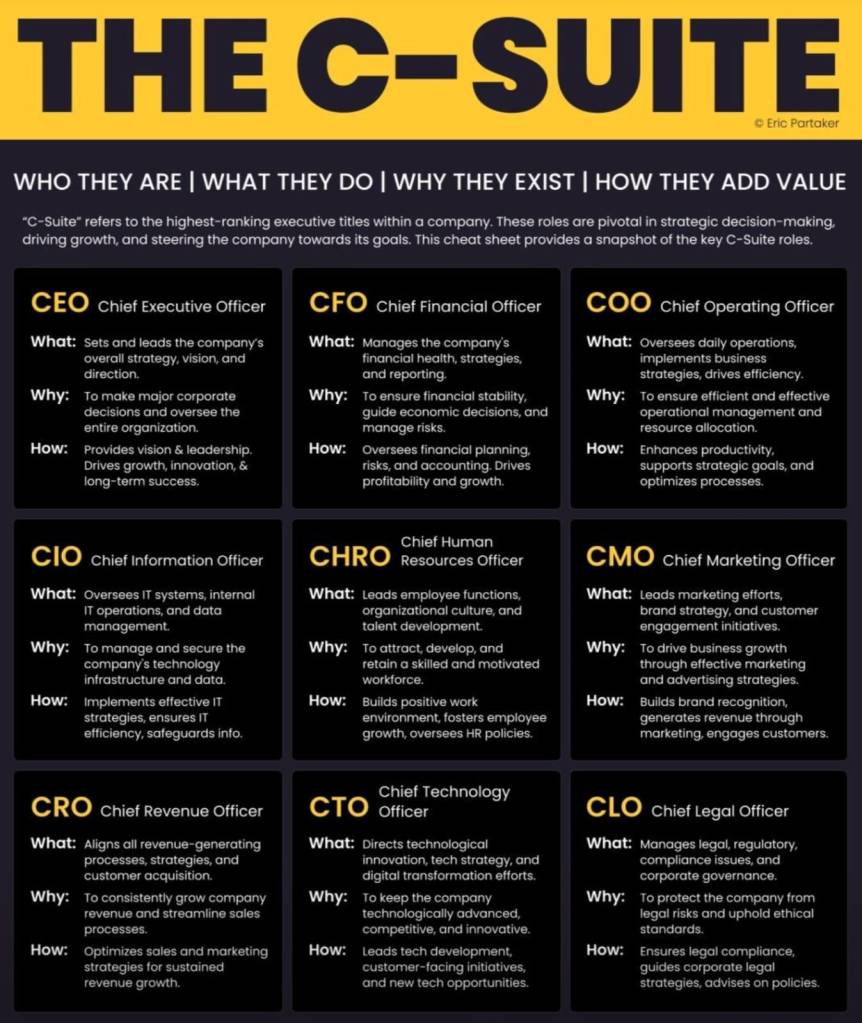
The C-Suite

WHO they are, What the do, Why they exist, How they add value

In corporate leadership, the C-Suite stands as the command centre, where strategic decisions are made, and the future of the company is shaped. Comprising key executives with specialised roles, the C-Suite plays a crucial role in steering organisations towards success. In this blog post, we’ll delve into the world of the C-Suite, shedding light on the responsibilities and value each role brings to the table.

  1. CEO – Chief Executive Officer

The CEO, or Chief Executive Officer, is the captain of the ship, responsible for charting the company’s course and ensuring its overall success. The CEO sets the vision, mission, and strategy, providing leadership to the entire organisation. They are the ultimate decision-maker, accountable to the board of directors and stakeholders.

  1. CFO – Chief Financial Officer

The CFO, or Chief Financial Officer, is the financial maestro of the C-Suite. Tasked with overseeing the financial health of the organisation, the CFO manages budgets, financial planning, and investment strategies. They play a pivotal role in risk management, ensuring sustainable growth and profitability.

  1. COO – Chief Operating Officer

The COO, or Chief Operating Officer, is the executor of the CEO’s vision. Responsible for day-to-day operations, the COO ensures that the company’s processes and systems align with strategic goals. They focus on efficiency, productivity, and scalability, optimising internal functions for maximum performance.

  1. CIO – Chief Information Officer

In the digital age, the CIO, or Chief Information Officer, holds a critical role. Charged with managing the company’s technology infrastructure, the CIO ensures that information systems align with business objectives. They play a pivotal role in driving innovation and digital transformation.

  1. CHRO – Chief Human Resources Officer

The CHRO, or Chief Human Resources Officer, is the guardian of the company’s most valuable asset—its people. Responsible for talent acquisition, employee development, and creating a positive work culture, the CHRO plays a key role in shaping the organisation’s human capital strategy.

  1. CMO – Chief Marketing Officer

The CMO, or Chief Marketing Officer, is the storyteller-in-chief. Charged with building and promoting the company’s brand, the CMO develops marketing strategies to drive growth and customer engagement. They are instrumental in shaping the company’s public image and market positioning.

  1. CRO – Chief Revenue Officer

The CRO, or Chief Revenue Officer, is the architect of revenue streams. Focused on driving sales and revenue growth, the CRO collaborates with sales, marketing, and other departments to optimise customer acquisition and retention strategies.

  1. CTO – Chief Technology Officer

The CTO, or Chief Technology Officer, is the technology visionary. Tasked with leading technological innovation, the CTO develops and implements technology strategies that align with the company’s business goals. They often play a crucial role in product development and ensuring technological competitiveness.

  1. CLO – Chief Legal Officer

The CLO, or Chief Legal Officer, is the legal guardian of the organisation. Responsible for managing legal risks and ensuring compliance with laws and regulations, the CLO provides legal counsel to the executive team and oversees matters such as contracts, intellectual property, and litigation.

Summary – Cheat sheet

Conclusion

The C-Suite represents a powerhouse of expertise, each member contributing their unique skills to the overall success of the organisation. By understanding the roles and responsibilities of the CEO, CFO, COO, CIO, CHRO, CMO, CRO, CTO, and CLO, we gain insights into the intricate workings of corporate leadership. Together, these leaders form a cohesive unit, steering the ship through the complexities of the business world, adding significant value to the organisation and its stakeholders.

Empowering Business Growth: The Strategic Integration of IT in Business Development and Sales Initiatives

Why IT should be involved in business development initiatives and new sales opportunities, from the very beginning.

In the dynamic landscape of modern business, the integration of Information Technology (IT) from the inception of business development and sales initiatives is not just a trend but a strategic necessity. This approach transforms IT from a mere support function to a driving force that shapes and propels business strategies. Let’s delve deeper into the reasons why involving IT from the outset is pivotal and explore the substantial benefits it brings to organisations:

Strategic Alignment and Innovation:

Early IT involvement ensures that technological strategies align seamlessly with business objectives. IT professionals, when engaged in the initial planning phases, can identify innovative solutions and technologies that can revolutionise products, services, and customer experiences.

Data-Driven Decision Making and Predictive Analytics:

IT experts excel in harnessing the power of data. By involving them early, businesses gain access to advanced analytics and predictive modeling. These capabilities empower data-driven decision-making, enabling businesses to anticipate market trends, customer preferences, and sales patterns.

Customer-Centric Solutions:

IT plays a pivotal role in creating customer-centric solutions. Through early involvement, businesses can leverage IT expertise to develop personalized interfaces, mobile apps, and e-commerce platforms tailored to customer needs. This customer-focused approach enhances user satisfaction and loyalty.

Operational Efficiency and Process Optimisation:

IT professionals optimise operational processes through automation, streamlining workflows, and integrating various systems. Early IT involvement ensures that business processes are designed with efficiency in mind, reducing manual errors and improving overall productivity.

Scalability and Flexibility:

Scalability is a cornerstone of successful businesses. IT architects systems that are scalable and flexible, allowing businesses to expand seamlessly. By involving IT early, companies can future-proof their solutions, saving costs in the long run and ensuring adaptability to market changes.

Cybersecurity and Compliance:

Security breaches can have devastating consequences. IT experts, when involved in the initial stages, design robust cybersecurity frameworks. They ensure compliance with industry regulations and standards, safeguarding sensitive data and building trust with customers and partners.

Collaborative Culture and Knowledge Sharing:

Early collaboration between IT, business development, and sales fosters a culture of open communication and knowledge sharing. Cross-functional teams collaborate on ideas and solutions, leading to holistic strategies that encompass technical and business aspects.

Continuous Improvement and Feedback Loops:

IT’s involvement from the beginning enables the establishment of feedback loops. Through continuous monitoring and analysis, businesses can gather insights, identify areas of improvement, and adapt strategies swiftly. This iterative approach drives continuous innovation and business growth.

In conlusion, the strategic integration of IT in business development and sales initiatives is a game-changer for organisations aiming to thrive in the digital age. By recognising IT as a core driver of business strategies, companies can harness innovation, enhance customer experiences, optimise operations, and ensure long-term success. Embracing this collaborative approach not only positions businesses as industry leaders but also fosters a culture of innovation and adaptability, crucial elements for sustained growth and competitiveness in today’s challenging business landscape.

The Crucial Elements of a Robust Data Strategy: A Blueprint for Success

In the digital age, data has become the lifeblood of businesses, driving innovation, enhancing customer experiences, and providing a competitive edge. However, the mere existence of data is not enough; what truly matters is how organisations harness and manage this valuable resource. Enter the realm of a good data strategy – a meticulously crafted plan that delineates the path for effective data management.

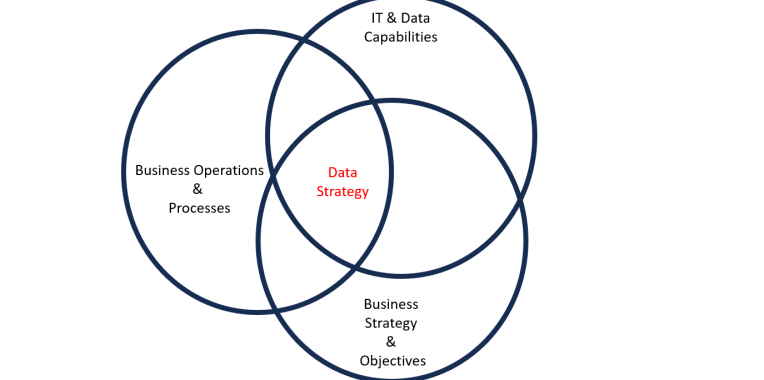
To unlock its true potential, a data strategy must be carefully aligned with the core pillars of an organisation: its operations, its current IT and data capabilities, and its strategic objectives.

Alignment with Business Operations and Processes:

The heart of any business beats to the rhythm of its operations and processes. A well-crafted data strategy ensures that this heartbeat remains strong and steady. It’s about understanding how data can be seamlessly integrated into everyday workflows to streamline operations, increase efficiency, and reduce costs.

As an example, consider a retail company, for instance. By aligning its data strategy with business operations, it can optimise inventory management through real-time data analysis. This allows for better stock replenishment decisions, reducing excess inventory and minimising stockouts. In turn, this alignment not only cuts costs but also enhances customer satisfaction by ensuring products are readily available.

Leveraging Current IT and Data Capabilities:

No data strategy exists in a vacuum – it must be rooted in the organisation’s existing IT and data capabilities. The alignment of these elements is akin to synchronising gears in a well-oiled machine. A data strategy that acknowledges the current technological landscape ensures a smooth transition from theory to practice.

Suppose an insurance company wishes to harness AI and machine learning to enhance fraud detection. An effective data strategy must take into account the available data sources, the capabilities of existing IT systems, and the skill sets of the workforce. It’s about leveraging what’s in place to create a more data-savvy organization.

Supporting Strategic Business Objectives:

Every business sets its course with strategic objectives as the guiding star. A data strategy must be a companion on this voyage, steering the ship towards these goals. Whether it’s revenue growth, customer acquisition, or market expansion, data can be a compass to navigate the path effectively.

For a healthcare provider, strategic objectives might include improving patient outcomes and reducing costs. By aligning the data strategy with these objectives, the organisation can use data to identify trends in patient care, optimising treatments and resource allocation. This not only furthers the business’s strategic goals but also enhances the quality of care provided.

Components of a Data Strategy

Let’s delve into the significance and essential components of a robust data strategy that forms the cornerstone of success in today’s data-driven world.

  1. Informed Decision-Making – A well-structured data strategy empowers businesses to make informed decisions. By analysing relevant data, organisations gain profound insights into market trends, customer behaviour, and operational efficiency. Informed decision-making becomes the guiding light, steering businesses away from guesswork towards calculated strategies.
  2. Strategic Planning and Forecasting – A good data strategy provides the foundation for strategic planning and forecasting. By evaluating historical data and patterns, businesses can anticipate future trends, enabling them to adapt proactively to market shifts and customer demands. This foresight is invaluable, especially in dynamic industries where agility is key.
  3. Enhanced Customer Experiences – Understanding customer preferences and behaviour is pivotal in delivering exceptional experiences. A data strategy facilitates the collection and analysis of customer data, enabling businesses to personalise offerings, optimise interactions, and foster stronger customer relationships. In essence, it’s the key to creating memorable customer journeys.
  4. Operational Efficiency and Cost Reduction – Efficient data management reduces operational complexities and costs. A well-designed data strategy streamlines data collection, storage, and analysis processes, eliminating redundancies and ensuring optimal resource allocation. This efficiency not only saves costs but also frees up valuable human resources for more strategic tasks.
  5. Risk Mitigation and Security – Data breaches and cyber threats pose significant risks to businesses. A robust data strategy includes stringent security measures and compliance protocols, safeguarding sensitive information and ensuring regulatory adherence. By mitigating risks, businesses can protect their reputation and build trust with customers.
  6. Innovation and Growth – Data-driven insights fuel innovation. By analysing data, businesses can identify emerging trends, unmet customer needs, and untapped market segments. This knowledge forms the bedrock for innovative product development and business expansion, driving sustained growth and competitiveness.
  7. Continuous Improvement – A data strategy is not static; it evolves with the business landscape. Regular assessment and feedback loops enable organisations to refine their strategies, incorporating new technologies and methodologies. This adaptability ensures that businesses remain at the forefront of the data revolution.

In summary, a data strategy’s success hinges on its alignment with the intricate web of business operations, current IT and data capabilities, and strategic objectives. The beauty lies in the harmony it creates, the symphony of data-driven insights that empowers an organization to thrive in a data-rich world. It is more than a strategy; it is a journey, a roadmap to a future where data is not just a resource but a strategic ally, guiding businesses to new horizons of success. A good data strategy is not merely a luxury; it is a necessity for any organisation aspiring to thrive in the digital era. It empowers businesses to make strategic decisions, enhance customer experiences, optimise operations, mitigate risks, foster innovation, and achieve sustained growth. As businesses continue to navigate the complex terrain of data, a well-crafted data strategy stands as a beacon, illuminating the path to success and ensuring a future that is both data-driven and prosperous.

Digital Strategy & the Board

Digital Strategy is a plan that uses digital resources to achieve one or more objectives. With Technology changing at a very fast pace, Organisations have many digital resources to choose from.

Digital Resources can be defined as materials that have been conceived and created digitally or by converting analogue materials to a digital format for example:

  • Utilising the internet for commerce (web-shops, customer service portals, etc…)
  • Secure working for all employees from anywhere via VPN
  • Digital documents, scanning paper copies and submitting online correspondence to customers i.e. online statements and payment facilities via customer portals
  • Digital resources via Knowledge Base, Wiki, Intranet site and Websites
  • Automation – use digital solutions like robotics and AI to complete repetitive tasks more efficiently
  • Utilising social media for market awareness, customer engagement and advertising

A Digital Strategy is typically a plan that helps the business to transform it’s course of action, operations and activities into a digital nature by utilising available applicable technology.

Many directors know that digital strategies, and there related spending, can be difficult to understand. From blockchain and virtual reality to artificial intelligence, no business can afford to fall behind with the latest technological innovations that are redefining how businesses connect with their customers, employees, and myriad of other stakeholders. Read this post that covers “The Digital Transformation Necessity“…

As a Board Director what are the crucial factors that the Board should consider when building a digital strategy?

Here are five critical aspects, in more detail, and the crucial things to be conscious of when planning a digital transformation strategy as part of a board.

Stakeholders

A stakeholder, by definition, is usually an individual or a group impacted by the outcome of a project. While in previous roles you may have worked with stakeholders at senior management level, when planning a digital strategy, it’s important to remember that your stakeholders could also include customers, employees or anyone that could be affected by a new digital initiative.

Digital strategies work from the top down, if you’re looking to roll out a digital transformation project, you need to consider how it will affect every person inside or outside of your business.

Investment

Digital transformation almost always involves capital and technology-intensive investments. It is not uncommon for promising transformation projects to stall because of a lack of funds, or due to technology infrastructure that cannot cope with increased demands.

Starting a budgeting process right at the start of planning a digital transformation project is essential. This helps ensure that the scope of a project does not grow beyond the capabilities of an enterprise to fund it. A realistic budgeting and funding approach is crucial because a stalled transformation project creates disruption, confusion and brings little value to a business.

Communications

From the get-go, any digital strategy, regardless of size, should be founded on clear and constant communication between all stakeholders involved in a project. This ensures everyone is in the loop on the focus of the project, their specific roles within it, and which processes are going to change. In addition, continuous communication helps build a spirit of shared success and ensures everyone has the information they need to address any frustrations or challenges that may occur as time passes. When developing an effective communication plan, Ian’s advice is to hardly mention the word digital at all.

The best digital strategies explain what digital can do and also explain the outcomes. Successful communication around digital strategies uses language that everyone can understand, plain English, no buzzwords, no crazy acronyms and no silly speak.

Also read “Effective Leadership Communication” which covers how you can communicate effectively to ensure that everyone in the team are on the same page.

Technology

While there are many technologies currently seeing rapid growth and adoption, it doesn’t necessarily mean that you will need to implement all of them in your business. The choice of technology depends upon the process you are trying to optimise. Technology, as a matter of fact, is just a means to support your idea and the associated business processes.

People often get overwhelmed with modern technologies and try to implement all of them in their current business processes. The focus should be on finding the technologies that rightly fit your business objectives and implement them effectively.

Never assume that rolling out a piece of technology is just going to work. When embarking on a digital project, deciding what not to do is just as important as deciding what to do. Look at whether a piece of technology can actually add value to your business or if it’s just a passing trend. Each digital project should hence be presented to Board with a business case that outlines the business value, return on investment and the associated benefits and risks, for board consideration.

Measurement

No strategy is complete without a goal and a Digital Strategy is no different. To measure the effectiveness of your plan you will need to set up some key performance indicators (KPIs). These metrics will demonstrate the effectiveness of the plan and will also guide your future decision making. You will need to set up smart goals that have clear achievable figures along with a timeline. These goals will guide and optimise the entire execution of a transformation project and ensure that the team does not lose focus.

Any decent strategy should say where we are now, where we want to get to and how we’re going to get there, but also, more importantly, how are we going to monitor and track against our progress.

Also Read

An Operating Model that Delivers

Every organisation that I have worked with around the world, whether it is in London, Johannesburg, Sydney, Singapore, Dallas, Kuala Lumpir, Las-Vegas, Nairobi or New York, there was always reference to a Target Operating Model (TOM) when business leaders spoke about business strategy and performance. Yes, the TOM – the ever eluding state of euphoria when all business operations work together in harmony to deliver the business vision…sometime in the near foreseen future.

Most business transformation programmes are focussed to deliver a target operating model – transforming the business by introducing a new way of working that better aligns the business offering with it’s customer’s changing expectation. Millions in business change budgets have been invested in TOM design projects and 1000s of people have worked in these TOM projects of which some have delivered against the promise.

With the TOM as the defined deliverable, the targeted operational state and the outcome of the business transformation programme, it is very important that the designed TOM are actually fit for purpose. The TOM also has to lend itself to be easily adjustable in order to contribute to the agility of an organisation. The way the business is operating must be able to adapt to an ever changing technology driven world and the associated workforce. The quick evolving digital world is probably the main catalyst for transformation in organisations today – read “The Digital Transformation Necessity” for further insights…

Operating Model (OM)

The Operating Model uses key inputs from the Business Model and Strategy.

The Business Model focuses on the business’ customers, the associated product and service offerings – how the organisation creates value for it’s cliental – and the commercial proposition. Within the business model the business’s revenue streams and how those are contributing to the business value chain to generate profits, are decried. In other words, the Business Model envisages the What within the organisation.

Within the Business Strategy the plan to achieve specific goals are defined, as well as the metrics required to measure how successfully these are achieved. The business goals are achieved through the daily actions as defined within the Operating Model.

Typically an Operating Model takes the What from the Business Model in conjunction with the business strategy, and defines the Why, What, How, Who and With. It is the way in which the business model and strategy is executed by conducting the day to day business operations. Execution is key as no business can be successful by just having a business strategy, the execution of the operating model delivering the business strategy is the operative ingredient of success.

In order to document and describe how an organisation functions, the Operating model usually includes business capabilities and associated processes, the products and/or services being delivered, the roles and responsibilities of people within the business and how these are organised and governed within the business, the metrics defined to manage, monitor and control the performance of the organisation and then the underpinning Technology, Information Systems and Tools the business uses in delivering it’s services and/or products.

Analogy: A good analogy to describe the Operating Model is to compare it to the engine of F1 car. In 2016 the Mercedes Silver Arrow (the fastest car, driven by Lewis Hamilton (arguably the fastest driver), did not win because of engine and reliability problems. Instead the World Championship was won by Nico Rosberg, who had a better performing engine over the whole season. Nico benefited from a better operating model – he had the processes, data, systems and the people (including himself) to win. The mechanical failures that Lewis suffered, mostly not through fault of his own, were a result of failures somewhere within his operating model.

Target Operating Model (TOM)

The Target Operating Model (TOM) is a future state version of the Operating Model. To derive the TOM, the existing Operating Model is compared with the desired future state keeping the key aspects of an operating model in mind: Why, What, How, Where, Who and With. The TOM also cover two additional key aspects: the When & Where defined within the transformation programme to evolve from current to future states.

The difference between the “as is” Operating Model and the “to be” Target Operating Model, indicates the gap that the business must bridge in the execution of its Transformation Model/Strategy – the When and Where. To achieve the Target Operating Model usually require large transformation effort, executed as change & transformation programmes and projects.

ToBe (TOM) – AsIs (OM) = Transformation Model (TM)

Why >> Business Vision & Mission

What >> Business Model (Revenue channels through Products and Services – the Value Chain)

How >> Business Values & Processes & Metrics

Who >> Roles & Responsibilities (RACI)

With >> Tools, Technology and Information

Where & When >> Transformation Model/Strategy

Defining the TOM

A methodology to compile the Target Operating Model (TOM) is summarised by the three steps shown in the diagram below:

TOM Methodology
Inputs to the methodology:

  • Business Model
  • Business Strategy
  • Current Operating Model
  • Formaly documented information, processes, resource models, strategies, statistics, metrics…
  • Information gathered through interviews, meetings, workshops…

Methodology produces TOM Outputs:

  • Business capabilities and associated processes
  • Clearly defined and monetised catalogue of the products and/or services being delivered
  • Organisation structure indicating roles and responsibilities of people within the business and how these are organised and governed
  • Metrics specifically defined to manage, monitor and control the performance of the organisation
  • Underpinning Technology, Information Systems and Tools the business uses in delivering it’s services and/or products

The outputs from this methodology covers each key aspect needed for a TOM that will deliver on the desired business outcomes. Understanding these desired outcomes and the associated goals and milestones to achieve them, is hence a fundamental prerequisite in compiling a TOM.

To Conclude

An achievable Target Operating Model, that delivers, is dependant on the execution of an overall business transformation strategy that aligns the business’ vision, mission and strategy with a future desired state in which the business should function.

Part of the TOM is this Business Transformation Model that outlines the transformation programme plan, which functionally syncs the current with the future operating states. It also outlines the execution phases required to deliver the desired outcomes, in the right place at the right time, while having the agility to continuously adapt to changes.

Only if an organisation has a strategically aligned and agile Target Operating Model in place that can achieve this, is the business in a position to successfully navigate its journey to the benefits and value growth it desires.

renierbotha Ltd has a demonstrable track record of compiling and delivering visionary Target Operating Models.

If you know that your business has to transform to stay relevant – Get in touch!


Originally written by Renier Botha in 2016 when, as Managing Director, he was pivotal in delivering the TOM for Systems Powering Healthcare Ltd.

NED :: Non-Executive Director’s proposition

Are you aware of the substantive and measurable value a Non-Executive Director can bring to you and your business…?

Introduction

The Non-Executive Director, no longer a role that is associated just with large organisations. There is a growing awareness of the NED role and more and more organisations are appointing NEDs of various types, and specific specialities, often within technology and digital transformation, to enhance the effectiveness of their boards as standard practise.

With the pressure on organisations to compete globally, deal with digital transformation and respond to rapidly changing market conditions, new skills are needed at board level. This leads to the role of the NED diversifying and introduces a need to refresh the NEDs as circumstances change, bringing in new specialities, experience and challenge when the organisation needs it.

A good NED can, and should make a substantive and measurable contribution to the effectiveness of the board. Do not see a NED as a consulting advisor – a NED, within the remit of the role of a company director, play a full and active part in the success efforts of an organisation. Irrespective of the skills, experience and network contacts that NEDs will bring, they must above all, provide appropriate independent and constructive challenge to the board.

Both the organisation and the NED must understand the purpose of being a NED, within the specific organisation, for the role to be effective. This includes a clear understanding of what value the NED is expected to bring. A NED’s value goes beyond just the statutory requirements.

On appointment a Non-executive director can:

  • Broaden the horizons and experience of existing executive directors.
  • Facilitate the cross-fertilisation of ideas, particularly in terms of business strategy and planning.
  • Have a vital part to play in appraising and commenting on a company’s investment/expenditure plans.
  • Bring wisdom, perspective, contacts and credibility to your business.
  • Be the lighthouse that helps you find your way and steer clear of near and present dangers.

The role of the NED

All directors, including NEDs, are required to:

  • provide entrepreneurial leadership of the company
  • set the company’s vision, strategy and strategic objectives
  • set the company’s values and standards
  • ensure that its obligations to its shareholders and others are understood and met.

In addition, the role of the NED has the following key elements:

  • Strategy: NEDs should constructively challenge and help develop proposals on strategy.
  • Performance: NEDs should scrutinise the performance of management in meeting agreed goals and objectives and monitor the reporting of performance.
  • Risk: NEDs should satisfy themselves on the integrity of financial information and that financial controls and systems of risk management are robust and defensible.
  • People: NEDs are responsible for determining appropriate levels of remuneration of executive directors and have a prime role in appointing, and where necessary removing, executive directors, and in succession planning.

“In broad terms, the role of the NED, under the leadership of the chairman, is: to ensure that there is an effective executive team in place; to participate actively in the decision–takingprocess of the board; and to exercise appropriate oversight over execution of the agreed strategy by the executive team.”; Walker Report, 2009


A non-executive director will bring the follow benefits to your company:

  • strengthen the board and provide an independent viewpoint
  • contribute to the creation of a sound business plan, policy and strategy
  • review plans and budgets that will implement policy and strategy
  • be a confidential and trusted sounding board for the MD/CEO and keep the focus of the MD/CEO
  • have the experience to objectively assess the company’s overall performance
  • have the experience and confidence to stand firm when he or she believes the executive directors are acting in an inappropriate manner
  • ensure good corporate governance
  • provide outside experience of the workings of other companies and industries, and have beneficial sector contacts and experience gained in previous businesses
  • have the ability to clearly communicate with fellow directors
  • have the ability to gain the respect of the other directors
  • possess the tact and skill to work with the executive directors, providing support and encouragement where difficult decisions are being made
  • have contacts with third parties such as financial sources, grant providers and potential clients

Looking for a NED?

Now that you understand what a NED can do – What are you waiting for?

Contact Renier Botha if you are looking for an experienced director with strong technology and digital transformation skills.

Renier has demonstrable success in developing and delivering visionary business & technology strategies. His experience include Mergers & Acquisitions (M&A), major capital projects, growth, governance, compliance, risk management as well as business and organisation development. From startup to FTSE listed enterprise, the value Renier can bring as NED is substantive, driving business growth.

Top 10 Technology Trends Impacting Infrastructure & Operations for 2018

Does your IT strategy include infrastructure, operations (I&O) practices and data center architectures that are sufficient to meet the demands of the digital business. Digital transformation requires IT agility and velocity that outstrips classical architectures and practices.

David Cappuccio, from Gartner outlines the top 10 trends that will impact IT operations (I&O) in 2018. Each will have an impact on how IT operates, plans, enhances internal skill sets, and supports the business.


Guest Blog: Original Article @ Gartner

Outside forces will shape IT’s journey towards a digital infrastructure.

Legacy infrastructure and operations (I&O) practices and traditional data center architectures are not sufficient to meet the demands of the digital business. Digital transformation requires IT agility and velocity that outstrips classical architectures and practices.

In 2018, IT will be increasingly tasked with supporting complex, distributed applications using new technologies that are spread across systems in multiple locations, including on-premises data centers, the public cloud and hosting providers.

David Cappuccio, vice president and distinguished analyst at Gartner, says I&O leaders should focus on 10 key technologies and trends to support digital transformation.

“These are not necessarily the top 10 technologies, or the hottest trends in IT, but rather the 10 trends we feel will have an impact on I&O teams over the next few years,” says Cappuccio. “Some are happening already, some are just beginning, but each will have an impact on how IT operates, plans, enhances internal skill sets, and supports the business.”

Strategic

Trend 1: Geo Planning
Outside factors including the European Union’s General Data Protection Regulation (GDPR), geo specific workloads and global and regional network access are driving IT to spend more time on geo planning as part of their longer term strategies. The long term objective is not to own a global infrastructure, but to build the infrastructure needed to support the business via partners, as well as leveraging an organization’s partner’s infrastructure to help support initiatives such as multiple network connections and infrastructure design and support.

Trend 2: The Intelligent Edge
Many digital business projects create data that can be processed more efficiently when the computing power is close to the thing or person generating it. Edge computing solutions address this need for localized computing power. For example, in the context of the Internet of Things (IoT), the sources of data generation are usually things with sensors or embedded devices. The intelligent edge serves as the decentralized extension of the campus networks, cellular networks, data center networks or the cloud. Organizations that have embarked on a digital business journey have realized that a more decentralized approach is required to address digital business infrastructure requirements.

Trend 3: Intent-based Networking (IBNS)
Gartner predicts that by 2020, more than 1,000 large enterprises will use intent-based networking systems in production, up from less than 50 today. Intent-based networking (IBNS) is not a product, or a market. Instead, it is a piece of networking software that helps to plan, design and implement/operate networks that can improve network availability and agility, which becomes increasingly important as organizations transition towards digital business.

With IBNS, rather than explicitly defining to the network what needs to be done, the software translates the business intent to determine the “correctness” of the network configuration before deployment. The system then continuously compares the actual and desired state of the running network.

Say no to business as usual
Gartner IT Operations Strategies & Solutions Summit 2018

LEARN MORE

Tactical

Trend 4: APIs – Integration Economy
A digital business is supported by technology platforms in five areas: information systems; customer experience; data and analytics; IoT; and ecosystems. The ecosystems technology platform supports the creation of, and connection to, external ecosystems, marketplaces and communities. Application performance interface (API) management enables the digital platform to function.

Organizations should design APIs from the “outside in,” based on ecosystem requirements, not “inside out,” based on existing applications or technology infrastructure. “Ensure that your organization takes an ‘API first’ approach, designing APIs based on the requirements of your organization’s ecosystem,” says Cappuccio. “APIs designed in this way can be mapped to internal technology infrastructure. This approach is more effective than simply generating APIs based on existing infrastructure and data models.”

Trend 5: Reputation and Digital Experience
There are two interlinked trends impacting business today that have nothing to do with IT infrastructure, but everything to do with infrastructure design. Digital experience management (DEM) is the impact of presenting the right digital experience to customers. The experience could be mobile or web-based, and should be always available, continually improving and perform quickly and consistently. If any of these tenants are lacking, customer satisfaction is in peril. If customer satisfaction is in peril, especially in today’s social media savvy world, corporate reputation could quickly be damaged.

Trend 6: Beyond Traditional IT – New Realities
Business units are demanding agility, in opening new markets, taking on emerging competitors, bringing in new suppliers, and creating innovative ways of interacting with customers. Over 30% of current IT spend is not part of the IT budget, but overall responsibility for supporting these new initiatives, once they are tested and stabilized, will reside with traditional IT. Managing those new providers, managing workflows and managing new types of assets in this hybrid environment, regardless of where they are located, will become crucial to IT’s success.

Operational

Trend 7: DCaaS as a Strategy
In a perfect world, at least from the perspective of many business leaders, IT and the data center would be essentially a very agile provider of service outcomes, rather than the owner of the infrastructure. To do this organizations are creating a data center as a service (DCaaS) model, where the role of IT and the data center is to deliver the right service, at the right pace, from the right provider, at the right price.

“Making key short-term decisions can lead to a long-term strategy that incorporates the best of ‘as a service’ and the cloud without compromising IT’s overall goals to both protect and enable the business,” says Cappuccio. “In this manner, IT can enable the use of cloud services across the business, but with a focus on picking the right service, at the right time, from the right provider, and in such a way that underlying IT service and support does not get compromised.”

Trend 8: Cautious Cloud Adoption
For many enterprises the journey to the cloud is a slow, controlled process. Colocation and hosting providers have established private or shared clouds on their premises to provide customers some basic cloud services, enabling controlled migrations, staff skills training and a “safe” cloud environment as a stepping stone to increased cloud adoption in the future. As customers get comfortable with these services and costs, increased migrations to external providers are enabled via interconnect services. Using this partner ecosystem to enable an agile infrastructure is a rapidly emerging trend.

Trend 9: Capacity Optimization – Everywhere
Organizations need to focus on optimizing capacity and guard against stranded capacity – things that are paid for, but not really being used. This issue can be found both in existing on premise data centers and in the cloud. A change in culture is needed to fix this problem. Organizations must learn to focus not just on uptime and availability, but also on capacity, utilization and density. Doing so can extend the life of an existing data center and reduce operating expenditures from cloud providers.

Trend 10: Extended Infrastructure Management
The data center as the sole source of IT infrastructure has given way to a hybrid of on-premises, colocation, hosting, and public and private cloud solutions. These elements are being combined with a focus on providing business-enabling services and outcomes, rather than a focus on physical infrastructure. Enterprises must apply a future-looking, enterprise-wide “steady hand” to IT strategy and planning, and apply appropriate guardrails, or face the possibility of losing relevance, governance and enterprise agility.


Case Study – Renier Botha’s Game-Changing Leadership at Systems Powering Healthcare (2015-2017)

Posted on November 1, 2017

Introduction:
Back in December 2015, Renier Botha stepped in as the big boss—Managing Director and Head of Service at Systems Powering Healthcare, aka SPHERE. This place is all about delivering top-notch IT services and infrastructure to a whole lot of NHS healthcare workers—over 10,000 to be exact. Let’s dive into how Botha totally revamped SPHERE in his two year tenure, turning it into a powerhouse through his sharp strategic moves, cool innovations, and rock-solid leadership.

Facing the Music and Setting Goals:
Right off the bat, Botha was up against some big challenges. He had to shift SPHERE from an old-school cost-plus model to a snazzy commercial-service-catalogue model while also trying to attract more clients. His main to-dos were to get the company on stable footing, map out a strategic game plan, and make sure they were all about putting customers first.

Key Moves and Wins:

  1. Strategic Master Plan: Botha wasted no time. Within the first three months, he whipped up a six-year strategic plan that laid out all the key investments and milestones to get SPHERE to grow and thrive.
  2. From Startup to Star: Managing a team of 75, Botha steered SPHERE from its startup phase to become a well-known medium-sized business, hitting their three-year targets way ahead of schedule – in just two years!
  3. Tech Makeover: One of his big programmes was pouring £42M into beefing up SPHERE’s tech – think better networks, better hosting, the works. This move was all about making sure they could keep up and stay ahead in the long run.
  4. Service Delivery Shake-up: Botha brought in a new, customer-focused operating model and rolled out Service-Now to up their tech game. This not only made things run smoother but also saved a ton of money, giving them a killer return on investment.
  5. Financial Growth: Under his guidance, SPHERE’s dough rolled in 42% thicker thanks to smart mergers, acquisitions, and raking in new clients. They also managed to save the NHS about £3m a year with their shared service gig.
  6. Cost-Cutting Genius: He managed to slash the “Cost per IT User” by 24% in two years, showing just how much bang for the buck SPHERE could offer.
  7. Big Win: Thanks to a revamped service catalogue, SPHERE nailed a whopping £10m contract to provide IT services for Northumbria Healthcare NHS Foundation Trust.
  8. Happy Campers: Botha didn’t just focus on the numbers; he also built a workplace where people actually wanted to stick around. Employee retention jumped from 82% to a whopping 98% by the end of his run.

Conclusion:
Renier Botha’s time at SPHERE shows just what can happen when you mix visionary leadership with a knack for making smart moves in healthcare IT. He not only met the big challenges head-on but also made sure that SPHERE became a go-to example of how IT can seriously improve healthcare services. His story isn’t just about a job well done; it’s about setting a whole new standard in the industry.

Empowering Healthcare through Strategic Leadership: Systems Powering Healthcare Case Study (2015-2017)

Introduction:
In December 2015, Renier Botha assumed the role of Managing Director (CEO) & Head of Service (CIO) at Systems Powering Healthcare (SPHERE), an IT specialist organisation providing essential IT infrastructure and shared IT services to over 10,000 healthcare workers in the NHS. This case study delves into Botha’s transformative journey, focusing on his strategic vision, innovative solutions, and steadfast leadership that reshaped SPHERE into a thriving and client-focused enterprise.

Challenges and Objectives:
When Botha took charge, SPHERE faced the challenge of transitioning from a cost-plus model to a commercial-service-catalogue model while expanding its clientele. His primary objectives included stabilising the newly founded business, developing a strategic roadmap, and establishing a customer-centric approach to service delivery.

Strategic Initiatives and Achievements:

  1. Strategic Planning: Within the initial three months, Botha meticulously crafted a six-year strategic business plan for SPHERE. This plan outlined clear annual investment and service delivery milestones, providing a roadmap for the organisation’s growth and development.
  2. Operational Excellence: Botha directed a workforce of 75 employees, overseeing the execution of the strategic plan. Under his leadership, SPHERE transformed from a startup to an established medium-sized enterprise, achieving its third-year targets by the end of the second financial year.
  3. IT Infrastructure Transformation: Botha led a comprehensive IT estate refresh strategy, investing £42M in core capabilities like IP Networks, Service Hosting, End User Computing, and more. This initiative not only modernised SPHERE’s infrastructure but also ensured long-term sustainability and efficiency.
  4. Service Delivery Innovation: Botha introduced a customer-centric Target Operating Model (TOM) and implemented Service-Now as the supporting ERP toolset. This digital transformation not only increased business maturity but also resulted in a five-year £2.4m NPV saving and a remarkable ROI of 493%.
  5. Financial Growth: Through strategic M&A, business transformation, and the onboarding of new clients, SPHERE’s revenue grew by 42%. This growth not only secured significant ROI for shareholders but also saved the NHS approximately £3m per annum through a shared service solution.
  6. Operational Efficiency: Botha defined and achieved the “Cost per IT User” KPI, showcasing SPHERE’s value proposition. The strategic business plan led to an 11% reduction in the Cost per IT User in 2016 and a further 13% reduction in 2017, surpassing the target KPI by 12%.
  7. Commercial Success: Botha developed a compelling commercial Service Catalogue, instrumental in winning a £10m tender bid to become an IT Service Provider to Northumbria Healthcare NHS Foundation Trust.
  8. Cultural Transformation: Through a focus on commercial awareness, customer-centricity, and employee empowerment, Botha fostered a high-performing team. Staff retention rates increased from 82% in early 2016 to an impressive 98% by the end of 2017.

Conclusion:
Renier Botha’s strategic foresight, operational acumen, and emphasis on innovation and client satisfaction transformed Systems Powering Healthcare into a robust, client-focused organisation. His leadership not only steered SPHERE through critical transitions but also positioned it as a beacon of efficiency and excellence within the healthcare technology sector. This case study exemplifies the profound impact of visionary leadership on organisational growth and success.

The Digital Transformation Necessity

Listening to every keynote, panel discussion or reading articles relating to business sustainability through technology, one message is repeated over and over again – Digital Transformation is imperative for all businesses!

Although this message is coming through loudly, is it not always clear to business leaders and the workforce, exactly what digital transformation really is and what it means for their organisation.

In explaining digital transformation as the benefit and value that technology can enable within the business through technology innovation including IT buzz words like: Cloud, Automation, Dev-Ops, Artificial Intelligence (AI), Machine Learning, Internet of Things (IoT), Single Sign-On, Data Mining & Big Data, Bit Chain – does not really make the need for digital transformation any clearer.

One thing is clear though – we are living in a hyper-connected world where technology and more specifically, digital devices, are the glue linking together people and information in new ways we can hardly comprehend. In this statement, is the clue of what digital transformation entails…

What is digital transformation?

We can define digital transformation as the fundamental changes in the manner in which business and organisational operations are conducted, to adapt to the changes and to leverage the opportunities, caused by the use of digital devices and their accelerated impact on the way we live.

Digital devices, operate on digital signals running through electronic circuits to collect, store, manipulate, interpret and display information. These digital electronic integrated circuits (ICs) evolved since 1947, when the functional transistor was invented, into what we know today as computers. All digital devices are, at its core, a computer of some sorts used by humans to interact with information.

Transformation on the other hand implies a fundamental change in the way things used to be (converting something from one state to another) – it enables new creativity and innovation inspired by technology evolution, bringing change that introduces a new way, a different way to do things, rather than just enhancing or improving an old or current way.

To simplify it, you could say that digital transformation is the profound changes in the way business is conducted, to adapt to the changes in society caused by the continuous evolvement of computers.

A typical example of digital transformation is the “paperless office” – fundamentally changing the way we preserve information by storing it in digital format rather than writing it down on paper. This concept has profound implications in our commerce interaction expectations if you are comparing the speed in which information can be recalled and processed through digital means vs paper files, archives and libraries…

Who should lead the Digital Transformation?

Computers are hardly breaking news anymore as it is widely used within business where technology has become an integral enabling part of any organisation. Modern digital devices i.e. tablets, smart phones, the IoT, smart watches and other smart wearable devices, are changing the way we live and interact in commerce and hence the way we, as the consumer society, expect business to be conducted. Digital transformation is thus more about the change in business operations – processes and systems – than just the adoption of new technologies. Due to the importance of technology in organisations and the key role IT plays in the organisation’s ability to adapt to the society’s changing needs, it is the role of the CIO to lead the Digitial Transformation initiatives.

Digital Transformation matters because…

Any business change is costly and businesses might avoid change, for that very reason. Howard King of The Guardian, (Nov’13) puts it this way: “Businesses don’t transform by choice because it is expensive and risky. Businesses go through transformation when they have failed to evolve.” He continues in saying that evolving businesses never necessarily need to transform as they are continually focussed on their clients. This evolution ensures the key drivers of transformation namely: changing customer demand, changing technology and changing competition, never coincide in such a way that the business operating model can no longer service it’s customers. When it does, the business reaches a tipping point that requires transformation within the business, to adapt and re-align or tip over the edge.

The pace, at which digital devices have evolved, changed the way we interact with information and has become an intrinsic and material part of daily live. This has left organisations, which did not evolve with the technology, at a tipping point. For businesses approaching or reaching this tipping point it might be too late to evolve and hence Digital Transformation becomes a necessity for survival.

Emerging, disruptive technology driven, companies are changing industries leaving competitor companies with one choice – adapt, through digital transformation, or face the consequences of slowly loosing market share and eventually…

What does a typical Digital Transformation strategy involve?

As every organisation delivers their products and services (the value proposition to it’s clients and customers) in a different way, so will the digital transformation within one company differ from the other.

To define a transformation strategy and the associate change programme, one must look at the value chain of the organisation. Each element within the value chain can, and in most cases must, contribute to the scope:

  • Infrastructure
  • People – Leadership and the overall Workforce
  • Technology
  • Supply Chain
  • Procurement
  • Operations
  • Manufacturing (Engineering)
  • Fulfillment
  • Marketing
  • Sales
  • Service Delivery
  • Business Market (Client’s & Customers)

For each of the business value chain components, one must question the impact of the key transformation drivers:

  • Change in Customer Demand
  • Change in Technology
  • Change in Competition

Understanding these impacts will outline what needs to change, which generally comes down to:

  • Transform the Customer Experience
  • Transform the Operational Processes
  • Transform the Business Model

Note that IT is not singled out in the above – this is because IT is the catalyst that should overall enable these transformation initiatives.

The following examples of Digital Transformation Frameworks can also be helpful in defining the strategy:

Change brings uncertainty… Address it!

Transformation, by definition, brings change and a typical digital transformation programme will dramatically change the organisation. This change will especially affect a key business asset within the value chain – the people working within the business – “Success?.. People come First!”.

It will also dramatically effect, if not completely change, the organisation’s culture. Culture comes from the top – make sure that the board and executives are promoting the transformation and are willing to change themselves, as change is always desired until it is required of one-self.

Empower the workforce to understand the reasons why transformation is needed. Involve everyone to actively contribute to the innovative rethinking of their roles – how does digital technologies impact their daily work experience? Articulate the core business focus (what is the value proposition to the clients and customers) and ask, how can enabling digital technologies be used in support of achieving value excellence?

Find ways to make the necessity of the change a positive win for everyone, as supporting the people through the transformation is just as important as the digital technology you are trying to embrace.

To Conclude

Digital organisations outperform organisations doing digital – making Digital Transformation the last survival action for organisations that have not evolved with digital technology.

Transformation is a dramatic change and hence must the people aspect and business culture be treated with extreme care and sensitivity. A strong CIO is needed to drive the transformation programme with full buy-in from the rest of the executives and the whole workforce.

A well executed digital transformation strategy will re-align the business with the growing digital demands of it’s customers, by addressing the needed adoption of technology innovation across the business value chain resulting in an agile business ready for a fast evolving digital future.

Let’s Talk – Are you looking to achieve your goals faster? Create better business value? Build strategies to improve growth? We can help – make contact!

IT Due Diligence – is IT an asset or liability?

Information Technology is an integral part of any organisation and enables the operations of enterprises. Through supporting business operations, IT collates and analyses business data to provide the management information required in making timely and effective decisions. IT can even be the product/service around which enterprises are built. Information is a key business asset. But IT can also be the skeleton in the closet. Technology assets can turn into liabilities costing more and/or introducing risks that are not anticipated. This makes IT a key priority consideration in strategy development, corporate governance and business risk mitigation as well as merger and acquisition (M&A) transactions.

Despite the obvious importance of IT within any organisation, do business executives, who are mostly more focused on the financial and legal aspects, often overlook it. The appropriate attention is not given to the IT diligence as part of corporate governance or during the due diligence in M&A initiatives. This might be due to the continuous limited understanding of the technology discipline amongst business executives and/or the absence of the right expertise within an organisation to conduct the needed IT review. Another contributing statistic is that IT due diligence rarely is the make or break factor in business deals, which in a lot of cases, result in unwanted surprises presented to directors. That is why IT should be part of the scope of business strategy development and be one of the key contributors in M&A negotiations, influencing the deal and price.

The key reason for IT due diligence is to ensure visibility to the directors of concerns relating to IT operations in order to develop addressing strategies and mitigating actions. Investors should also use this information in assessing a potential business asset and it’s associated opportunity versus risk.

A due diligence exercise will cover at least the following main IT considerations: Systems, Projects & Change, Data, Security and IT Service Provision. Each of these considerations should be reviewed covering at least the following four elements: People, Process, Technology and Value.

Meaningful IT due diligence can be accomplished by practitioners who can ask the right questions stemming from the appropriate industry experience and domain knowledge. The art of due diligence is in formulating the right questions around key investment and/or corporate success drivers and interpreting the answers to inform the true state of affairs and it’s associated business enablement ability, future opportunity contributions and the associated business risk. Mostly, this diligence informs on the present and future role and influence of IT assets within the overall business success, for example:

  • Product, service and information Ownership – does the business really own what IT claims to be the property and assets of the business in relation to it’s true value and the balance sheet?
  • Reliability – can the business rely on its technology, now and in the future?
  • Sustainability – does the business have the ability to sustain its IT asset and visa versa?
  • Scalability – can the technology assets keep up with the business’ growth plans?
  • Adaptability – how easy can the technology asset integrate or be adapted to integrate with other systems and new emerging technologies in the future?
  • Compliance – does an IT asset introduce unwanted risk through non-compliance? For example, the introduction of new legislation to address the continuous increase in cyber and information security concerns might have a significant impact on the legality of an IT asset that might result in serious financial risk and penalties, if not addressed.
  • Finance – how much are IT assets likely to cost the business and what contributions will these expenses have on the financial success of the organisation?

A typical IT due diligence exercise could cover the following areas of IT operations (Some of these areas might not always be applicable in all organisations.):

  • Clarity on the Business Value Chain
  • IT Staff
    • IT Organisation Structure
    • Leadership
    • Qualifications & Skills
  • Certifications & Standards i.e. ISO9001 (Quality), ISO17001 (Security), ITIL (Service Management) or ISO20000 (ITSM)
  • Products and Services
  • Documentation
  • Software Development Processes & Methodologies
  • Service Management
  • Software applications and Services utilized
  • IT Infrastructure
    • Hardware
    • IP Network Infrastructure
    • Hosting Environments
  • Business Continuity
    • Service Availability
    • Systems Up-time
    • Backup and Recovery
    • Disaster Prevention & Recovery
  • Security
    • Cyber & Information Security
    • Network Security
    • IT Services & Systems Access
    • Physical Access
  • Governance
    • Operating Model
    • Policies
    • Procedures
    • Risk Management
    • Performance & KPIs
  • Projects & delivery methodologies
  • Compliance
  • Legal
    • SLAs
    • Supplier & 3rd party Service/Support Agreements
  • Intellectual Property
  • Quality Assurance & Improvement
  • Financial
  • Client and/or Customers

Understanding this information is vital in corporate governance, strategy formulation and capital investment decisions ensuring business critical assets are sustained and developed appropriately for a viable ongoing business concern.

The content of an IT due diligence report should focus on the objectives of the due diligence review, outlining priority findings with recommendations that present a clear call to action addressing the key issues found. A typical report should contain:

  • The objectives of the IT due diligence review
  • An executive summary with the key take aways
  • Key findings and the associated risk
  • Recommendations

The review findings and recommendations should be acted upon through appropriate remediation projects and a clear transition & support plan with inclusion into IT & business strategy. The business benefits can only be realised if these post review projects and transition, are successfully integrated into the organisation.

Let’s Talk – Are you looking to achieve your goals faster? Create better business value? Build strategies to improve growth? We can help – make contact!

Book Summary: “Staying in the Helicopter: The Key to Sustained Strategic Success” by Richard Harrop

“Staying in the Helicopter: The Key to Sustained Strategic Success” by Richard Harrop is a business leadership book that emphasises the importance of maintaining a strategic, high-level perspective to achieve long-term success. Harrop uses the metaphor of “staying in the helicopter” to illustrate the necessity for leaders to rise above daily operations and view their organisation and its environment from a broader perspective.

Key themes of the book include:

  • Strategic Vision: Encourages leaders to develop and maintain a clear, long-term vision for their organisations.
  • Adaptability: Stresses the need for organisations to be flexible and adaptable in response to changing market conditions.
  • Leadership Skills: Discusses the qualities and skills necessary for effective leadership, including decision-making, communication, and the ability to inspire and motivate others.
  • Continuous Improvement: Advocates for a culture of continuous learning and improvement within organisations.
  • Balanced Perspective: Emphasises balancing short-term operational demands with long-term strategic goals.

Through practical advice, case studies, and personal anecdotes, Harrop provides insights and tools for leaders to enhance their strategic thinking and ensure sustained success in their organisations.

As a senior business leader, I highly recommend reading “Staying in the Helicopter: The Key to Sustained Strategic Success” by Richard Harrop. This book has been invaluable in helping me understand the importance of maintaining a high-level perspective while managing the complexities of daily operations. Harrop’s practical advice and compelling case studies provide the tools needed to balance immediate demands with long-term vision, ensuring sustained success and growth. This guide has enhanced my strategic thinking and enabled me to lead my organisation with greater clarity and foresight.

Case Study: IT Transformation and Operational Excellence at Regus

Background:

Regus, a global leader in providing flexible workspaces and business solutions, faced the challenge of enhancing its IT systems and professional services to meet the growing demands of a dynamic market. To address this, Regus appointed Renier Botha from renierbotha Ltd, as the Global Head of Systems and Professional Services on a contractual basis. Renier’s objective was to lead the IT Systems and Professional Services teams, ensuring the delivery of a comprehensive portfolio of IT programmes and projects, and maintaining high availability of operational IT systems across 25 countries.

Challenges:

  1. Diverse Geographical Presence: Regus operated in 25 countries, each with unique IT needs and challenges, requiring a cohesive global strategy.
  2. Legacy Systems: Outdated legacy systems led to technical debt, hindering operational efficiency and scalability.
  3. Operational Costs: High operational costs required optimisation without compromising service quality.

Solution:

Renier Botha, with his expertise, initiated a transformative approach focusing on efficient IT service delivery, cost optimisation, and integration of modern technologies.

Achievements:

  1. Strategic Leadership: Renier led a team of 105 multi-disciplined technologists across 25 countries. His strategic vision and effective team management ensured streamlined operations and standardised services globally.
  2. IT Department Transformation: Renier developed a comprehensive IT Department transformation plan. By modelling technology requirements into a service delivery framework, the plan accomplished an annual operational saving of £3.6m. This was achieved through process optimisation, resource reallocation, and leveraging cost-effective technologies.
  3. Oracle Sales Cloud Deployment: Renier successfully programme managed the deployment of Oracle Sales Cloud, a £7m initiative covering 32 projects and workstreams. This integration of Enterprise Resource Planning (ERP) and Customer Relations Management (CRM) solutions replaced legacy systems, reducing technical debt and improving operational agility.

Results:

  1. Operational Efficiency: The implementation of the IT transformation plan significantly enhanced operational efficiency. Standardised processes and optimised resource allocation led to streamlined operations, reducing costs and improving productivity.
  2. Modernised IT Infrastructure: The deployment of Oracle Sales Cloud and integration of ERP and CRM solutions modernised Regus’ IT infrastructure. This enhanced system performance, scalability, and flexibility, enabling Regus to adapt swiftly to market changes and customer demands.
  3. Cost Optimisation: Through strategic planning and efficient resource allocation, Renier achieved an annual operational saving of £3.6m. These savings were reinvested into innovation and further enhancing customer experience, ensuring long-term sustainability.

Conclusion:

Renier Botha’s tenure as the Global Head of Systems and Professional Services at Regus exemplifies how strategic leadership, meticulous planning, and effective team management can drive transformative change within a global organisation. By optimising operational efficiency, integrating modern technologies, and achieving significant cost savings, Renier not only enhanced Regus’ IT capabilities but also positioned the company for sustained growth in a competitive market. His achievements stand as a testament to the impact of visionary leadership on organisational success and operational excellence.